REVIEW 4 major objections 6 minor 57 references
Why Multi-Interest Fairness Matters: Hypergraph Contrastive Multi-Interest Learning for Fair Conversational Recommender System
T0 review · 4 major / 6 minor · reviewed 2026-08-06 · deepseek-v4-flash
Pith's one-line read The paper claims that a conversational recommender that learns eight distinct interest views from hypergraphs and line graphs, then feeds them into both ranking and dialogue generation, achieves state-of-the-art accuracy on REDIAL and…
desk verdict Plausible incremental method with strong static popularity-fairness results, but the dynamic fairness claim is untested and the fairness metrics are under-specified. read the letter →
The pith
A machine-rendered reading of the paper's core claim, the machinery that carries it, and where it could break.
The reading
What carries the argument
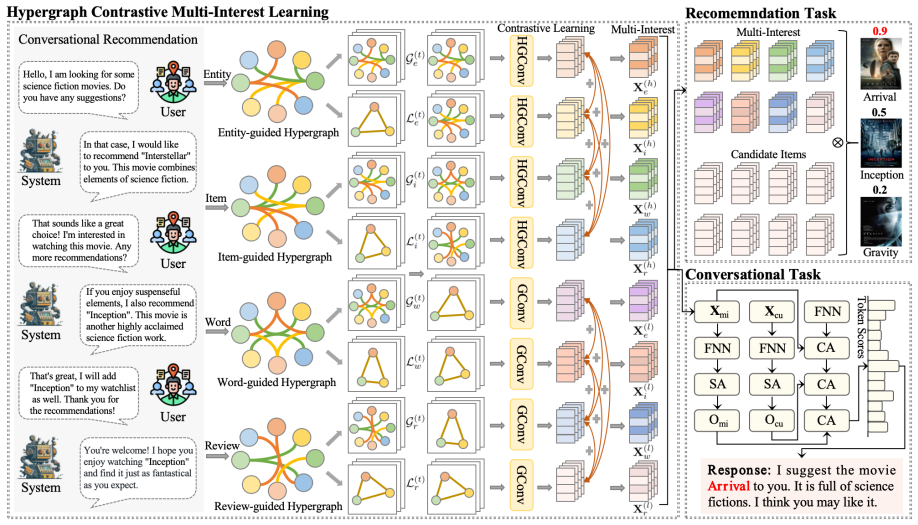
The load-bearing mechanism is the paired hypergraph and line graph. A hypergraph is a graph whose edges can connect more than two nodes, capturing a user's interest as a shared relation among many items; a line graph converts each hyperedge into a node so relationships between hyperedges can be learned. HyFairCRS builds four such hypergraphs—entity-, item-, word-, and review-guided—from conversation history plus DBpedia, ConceptNet, and item reviews, then applies hypergraph convolution and graph convolution to each pair. Contrastive learning (an InfoNCE-style loss) pulls together representations of the same interest across views and pushes apart different interest views. The resulting eight representations are concatenated, pooled, and passed through multi-head attention to produce one fair representation for ranking and one for response generation.
What would settle it
Run a repeated-interaction simulation with HyFairCRS and a baseline: at each round recommend, log user feedback, retrain or re-rank, and track interest-group exposure over time. If the static A@K, G@K, L@K, and D@K improvements vanish or reverse, the dynamic fairness claim is falsified.
Extended reading notes
Core claim
The central claim is that multi-interest diversity fairness is the right lens for unfairness in conversational recommenders, and that it can be achieved by learning many user-interest views rather than one pooled preference. The paper's concrete discovery is that decoupling four interest hypergraphs into hypergraph and line-graph views and refining them with contrastive learning yields eight interest representations that simultaneously improve recommendation accuracy, response quality, and popularity-based fairness on REDIAL and TG-REDIAL. HyFairCRS also transfers to OpenDialKG and DuRecDial. The authors state this is the first work to investigate diversity fairness related to multiple interests in a dynamic CRS involving a user-system feedback loop.
Load-bearing premise
The claim that HyFairCRS improves fairness in a dynamic feedback loop rests on static test-set metrics; if those metrics are not a valid stand-in for long-run interactive fairness, the main fairness contribution is unsupported.
Editorial extensions
If this is right
- HyFairCRS reports simultaneous gains in recommendation recall, conversation distinctness, and popularity fairness, so accuracy and fairness do not have to be traded off on these benchmarks.
- Because removing any single hypergraph or line graph degrades both accuracy and fairness, each of the four interest views contributes to the result.
- The cross-domain results suggest the same multi-interest fairness mechanism transfers to datasets spanning movies, music, books, sports, news, and restaurants.
- The complexity analysis positions HyFairCRS as more scalable than the triangle-enumerating hypergraph baseline HiCore.
Reading between the lines
- The dynamic feedback-loop benefit is asserted rather than measured; a natural test is to simulate repeated rounds of recommendation and re-ranking and compare long-run exposure diversity against static gains.
- The same eight interest views could serve as a plug-in fairness regularizer for non-conversational recommenders, since popularity bias and filter bubbles are not conversation-specific.
- A targeted experiment would check whether responses generated from under-represented interest views actually steer users toward those interests, which would connect the fairness claim to engagement rather than only to metrics.
Editorial analysis
A structured set of objections, weighed in public.
Referee Report
Summary. The paper presents HyFairCRS, a hypergraph contrastive multi-interest learning framework for conversational recommender systems. The model builds four types of hypergraphs (entity-, item-, word-, and review-guided) together with their line graphs, applies hypergraph and graph convolution plus contrastive learning to obtain eight interest representations, and integrates them into both the recommendation and response-generation tasks. Experiments are reported on REDIAL, TG-REDIAL, OpenDialKG, and DuRecDial against a broad set of baselines, with claims of state-of-the-art recommendation and conversation performance and improved popularity-based fairness metrics (A@K, G@K, L@K, D@K). The paper's primary stated novelty is that it is the first work to address diversity fairness in a dynamic CRS that involves a user-system feedback loop.
Significance. If the results hold, the paper would offer a competitive CRS architecture that improves both accuracy and popularity-based fairness, with public code and evaluation across four datasets. The multi-hypergraph contrastive design is technically coherent, and the ablations in Table 4 suggest each component contributes. However, the central dynamic-fairness claim rests entirely on static test-set metrics, the fairness metrics are not defined in the paper, and the claimed statistical significance is not supported by reported experimental detail. These issues currently leave the significance of the fairness contribution unestablished, even though the recommendation and conversation results are promising.
major comments (4)
- [Introduction (contribution 1) and Section 4.4] The paper's first contribution claims to investigate diversity fairness 'in the dynamic CRS that involves a user-system feedback loop,' but the evaluation is entirely static: all four datasets are used as fixed train/test corpora, and Section 4.4 reports only one-shot A@K, G@K, L@K, and D@K values on a test set. No user-system interaction is simulated, no multi-turn fairness trajectory is measured, and the model equations in Section 3 contain no online learning or feedback mechanism. The dynamic fairness claim is therefore unsupported by the provided evidence.
- [Section 4.4] The fairness metrics A@K, G@K, L@K, and D@K are cited to Jin et al. (2023a) but never defined: the paper gives no formulas, no description of how items are binned by popularity, and no definition of the 'Difference' D@K. Without these operational definitions, the improvements in Table 3 cannot be interpreted or reproduced. Since these metrics are the sole quantitative evidence for the fairness contribution, the fairness claim rests on unverifiable quantities.
- [Tables 1, 2, and 5] The asterisks in Tables 1, 2, and 5 state 'statistically significant improvement (p < 0.05) over all baselines,' but the paper reports no standard deviations, confidence intervals, number of independent runs, or description of the statistical test. Given that the gains over the strongest baseline in Table 1 are small (e.g., R@10 on REDIAL: 0.2192 for HiCore vs. 0.2237 for HyFairCRS), the significance claim is unsubstantiated as reported.
- [Section 4.4] The four reported metrics are item-popularity-based (average popularity, Gini coefficient, KL divergence, and a difference measure), yet the paper frames them as measuring 'multi-interest diversity fairness.' No argument or evidence is provided that these popularity metrics operationalize diversity across a user's multiple interests, and no connection is drawn between the eight learned interest representations and the reported metric values. The construct validity of the fairness evaluation is therefore not established.
minor comments (6)
- [Section 3.2] The subsection title 'Hypergraph Contrative Multi-Interest Learning' contains a typo; 'Contrative' should be 'Contrastive.'
- [Equation (7)] The InfoNCE loss notation is ambiguous: the positive sample X^{(h)+}_i and the negative samples X^{(k)-}_i are not clearly defined, and the placement of the '+' symbol inside the cosine similarity argument makes the formula difficult to read. Please rewrite with explicit notation.
- [Section 3.4] The sentence comparing complexity with HiCore is grammatically incomplete ('Compared with the strongest baseline HiCore ..., has a complexity of O(n^3)'), and the claim that the method 'outperforms HiCore in both accuracy and efficiency' is not empirically supported because no runtime measurements are reported.
- [Abstract and Section 4.1] The abstract states 'Experiments on two CRS-based datasets,' but Section 4.1 evaluates on four datasets (REDIAL, TG-REDIAL, OpenDialKG, DuRecDial); please reconcile this description.
- [Section 6] The Limitations section does not mention the absence of any dynamic or online evaluation, which is central to the paper's motivation; consider adding this as a limitation.
- [Throughout] There are several stylistic issues, such as 'we proposed' in the abstract, 'emphi.e.' in Section 4.2, and inconsistent use of tense; a careful proofread is needed.
Circularity Check
No significant circularity: the SOTA and fairness claims are benchmarked externally; the dynamic-feedback fairness gap is a validity weakness, not a self-referential derivation.
full rationale
The paper's central empirical claims—state-of-the-art recommendation/conversation performance and improved popularity-fairness on REDIAL, TG-REDIAL, OpenDialKG, and DuRecDial—are evaluated against external datasets and external baselines. No parameter is fitted to the fairness metrics and then reported as a prediction: the training objectives (Eqs. 12-13 and 16-17) contain only cross-entropy and contrastive losses, with no fairness term, so the A/G/L/D@K values in Table 3 are post-hoc measurements rather than fitted outputs. The hypergraph/line-graph/contrastive architecture overlaps with the authors' prior HiCore and HyCoRec, but those works are used as baselines and building blocks, not as the evidence for the current SOTA or fairness claims; the self-citation is therefore not load-bearing. The most serious weakness is a construct-validity gap, not circularity: the paper claims to address unfairness 'within the dynamic user-system feedback loop' (Abstract and Introduction) yet evaluates fairness with static one-shot popularity metrics on fixed test sets and never simulates user-system interaction. Additionally, the fairness metrics are cited to Jin et al. (2023a) without formulas, so they are not independently checkable as operationalizations of 'multi-interest diversity fairness.' The 'first to investigate' priority claim is also contestable given the same authors' earlier HiCore/HyCoRec work on Matthew effect and diversity in CRS, but that is a novelty concern, not a circular derivation. In sum, I find no step where a claimed result reduces by construction to its inputs or to a self-citation chain.
Assumptions & free parameters
free parameters (5)
- temperature tau (Eq. 7) =
not reported
- alpha (Eq. 13) =
not reported
- beta (Eq. 17) =
not reported
- gamma (Eq. 14) =
not reported
- number of convolution layers and feature dimensions =
not reported
assumptions (5)
- domain assumption Hypergraphs built from entity, item, word, and review sources capture a wide range of user interests relevant to fairness.
- domain assumption Decoupling each hypergraph into a hypergraph and a line graph yields complementary intra- and inter-hyperedge information that improves diversity and fairness.
- domain assumption Popularity-based fairness metrics (A@K, G@K, L@K, D@K) are a valid operationalization of multi-interest diversity fairness.
- domain assumption Offline evaluation on REDIAL and TG-REDIAL approximates the dynamic user-system feedback loop.
- standard math Standard hypergraph and graph convolution propagation rules (Eqs. 5-6) are correct and appropriate for the proposed architecture.
Cite this review
Pith. "Pith review of Why Multi-Interest Fairness Matters: Hypergraph Contrastive Multi-Interest Learning for Fair Conversational Recommender System." pith.science (2026). https://pith.science/paper/D6YXRVJF
@misc{pith2026250702000,
  author       = {Pith},
  title        = {Pith review of: Why Multi-Interest Fairness Matters: Hypergraph Contrastive Multi-Interest Learning for Fair Conversational Recommender System},
  year         = {2026},
  howpublished = {\url{https://pith.science/paper/D6YXRVJF}},
  note         = {Machine review of arXiv:2507.02000}
}
read the original abstract
Unfairness is a well-known challenge in Recommender Systems (RSs), often resulting in biased outcomes that disadvantage users or items based on attributes such as gender, race, age, or popularity. Although some approaches have started to improve fairness recommendation in offline or static contexts, the issue of unfairness often exacerbates over time, leading to significant problems like the Matthew effect, filter bubbles, and echo chambers. To address these challenges, we proposed a novel framework, Hypergraph Contrastive Multi-Interest Learning for Fair Conversational Recommender System (HyFairCRS), aiming to promote multi-interest diversity fairness in dynamic and interactive Conversational Recommender Systems (CRSs). HyFairCRS first captures a wide range of user interests by establishing diverse hypergraphs through contrastive learning. These interests are then utilized in conversations to generate informative responses and ensure fair item predictions within the dynamic user-system feedback loop. Experiments on two CRS-based datasets show that HyFairCRS achieves a new state-of-the-art performance while effectively alleviating unfairness. Our code is available at https://github.com/zysensmile/HyFairCRS.
Figures

Reference graph
Works this paper leans on
-
[1]
URL: " 'urlintro :=
ENTRY address author booktitle chapter edition editor howpublished institution journal key month note number organization pages publisher school series title type volume year eprint doi pubmed url lastchecked label extra.label sort.label short.list INTEGERS output.state before.all mid.sentence after.sentence after.block STRINGS urlintro eprinturl eprintpr...
-
[2]
write newline
" write newline "" before.all 'output.state := FUNCTION n.dashify 't := "" t empty not t #1 #1 substring "-" = t #1 #2 substring "--" = not "--" * t #2 global.max substring 't := t #1 #1 substring "-" = "-" * t #2 global.max substring 't := while if t #1 #1 substring * t #2 global.max substring 't := if while FUNCTION word.in bbl.in capitalize " " * FUNCT...
-
[3]
S \" o ren Auer, Christian Bizer, Georgi Kobilarov, Jens Lehmann, Richard Cyganiak, and Zachary G. Ives. 2007. Dbpedia: A nucleus for a web of open data. In International Semantic Web Conference/Asian Semantic Web Conference, volume 4825, pages 722--735
work page 2007
-
[4]
Alex Beutel, Jilin Chen, Tulsee Doshi, Hai Qian, Li Wei, Yi Wu, Lukasz Heldt, Zhe Zhao, Lichan Hong, Ed H. Chi, and Cristos Goodrow. 2019. Fairness in recommendation ranking through pairwise comparisons. In Proceedings of ACM SIGKDD International Conference on Knowledge Discovery & Data Mining, KDD 2019 , pages 2212--2220. ACM
work page 2019
-
[5]
Jes \' u s Bobadilla, Ra \' u l Lara - Cabrera, \' A ngel Gonz \' a lez - Prieto, and Fernando Ortega. 2021. Deepfair: Deep learning for improving fairness in recommender systems. Int. J. Interact. Multim. Artif. Intell., 6(6):86--94
work page 2021
-
[6]
Tom B. Brown, Benjamin Mann, Nick Ryder, Melanie Subbiah, Jared Kaplan, Prafulla Dhariwal, Arvind Neelakantan, Pranav Shyam, Girish Sastry, Amanda Askell, Sandhini Agarwal, Ariel Herbert - Voss, Gretchen Krueger, Tom Henighan, Rewon Child, Aditya Ramesh, Daniel M. Ziegler, Jeffrey Wu, Clemens Winter, Christopher Hesse, Mark Chen, Eric Sigler, Mateusz Litw...
work page 2020
-
[7]
Robin Burke, Nasim Sonboli, and Aldo Ordonez - Gauger. 2018. Balanced neighborhoods for multi-sided fairness in recommendation. In Conference on Fairness, Accountability and Transparency, FAT 2018 , volume 81 of Proceedings of Machine Learning Research, pages 202--214. PMLR
work page 2018
-
[8]
Qibin Chen, Junyang Lin, Yichang Zhang, Ming Ding, Yukuo Cen, Hongxia Yang, and Jie Tang. 2019. Towards knowledge-based recommender dialog system. arXiv preprint arXiv:1908.05391
arXiv 2019
Show all 57 references
-
[9]
Yang Deng, Yaliang Li, Fei Sun, Bolin Ding, and Wai Lam. 2021 a . Unified conversational recommendation policy learning via graph-based reinforcement learning. In Conference on Research and Development in Information Retrieval, pages 1431--1441
2021
-
[10]
Yang Deng, Yaliang Li, Fei Sun, Bolin Ding, and Wai Lam. 2021 b . Unified conversational recommendation policy learning via graph-based reinforcement learning. In Conference on Research and Development in Information Retrieval, pages 1431--1441
2021
-
[11]
Jacob Devlin, Ming - Wei Chang, Kenton Lee, and Kristina Toutanova. 2019. BERT: pre-training of deep bidirectional transformers for language understanding. In the North American Chapter of the Association for Computational Linguistics: Human Language Technologies, pages 4171--...
2019
-
[12]
Yingqiang Ge, Shuchang Liu, Ruoyuan Gao, Yikun Xian, Yunqi Li, Xiangyu Zhao, Changhua Pei, Fei Sun, Junfeng Ge, Wenwu Ou, and Yongfeng Zhang. 2021. Towards long-term fairness in recommendation. In W ACM International Conference on Web Search and Data Mining, WSDM 2021 , pages ...
2021
-
[13]
Yingqiang Ge, Shuya Zhao, Honglu Zhou, Changhua Pei, Fei Sun, Wenwu Ou, and Yongfeng Zhang. 2020. Understanding echo chambers in e-commerce recommender systems. In Conference on Research and Development in Information Retrieval, pages 2261--2270. ACM
2020
-
[14]
Di Jin, Luzhi Wang, He Zhang, Yizhen Zheng, Weiping Ding, Feng Xia, and Shirui Pan. 2023 a . A survey on fairness-aware recommender systems. Information Fusion, 100:101906
2023
-
[15]
Xin Jin, Wu Zhou, Jinyu Wang, Duo Xu, and Yongsen Zheng. 2023 b . An order-complexity aesthetic assessment model for aesthetic-aware music recommendation. In Proceedings of the 31st ACM International Conference on Multimedia, pages 6938--6947
2023
-
[16]
Wang - Cheng Kang and Julian J. McAuley. 2018. Self-attentive sequential recommendation. In IEEE International Conference on Data Mining , pages 197--206
2018
-
[17]
Yoon Kim. 2014. Convolutional neural networks for sentence classification. In Empirical Methods in Natural Language Processing (Demonstrations), pages 1746--1751
2014
-
[18]
Hang Lei, Yin Zhao, and Longjun Cai. 2020 a . Multi-objective optimization for guaranteed delivery in video service platform. In ACM SIGKDD Conference on Knowledge Discovery and Data Mining, KDD 2020 , pages 3017--3025. ACM
2020
-
[19]
Wenqiang Lei, Xiangnan He, Yisong Miao, Qingyun Wu, Richang Hong, Min-Yen Kan, and Tat-Seng Chua. 2020 b . Estimation-action-reflection: Towards deep interaction between conversational and recommender systems. In Web Search and Data Mining, pages 304--312
2020
-
[20]
Wenqiang Lei, Gangyi Zhang, Xiangnan He, Yisong Miao, Xiang Wang, Liang Chen, and Tat-Seng Chua. 2020 c . Interactive path reasoning on graph for conversational recommendation. In International Conference on Knowledge Discovery and Data Mining, pages 2073--2083
2020
-
[21]
Mike Lewis, Yinhan Liu, Naman Goyal, Marjan Ghazvininejad, Abdelrahman Mohamed, Omer Levy, Veselin Stoyanov, and Luke Zettlemoyer. 2020. BART: denoising sequence-to-sequence pre-training for natural language generation, translation, and comprehension. In the Association for Co...
2020
-
[22]
Raymond Li, Samira Ebrahimi Kahou, Hannes Schulz, Vincent Michalski, Laurent Charlin, and Chris Pal. 2018 a . Towards deep conversational recommendations. Advances in Neural Information Processing Systems, 31
2018
-
[23]
Raymond Li, Samira Ebrahimi Kahou, Hannes Schulz, Vincent Michalski, Laurent Charlin, and Chris Pal. 2018 b . Towards deep conversational recommendations. In Advances in Neural Information Processing Systems, pages 9748--9758
2018
-
[24]
Qin Liu, Xuan Feng, Tianlong Gu, and Xiaoli Liu. 2024. Faircrs: Towards user-oriented fairness in conversational recommendation systems. In Proceedings of ACM Conference on Recommender Systems, RecSys 2024 , pages 126--136. ACM
2024
-
[25]
Ying Chieh Liu and Min Qi Huang. 2021. Examining the matthew effect on youtube recommendation system. In Conference on Technologies and Applications of Artificial Intelligence, pages 146--148
2021
-
[26]
Zeming Liu, Haifeng Wang, Zhengyu Niu, Hua Wu, and Wanxiang Che. 2021. Durecdial 2.0: A bilingual parallel corpus for conversational recommendation. In Conference on Empirical Methods in Natural Language Processing EMNLP , pages 4335--4347. Association for Computational Linguistics
2021
-
[27]
Yu Lu, Junwei Bao, Yan Song, Zichen Ma, Shuguang Cui, Youzheng Wu, and Xiaodong He. 2021. Revcore: Review-augmented conversational recommendation. In Findings of the Association for Computational Linguistics, pages 1161--1173
2021
-
[28]
Seungwhan Moon, Pararth Shah, Anuj Kumar, and Rajen Subba. 2019. Opendialkg: Explainable conversational reasoning with attention-based walks over knowledge graphs. In Conference of the Association for Computational Linguistics ACL , pages 845--854. Association for Computationa...
2019
-
[29]
Patro, Arpita Biswas, Niloy Ganguly, Krishna P
Gourab K. Patro, Arpita Biswas, Niloy Ganguly, Krishna P. Gummadi, and Abhijnan Chakraborty. 2020. Fairrec: Two-sided fairness for personalized recommendations in two-sided platforms. In WWW The Web Conference 2020 , pages 1194--1204. ACM / IW3C2
2020
-
[30]
Mingjie Qian, Yongsen Zheng, Jinghui Qin, and Liang Lin. 2023. Hutcrs: Hierarchical user-interest tracking for conversational recommender system. In Conference on Empirical Methods in Natural Language Processing, pages 10281--10290
2023
-
[31]
Xuhui Ren, Hongzhi Yin, Tong Chen, Hao Wang, Zi Huang, and Kai Zheng. 2021. Learning to ask appropriate questions in conversational recommendation. In Conference on Research and Development in Information Retrieval, pages 808--817
2021
-
[32]
Rajdeep Sarkar, Koustava Goswami, Mihael Arcan, and John Philip McCrae. 2020. Suggest me a movie for tonight: Leveraging knowledge graphs for conversational recommendation. In Conference on Computational Linguistics, pages 4179--4189
2020
-
[33]
Chenzhan Shang, Yupeng Hou, Wayne Xin Zhao, Yaliang Li, and Jing Zhang. 2023. Multi-grained hypergraph interest modeling for conversational recommendation. AI Open , 4:154--164
2023
-
[34]
Robyn Speer, Joshua Chin, and Catherine Havasi. 2017. Conceptnet 5.5: An open multilingual graph of general knowledge. In Association for the Advancement of Artificial Intelligence, pages 4444--4451
2017
-
[35]
Harald Steck. 2018. Calibrated recommendations. In Conference on Recommender Systems, pages 154--162
2018
-
[36]
Fei Sun, Jun Liu, Jian Wu, Changhua Pei, Xiao Lin, Wenwu Ou, and Peng Jiang. 2019. Bert4rec: Sequential recommendation with bidirectional encoder representations from transformer. In International Conference on Information and Knowledge Management, pages 1441--1450. ACM
2019
-
[37]
Gomez, Lukasz Kaiser, and Illia Polosukhin
Ashish Vaswani, Noam Shazeer, Niki Parmar, Jakob Uszkoreit, Llion Jones, Aidan N. Gomez, Lukasz Kaiser, and Illia Polosukhin. 2017. Attention is all you need. In Advances in Neural Information Processing Systems, pages 5998--6008
2017
-
[38]
Yifan Wang, Peijie Sun, Weizhi Ma, Min Zhang, Yuan Zhang, Peng Jiang, and Shaoping Ma. 2024. Intersectional two-sided fairness in recommendation. In WWW on Web Conference 2024 , pages 3609--3620. ACM
2024
-
[39]
Haolun Wu, Yansen Zhang, Chen Ma, Fuyuan Lyu, Fernando Diaz, and Xue Liu. 2022. A survey of diversification techniques in search and recommendation. CoRR, abs/2212.14464
2022 arXiv
-
[40]
Le Wu, Lei Chen, Pengyang Shao, Richang Hong, Xiting Wang, and Meng Wang. 2021 a . Learning fair representations for recommendation: A graph-based perspective. In WWW '21: The Web Conference 2021 , pages 2198--2208. ACM / IW3C2
2021
-
[41]
Yao Wu, Jian Cao, Guandong Xu, and Yudong Tan. 2021 b . TFROM: A two-sided fairness-aware recommendation model for both customers and providers. In ACM SIGIR Conference on Research and Development in Information Retrieval , pages 1013--1022. ACM
2021
-
[42]
Lanling Xu, Zihan Lin, Jinpeng Wang, Sheng Chen, Wayne Xin Zhao, and Ji - Rong Wen. 2024. Promoting two-sided fairness with adaptive weights for providers and customers in recommendation. In ACM RecSys Conference on Recommender Systems , pages 918--923. ACM
2024
-
[43]
Carbonell, Ruslan Salakhutdinov, and Quoc V
Zhilin Yang, Zihang Dai, Yiming Yang, Jaime G. Carbonell, Ruslan Salakhutdinov, and Quoc V. Le. 2019. Xlnet: Generalized autoregressive pretraining for language understanding. In Advances in Neural Information Processing Systems, pages 5754--5764
2019
-
[44]
Meike Zehlike and Carlos Castillo. 2020. Reducing disparate exposure in ranking: A learning to rank approach. In The Web Conference 2020, WWW 2020 , pages 2849--2855. ACM / IW3C2
2020
-
[45]
Yizhe Zhang, Siqi Sun, Michel Galley, Yen - Chun Chen, Chris Brockett, Xiang Gao, Jianfeng Gao, Jingjing Liu, and Bill Dolan. 2020. DIALOGPT : Large-scale generative pre-training for conversational response generation. In the Association for Computational Linguistics, pages 27...
2020
-
[46]
Aggarwal, and Tyler Derr
Yuying Zhao, Yu Wang, Yunchao Liu, Xueqi Cheng, Charu C. Aggarwal, and Tyler Derr. 2023 a . Fairness and diversity in recommender systems: A survey. CoRR, abs/2307.04644
2023 arXiv
-
[47]
Zhipeng Zhao, Kun Zhou, Xiaolei Wang, Wayne Xin Zhao, Fan Pan, Zhao Cao, and Ji - Rong Wen. 2023 b . Alleviating the long-tail problem in conversational recommender systems. In ACM Conference on Recommender Systems , pages 374--385. ACM
2023
-
[48]
Yongsen Zheng, Ziliang Chen, Jinghui Qin, and Liang Lin. 2024 a . Facetcrs: multi-faceted preference learning for pricking filter bubbles in conversational recommender system. In Proceedings of the AAAI Conference on Artificial Intelligence, volume 38, pages 9405--9413
2024
-
[49]
Yongsen Zheng, Jinghui Qin, Pengxu Wei, Ziliang Chen, and Liang Lin. 2023 a . Cipl: counterfactual interactive policy learning to eliminate popularity bias for online recommendation. IEEE Transactions on Neural Networks and Learning Systems
2023
-
[50]
Yongsen Zheng, Guohua Wang, Yang Liu, and Liang Lin. 2024 b . https://doi.org/10.1145/3664647.3680909 Diversity matters: User-centric multi-interest learning for conversational movie recommendation . MM '24. Association for Computing Machinery
2024
-
[51]
Yongsen Zheng, Pengxu Wei, Ziliang Chen, Yang Cao, and Liang Lin. 2021. Graph-convolved factorization machines for personalized recommendation. IEEE Transactions on Knowledge and Data Engineering, 35(2):1567--1580
2021
-
[52]
Yongsen Zheng, Pengxu Wei, Ziliang Chen, Chengpei Tang, and Liang Lin. 2023 b . Routing user-interest markov tree for scalable personalized knowledge-aware recommendation. IEEE Transactions on Neural Networks and Learning Systems
2023
-
[53]
Yongsen Zheng, Ruilin Xu, Ziliang Chen, Guohua Wang, Mingjie Qian, Jinghui Qin, and Liang Lin. 2024 c . Hycorec: Hypergraph-enhanced multi-preference learning for alleviating matthew effect in conversational recommendation. In Proceedings of Annual Meeting of the Association f...
2024
-
[54]
Yongsen Zheng, Ruilin Xu, Guohua Wang, Liang Lin, and Kwok - Yan Lam. 2024 d . Mitigating matthew effect: Multi-hypergraph boosted multi-interest self-supervised learning for conversational recommendation. In Proceedings of Conference on Empirical Methods in Natural Language P...
2024
-
[55]
Kun Zhou, Wayne Xin Zhao, Shuqing Bian, Yuanhang Zhou, Ji-Rong Wen, and Jingsong Yu. 2020 a . Improving conversational recommender systems via knowledge graph based semantic fusion. In International Conference on Knowledge Discovery and Data Mining, pages 1006--1014
2020
-
[56]
Kun Zhou, Yuanhang Zhou, Wayne Xin Zhao, Xiaoke Wang, and Ji - Rong Wen. 2020 b . Towards topic-guided conversational recommender system. In International Conference on Computational Linguistics, pages 4128--4139
2020
-
[57]
Yuanhang Zhou, Kun Zhou, Wayne Xin Zhao, Cheng Wang, Peng Jiang, and He Hu. 2022. C \( ^2 \) -crs: Coarse-to-fine contrastive learning for conversational recommender system. In Web Search and Data Mining, pages 1488--1496. ACM
2022
Reviewed August 6, 2026 · model on record in the stance chip above.
Discussion (0). Continue with ORCID to comment.