REVIEW 3 major objections 5 minor 40 references
Study of the velocity plateau of Dzyaloshinskii domain walls
T0 review · 3 major / 5 minor · reviewed 2026-08-14 · deepseek-v4-flash
Pith's one-line read The velocity plateau of a field-driven Dzyaloshinskii domain wall ends at a breakdown field close to $1.11\,D/(\mu_0 M_s \Delta)$, not at a damping-controlled field.
desk verdict Solid, useful paper on the velocity plateau in Dzyaloshinskii domain walls; the plateau-end formula is predictive but overextended to samples where its DMI-dominance precondition fails. read the letter →
The pith
A machine-rendered reading of the paper's core claim, the machinery that carries it, and where it could break.
The reading
What carries the argument
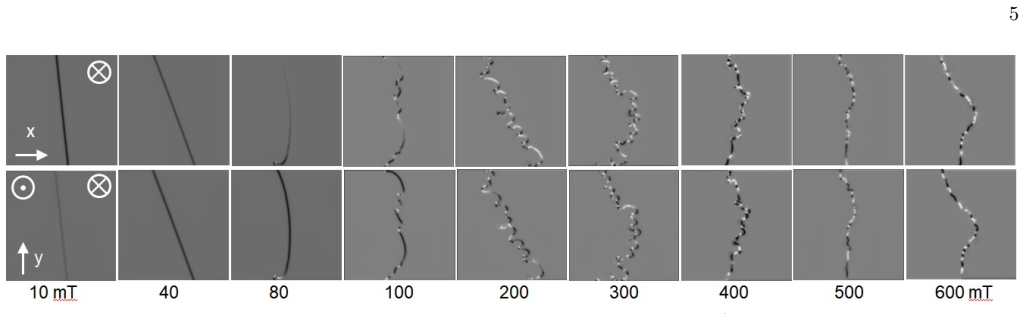
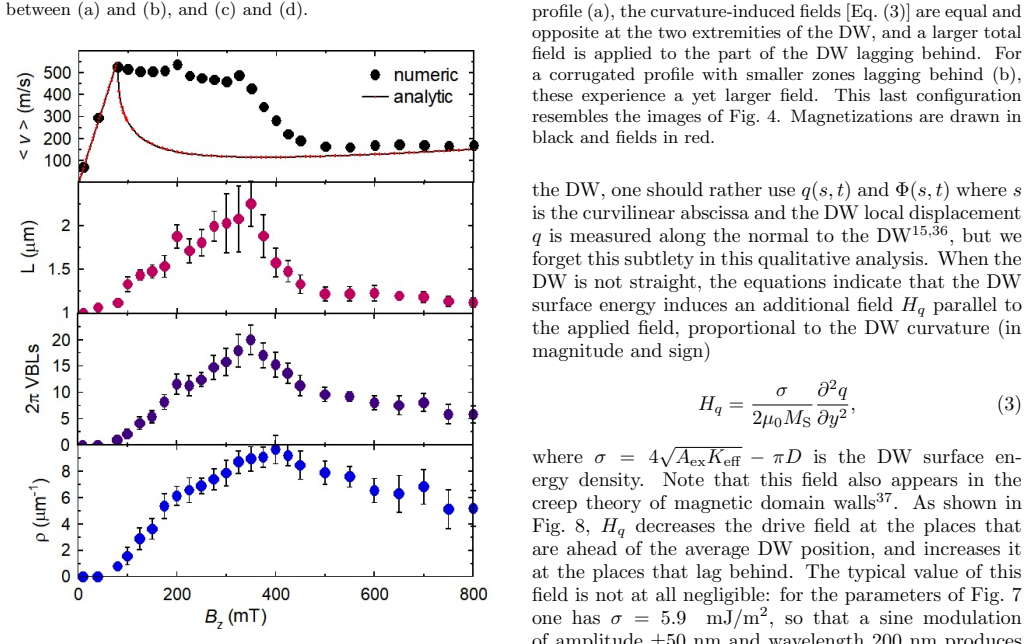
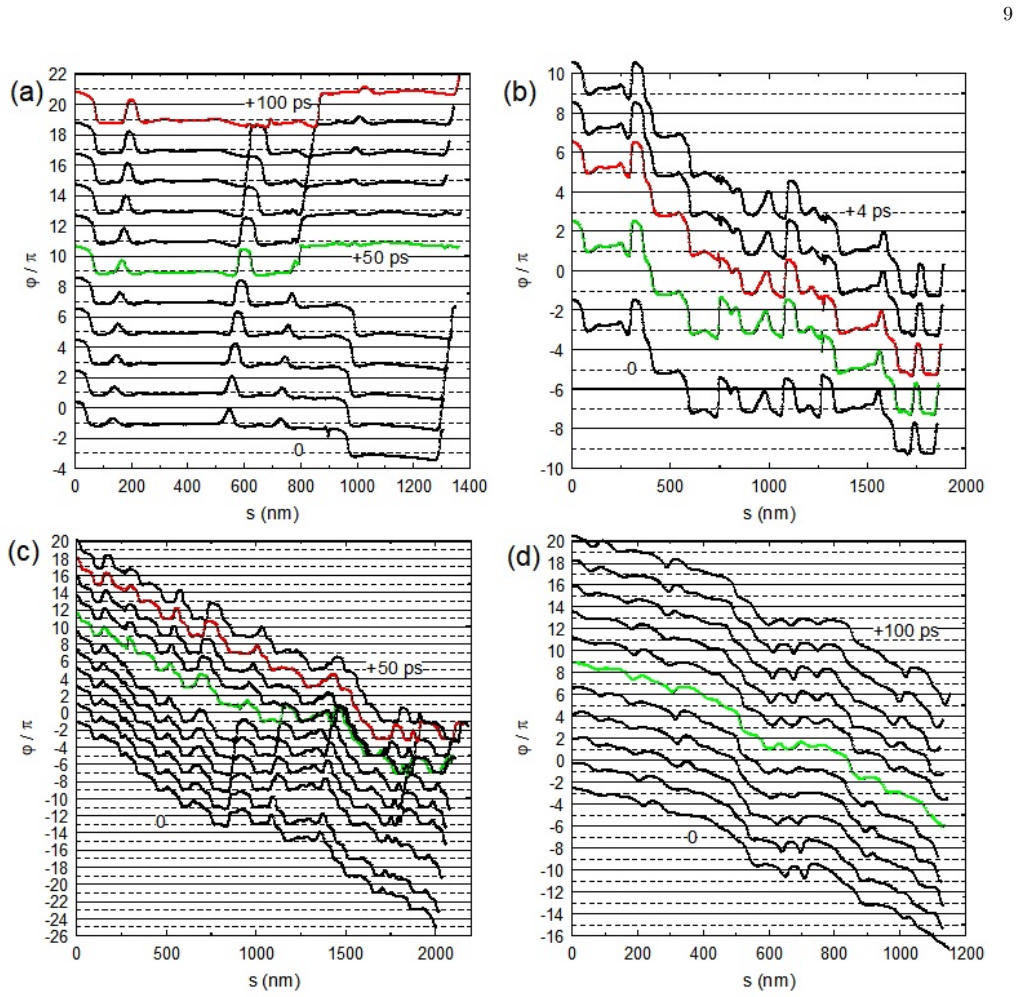
The load-bearing mechanism is the corrugated-wall description of the negative-mobility regime, in which a meandering wall experiences curvature-induced fields $H_q=\frac{\sigma}{2\mu_0 M_s}\frac{\partial^2 q}{\partial y^2}$ that add to the drive on lagging parts and nucleate $2\pi$ vertical Bloch lines. A $2\pi$ vertical Bloch line is a twist of the wall magnetization angle by $2\pi$; it is topologically stable and disappears through a Bloch point, radiating spin waves, with energy $\lambda=16\sqrt{A_{\rm ex}\Delta \pi D}$ per unit thickness. Two integral relations carry the argument: an averaged wall equation expressing momentum conservation, and an energy balance in which Bloch-line annihilation supplies a dominant share of the extra dissipation needed to move at the Walker velocity. The terminal field comes from mapping the one-dimensional minimum-velocity field onto the DMI field, giving Eq. (8).
What would settle it
Measure the plateau-end field $B_{\rm break}$ in a series of samples in which $D/(M_s \Delta)$ is varied by, say, a factor of two while the wall width is kept fixed; if $B_{\rm break}$ does not track $1.11\,D/(\mu_0 M_s \Delta)$ within experimental error, the central quantitative claim fails. A complementary check is to image the predicted spin-wave wakes at the moments when $2\pi$ vertical Bloch lines annihilate.
Extended reading notes
Core claim
The central claim is that the end of the high-velocity plateau of a Dzyaloshinskii domain wall is the Slonczewski field of the one-dimensional wall model, evaluated with the DMI effective field in place of the wall anisotropy field: $H_S=\frac{1+\alpha^2}{\sqrt{2+\alpha^2}}H_D=\frac{\pi(1+\alpha^2)}{2\sqrt{2+\alpha^2}}\frac{D}{\mu_0 M_s \Delta}\approx 1.11\,\frac{D}{\mu_0 M_s \Delta}$ for small damping. Above the Walker field the wall corrugates; lagging parts of the wall precess faster and nucleate $2\pi$ vertical Bloch lines, and the annihilation of these topologically stable lines through Bloch points releases their energy as spin waves. This dissipation, together with localized precession in the lagging parts, lets the wall keep moving at essentially the Walker velocity instead of falling into low-mobility precessional motion. The claim is supported by Kerr-microscopy velocities in four samples and by micromagnetic simulations that reproduce both the plateau speed and the breakdown field, and the paper shows that the end of the plateau is not set by dense packing of vertical Bloch lines.
Load-bearing premise
The load-bearing premise is that the breakdown field derived for a straight wall in the one-dimensional model continues to give the end of the plateau for a strongly corrugated two-dimensional wall once the DMI effective field is substituted for the wall anisotropy field, even though the paper admits the corrugated-wall model cannot be applied directly to the simulated wall shapes.
Editorial extensions
If this is right
- Above the Walker field, a wide strip with strong DMI should keep a constant velocity near the Walker velocity instead of dropping to low mobility; the plateau is the negative-mobility regime of the one-dimensional model.
- The breakdown field is set by material parameters alone: $B_{\rm break}\approx 1.11\,D/(\mu_0 M_s \Delta)$, so increasing $D/M_s$ or the wall width $\Delta$ extends the plateau.
- The end of the plateau is not governed by vertical Bloch lines packing to a maximum density; their destruction, not their crowding, sets the energetics.
- In narrow strips the corrugation needed for the plateau is suppressed, so the usual one-dimensional Walker breakdown (or even two successive breakdowns) reappears; the simulations place the crossover near 500 nm for the studied parameters.
- Annihilation of a $2\pi$ vertical Bloch line through a Bloch point radiates spin waves, and this channel accounts for at least one third, likely more, of the extra energy dissipated while moving at the Walker velocity.
Reading between the lines
- Because the breakdown field is independent of damping at low damping, the same plateau field range should in principle be accessible in materials with higher Gilbert damping; the paper does not state this consequence.
- The spin-wave bursts accompanying Bloch-line annihilation are a testable fingerprint: time-resolved magnetic imaging or microwave emission measurements should see intermittent bursts whose rate matches the observed annihilation rate on the plateau.
- The same corrugation-and-Bloch-line mechanism may set saturation velocities for current-driven domain walls under spin-orbit torque, where comparable wall shapes are expected, but the paper studies field drive only.
- The scaling formula gives an application-oriented dial: tuning $D/M_s$ by interface or alloy engineering changes the plateau range without changing its speed, which could help stabilize high-speed wall motion in devices.
Editorial analysis
A structured set of objections, weighed in public.
Referee Report
Summary. The manuscript reports field-driven domain-wall velocity measurements on four asymmetric multilayer stacks with PMA and interfacial DMI, together with Mumax3 micromagnetic simulations. The experiments show a velocity plateau above the Walker field whose height scales roughly with D/Ms and whose field extent depends on D, Ms, and Keff. Simulations reproduce the plateau and reveal that the moving wall is corrugated and contains 2π vertical Bloch lines; the paper argues that VBL pair annihilation dissipates energy via spin-wave emission, sustaining the wall near the Walker velocity. The central quantitative claim is Eq. (8), which identifies the end of the plateau with the Slonczewski field HS ≈ 1.11 D/(μ0 Ms Δ) in the low-damping limit.
Significance. If correct, Eq. (8) gives a parameter-free prediction for the plateau-end field using independently measured D, Ms, and Keff, with no parameter fitted to the plateau dynamics. This would be a useful design rule for spintronic devices. The paper is also valuable for its detailed micromagnetic statistics of 2π VBL dynamics and its energy-balance argument. However, the universality of the numerical factor is not fully established: sample (iv) deviates from the prediction by factors 2.3 (simulation) and 1.7 (experiment), and the derivation's precondition HD >> HKDW is never checked.
major comments (3)
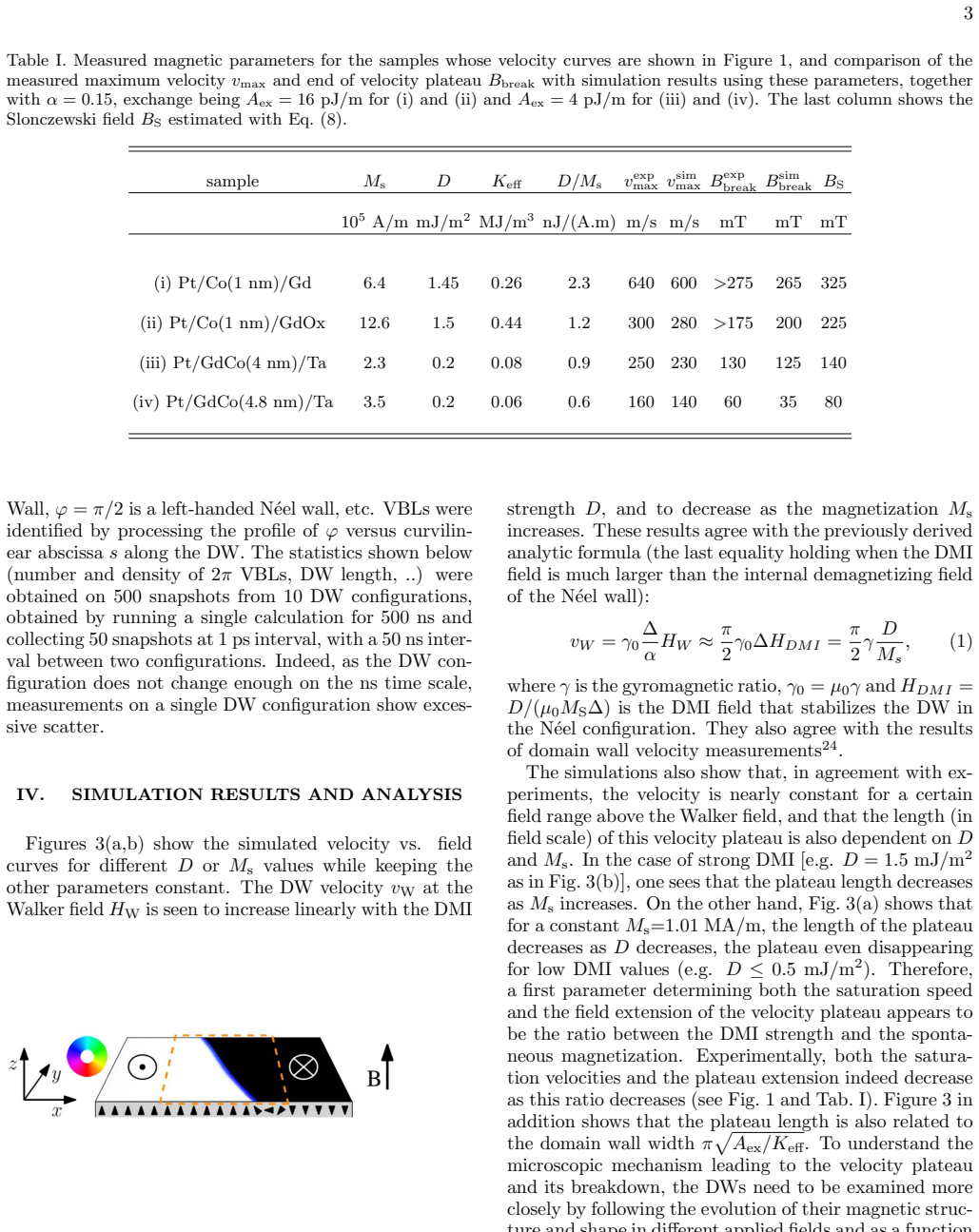
- [Section V, Eq. (8)] Equation (8) is derived under the condition HD >> HKDW, but the paper never quantifies HKDW for the four samples. For sample (iv) in Table I (D = 0.2 mJ/m^2, Ms = 0.35 MA/m, Keff = 0.06 MJ/m^3, Δ ≈ 8.2 nm), standard estimates of the Néel-wall magnetostatic anisotropy give HKDW comparable to or larger than HD, so the DMI-dominated limit invoked in the derivation is not satisfied. This matters because sample (iv) is precisely the one with the largest discrepancy between the predicted BS = 80 mT and Bsim_break = 35 mT. The authors should either compute HKDW for all samples and restrict the claim to the HD >> HKDW regime, or revise Eq. (8) to include the magnetostatic contribution.
- [Table I and Section V] The statement in Section V that the agreement of Eq. (8) with experiments and simulations is 'quantitatively very good' is not supported for sample (iv): the simulated breakdown field is 35 mT, the experimental one is 60 mT, and the predicted Slonczewski field is 80 mT. This is a factor-2.3 error against simulations and a factor-1.7 error against experiment. The paper should report these deviations explicitly and discuss their origin, rather than summarizing the agreement as very good.
- [Section V, corrugated-wall model] The identification of the 1D Slonczewski field with the end of the 2D velocity plateau is explicitly heuristic: the text states that Slonczewski's steady-state corrugated-wall model 'cannot be directly applied' to the simulated walls, yet Eq. (8) uses the 1D result with HD substituted for HKDW. The authors should provide a quantitative argument for why the 1D plateau-end field should survive 2D corrugations, or clearly present Eq. (8) as an empirical interpolation supported only in the parameter range where it has been tested.
minor comments (5)
- [Table I caption] Bexp_break for samples (i) and (ii) are lower bounds because the plateau extends to the largest measurable field; this should be stated in the caption or text to avoid an impression of exact agreement.
- [Section VI and Abstract] The conclusion and abstract repeat the 'simply proportional' phrasing without the HD >> HKDW qualification; please add this qualification to the abstract and conclusion.
- [Appendix] The Bloch-point annihilation occurs in a one-cell-thick simulation, so the Bloch point is numerically virtual; a sentence on how this discretization might affect the estimated VBL annihilation energy would strengthen the energy-balance argument.
- [Section V, Eq. (4)] The notation << ... >> is not defined at first use; please define it as the combined spatial and temporal average.
- [References] Reference [31] is cited as an arXiv preprint; please update to the published version if one exists.
Circularity Check
No significant circularity: Eq. (8) predicts the plateau end from independently measured D, Ms, and Keff via Slonczewski's 1D result, with no parameter fitted to the plateau velocity or to B_break.
full rationale
The central quantitative claim is Eq. (8), HS = (1+alpha^2)/sqrt(2+alpha^2) HD = pi(1+alpha^2)/(2 sqrt(2+alpha^2)) D/(mu0 Ms Delta), with HS ~ 1.11 D/(mu0 Ms Delta) in the small-damping limit. The inputs D, Ms, and Keff (hence Delta) are determined by magnetometry and by in-plane-field velocity measurements in the flow regime, not by fitting the plateau velocity or B_break. Equation (8) is obtained by applying the DMI-dominated limit of the 1D Slonczewski model (Eq. 6), not by inverting the experimental plateau curves, so the plateau-end prediction is not equivalent to its inputs by construction. The micromagnetic Mumax3 simulations independently solve the LLG equation with the same material parameters and reproduce the plateau and its end without any fitting to B_break. The identification of the plateau end with the Slonczewski field is an explanatory hypothesis supported by the simulations. The paper explicitly states the condition 'when the DMI-induced field satisfies HD >> HKDW this 1D model applies,' and the possible failure of this condition for sample (iv), where the predicted BS = 80 mT versus Bsim_break = 35 mT, is a validity/robustness concern rather than a circular reduction. Reference [24] is a self-citation for the D values and for earlier velocity measurements, but those measurements are made in the flow regime outside the plateau and are externally falsifiable; they are not a self-supporting uniqueness theorem. No step in the derivation chain reduces the predicted quantity to a fitted parameter, a definitional identity, or a self-citation chain.
Assumptions & free parameters
free parameters (3)
- DMI strength D =
1.45, 1.5, 0.2, 0.2 mJ/m^2 (Table I)
- Exchange stiffness Aex =
16 pJ/m for samples (i) and (ii); 4 pJ/m for samples (iii) and (iv)
- Damping constant alpha =
0.15
assumptions (5)
- standard math The Landau-Lifshitz-Gilbert equation as solved by Mumax3 accurately describes the DW dynamics in these films.
- ad hoc to paper The 1D Slonczewski (q,Phi) model with purely second-degree effective anisotropy remains valid for DMI-stabilized chiral walls when HD is substituted for HKDW.
- domain assumption The samples can be represented as single-layer ferromagnets with uniform Ms, Keff, D and no disorder.
- ad hoc to paper In the DMI-dominated regime, only 2 pi vertical Bloch lines are relevant objects; 1 pi VBLs are energetically unfavored.
- domain assumption The one-cell-thick discretization captures the essential VBL dynamics even though Bloch points are numerically virtual.
Cite this review
Pith. "Pith review of Study of the velocity plateau of Dzyaloshinskii domain walls." pith.science (2026). https://pith.science/paper/D75HZQIR
@misc{pith2026190808282,
  author       = {Pith},
  title        = {Pith review of: Study of the velocity plateau of Dzyaloshinskii domain walls},
  year         = {2026},
  howpublished = {\url{https://pith.science/paper/D75HZQIR}},
  note         = {Machine review of arXiv:1908.08282}
}
read the original abstract
We study field-driven domain wall (DW) velocities in asymmetric multilayer stacks with perpendicular magnetic anisotropy and Dzyaloshinskii-Moriya interaction (DMI), both experimentally and by micromagnetic simulations. Using magneto-optical Kerr microscopy under intense and nanoseconds-long fields, we show that DWs in these films propagate at velocities up to hundreds of m/s and that, instead of the expected decrease of velocity after the Walker field, a long plateau with constant velocity is observed, before breakdown. Both the maximum speed and the field extent of the velocity plateau strongly depend on the values of the spontaneous magnetization and the DMI strength, as well as on the magnetic anisotropy. Micromagnetic simulations reproduce these features in sufficiently wide strips, even for perfect samples. A physical model explaining the microscopic origin of the velocity plateau is proposed.
Figures


Figures from the paper (5 more)


Reference graph
Works this paper leans on
-
[1]
author author I. E. \ Dzyaloshinskii ,\ @noop journal journal Sov. Phys. JETP \ volume 5 ,\ pages 1259 ( year 1957 ) NoStop
work page 1957
-
[2]
Moriya ,\ @noop journal journal Phys
author author T. Moriya ,\ @noop journal journal Phys. Rev. \ volume 120 ,\ pages 91 ( year 1960 ) NoStop
work page 1960
-
[3]
author author S. Heinze , author K. von Bergmann , author M. Menzel , author J. Brede , author A. Kubetzka , author R. Wiesendanger , author G. Bihlmayer , \ and\ author S. Bl \" u gel ,\ @noop journal journal Nat. Phys. \ volume 7 ,\ pages 713 ( year 2011 ) NoStop
work page 2011
-
[4]
author author G. Chen , author T. Ma , author A. T. \ N'Diaye , author H. Kwon , author C. Won , author Y. Wu , \ and\ author A. K. \ Schmid ,\ @noop journal journal Nat. Commun. \ volume 4 ,\ pages 2671 ( year 2013 ) NoStop
work page 2013
-
[5]
author author A. Fert , author V. Cros , \ and\ author J. Sampaio ,\ @noop journal journal Nat. Nanotechnol. \ volume 8 ,\ pages 152 ( year 2013 ) NoStop
work page 2013
-
[6]
author author A. Thiaville , author S. Rohart , author E. Ju \' e , author V. Cros , \ and\ author A. Fert ,\ 10.1209/0295-5075/100/57002 journal journal EPL \ volume 100 ,\ pages 57002 ( year 2012 ) NoStop
-
[7]
author author T. A. \ Moore , author I. M. \ Miron , author G. Gaudin , author G. Serret , author S. Auffret , author B. Rodmacq , author A. Schuhl , author S. Pizzini , author J. Vogel , \ and\ author M. Bonfim ,\ 10.1063/1.3062855 journal journal Appl. Phys. Lett. \ volume 93 ,\ eid 262504 ( year 2008 ),\ 10.1063/1.3062855 NoStop
-
[8]
author author I. M. \ Miron , author T. Moore , author H. Szambolics , author L. D. \ Buda-Prejbeanu , author S. Auffret , author S. Rodmacq , B.and Pizzini , author J. Vogel , author M. Bonfim , author A. Schuhl , \ and\ author G. Gaudin ,\ 10.1038/NMAT3020 journal journal Nat. Mater. \ volume 10 ,\ pages 419 ( year 2011 ) NoStop
Show all 40 references
-
[9]
\ Ryu , author T
author author K.-S. \ Ryu , author T. L. , author S.-H. \ Yang , \ and\ author S. Parkin ,\ 10.1038/NNANO.2013.102 journal journal Nat. Nanotechnol. \ volume 8 ,\ pages 527 ( year 2013 ) NoStop
2013 doi
-
[10]
Emori , author U
author author S. Emori , author U. Bauer , author S.-M. \ Ahn , author E. Martinez , \ and\ author G. Beach ,\ 10.1038/NMAT3675 journal journal Nat. Mater. \ volume 12 ,\ pages 611 ( year 2013 ) NoStop
2013 doi
-
[11]
author author S. S. P. \ Parkin , author M. Hayashi , \ and\ author L. Thomas ,\ @noop journal journal Science \ volume 320 ,\ pages 190 ( year 2008 ) NoStop
2008
-
[12]
author author L. R. \ Walker ,\ @noop note Bell Telephone Laboratories Memorandum (1956, unpublished); see however the presentation by Dillon Dillon1963 and the later paper by Schryer and Walker Schryer1974 NoStop
1956
-
[13]
author author J. C. \ Slonczewski ,\ @noop journal journal Intern.\ J.\ Magnetism \ volume 2 ,\ pages 85 ( year 1972 a ) NoStop
1972
-
[14]
author author N. L. \ Schryer \ and\ author L. R. \ Walker ,\ @noop journal journal J.\ Appl.\ Phys. \ volume 45 ,\ pages 5406 ( year 1974 ) NoStop
1974
-
[15]
author author A. P. \ Malozemoff \ and\ author J. C. \ Slonczewski ,\ @noop title Magnetic Domain Walls in Bubble Materials \ ( publisher Academic Press ,\ address New York ,\ year 1979 ) NoStop
1979
-
[16]
author author A. H. \ Bobeck , author I. Danylchuk , author J. P. \ Remeika , author L. G. \ van Uitert , \ and\ author E. M. \ Walters ,\ title Proceedings of the international conference on ferrites 1970 , \ \ ( publisher U. of Tokyo Press ,\ address Tokyo ,\ year 1971 )\ p....
1970
-
[17]
author author B. E. \ Argyle , author J. C. \ Slonczewski , \ and\ author A. F. \ Mayadas ,\ @noop journal journal AIP\ Conf.\ Proc. \ volume 5 ,\ pages 175 ( year 1972 ) NoStop
1972
-
[18]
author author F. H. \ de Leeuw ,\ @noop journal journal IEEE Trans.\ Magn. \ volume 14 ,\ pages 596 ( year 1978 ) NoStop
1978
-
[19]
author author V. V. \ Volkov , author V. A. \ Bokov , \ and\ author V. I. \ Karpovich ,\ @noop journal journal Sov.\ Phys.\ Solid State \ volume 24 ,\ pages 1315 ( year 1982 ) NoStop
1982
-
[20]
author author J. C. \ Slonczewski ,\ @noop journal journal AIP\ Conf.\ Proc. \ volume 5 ,\ pages 170 ( year 1972 b ) NoStop
1972
-
[21]
Dourlat , author V
author author A. Dourlat , author V. Jeudy , author A. Lema \^ i tre , \ and\ author C. Gourdon ,\ @noop journal journal Phys.\ Rev.\ B \ volume 78 ,\ pages 161303(R) ( year 2008 ) NoStop
2008
-
[22]
Gourdon , author L
author author C. Gourdon , author L. Thevenard , author S. Haghgoo , \ and\ author A. C \- e bers ,\ @noop journal journal Phys.\ Rev.\ B \ volume 88 ,\ pages 014428 ( year 2013 ) NoStop
2013
-
[23]
Yoshimura , author K.-J
author author Y. Yoshimura , author K.-J. \ Kim , author T. Taniguchi , author T. Tono , author K. Ueda , author R. Hiramatsu , author T. Moriyama , author N. Yamada , author Y. Nakatani , \ and\ author T. Ono ,\ @noop journal journal Nat. Phys. \ volume 12 ,\ pages 157 ( year...
2016
-
[24]
author author T. H. \ Pham , author J. Vogel , author J. Sampaio , author M. Va n atka , author J.-C. \ Rojas-Sanchez , author M. Bonfim , author D. S. \ Chaves , author F. Choueikani , author P. Ohresser , author E. Otero , author A. Thiaville , \ and\ author S. Pizzini ,\ @n...
2016
-
[25]
Ajejas , author V
author author F. Ajejas , author V. Krizakova , author D. de Souza Chaves , author J. Vogel , author P. Perna , author R. Guerrero , author A. Gudin , author J. Camarareo , \ and\ author S. Pizzini ,\ @noop journal journal Appl. Phys. Lett. \ volume 111 ,\ pages 202402 ( year ...
2017
-
[26]
Yamada \ and\ author Y
author author K. Yamada \ and\ author Y. Nakatani ,\ @noop journal journal Appl. Phys. Express \ volume 8 ,\ pages 093004 ( year 2015 ) NoStop
2015
-
[27]
author author D. de Souza Chaves ,\ @noop title The dynamics of chiral domain walls in multilayer films with perpendicular magnetic anisotropy \ ( publisher PhD, Universit\' e Grenoble Alpes ,\ year 2018 ) NoStop
2018
-
[28]
Vansteenkiste , author J
author author A. Vansteenkiste , author J. Leliaert , author M. Dvornik , author M. Helsen , author F. Garcia-Sanchez , \ and\ author B. Van Waeyenberge ,\ @noop journal journal AIP Adv. \ volume 4 ,\ pages 107133 ( year 2014 ) NoStop
2014
-
[29]
Boulle , author S
author author O. Boulle , author S. Rohart , author L. D. \ Buda-Prejbeanu , author E. Ju\'e , author I. M. \ Miron , author S. Pizzini , author J. Vogel , author G. Gaudin , \ and\ author A. Thiaville ,\ 10.1103/PhysRevLett.111.217203 journal journal Phys. Rev. Lett. \ volume...
-
[30]
For the magnetic bubbles, there is a natural way to do it Malozemoff1979 as the bubble has an interior
@noop note To define a winding sense, the DW needs to be oriented. For the magnetic bubbles, there is a natural way to do it Malozemoff1979 as the bubble has an interior. Stop
-
[31]
Cheng , author M
author author R. Cheng , author M. Li , author A. Sapkota , author A. Pokhrel , author T. Mewes , author C. Mewes , author D. Xiao , author M. De Graef , \ and\ author V. Sokalski ,\ @noop note ArXiv:1809.02730v1 NoStop
-
[32]
Hubert \ and\ author R
author author A. Hubert \ and\ author R. Sch\" a fer ,\ @noop title Magnetic Domains \ ( publisher Springer Verlag, Berlin ,\ year 1998 ) NoStop
1998
-
[33]
Hubert ,\ @noop journal journal AIP\ Conf.\ Proc
author author A. Hubert ,\ @noop journal journal AIP\ Conf.\ Proc. \ volume 18 ,\ pages 178 ( year 1974 ) NoStop
1974
-
[34]
Nakatani \ and\ author N
author author Y. Nakatani \ and\ author N. Hayashi ,\ @noop journal journal IEEE\ Trans.\ Magn. \ volume 23 ,\ pages 2179 ( year 1987 ) NoStop
1987
-
[35]
author author J. C. \ Slonczewski ,\ @noop journal journal J.\ Appl.\ Phys. \ volume 44 ,\ pages 1759 ( year 1973 ) NoStop
1973
-
[36]
author author J. C. \ Slonczewski ,\ @noop journal journal J.\ Appl.\ Phys. \ volume 45 ,\ pages 2705 ( year 1974 ) NoStop
1974
-
[37]
Lemerle , author J
author author S. Lemerle , author J. Ferr\'e , author C. Chappert , author V. Mathet , author T. Giamarchi , \ and\ author P. Le Doussal ,\ 10.1103/PhysRevLett.80.849 journal journal Phys. Rev. Lett. \ volume 80 ,\ pages 849 ( year 1998 ) NoStop
-
[38]
Thiaville , author Y
author author A. Thiaville , author Y. Nakatani , author F. Pi \' e chon , author J. Miltat , \ and\ author T. Ono ,\ @noop journal journal Eur.\ Phys.\ J. B \ volume 60 ,\ pages 15 ( year 2007 ) NoStop
2007
-
[39]
Thiaville \ and\ author J
author author A. Thiaville \ and\ author J. Miltat ,\ in\ @noop booktitle Topology in Magnetism ,\ series Springer Series in Solid-State Sciences , Vol.\ volume 192 ,\ editor edited by\ editor J. Zang, V. Cros and A. Hoffmann \ ( year 2018 )\ pp.\ pages 41--73 NoStop
2018
-
[40]
author author J. F. \ Dillon , Jr. ,\ in\ @noop booktitle Magnetism, vol. III ,\ editor edited by\ editor G. Rado \ and\ editor H. Suhl \ ( publisher Academic Press ,\ address New York ,\ year 1963 )\ pp.\ pages 415--464 NoStop
1963
Reviewed August 14, 2026 · model on record in the stance chip above.
Discussion (0). Continue with ORCID to comment.