REVIEW 3 major objections 6 minor 67 references
Inelastic H + H$^+_3$ Collision rates and their impact in the determination of the excitation temperature of H$^+_3$
T0 review · 3 major / 6 minor · reviewed 2026-08-11 · deepseek-v4-flash
Pith's one-line read New inelastic H + H3+ collision rates change interstellar H3+ excitation temperatures by up to 20%.
desk verdict First real H+H3+ inelastic rates, with a modest but real impact on T12; the rigid-rotor omega approximation needs justification at high j, but the paper deserves refereeing. read the letter →
The pith
A machine-rendered reading of the paper's core claim, the machinery that carries it, and where it could break.
The reading
What carries the argument
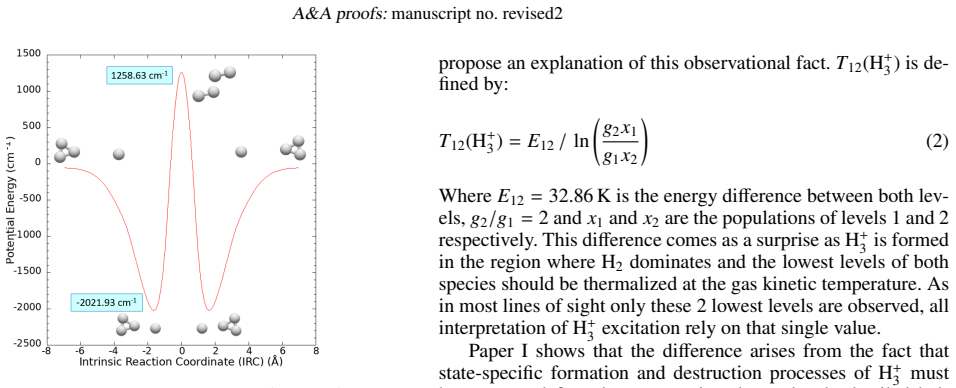
The central object is the state-to-state inelastic rate-coefficient matrix for H3+ + H, built from time-independent close-coupling cross sections solved on a 5000-point radial grid from 1 to 100 bohr, with total angular momentum up to J = 30 and energies from 70 to 2070 cm−1. H3+ is treated as a frozen equilateral symmetric top, but its rotational energies come from full-dimensional hyperspherical-bound-state calculations for the ground vibrational state; the ortho (A2) and para (E) permutation symmetries are handled in separate scattering runs. Transition probabilities are governed by the angular matrix element involving 3-j and 6-j symbols, which yields propensity rules favoring small Δj, Δω, and unchanged sign of ω, and the resulting cross sections are Boltzmann-averaged to obtain rate coefficients. These rates feed the steady-state code ExcitH3+ that computes the population of the two lowest H3+ levels and the resulting T12.
What would settle it
Compare the predicted state-to-state de-excitation rates, for example k(1,0,+) to (3,0,+) and k(1,1,-) to (2,±2,+), at 10-300 K with experimental measurements of rotational relaxation of H3+ in cold ion traps or merged beams; alternatively, rerun the scattering with a full asymmetric-top treatment that includes all omega components for the same potential energy surface and check whether any rate changes by more than the claimed accuracy, since such a change would propagate directly into T12.
Extended reading notes
Core claim
The paper derives state-to-state inelastic rotational excitation and de-excitation rate coefficients for H3+ + H over 10-300 K using a time-independent close-coupling method, describing H3+ as a rigid symmetric top with exact full-dimensional ground-state rovibrational energies and separately treating ortho (A2) and para (E) nuclear-spin symmetries. Compared with the previously used proxy kH = sqrt(2) kpH2, the new H collision rates are stronger, and the ortho and para sets are much closer to each other. When these rates are inserted into the steady-state excitation model of Paper I for HD 110432 and HD 73882, the derived excitation temperature T12(H3+) changes by up to 20%, with the largest changes in the lower molecular fraction cloud. The paper also confirms that the ratio of ortho to para dissociative recombination rates has a significant effect on T12, an effect amplified by the new collision rates.
Load-bearing premise
The paper assumes that H3+ behaves as a rigid symmetric top with a single dominant omega component (weight above 90%) for every ground-vibrational state included in the close-coupling basis, and it does not test how sensitive the computed rates are to omega mixing at higher j.
Editorial extensions
If this is right
- If the new H + H3+ rates are adopted, model predictions of T12(H3+) in low molecular fraction clouds shift by up to 20%, so previous analyses that used the sqrt(2)-scaled H2 proxy should be revisited.
- The delivered rate files provide a consistent set of H3+ + H collisional data for astrochemical codes up to (j,omega) = (7,6) for ortho-H3+ and (6,4) for para-H3+, extending the range of temperatures and states available for modeling.
- The stronger sensitivity to the ortho-to-para dissociative recombination rate ratio means that pinning down ko_DR/kp_DR becomes more important for interpreting H3+ observations.
- Ortho-para conversion through reactive H + H3+ collisions, although estimated to be slower than 10^-12 cm^3 s^-1 below 100 K, may still matter in specific conditions; the paper flags this as a necessary next step.
- Because the new ortho and para H-collision rates are much closer to each other than the proxy, the ortho/para population balance of H3+ is more controlled by state-specific formation and destruction chemistry than by collisions.
Reading between the lines
- Because the new ortho and para H-collision rates are much closer to each other than the previous proxy, collisional processes likely play a smaller role in setting the ortho/para ratio of H3+ in diffuse clouds, so interpreting observed ortho/para ratios should focus on chemical state-to-state processes.
- The crossing of the computed T12 curves as a function of ko_DR/kp_DR offers an observational lever: combining a measured T12 with independent estimates of electron density and molecular fraction could constrain the currently uncertain ortho/para dissociative recombination rate ratio.
- The same close-coupling machinery with the H4+ potential energy surface could be extended to compute state-to-state H3+ + H2 collisional rates including reactive channels, which would remove the need for any scaled-proxy treatment.
- The rigid-rotor single-omega assumption could be tested by rerunning the scattering with full multi-omega wavefunctions for a few high-j states; if the rates change noticeably, the published values for j > 4 would need error bars.
Editorial analysis
A structured set of objections, weighed in public.
Referee Report
Summary. This paper computes state-to-state rotational (de-)excitation rate coefficients for H3+ + H collisions using a time-independent close-coupling method in which H3+ is treated as a rigid symmetric top, on the full-dimensional H4+ potential energy surface of del Mazo-Sevillano et al. (2024). The rates are obtained for the lowest ortho and para levels of H3+, fitted to a three-parameter Arrhenius form (Table 1), and supplied as data files in a format suitable for the Meudon PDR code. The authors then use the ExcitH3+ code to evaluate the excitation temperature T12(H3+) toward two diffuse-cloud lines of sight, replacing the previous H2-based proxy with the new H collision rates. They report differences of up to 20% in T12 relative to the proxy, with the impact increasing as the molecular fraction decreases, and confirm the sensitivity of T12 to the ortho/para dissociative-recombination ratio.
Significance. If the rates are robust, the paper fills a real gap: state-specific H3+ + H inelastic collision rates have been unavailable, and the new data are directly usable in PDR codes. The use of a recent full-dimensional PES, the standard close-coupling treatment, and the public delivery of fitted rates and energy levels are strengths. The claimed 20% effect on T12 and the increased influence at low molecular fraction are observationally relevant and falsifiable with improved data. However, the reliability of the rates depends on the unquantified rigid-rotor single-omega approximation for the higher j states included here, and on the unstated convergence of the channel truncation; these issues need to be addressed before the numerical rates can be taken at face value.
major comments (3)
- [Appendix A.1, Section 2, Eq. (B.6)] The rigid-rotor symmetric-top approximation is justified in Appendix A.1 by the statement that for the ground vibrational state and low j there is a dominant omega component with weight larger than 90%, but the scattering calculation includes levels up to (7,6,+) and (6,4,+) (Fig. 2 and Table 1). The omega decomposition is not reported for these higher-j states, and no sensitivity test is provided. Since the potential coupling in Eq. (B.6) depends on omega through the 3-j symbol, a state that is a significant mixture of omega components would couple with different strength than the pure symmetric-top state used in the calculation. I request the authors to give the omega weight distribution for every channel included in the close-coupling calculation and to test at least representative endothermic transitions (e.g., from (1,0,+) to (7,6,+) and from (1,±1,-) to (6,±4,+)) against a calculation that retains the exact rovibrational eigenfunction or the two dominant omega components.
- [Section 2, channel truncation (near Fig. 2)] The truncation of channels with j>6 in the E representation to ℓ≤J+j/2 is stated to have a small net effect on the final rate constants, but no quantitative convergence test is presented. This is load-bearing because the rates in Table 1 are the basis for the 20% T12 claim. I ask for a convergence test that varies the ℓ cutoff for a representative set of transitions, or otherwise provides an error estimate for each fitted rate coefficient.
- [Section 3, Fig. 7 and Conclusions] The central numerical claim, that the new rates change T12 by up to 20%, rests on two lines of sight and on rates with no quoted numerical uncertainty. The absence of error bars makes it difficult to judge whether the differences from the proxy are significant relative to the uncertainties in the collision calculation itself. Please propagate the uncertainties from the basis truncation and the rigid-rotor approximation into T12, or at least quantify the numerical convergence of the rates used in Fig. 7.
minor comments (6)
- [Abstract / body] The notation (J;K;±) used in the abstract should be reconciled with (j,ω,pt) used throughout the body.
- [Table 1, header] The header '(1,± ,-)' is typographically incomplete; it should read '(1,±1,-)'.
- [Section 2 / Data availability] The paper states that the rate files are provided in the S.I. and in the format required by the Meudon PDR code, but gives no documentation of the file format; a short README would make the data reproducible.
- [Throughout] There are numerous typos and inconsistent abbreviations (e.g., 'di ffuse', 'circunstance', 'inaffordable', 'Kokoouline et-al.', 'AstroPhys.'); a careful language and reference pass is needed.
- [Appendix A.1] The sentence 'for (0,0^0) and low triatomic angular momenta j there is a dominant omega value' should state explicitly the maximum j for which the 90% weight has been verified.
- [Section 2] Because the rates rely on a single PES from the same group, a brief comparison with earlier H3+ - H surfaces or with measured low-energy collisional data (if any) would help the reader calibrate the systematic uncertainty.
Circularity Check
No circular derivation: the new H3+ + H rates are computed from a prior PES and only later compared with T12 observations; no fitted input is renamed as a prediction.
full rationale
The derivation chain is not circular. The state-to-state H3+ + H rate coefficients are obtained by time-independent close-coupling on the del Mazo-Sevillano et al. (2024) PES; that PES is prior work by overlapping authors but is not fitted to the target observable (the H3+ excitation temperature), so the citation is independent support rather than a load-bearing self-reference. The only numerical fits in the paper (Table 1) are Arrhenius fits to the computed rate constants, not fits to T12 data, so the subsequent T12 comparison is a genuine prediction. The proxy comparison (kH = sqrt(2) kpH2, Gomez-Carrasco et al. 2012) is an external benchmark, and the reported 20% difference is not forced by construction. The acknowledged rigid-rotor single-omega approximation (Appendix A.1) is an unvalidated modeling assumption that could affect accuracy, but it does not reduce the result to its inputs; it is a correctness/robustness caveat, not circularity. Similarly, the confirmation of Paper I's destruction-reaction impact is a consistency check using the same model, not a circular derivation of the new rates.
Assumptions & free parameters
free parameters (1)
- Arrhenius fit parameters (alpha, beta, gamma) for each transition =
Various, see Table 1
assumptions (4)
- domain assumption The full-dimensional neural network PES of del Mazo-Sevillano et al. (2024) accurately describes the H+H3+ interaction at the energies and geometries sampled.
- domain assumption H3+ can be treated as a rigid symmetric top with a single dominant omega component (weight >90%) for the ground vibrational states included.
- ad hoc to paper Truncation of channels (levels above j=6 in the E representation, and l <= J + j/2) has a negligible effect on the rate coefficients.
- domain assumption Max total angular momentum J=30 and the radial grid of 5000 points from 1 to 100 bohr are sufficient for convergence.
Cite this review
Pith. "Pith review of Inelastic H + H$^+_3$ Collision rates and their impact in the determination of the excitation temperature of H$^+_3$." pith.science (2026). https://pith.science/paper/D7ARDVK3
@misc{pith2026241206697,
  author       = {Pith},
  title        = {Pith review of: Inelastic H + H$^+_3$ Collision rates and their impact in the determination of the excitation temperature of H$^+_3$},
  year         = {2026},
  howpublished = {\url{https://pith.science/paper/D7ARDVK3}},
  note         = {Machine review of arXiv:2412.06697}
}
abstract
Context. In dffuse interstellar clouds the excitation temperature derived from the lowest levels of H$^+_3$ is systematically lower than that derived from H2. The differences may be attributed to the lack of state-specific formation and destruction rates of H$^+_3$ needed to thermalize the two species. Aims. In this work, we want to check the role of rotational excitation collisions of H$^+_3$ with atomic hydrogen on its excitation temperature. Methods. A time independent close-coupling method is used to calculate the state-to-state rate coefficients, using a very accurate and full dimensional potential energy surface recently developed for H$^+_4$. A symmetric top approach is used to describe a frozen H$^+_3$ as equilateral triangle. Results. Rotational excitation collision rate coefficients of H$^+_3$ with atomic Hydrogen have been derived in a temperature range appropriate to diffuse interstellar conditions up to $(J; K; \pm) = (7; 6; +)$ and $(J; K; \pm) = (6; 4; +)$ for its ortho and para forms. This allows to have a consistent set of collisional excitation rate coefficients and to improve the previous study where these contributions were speculated. Conclusions. The new state-specific inelastic H$^+_3$ + H rate coeffcients yield differences up to 20% in the excitation temperature, and their impact increases with decreasing molecular fraction. We also confirm the impact of chemical state-to-state destruction reactions in the excitation balance of H$^+_3$ , and that reactive H + H$^+_3$ collisions are also needed to account for possible further ortho to para transitions
Figures


Figures from the paper (2 more)


Reference graph
Works this paper leans on
-
[1]
Abramowitz, M. & Stegun, I. 1972, Handbook of mathematical functions (Dover Publications, Inc., New York)
work page 1972
-
[2]
Aguado, A., Barragan, P., Prosmiti, R., et al. 2010, J. Chem. Phys., 133, 024306
work page 2010
-
[3]
Aguado, A., Roncero, O., Tablero, C., Sanz, C., & Paniagua, M. 2000, J. Chem. Phys., 112, 1240
work page 2000
-
[4]
Arthurs , A. M. & Dalgarno , A. 1960, Proc. R. Soc. Lond. A Math. Phys. Sci., 256, 540
work page 1960
-
[5]
A., Cencek, W., Jaquet, R., & Komasa, J
Bachorz, R. A., Cencek, W., Jaquet, R., & Komasa, J. 2009, The Journal of chemical physics, 131, 024105
work page 2009
- [6]
-
[7]
P., Hillenbrand, P.-M., Li\'evan, J., Savin, D
Bowen, K. P., Hillenbrand, P.-M., Li\'evan, J., Savin, D. W., & Urbain, X. 2021, J. Chem. Phys., 154, 084307
work page 2021
-
[8]
Bulut, N., Aguado, A., Sanz-Sanz, C., & Roncero, O. 2019, J. Phys. Chem. A, 123, 8766
work page 2019
Show all 67 references
-
[9]
Cencek, W., Rychlewski, J., Jaquet, R., & Kutzelnigg, W. 1998, J. Chem. Phys., 108, 2831
1998
-
[10]
& Willoughby, R
Cullum, J. & Willoughby, R. 1985, Lanczos Algorithms for Large Symmetric Eigenvalues Computations (Birkh \"a user, Boston)
1985
-
[11]
2024, Mol
del Mazo-Sevillano, P., F \'e lix-Gonz \'a lez, D., Aguado, A., et al. 2024, Mol. Phys., e2183071
2024
-
[12]
2024, A&A, 685, A82
Edenhofer , G., Zucker , C., Frank , P., et al. 2024, A&A, 685, A82
2024
-
[13]
1985, Numerical Mathematics: Theory and Computer Applications (The Benjamin/Cummings Publishing Company)
Fr\"oberg, C.-E. 1985, Numerical Mathematics: Theory and Computer Applications (The Benjamin/Cummings Publishing Company)
1985
-
[14]
Furtenbacher, T., Szidarovsky, T., Matyus, E., Fabri, C., & Csaszar, A. G. 2013, Journal of Chemical Theory and Computation, 9, 5471
2013
-
[15]
X., Berriche, H., Roncero, O., Villarreal, P., & Delgado-Barrio, G
Gad \'e a, F. X., Berriche, H., Roncero, O., Villarreal, P., & Delgado-Barrio, G. 1997, J. Chem. Phys., 107, 10515
1997
-
[16]
R., McCall, B
Geballe, T. R., McCall, B. J., Hinkle, K. H., & Oka, T. 1999, AstroPhys. J., 510, 251
1999
-
[17]
Geballe, T. R. & Oka, T. 1989, AstroPhys. J., 342, 855
1989
-
[18]
Rou c ka, et al
Gerlich, D., Jusko, P., S . Rou c ka, et al. 2012, Ap. J., 749, 22
2012
-
[19]
Ghosh, S., Mukherjee, S., Mukherjee, B., et al. 2017, J. Chem. Phys., 147, 074105
2017
-
[20]
G\'omez-Carrasco, S., Gonz\'alez-S\'anchez, L., Aguado, A., Zanchet, A., & Roncero, O. 2012, J. Chem. Phys., 137, 094303
2012
-
[21]
Green , S. 1976, J. Chem. Phys., 64, 3463
1976
-
[22]
Green , S. 1980, J. Chem. Phys., 73, 2740
1980
-
[23]
2000, Phil
Herbst, E. 2000, Phil. Trans. R. Soc. Lond. A, 358, 2523
2000
-
[24]
& Klemperer, W
Herbst, E. & Klemperer, W. 1973, Astrophys. J., 185, 505
1973
-
[25]
P., Li \'e vin , J., Urbain , X., & Savin , D
Hillenbrand , P.-M., Bowen , K. P., Li \'e vin , J., Urbain , X., & Savin , D. W. 2019, Astrophys. J., 877, 38
2019
-
[26]
Hugo, E., Asvany, O., & Schlemmer, S. 2009, J. Chem. Phys., 130, 164302
2009
-
[27]
& McCall , B
Indriolo , N. & McCall , B. J. 2012, ApJ, 745, 91
2012
-
[28]
Jaquet, R., Cencek, W., Kutzelnigg, W., & Rychlewski, J. 1998, J. Chem. Phys., 108, 2837
1998
-
[29]
Kokoouline, V., Faure, A., Tennyson, J., Greene, C. H. 2010, MNRAS, 405, 1195
2010
-
[30]
2024, Molecular Physics, 122, e2182612
Le Bourlot , J., Roueff , E., Le Petit , F., et al. 2024, Molecular Physics, 122, e2182612
2024
-
[31]
2006, , 164, 506
Le Petit , F., Nehm \'e , C., Le Bourlot , J., & Roueff , E. 2006, , 164, 506
2006
-
[32]
2004, , 417, 993
Le Petit , F., Roueff , E., & Herbst , E. 2004, , 417, 993
2004
-
[33]
2016, Astron
Le Petit , F., Ruaud , M., Bron , E., et al. 2016, Astron. Astrophysics., 585, A105
2016
-
[34]
J., Geballe, T
McCall, B. J., Geballe, T. R., Hinkle, K. H., & Oka, T. 1999, AstroPhys. J., 522, 338
1999
-
[35]
McCall, B. J. & Oka, T. 2000, Science, 287, 1941
2000
-
[36]
J., Bernett, A., & Herbst, E
Millar, T. J., Bernett, A., & Herbst, E. 1989, Astrophys. J., 340, 906
1989
-
[37]
R., & Stallard, T
Miller, S., Tennyson, J., Geballe, T. R., & Stallard, T. 2020, Rev. Mod. Phys., 92, 035003
2020
-
[38]
I., Polyansky, O
Mizus, I. I., Polyansky, O. L., McKemmish, L. K., et al. 2018, Molecular Physics, 117, 1663
2018
-
[39]
V., Silsbee , K., et al
Obolentseva , M., Ivlev , A. V., Silsbee , K., et al. 2024, arXiv e-prints, arXiv:2408.11511
2024 arXiv
-
[40]
1980, Phys
Oka, T. 1980, Phys. Rev. Lett., 45, 531
1980
-
[41]
Oka, T. 2004, J. Mol. Spectros., 228, 635
2004
-
[42]
2006, PNAS, 103, 12235
Oka, T. 2006, PNAS, 103, 12235
2006
-
[43]
2012, Phil
Oka, T. 2012, Phil. Trans. R. Soc. A, 370, 4991
2012
-
[44]
2013, Chem
Oka, T. 2013, Chem. Rev., 113, 8738
2013
-
[45]
& Epp, E
Oka, T. & Epp, E. 2004, Astrophys. J., 613, 349
2004
-
[46]
Pack, R. T. & Parker, G. A. 1989, J. Chem. Phys., 90, 3511
1989
-
[47]
2011, Astrophys
Pagani , L., Roueff , E., & Lesaffre , P. 2011, Astrophys. J. Lett., 739, L35
2011
-
[48]
1992, Astron
Pagani, L., Salez, M., & Wannier, P. 1992, Astron. Astrophys., 258, 479
1992
-
[49]
2009, Astronomy and Astrophys., 494, 623
Pagani, L., Vastel, C., Hugo, E., et al. 2009, Astronomy and Astrophys., 494, 623
2009
-
[50]
& Light, J
Park, K. & Light, J. C. 2007, J. Chem. Phys., 126, 044305
2007
-
[51]
2012, J Chem Phys , 136, 184303
Pavanello, M., Adamowicz, L., Alijah, A., et al. 2012, J Chem Phys , 136, 184303
2012
-
[52]
2024, , 689, L12
Pereira-Santaella , M., Gonz \'a lez-Alfonso , E., Garc \' a-Bernete , I., et al. 2024, , 689, L12
2024
-
[53]
L., Alijah, A., Zobov, N
Polyansky, O. L., Alijah, A., Zobov, N. F., et al. 2012, Philos Trans A Math Phys Eng Sci , 370, 5014
2012
-
[54]
1994, The Journal of chemical physics, 101, 2231
R \"o hse, R., Kutzelnigg, W., Jaquet, R., & Klopper, W. 1994, The Journal of chemical physics, 101, 2231
1994
-
[55]
Sanz, C., Roncero, O., Tablero, C., Aguado, A., & Paniagua, M. 2001, J. Chem. Phys., 114, 2182
2001
-
[56]
Sanz-Sanz, C., Aguado, A., Roncero, O., & Naumkin, F. 2015, J. Chem. Phys., 143, 234303
2015
-
[57]
Sanz-Sanz, C., Roncero, O., Paniagua, M., & Aguado, A. 2013, J. Chem. Phys., 139, 184302
2013
-
[58]
2012, Phil
Special issue . 2012, Phil. Trans. R. Soc. A, 370
2012
-
[59]
2019, Phil
Special issue . 2019, Phil. Trans. R. Soc. A, 377
2019
-
[60]
1995, Rep
Tennyson, J. 1995, Rep. Prog. Phys., 58, 412
1995
-
[61]
L., Zobov, N
Tennyson, J., Polyansky, O. L., Zobov, N. F., Alijah, A., & Császár, A. G. 2017, J. Phys. B: At. Mol. Opt. Phys., 50, 232001
2017
-
[62]
A., & Paniagua, M
Velilla, L., Lepetit, B., Aguado, A., Beswick, J. A., & Paniagua, M. 2008, J. Chem. Phys., 129, 084307
2008
-
[63]
2010, International Journal of Quantum Chemistry, 111, 387
Velilla, L., Paniagua, M., & Aguado, A. 2010, International Journal of Quantum Chemistry, 111, 387
2010
-
[64]
P., Alijah, A., & Varandas, A
Viegas, L. P., Alijah, A., & Varandas, A. J. C. 2007, J Chem Phys , 126, 074309
2007
-
[65]
Watson, J. 1984, J. Mole. Spect., 103, 350
1984
-
[66]
Watson, W. D. 1973, Astrophys. J., 183, L17
1973
-
[67]
1988, Angular Momentum (John Wiley and Sons, Inc.)
Zare, R. 1988, Angular Momentum (John Wiley and Sons, Inc.)
1988
Reviewed August 11, 2026 · model on record in the stance chip above.
Discussion (0). Continue with ORCID to comment.