Weak Lensing with SKAO: Cosmic Shear Cosmology
Pith reviewed 2026-06-25 20:42 UTC · model grok-4.3
The pith
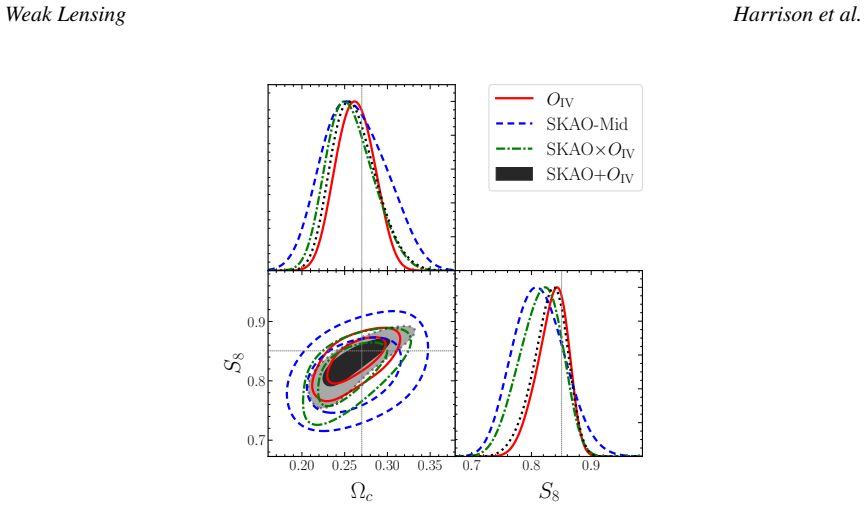
SKAO radio surveys can measure the S8 structure formation parameter to 5% precision alone and 3% when combined with optical surveys.
A machine-rendered reading of the paper's core claim, the machinery that carries it, and where it could break.
Core claim
Surveys with the AA4 configuration of the SKAO will measure the growth of structure on large scales through the weak gravitational lensing effect on the shapes of resolved high-redshift star-forming galaxies in Band 2, delivering 5% constraints on the S8 parameter alone and 3% in full combination with either LSST or Euclid, while radio polarization and kinematics enable cleaner separation of lensing from intrinsic shapes.
What carries the argument
Cosmic shear measured from weak gravitational lensing distortions to the shapes of radio star-forming galaxies, with polarization and kinematics used to isolate the lensing signal.
If this is right
- SKAO measurements supply an independent test of optical weak lensing results because they respond differently to instrumental and astrophysical systematics.
- Polarization and kinematic data allow separation of lensing from intrinsic alignments, increasing statistical power by factors of approximately 5 to 10.
- Joint analyses with LSST or Euclid tighten S8 constraints to 3% while cross-checking robustness.
- Radio surveys add unique information on galaxy samples that can refine models of star-forming populations at high redshift.
Where Pith is reading between the lines
- Successful radio shape measurements could extend weak lensing constraints to redshift ranges where optical surveys lose sensitivity.
- The distinct radio systematics might help isolate whether current S8 tensions arise from astrophysical effects common to optical data.
- Polarization-based intrinsic alignment removal could become a standard technique for reducing one of the dominant uncertainties in future lensing surveys.
Load-bearing premise
High-fidelity reconstruction of galaxy shapes from the radio observations is possible.
What would settle it
An end-to-end simulation or early SKAO data analysis showing that shape measurement errors exceed the level needed to reach the forecasted 5% precision on S8 would falsify the central claim.
Figures
read the original abstract
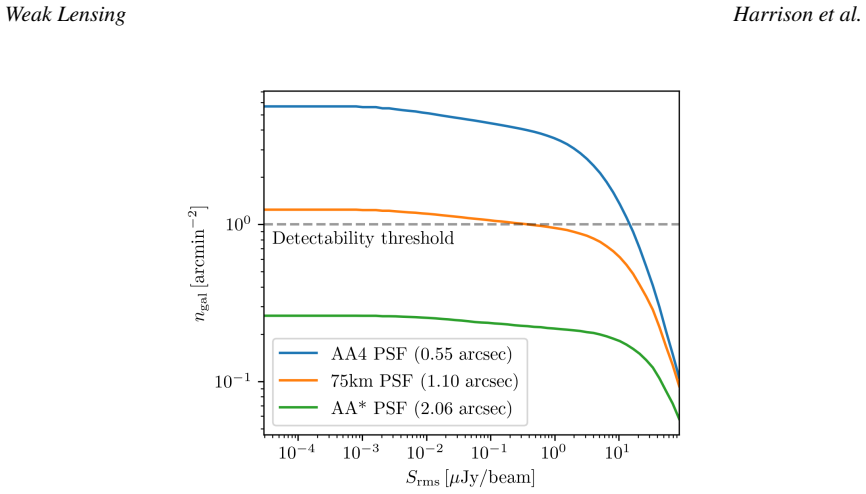
We discuss the power of weak gravitational lensing surveys with the SKAO in constraining cosmological parameters and the properties of radio star-forming galaxy samples. As well as reviewing progress to date on cosmic shear in radio experiments, we show forecasts for parameter constraints using the Mid telescope both alone and in cross-correlation with contemporaneous optical surveys. By selecting a sample of resolved, high-redshift star-forming galaxies in Band 2, surveys with the AA4 configuration will be capable of measuring the growth of structure on large scales in the Universe through the effect of weak gravitational lensing on their shapes. Assuming the high fidelity reconstruction of such galaxy shapes to be possible, we find that SKAO will measure the $S_8$ structure formation parameter to a level of $5\%$ alone and $3\%$ in full combination with either LSST or the \emph{Euclid} satellite. These measurements will be highly important due to their radically different sensitivities to key weak lensing systematics, both instrumental and astrophysical, and as such provide a vital robustness test to a pillar of modern cosmological measurements. Radio surveys also provide unique and potentially game-changing information in the form of polarisation and galaxy kinematics, which allow the cleaner separation of lensing from intrinsic galaxy shapes and can increase statistical power by factors $\sim5$-$10$.
Editorial analysis
A structured set of objections, weighed in public.
Referee Report
Summary. The manuscript forecasts the cosmological constraining power of weak gravitational lensing (cosmic shear) measurements with the SKA Observatory Mid telescope. By selecting resolved high-redshift star-forming galaxies in Band 2 under the AA4 configuration, and assuming high-fidelity shape reconstruction is possible, it predicts that SKAO alone will constrain the structure-growth parameter S8 to 5% precision and to 3% when combined with LSST or Euclid. The work reviews prior radio weak-lensing efforts, emphasizes the orthogonal systematics relative to optical surveys, and highlights the potential of polarization and kinematic information to separate lensing from intrinsic alignments, increasing statistical power by factors of ~5-10.
Significance. If the forecasts are realized, the results would supply an independent radio-based probe of structure growth whose instrumental and astrophysical systematics differ markedly from those of LSST and Euclid, thereby providing a valuable robustness test for weak-lensing cosmology. The explicit incorporation of radio-specific observables (polarization, kinematics) is a distinctive strength that could materially improve intrinsic-alignment mitigation.
minor comments (2)
- Abstract: the quantitative forecasts (5% and 3% on S8) are presented without reference to the specific Fisher-matrix or simulation pipeline used to obtain them; a brief pointer to the relevant section or equation would improve traceability.
- Abstract, final sentence: the factor '~5-10' gain from polarization/kinematics is stated without an accompanying citation or derivation; adding a reference to the calculation would strengthen the claim.
Simulated Author's Rebuttal
We thank the referee for their positive summary, recognition of the work's significance, and recommendation for minor revision. No major comments were raised in the report.
Circularity Check
No significant circularity; forecasts are conditional projections
full rationale
The paper presents standard cosmological forecasts for SKAO weak lensing surveys under an explicit upfront assumption of high-fidelity galaxy shape reconstruction. No derivation chain, equations, or self-citations are exhibited in the provided text that reduce any claimed prediction (e.g., 5% or 3% S8 precision) to fitted inputs or prior results by construction. The central results are framed as conditional projections with orthogonal systematics, not as first-principles derivations equivalent to their inputs. This is the normal case for forecast papers and scores as self-contained.
Axiom & Free-Parameter Ledger
Reference graph
Works this paper leans on
-
[1]
arXiv , author =:1910.09273 , journal =
Blanchard, A. and others. Euclid preparation. VII. Forecast validation for Euclid cosmological probes. Astron. Astrophys. 2020. doi:10.1051/0004-6361/202038071. arXiv:1910.09273
-
[2]
Anticipated Performance of the Square Kilometre Array -- Phase 1 (SKA1). arXiv e-prints , keywords =. doi:10.48550/arXiv.1912.12699 , archivePrefix =. 1912.12699 , primaryClass =
-
[3]
Cosmological constraints from the convergence 1-point probability distribution
Patton, Kenneth and Blazek, Jonathan and Honscheid, Klaus and Huff, Eric and Melchior, Peter and Ross, Ashley J. and Suchyta, Eric. Cosmological constraints from the convergence 1-point probability distribution. Mon. Not. Roy. Astron. Soc. 2017. doi:10.1093/mnras/stx1626. arXiv:1611.01486
work page internal anchor Pith review Pith/arXiv arXiv doi:10.1093/mnras/stx1626 2017
-
[4]
Bye binormal: analysing the joint PDF of galaxy density and weak lensing convergence
Friedrich, Oliver and Castiblanco, Lina and Halder, Anik and Uhlemann, Cora. Bye binormal: analysing the joint PDF of galaxy density and weak lensing convergence. Mon. Not. Roy. Astron. Soc. 2026. doi:10.1093/mnras/staf2181. arXiv:2507.16957
-
[5]
Armijo, Joaquin and Marques, Gabriela A. and Novaes, Camila P. and Thiele, Leander and Cowell, Jessica A. and Grand \'o n, Daniela and Shirasaki, Masato and Liu, Jia. Cosmological constraints using Minkowski functionals from the first year data of the Hyper Suprime-Cam. Mon. Not. Roy. Astron. Soc. 2025. doi:10.1093/mnras/staf257. arXiv:2410.00401
-
[6]
KiDS-1000 and DES-Y1 combined: cosmology from peak count statistics
Harnois-Deraps, Joachim and others. KiDS-1000 and DES-Y1 combined: cosmology from peak count statistics. Mon. Not. Roy. Astron. Soc. 2024. doi:10.1093/mnras/stae2249. arXiv:2405.10312
-
[7]
Lifting weak lensing degeneracies with a field-based likelihood
Porqueres, Natalia and Heavens, Alan and Mortlock, Daniel and Lavaux, Guilhem. Lifting weak lensing degeneracies with a field-based likelihood. Mon. Not. Roy. Astron. Soc. 2021. doi:10.1093/mnras/stab3234. arXiv:2108.04825
-
[8]
Towards a full wCDM map-based analysis for weak lensing surveys
Z. Towards a full wCDM map-based analysis for weak lensing surveys. Mon. Not. Roy. Astron. Soc. 2023. doi:10.1093/mnras/stad2212. arXiv:2206.01450
-
[9]
Ajani, V. and Baldi, M. and Barthelemy, A. and Boyle, A. and Burger, P. and Cardone, V. F. and Cheng, S. and Codis, S. and Giocoli, C. and Harnois-Déraps, J. and Heydenreich, S. and Kansal, V. and Kilbinger, M. and Linke, L. and Llinares, C. and Martinet, N. and Parroni, C. and Peel, A. and Pires, S. and Porth, L. and Tereno, I. and Uhlemann, C. and Vicin...
-
[10]
Nuw CDM cosmology from the weak-lensing convergence PDF , volume=
Boyle, Aoife and Uhlemann, Cora and Friedrich, Oliver and Barthelemy, Alexandre and Codis, Sandrine and Bernardeau, Francis and Giocoli, Carlo and Baldi, Marco , year=. Nuw CDM cosmology from the weak-lensing convergence PDF , volume=. Monthly Notices of the Royal Astronomical Society , publisher=. doi:10.1093/mnras/stab1381 , number=
-
[11]
Unleashing cosmic shear information with the tomographic weak lensing PDF , volume=
Castiblanco, Lina and Uhlemann, Cora and Harnois-Déraps, Joachim and Barthelemy, Alexandre , year=. Unleashing cosmic shear information with the tomographic weak lensing PDF , volume=. doi:10.33232/001c.121302 , journal=
-
[12]
Friedrich, O. and others. Density Split Statistics: Joint Model of Counts and Lensing in Cells. Phys. Rev. D. 2018. doi:10.1103/PhysRevD.98.023508. arXiv:1710.05162
-
[13]
Marques, Gabriela A. and Liu, Jia and Shirasaki, Masato and Thiele, Leander and Grand \'o n, Daniela and Huffenberger, Kevin M. and Cheng, Sihao and Harnois-D \'e raps, Joachim and Osato, Ken and Coulton, William R. Cosmology from weak lensing peaks and minima with Subaru Hyper Suprime-Cam Survey first-year data. Mon. Not. Roy. Astron. Soc. 2024. doi:10.1...
-
[14]
Foreman-Mackey, Daniel and Hogg, David W. and Lang, Dustin and Goodman, Jonathan. emcee: The MCMC Hammer. Publ. Astron. Soc. Pac. 2013. doi:10.1086/670067. arXiv:1202.3665
work page internal anchor Pith review Pith/arXiv arXiv doi:10.1086/670067 2013
-
[15]
E., Alonso, D., Krause, E., et al
Chisari, Nora Elisa and others. Core Cosmology Library: Precision Cosmological Predictions for LSST. Astrophys. J. Suppl. 2019. doi:10.3847/1538-4365/ab1658. arXiv:1812.05995
-
[16]
SBi3PCF: simulation-based inference with the integrated 3PCF
Gebauer, David and Halder, Anik and Seitz, Stella and Anbajagane, Dhayaa. SBi3PCF: simulation-based inference with the integrated 3PCF. JCAP. 2026. doi:10.1088/1475-7516/2026/06/036. arXiv:2510.13805
-
[17]
The integrated three-point correlation function of cosmic shear
Halder, Anik and Friedrich, Oliver and Seitz, Stella and Varga, Tamas N. The integrated three-point correlation function of cosmic shear. Mon. Not. Roy. Astron. Soc. 2021. doi:10.1093/mnras/stab1801. arXiv:2102.10177
-
[18]
Gong, Zhengyangguang and Halder, Anik and Barreira, Alexandre and Seitz, Stella and Friedrich, Oliver. Cosmology from the integrated shear 3-point correlation function: simulated likelihood analyses with machine-learning emulators. JCAP. 2023. doi:10.1088/1475-7516/2023/07/040. arXiv:2304.01187
-
[19]
A roadmap to cosmological parameter analysis with third-order shear statistics - I
Heydenreich, Sven and Linke, Laila and Burger, Pierre and Schneider, Peter. A roadmap to cosmological parameter analysis with third-order shear statistics - I. Modelling and validation. Astron. Astrophys. 2023. doi:10.1051/0004-6361/202244820. arXiv:2208.11686
-
[20]
Burger, Pierre A. and others. KiDS-1000 cosmology: Combined second- and third-order shear statistics. Astron. Astrophys. 2024. doi:10.1051/0004-6361/202347986. arXiv:2309.08602
-
[21]
Gatti, M. and others. Dark Energy Survey Year 3 results: Simulation-based cosmological inference with wavelet harmonics, scattering transforms, and moments of weak lensing mass maps. II. cosmological results. Phys. Rev. D. 2025. doi:10.1103/PhysRevD.111.063504. arXiv:2405.10881
-
[22]
Enhancing cosmic shear with the multiscale lensing probability density function
Giblin, Benjamin and Cai, Yan-Chuan and Harnois-D \'e raps, Joachim. Enhancing cosmic shear with the multiscale lensing probability density function. Mon. Not. Roy. Astron. Soc. 2023. doi:10.1093/mnras/stad230. arXiv:2211.05708
-
[23]
Burger, Pierre A. and Friedrich, Oliver and Harnois-Déraps, Joachim and Schneider, Peter and Asgari, Marika and Bilicki, Maciej and Hildebrandt, Hendrik and Wright, Angus H. and Castro, Tiago and Dolag, Klaus and Heymans, Catherine and Joachimi, Benjamin and Kuijken, Konrad and Martinet, Nicolas and Shan, HuanYuan and Tröster, Tilman , year=. KiDS-1000 co...
-
[24]
Gruen, D. and others. Density Split Statistics: Cosmological Constraints from Counts and Lensing in Cells in DES Y1 and SDSS Data. Phys. Rev. D. 2018. doi:10.1103/PhysRevD.98.023507. arXiv:1710.05045
work page internal anchor Pith review Pith/arXiv arXiv doi:10.1103/physrevd.98.023507 2018
-
[25]
Probability distribution function of the aperture mass field with large deviation theory , volume=
Barthelemy, Alexandre and Codis, Sandrine and Bernardeau, Francis , year=. Probability distribution function of the aperture mass field with large deviation theory , volume=. Monthly Notices of the Royal Astronomical Society , publisher=. doi:10.1093/mnras/stab818 , number=
-
[26]
2015 , publisher=
Advancing Astrophysics with the Square Kilometre Array (AASKA14) , author=. 2015 , publisher=
2015
-
[27]
SKA Weak Lensing I: Cosmological Forecasts and the Power of Radio-Optical Cross-Correlations
Harrison, Ian and Camera, Stefano and Zuntz, Joe and Brown, Michael L. SKA weak lensing I. Cosmological forecasts and the power of radio-optical cross-correlations. Mon. Not. Roy. Astron. Soc. 2016. doi:10.1093/mnras/stw2082. arXiv:1601.03947
work page internal anchor Pith review Pith/arXiv arXiv doi:10.1093/mnras/stw2082 2016
-
[28]
Polarization-shape alignment of IllustrisTNG star-forming galaxies
Zhou, Rui and Dai, Liang and Huang, Junwu and Yin, Weichen Winston and Ferraro, Simone. Polarization-shape alignment of IllustrisTNG star-forming galaxies. JCAP. 2025. doi:10.1088/1475-7516/2025/11/051. arXiv:2507.06106
-
[29]
Prospects for radio weak lensing - Studies using LOFAR observations in the ELAIS-N1 field
Liu, Jinyi and van Weeren, Reinout and Rottgering, Huub and Kuijken, Konrad. Prospects for radio weak lensing - Studies using LOFAR observations in the ELAIS-N1 field. Astron. Astrophys. 2025. doi:10.1051/0004-6361/202554446. arXiv:2506.20845
-
[30]
Cosmology and source redshift distributions from combining radio weak lensing with CMB lensing
Kalaja, Alba and Harrison, Ian and Coulton, William R. Cosmology and source redshift distributions from combining radio weak lensing with CMB lensing. JCAP. 2025. doi:10.1088/1475-7516/2025/07/001. arXiv:2412.14713
-
[31]
Three-dimensional weak gravitational lensing of the 21-cm radiation background
Lozano Torres, Jose Agustin and Schaefer, Bjoern Malte. Three-dimensional weak gravitational lensing of the 21-cm radiation background. Mon. Not. Roy. Astron. Soc. 2022. doi:10.1093/mnras/stac796. arXiv:2205.03713
-
[32]
Radio Weak Lensing Shear Measurement in the Visibility Domain - I. Methodology
Rivi, Marzia and Miller, Lance and Makhathini, Sphesihle and Abdalla, Filipe Batoni. Radio weak lensing shear measurement in the visibility domain I. Methodology. Mon. Not. Roy. Astron. Soc. 2016. doi:10.1093/mnras/stw2041. arXiv:1603.04784
work page internal anchor Pith review Pith/arXiv arXiv doi:10.1093/mnras/stw2041 2016
-
[33]
RadioLensfit: An HPC tool for accurate galaxy shape measurement with SKA
Rivi, Marzia and Miller, Lance. RadioLensfit: An HPC tool for accurate galaxy shape measurement with SKA. Astron. Comput. 2022. doi:10.1016/j.ascom.2022.100574. arXiv:2203.14071
-
[34]
Radio Galaxy Shape Measurement with Hamiltonian Monte Carlo in the Visibility Domain
Rivi, M. and Lochner, M. and Balan, S. T. and Harrison, I. and Abdalla, F. B. Radio Galaxy Shape Measurement with Hamiltonian Monte Carlo in the Visibility Domain. Mon. Not. Roy. Astron. Soc. 2019. doi:10.1093/mnras/sty2700. arXiv:1805.06799
work page internal anchor Pith review Pith/arXiv arXiv doi:10.1093/mnras/sty2700 2019
-
[35]
Radio Weak Lensing Shear Measurement in the Visibility Domain - II. Source Extraction
Rivi, Marzia and Miller, Lance. Radio weak lensing shear measurement in the visibility domain II. Source extraction. Mon. Not. Roy. Astron. Soc. 2018. doi:10.1093/mnras/sty371. arXiv:1709.01827
work page internal anchor Pith review Pith/arXiv arXiv doi:10.1093/mnras/sty371 2018
-
[36]
Weak gravitational lensing with CO galaxies
Bull, Philip and Harrison, Ian and Huff, Eric. Weak gravitational lensing with CO galaxies. ASP Conf. Ser. 2018. arXiv:1806.08339
Pith/arXiv arXiv 2018
-
[37]
Weak Lensing Simulations for the SKA
Weak Lensing Simulations for the SKA. Advancing Astrophysics with the Square Kilometre Array (AASKA14) , year = 2015, month = apr, eid =. doi:10.22323/1.215.0030 , archivePrefix =. 1501.03892 , primaryClass =
work page internal anchor Pith review Pith/arXiv arXiv doi:10.22323/1.215.0030 2015
-
[38]
Kamionkowski, Marc and Babul, Arif and Cress, Catherine M. and Refregier, Alexandre. Theory and statistics of weak lensing from large scale mass inhomogeneities. Mon. Not. Roy. Astron. Soc. 1998. doi:10.1046/j.1365-8711.1998.02054.x. arXiv:astro-ph/9712030
-
[39]
Cosmology with the Square Kilometre Array
Blake, Chris A. and Abdalla, Filipe B. and Bridle, Sarah L. and Rawlings, Steve. Cosmology with the Square Kilometre Array. New Astron. Rev. 2004. doi:10.1016/j.newar.2004.09.045. arXiv:astro-ph/0409278
work page internal anchor Pith review Pith/arXiv arXiv doi:10.1016/j.newar.2004.09.045 2004
-
[40]
The super cluster assisted shear survey: Project overview and data release 1
SuperCLASS - I. The super cluster assisted shear survey: Project overview and data release 1. Mon. Not. Roy. Astron. Soc. doi:10.1093/mnras/staa709 , archivePrefix =. 2003.01734 , primaryClass =
-
[41]
Peters, Aaron and Brown, Michael L. and Kay, Scott T. and Barnes, David J. Supercluster simulations: impact of baryons on the matter power spectrum and weak lensing forecasts for Super-CLASS. Mon. Not. Roy. Astron. Soc. 2018. doi:10.1093/mnras/stx2780. arXiv:1612.04247
work page internal anchor Pith review Pith/arXiv arXiv doi:10.1093/mnras/stx2780 2018
-
[42]
Hill, Alexander D. and Crain, Robert A. and McCarthy, Ian G. and Brown, Shaun T. Intrinsic alignments of the extended radio continuum emission of galaxies in the EAGLE simulations. Mon. Not. Roy. Astron. Soc. 2022. doi:10.1093/mnras/stac304. arXiv:2201.04644
-
[43]
Wittman, David M. and Tyson, J. Anthony and Kirkman, David and Dell'Antonio, Ian and Bernstein, Gary. Detection of weak gravitational lensing distortions of distant galaxies by cosmic dark matter at large scales. Nature. 2000. doi:10.1038/35012001. arXiv:astro-ph/0003014
work page internal anchor Pith review Pith/arXiv arXiv doi:10.1038/35012001 2000
-
[44]
van Waerbeke, Ludovic and others. Detection of correlated galaxy ellipticities on CFHT data: First evidence for gravitational lensing by large scale structures. Astron. Astrophys. 2000. arXiv:astro-ph/0002500
Pith/arXiv arXiv 2000
-
[45]
Abundance and colour gradients in discs
Bacon, David J. and Refregier, Alexandre R. and Ellis, Richard S. Detection of weak gravitational lensing by large-scale structure. Mon. Not. Roy. Astron. Soc. 2000. doi:10.1046/j.1365-8711.2000.03851.x. arXiv:astro-ph/0003008
-
[46]
Secco, L. F. and Samuroff, S. and others. Dark Energy Survey Year 3 results: Cosmology from cosmic shear and robustness to modeling uncertainty. Phys. Rev. D. 2022. doi:10.1103/PhysRevD.105.023515. arXiv:2105.13544
-
[47]
Efficient Computation of CMB anisotropies in closed FRW models
Lewis, Antony and Challinor, Anthony and Lasenby, Anthony. Efficient computation of CMB anisotropies in closed FRW models. Astrophys. J. 2000. doi:10.1086/309179. arXiv:astro-ph/9911177
work page internal anchor Pith review Pith/arXiv arXiv doi:10.1086/309179 2000
-
[48]
Amon, A. and others. Dark Energy Survey Year 3 results: Cosmology from cosmic shear and robustness to data calibration. Phys. Rev. D. 2022. doi:10.1103/PhysRevD.105.023514. arXiv:2105.13543
-
[49]
KiDS-Legacy: Cosmological constraints from cosmic shear with the complete Kilo-Degree Survey
Wright, Angus H. and others. KiDS-Legacy: Cosmological constraints from cosmic shear with the complete Kilo-Degree Survey. Astron. Astrophys. 2025. doi:10.1051/0004-6361/202554908. arXiv:2503.19441
work page internal anchor Pith review Pith/arXiv arXiv doi:10.1051/0004-6361/202554908 2025
-
[50]
Hyper Suprime-Cam Year 3 results: Cosmology from cosmic shear power spectra
Dalal, Roohi and others. Hyper Suprime-Cam Year 3 results: Cosmology from cosmic shear power spectra. Phys. Rev. D. 2023. doi:10.1103/PhysRevD.108.123519. arXiv:2304.00701
-
[51]
Li, Xiangchong and others. Hyper Suprime-Cam Year 3 results: Cosmology from cosmic shear two-point correlation functions. Phys. Rev. D. 2023. doi:10.1103/PhysRevD.108.123518. arXiv:2304.00702
-
[52]
Large-Scale Cosmic Shear Measurements
Large-Scale Cosmic Shear Measurements. arXiv e-prints , keywords =. doi:10.48550/arXiv.astro-ph/0003338 , archivePrefix =. astro-ph/0003338 , primaryClass =
work page internal anchor Pith review Pith/arXiv arXiv doi:10.48550/arxiv.astro-ph/0003338
-
[53]
A rising tide: intrinsic alignments since the turn of the millennium
Chisari, Nora Elisa. A rising tide: intrinsic alignments since the turn of the millennium. Astron. Astrophys. Rev. 2025. doi:10.1007/s00159-025-00161-8. arXiv:2510.15738
-
[54]
Pourtsidou, Alkistis and Bacon, David and Crittenden, Robert and Metcalf, R. Benton. Prospects for clustering and lensing measurements with forthcoming intensity mapping and optical surveys. Mon. Not. Roy. Astron. Soc. 2016. doi:10.1093/mnras/stw658. arXiv:1509.03286
work page internal anchor Pith review Pith/arXiv arXiv doi:10.1093/mnras/stw658 2016
-
[55]
Weak Gravitational Lensing of the CMB
Lewis, Antony and Challinor, Anthony. Weak gravitational lensing of the CMB. Phys. Rept. 2006. doi:10.1016/j.physrep.2006.03.002. arXiv:astro-ph/0601594
work page internal anchor Pith review Pith/arXiv arXiv doi:10.1016/j.physrep.2006.03.002 2006
-
[56]
The first shear measurements from precision weak lensing. Mon. Not. Roy. Astron. Soc. doi:10.1093/mnras/staa2893 , archivePrefix =. 2009.10067 , primaryClass =
-
[57]
Cosmic Birefringence from the Atacama Cosmology Telescope Data Release 6
Diego-Palazuelos, Patricia and Komatsu, Eiichiro. Cosmic birefringence from the Atacama Cosmology Telescope Data Release 6. Phys. Rev. D. 2026. doi:10.1103/pbc3-t52s. arXiv:2509.13654
work page internal anchor Pith review Pith/arXiv arXiv doi:10.1103/pbc3-t52s 2026
-
[58]
and Ravi, Vikram and Hallinan, Gregg
Connor, Liam and Bouman, Katherine L. and Ravi, Vikram and Hallinan, Gregg. Deep radio-interferometric imaging with POLISH: DSA-2000 and weak lensing. Mon. Not. Roy. Astron. Soc. 2022. doi:10.1093/mnras/stac1329. arXiv:2111.03249
-
[59]
Weak lensing using only galaxy position angles
Whittaker, Lee and Brown, Michael and Battye, Richard. Weak lensing using only galaxy position angles. Mon. Not. Roy. Astron. Soc. 2014. doi:10.1093/mnras/stu1858. arXiv:1311.3926
work page internal anchor Pith review Pith/arXiv arXiv doi:10.1093/mnras/stu1858 2014
-
[60]
Amara, Adam and Refregier, Alexandre. Systematic Bias in Cosmic Shear: Beyond the Fisher Matrix. Mon. Not. Roy. Astron. Soc. 2008. doi:10.1111/j.1365-2966.2008.13880.x. arXiv:0710.5171
-
[61]
Cosmic shear with one component and its application to future radio surveys
Huang, Yu-Hsiu and Krause, Elisabeth and Eifler, Tim and Bernstein, Gary and Xu, Jiachuan and Huff, Eric and S., Pranjal R. Cosmic shear with one component and its application to future radio surveys. Phys. Rev. D. 2026. doi:10.1103/bfx7-4fsw. arXiv:2510.18011
work page internal anchor Pith review Pith/arXiv arXiv doi:10.1103/bfx7-4fsw 2026
-
[62]
Dark Energy Survey Year 6 Results: Cosmological Constraints from Cosmic Shear. arXiv e-prints , keywords =. doi:10.48550/arXiv.2602.10065 , archivePrefix =. 2602.10065 , primaryClass =
-
[63]
Abbott, T. M. C. and others. Dark Energy Survey Year 6 Results: Cosmological Constraints from Galaxy Clustering and Weak Lensing. 2026. arXiv:2601.14559
arXiv 2026
-
[64]
Harrison, Ian and others. SuperCLASS III. Weak lensing from radio and optical observations in Data Release 1. Mon. Not. Roy. Astron. Soc. 2020. doi:10.1093/mnras/staa696. arXiv:2003.01736
-
[65]
Manning, Sinclaire M. and others. SuperCLASS II. Photometric redshifts and characteristics of spatially resolved Jy radio sources. Mon. Not. Roy. Astron. Soc. 2020. doi:10.1093/mnras/staa657. arXiv:2003.01735
-
[66]
Bacon, David J. and others. Cosmology with Phase 1 of the Square Kilometre Array: Red Book 2018: Technical specifications and performance forecasts. Publ. Astron. Soc. Austral. 2020. doi:10.1017/pasa.2019.51. arXiv:1811.02743
-
[67]
Hillier, Tom and Brown, Michael L. and Harrison, Ian and Whittaker, Lee. Radio optical galaxy shape and shear correlations in the COSMOS field using 3 GHz VLA observations. Mon. Not. Roy. Astron. Soc. 2019. doi:10.1093/mnras/stz2098. arXiv:1810.01220
-
[68]
Estimating the weak-lensing rotation signal in radio cosmic shear surveys
Thomas, Daniel B. and Whittaker, Lee and Camera, Stefano and Brown, Michael L. Estimating the weak-lensing rotation signal in radio cosmic shear surveys. Mon. Not. Roy. Astron. Soc. 2017. doi:10.1093/mnras/stx1468. arXiv:1612.01533
work page internal anchor Pith review Pith/arXiv arXiv doi:10.1093/mnras/stx1468 2017
-
[69]
Practical Weak Lensing Shear Measurement with Metacalibration
Sheldon, Erin S. and Huff, Eric M. Practical Weak Lensing Shear Measurement with Metacalibration. Astrophys. J. 2017. doi:10.3847/1538-4357/aa704b. arXiv:1702.02601
work page internal anchor Pith review Pith/arXiv arXiv doi:10.3847/1538-4357/aa704b 2017
-
[70]
The Tiered Radio Extragalactic Continuum Simulation (T-RECS)
Bonaldi, Anna and Bonato, Matteo and Galluzzi, Vincenzo and Harrison, Ian and Massardi, Marcella and Kay, Scott and De Zotti, Gianfranco and Brown, Michael L. The Tiered Radio Extragalactic Continuum Simulation (T-RECS). Mon. Not. Roy. Astron. Soc. 2019. doi:10.1093/mnras/sty2603. arXiv:1805.05222
work page internal anchor Pith review Pith/arXiv arXiv doi:10.1093/mnras/sty2603 2019
-
[71]
Radio-Optical Galaxy Shape Correlations in the COSMOS Field
Tunbridge, Ben and Harrison, Ian and Brown, Michael L. Radio optical galaxy shape correlations in the COSMOS field. Mon. Not. Roy. Astron. Soc. 2016. doi:10.1093/mnras/stw2224. arXiv:1607.02875
work page internal anchor Pith review Pith/arXiv arXiv doi:10.1093/mnras/stw2224 2016
-
[72]
SKA Weak Lensing III: Added Value of Multi-Wavelength Synergies for the Mitigation of Systematics
Camera, Stefano and Harrison, Ian and Bonaldi, Anna and Brown, Michael L. SKA weak lensing III. Added value of multiwavelength synergies for the mitigation of systematics. Mon. Not. Roy. Astron. Soc. 2017. doi:10.1093/mnras/stw2688. arXiv:1606.03451
work page internal anchor Pith review Pith/arXiv arXiv doi:10.1093/mnras/stw2688 2017
-
[73]
SKA Weak Lensing II: Simulated Performance and Survey Design Considerations
Bonaldi, Anna and Harrison, Ian and Camera, Stefano and Brown, Michael L. SKA weak lensing II. Simulated performance and survey design considerations. Mon. Not. Roy. Astron. Soc. 2016. doi:10.1093/mnras/stw2104. arXiv:1601.03948
work page internal anchor Pith review Pith/arXiv arXiv doi:10.1093/mnras/stw2104 2016
-
[74]
and Huang, Hung-Jin and Everett, Spencer and Krause, Elisabeth
Xu, Jiachuan and Eifler, Tim and Huff, Eric and S., Pranjal R. and Huang, Hung-Jin and Everett, Spencer and Krause, Elisabeth. Kinematic lensing with the Roman Space Telescope. Mon. Not. Roy. Astron. Soc. 2022. doi:10.1093/mnras/stac3685. arXiv:2201.00739
-
[75]
and Leauthaud, Alexie and Stark, David
DiGiorgio, Brian and Bundy, Kevin and Westfall, Kyle B. and Leauthaud, Alexie and Stark, David. A Novel Framework for Modeling Weakly Lensing Shear Using Kinematics and Imaging at Moderate Redshift. Astrophys. J. 2021. doi:10.3847/1538-4357/ac2572. arXiv:2109.14044
-
[76]
Separating weak lensing and intrinsic alignments using radio observations
Whittaker, Lee and Brown, Michael L. and Battye, Richard A. Separating weak lensing and intrinsic alignments using radio observations. Mon. Not. Roy. Astron. Soc. 2015. doi:10.1093/mnras/stv993. arXiv:1503.00061
work page internal anchor Pith review Pith/arXiv arXiv doi:10.1093/mnras/stv993 2015
-
[77]
J., Brieden, S., Tr¨ oster, T., & Heymans, C
Mead, Alexander and Brieden, Samuel and Tr. hmcode-2020: improved modelling of non-linear cosmological power spectra with baryonic feedback. Mon. Not. Roy. Astron. Soc. 2021. doi:10.1093/mnras/stab082. arXiv:2009.01858
-
[78]
and Camera, S
Ingrao, R. and Camera, S. and Harrison, I. SKA weak lensing -- IV. Self-calibration of observational systematic effects via joint multi-wavelength analyses. In prep. 2026. arXiv:XXXX.XXXXX
2026
-
[79]
Weak lensing for precision cosmology
Mandelbaum, Rachel. Weak lensing for precision cosmology. Ann. Rev. Astron. Astrophys. 2018. doi:10.1146/annurev-astro-081817-051928. arXiv:1710.03235
work page internal anchor Pith review Pith/arXiv arXiv doi:10.1146/annurev-astro-081817-051928 2018
-
[80]
Morales, Miguel F. A Technique for Weak Lensing with Velocity Maps: Eliminating Ellipticity Noise in HI Radio Observations. Astrophys. J. Lett. 2006. doi:10.1086/508614. arXiv:astro-ph/0608494
work page internal anchor Pith review Pith/arXiv arXiv doi:10.1086/508614 2006
discussion (0)
Sign in with ORCID, Apple, or X to comment. Anyone can read and Pith papers without signing in.