Cosmic shear with one component and its application to future radio surveys
Pith reviewed 2026-05-25 08:05 UTC · model grok-4.3
The pith
A one-component kinematic lensing technique can deliver stronger cosmic shear constraints than traditional weak lensing in deeper spectroscopic surveys.
A machine-rendered reading of the paper's core claim, the machinery that carries it, and where it could break.
Core claim
The one-component kinematic lensing method provides a reduced-effort way to incorporate kinematic data into shear measurements, and likelihood forecasts demonstrate that it can achieve better constraints on cosmological parameters than conventional weak lensing when used on deep spectroscopic samples with strong emission lines.
What carries the argument
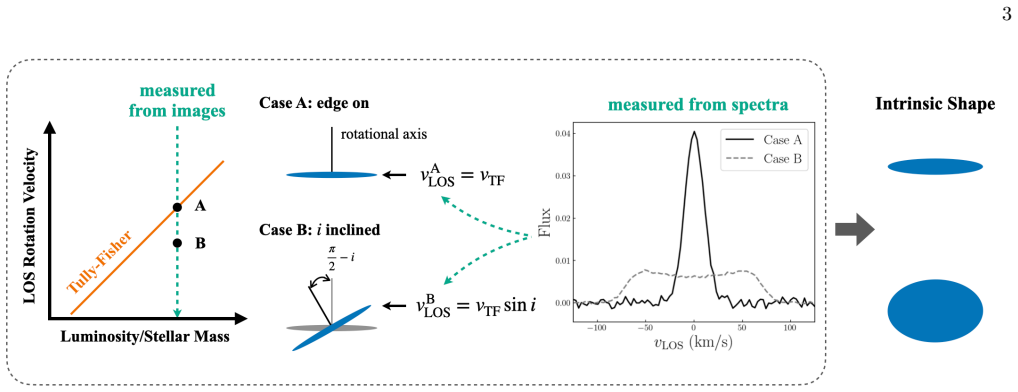
The one-component kinematic lensing (KL) approach, which uses a single kinematic component alongside imaging to suppress shape noise in cosmic shear estimation.
Load-bearing premise
The conclusions about competitiveness rely on the assumed shallow redshift distribution for HI galaxies and the presence of stronger emission lines in deeper samples.
What would settle it
Observing whether one-component KL actually yields tighter parameter constraints than WL in a real deep spectroscopic survey would confirm or refute the forecast advantage.
Figures


read the original abstract
We present a new approach to measuring cosmic shear: the one-component kinematic lensing (KL) method. This technique provides a simplified implementation of KL that reduces shape noise in weak lensing (WL) by combining kinematic information with imaging data, while requiring less observational effort than the full two-component KL. We perform simulated likelihood analyses to assess the performance of the one-component KL and demonstrate its applicability to future radio surveys. Our forecasts indicate that, for radio surveys, the one-component KL is not yet competitive with traditional WL due to the shallow redshift distribution of Hi-selected galaxies. However, when applying this method to deeper spectroscopic surveys with stronger emission lines, the one-component KL approach could surpass WL in constraining power, offering a promising and efficient pathway for future shear analyses.
Editorial analysis
A structured set of objections, weighed in public.
Referee Report
Summary. The paper introduces a simplified one-component kinematic lensing (KL) method for cosmic shear that combines kinematic information with imaging data to reduce shape noise relative to traditional weak lensing (WL), while requiring less observational effort than full two-component KL. Simulated likelihood analyses are performed to forecast performance on future radio surveys; the results indicate that one-component KL is not competitive with WL for HI-selected galaxies owing to their shallow redshift distribution, but could surpass WL for deeper spectroscopic surveys with stronger emission lines.
Significance. If the forecasts hold under the stated survey assumptions, the method offers a lower-effort route to shear measurements that could improve cosmological constraints in spectroscopic samples. The work provides a concrete comparison of KL versus WL constraining power under explicit n(z) and emission-line scalings, which is a useful benchmark even if the headline reversal requires further testing.
major comments (2)
- [forecast results / simulated likelihood analyses] The central claim that one-component KL could surpass WL for deeper spectroscopic surveys (abstract and forecast results) is obtained from simulated likelihood analyses whose inputs include a specific shallow n(z) for HI-selected galaxies and a particular scaling of emission-line strength. No quantitative sensitivity analysis is shown demonstrating how large a change in these parameters is required to flip the performance comparison, nor is it demonstrated that the fiducial values are representative rather than optimistic.
- [abstract and forecast results] The competitiveness conclusions rest on the assumed shallow redshift distribution of HI-selected galaxies and the presence of stronger emission lines in deeper samples (abstract). Changes in these survey properties would alter the performance comparison, yet the manuscript provides no robustness tests or alternative n(z) realizations to bound the uncertainty in the headline result.
minor comments (1)
- [methods] Clarify the exact definition of the one-component KL estimator and its relation to the two-component version in the methods section to aid reproducibility.
Simulated Author's Rebuttal
We thank the referee for their constructive comments on our manuscript. We agree that additional sensitivity and robustness tests would strengthen the presentation of our forecast results and will incorporate them in the revised version.
read point-by-point responses
-
Referee: The central claim that one-component KL could surpass WL for deeper spectroscopic surveys (abstract and forecast results) is obtained from simulated likelihood analyses whose inputs include a specific shallow n(z) for HI-selected galaxies and a particular scaling of emission-line strength. No quantitative sensitivity analysis is shown demonstrating how large a change in these parameters is required to flip the performance comparison, nor is it demonstrated that the fiducial values are representative rather than optimistic.
Authors: We agree that a quantitative sensitivity analysis would improve the robustness of the headline result. In the revised manuscript we will add an appendix containing forecasts in which the n(z) parameters and emission-line strength scalings are varied over ranges consistent with current observational uncertainties; this will explicitly show the threshold changes required to reverse the performance ordering between one-component KL and WL. revision: yes
-
Referee: The competitiveness conclusions rest on the assumed shallow redshift distribution of HI-selected galaxies and the presence of stronger emission lines in deeper samples (abstract). Changes in these survey properties would alter the performance comparison, yet the manuscript provides no robustness tests or alternative n(z) realizations to bound the uncertainty in the headline result.
Authors: We accept that alternative n(z) realizations are needed to bound the uncertainty. The revised manuscript will include results for two additional n(z) models (one drawn from a deeper HI survey simulation and one from a spectroscopic emission-line galaxy sample) so that readers can assess how sensitive the KL-versus-WL comparison is to the choice of redshift distribution. revision: yes
Circularity Check
No circularity: forecasts use external survey inputs, not self-derived quantities
full rationale
The paper performs simulated likelihood analyses whose inputs are external survey specifications (shallow n(z) for HI-selected galaxies, emission-line strengths). These are not obtained from the paper's own equations or fits. No step renames a fitted parameter as a prediction, invokes a self-citation uniqueness theorem, or reduces a claimed result to an input by construction. The derivation chain remains independent of the target forecasts.
Axiom & Free-Parameter Ledger
axioms (2)
- domain assumption Redshift distribution of HI-selected galaxies in radio surveys is shallow
- domain assumption Deeper spectroscopic surveys provide stronger emission lines
Forward citations
Cited by 1 Pith paper
-
Kinematic Lensing Ratio: Reviving Weak Lensing Cosmography as a Geometric Dark Energy Probe
KiLeR combines shear ratios with kinematic intrinsic shapes to mitigate first-order lensing systematics and forecasts a 192% improvement in dark energy constraints from the Roman telescope.
Reference graph
Works this paper leans on
-
[1]
Cosmic shear with one component and its application to future radio surveys
and the Square-Kilometer Array (SKA) are compet- itive cosmic shear dataset [13]. These future radio sur- veys offer a potential platform for large-scale KL analyses without the need for separate imaging and spectroscopic observations. Although the limited spatial resolution of radio tele- scopes makes it challenging to reconstruct a velocity map for indi...
work page internal anchor Pith review Pith/arXiv arXiv 2025
-
[2]
WL sample The WL galaxies should have continuum detections that are bright enough and sufficiently resolved to allow reliable shape measurements. We therefore select galax- ies based on their continuum signal-to-noise ratio (SNR) and apparent size. The continuum SNR of an extended source is given as SNRcont = Scont σcont √nb ,(12) whereS cont is the obser...
-
[3]
KL sample For the one-component KL, we select galaxies based on the detectability of their HI line emission. The SNR of a spectral line measurement is SNRline = S21 σlineδν √nbnc ,(13) whereS 21 is the integrated HI flux density (Jy km s −1), σline is the per-channel rms noise,δνis the channel band- width, andn c is the number of channels across the line ...
-
[4]
M. Kilbinger, Cosmology with cosmic shear observations: a review, Reports on Progress in Physics78, 086901 (2015)
work page 2015
-
[5]
R. Mandelbaum, Weak Lensing for Precision Cosmology, Annual Review of Astronomy and Astrophysics56, 393 (2018)
work page 2018
-
[6]
G. M. Bernstein and M. Jarvis, Shapes and Shears, Stars and Smears: Optimal Measurements for Weak Lensing, Astronomical Journal123, 583 (2002)
work page 2002
-
[7]
E. M. Huff, E. Krause, T. Eifler, X. Fang, M. R. George, and D. Schlegel, Cosmic shear without shape noise, arXiv e-prints , arXiv:1311.1489 (2013)
work page internal anchor Pith review Pith/arXiv arXiv 2013
-
[8]
J. Xu, T. Eifler, E. Huff, R. S. Pranjal, H.-J. Huang, S. Everett, and E. Krause, Kinematic lensing with the Roman Space Telescope, Monthly Notices of the Royal Astronomical Society519, 2535 (2023)
work page 2023
-
[9]
R. S. Pranjal, E. Krause, H.-J. Huang, E. Huff, J. Xu, T. Eifler, and S. Everett, Kinematic lensing inference - I. Characterizing shape noise with simulated analyses, Monthly Notices of the Royal Astronomical Society524, 3324 (2023)
work page 2023
- [10]
- [11]
-
[12]
R. B. Tully and J. R. Fisher, A new method of determin- ing distances to galaxies., Astronomy and Astrophysics 54, 661 (1977)
work page 1977
-
[13]
A. W. Blain, Detecting Gravitational Lensing Cosmic Shear from Samples of Several Galaxies Using Two- dimensional Spectral Imaging, Astrophysical Journal Letter570, L51 (2002)
work page 2002
- [14]
-
[15]
The DSA-2000 -- A Radio Survey Camera
G. Hallinan, V. Ravi, S. Weinreb, J. Kocz, Y. Huang, and et al., The DSA-2000 — A Radio Survey Camera, in Bulletin of the American Astronomical Society, Vol. 51 (2019) p. 255, arXiv:1907.07648 [astro-ph.IM]
work page internal anchor Pith review Pith/arXiv arXiv 2000
-
[16]
I. Harrison, S. Camera, J. Zuntz, and M. L. Brown, SKA weak lensing - I. Cosmological forecasts and the power of radio-optical cross-correlations, Monthly Notices of the Royal Astronomical Society463, 3674 (2016)
work page 2016
-
[17]
A. Bonaldi, M. Bonato, V. Galluzzi, I. Harrison, M. Mas- sardi, and et al., The Tiered Radio Extragalactic Contin- uum Simulation (T-RECS), Monthly Notices of the Royal Astronomical Society482, 2 (2019)
work page 2019
-
[18]
A. Bonaldi, P. Hartley, T. Ronconi, G. De Zotti, and M. Bonato, The tiered radio extragalactic continuum (T- RECS) simulation II: H I emission and continuum-H I cross-correlation, Monthly Notices of the Royal Astro- nomical Society524, 993 (2023)
work page 2023
-
[19]
C. M. Baugh, V. Gonzalez-Perez, C. D. P. Lagos, C. G. Lacey, J. C. Helly, A. Jenkins, C. S. Frenk, A. J. Ben- son, R. G. Bower, and S. Cole, Galaxy formation in the Planck Millennium: the atomic hydrogen content of dark matter haloes, Monthly Notices of the Royal Astronom- ical Society483, 4922 (2019)
work page 2019
-
[20]
M. G. Jones, M. P. Haynes, R. Giovanelli, and C. Moor- man, The ALFALFA H I mass function: a dichotomy in the low-mass slope and a locally suppressed ‘knee’ mass, Monthly Notices of the Royal Astronomical Society477, 2 (2018)
work page 2018
- [21]
-
[22]
S. H. A. Rajohnson, B. S. Frank, A. A. Pono- mareva, N. Maddox, R. C. Kraan-Korteweg, and et al., MIGHTEE-H I: the H I size-mass relation over the last billion years, Monthly Notices of the Royal Astronomical Society512, 2697 (2022)
work page 2022
-
[23]
A. R. Gogate, M. A. W. Verheijen, J. M. van der Hulst, and Y. L. Jaff´ e, BUDH IES V: the baryonic Tully- Fisher relation at z = 0.2 based on direct H I detections, Monthly Notices of the Royal Astronomical Society519, 4279 (2023)
work page 2023
-
[24]
E. Krause and T. Eifler, cosmolike - cosmological likeli- hood analyses for photometric galaxy surveys, Monthly Notices of the Royal Astronomical Society470, 2100 (2017)
work page 2017
-
[25]
J. Goodman and J. Weare, Ensemble samplers with affine invariance, Communications in Applied Mathematics and Computational Science5, 65 (2010)
work page 2010
-
[26]
D. Foreman-Mackey, D. W. Hogg, D. Lang, and J. Good- man, emcee: The MCMC Hammer, Publications of the Astronomical Society of the Pacific125, 306 (2013)
work page 2013
- [27]
discussion (0)
Sign in with ORCID, Apple, or X to comment. Anyone can read and Pith papers without signing in.