REVIEW 2 major objections 4 minor 24 references
Ferromagnetism in Quantum Dot Plaquettes
T0 review · 2 major / 4 minor · reviewed 2026-08-14 · deepseek-v4-flash
Pith's one-line read This paper predicts that small plaquettes of coupled quantum dots—square and rectangular four-dot arrays with one hole, a Y-shaped half-filled array, and a five-dot ring with four electrons—can have ferromagnetic or partially…
desk verdict A useful analytic map of Nagaoka-type ferromagnetism in few-dot plaquettes, with a real gap: the finite-U predictions, especially the 5-dot ring, are not numerically backed. read the letter →
The pith
A machine-rendered reading of the paper's core claim, the machinery that carries it, and where it could break.
The reading
What carries the argument
The load-bearing object is the single-band extended Hubbard Hamiltonian—one orbital level with two spin states per dot, on-site repulsion $U_0$, inter-site Coulomb terms $V_{ij}$, and nearest- and next-nearest-neighbor hopping. The argument works by constructing this Hamiltonian separately in each total-spin sector ($3/2$, $1/2$, $2$, $1$, $0$) and diagonalizing exactly, then adding finite-$U$ corrections to second order in $t/U$ through the matrix $T^{\dagger} \Lambda^{-1} T$. The mechanism that favors ferromagnetism is kinetic-energy gain with a phase twist: when the single hole tunnels around a plaquette loop it cyclically permutes the electron spins, and in the lower-spin sectors the permutation multiplies the amplitude by a phase such as $e^{\pm 2\pi i/3}$, raising that state's energy; in the fully polarized sector no phase appears, so the hole moves freely. Next-nearest-neighbor hopping adds extra signs from Fermi exchange that counteract this gain, which is why the thresholds on $t_d$ appear.
What would settle it
Measure the ground-state spin of a square four-dot plaquette with three electrons (one hole) as a function of interdot tunneling and detuning: the paper predicts a spin-3/2 ground state for $t_d < t_a/4$ and $U$ above the calculated critical value, and a spin-1/2 ground state otherwise. Observing a spin-3/2 state at $t_d > t_a/4$, or failing to see the spin-1/2 to spin-3/2 crossover at the predicted critical $U$, would falsify the central claim.
Extended reading notes
Core claim
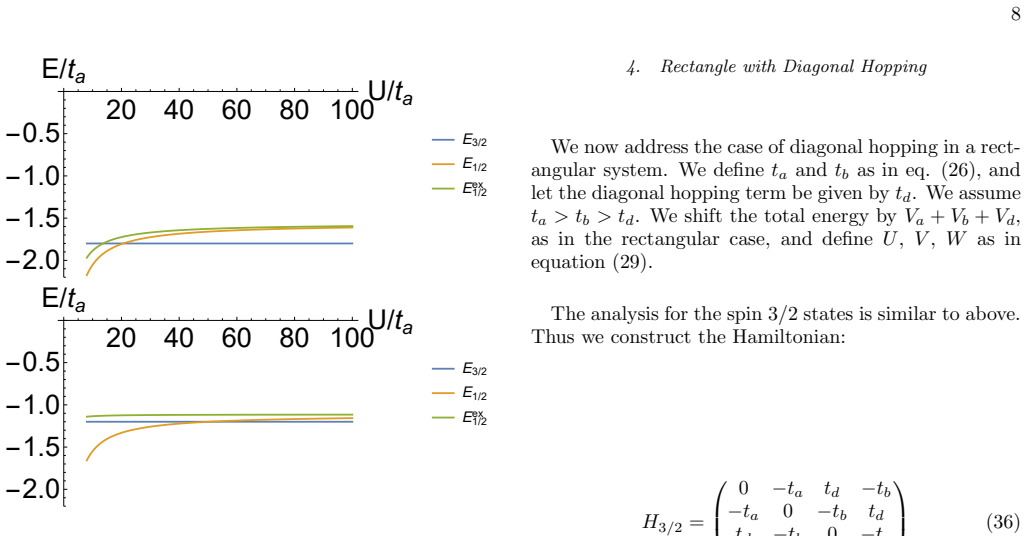
The central discovery, on the paper's own terms, is that Nagaoka-type ferromagnetism—the phenomenon in which a single hole drives full spin alignment—is not confined to the infinite-$U$ thermodynamic setting of Nagaoka's theorem. In the single-orbital Hubbard model with long-range Coulomb interactions and distant-neighbor hopping, three electrons in a four-dot square or rectangle have a spin-3/2 ground state for large $U$, with a spin gap of $2t_a$ for the square and a critical on-site repulsion of about $18.7 t_a$ in the zero-$V$ limit. The ferromagnetic state survives finite $U$ and diagonal hopping up to $t_d < t_a/4$ (square) or $t_d < t_a t_b/(3t_a+t_b)$ (rectangle), beyond which the ground state becomes a spin singlet. For half filling, the Y-shaped plaquette has a spin-1 ground state to leading order in $t^2/U$, while square, rectangular, and linear geometries remain antiferromagnetic. Four electrons in a five-dot ring have a spin-1 ground state for strong but finite $U$, so partial ferromagnetism can appear even when the Nagaoka loop-sign condition fails.
Load-bearing premise
The whole analysis assumes each dot contributes exactly one relevant orbital level carrying two spin states, so higher dot orbitals and orbital-dependent tunneling are absent; if real dots have multiple active orbitals, the predicted ground-state spins and the critical interaction strength could change.
Editorial extensions
If this is right
- Square and rectangular four-dot plaquettes with three electrons should show a fully polarized spin-3/2 ground state, with a measurable spin gap of $2t_a$ for the square.
- Long-range Coulomb interactions do not destroy the ferromagnetism; they only renormalize the effective interaction differences, so experiments need not screen interdot Coulomb repulsion.
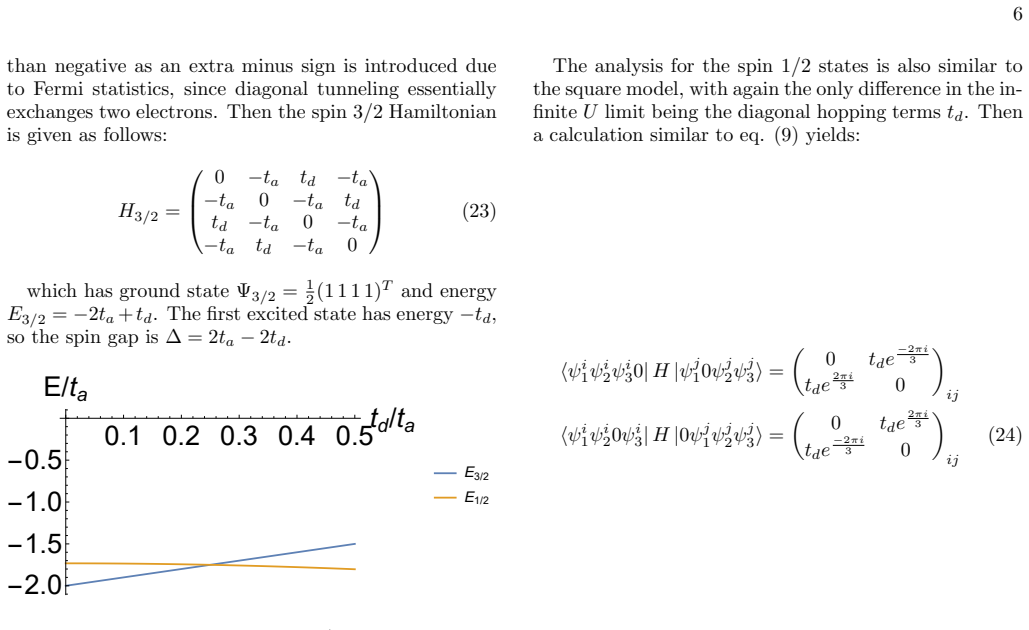
- Diagonal hopping is the main destructive knob, and the derived thresholds $t_d < t_a/4$ and $t_d < t_a t_b/(3t_a+t_b)$ give quantitative design targets for dot placement and barrier control.
- A five-dot ring with four electrons and a half-filled Y-shaped four-dot plaquette should each have a spin-1 ground state for strong, finite interactions, providing examples of partial ferromagnetism beyond the strict Nagaoka setting.
Reading between the lines
- The same phase-cycling mechanism suggests a design rule the paper states only for its geometries: plaquettes whose only loops have positive hopping products and even site counts should favor full saturation, while odd-membered loops should at best give partial polarization, so larger even-sided rings or ladders are the natural next candidates.
- The Y-shaped half-filled result offers a sublattice-imbalance route to partial ferromagnetism that needs no hole at all; testing whether other bipartite fragments with unequal sublattice sizes (for instance a two-by-one or T-shaped array) also give spin-1 ground states would be a direct extension.
- Because the paper's method is fully analytic within its model, the same $T^{\dagger} \Lambda^{-1} T$ perturbation machinery could be pushed to higher order in $t/U$ or to larger plaquettes, yielding spin-gap predictions that spin-resolved transport could check.
Signed reviews
Editorial analysis
A structured set of objections, weighed in public.
Referee Report
Summary. The manuscript studies a single-orbital Hubbard model with on-site and long-range Coulomb interactions and nearest- and next-nearest-neighbor hopping on small plaquettes of four or five quantum dots. For three electrons in four dots, it computes exact infinite-U ground states and second-order t^2/U corrections for square, rectangular, linear, and Y-shaped geometries, deriving conditions for saturated ferromagnetism (square and rectangle) and showing its absence in linear and Y arrays. For four electrons in four dots, it calculates t^2/U corrections to spin-0 and spin-1 energies and predicts a partially polarized spin-1 ground state for the Y geometry. For four electrons in a five-dot ring, it finds an infinite-U degeneracy between spin-0 and spin-1 states and uses second-order perturbation theory to claim a spin-1 ground state at finite U.
Significance. If the results are correct, the paper provides an unusually complete analytical map of magnetic ground states in few-dot Hubbard plaquettes, with explicit thresholds (e.g., U_crit ~ 18.7 t_a for the square in the V=0 limit and t_d < t_a/4 for the square with diagonal hopping) that can be tested in current quantum dot arrays. The infinite-U spin-gap calculations are exact for the stated model and are presented transparently; the derivation of U_crit from the intersection of E_3/2 and E_1/2 is a useful, parameter-free prediction. The principal weakness is the five-dot ring finite-U prediction, which rests on second-order coefficients that are not derived or independently checked; this is the weakest link in an otherwise well-structured analytical study.
major comments (2)
- [IV.B.4] Equations (112) and (113) give the finite-U corrections to the spin-1 and spin-0 ground-state energies of the five-dot ring and are the sole basis for the paper's claim that the ground state has spin 1. The coefficients are asserted without derivation, and the manuscript explicitly declines numerical checks in the Conclusion. Because the infinite-U spin-0 and spin-1 states are degenerate at -2t_a, the sign of E1 - E0 is decided entirely by these second-order coefficients; a small error in the count of virtual processes would reverse the conclusion. Please provide the full derivation of Eqs. (112)-(113) or, preferably, an exact diagonalization of the 5-site, 4-electron ring (a straightforward numerical task) to confirm the spin-1 ordering.
- [II.B.7] The conclusion that the Y-shaped plaquette with NNN hopping is not ferromagnetic for 0 < t_d < t_a relies on the unproved assertion 'one can show that P(E_3/2) > 0' after Eq. (61). Since this inequality is not evident and is load-bearing for the non-ferromagnetism claim, please include the algebraic proof or an explicit factorization of P(E_3/2).
minor comments (4)
- [Abstract and Section I] The word 'obsevation' in the abstract should be 'observation'.
- [Introduction] The neglect of higher orbital levels is described as 'not an essential approximation'; this should be substantiated or softened, since it is a model limitation that affects the quantitative predictions such as U_crit and the t_d thresholds.
- [Fig. 1 caption] The caption numbering '1, 2: 3, 4:' is confusing; please use a clearer legend for the seven geometries.
- [II.A.2] In the sentence 'The lowest energy spin 3/2 state is compared to the lowest energy spin 1/2 state to detrmine whether...', 'detrmine' should be 'determine'.
Circularity Check
No significant circularity: all predictions follow analytically from the stated Hubbard Hamiltonian with parameters treated as free inputs.
full rationale
The paper derives ferromagnetic and partially ferromagnetic ground-state criteria for small quantum-dot plaquettes by exact diagonalization in the infinite-U limit and by second-order perturbation theory in t/U for finite U. The model Hamiltonian in Eq. (1) contains on-site U0, inter-site Coulomb Vij, and hopping tij; the parameters U, V, W are defined as shifted combinations of these bare parameters (e.g., Eq. (16), Eq. (29), Eq. (102)), which is a relabeling of energy offsets, not a fit to the target result. No parameter is adjusted to force the predicted ground-state spin, and no prediction is obtained by substituting the conclusion into the derivation. The central results — E3/2 < E1/2 for the square and rectangle, the td < ta/4 threshold with diagonal hopping, the spin-1 ground state of the Y-shaped half-filled plaquette, and the spin-1 ground state of the five-dot ring — are inequalities and energies computed from the same Hamiltonian used to define the system. The self-citations in the reference list (e.g., Refs. 14-16, 19-21) are background or methodological citations and are not load-bearing for the present derivations; the Nagaoka theorem is an external classical result and is used only as motivation, not as the proof of the finite-size results. The most delicate calculation, the finite-U coefficient for the five-dot ring in Eqs. (112)-(113), is an internally derived perturbative result and is not checked numerically, but an unverified or potentially incorrect coefficient is a correctness risk, not circularity, since it is not assumed as an input. Likewise, the single-orbital-per-dot assumption is an explicit modeling approximation, not a derivation step that presupposes the ferromagnetic conclusion. The paper is self-contained against the stated model, and none of the seven circularity patterns applies.
Assumptions & free parameters
free parameters (5)
- t_a (nearest-neighbor hopping)
- t_b (rectangle short-side hopping)
- t_d (next-nearest-neighbor or diagonal hopping)
- U (shifted on-site interaction)
- V (shifted long-range Coulomb difference)
assumptions (5)
- domain assumption The single-band Hubbard model with one orbital per dot and two spin states is an adequate description of the quantum dot plaquettes.
- domain assumption Second-order perturbation theory in t/U gives the leading finite-U corrections and the location of the ferromagnetic to antiferromagnetic crossover.
- domain assumption The hopping matrix elements are all negative (t_ij = -t), giving a positive Nagaoka loop product for even loops.
- standard math The density-density Coulomb interaction does not mix spin sectors and is a constant on the single-occupancy infinite-U subspace of the symmetric geometries.
- ad hoc to paper The inequality P(E3/2) > 0 for 0 < td < ta, used to establish the non-ferromagnetic nature of the Y shape with NNN hopping, is true.
Cite this review
Pith. "Pith review of Ferromagnetism in Quantum Dot Plaquettes." pith.science (2026). https://pith.science/paper/D7YG5E32
@misc{pith2026190803226,
  author       = {Pith},
  title        = {Pith review of: Ferromagnetism in Quantum Dot Plaquettes},
  year         = {2026},
  howpublished = {\url{https://pith.science/paper/D7YG5E32}},
  note         = {Machine review of arXiv:1908.03226}
}
read the original abstract
Following the recent claimed obsevation of Nagaoka ferromagnetism in finite size quantum dot plaquettes, a general theoretical analysis is warranted in order to ascertain in rather generic terms which arrangements of a small number of quantum dots can produce saturated ferromagnetic ground states and under which constraints on interaction and inter-dot tunneling in the plaquette. This is particularly necessary since Nagaoka ferromagnetism is fragile and arises only under rather special conditions. We test the robustness of ground state ferromagnetism in the presence of a long-range Coulomb interaction and long-range as well as short-range interdot hopping by modeling a wide range of different plaquette geometries accessible by arranging a few (~4) quantum dots in a controlled manner. We find that ferromagnetism is robust to the presence of long range Coulomb interactions, and we develop conditions constraining the tunneling strength such that the ground state is ferromagnetic. Additionally, we predict the presence of a partially spin-polarized ferromagnetic state for 4 electrons in a Y-shaped 4-quantum dot plaquette. Finally, we consider 4 electrons in a ring of 5 dots. This does not satisfy the Nagaoka condition, however, we show that the ground state is spin one for strong, but not infinite, onsite interaction. Thus, even though Nagaoka's theorem does not apply, the ground state for the finite system with one hole in a ring of 5 dots is partially ferromagnetic. We provide detailed fully analytical results for the existence or not of ferromagnetic ground states in several quantum dot geometries which can be studied in currently available coupled quantum dot systems.
Figures


Figures from the paper (6 more)




Reference graph
Works this paper leans on
-
[1]
Hamiltonian We consider a single-band Hubbard model with onsite interaction energy U0, long-range Coulomb interaction terms Vij and hopping terms tij. Thus the Hamiltonian is given by: H = ∑ i⁄=j,α tijc† i,αcj,α + ∑ i U0ni↑ni↓ + ∑ i⁄=j Vij 2 ninj (1) Nagaoka’s theorem predicts ferromagnetism in systems with one hole in a half-filled band with certain geome...
-
[2]
Spin 3/2 States A system of three electrons can have either spin 1/2 or 3/2. To investigate the spin 3/2 states, we merely consider the case where all electrons are spin up, as all other states in the spin 3/2 quartet will be identical, aside from the value of Sz. We define the notation |d1d2d3d4⟩ to be the state where the electron filling of dot i is given...
-
[3]
Spin 1/2 States For the spin 1/2 state, we consider the case where two electrons are spin up and one is spin down. For configu- rations with at most one electron per site, this gives three states, one of which is part of the spin 3/2 quartet, and 4 the other two of which have spin 1/2, as follows: |ψ3/2⟩ = 1√ 3 ( |↑↑↓⟩ +|↑↓↑⟩ +|↓↑↑⟩ ) |ψ+ 1/2⟩ = 1√ 3 ( e 2...
-
[4]
Finite U Corrections For several of the geometries, we also determine the leading order corrections to E1/2 for U≫ t but not in- finite. This is done using perturbation theory, but is complicated by the fact that the spin 0 states are often degenerate. We determine the matrix elements of H be- tween the lowest energy spin 0 states, which we denote |Ψi 1/2⟩...
-
[5]
(15) become 0, U, and U + 2V respectively
Square with no Diagonal Hopping We initially consider a system of four dots in a square, where tij and Vij are given as follows: tij = { −ta if i−j =±1 mod 4 0 otherwise (13) Vij = { Va if i−j =±1 mod 4 Vd if i−j = 2 mod 4 (14) 5 Up to symmetry, three different electron configurations are possible: (1, 1, 1, 0) with energy: 2 Va +Vd (2, 0, 1, 0) with energy...
-
[6]
Square with Diagonal Hopping We now investigate how diagonal hopping terms ef- fect the system. We use the same square configura- tion of four dots, but now add extra hopping terms t13 =t31 =t42 =t24 =−td. We again define U andV as in equation (16). The analysis for the spin 3/2 states is similar to above, except there are now extra matrix ele- ments corres...
-
[7]
Rectangle with no Diagonal Hopping We now model a rectangular configuration of four dots. This will be similar to the square model, except tij and Vij are given by: tij = −ta if{i,j} ={1, 2} or{3, 4} −tb if{i,j} ={2, 3} or{1, 4} 0 otherwise (26) Vij = Va if{i,j} ={1, 2} or{3, 4} Vb if{i,j} ={2, 3} or{1, 4} Vd if i−j =±2 (27) Without loss of...
-
[8]
Rectangle with Diagonal Hopping We now address the case of diagonal hopping in a rect- angular system. We define ta and tb as in eq. (26), and let the diagonal hopping term be given bytd. We assume ta >t b >t d. We shift the total energy by Va +Vb +Vd, as in the rectangular case, and define U, V , W as in equation (29). The analysis for the spin 3/2 states ...
Show all 24 references
-
[9]
Linear Array of Four Dots We also model a linear array of four dots. This will be similar to the square model, except t14 = t41 = 0, and 9 Vij is given by: Vij = Va if i−j =±1 V2a if i−j =±2 V3a if i−j =±3 (38) We note that up to symmetry, the following electron configu...
-
[10]
We will let dots 2 through 4 be positioned at the corners of an equilateral triangle, and dot 1 be at the center, with hopping terms only between a corner dot and the center dot
Y-Shaped Configuration We now model a Y-shaped configuration of four dots. We will let dots 2 through 4 be positioned at the corners of an equilateral triangle, and dot 1 be at the center, with hopping terms only between a corner dot and the center dot. Then tij and Vij are give...
-
[11]
Hopping We now add a next nearest neighbor hopping term td between the outer corners of the Y-shaped configuration
Y-Shaped Configuration With N.N.N. Hopping We now add a next nearest neighbor hopping term td between the outer corners of the Y-shaped configuration. Then tij is given by: tij = { −ta if i or j = 1 −td otherwise (57) The same electron configurations as in eq. (50) above are poss...
-
[12]
However, due to conservation of spin, only states where the two single electrons form a spin singlet will contribute, and thus we need only consider 12 states
Spin 0 States There are two states with total spin 0 for electrons in the (1, 1, 1, 1) configuration: |Ψ± 0⟩ = 1√ 6 [ e± 2πi 3 |↑↑↓↓⟩ +|↑↓↑↓⟩ +e∓ 2πi 3 |↑↓↓↑⟩ +e∓ 2πi 3 |↓↑↑↓⟩ +|↓↑↓↑⟩ +e± 2πi 3 |↓↓↑↑⟩ ] (62) There are 24 high energy states connected to|Ψ± 0⟩ by a single tunneli...
-
[13]
Spin 1 States To investigate the spin 1 states, we consider the sub- space where Sz = 1. There are three states with total spin 1 for electrons in the (1 , 1, 1, 1) configuration: |Ψ1 1⟩ = 1 2 [ |↑↑↑↓⟩ +|↑↑↓↑⟩−|↑↓↑↑⟩−|↓↑↑↑⟩ ] |Ψ2 1⟩ = 1 2 [ |↑↑↑↓⟩−|↑↑↓↑⟩ +|↑↓↑↑⟩−|↓↑↑↑⟩ ] |Ψ3 1⟩...
-
[14]
Square with no Diagonal Hopping For four dots in a square, with no diagonal hopping, we have for spin 0, (−T†Λ−1T )0 =−t2 a U ( 8 4 4 8 ) (69) where U≡U0−Va. The off-diagonal terms break the degeneracy, and the ground state and energy is given by: 13 |Ψ0⟩ = 1 2 √ 3 [ −|↑↑↓↓⟩ + ...
-
[15]
Square With Diagonal Hopping For four dots in a square, with diagonal hopping, we have (−T†Λ−1T )0 =−t2 a U ( 8 4 4 8 ) − t2 d U +V ( 4 −4 −4 4 ) (74) E0 =−12t2 a U (75) where U≡U0−Va and V ≡Va−Vd. For spin 1, (−T†Λ−1T )1 =−t2 a U 4 0 0 0 8 0 0 0 4 − t2 d U +V 4 ...
-
[16]
Rectangle For four dots in a rectangle, with no diagonal hopping, we have (−T†Λ−1T )0 = − 4 ( t2 a U + t2 b U +V t2 a Ue −πi 3 + t2 b U +Ve πi 3 t2 a Ue πi 3 + t2 b U +Ve −πi 3 t2 a U + t2 b U +V ) (78) E0 =−4 [ t2 a U + t2 b U +V + √ t4a U 2 + t4 b (U +V )2− t2at2 b U(U +V ) ...
-
[17]
Rectangle With Diagonal Hopping For four dots in a rectangle, with diagonal hopping, we have (−T†Λ−1T )0 = − 4 ( t2 a U + t2 b U +V + t2 d U +W t2 a Ue −πi 3 + t2 b U +Ve πi 3− t2 d U +W t2 a Ue πi 3 + t2 b U +Ve −πi 3 − t2 d U +W t2 a U + t2 b U +V + t2 d U +W ) (82) E0 =−4 [...
-
[18]
Linear Array For four dots in a line, we have (−T†Λ−1T )0 = − 2t2 a 1 U + 1 U +2V + 1 U +V ( 1 U + 1 U +2V )e −πi 3 + e πi 3 U +V ( 1 U + 1 U +2V )e πi 3 +e −πi 3 U +V 1 U + 1 U +2V + 1 U +V (86) E0 =−2t2 a [ 1 U + 1 U +2V + 1 U +V + √ ( 1 U + 1 U +2V )2 + 1 (U +V )2− ...
-
[19]
Thus, the |Ψ± 0⟩ degeneracy remains unbroken, due to the three-fold rotational symmetry of the system
Y-Shaped Configuration For four dots in a Y-shaped configuration, we have (−T†Λ−1T )0 =− (t2 a U + t2 a U + 4V )( 3 0 0 3 ) (90) E0 =−3 (t2 a U + t2 a U + 4V ) (91) whereU≡U0−3Va +2Vd andV ≡Va−Vd. Thus, the |Ψ± 0⟩ degeneracy remains unbroken, due to the three-fold rotational sym...
-
[20]
Y-Shaped Configuration with N.N.N. Hopping For four dots in a Y-shaped configuration, with next nearest neighbor hopping (that is hopping between the outer corners), we have (−T†Λ−1T )0 =− (t2 a U + t2 a U + 4V + 2t2 d U + 3V )( 3 0 0 3 ) (95) E0 =−3 (t2 a U + t2 a U + 4V + 2t2 ...
-
[21]
For spin 2, there are five states for each value of Sz corresponding to the position of the hole, since there is only one spin configuration for a given value of Sz that has spin 2
Spin 2 We proceed in a similar fashion as above. For spin 2, there are five states for each value of Sz corresponding to the position of the hole, since there is only one spin configuration for a given value of Sz that has spin 2. For Sz = 2, these states are: |↑↑↑↑ 0⟩, |↑↑↑ 0↑⟩...
-
[22]
We define the following spin configurations: |ψj 1⟩ = 1 2 [ |↑↑↑↓⟩ +ejπi 2 |↑↑↓↑⟩ +e2jπi 2 |↑↓↑↑⟩ +e3jπi 2 |↓↑↑↑⟩ ] (107) for j between 1 and 3
Spin 1 We now consider the spin 1 subspace. We define the following spin configurations: |ψj 1⟩ = 1 2 [ |↑↑↑↓⟩ +ejπi 2 |↑↑↓↑⟩ +e2jπi 2 |↑↓↑↑⟩ +e3jπi 2 |↓↑↑↑⟩ ] (107) for j between 1 and 3. We see that cycling the spins will return the same state with an extra phase ejπi 2 . The ...
-
[23]
Spin 0 Finally, we examine the spin 0 subspace. There are two spin configurations, which we define as follows: |ψ0 0⟩ = 1 2 √ 3 [ −|↑↑↓↓⟩ + 2|↑↓↑↓⟩−|↑↓↓↑⟩ −|↓↑↑↓⟩ + 2|↓↑↓↑⟩−|↓↓↑↑⟩ ] (109) |ψ1 0⟩ = 1 2 [ |↑↑↓↓⟩−|↑↓↓↑⟩−|↓↑↑↓⟩ +|↓↓↑↑⟩ ] (110) We note that cycling the spins of|ψj 0⟩...
-
[24]
Finite U Corrections As before, the spin 2 energy is exact for finite U, since the Pauli exclusion principle forbids any other states than the five examined. Additionally, since neither the spin 1 nor spin 0 ground states are degenerate with other states of the same spin, we sim...
2019 arXiv
Reviewed August 14, 2026 · model on record in the stance chip above.
Discussion (0). Continue with ORCID to comment.