Democracy on Rugged Landscapes: Phase Transitions in Optimal Voting Rules
Pith reviewed 2026-06-28 11:44 UTC · model grok-4.3
The pith
As governance landscapes grow more rugged the best voting method switches from cardinal scoring to Borda count to STAR voting.
A machine-rendered reading of the paper's core claim, the machinery that carries it, and where it could break.
Core claim
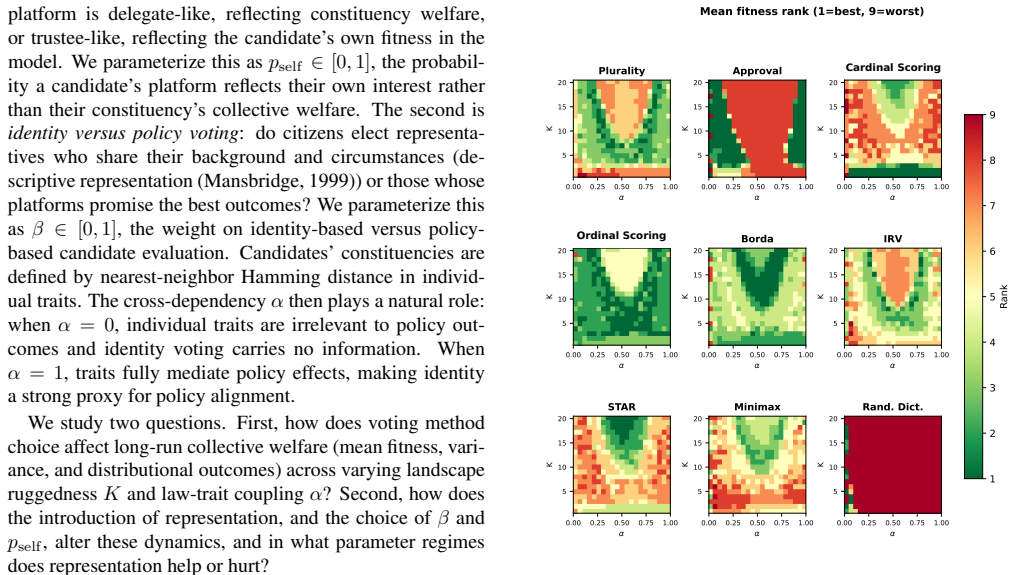
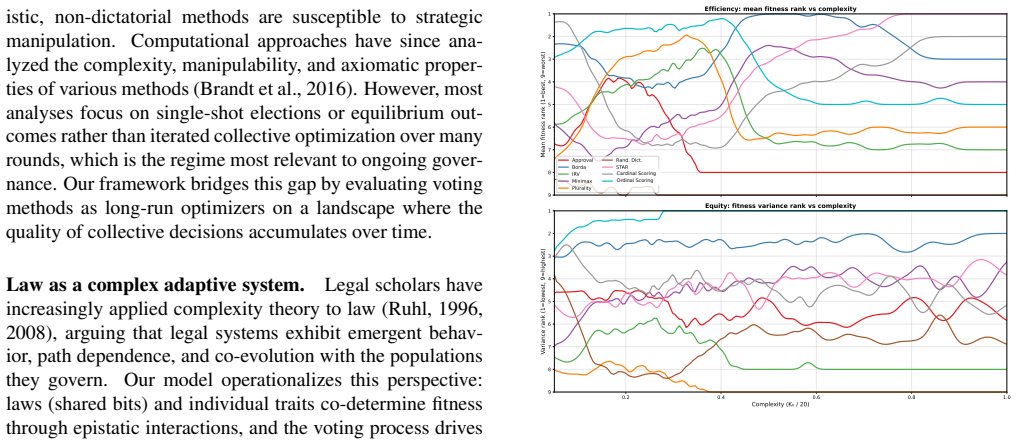
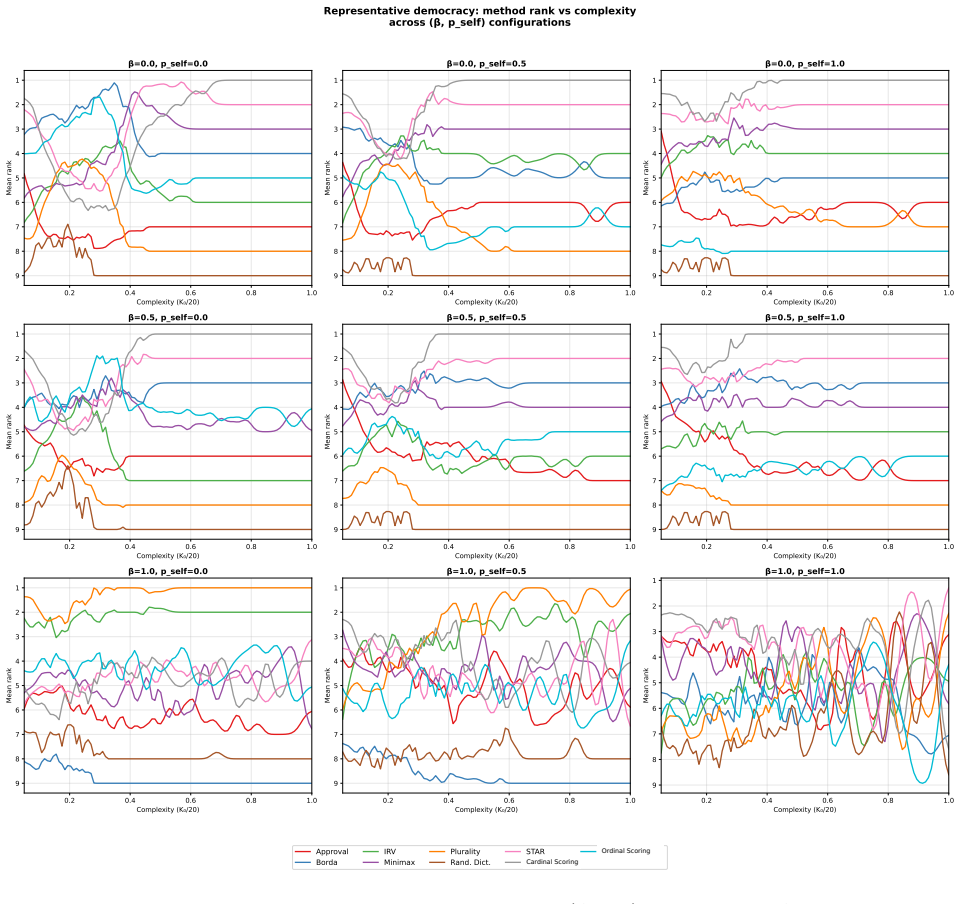
Under direct democracy on NK landscapes the optimal voting method undergoes sharp phase transitions as a function of landscape complexity: cardinal score voting dominates on smooth landscapes, ordinal scoring with p=0.35 at low-to-moderate ruggedness, Borda count across a wide middle range, and STAR voting at the highest complexity. Borda count achieves the highest mean fitness and lowest variance across most of the parameter space. Representation reshapes the structure so that cardinal score voting dominates across most regimes while plurality emerges at high identity weight and low-to-moderate candidate self-interest.
What carries the argument
NK fitness landscapes in which shared law bits are updated by voting while individual bits remain fixed, with cross-dependency strength controlled by the scalar alpha.
If this is right
- Borda count supplies the highest average outcome quality and the smallest outcome variance over most values of ruggedness and dependency strength.
- No single voting rule is optimal; the winner depends on the measured complexity of law-citizen interactions.
- Representative institutions with strong identity weighting and low candidate self-interest favor plurality over the other tested rules.
Where Pith is reading between the lines
- If policy domains can be ranked by their effective K, election designers could select the matching rule rather than defaulting to one method for all decisions.
- The two-parameter reduction of the (K, alpha) plane to a single axis offers a practical way to classify real legislative problems by complexity before choosing a voting rule.
Load-bearing premise
That real collective governance can be faithfully captured by NK optimization on shared-law bits controlled by a single cross-dependency scalar.
What would settle it
Running the same voting rules on landscapes whose ruggedness is measured directly from real policy-outcome data and checking whether the predicted switches in best rule appear.
Figures
read the original abstract
Laws and institutions shape individual outcomes through complex interactions with citizens' diverse circumstances, yet how different voting methods navigate this coupled landscape remains poorly understood. We model collective governance as optimization on NK fitness landscapes, where shared bits (laws) are updated by voting while individual bits (personal traits) remain fixed. A cross-dependency parameter $\alpha$ controls how legislation's effects depend on individual circumstances. We compare eight standard voting methods and a generalized scoring family across landscape ruggedness $K \in \{1,\ldots,20\}$ and $\alpha \in [0,1]$ with 1000 runs per configuration. Under direct democracy, the optimal voting method undergoes sharp phase transitions as a function of landscape complexity: cardinal score voting dominates on smooth landscapes, ordinal scoring with $p=0.35$ at low-to-moderate ruggedness, Borda count across a wide middle range, and STAR voting at the highest complexity. A two-parameter empirical formula reduces the $(K, \alpha)$ plane to a single complexity axis for visualization. Borda count achieves the highest mean fitness and lowest variance across most of the parameter space. We further introduce a representative democracy model parameterized by identity weight $\beta$ and candidate self-interest $p_{\mathrm{self}}$. Representation reshapes the complexity-dependent structure even under favorable conditions: cardinal score voting dominates across most regimes, with plurality emerging as the top method at high $\beta$ and low-to-moderate $p_{\mathrm{self}}$.
Editorial analysis
A structured set of objections, weighed in public.
Referee Report
Summary. The paper models collective governance as optimization on NK fitness landscapes, with shared law bits updated by voting and individual bits fixed, controlled by a cross-dependency parameter α. Simulations of eight voting methods plus a parameterized ordinal scoring family across K ∈ {1,…,20} and α ∈ [0,1] (1000 runs per cell) report sharp phase transitions in the optimal method under direct democracy: cardinal score voting on smooth landscapes, ordinal scoring (p=0.35) at low-to-moderate ruggedness, Borda count over a wide middle range, and STAR voting at highest complexity. Borda achieves highest mean fitness and lowest variance across most of the space. A two-parameter empirical formula collapses the (K,α) plane to one axis. Representative democracy (parameters β, p_self) shifts the structure, with cardinal score dominating and plurality emerging at high β and low-to-moderate p_self.
Significance. If the NK model with scalar α captures essential features of law-citizen interactions, the work supplies a quantitative, simulation-driven taxonomy of voting-rule performance across complexity regimes. The scale of 1000 runs per configuration and the explicit ordering of methods provide a reproducible empirical baseline for comparing voting systems on rugged landscapes; this could inform mechanism-design questions in computational social choice.
major comments (3)
- [Abstract] Abstract, model description paragraph: the central claim of sharp phase transitions rests on forward simulation; the manuscript supplies no statistical tests (e.g., bootstrap or permutation tests on dominance boundaries) to establish that observed switches are distinguishable from sampling noise or gradual transitions.
- [Abstract] Abstract, results paragraph: the two-parameter empirical formula is used to reduce the (K,α) plane to a single complexity axis for visualization, yet the text gives no indication whether the parameters were fitted to the same simulation output they summarize or derived independently; post-hoc fitting would render the reported dominance regions partly circular.
- [Abstract] Abstract, experimental protocol sentence: the protocol states 1000 runs per (K,α) pair but omits random-seed handling, exact NK landscape generation procedure (e.g., how the dependency matrix is sampled), and any pre-registration or cross-validation steps; these omissions are load-bearing for assessing whether the reported ordering of methods (Borda, STAR, etc.) is robust.
minor comments (1)
- [Abstract] Abstract: the notation p=0.35 for the ordinal scoring exponent and the interval α ∈ [0,1] are introduced without a forward reference to the precise functional form used in the generalized scoring family.
Simulated Author's Rebuttal
We thank the referee for the careful review and the recommendation of minor revision. We respond point by point to the three major comments, indicating revisions where appropriate.
read point-by-point responses
-
Referee: [Abstract] Abstract, model description paragraph: the central claim of sharp phase transitions rests on forward simulation; the manuscript supplies no statistical tests (e.g., bootstrap or permutation tests on dominance boundaries) to establish that observed switches are distinguishable from sampling noise or gradual transitions.
Authors: We agree that formal statistical tests would strengthen the claim of sharp transitions. With 1000 runs per cell the observed dominance separations are large, but we will add bootstrap resampling to compute confidence intervals on mean fitness differences between methods and thereby quantify the transition boundaries more rigorously. revision: yes
-
Referee: [Abstract] Abstract, results paragraph: the two-parameter empirical formula is used to reduce the (K,α) plane to a single complexity axis for visualization, yet the text gives no indication whether the parameters were fitted to the same simulation output they summarize or derived independently; post-hoc fitting would render the reported dominance regions partly circular.
Authors: The two-parameter formula was obtained by fitting the simulation output to collapse the plane for visualization. We will revise the text to state this explicitly and to emphasize that the dominance regions themselves are determined directly from the raw per-cell simulation results, not from the fitted formula, so the reported ordering remains non-circular. revision: yes
-
Referee: [Abstract] Abstract, experimental protocol sentence: the protocol states 1000 runs per (K,α) pair but omits random-seed handling, exact NK landscape generation procedure (e.g., how the dependency matrix is sampled), and any pre-registration or cross-validation steps; these omissions are load-bearing for assessing whether the reported ordering of methods (Borda, STAR, etc.) is robust.
Authors: We will expand the methods section (and the abstract if space permits) to specify the random-seed protocol, the standard Kauffman NK generation procedure including uniform sampling of the dependency matrix, and the absence of pre-registration or cross-validation (neither applies to an exhaustive simulation sweep). The complete simulation code and data will be released to permit independent verification of the method ordering. revision: yes
Circularity Check
No significant circularity; results are direct simulation outputs
full rationale
The paper reports phase transitions and dominance regions among voting methods as empirical findings obtained by forward simulation on NK landscapes whose fitness functions are defined independently of the voting rules being tested. The abstract states that results come from 1000 runs per (K, α) configuration with no equations shown that would make any reported optimum a function of the same simulation outputs. The two-parameter empirical formula is used only for visualization of the (K, α) plane and is not load-bearing for the ordering of methods. No self-citations or uniqueness theorems are invoked to justify the central claims, so the derivation chain remains self-contained against external benchmarks.
Axiom & Free-Parameter Ledger
free parameters (2)
- ordinal scoring exponent p =
0.35
- two parameters of empirical complexity formula
axioms (1)
- domain assumption NK landscapes with tunable K and α faithfully represent the interaction structure of laws and individual circumstances
Reference graph
Works this paper leans on
-
[1]
Achen, C. H. and Bartels, L. M. (2016).Democracy for Real- ists: Why Elections Do Not Produce Responsive Government. Princeton University Press
2016
-
[2]
Arrow, K. J. (1951).Social Choice and Individual Values. Wiley
1951
-
[3]
D., editors (2016).Handbook of Computational Social Choice
Brandt, F., Conitzer, V ., Endriss, U., Lang, J., and Procaccia, A. D., editors (2016).Handbook of Computational Social Choice. Cambridge University Press
2016
-
[4]
Gibbard, A. (1973). Manipulation of voting schemes: A general result.Econometrica, 41(4):587–601
1973
-
[5]
Kauffman, S. A. (1993).The Origins of Order: Self-Organization and Selection in Evolution. Oxford University Press
1993
-
[6]
Levinthal, D. A. (1997). Adaptation on rugged landscapes.Man- agement Science, 43(7):934–950
1997
-
[7]
Mansbridge, J. (1999). Should blacks represent blacks and women represent women? a contingent “yes”.The Journal of Poli- tics, 61(3):628–657
1999
-
[8]
Rivkin, J. W. (2000). Imitation of complex strategies.Management Science, 46(6):824–844
2000
-
[9]
Ruhl, J. B. (1996). Fitness of law: Using complexity theory to de- scribe the evolution of law and society and its practical mean- ing for democracy.Vanderbilt Law Review, 49:1407–1490
1996
-
[10]
Ruhl, J. B. (2008). Law’s complexity: A primer.Georgia State University Law Review, 24:885–911
2008
-
[11]
Saari, D. G. (1995).Basic Geometry of Voting. Springer
1995
-
[12]
Satterthwaite, M. A. (1975). Strategy-proofness and arrow’s con- ditions: Existence and correspondence theorems for voting procedures and social welfare functions.Journal of Economic Theory, 10(2):187–217
1975
-
[13]
Young, H. P. (1974). An axiomatization of borda’s rule.Journal of Economic Theory, 9(1):43–52
1974
discussion (0)
Sign in with ORCID, Apple, or X to comment. Anyone can read and Pith papers without signing in.