REVIEW 2 major objections 5 minor 1 cited by
Measurement of the 3He Spin-Structure Functions and of Neutron (3He) Spin-Dependent Sum Rules at 0.035<Q^2<0.24 GeV^2
T0 review · 2 major / 5 minor · reviewed 2026-08-14 · deepseek-v4-flash
Pith's one-line read This paper extracts the neutron spin-structure moments Γ1, Γ2 and ITT from polarized 3He scattering at Q² between 0.035 and 0.24 GeV² and shows that chiral effective field theory must include the Δ(1232) resonance to describe them.
desk verdict Precision low-Q2 neutron spin moments that mostly hold up, but the BC check is conditional on an unquantified g2^WW extrapolation. read the letter →
The pith
A machine-rendered reading of the paper's core claim, the machinery that carries it, and where it could break.
The reading
What carries the argument
The load-bearing machinery is the set of sum-rule identities that connect measured cross-section differences to moments that theory can calculate. The polarized cross-section differences $\Delta\sigma_\parallel$ and $\Delta\sigma_\perp$ are combined to give $g_1$ and $g_2$; the moments $\Gamma_1 = \int g_1\,dx$, $\Gamma_2 = \int g_2\,dx$, and $I_{\mathrm{TT}} = (2M^2/Q^2)\int [g_1 - (4M^2/Q^2)x^2 g_2]\,dx$ are then formed. The neutron moments are obtained from the polarized-$^{3}$He data with an effective polarized-neutron prescription, supplemented by a neutron parameterization to extend the integrals to $x=0.001$ and a Regge parameterization below that. For the Burkhardt–Cottingham check, the unmeasured low-$x$ part of $\Gamma_2$ is evaluated with the Wandzura–Wilczek relation $g_2 = g_2^{\mathrm{WW}}$, the twist-2 part of $g_2$; this is the point at which the paper explicitly declines to assign an uncertainty.
What would settle it
A direct low-$x$ measurement of $g_2$ at these $Q^2$ values, for instance extending the integral to $x<0.02$, would settle whether the Wandzura–Wilczek estimate used for the unmeasured tail is correct; if the measured integral then deviates from zero by more than the quoted uncertainty, the reported consistency of $\Gamma_2$ with the Burkhardt–Cottingham sum rule fails.
Extended reading notes
Core claim
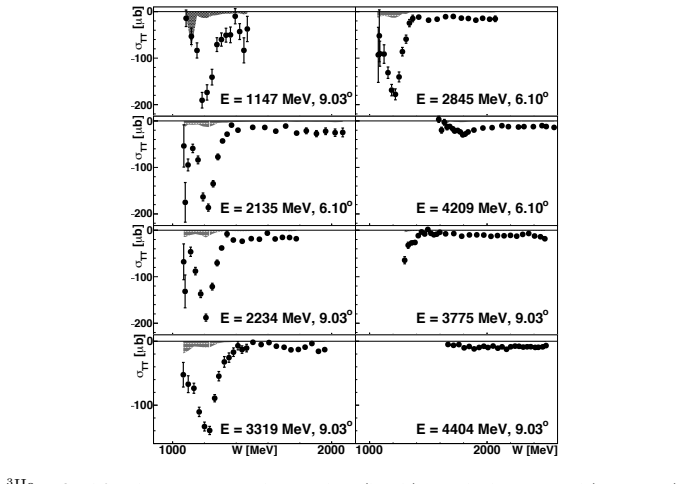
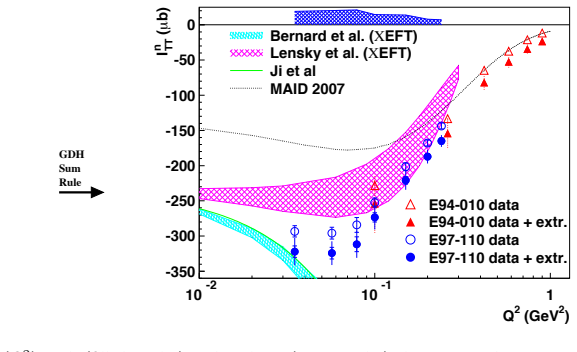
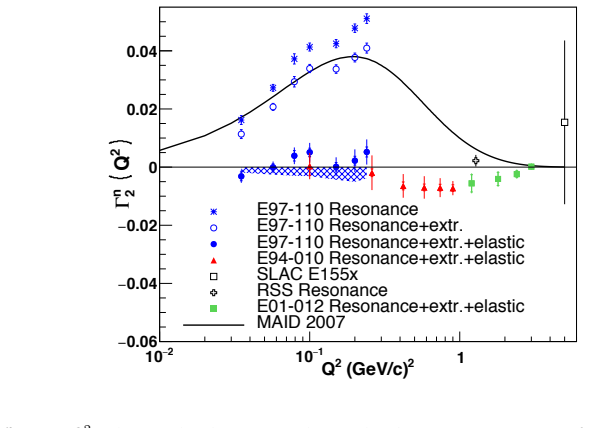
The central discovery is a set of precision neutron moments in a $Q^2$ range that had been poorly covered. From the measured cross-section differences $\Delta\sigma_\parallel$ and $\Delta\sigma_\perp$ for polarized electrons on polarized $^{3}$He, the paper obtains $g_1$, $g_2$ and $\sigma_{\mathrm{TT}}$ over the resonance region and beyond, interpolates to constant $Q^2$, and forms $\Gamma_1$, $\Gamma_2$ and $I_{\mathrm{TT}}$ for the neutron. The $\Gamma_1$ results agree with earlier data where kinematic ranges overlap and with both recent next-to-leading-order $\chi$EFT calculations up to $Q^2\approx 0.06$ GeV$^2$; above that, only the calculation that includes the $\Delta(1232)$ explicitly follows the measured flattening. The $I_{\mathrm{TT}}$ results agree with one calculation only at the lowest $Q^2$ point and otherwise do not match either calculation. For $\Gamma_2$, the measured integral plus the Wandzura–Wilczek estimate of the unmeasured low-$x$ tail is consistent with the Burkhardt–Cottingham prediction $\Gamma_2=0$ at all $Q^2$ values, although no uncertainty is assigned to that low-$x$ estimate.
Load-bearing premise
The load-bearing assumption is that in the unmeasured low-$x$ region, the second spin structure function $g_2$ is exactly given by its twist-2 (Wandzura–Wilczek) part; if that model is wrong, the reported consistency of the neutron moment $\Gamma_2$ with the Burkhardt–Cottingham sum rule is not established.
Editorial extensions
If this is right
- If the $\Gamma_1$ and $I_{\mathrm{TT}}$ results are correct, chiral effective field theory calculations of nucleon spin structure must include the $\Delta(1232)$ degree of freedom to reproduce the data; calculations without it fail.
- The data extend the empirical basis for the Burkhardt–Cottingham sum rule into the $Q^2$ range where quark confinement dominates, on the condition that the low-$x$ $g_2$ estimate is correct.
- The disagreement between the data and both recent $\chi$EFT calculations for $I_{\mathrm{TT}}$ except at the lowest $Q^2$ means further refinement of the pion–$\Delta$ loop treatment is needed before these moments can be considered understood.
- These moments provide fixed targets that future lattice QCD computations of the forward virtual Compton amplitudes can be checked against.
Reading between the lines
- Because the paper's $\Gamma_2$ consistency is conditional on the Wandzura–Wilczek low-$x$ estimate, a dedicated low-$x$ measurement of $g_2$ at these $Q^2$ values would be the direct test; until then the BC result should be read as model-dependent.
- The two $\chi$EFT calculations differ mainly in how they expand the pion–$\Delta$ corrections, so comparing proton and neutron moments at the same $Q^2$ may isolate the isoscalar part of the discrepancy.
- The disagreement between the two $\chi$EFT extrapolations for $I_{\mathrm{TT}}$ at the lowest $Q^2$ suggests a lever for future experiments: data below 0.035 GeV$^2$ would pick out the calculation that correctly captures the neutron GDH slope.
Editorial analysis
A structured set of objections, weighed in public.
Referee Report
Summary. This paper reports new inclusive measurements of the spin-dependent cross-section differences on polarized 3He in Jefferson Lab experiment E97-110, covering Q^2 from 0.035 to 0.24 GeV^2. From these data the authors extract the 3He spin structure functions g1 and g2 and the transverse-transverse spin cross section sigma_TT, and then obtain the neutron moments Gamma1, Gamma2, and I_TT using a prescription that treats polarized 3He as an effective polarized neutron. The moments are compared with two modern NLO chiral effective field theory calculations, with older chiEFT and model predictions, and with earlier data. The Gamma1 and I_TT results are reported with propagated low-x extrapolation uncertainties. The Gamma2 result is compared with the Burkhardt-Cottingham sum rule using a low-x completion built from g2 = g2^WW, with the stated caveat that no uncertainty is assigned to that completion. The central claims are that the new data provide precise neutron spin moments in the chiral domain and that the comparison with chiEFT demonstrates the need for explicit Delta(1232) degrees of freedom and further theoretical refinement.
Significance. If the Gamma1 and I_TT results stand, they are the most precise neutron spin moments in this low-Q^2 chiral region and provide valuable constraints for chiEFT and for the Q^2 evolution toward the GDH sum rule. The paper is generally careful: the analysis is based on measured asymmetry differences, the systematic accounting is detailed, and the low-x extrapolation uncertainties for Gamma1 and I_TT are explicitly propagated from varied model parameters. The Gamma2/BC part is not on the same footing: the low-x completion uses a model whose first moment vanishes, so the reported consistency with the BC sum rule is not an independent test. The data tables in the Supplemental Material are a useful resource for future comparisons.
major comments (2)
- [Fig. 5 and the concluding paragraph] The claim that Gamma_n2 is consistent with the Burkhardt-Cottingham sum rule is not established by the presented analysis. The open circles in Fig. 5 combine the measured resonance-region integral with a low-x contribution computed from g2 = g2^WW, and the Wandzura-Wilczek function has a first moment that vanishes identically. The completion therefore biases the reconstructed Gamma_n2 toward the BC expectation of zero, and the paper explicitly states near Fig. 5 that no uncertainty is assigned to this low-x extrapolation. The quoted error bars in Fig. 5 consequently omit the dominant model uncertainty, so the agreement with zero is not a genuine test of the sum rule. Please add a sensitivity estimate using alternative low-x models (for example g2 = 0, a twist-3/Regge parameterization, or a sign-flipped g2^WW piece) and report the resulting shifts in the full Gamma_n2 values; if such an estimate cannot be made, the conclusion should be downgraded to a consistency check under an explicit model assumption.
- [Comparison with chiEFT in Figs. 3 and 4] The quantitative comparison with the Lensky et al. calculation relies on a 2019 update that is described only as a private communication, so the curves in Figs. 3 and 4 cannot be reproduced from the published literature. Because the conclusion about the role of the Delta(1232) degree of freedom depends on this comparison, please provide the numerical values of the updated calculation as supplemental data or replace the private communication with a public reference, and state explicitly which version of the calculation is plotted.
minor comments (5)
- [Experimental section, dilution sentence] The sentence 'The dilution of the asymmetry by unpolarized background canceling that same background in sigma0, such correction is unnecessary when forming Delta_sigma' is grammatically incomplete and should be rewritten.
- [Fig. 5] The figure should indicate in the legend that the open circles include the g2 = g2^WW low-x completion with no assigned uncertainty, since this information currently appears only in the text.
- [References [42]] The '2019 update: private communication' should be replaced with a public reference or an appendix table of the updated values for reproducibility.
- [Abstract] The abstract refers to 'first moments Gamma1, Gamma2 and I_TT'; consider using 'moments' generically, since I_TT is a moment of a combination of g1 and g2 rather than a first moment of a single structure function.
- [Equations (1)-(4)] Please define explicitly the integration threshold nu0 used in the moment integrals (the pion-production threshold) and distinguish it from the inelastic threshold introduced in Eq. (1).
Circularity Check
No significant circularity: the moments are formed directly from measured cross-section differences, and the low-x completions use external parameterizations with propagated or explicitly disclosed uncertainties.
full rationale
The derivation chain is self-contained. The spin-structure functions g1 and g2 are extracted from the measured polarized cross-section differences Δσ∥ and Δσ⊥ via the standard formulas given in the text, and Γ1, Γ2, and ITT are direct integrals of these measured structure functions. No parameter is fitted to the target sum rules and then re-presented as a prediction. The low-x completions for Γ1 and ITT use published external inputs: the text states, "The same neutron parameterization as used in Ref. [15] was used to complete the integration down to x = 0.001, and the recent Regge parameterization [40] was used for x < 0.001," with parameter variations combined into an extrapolation uncertainty, so these are propagated external inputs rather than outputs of this experiment. The Γ2 low-x completion is the only caveated step: the paper explicitly assumes g2 = g2^WW and states, "it is unknown how well g2^WW matches g2 there, one cannot reliably assess an uncertainty on the low-x extrapolation and none was assigned." This is a disclosed model assumption with a recognized limitation rather than a circular reduction; g2^WW is an external twist-2 construct, not fitted to force Γ2 to zero, and the Burkhardt-Cottingham claim is explicitly qualified with the proviso that g2^WW is used. Theory comparisons use external χEFT calculations from Bernard et al. and Lensky et al., and earlier JLab results are cited for comparison rather than as load-bearing justification of the extraction. No self-citation chain or uniqueness argument forces the reported moments, and no equation in the paper reduces by construction to its own inputs.
Assumptions & free parameters
free parameters (1)
- Low-x extrapolation model parameters =
varied over estimated ranges; not tabulated
assumptions (4)
- domain assumption 3He spin structure can be treated as an effective polarized neutron using the prescription of Ref. [39].
- domain assumption The low-x behavior of Gamma1 and ITT follows the neutron parameterization of Ref. [15] above x = 0.001 and a Regge parameterization [40] below x = 0.001.
- ad hoc to paper g2 equals g2^WW, the twist-2 Wandzura-Wilczek part of g2, in the unmeasured low-x region.
- standard math The standard inclusive scattering formalism relating cross-section differences to g1 and g2, with radiative corrections from Refs. [37,38], is valid.
Cite this review
Pith. "Pith review of Measurement of the 3He Spin-Structure Functions and of Neutron (3He) Spin-Dependent Sum Rules at 0.035<Q^2<0.24 GeV^2." pith.science (2026). https://pith.science/paper/DALYN6UC
@misc{pith2026190805709,
  author       = {Pith},
  title        = {Pith review of: Measurement of the 3He Spin-Structure Functions and of Neutron (3He) Spin-Dependent Sum Rules at 0.035<Q^2<0.24 GeV^2},
  year         = {2026},
  howpublished = {\url{https://pith.science/paper/DALYN6UC}},
  note         = {Machine review of arXiv:1908.05709}
}
abstract
The spin-structure functions $g_1$ and $g_2$, and the spin-dependent partial cross-section $\sigma_\mathrm{TT}$ have been extracted from the polarized cross-sections differences, $\Delta \sigma_{\parallel}\hspace{-0.06cm}\left(\nu,Q^{2}\right)$ and $\Delta \sigma_{\perp}\hspace{-0.06cm}\left(\nu,Q^{2}\right)$ measured for the $\vec{^\textrm{3}\textrm{He}}(\vec{\textrm{e}},\textrm{e}')\textrm{X}$ reaction, in the E97-110 experiment at Jefferson Lab. Polarized electrons with energies from 1.147 to 4.404 GeV were scattered at angles of 6$^{\circ}$ and 9$^{\circ}$ from a longitudinally or transversely polarized $^{3}$He target. The data cover the kinematic regions of the quasi-elastic, resonance production and beyond. From the extracted spin-structure functions, the first moments $\overline{\Gamma_1}\hspace{-0.06cm}\left(Q^{2}\right)$, $\Gamma_2\hspace{-0.06cm}\left(Q^{2}\right)$ and $I_{\mathrm{TT}}\hspace{-0.06cm}\left(Q^{2}\right)$ are evaluated with high precision for the neutron in the $Q^2$ range from 0.035 to 0.24~GeV$^{2}$. The comparison of the data and the chiral effective field theory predictions reveals the importance of proper treatment of the $\Delta$ degree of freedom for spin observables.
Figures


Figures from the paper (2 more)
Forward citations
Cited by 1 Pith paper
-
Extraction of $\sigma_{TT}$ for Proton, Neutron, Deuteron and $^3$He from Quasi-real Photon Scattering
Quasi-real electroproduction data extrapolated to Q²=0 give σ_TT for p, n, d and ³He, with larger neutron/deuteron Δ(1232) strength than real-photon data and better isospin consistency.
Reference graph
Works this paper leans on
-
[1]
J. P. Chen, A. Deur and Z. E. Meziani, Mod. Phys. Lett. A 20, 2745 (2005) J. P. Chen, Int. J. Mod. Phys. E 19, 1893 (2010) S. E. Kuhn, J.-P. Chen and E. Leader, Prog. Part. Nucl. Phys. 63, 1 (2009) A. Deur, S. J. Brodsky and G. F. De T´ eramond, Rep. Prog. Phys., 82, 7 (2019)
work page 2005
-
[2]
J. Ashman et al. , [European Muon Collaboration], Phys. Lett. B 206, 364 (1988); D. Adams et al. , [Spin Muon (SMC) Collaboration], Phys. Lett. B 396, 338 (1997); Phys. Rev. D 56, 5330 (1997) V. Y. Alexakhin et al. , [COMPASS Collaboration], Phys. Lett. B 647, 8 (2007) 18
work page 1988
-
[3]
P. L. Anthony et al., [E142 Collaboration] Phys. Rev. D 54, 6620 (1996); K. Abe et al., [E143 Collaboration] Phys. Rev. D 58, 112003 (1998); K. Abe et al. , [E154 Collaboration] Phys. Rev. Lett. 79, 26 (1997); P. L. Anthony et al. , [E155 Collaboration] Phys. Lett. B 458, 529 (1999)
work page 1996
-
[4]
P. L. Anthony et al. , [E155 Collaboration] Phys. Lett. B 553, 18 (2003)
work page 2003
-
[5]
K. Ackerstaff et al. , [HERMES Collaboration] Phys. Lett. B 404, 383 (1997); A. Airapetian et al. , [HERMES Collaboration] Phys. Lett. B 442, 484 (1998); Phys. Rev. D 75, 012007 (2007)
work page 1997
-
[6]
A. Airapetian et al. , [HERMES Collaboration] Eur. Phys. J. C 26, 527 (2003)
work page 2003
- [7]
-
[8]
K. Slifer et al. , [E94010 Collaboration] Phys. Rev. Lett. 101, 022303 (2008); X. Zheng et al. , [Jefferson Lab Hall A Collaboration] (E99-117 experiment) Phys. Rev. C 70, 065207 (2004); K. Kramer et al. , [Jefferson Lab Hall A Collaboration] (E97-103 experiment) Phys. Rev. Lett. 95, 142002 (2005); D. S. Parno et al. , [Jefferson Lab Hall A Collaboration] (E...
work page 2008
Show all 47 references
-
[9]
Amarian et al
M. Amarian et al. , [E94010 Collaboration] Phys. Rev. Lett. 89, 242301 (2002)
2002
-
[10]
Amarian et al
M. Amarian et al. , [E94010 Collaboration] Phys. Rev. Lett. 92, 022301 (2004)
2004
-
[11]
Amarian et al
M. Amarian et al. , [E94010 Collaboration] Phys. Rev. Lett. 93, 152301 (2004)
2004
-
[12]
Deur et al
A. Deur et al. , Phys. Rev. Lett. 93, 212001 (2004); Phys. Rev. D 78, 032001 (2008); Phys. Rev. D 90, 012009 (2014)
2004
-
[13]
Slifer et al., [Resonance Spin Structure Collaboration] Phys
K. Slifer et al., [Resonance Spin Structure Collaboration] Phys. Rev. Lett. 105, 101601 (2010)
2010
-
[14]
Solvignon et al
P. Solvignon et al. , [Jefferson Lab Hall A Collaboration] (E01-012 experiment) Phys. Rev. C 92, 015208 (2015) 19
2015
-
[15]
K. P. Adhikari et al. , [CLAS Collaboration] (EG4 experiment) Phys. Rev. Lett. 120, 062501 (2018)
2018
-
[16]
A. Deur, S. J. Brodsky and G. F. de Teramond, Prog. Part. Nucl. Phys. 90, 1 (2016)
2016
-
[17]
Bernard, N
V. Bernard, N. Kaiser and U. G. Meissner, Int. J. Mod. Phys. E 4, 193 (1995)
1995
-
[18]
S. B. Gerasimov, Sov. J. Nucl. Phys. 2, 430 (1966) [Yad. Fiz. 2, 598 (1965)]; S. D. Drell and A. C. Hearn, Phys. Rev. Lett. 16, 908 (1966)
1966
-
[19]
Ahrens et al., [GDH Collaboration (MAMI A2)] Phys
J. Ahrens et al., [GDH Collaboration (MAMI A2)] Phys. Rev. Lett.87, 022003 (2001), H. Dutz et al., [GDH Collaboration (ELSA)] Phys. Rev. Lett. 93, 032003 (2004); S. Hoblit et al., [LSC Collaboration] (LEGS experiment) Phys. Rev. Lett. 102, 172002 (2009)
2001
-
[20]
Anselmino, B
M. Anselmino, B. L. Ioffe and E. Leader, Sov. J. Nucl. Phys. 49, 136 (1989) [Yad. Fiz. 49, 214 (1989)]
1989
-
[21]
Drechsel, B
D. Drechsel, B. Pasquini and M. Vanderhaeghen, Phys. Rept. 378, 99 (2003)
2003
-
[22]
Drechsel, S
D. Drechsel, S. S. Kamalov and L. Tiator, Phys. Rev. D 63, 114010 (2001)
2001
-
[23]
L. N. Hand, Phys. Rev. 129, 1834 (1963)
1963
-
[24]
X. D. Ji and J. Osborne, J. Phys. G 27, 127 (2001)
2001
-
[25]
A. J. Chambers et al. , Phys. Rev. Lett. 118, 24 242001 (2017)
2017
-
[26]
Bernard, T
V. Bernard, T. R. Hemmert and U. G. Meissner, Phys. Rev. D 67, 076008 (2003)
2003
-
[27]
X. D. Ji, C. W. Kao and J. Osborne, Phys. Lett. B 472, 1 (2000)
2000
-
[28]
Burkhardt and W
H. Burkhardt and W. N. Cottingham, Annals Phys. 56, 453 (1970)
1970
-
[29]
R. L. Jaffe and X. D. Ji, Phys. Rev. D 43, 724 (1991)
1991
-
[30]
Details of JLab E97-110 and relevant theses can be found at http://hallaweb.jlab.org/experiment/E97-110/
-
[31]
Sulkosky Ph.D
V. Sulkosky Ph.D. thesis, College of William & Mary (2007), Williamsburg, Virginia 23187 USA; http://hallaweb.jlab.org/experiment/E97-110/thesis/PhD thesis V Sulkosky.pdf 20
2007
-
[32]
Alcorn et al., [Jefferson Lab Hall A Collaboration] Nucl
J. Alcorn et al., [Jefferson Lab Hall A Collaboration] Nucl. Instrum. Meth. A 522, 294 (2004)
2004
-
[33]
T. R. Gentile, P. J. Nacher, B. Saam and T. G. Walker, Rev. Mod. Phys. 89, 045004 (2017)
2017
-
[34]
Garibaldi et al
F. Garibaldi et al. [Jefferson Lab Hall A Collaboration], Phys. Rev. C 99, 054309 (2019)
2019
-
[35]
Golak, et al., Phys
J. Golak, et al., Phys. Rev. C 65, 064004 (2002); Phys. Rev. C 72, 054005 (2005); L. P. Yuan, et al. , Phys. Rev. C 66, 054004 (2002); A. Deltuva, et al. , Phys. Rev. C 69, 034004 (2004); Phys. Rev. C 70, 034004 (2004); Phys. Rev. C 71, 054005 (2005)
2002
-
[36]
Drechsel, O
D. Drechsel, O. Hanstein, S. S. Kamalov and L. Tiator, Nucl. Phys. A 645, 145 (1999)
1999
-
[37]
L. W. Mo and Y. S. Tsai, Rev. Mod. Phys. 41, 205 (1969)
1969
-
[38]
I. V. Akushevich and N. M. Shumeiko, J. Phys. G 20, 513 (1994); I. Akushevich, A. Ilyichev, N. Shumeiko, A. Soroko and A. Tolkachev, Comput. Phys. Commun. 104, 201 (1997)
1994
-
[39]
Ciofi degli Atti and S
C. Ciofi degli Atti and S. Scopetta, Phys. Lett. B 404, 223 (1997)
1997
-
[40]
S. D. Bass, M. Skurzok and P. Moskal, Phys. Rev. C 98, 025209 (2018)
2018
-
[41]
Bernard, E
V. Bernard, E. Epelbaum, H. Krebs and U. G. Meissner, Phys. Rev. D 87, 054032 (2013)
2013
-
[42]
Lensky, J
V. Lensky, J. M. Alarc´ on and V. Pascalutsa, Phys. Rev. C 90, 055202 (2014). 2019 update: private communication
2014
-
[43]
V. D. Burkert and B. L. Ioffe, Phys. Lett. B 296, 223 (1992); J. Exp. Theor. Phys. 78, 619 (1994) [Zh. Eksp. Teor. Fiz. 105, 1153 (1994)]
1992
-
[44]
R. S. Pasechnik, J. Soffer and O. V. Teryaev, Phys. Rev. D82, 076007 (2010); R. S. Pasechnik, D. V. Shirkov, O. V. Teryaev, O. P. Solovtsova and V. L. Khandramai, Phys. Rev. D 81, 016010 (2010)
2010
-
[45]
Wandzura and F
S. Wandzura and F. Wilczek, Phys. Lett. B 72, 195 (1977)
1977
-
[46]
Mergell, U
P. Mergell, U. G. Meissner and D. Drechsel, Nucl. Phys. A 596, 367 (1996)
1996
-
[47]
Battaglieri, R
M. Battaglieri, R. De Vita, A. Deur and M. Ripani, spokespersons for Jefferson Lab Ex- periment E03-006; A. Camsonne, J.-P. Chen and K. Slifer, spokespersons for Jefferson Lab Experiment E08-027 21 Supplemental material Data tables and kinematics of Jefferson Lab experiment E97-1...
Reviewed August 14, 2026 · model on record in the stance chip above.
Discussion (0). Continue with ORCID to comment.