Chemical Equilibration and Thermalization of Quark-Gluon Plasma in a Parton Cascade Model with 2-to-3 Quark Interactions
Pith reviewed 2026-06-28 08:22 UTC · model grok-4.3
The pith
Including 2-to-3 quark processes speeds thermalization of quark-gluon plasma but leaves chemical equilibration incomplete after 5 fm.
A machine-rendered reading of the paper's core claim, the machinery that carries it, and where it could break.
Core claim
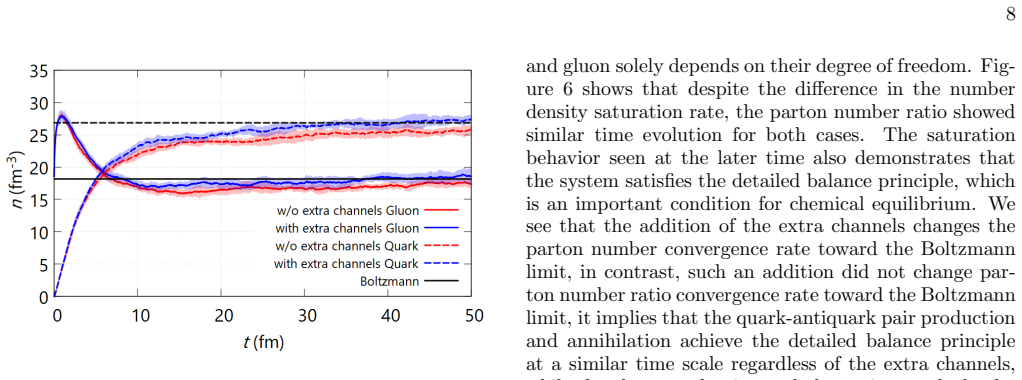
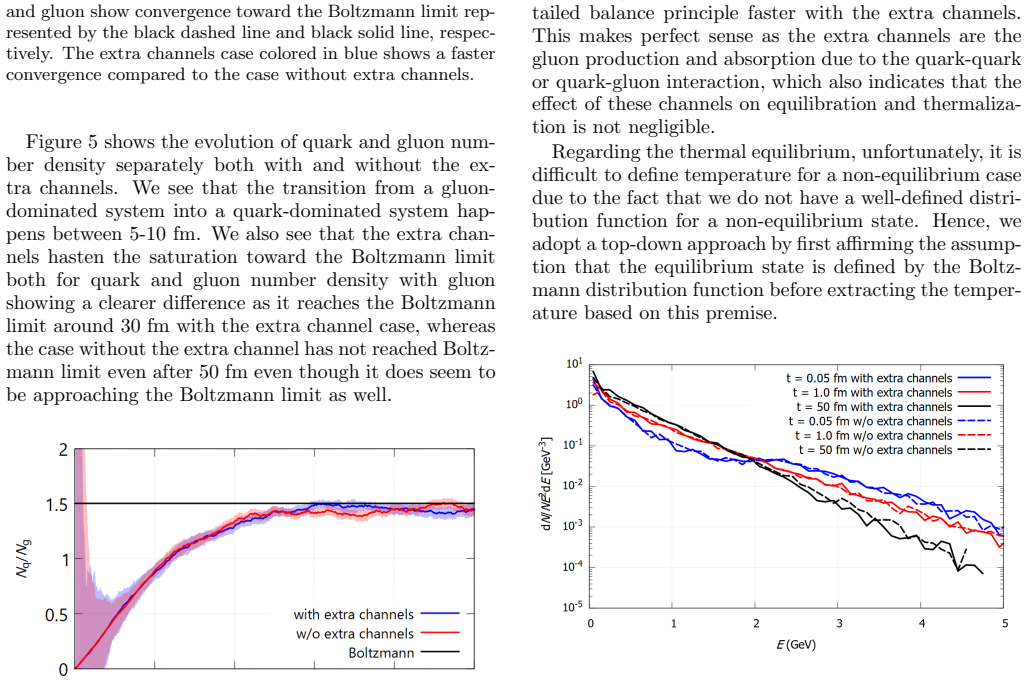
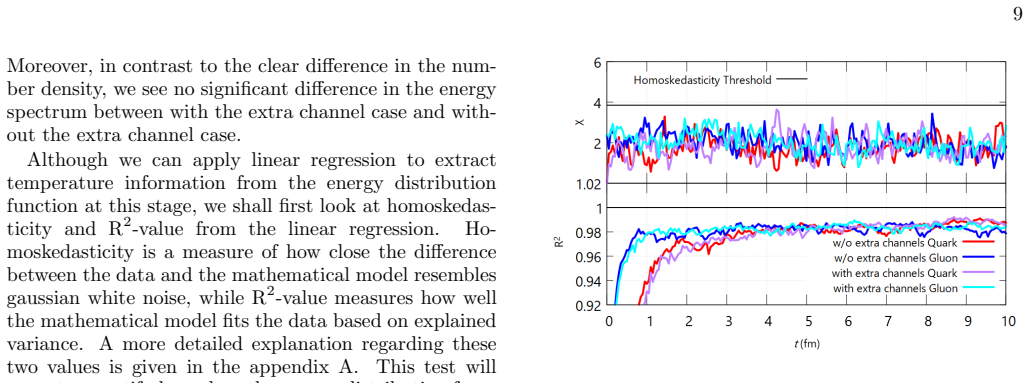
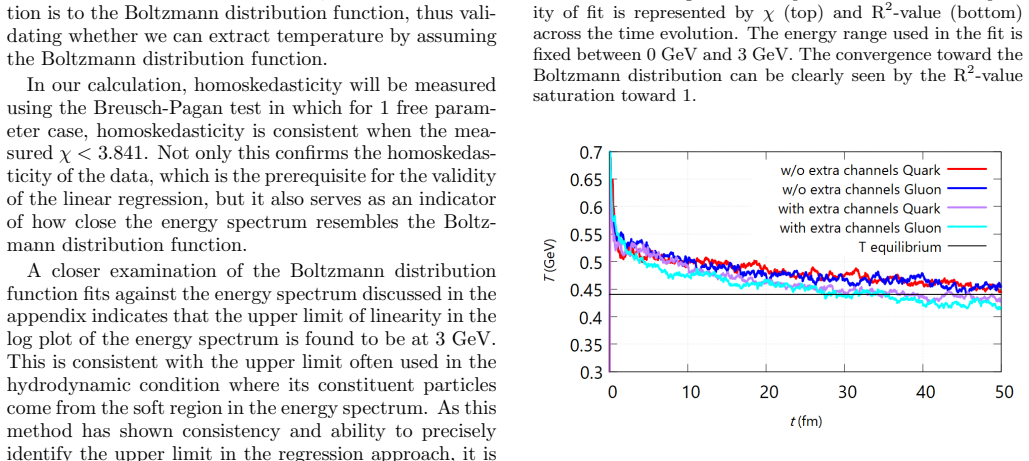
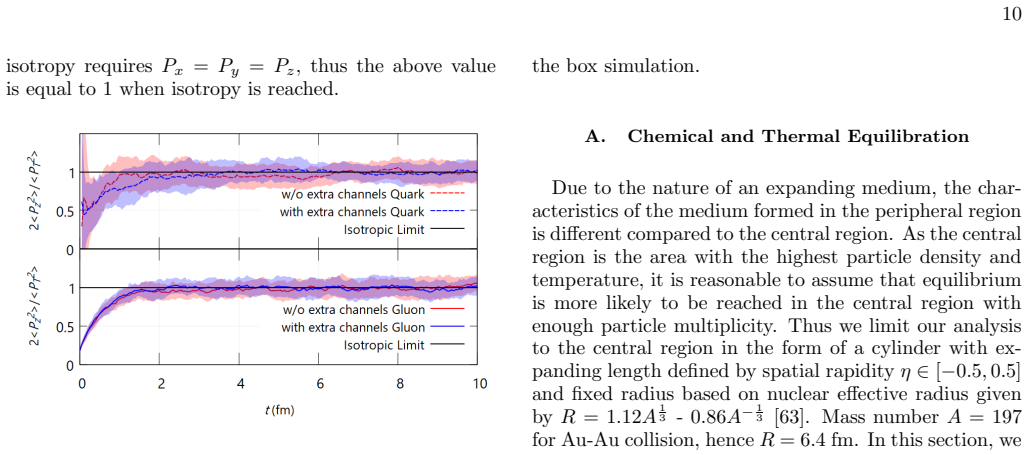
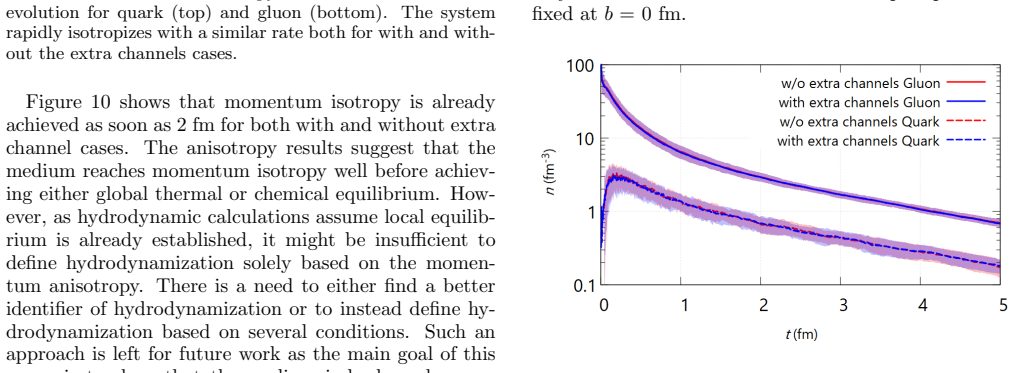
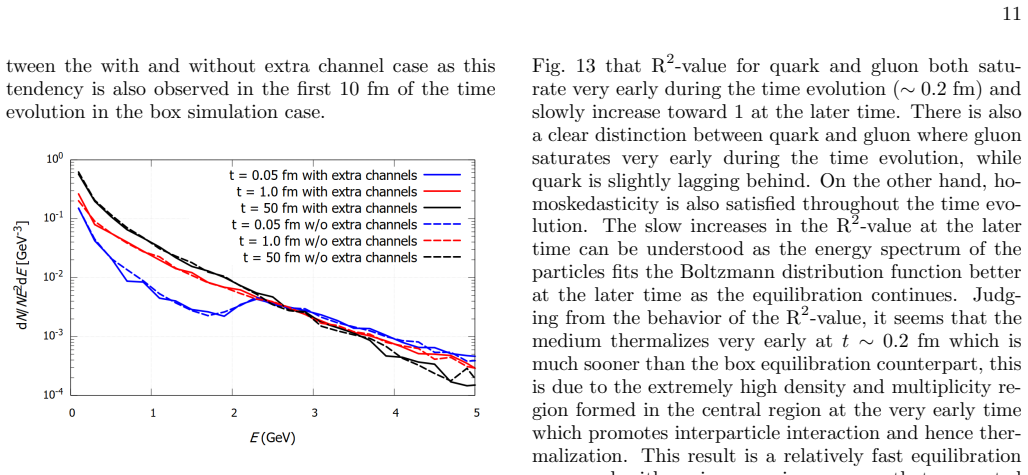
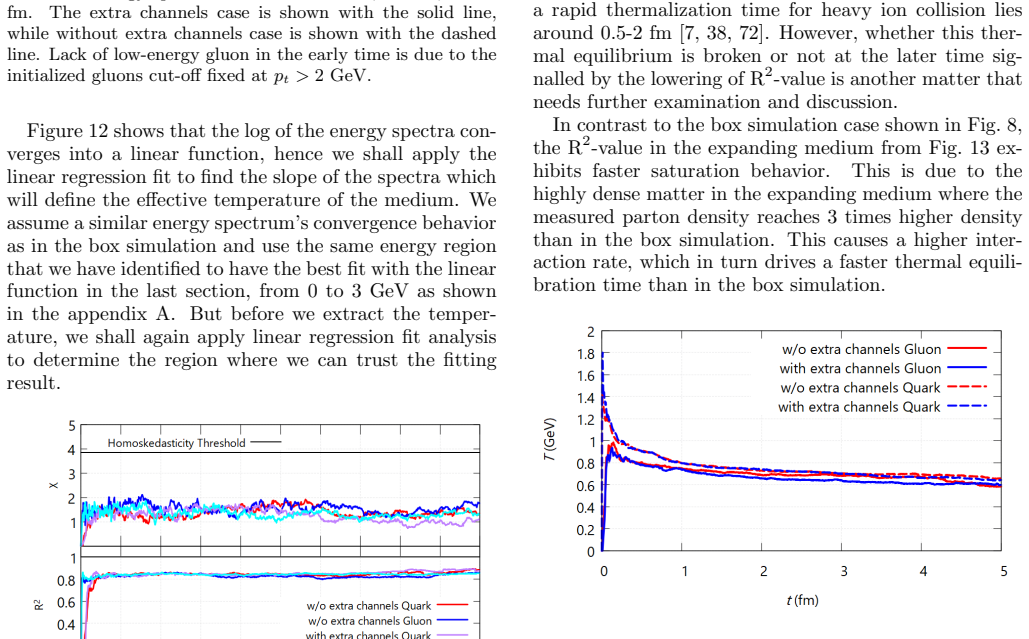
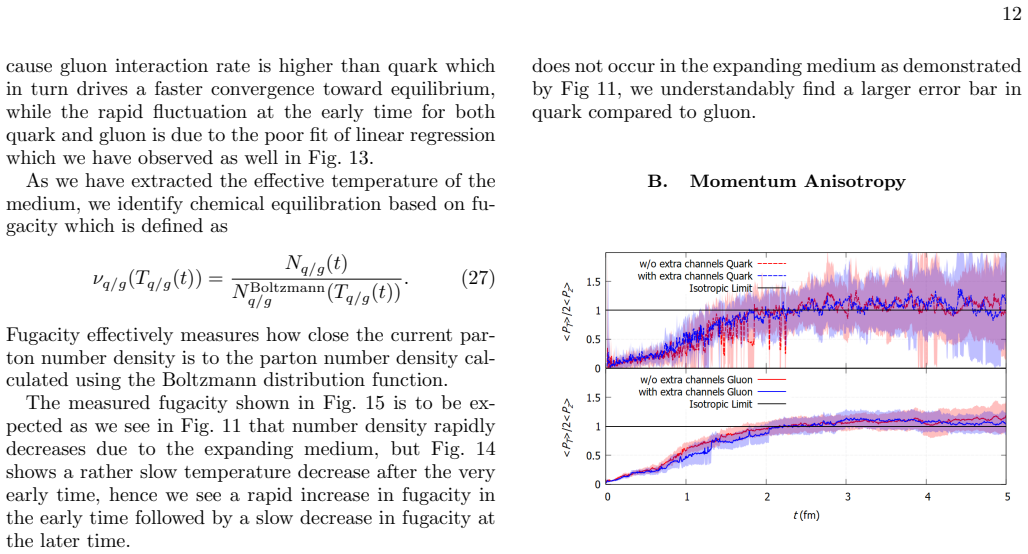
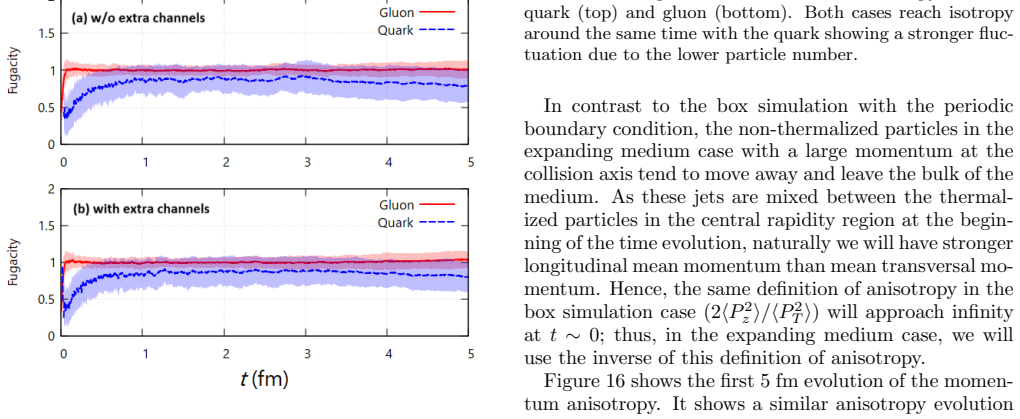
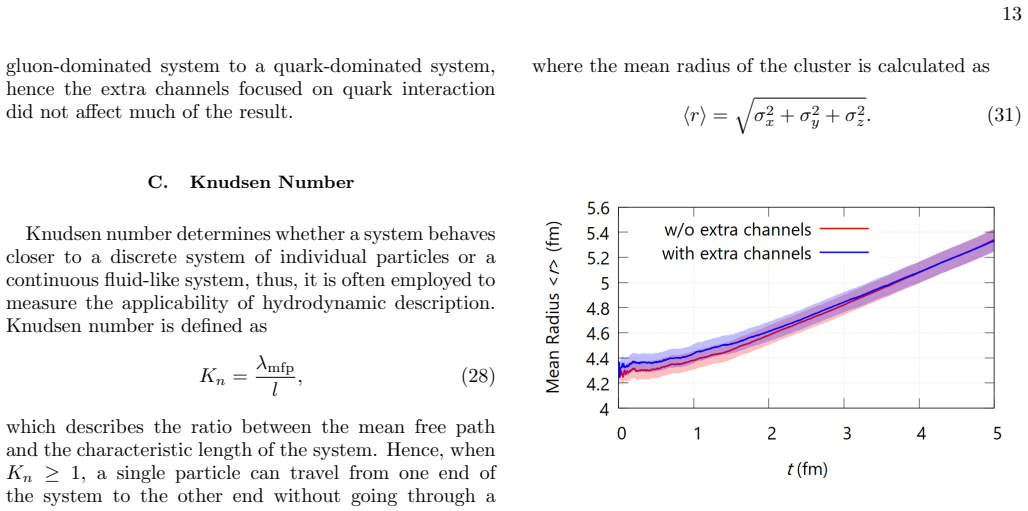
The additional inelastic 2-to-3 channels accelerate thermalization and chemical equilibration compared to the gluon-only scheme. In the expanding medium the energy spectrum converges toward the Boltzmann distribution at t ~ 0.2 fm while momentum isotropization is achieved at t ~ 2 fm, but chemical equilibration is not clearly established even after 5 fm. The Knudsen number rises above unity after ~ 4 fm, indicating a breakdown of the hydrodynamic regime at later times.
What carries the argument
The parton cascade model extended with 2-to-3 quark interactions on mini-jet initial conditions, tracking energy spectra, momentum anisotropy and particle yields to measure equilibration.
Load-bearing premise
The mini-jet initial conditions with nuclear PDFs and the particular implementation of 2-to-3 partonic processes produce dynamics that represent real QGP evolution.
What would settle it
If experimental data from heavy-ion collisions show chemical equilibration occurring well before 5 fm or if simulations without the 2-to-3 channels yield the same timelines, the acceleration claim would be falsified.
Figures
read the original abstract
We investigate the thermalization, chemical equilibration, and hydrodynamization behavior of the far-from-equilibrium, gluon-dominated quark gluon plasma (QGP) produced in Au+Au collisions at $\sqrt{s_{\text{NN}}} = 200$ GeV using the hadronic transport model SMASH extended to simulate partonic interactions. The initial conditions are prepared using the mini-jet model with nuclear parton distribution functions. We first validate the model in a box simulation with the periodic boundary condition to establish indicators for thermalization, chemical equilibration, and hydrodynamization by analyzing energy spectrum and momentum anisotropy. We observe that the additional inelastic channels accelerate thermalization and chemical equilibration compared to the gluon-only scheme. Applying the same framework to the expanding medium, we find that the energy spectrum converges toward the Boltzmann distribution at $t \sim 0.2$ fm while momentum isotropization is achieved at $t \sim 2$ fm, but chemical equilibration is not clearly established even after 5 fm. The Knudsen number rises above unity after $\sim 4$ fm, indicating a breakdown of the hydrodynamic regime at later times consistent with other kinetic theory approaches.
Editorial analysis
A structured set of objections, weighed in public.
Referee Report
Summary. The manuscript investigates thermalization, chemical equilibration, and hydrodynamization of far-from-equilibrium gluon-dominated QGP in Au+Au collisions at √s_NN=200 GeV using the SMASH transport model extended to include 2-to-3 partonic interactions. Initial conditions are generated via the mini-jet model with nuclear PDFs. A periodic-box validation establishes indicators based on energy spectra and momentum anisotropy, showing that the inelastic channels accelerate equilibration relative to gluon-only dynamics. In the expanding system the energy spectrum approaches a Boltzmann distribution at t∼0.2 fm, momentum isotropization occurs at t∼2 fm, chemical equilibration is not clearly reached by t=5 fm, and the Knudsen number exceeds unity after ∼4 fm, signaling the end of the hydrodynamic regime.
Significance. If the modeling assumptions hold, the work supplies explicit, simulation-derived timescales separating different equilibration processes in a kinetic-theory framework that incorporates quark 2-to-3 processes; the explicit time-stepped evolution and the Knudsen-number diagnostic constitute concrete, falsifiable outputs that can be compared with other transport and hydrodynamic approaches.
major comments (3)
- [Validation section (box simulation)] Validation section (box simulation): the statement that inelastic 2-to-3 channels accelerate thermalization and chemical equilibration is load-bearing for the central claim, yet the box test only reports internal consistency; quantitative convergence tests, statistical error bars on the spectra, and the precise definition of the chemical-equilibration metric are not shown, leaving the magnitude of the acceleration uncertain.
- [Expanding medium application] Expanding-medium results: the reported timescales (spectrum convergence at t∼0.2 fm, isotropization at t∼2 fm, chemical equilibration not reached by 5 fm) rest on the specific mini-jet initial conditions with nuclear PDFs and the chosen implementation of the 2-to-3 matrix elements; without sensitivity tests to alternate initial-state models (e.g., CGC) or variations in the partonic cross sections, these numbers cannot be regarded as general features of QGP evolution.
- [Hydrodynamization and Knudsen number] Hydrodynamization paragraph: the claim that the Knudsen number rises above unity after ∼4 fm indicates breakdown of hydrodynamics is central to the hydrodynamization conclusion, but the explicit definition of the Knudsen number (mean free path versus system size or gradient scale) and its numerical evaluation are not provided, preventing direct comparison with other kinetic-theory studies.
minor comments (1)
- [Abstract] Abstract: the phrase 'chemical equilibration is not clearly established' should be accompanied by the concrete observable (e.g., time evolution of quark/gluon number ratios or effective chemical potentials) used to reach that conclusion.
Simulated Author's Rebuttal
We thank the referee for the careful reading and constructive comments on our manuscript. We provide point-by-point responses below and will make the indicated revisions in the next version.
read point-by-point responses
-
Referee: Validation section (box simulation): the statement that inelastic 2-to-3 channels accelerate thermalization and chemical equilibration is load-bearing for the central claim, yet the box test only reports internal consistency; quantitative convergence tests, statistical error bars on the spectra, and the precise definition of the chemical-equilibration metric are not shown, leaving the magnitude of the acceleration uncertain.
Authors: We agree that the validation section would be strengthened by these quantitative elements. In the revised manuscript we will add statistical error bars to the energy spectra, present convergence tests with respect to the number of test particles, and give an explicit definition of the chemical-equilibration metric (the evolution of the quark-to-gluon number-density ratio toward its equilibrium value). revision: yes
-
Referee: Expanding-medium results: the reported timescales (spectrum convergence at t∼0.2 fm, isotropization at t∼2 fm, chemical equilibration not reached by 5 fm) rest on the specific mini-jet initial conditions with nuclear PDFs and the chosen implementation of the 2-to-3 matrix elements; without sensitivity tests to alternate initial-state models (e.g., CGC) or variations in the partonic cross sections, these numbers cannot be regarded as general features of QGP evolution.
Authors: The reported timescales are obtained for the mini-jet initial conditions with nuclear PDFs and the specific 2-to-3 matrix elements implemented in our SMASH extension; the manuscript does not claim these values are universal. Performing sensitivity studies to CGC initial conditions or varied cross sections would require substantial new simulations beyond the present scope. We will add a paragraph clarifying the model dependence and the limitations of the current setup. revision: partial
-
Referee: Hydrodynamization paragraph: the claim that the Knudsen number rises above unity after ∼4 fm indicates breakdown of hydrodynamics is central to the hydrodynamization conclusion, but the explicit definition of the Knudsen number (mean free path versus system size or gradient scale) and its numerical evaluation are not provided, preventing direct comparison with other kinetic-theory studies.
Authors: We acknowledge the omission. In the revised manuscript we will explicitly define the Knudsen number (Kn = λ/L, with λ the mean free path obtained from the local interaction rate and L the system size or inverse gradient length) and describe its numerical evaluation from the simulation output at each time step. revision: yes
Circularity Check
No circularity: results are direct outputs of explicit numerical simulation
full rationale
The paper's central results (energy spectrum convergence at t~0.2 fm, momentum isotropization at t~2 fm, chemical equilibration not reached by 5 fm) are obtained by running the extended SMASH parton cascade with mini-jet initial conditions in both box and expanding geometries. These times are simulation outputs, not parameters fitted to reproduce an external target or defined in terms of the quantities being measured. No self-citations are invoked to establish uniqueness theorems or to smuggle in ansatzes for the 2-to-3 matrix elements. The box validation checks internal consistency of the chosen implementation but does not reduce the expanding-medium predictions to the inputs by construction. This is a standard kinetic-theory simulation study whose derivation chain remains independent of the enumerated circularity patterns.
Axiom & Free-Parameter Ledger
Reference graph
Works this paper leans on
-
[1]
Expectation-Maximization Characteristic Length We determine the characteristic length by assuming a single cluster of 3D Gaussian shape at the center point of the 2 colliding nuclei. The width of the gaussian is defined by the expectation-maximisation clustering algo- rithm where we set its gaussian widthσto maximize the expectation value F= NX i −1 2 x2 ...
-
[2]
In contrast to the previous approach, we did not make an assumption regarding the number of clusters
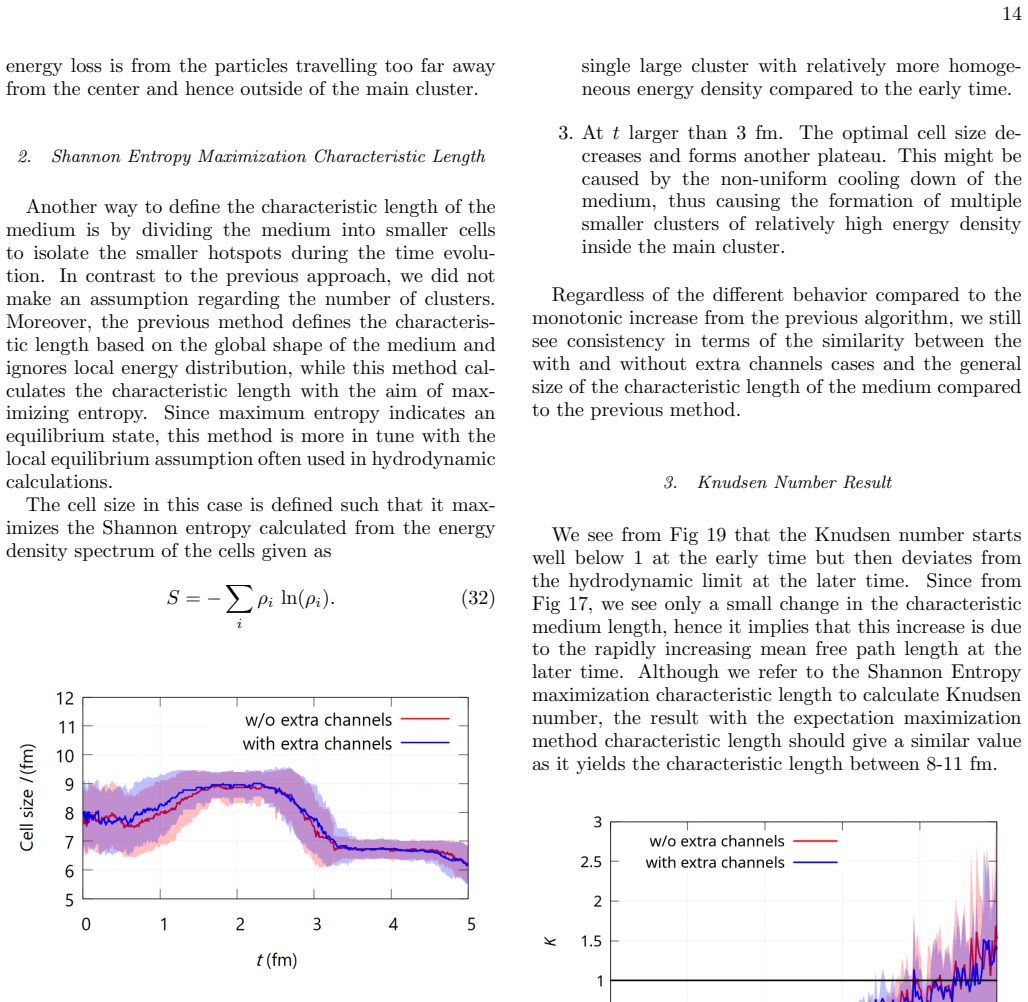
Shannon Entropy Maximization Characteristic Length Another way to define the characteristic length of the medium is by dividing the medium into smaller cells to isolate the smaller hotspots during the time evolu- tion. In contrast to the previous approach, we did not make an assumption regarding the number of clusters. Moreover, the previous method define...
-
[3]
At smallt, we see that a smaller cell size maximizes Shannon entropy, this can be interpreted as the al- gorithm capturing the microscopic features of the multiple small hotspots created at the beginning
-
[4]
At aroundt= 2 fm, we see a plateau after an in- crease. This is reached when the energy of each small hotspot has spread and amalgamated into a single large cluster with relatively more homoge- neous energy density compared to the early time
-
[5]
The optimal cell size de- creases and forms another plateau
Attlarger than 3 fm. The optimal cell size de- creases and forms another plateau. This might be caused by the non-uniform cooling down of the medium, thus causing the formation of multiple smaller clusters of relatively high energy density inside the main cluster. Regardless of the different behavior compared to the monotonic increase from the previous al...
-
[6]
Knudsen Number Result We see from Fig 19 that the Knudsen number starts well below 1 at the early time but then deviates from the hydrodynamic limit at the later time. Since from Fig 17, we see only a small change in the characteristic medium length, hence it implies that this increase is due to the rapidly increasing mean free path length at the later ti...
-
[7]
Gyulassy,Structure and Dynamics of Elementary Matter, edited by W
M. Gyulassy,Structure and Dynamics of Elementary Matter, edited by W. Greiner, M. G. Itkis, J. Rein- hardt, and M. C. G¨ u¸ cl¨ u (Springer Netherlands, Dor- drecht, 2004) pp. 159–182
2004
-
[8]
Cifarelli and F
L. Cifarelli and F. Bellini, Investigation of the quark- gluon plasma with the alice experiment, inOxford Re- search Encyclopedia of Physics, edited by B. Foster (Ox- ford University Press, 2024)
2024
-
[9]
Keegan, A
L. Keegan, A. Kurkela, A. Mazeliauskas, and D. Teaney, Initial conditions for hydrodynamics from weakly cou- pled pre-equilibrium evolution, Journal of High Energy Physics2016, 171 (2016)
2016
-
[10]
Kurkela and A
A. Kurkela and A. Mazeliauskas, Chemical equilibration in weakly coupled qcd, Phys. Rev. D99, 054018 (2019)
2019
-
[11]
Geiger, Thermalization in ultrarelativistic nuclear col- lisions
K. Geiger, Thermalization in ultrarelativistic nuclear col- lisions. ii. entropy production and energy densities at the bnl relativistic heavy ion collider and the cern large hadron collider, Phys. Rev. D46, 4986 (1992)
1992
-
[12]
Kurkela, A
A. Kurkela, A. Mazeliauskas, J.-F. m. c. Paquet, S. Schlichting, and D. Teaney, Matching the nonequilib- rium initial stage of heavy ion collisions to hydrodynam- ics with qcd kinetic theory, Phys. Rev. Lett.122, 122302 (2019)
2019
-
[13]
bottom-up
R. Baier, A. Mueller, D. Schiff, and D. Son, “bottom-up” thermalization in heavy ion collisions, Physics Letters B 502, 51 (2001)
2001
-
[14]
Back.et al., The phobos perspective on discoveries at rhic, Nuclear Physics A757, 28 (2005), first Three Years of Operation of RHIC
B. Back.et al., The phobos perspective on discoveries at rhic, Nuclear Physics A757, 28 (2005), first Three Years of Operation of RHIC
2005
-
[15]
K. Adcox.et al., Formation of dense partonic matter in relativistic nucleus–nucleus collisions at rhic: Exper- imental evaluation by the phenix collaboration, Nuclear Physics A757, 184 (2005), first Three Years of Operation of RHIC
2005
-
[16]
I. Arsene.et al., Quark–gluon plasma and color glass con- densate at rhic? the perspective from the brahms experi- ment, Nuclear Physics A757, 1 (2005), first Three Years of Operation of RHIC
2005
-
[17]
H. Petersen, G.-Y. Qin, S. A. Bass, and B. Muller, Tri- angular flow in event-by-event ideal hydrodynamics in Au+Au collisions at √sNN = 200AGeV, Phys. Rev. C 82, 041901 (2010), arXiv:1008.0625 [nucl-th]
Pith/arXiv arXiv 2010
-
[18]
Z. Qiu, C. Shen, and U. Heinz, Hydrodynamic elliptic and triangular flow in Pb-Pb collisions at √s= 2.76ATeV, Phys. Lett. B707, 151 (2012), arXiv:1110.3033 [nucl-th]
Pith/arXiv arXiv 2012
-
[19]
Adamet al.(The ALICE Collaboration), Anisotropic flow of charged particles in pb-pb collisions at √sN N = 5.02 TeV, Phys
J. Adamet al.(The ALICE Collaboration), Anisotropic flow of charged particles in pb-pb collisions at √sN N = 5.02 TeV, Phys. Rev. Lett.116, 132302 (2016)
2016
-
[20]
D. A. Teaney, Viscous Hydrodynamics and the Quark Gluon Plasma, inQuark-gluon plasma 4, edited by R. C. Hwa and X.-N. Wang (2010) pp. 207–266, arXiv:0905.2433 [nucl-th]
Pith/arXiv arXiv 2010
-
[21]
W. Zhao, Y. Zhou, H. Xu, W. Deng, and H. Song, Hy- drodynamic collectivity in proton–proton collisions at 13 TeV, Phys. Lett. B780, 495 (2018), arXiv:1801.00271 [nucl-th]
Pith/arXiv arXiv 2018
-
[22]
Pandey and B
S. Pandey and B. K. Singh, Higher-order anisotropic flow correlations in Xe–Xe collisions at √sN N = 5.44 TeV, The European Physical Journal Plus139, 400 (2024)
2024
-
[23]
G. Giacalone, J. Noronha-Hostler, M. Luzum, and J.-Y. Ollitrault, Confronting hydrodynamic predictions with Xe-Xe data, Nucl. Phys. A982, 371 (2019), arXiv:1807.05557 [nucl-th]
Pith/arXiv arXiv 2019
-
[24]
Bo˙ zek and W
P. Bo˙ zek and W. Broniowski, Hydrodynamic modeling of 3he–au collisions at √sN N = 200 GeV, Physics Letters B747, 135 (2015)
2015
-
[25]
A. Goldschmidt, Z. Qiu, C. Shen, and U. Heinz, Colli- sion geometry and flow in uranium + uranium collisions, Phys. Rev. C92, 044903 (2015), arXiv:1507.03910 [nucl- th]
Pith/arXiv arXiv 2015
-
[26]
Okamoto and C
K. Okamoto and C. Nonaka, Temperature dependence of transport coefficients of qcd in high-energy heavy-ion collisions, Phys. Rev. C98, 054906 (2018)
2018
-
[27]
Nakamura, T
K. Nakamura, T. Miyoshi, C. Nonaka, and H. R. Taka- hashi, Directed flow in relativistic resistive magneto- hydrodynamic expansion for symmetric and asymmetric collision systems, Phys. Rev. C107, 014901 (2023)
2023
-
[28]
Nakamura, T
K. Nakamura, T. Miyoshi, C. Nonaka, and H. R. Taka- hashi, Charge-dependent anisotropic flow in high-energy heavy-ion collisions from a relativistic resistive magneto- hydrodynamic expansion, Phys. Rev. C107, 034912 (2023)
2023
-
[29]
J. S. Moreland, J. E. Bernhard, and S. A. Bass, Alter- native ansatz to wounded nucleon and binary collision scaling in high-energy nuclear collisions, Phys. Rev. C 92, 011901 (2015), arXiv:1412.4708 [nucl-th]
Pith/arXiv arXiv 2015
-
[30]
B. Schenke, P. Tribedy, and R. Venugopalan, Fluctuating Glasma initial conditions and flow in heavy ion collisions, Phys. Rev. Lett.108, 252301 (2012), arXiv:1202.6646 [nucl-th]
Pith/arXiv arXiv 2012
-
[31]
B. Schenke and S. Schlichting, 3D glasma initial state for relativistic heavy ion collisions, Phys. Rev. C94, 044907 (2016), arXiv:1605.07158 [hep-ph]
Pith/arXiv arXiv 2016
-
[32]
M. Strickland, J. Noronha, and G. Denicol, Anisotropic nonequilibrium hydrodynamic attractor, Phys. Rev. D 97, 036020 (2018), arXiv:1709.06644 [nucl-th]
Pith/arXiv arXiv 2018
-
[33]
A. Kurkela, A. Mazeliauskas, J.-F. Paquet, S. Schlicht- ing, and D. Teaney, Matching the Nonequilibrium Ini- tial Stage of Heavy Ion Collisions to Hydrodynamics with QCD Kinetic Theory, Phys. Rev. Lett.122, 122302 (2019), arXiv:1805.01604 [hep-ph]
Pith/arXiv arXiv 2019
-
[34]
K. Boguslavski, A. Kurkela, T. Lappi, F. Lindenbauer, and J. Peuron, Limiting attractors in heavy-ion collisions, Phys. Lett. B852, 138623 (2024), arXiv:2312.11252 [hep- ph]
arXiv 2024
-
[35]
S. K. Das, M. Ruggieri, F. Scardina, S. Plumari, and V. Greco, Effect of pre-equilibrium phase onR AA andv 2 of heavy quarks in heavy ion collisions, J. Phys. G44, 095102 (2017), arXiv:1701.05123 [nucl-th]
Pith/arXiv arXiv 2017
- [36]
-
[37]
Chattopadhyay and U
C. Chattopadhyay and U. Heinz, Hydrodynamics from free-streaming to thermalization and back again, Physics Letters B801, 135158 (2020)
2020
-
[38]
G. Nijs and W. van der Schee, A generalized hydrody- namizing initial stage for Heavy Ion Collisions (2023), arXiv:2304.06191 [nucl-th]
arXiv 2023
-
[39]
Behtash, S
A. Behtash, S. Kamata, M. Martinez, T. Sch¨ afer, and V. Skokov, Transasymptotics and hydrodynamization of the fokker-planck equation for gluons, Phys. Rev. D103, 18 056010 (2021)
2021
-
[40]
R. T¨ ornkvist and K. Zapp, Thermalization and isotropization in the AMY parton cascade ALPACA (2023), arXiv:2309.04413 [hep-ph]
arXiv 2023
-
[41]
Y. Kanakubo, Y. Tachibana, and T. Hirano, Interplay between core and corona components in high-energy nuclear collisions, Phys. Rev. C105, 024905 (2022), arXiv:2108.07943 [nucl-th]
arXiv 2022
-
[42]
S. Chen and S. Shi, Anisotropic hydrodynamics with a boost-noninvariant expansion, Phys. Rev. D111, 014001 (2025), arXiv:2409.19897 [nucl-th]
arXiv 2025
-
[43]
Kaminski, Non-Equilibrium Dynamics in QCD and Holography (2025), arXiv:2512.24909 [nucl-th]
M. Kaminski, Non-Equilibrium Dynamics in QCD and Holography (2025), arXiv:2512.24909 [nucl-th]
arXiv 2025
-
[44]
Z. Xu and C. Greiner, Thermalization of gluons in ultra- relativistic heavy ion collisions by including three-body interactions in a parton cascade, Phys. Rev. C71, 064901 (2005), arXiv:hep-ph/0406278
Pith/arXiv arXiv 2005
-
[45]
S. Barrera Cabodevila, C. A. Salgado, and B. Wu, Ther- malization and quark production in spatially homoge- neous systems of gluons, EPJ Web Conf.296, 10013 (2024), arXiv:2312.14594 [hep-ph]
arXiv 2024
- [46]
-
[47]
Kurkela and A
A. Kurkela and A. Mazeliauskas, Chemical equilibra- tion in hadronic collisions, Phys. Rev. Lett.122, 142301 (2019)
2019
-
[48]
A. Kurkela and Y. Zhu, Isotropization and hydrody- namization in weakly coupled heavy-ion collisions, Phys. Rev. Lett.115, 182301 (2015), arXiv:1506.06647 [hep- ph]
Pith/arXiv arXiv 2015
-
[49]
A. Kurkela and A. Mazeliauskas, Chemical Equilibra- tion in Hadronic Collisions, Phys. Rev. Lett.122, 142301 (2019), arXiv:1811.03040 [hep-ph]
Pith/arXiv arXiv 2019
-
[50]
J. Weilet al.(SMASH), Particle production and equilib- rium properties within a new hadron transport approach for heavy-ion collisions, Phys. Rev. C94, 054905 (2016), arXiv:1606.06642 [nucl-th]
Pith/arXiv arXiv 2016
-
[51]
Z.-W. Lin, C. M. Ko, B.-A. Li, B. Zhang, and S. Pal, Multiphase transport model for relativistic heavy ion col- lisions, Phys. Rev. C72, 064901 (2005)
2005
-
[52]
Zhang, Zpc 1.0.1: a parton cascade for ultrarelativistic heavy ion collisions, Computer Physics Communications 109, 193 (1998)
B. Zhang, Zpc 1.0.1: a parton cascade for ultrarelativistic heavy ion collisions, Computer Physics Communications 109, 193 (1998)
1998
-
[53]
Coleman-Smith, B
C. Coleman-Smith, B. M¨ uller, and S. Bass, Systematic monte-carlo studies of dijets at rhic using the vni/bms parton cascade, Nuclear Physics A904-905, 759c (2013), the Quark Matter 2012
2013
-
[54]
Sj¨ ostrand, S
T. Sj¨ ostrand, S. Mrenna, and P. Skands, Pythia 6.4 physics and manual, Journal of High Energy Physics 2006, 026 (2006)
2006
-
[55]
Bleicher, E
M. Bleicher, E. Zabrodin, C. Spieles, S. A. Bass, C. Ernst, S. Soff, L. Bravina, M. Belkacem, H. Weber, H. St¨ ocker, and W. Greiner, Relativistic hadron-hadron collisions in the ultra-relativistic quantum molecular dy- namics model, Journal of Physics G: Nuclear and Particle Physics25, 1859 (1999)
1999
-
[56]
Avramescu, V
D. Avramescu, V. Greco, T. Lappi, H. M¨ antysaari, and D. M¨ uller, Heavy-flavor angular correlations as a direct probe of the glasma, Phys. Rev. Lett.134, 172301 (2025)
2025
-
[57]
Sun and L
J.-A. Sun and L. Yan, Estimating the magnetic field strength in heavy-ion collisions via direct photon ellip- tic flow, Phys. Rev. C109, 034917 (2024)
2024
-
[58]
L. Yan and X.-G. Huang, Dynamical evolution of a mag- netic field in the preequilibrium quark-gluon plasma, Phys. Rev. D107, 094028 (2023), arXiv:2104.00831 [nucl-th]
arXiv 2023
-
[59]
R. Abir, C. Greiner, M. Martinez, and M. G. Mustafa, Generalisation of Gunion-Bertsch Formula for Soft Gluon Emission, Phys. Rev. D83, 011501 (2011), arXiv:1011.4638 [nucl-th]
Pith/arXiv arXiv 2011
-
[60]
J. F. Gunion and G. Bertsch, Hadronization by color bremsstrahlung, Phys. Rev. D25, 746 (1982)
1982
-
[61]
Fochler, J
O. Fochler, J. Uphoff, Z. Xu, and C. Greiner, Radiative parton processes in perturbative qcd: An improved ver- sion of the gunion and bertsch cross section from com- parisons to the exact result, Phys. Rev. D88, 014018 (2013)
2013
-
[62]
O. Fochler, J. Uphoff, Z. Xu, and C. Greiner, Radia- tive parton processes in perturbative QCD: An improved version of the gunion and bertsch cross section from comparisons to the exact result, Physical Review D88, 10.1103/physrevd.88.014018 (2013)
-
[63]
Staudenmaier, D
J. Staudenmaier, D. Oliinychenko, J. M. Torres-Rincon, and H. Elfner, Deuteron production in relativistic heavy ion collisions via stochastic multiparticle reactions, Phys. Rev. C104, 034908 (2021)
2021
-
[64]
Seifert and W
E. Seifert and W. Cassing, Baryon-antibaryon dynam- ics in relativistic heavy-ion collisions, Phys. Rev. C97, 044907 (2018)
2018
-
[65]
O. Buss, T. Gaitanos, K. Gallmeister, H. van Hees, M. Kaskulov, O. Lalakulich, A. Larionov, T. Leitner, J. Weil, and U. Mosel, Transport-theoretical descrip- tion of nuclear reactions, Physics Reports512, 1 (2012), transport-theoretical Description of Nuclear Reactions
2012
-
[66]
A. Lang, H. Babovsky, W. Cassing, U. Mosel, H.-G. Reusch, and K. Weber, A new treatment of boltzmann- like collision integrals in nuclear kinetic equations, Jour- nal of Computational Physics106, 391 (1993)
1993
-
[67]
Uphoff, O
J. Uphoff, O. Fochler, Z. Xu, and C. Greiner, Elastic and radiative heavy quark interactions in ultra-relativistic heavy-ion collisions, Journal of Physics G: Nuclear and Particle Physics42, 115106 (2015)
2015
-
[68]
S. M. H. Wong, Thermal and chemical equilibration in relativistic heavy ion collisions, Phys. Rev. C54, 2588 (1996)
1996
-
[69]
M. L. Miller, K. Reygers, S. J. Sanders, and P. Stein- berg, Glauber modeling in high energy nuclear collisions, Ann. Rev. Nucl. Part. Sci.57, 205 (2007), arXiv:nucl- ex/0701025
arXiv 2007
-
[70]
van der Schee, P
W. van der Schee, P. Romatschke, and S. Pratt, Fully dynamical simulation of central nuclear collisions, Phys. Rev. Lett.111, 222302 (2013)
2013
-
[71]
R. Abdul Khalek, J. J. Ethier, and J. Rojo (NNPDF), Nuclear parton distributions from lepton-nucleus scatter- ing and the impact of an electron-ion collider, Eur. Phys. J. C79, 471 (2019), arXiv:1904.00018 [hep-ph]
Pith/arXiv arXiv 2019
-
[72]
Bierlich, G
C. Bierlich, G. Gustafson, L. L¨ onnblad, and H. Shah, The angantyr model for heavy-ion collisions in pythia8, Journal of High Energy Physics2018, 134 (2018)
2018
-
[73]
J. R. Cudell, V. V. Ezhela, P. Gauron, K. Kang, Y. V. Kuyanov, S. B. Lugovsky, E. Martynov, B. Nicolescu, E. A. Razuvaev, and N. P. Tkachenko (COMPETE Col- laboration), Benchmarks for the forward observables at rhic, the tevatron-run ii, and the lhc, Phys. Rev. Lett. 89, 201801 (2002)
2002
-
[74]
B. Pawlik and W. Guryn (STAR), Results on Total and Elastic Cross Sections in Proton-Proton Collisions at √s 19 = 200 GeV Obtained with the STAR Detector at RHIC (2020), arXiv:2005.00776 [hep-ex]
arXiv 2020
-
[75]
Z. Xu, K. Zhou, P. Zhuang, and C. Greiner, Thermal- ization of gluons with bose-einstein condensation, Phys. Rev. Lett.114, 182301 (2015)
2015
-
[76]
T. S. Bir´ o, E. van Doorn, B. M¨ uller, M. H. Thoma, and X.-N. Wang, Parton equilibration in relativistic heavy ion collisions, Phys. Rev. C48, 1275 (1993)
1993
-
[77]
Sengupta, J
S. Sengupta, J. R. Bhatt, P. K. Kaw, and J. C. Parikh, Collective thermalization in quark gluon plasma, Pra- mana48, 655 (1997)
1997
-
[78]
Berges, K
J. Berges, K. Boguslavski, S. Schlichting, and R. Venu- gopalan, Turbulent thermalization process in heavy-ion collisions at ultrarelativistic energies, Phys. Rev. D89, 074011 (2014)
2014
-
[79]
Almaalol, M
D. Almaalol, M. Alqahtani, and M. Strickland, Anisotropic hydrodynamic modeling of 200 gev au-au col- lisions, Phys. Rev. C99, 044902 (2019)
2019
- [80]
discussion (0)
Sign in with ORCID, Apple, or X to comment. Anyone can read and Pith papers without signing in.