REVIEW 4 major objections 4 minor 46 references
SROBB: Targeted Perceptual Loss for Single Image Super-Resolution
T0 review · 4 major / 4 minor · reviewed 2026-08-14 · deepseek-v4-flash
Pith's one-line read Single-image super-resolution produces sharper edges and more realistic textures when the perceptual loss is computed separately for boundary, background, and object regions instead of uniformly over the whole image.
desk verdict Genuinely new training-time semantic prior for super-resolution, but the evaluation is too narrow and under-powered to support the claimed across-the-board superiority. read the letter →
The pith
A machine-rendered reading of the paper's core claim, the machinery that carries it, and where it could break.
The reading
What carries the argument
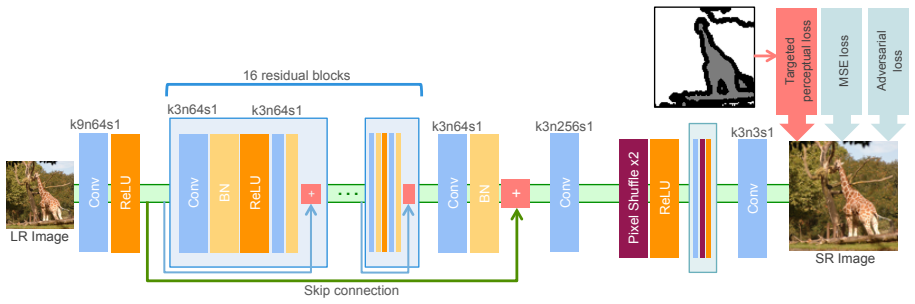
The central object is the OBB label, a three-region mask built from segmentation annotations: the boundary class is obtained by detecting edges between labeled classes and dilating them into a strip, the background class groups the 'sky', 'plant', 'ground', and 'water' classes, and everything else is the object class. These masks enter the targeted perceptual loss $$\mathcal{L}_{\mathrm{perc}} = \$\alpha$\, G_e($I^{{\mathrm{SR}}$}\circ $M^{{\mathrm{boundary}}$}_{\mathrm{OBB}}, $I^{{\mathrm{HR}}$}\circ $M^{{\mathrm{boundary}}$}_{\mathrm{OBB}}) + \$\beta$\, G_b($I^{{\mathrm{SR}}$}\circ $M^{{\mathrm{background}}$}_{\mathrm{OBB}}, $I^{{\mathrm{HR}}$}\circ $M^{{\mathrm{background}}$}_{\mathrm{OBB}}),$$ with the object-term weight set to zero. Here $G_e$ is the feature distance at the early ReLU 2-2 layer of the pre-trained classification network and $G_b$ is the feature distance at the mid-level ReLU 4-3 layer. Because the same mask is applied to both the super-resolved and the high-resolution image, any artificial edges created by masking cancel out, and the computed feature distance is localized to the region being supervised.
What would settle it
A controlled ablation that swaps the two feature-layer assignments, mid-level features on boundaries and early features on backgrounds, while keeping every other loss and hyperparameter fixed would settle the claim: if the original SROBB configuration does not win the user study against this swapped version, the specific layer-to-region mapping is not what drives the improvement.
Extended reading notes
Core claim
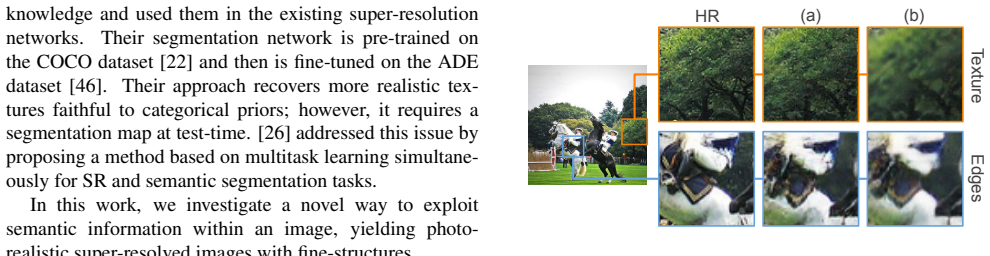
The paper's central claim is that super-resolution quality improves when the perceptual loss is partitioned by semantic region: the same pre-trained network's low-level features are used to judge object-background boundaries, its mid-level features are used to judge background textures, and object interiors are excluded from perceptual supervision. The authors derive the partition from segmentation labels by turning class edges into dilated boundary strips and grouping a fixed set of stuff classes (sky, plant, ground, water) as background. They train a generative adversarial super-resolution decoder with this targeted loss together with pixel-wise and adversarial losses, and report that the resulting images have sharper edges and more realistic textures than those from uniform perceptual loss and from several recent super-resolution methods. The supporting evidence is qualitative comparison plus two user studies: one against other methods and one ablating the targeted loss against the standard perceptual loss.
Load-bearing premise
The load-bearing premise is that the early ReLU 2-2 layer is the right feature space for judging boundary sharpness and the mid-level ReLU 4-3 layer is the right feature space for judging background texture; the paper supports this choice with a single qualitative comparison rather than a quantitative study.
Editorial extensions
If this is right
- A super-resolution system can be trained once on segmentation-annotated data and then run at test time with no segmentation network and no semantic input, because the OBB labels are used only in the loss.
- Switching from a uniform whole-image perceptual loss to the same loss applied only to boundary and background regions is enough to shift user preference, so objective-function design can capture semantic priors without changing the decoder architecture.
- Distortion metrics such as PSNR and SSIM can move in the opposite direction from perceived quality: the baboon example shows lower PSNR and SSIM for SROBB than for baselines while users prefer it.
- The trained model generalizes to benchmark images without outdoor backgrounds, suggesting the boundary and background supervision transfers beyond the training label distribution.
Reading between the lines
- Inference: the region-to-layer mapping need not be fixed; a learned assignment from segmentation classes to feature depths could replace the hand-picked ReLU 2-2 and ReLU 4-3 choice and might improve robustness on categories not in the background list.
- Inference: because the loss is agnostic to the generator architecture, the targeted perceptual term could be stacked onto stronger decoders than the SRGAN backbone used here and would likely combine with architectural gains.
- Inference: a direct quantitative test of boundary sharpness, such as edge-profile width or gradient statistics on the boundary strip, would complement the user studies and reveal whether the perceptual wins come from edges, textures, or both.
Signed reviews
Editorial analysis
A structured set of objections, weighed in public.
Referee Report
Summary. The paper proposes SROBB, a single-image super-resolution method that augments the SRGAN objective with a targeted perceptual loss. Using segmentation labels (from COCO-Stuff), the method partitions each image into background, boundary, and object regions, and applies different VGG feature layers to each: low-level ReLU 2-2 features for boundary sharpness and mid-level ReLU 4-3 features for background texture, while applying no perceptual loss to object regions. The decoder is the same SRGAN generator, trained with MSE, adversarial, and the proposed targeted perceptual loss. The authors report qualitative results on Set5/Set14 and COCO-Stuff, quantitative metrics on two benchmark images, and two user studies favoring SROBB over RCAN, SRGAN, SFT-GAN, and ESRGAN. The central claim is that the method produces more realistic textures and sharper edges and outperforms state-of-the-art methods both on standard benchmarks and in user studies.
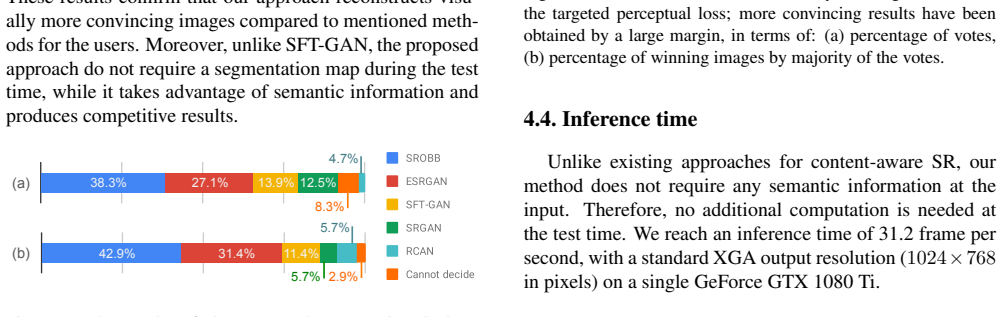
Significance. The underlying idea of semantic-aware, spatially targeted perceptual losses is reasonable and potentially useful: it avoids penalizing object interiors with inappropriate feature statistics and matches feature level to region content. The paper also demonstrates a practical advantage: unlike SFT-GAN, the method requires no segmentation input at test time, and the user-study vote margins are large (617 vs. 436 votes for the nearest competitor). If properly supported, the approach would be a credible contribution to perceptual SR. However, the current evidence does not establish the claimed across-the-board superiority on standard benchmarks, and the evaluation has in-distribution and statistical-rigor issues.
major comments (4)
- [Sec. 4.2.1, Table 1, Fig. 5] The abstract claims that the method outperforms state-of-the-art algorithms on standard benchmarks, but the quantitative evidence on Set5 and Set14 is limited to two images (baby and baboon), and Table 1 does not show consistent superiority: on baboon, SRGAN achieves better PSNR (19.147 vs. 18.660), better SSIM (0.615 vs. 0.607), and better LPIPS (0.220 vs. 0.245) than SROBB. No aggregate PSNR, SSIM, or LPIPS values are reported for the full Set5 or Set14 datasets, and no user study is performed on standard benchmark images. The claim of outperformance on standard benchmarks therefore rests on a subjective reading of two examples and is not quantitatively established.
- [Sec. 4.3.2 and Sec. 4.3.3] Both user studies are conducted on 35 images from COCO-Stuff selected for outdoor scenes, which directly match the training distribution and contain the background classes (sky, plant, ground, water) used to define the targeted loss. This evaluates in-distribution performance and does not test the generalization claim to standard benchmarks. Furthermore, the studies report only raw aggregate vote counts and percentages, without per-image vote distributions, confidence intervals, or significance tests against chance-level voting, so the reported large margins cannot be assessed statistically.
- [Sec. 3.1 and Fig. 2] The mapping from semantic region to VGG feature layer, specifically ReLU 2-2 for boundaries and ReLU 4-3 for background textures, is justified by a single qualitative comparison in Figure 2. Because the entire method depends on this mapping, the authors should provide a quantitative analysis (e.g., reconstruction or perceptual metrics for boundary and background regions across candidate VGG layers) to show that the chosen layers are indeed the most appropriate for each region and that the result is not sensitive to this choice.
- [Sec. 4.1] The loss weights alpha, beta, the boundary dilation diameter d1, and the set of background classes are fixed without ablations or sensitivity analysis. The reported improvements could be contingent on these specific choices; the authors should report results for variations of these hyperparameters and for different background class sets to demonstrate robustness.
minor comments (4)
- [Sec. 4.3.2] There is a typo in the list of methods: 'SROBBB (ours)' should read 'SROBB (ours)'.
- [Sec. 3.1, Eq. (1)] The notation is inconsistent: the loss is introduced as Lperc., and the terms Ge, Gb, Go are used before being formally defined. Please define the feature-distance functions and specify the VGG layers in the equation or immediately after it.
- [Sec. 4.3.1] The claim that LPIPS has a similar trend to distortion metrics is made by citing reference [10]; please clarify whether this refers to the cited workshop paper and provide the specific finding.
- [Fig. 7 and Fig. 8] The pie charts report percentages without stating the total number of votes represented in each chart; adding the vote counts to the figures would improve clarity.
Circularity Check
No circularity: the targeted perceptual loss is defined, trained, and evaluated against external benchmarks and user judgments, with no equation reducing to its inputs.
full rationale
The paper's central contribution is an empirical method: a targeted perceptual loss (Eq. 1) that combines a boundary term using ReLU 2-2, a background term using ReLU 4-3, and no object perceptual term, with hyperparameters alpha and beta set to fixed values chosen during training (Section 4.1). The loss is defined directly in terms of the OBB masks, which are constructed from segmentation labels via standard image-processing operations (derivative and dilation, Section 3.2). No result is 'predicted' from a fitted parameter; the user study (Section 4.3.2) and ablation (Section 4.3.3) compare trained models against external human judgments and against a standard perceptual-loss baseline. The only self-citation is to the authors' prior work [26] 'inspired by' the OBB label construction, but this is not load-bearing: the labeling approach is described in full in Section 3.2 and does not rely on any theorem or uniqueness claim from [26]. The layer-selection choice (ReLU 2-2 vs. ReLU 4-3) is justified by a qualitative figure but is an empirical design decision, not a circularity. Thus the derivation is self-contained with respect to circularity.
Assumptions & free parameters
free parameters (5)
- alpha (boundary loss weight) =
2e-6
- beta (background loss weight) =
1.5e-6
- d1 (boundary dilation disk diameter) =
2.0
- Background class set =
sky, plant, ground, water
- VGG layer choices =
ReLU 2-2 for boundary, ReLU 4-3 for background
assumptions (5)
- domain assumption VGG-16 feature maps at different layers correspond to different levels of image semantics: early layers for edges, mid-level for textures.
- domain assumption Applying the same OBB mask to both HR and SR images makes the artificial boundary contribution to the perceptual distance negligible.
- ad hoc to paper The four classes sky, plant, ground, water constitute the background for the purpose of texture loss.
- ad hoc to paper No perceptual loss on object regions is sufficient; background and boundary losses will indirectly improve objects.
- domain assumption User preference is the appropriate ground truth for perceptual quality.
Cite this review
Pith. "Pith review of SROBB: Targeted Perceptual Loss for Single Image Super-Resolution." pith.science (2026). https://pith.science/paper/DBL7WEDE
@misc{pith2026190807222,
  author       = {Pith},
  title        = {Pith review of: SROBB: Targeted Perceptual Loss for Single Image Super-Resolution},
  year         = {2026},
  howpublished = {\url{https://pith.science/paper/DBL7WEDE}},
  note         = {Machine review of arXiv:1908.07222}
}
read the original abstract
By benefiting from perceptual losses, recent studies have improved significantly the performance of the super-resolution task, where a high-resolution image is resolved from its low-resolution counterpart. Although such objective functions generate near-photorealistic results, their capability is limited, since they estimate the reconstruction error for an entire image in the same way, without considering any semantic information. In this paper, we propose a novel method to benefit from perceptual loss in a more objective way. We optimize a deep network-based decoder with a targeted objective function that penalizes images at different semantic levels using the corresponding terms. In particular, the proposed method leverages our proposed OBB (Object, Background and Boundary) labels, generated from segmentation labels, to estimate a suitable perceptual loss for boundaries, while considering texture similarity for backgrounds. We show that our proposed approach results in more realistic textures and sharper edges, and outperforms other state-of-the-art algorithms in terms of both qualitative results on standard benchmarks and results of extensive user studies.
Figures


Figures from the paper (5 more)


Reference graph
Works this paper leans on
-
[1]
Low-Complexity Single-Image Super-Resolution based on Nonnegative Neighbor Embed- ding
Marco Bevilacqua, Aline Roumy, Christine Guillemot, and Marie-Line Alberi Morel. Low-Complexity Single-Image Super-Resolution based on Nonnegative Neighbor Embed- ding. In British Machine Vision Conference (BMVC), Guild- ford, Surrey, United Kingdom, Sept. 2012
work page 2012
-
[2]
The 2018 PIRM Challenge on Perceptual Image Super-resolution
Yochai Blau, Roey Mechrez, Radu Timofte, Tomer Michaeli, and Lihi Zelnik-Manor. 2018 PIRM challenge on perceptual image super-resolution. CoRR, abs/1809.07517, 2018
work page Pith review arXiv 2018
-
[3]
Super- resolution with deep convolutional sufficient statistics
Joan Bruna, Pablo Sprechmann, and Yann LeCun. Super- resolution with deep convolutional sufficient statistics. arXiv preprint arXiv:1511.05666, 2015
arXiv 2015
-
[4]
Holger Caesar, Jasper R. R. Uijlings, and Vittorio Fer- rari. Coco-stuff: Thing and stuff classes in context. 2018 IEEE/CVF Conference on Computer Vision and Pattern Recognition, pages 1209–1218, 2016
work page 2018
-
[5]
Image super-resolution using deep convolutional net- works
Chao Dong, Chen Change Loy, Kaiming He, and Xiaoou Tang. Image super-resolution using deep convolutional net- works. IEEE Transactions on Pattern Analysis and Machine Intelligence, 38:295–307, 2014
work page 2014
-
[6]
Learning a deep convolutional network for im- age super-resolution
Chao Dong, Chen Change Loy, Kaiming He, and Xiaoou Tang. Learning a deep convolutional network for im- age super-resolution. In David Fleet, Tomas Pajdla, Bernt Schiele, and Tinne Tuytelaars, editors, Computer Vision – ECCV 2014, pages 184–199, Cham, 2014. Springer Interna- tional Publishing
work page 2014
-
[7]
W. Dong, L. Zhang, G. Shi, and X. Wu. Image deblurring and super-resolution by adaptive sparse domain selection and adaptive regularization. IEEE Transactions on Image Pro- cessing, 20(7):1838–1857, July 2011
work page 2011
-
[8]
Leon A. Gatys, Alexander S. Ecker, and Matthias Bethge. A neural algorithm of artistic style. CoRR, abs/1508.06576, 2015
arXiv 2015
Show all 46 references
-
[9]
Gatys, Alexander S
Leon A. Gatys, Alexander S. Ecker, and Matthias Bethge. Texture synthesis and the controlled generation of natu- ral stimuli using convolutional neural networks. CoRR, abs/1505.07376, 2015
2015 arXiv
-
[10]
The unreasonable effectiveness of texture transfer for single image super-resolution
Muhammad Waleed Gondal, Bernhard Sch ¨olkopf, and Michael Hirsch. The unreasonable effectiveness of texture transfer for single image super-resolution. In ECCV Work- shops, 2018
2018
-
[11]
Generative adversarial nets
Ian Goodfellow, Jean Pouget-Abadie, Mehdi Mirza, Bing Xu, David Warde-Farley, Sherjil Ozair, Aaron Courville, and Yoshua Bengio. Generative adversarial nets. In Z. Ghahra- mani, M. Welling, C. Cortes, N. D. Lawrence, and K. Q. Weinberger, editors, Advances in Neural Informatio...
2014
-
[12]
Deep residual learning for image recognition
Kaiming He, Xiangyu Zhang, Shaoqing Ren, and Jian Sun. Deep residual learning for image recognition. 2016 IEEE Conference on Computer Vision and Pattern Recognition (CVPR), pages 770–778, 2015
2016
-
[13]
Identity mappings in deep residual networks
Kaiming He, Xiangyu Zhang, Shaoqing Ren, and Jian Sun. Identity mappings in deep residual networks. ECCV, 2016
2016
-
[14]
Sin- gle image super-resolution from transformed self-exemplars
Jia-Bin Huang, Abhishek Singh, and Narendra Ahuja. Sin- gle image super-resolution from transformed self-exemplars. In IEEE Conference on Computer Vision and Pattern Recog- nition), 2015
2015
-
[15]
Perceptual losses for real-time style transfer and super-resolution
Justin Johnson, Alexandre Alahi, and Li Fei-Fei. Perceptual losses for real-time style transfer and super-resolution. In ECCV, 2016
2016
-
[16]
Accu- rate image super-resolution using very deep convolutional networks
Jiwon Kim, Jung Kwon Lee, and Kyoung Mu Lee. Accu- rate image super-resolution using very deep convolutional networks. 2016 IEEE Conference on Computer Vision and Pattern Recognition (CVPR), pages 1646–1654, 2015
2016
-
[17]
Deeply- recursive convolutional network for image super-resolution
Jiwon Kim, Jung Kwon Lee, and Kyoung Mu Lee. Deeply- recursive convolutional network for image super-resolution. 2016 IEEE Conference on Computer Vision and Pattern Recognition (CVPR), pages 1637–1645, 2015
2016
-
[18]
Adam: A method for stochastic optimization
Diederik Kingma and Jimmy Ba. Adam: A method for stochastic optimization. International Conference on Learn- ing Representations, 2014
2014
-
[19]
Deep laplacian pyramid networks for fast and accurate super-resolution
Wei-Sheng Lai, Jia-Bin Huang, Narendra Ahuja, and Ming- Hsuan Yang. Deep laplacian pyramid networks for fast and accurate super-resolution. 2017 IEEE Conference on Com- puter Vision and Pattern Recognition (CVPR), pages 5835– 5843, 2017
2017
-
[20]
Aitken, Alykhan Tejani, Johannes Totz, Zehan Wang, and Wenzhe Shi
Christian Ledig, Lucas Theis, Ferenc Husz´ar, Jose Caballero, Andrew P. Aitken, Alykhan Tejani, Johannes Totz, Zehan Wang, and Wenzhe Shi. Photo-realistic single image super- resolution using a generative adversarial network. 2017 IEEE Conference on Computer Vision and Pattern...
2017
-
[21]
Enhanced deep residual networks for single image super-resolution
Bee Lim, Sanghyun Son, Heewon Kim, Seungjun Nah, and Kyoung Mu Lee. Enhanced deep residual networks for single image super-resolution. 2017 IEEE Conference on Computer Vision and Pattern Recognition Workshops (CVPRW), pages 1132–1140, 2017
2017
-
[22]
Microsoft coco: Common objects in context
Tsung-Yi Lin, Michael Maire, Serge Belongie, James Hays, Pietro Perona, Deva Ramanan, Piotr Doll´ar, and C Lawrence Zitnick. Microsoft coco: Common objects in context. In European conference on computer vision , pages 740–755. Springer, 2014
2014
-
[23]
Visualizing deep convolutional neural networks using natural pre-images
Aravindh Mahendran and Andrea Vedaldi. Visualizing deep convolutional neural networks using natural pre-images. In- ternational Journal of Computer Vision , 120(3):233255, May 2016
2016
-
[24]
Learning to maintain natural image statistics
Roey Mechrez, Itamar Talmi, Firas Shama, and Lihi Zelnik- Manor. Learning to maintain natural image statistics. arXiv preprint arXiv:1803.04626, 2018
2018 arXiv
-
[25]
Eduardo P ´erez-Pellitero, Mehdi S. M. Sajjadi, Michael Hirsch, and Bernhard Sch ¨olkopf. Photorealistic video super resolution. In Workshop and Challenge on Perceptual Image Restoration and Manipulation (PIRM) at the 15th European Conference on Computer Vision (ECCV), 2018
2018
-
[26]
Benefiting from multitask learn- ing to improve single image super-resolution
Mohammad Saeed Rad, Behzad Bozorgtabar, Claudiu Musat, Urs-Viktor Marti, Max Basler, Hazim Kemal Ekenel, and Jean-Philippe Thiran. Benefiting from multitask learn- ing to improve single image super-resolution. accepted at Neurocomputing (Special Issue on Deep Learning for Image...
2019
-
[27]
Mehdi S. M. Sajjadi, Bernhard Sch ¨olkopf, and Michael Hirsch. Enhancenet: Single image super-resolution through automated texture synthesis. 2017 IEEE International Con- ference on Computer Vision (ICCV) , pages 4501–4510, 2016
2017
-
[28]
Deep inside convolutional networks: Visualising image clas- sification models and saliency maps
Karen Simonyan, Andrea Vedaldi, and Andrew Zisserman. Deep inside convolutional networks: Visualising image clas- sification models and saliency maps. CoRR, abs/1312.6034, 2013
2013 arXiv
-
[29]
Very deep convo- lutional networks for large-scale image recognition
Karen Simonyan and Andrew Zisserman. Very deep convo- lutional networks for large-scale image recognition. CoRR, abs/1409.1556, 2014
2014 arXiv
-
[30]
J. Sun, J. Zhu, and M. F. Tappen. Context-constrained hallu- cination for image super-resolution. In2010 IEEE Computer Society Conference on Computer Vision and Pattern Recog- nition, pages 231–238, June 2010
2010
-
[31]
Mem- net: A persistent memory network for image restoration
Ying Tai, Jian Yang, Xiaoming Liu, and Chunyan Xu. Mem- net: A persistent memory network for image restoration. In Proceedings of the IEEE Conference on Computer Vision and Pattern Recognition, pages 4539–4547, 2017
2017
-
[32]
Seman- tic super-resolution: When and where it is useful? Computer Vision and Image Understanding, September 2015
Radu Timofte, Vincent De Smet, and Luc Van Gool. Seman- tic super-resolution: When and where it is useful? Computer Vision and Image Understanding, September 2015
2015
-
[33]
Tsai and T
R. Tsai and T. Huang. Multiframe image restoration and registration. Advances in Computer Vision and Image Pro- cessing, 1:317339, 1984
1984
-
[34]
Subeesh Vasu, Thekke Madam Nimisha, and A. N. Ra- jagopalan. Analyzing perception-distortion tradeoff using enhanced perceptual super-resolution network. In ECCV Workshops, 2018
2018
-
[35]
Recovering realistic texture in image super-resolution by deep spatial feature transform
Xintao Wang, Ke Yu, Chao Dong, and Chen Change Loy. Recovering realistic texture in image super-resolution by deep spatial feature transform. 2018 IEEE/CVF Conference on Computer Vision and Pattern Recognition , pages 606– 615, 2018
2018
-
[36]
Esrgan: En- hanced super-resolution generative adversarial networks
Xintao Wang, Ke Yu, Shixiang Wu, Jinjin Gu, Yihao Liu, Chao Dong, Yu Qiao, and Chen Change Loy. Esrgan: En- hanced super-resolution generative adversarial networks. In ECCV Workshops, 2018
2018
-
[37]
Zhou Wang, A. C. Bovik, H. R. Sheikh, and E. P. Simon- celli. Image quality assessment: from error visibility to struc- tural similarity. IEEE Transactions on Image Processing , 13(4):600–612, April 2004
2004
-
[38]
Fuchs, and Hod Lipson
Jason Yosinski, Jeff Clune, Anh Mai Nguyen, Thomas J. Fuchs, and Hod Lipson. Understanding neural networks through deep visualization. CoRR, abs/1506.06579, 2015
2015 arXiv
-
[39]
Craft- ing a toolchain for image restoration by deep reinforcement learning
Ke Yu, Chao Dong, Liang Lin, and Chen Change Loy. Craft- ing a toolchain for image restoration by deep reinforcement learning. In Proceedings of the IEEE Conference on Com- puter Vision and Pattern Recognition , pages 2443–2452, 2018
2018
-
[40]
Visualizing and comparing convolutional neural net- works, 2014
Wei Yu, Kuiyuan Yang, Yalong Bai, Hongxun Yao, and Yong Rui. Visualizing and comparing convolutional neural net- works, 2014
2014
-
[41]
Unsupervised image super- resolution using cycle-in-cycle generative adversarial net- works
Yuan Yuan, Siyuan Liu, Jiawei Zhang, Yongbing Zhang, Chao Dong, and Liang Lin. Unsupervised image super- resolution using cycle-in-cycle generative adversarial net- works. 2018 IEEE/CVF Conference on Computer Vision and Pattern Recognition Workshops (CVPRW) , pages 814– 81409, 2018
2018
-
[42]
On single image scale-up using sparse-representations
Roman Zeyde, Michael Elad, and Matan Protter. On single image scale-up using sparse-representations. In Proceedings of the 7th International Conference on Curves and Surfaces, pages 711–730, Berlin, Heidelberg, 2012. Springer-Verlag
2012
-
[43]
Efros, Eli Shecht- man, and Oliver Wang
Richard Zhang, Phillip Isola, Alexei A. Efros, Eli Shecht- man, and Oliver Wang. The unreasonable effectiveness of deep features as a perceptual metric. 2018 IEEE/CVF Con- ference on Computer Vision and Pattern Recognition, pages 586–595, 2018
2018
-
[44]
Image super-resolution using very deep residual channel attention networks
Yulun Zhang, Kunpeng Li, Kai Li, Lichen Wang, Bineng Zhong, and Yun Fu. Image super-resolution using very deep residual channel attention networks. In ECCV, 2018
2018
-
[45]
Residual dense network for image super-resolution
Yulun Zhang, Yapeng Tian, Yu Kong, Bineng Zhong, and Yun Fu. Residual dense network for image super-resolution. In The IEEE Conference on Computer Vision and Pattern Recognition (CVPR), June 2018
2018
-
[46]
Scene parsing through ade20k dataset
Bolei Zhou, Hang Zhao, Xavier Puig, Sanja Fidler, Adela Barriuso, and Antonio Torralba. Scene parsing through ade20k dataset. In Proceedings of the IEEE Conference on Computer Vision and Pattern Recognition, volume 1, page 4. IEEE, 2017
2017
Reviewed August 14, 2026 · model on record in the stance chip above.
Discussion (0). Continue with ORCID to comment.