Improving Beam Quality in Gravitational-Wave Interferometers Illuminated by Higher-Order Laguerre-Gaussian Modes
Pith reviewed 2026-06-30 03:39 UTC · model grok-4.3
The pith
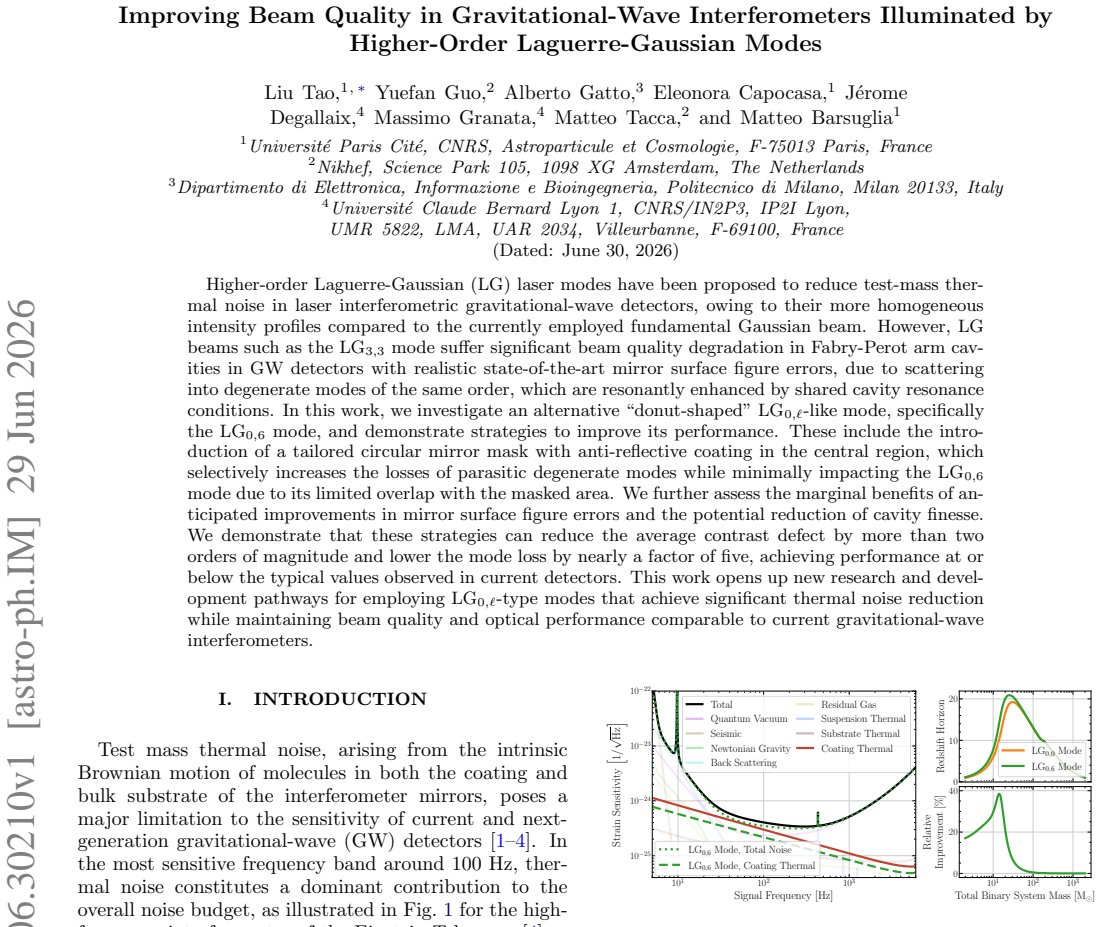
A central mask on test-mass mirrors lets the LG0,6 mode reach beam quality comparable to current gravitational-wave detectors.
A machine-rendered reading of the paper's core claim, the machinery that carries it, and where it could break.
Core claim
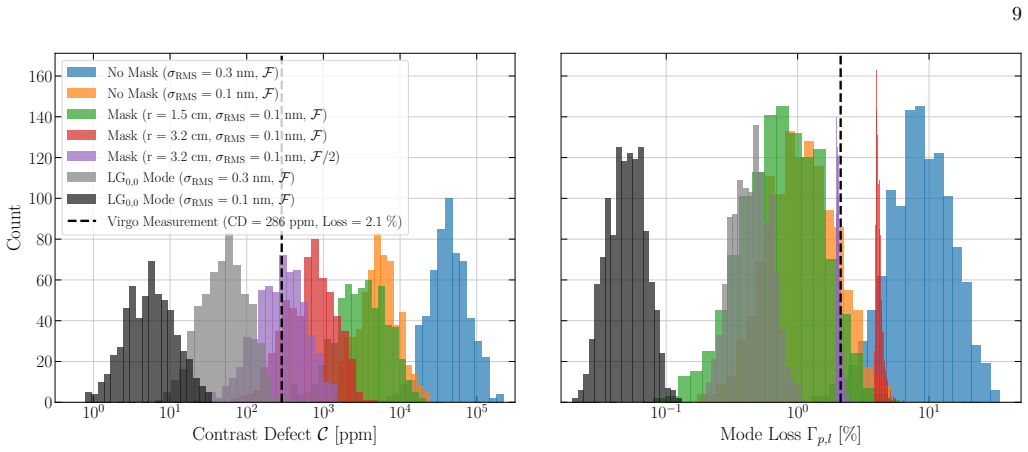
The central claim is that the LG0,6 mode, when used with a tailored circular mirror mask that has anti-reflective coating in the central region, reduces the average contrast defect by more than two orders of magnitude and lowers the mode loss by nearly a factor of five in cavities with state-of-the-art mirror surface figure errors, achieving performance at or below the typical values observed in current detectors.
What carries the argument
The tailored circular mirror mask with anti-reflective coating in the central region, which selectively increases losses of parasitic degenerate modes while minimally impacting the LG0,6 mode due to its limited central overlap.
If this is right
- Average contrast defect falls by more than two orders of magnitude relative to the unmasked case.
- Mode loss drops by nearly a factor of five, reaching or undercutting values typical of current detectors.
- The LG0,ℓ family becomes usable for thermal-noise reduction while preserving required optical performance.
- Further mirror-figure improvements or lower cavity finesse can compound the contrast and loss gains.
- New research pathways open for employing donut-shaped higher-order modes in arm cavities.
Where Pith is reading between the lines
- The same masking approach could be tested on other LG0,ℓ orders or in non-arm cavities to suppress similar degeneracies.
- If real mirrors exhibit scattering beyond the modeled surface errors, the mask benefit would shrink unless the mask radius is re-optimized.
- Lowering finesse as one of the explored levers might allow trading some stored power for still better mode purity in future detector designs.
- The technique might transfer to other high-precision interferometers where mode purity limits sensitivity.
Load-bearing premise
The optical simulations assume that the modeled mirror surface figure errors accurately represent real mirrors and that the central mask introduces no unmodeled scattering, absorption, or alignment sensitivities beyond the selective loss increase for degenerate modes.
What would settle it
A laboratory measurement of contrast defect and round-trip mode loss inside a Fabry-Perot cavity illuminated by an LG0,6 beam, using mirrors whose surface errors match the modeled figure and equipped with the described central anti-reflective mask, that deviates significantly from the simulated reductions.
Figures




read the original abstract
Higher-order Laguerre-Gaussian (LG) laser modes have been proposed to reduce test-mass thermal noise in laser interferometric gravitational-wave detectors, owing to their more homogeneous intensity profiles compared to the currently employed fundamental Gaussian beam. However, LG beams such as the LG$_{3,3}$ mode suffer significant beam quality degradation in Fabry-Perot arm cavities in GW detectors with realistic state-of-the-art mirror surface figure errors, due to scattering into degenerate modes of the same order, which are resonantly enhanced by shared cavity resonance conditions. In this work, we investigate an alternative ''donut-shaped'' LG$_{0,\ell}$-like mode, specifically the LG$_{0,6}$ mode, and demonstrate strategies to improve its performance. These include the introduction of a tailored circular mirror mask with anti-reflective coating in the central region, which selectively increases the losses of parasitic degenerate modes while minimally impacting the LG$_{0,6}$ mode due to its limited overlap with the masked area. We further assess the marginal benefits of anticipated improvements in mirror surface figure errors and the potential reduction of cavity finesse. We demonstrate that these strategies can reduce the average contrast defect by more than two orders of magnitude and lower the mode loss by nearly a factor of five, achieving performance at or below the typical values observed in current detectors. This work opens up new research and development pathways for employing LG$_{0,\ell}$-type modes that achieve significant thermal noise reduction while maintaining beam quality and optical performance comparable to current gravitational-wave interferometers.
Editorial analysis
A structured set of objections, weighed in public.
Referee Report
Summary. The manuscript investigates the use of the LG_{0,6} mode (a 'donut-shaped' higher-order Laguerre-Gaussian mode) in Fabry-Perot arm cavities of gravitational-wave interferometers as an alternative to LG_{3,3}. It proposes a tailored central circular mirror mask with anti-reflective coating to selectively increase losses for parasitic degenerate modes while minimally affecting the target mode, and evaluates this alongside anticipated mirror surface-figure improvements and reduced cavity finesse. Optical simulations are used to claim that these strategies reduce average contrast defect by more than two orders of magnitude and mode loss by nearly a factor of five, reaching performance at or below typical values in current detectors.
Significance. If the simulation assumptions hold, the work identifies a viable path to employ LG_{0,ℓ}-type modes that deliver substantial test-mass thermal-noise reduction while preserving beam quality and optical performance comparable to existing interferometers, thereby opening new R&D directions for detector upgrades.
major comments (3)
- [Abstract] Abstract: the headline performance numbers (>100× contrast-defect reduction, ~5× lower mode loss) are obtained from numerical cavity simulations that inject specific surface-figure-error maps and a central AR-coated mask; the central claim holds only if the injected error maps statistically represent the spatial-frequency content and amplitude of real test-mass surfaces at the relevant scales, yet no cross-checks against measured mirror maps are reported.
- [Abstract] Abstract: the simulations assume the central mask introduces no unmodeled scattering, absorption, or alignment sensitivities beyond the selective loss increase for degenerate modes; this assumption is stated but not independently verified by full-wave scattering calculations or experimental data.
- [Abstract] Abstract: the reported contrast defect and mode-loss figures are benchmarked against 'typical values observed in current detectors' (an external reference) with no equations reducing those figures to quantities fitted from the same dataset, and no error bars or details on post-selection of mask parameters are supplied.
minor comments (1)
- Notation for the LG_{0,6} mode and the mask geometry could be clarified with an explicit diagram or equation defining the mask radius relative to the beam waist.
Simulated Author's Rebuttal
We thank the referee for their careful reading and constructive comments on our manuscript. We address each major comment point by point below, indicating planned revisions where appropriate.
read point-by-point responses
-
Referee: [Abstract] Abstract: the headline performance numbers (>100× contrast-defect reduction, ~5× lower mode loss) are obtained from numerical cavity simulations that inject specific surface-figure-error maps and a central AR-coated mask; the central claim holds only if the injected error maps statistically represent the spatial-frequency content and amplitude of real test-mass surfaces at the relevant scales, yet no cross-checks against measured mirror maps are reported.
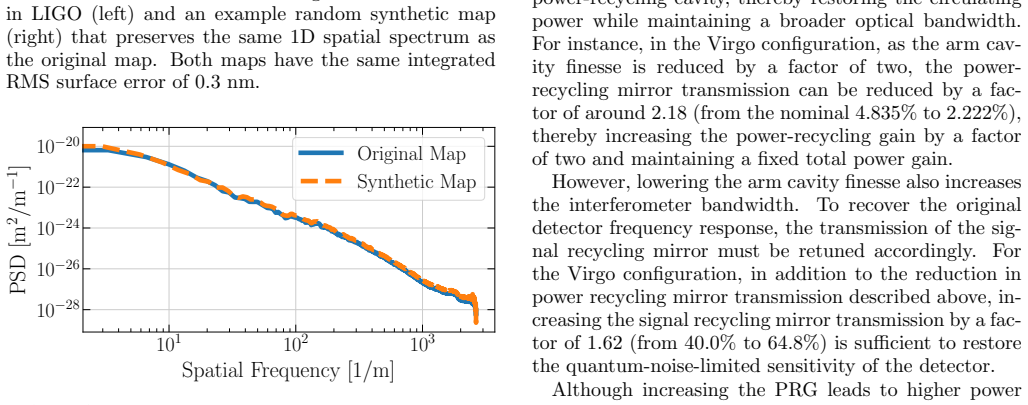
Authors: We agree that explicit validation of the error maps against measured data would strengthen the claims. In the revised manuscript we will add a comparison (new figure or subsection) of the power spectral density and RMS values of our simulated maps against published LIGO test-mass metrology data at the relevant spatial frequencies, confirming statistical representativeness. revision: yes
-
Referee: [Abstract] Abstract: the simulations assume the central mask introduces no unmodeled scattering, absorption, or alignment sensitivities beyond the selective loss increase for degenerate modes; this assumption is stated but not independently verified by full-wave scattering calculations or experimental data.
Authors: The selective-loss mechanism is quantified through overlap integrals in the cavity simulations. We acknowledge that full-wave scattering verification lies outside the present scope. In revision we will expand the discussion of this assumption with order-of-magnitude estimates drawn from existing scattering literature and explicitly note the need for future experimental checks; no change to the reported performance numbers is anticipated. revision: partial
-
Referee: [Abstract] Abstract: the reported contrast defect and mode-loss figures are benchmarked against 'typical values observed in current detectors' (an external reference) with no equations reducing those figures to quantities fitted from the same dataset, and no error bars or details on post-selection of mask parameters are supplied.
Authors: The benchmark values are taken from the cited LIGO performance literature already referenced in the manuscript. We will revise the abstract and relevant sections to include explicit numerical comparisons, cite the source equations or tabulated values, report error bars derived from the simulation ensemble, and add a description of the mask-parameter selection procedure in the methods. revision: yes
Circularity Check
No circularity; numerical results benchmarked to external detector values
full rationale
The paper reports contrast-defect and mode-loss reductions obtained from cavity simulations that inject surface-figure-error maps and a central mask. These outputs are compared directly to 'typical values observed in current detectors,' supplying an external reference point. No equations reduce the reported figures to quantities fitted from the same dataset, no parameters are renamed as predictions, and no self-citation chain is invoked to justify the central claims. The derivation chain therefore remains self-contained against external benchmarks.
Axiom & Free-Parameter Ledger
axioms (1)
- domain assumption Mirror surface figure errors follow realistic state-of-the-art statistics that produce resonant scattering into same-order degenerate modes
Reference graph
Works this paper leans on
-
[1]
Circular mask radii ranging from 0 (no mask) to 4.5 cm in 0.5 cm increments,
-
[2]
Two mirror surface RMS values: 0.3 nm (cur- rent state-of-the-art) and 0.1 nm (anticipated near- future performance),
-
[3]
A reduced cavity finesse case by half for the 0.1 nm RMS scenario,
-
[4]
donut-shaped
Equivalent simulations for the fundamental LG 0,0 mode as a reference study. For each configuration, statistical quantities such as the mean and standard deviation from the Monte Carlo simulations are extracted. Fig. 10 shows the histogram distributions of the contrast defect and mode loss for various representative cases, including no mask, differ- ent R...
-
[5]
E. Capote, W. Jia, N. Aritomi, M. Nakano, V. Xu, R. Abbott, I. Abouelfettouh, R. Adhikari, A. Ananyeva, S. Appert, S. Apple, K. Arai, S. Aston, M. Ball, S. Ballmer, D. Barker, L. Barsotti, B. Berger, J. Bet- zwieser, D. Bhattacharjee, G. Billingsley, S. Biscans, C. Blair, N. Bode, E. Bonilla, V. Bossilkov, A. Branch, A. Brooks, D. Brown, J. Bryant, C. Cah...
-
[6]
Acernese, M
F. Acernese, M. Agathos, K. Agatsuma, D. Aisa, N. Alle- mandou, A. Allocca, J. Amarni, P. Astone, G. Balestri, G. Ballardin, F. Barone, J.-P. Baronick, M. Barsug- lia, A. Basti, F. Basti, T. S. Bauer, V. Bavigadda, M. Bejger, M. G. Beker, C. Belczynski, D. Bersanetti, A. Bertolini, M. Bitossi, M. A. Bizouard, S. Bloemen, M. Blom, M. Boer, G. Bogaert, D. B...
2014
-
[7]
A Horizon Study for Cosmic Explorer: Science, Observatories, and Community
M. Evans, R. X. Adhikari, C. Afle, S. W. Ballmer, S. Bis- coveanu, S. Borhanian, D. A. Brown, Y. Chen, R. Eisen- stein, A. Gruson, A. Gupta, E. D. Hall, R. Huxford, B. Kamai, R. Kashyap, J. S. Kissel, K. Kuns, P. Landry, A. Lenon, G. Lovelace, L. McCuller, K. Ng, A. H. Nitz, J. Read, B. S. Sathyaprakash, D. H. Shoemaker, B. Slag- molen, J. R. Smith, V. Sr...
work page internal anchor Pith review Pith/arXiv arXiv 2021
-
[8]
Code issue time: 13:22, 19 February 2024
ET Steering Committee,ET Design Report Update 2020, Official document ET-0007C-20 (Einstein Tele- scope, 2024) latest release. Code issue time: 13:22, 19 February 2024. Series: Projects ILIAS and Design Study Project, WP5 – Management. Previous releases: ET- 0007A-20, ET-0007B-20
2020
-
[9]
Amato, M
A. Amato, M. Magnozzi, and J. W¨ ohler, Mirror coat- ing research and developments for current and future gravitational-wave detectors, Advanced Photonics Re- 13 search6, 2400117 (2025)
2025
-
[10]
Vajente, L
G. Vajente, L. Yang, A. Davenport, M. Fazio, A. Ananyeva, L. Zhang, G. Billingsley, K. Prasai, A. Markosyan, R. Bassiri, M. M. Fejer, M. Chicoine, F. m. c. Schiettekatte, and C. S. Menoni, Low mechani- cal loss tio 2 : geo2 coatings for reduced thermal noise in gravitational wave interferometers, Phys. Rev. Lett.127, 071101 (2021)
2021
-
[11]
G. D. Cole, S. W. Ballmer, G. Billingsley, S. B. Cata˜ no-Lopez, M. Fejer, P. Fritschel, A. M. Gretars- son, G. M. Harry, D. Kedar, T. Legero, C. Makarem, S. D. Penn, D. H. Reitze, J. Steinlechner, U. Sterr, S. Tanioka, G.-W. Truong, J. Ye, and J. Yu, Substrate-transferred gaas/algaas crystalline coatings for gravitational-wave detectors, Applied Physics ...
-
[12]
R. X. Adhikari, K. Arai, A. F. Brooks, C. Wipf, O. Aguiar, P. Altin, B. Barr, L. Barsotti, R. Bassiri, A. Bell, G. Billingsley, R. Birney, D. Blair, E. Bonilla, J. Briggs, D. D. Brown, R. Byer, H. Cao, M. Con- stancio, S. Cooper, T. Corbitt, D. Coyne, A. Cum- ming, E. Daw, R. deRosa, G. Eddolls, J. Eichholz, M. Evans, M. Fejer, E. C. Ferreira, A. Freise, ...
2020
-
[13]
Fritschel, K
P. Fritschel, K. Kuns, J. Driggers, A. Effler, B. Lantz, D. Ottaway, S. Ballmer, K. Dooley, R. X. Adhikari, M. Evans, B. Farr, G. Gonzalez, P. Schmidt, and S. Raja, Report of the LSC Post-O5 Study Group, LIGO Techni- cal Report LIGO-T2200287 (2022)
2022
-
[14]
Mours, E
B. Mours, E. Tournefier, and J.-Y. Vinet, Thermal noise reduction in interferometric gravitational wave antennas: using high order tem modes, Classical and Quantum Gravity23, 5777 (2006)
2006
-
[15]
Vinet, On special optical modes and thermal issues in advanced gravitational wave interferometric detectors, Living Rev
J.-Y. Vinet, On special optical modes and thermal issues in advanced gravitational wave interferometric detectors, Living Rev. Rel.12, 5 (2009)
2009
-
[16]
Vinet, Thermal noise in advanced gravitational wave interferometric antennas: A comparison between arbitrary order hermite and laguerre gaussian modes, Phys
J.-Y. Vinet, Thermal noise in advanced gravitational wave interferometric antennas: A comparison between arbitrary order hermite and laguerre gaussian modes, Phys. Rev. D82, 042003 (2010)
2010
-
[17]
D’Ambrosio, Nonspherical mirrors to reduce thermoe- lastic noise in advanced gravitational wave interferome- ters, Phys
E. D’Ambrosio, Nonspherical mirrors to reduce thermoe- lastic noise in advanced gravitational wave interferome- ters, Phys. Rev. D67, 102004 (2003)
2003
-
[18]
Bondarescu, O
M. Bondarescu, O. Kogan, and Y. Chen, Optimal light beams and mirror shapes for future ligo interferometers, Phys. Rev. D78, 082002 (2008)
2008
-
[19]
Fulda, K
P. Fulda, K. Kokeyama, S. Chelkowski, and A. Freise, Ex- perimental demonstration of higher-order laguerre-gauss mode interferometry, Phys. Rev. D82, 012002 (2010)
2010
-
[20]
C. Bond, P. Fulda, L. Carbone, K. Kokeyama, and A. Freise, Higher order laguerre-gauss mode degeneracy in realistic, high finesse cavities, Phys. Rev. D84, 102002 (2011)
2011
-
[21]
T. Hong, J. Miller, H. Yamamoto, Y. Chen, and R. Ad- hikari, Effects of mirror aberrations on laguerre-gaussian beams in interferometric gravitational-wave detectors, Phys. Rev. D84, 102001 (2011)
2011
-
[22]
Sorazu, P
B. Sorazu, P. J. Fulda, B. W. Barr, A. S. Bell, C. Bond, L. Carbone, A. Freise, S. Hild, S. H. Huttner, J. Macarthur, and K. A. Strain, Experimental test of higher-order laguerre–gauss modes in the 10 m glasgow prototype interferometer, Classical and Quantum Grav- ity30, 035004 (2013)
2013
-
[23]
Granata, C
M. Granata, C. Buy, R. Ward, and M. Barsuglia, Higher- order laguerre-gauss mode generation and interferometry for gravitational wave detectors, Phys. Rev. Lett.105, 231102 (2010)
2010
-
[24]
Gatto, M
A. Gatto, M. Tacca, F. K´ ef´ elian, C. Buy, and M. Barsug- lia, Fabry-p´ erot-michelson interferometer using higher- order laguerre-gauss modes, Phys. Rev. D90, 122011 (2014)
2014
-
[25]
Allocca, A
A. Allocca, A. Gatto, M. Tacca, R. A. Day, M. Bar- suglia, G. Pillant, C. Buy, and G. Vajente, Higher-order laguerre-gauss interferometry for gravitational-wave de- tectors with in situ mirror defects compensation, Phys. Rev. D92, 102002 (2015)
2015
-
[26]
L. Tao, A. Green, and P. Fulda, Higher-order hermite- gauss modes as a robust flat beam in interferometric gravitational wave detectors, Phys. Rev. D102, 122002 (2020)
2020
-
[27]
S. Ast, S. Di Pace, J. Millo, M. Pichot, M. Turconi, N. Christensen, and W. Chaibi, Higher-order hermite- gauss modes for gravitational waves detection, Phys. Rev. D103, 042008 (2021)
2021
-
[28]
Tao and P
L. Tao and P. Fulda, Experimental demonstrations of alignment and mode matching in optical cavities with higher-order hermite-gauss modes, Phys. Rev. Lett.132, 101402 (2024)
2024
-
[29]
Krenn, M
M. Krenn, M. Malik, M. Erhard, and A. Zeilinger, Or- bital angular momentum of photons and the entangle- ment of laguerre–gaussian modes, Philosophical Trans- actions of the Royal Society A: Mathematical, Physical and Engineering Sciences375, 20150442 (2017)
2017
-
[30]
N. K. Fontaine, R. Ryf, H. Chen, D. T. Neilson, K. Kim, and J. Carpenter, Laguerre-gaussian mode sorter, Na- ture Communications10, 10.1038/s41467-019-09840-4 (2019)
-
[31]
Allen, M
L. Allen, M. W. Beijersbergen, R. J. C. Spreeuw, and J. P. Woerdman, Orbital angular momentum of light and the transformation of laguerre-gaussian laser modes, Phys. Rev. A45, 8185 (1992)
1992
-
[32]
Porfirev, S
A. Porfirev, S. Khonina, and A. Kuchmizhak, Light- matter interaction empowered by orbital angular mo- mentum: Control of matter at the micro- and nanoscale, Progress in Quantum Electronics88, 100459 (2023)
2023
-
[33]
Wanget al., Terabit free-space data transmission em- ploying orbital angular momentum multiplexing, Nature Photon.6, 488 (2012)
J. Wanget al., Terabit free-space data transmission em- ploying orbital angular momentum multiplexing, Nature Photon.6, 488 (2012). 14
2012
-
[34]
Pinard, C
L. Pinard, C. Michel, B. Sassolas, L. Balzarini, J. De- gallaix, V. Dolique, R. Flaminio, D. Forest, M. Granata, B. Lagrange, N. Straniero, J. Teillon, and G. Cagnoli, Mirrors used in the ligo interferometers for first detec- tion of gravitational waves, Appl. Opt.56, C11 (2017)
2017
-
[35]
Billingsley, H
G. Billingsley, H. Yamamoto, and L. Zhang, Character- ization of advanced ligo core optics, LIGO Document LIGO-P1700029-v5 (2017), proceedings of the American Society for Precision Engineering (ASPE) Spring Topical Meeting, Vol. 66, pp. 78–83
2017
-
[36]
Collaboration, Optical characterization of the ad- vanced virgo gravitational wave detector for the o4 ob- serving run, Appl
V. Collaboration, Optical characterization of the ad- vanced virgo gravitational wave detector for the o4 ob- serving run, Appl. Opt.64, 4710 (2025)
2025
-
[37]
Was, Comment to carrier contrast defect vs das tun- ing, Virgo Logbook Entry 68368 (2025)
M. Was, Comment to carrier contrast defect vs das tun- ing, Virgo Logbook Entry 68368 (2025)
2025
-
[38]
Y. Yan, G. Xie, M. P. Lavery, H. Huang, N. Ahmed, C. Bao, Y. Ren, Y. Cao, L. Li, Z. Zhao,et al., High- capacity millimetre-wave communications with orbital angular momentum multiplexing, Nature Communica- tions5, 4876 (2014)
2014
-
[39]
Y. Liu, C. Pan, G. Liu, L. Shi, B. Yang, H. Chen, and D. Wei, Manipulation of oam spectrum in four-wave mix- ing with perfect laguerre–gaussian beams, Opt. Lett.51, 2120 (2026)
2026
-
[40]
C. Bond, D. Brown, A. Freise, and K. A. Strain, Interfer- ometer techniques for gravitational-wave detection, Liv- ing Reviews in Relativity19, 10.1007/s41114-016-0002-8 (2017)
-
[41]
L. Tao, Y. Zhao, Z.-H. Zhu, and P. Fulda, Thermal de- formation reduction in high-power interferometry with higher-order laser modes (2026), arXiv:2605.10222 [astro- ph.IM]
work page internal anchor Pith review Pith/arXiv arXiv 2026
-
[42]
J. G. Rollins, E. Hall, C. Wipf, and L. McCuller, pygwinc: Gravitational Wave Interferometer Noise Calculator, As- trophysics Source Code Library, record ascl:2007.020 (2020), ascl:2007.020
2007
-
[43]
Yamamoto, Reduction of degenerate modes excitation in an imperfect fp cavity for lg33 beam, LIGO Technical Note T1100220-v1 (2011), core Optics, Modelling
H. Yamamoto, Reduction of degenerate modes excitation in an imperfect fp cavity for lg33 beam, LIGO Technical Note T1100220-v1 (2011), core Optics, Modelling
2011
-
[44]
Gatto and M
A. Gatto and M. Barsuglia, Paths to reduce the beam quality degradation in gravitational-wave interferome- ters illuminated with higher-order laguerre-gauss beams (2014), unpublished work
2014
-
[45]
Guo, Optical strategies for gravitational-wave detec- tor enhancement (2025), PhD thesis
Y. Guo, Optical strategies for gravitational-wave detec- tor enhancement (2025), PhD thesis. The work was done using the LG09 mode, but similar results can be obtained for the LG06 mode
2025
-
[46]
D. D. Brown, A. Freise, H. T. Cao, A. Ciobanu, J. Gobeil, A. Green, P. Hapke, P. Jones, M. van der Kolk, K. Kuns, S. Leavey, J. W. Perry, S. Rowlinson, and M. Sall´ e, Fi- nesse (2025)
2025
-
[47]
C. L. Mueller, M. A. Arain, G. Ciani, R. T. DeRosa, A. Effler, D. Feldbaum, V. V. Frolov, P. Fulda, J. Glea- son, M. Heintze, K. Kawabe, E. J. King, K. Kokeyama, W. Z. Korth, R. M. Martin, A. Mullavey, J. Peold, V. Quetschke, D. H. Reitze, D. B. Tanner, C. Vor- vick, L. F. Williams, and G. Mueller, The advanced ligo input optics, Review of Scientific Inst...
-
[48]
B. v. Behren, J. Heinze, N. Bode, and B. Willke, High-power laser beam in higher-order hermite–gaussian modes, Applied Physics Letters122, 191105 (2023)
2023
-
[49]
Degallaix, C
J. Degallaix, C. Michel, B. Sassolas, A. Allocca, G. Cagnoli, L. Balzarini, V. Dolique, R. Flaminio, D. For- est, M. Granata, B. Lagrange, N. Straniero, J. Teillon, and L. Pinard, Large and extremely low loss: the unique challenges of gravitational wave mirrors, J. Opt. Soc. Am. A36, C85 (2019)
2019
discussion (0)
Sign in with ORCID, Apple, or X to comment. Anyone can read and Pith papers without signing in.