REVIEW 1 major objections 7 minor 48 references
A Caching Strategy Towards Maximal D2D Assisted Offloading Gain
T0 review · 1 major / 7 minor · reviewed 2026-08-14 · deepseek-v4-flash
Pith's one-line read This paper derives the D2D success probability under trust-biased user association and uses it to compute per-group caching densities that maximize D2D-assisted offloading gain.
desk verdict Solid stochastic-geometry caching paper with a real but fixable algebra error in the specialized active-ratio formulas that currently undermines the stated global-optimality claims. read the letter →
The pith
A machine-rendered reading of the paper's core claim, the machinery that carries it, and where it could break.
The reading
What carries the argument
The central object is the caching-density vector $c=(c_1,\dots,c_M)$, where $c_m$ is the density of users in group $m$ that store the reference content. The load-bearing identity is the D2D success probability $P_s=\pi R^2\sum_m c_m f(\phi_m)$ with $f(t)=(1-e^{-t})/t$, obtained by associating each requester with the user giving maximum biased received power $p_t B_m d_m^{-\alpha}$ and accounting for interference from active cached users and underlaid base stations. The optimization trick is that fixing $x=\sum_i c_i$ and $y=\sum_i B_i^{2/\alpha} c_i$ makes the objective concave in $c$, so a two-dimensional grid plus gradient projection finds the global maximizer; the asymptotic variant replaces the finite-range $\phi_m$ with a rational expression and is solved as a sum-of-ratios problem.
What would settle it
At equal trust biases, evaluate Proposition 2's $\rho_m$ against the simplified expression (34) at a concrete point, e.g., $M=2$, $R=15$ m, $\lambda_1=\lambda_2=0.02$, and $x=0.02$; if the two quantities differ, then the cache vector from Algorithm 1 maximizes the simplified objective rather than the original model, and a Monte Carlo simulation of active cached users under the paper's association rule would show a systematic gap between predicted and simulated offloading gain.
Extended reading notes
Core claim
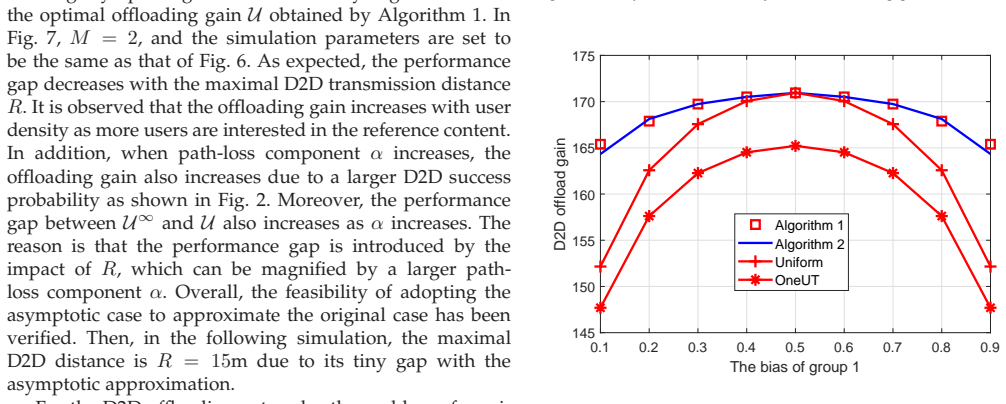
The central claim is that the D2D-assisted offloading gain, $U(c)=(\lambda_0-\sum_i c_i)P_s$, is maximized by a caching vector $c$ that can be found exactly, or to KKT precision, from the derived formula $P_s=\pi R^2\sum_m c_m f(\phi_m)$, where $f(t)=(1-e^{-t})/t$ and $\phi_m$ combines path loss, underlaid cellular interference, and active-user ratios. In the unbiased case the per-group optimum is to spread cached copies as evenly as the capacity constraints allow. In the general case the paper proves that for fixed $x=\sum c_i$ and $y=\sum B_i^{2/\alpha} c_i$ the subproblem is concave, so a two-dimensional search over $(x,y)$ plus gradient projection recovers the global maximizer. A lower-complexity variant lets $R\to\infty$ and solves the resulting sum-of-ratios problem with an alternating algorithm that converges to a KKT point. Simulations with two and three groups show the analytical $P_s$ matching averaged Poisson-point-process realizations and the proposed policies outperforming the OneUT and Uniform caching benchmarks.
Load-bearing premise
The whole result rests on an approximate count of how many cached users are actually transmitting, obtained by treating each user's serving region as a typical cell in a random tessellation; if that count is inaccurate, or if the simplified formulas used in the optimization differ from the original derivation, the computed optimal cache densities will not maximize the true offloading gain.
Editorial extensions
If this is right
- Under equal trust biases, the optimal caching density spreads cached copies as evenly across user groups as capacity limits allow, because no group's copies enjoy an association advantage.
- With unequal trust biases, optimal caching concentrates copies in low-trust groups; the paper's numerical results show caching density is inversely proportional to the trust bias, since rarely chosen cached copies add less interference per successful transmission.
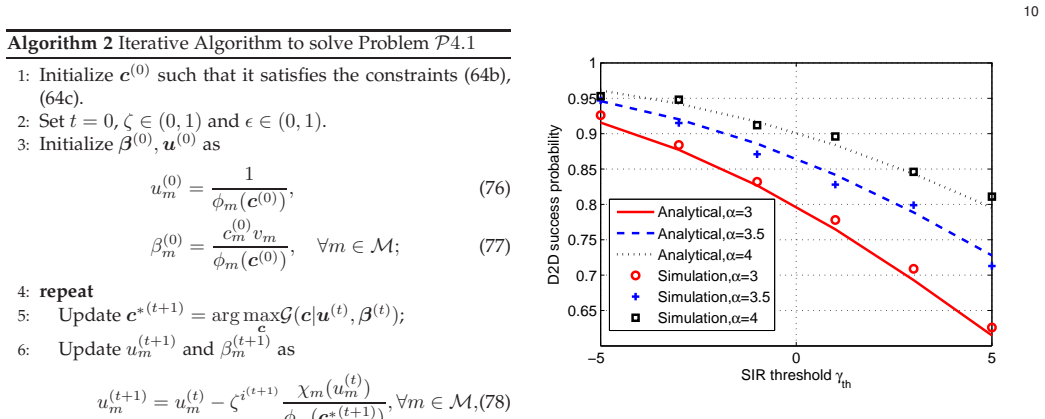
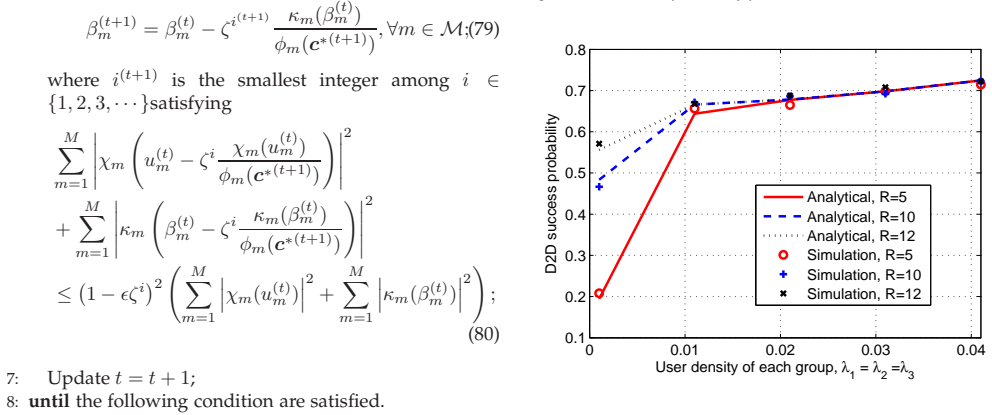
- The derived success probability (29) is accurate enough to replace simulation for parameter studies, with the paper reporting close agreement against Monte Carlo PPP realizations across path-loss exponents, D2D ranges, and SIR thresholds.
- For large D2D range $R$, the asymptotic formula (56) closely tracks the finite-range optimum, and the iterative algorithm converges to a KKT point within tens of iterations regardless of initialization.
- The optimal total cache density is strictly below $\lambda_0$: because offloading gain equals $(\lambda_0-\sum_i c_i)P_s$, caching more copies eventually removes too many requesters, so the objective is not monotone in cache size.
Reading between the lines
- The governing rule that cache density should be inversely proportional to association bias is a transferable design principle: any network where requesters pick servers by weighted received power should place extra copies where users are unlikely to be chosen, lowering interference from seldom-used caches.
- A natural test beyond the paper is to replace the Poisson-Voronoi active-user count with a direct simulation of the same association rule and check whether Algorithm 1's cache vector stays near-optimal under non-Poisson user layouts, such as clustered hotspots.
- The fixed-$x$, fixed-$y$ concavity reduction could be applied to multi-content Zipf catalogues, with one per-content transmission and interference budget, to see whether the inverse-bias rule persists when popularity varies across contents.
- Because the paper models a single static reference content, an immediate dynamic extension is to re-run the per-group optimization periodically and compare it to a greedy online caching policy under time-varying preferences.
Signed reviews
Editorial analysis
A structured set of objections, weighed in public.
Referee Report
Summary. This paper studies probabilistic content caching in a D2D underlay network where users are partitioned into social groups with different content interest densities and trust biases. A user requests the reference content from the UT with maximum biased received power, and the paper derives an analytical D2D success probability Ps (Propositions 1-3, Eq. (29)). The offloading gain is defined as U=(lambda0 - sum_i c_i) Ps, and the authors address its maximization: a closed-form water-filling solution for the unbiased case (Section 4.1), a grid-search/gradient-projection Algorithm 1 for the general case (Section 4.2), and a low-complexity iterative Algorithm 2 based on an asymptotic approximation (Section 4.3). Simulations compare the proposed schemes with OneUT and Uniform baselines and report improved offloading gain.
Significance. The paper's main modeling contribution, Propositions 1-3 and the resulting expression Ps = pi R^2 sum_m c_m f(phi_m), is elegant and appears internally consistent; the derivation is self-contained, and the simulation validation of the success probability is a genuine strength. The cancellation of P_m in P_m * Pth_m is non-trivial and useful. If the algebraic errors in the active-ratio simplifications are corrected, the framework would provide a tractable trust-aware caching design with no fitted parameters, and the proposed algorithms would be credible. At present, however, the optimization claims are not yet supported because the formulas feeding the objective are inconsistent with the model.
major comments (1)
- [Section 4.1, Eq. (34); Section 4.2, Eq. (48)] Equations (34) and (48) are algebraically inconsistent with Proposition 2. In the unbiased case, Proposition 1 gives P_m=(c_m/x)E(x) for x=sum_i c_i, so P_m/c_m=E(x)/x; substituting this into Eq. (14) yields the first factor (1+(lambda0-x)E(x)/(3.5x))^{-3.5}, whereas Eq. (34) has (1+(lambda0-x)/(3.5xE(x)))^{-3.5}, with E(x) inverted. The same inversion appears in Eq. (48): the correct factor is (1+v_m(lambda0-x)E_m(y)/(3.5y))^{-3.5}, not (1+v_m(lambda0-x)/(3.5yE_m(y)))^{-3.5}. Because rho_m enters phi_m in Eq. (49) and hence Ps in Eq. (29), the objective optimized in P2.1, P3, and Algorithm 1 is evaluated with a different active-interference density than the one derived in Proposition 2. The closed-form unbiased solution and the global-optimality claim for Algorithm 1 are therefore not supported until these formulas are corrected and the numerical results in Section 5 are re-run.
minor comments (7)
- [Notation] The symbol P_m is used both for the biased received power in Eq. (2) and for the serving probability in Proposition 1 and throughout Section 3; this collision makes Proposition 2 difficult to parse and should be resolved by renaming one of the two quantities.
- [Proposition 3, Eq. (28)] The definition of phi_m in Proposition 3 includes the factor pi R^2, but the proof in Eq. (28) defines phi_m without it; this creates ambiguity in Eq. (29), where Ps is written as pi R^2 sum c_m f(phi_m). Please align the two definitions.
- [Eq. (39)] The displayed identity 2f'(phi_m)+phi_m f''(phi_m) = -e^{-phi_m} phi_m^2 / phi_m^3 is algebraically incorrect; direct differentiation gives -e^{-phi_m}. The negativity conclusion is unaffected, but the identity should be corrected.
- [Section 4.2, Eq. (52)] The statement that the optimal step length s^{(t)} can be found by bisection 'since the objective function is increasing with respect to s' is contradictory; a concave function along a line is unimodal, not monotone increasing. Please replace this with the correct derivative-based line-search condition.
- [Fig. 9] In the caption of Fig. 9, the parameter list 'lambda1=0.04, lambda1=0.02' should presumably read 'lambda1=0.04, lambda2=0.02'.
- [Section 5.2, Fig. 11] The sentence introducing the invariance of the gap in Fig. 11 is incomplete ('It is observed that the performance gaps between the proposed Algorithm Moreover...'), making the claimed observation unclear.
- [Section 5.2, baseline OneUT] The 'OneUT' baseline is described with cm=delta, where delta is the search stepsize of Algorithm 1; tying a baseline to an arbitrary algorithmic parameter makes the comparison difficult to interpret, and the description should be aligned with the scheme in [8].
Circularity Check
No significant circularity: the paper's derivation is self-contained, with model parameters as inputs and no fitted quantity renamed as a prediction.
full rationale
The paper's derivation chain is self-contained rather than circular. The D2D success probability Ps in Eq. (29) is assembled from Proposition 1 (association probability), Proposition 2 (active-user ratio), and Proposition 3 (SIR success probability), all expressed in terms of exogenous model inputs: trust biases Bm, interested-user densities λm, caching densities cm, D2D range R, BS density λB, path-loss exponent α, and SIR threshold γth. Nothing in these steps is fitted to the target offloading gain U; instead, U is defined directly from Ps and the densities (λm − cm) of requesters, and the optimization problems P1–P4 optimize that same analytic expression. The active-ratio approximation in Proposition 2 is imported from external Voronoi-cell literature ([39]–[42]) as a modeling tool, not from the paper's own conclusions, and the paper validates the analytical success probability against independent Monte Carlo simulation rather than tuning parameters to match it. Self-citations such as [23], [34], and [35] are contextual (prior D2D work and underlay assumptions) and are not load-bearing for the central derivation or the claimed global optimality. The apparent inversion of the E(·) factor in Eqs. (34) and (48) relative to substituting the unbiased/general Pm into Proposition 2 is an internal algebraic consistency issue in how the active ratio is written for the optimization, but it is not a circularity: the active-ratio model still comes from an external approximation and is not defined by, fitted to, or equivalent to the offloading gain being predicted. Since no prediction reduces to an input by construction and no load-bearing claim rests on self-citation, the appropriate circularity score is 0.
Assumptions & free parameters
assumptions (6)
- domain assumption User locations and base station locations follow independent Poisson point processes.
- standard math Caching is performed by independent thinning, so users that cache and users that request form independent PPPs.
- domain assumption Users select the serving transmitter by maximum biased received power, with trust bias Bm multiplying the received power.
- domain assumption Active transmitters form an independent PPP with density ρm cm, and the association area of a transmitter follows the gamma approximation for Poisson Voronoi cells.
- domain assumption Different user groups use orthogonal frequencies, so interference only comes from the same group plus all base stations.
- domain assumption Algorithm 2 converges to a KKT point of the sum-of-ratios problem.
Cite this review
Pith. "Pith review of A Caching Strategy Towards Maximal D2D Assisted Offloading Gain." pith.science (2026). https://pith.science/paper/DCIRJZ6G
@misc{pith2026190800786,
  author       = {Pith},
  title        = {Pith review of: A Caching Strategy Towards Maximal D2D Assisted Offloading Gain},
  year         = {2026},
  howpublished = {\url{https://pith.science/paper/DCIRJZ6G}},
  note         = {Machine review of arXiv:1908.00786}
}
read the original abstract
Device-to-Device (D2D) communications incorporated with content caching have been regarded as a promising way to offload the cellular traffic data. In this paper, the caching strategy is investigated to maximize the D2D offloading gain with the comprehensive consideration of user collaborative characteristics as well as the physical transmission conditions. Specifically, for a given content, the number of interested users in different groups is different, and users always ask the most trustworthy user in proximity for D2D transmissions. An analytical expression of the D2D success probability is first derived, which represents the probability that the received signal to interference ratio is no less than a given threshold. As the formulated problem is non-convex, the optimal caching strategy for the special unbiased case is derived in a closed form, and a numerical searching algorithm is proposed to obtain the globally optimal solution for the general case. To reduce the computational complexity, an iterative algorithm based on the asymptotic approximation of the D2D success probability is proposed to obtain the solution that satisfies the Karush-Kuhn-Tucker conditions. The simulation results verify the effectiveness of the analytical results and show that the proposed algorithm outperforms the existing schemes in terms of offloading gain.
Figures

Figures from the paper (7 more)




Reference graph
Works this paper leans on
-
[1]
Cisco visual networking index: global mobile da ta traffic forecast update, 2015–2020,
Cisco, “Cisco visual networking index: global mobile da ta traffic forecast update, 2015–2020,” T ech. Rep, 2016
work page 2015
-
[2]
Distributed antenna sys tems for mobile communications in high speed trains,
J. Wang, H. Zhu, and N. J. Gomes, “Distributed antenna sys tems for mobile communications in high speed trains,” IEEE Journal on Selected Areas in Communications , vol. 30, no. 4, pp. 675–683, May 2012
work page 2012
-
[3]
Performance comparison between distributed an tenna and microcellular systems,
H. Zhu, “Performance comparison between distributed an tenna and microcellular systems,” IEEE Journal on Selected Areas in Com- munications, vol. 29, no. 6, pp. 1151–1163, June 2011
work page 2011
-
[4]
Data offloading techniques in cellular networ ks: a survey ,
F. Rebecchi, M. Dias de Amorim, V . Conan, A. Passarella, R . Bruno, and M. Conti, “Data offloading techniques in cellular networ ks: a survey ,” IEEE Communication Surveys and T utorials. , vol. 17, no. 2, pp. 580–603, 2015
work page 2015
-
[5]
X. Chen, J. Wu, Y . Cai, H. Zhang, and T. Chen, “Energy-effic iency oriented traffic offloading in wireless networks: A brief sur vey and a learning approach for heterogeneous cellular networks,” IEEE Journal on Selected Areas in Communications , vol. 33, no. 4, pp. 627– 640, 2015
work page 2015
-
[6]
Wireless device-to-d evice caching networks: Basic principles and system performance ,
M. Ji, G. Caire, and A. F. Molisch, “Wireless device-to-d evice caching networks: Basic principles and system performance ,” IEEE Journal on Selected Areas in Communications , vol. 34, no. 1, pp. 176–189, Jan 2016
work page 2016
-
[7]
Base-station assisted device-to-device communications for high- throughput wireless video networks,
N. Golrezaei, P . Mansourifard, A. F. Molisch, and A. G. Di makis, “Base-station assisted device-to-device communications for high- throughput wireless video networks,” IEEE T ransactions on Wire- less Communications , vol. 13, no. 7, pp. 3665–3676, July 2014
work page 2014
-
[8]
D. Malak, M. Al-Shalash, and J. G. Andrews, “Optimizing co n- tent caching to maximize the density of successful receptio ns in device-to-device networking,” IEEE T ransactions on Communica- tions, vol. 64, no. 10, pp. 4365–4380, Oct 2016
work page 2016
Show all 48 references
-
[9]
Optimal caching and sched uling for cache-enabled D2D communications,
B. Chen, C. Y ang, and Z. Xiong, “Optimal caching and sched uling for cache-enabled D2D communications,” IEEE Communications Letters, vol. 21, no. 5, pp. 1155–1158, May 2017
2017
-
[10]
Multip le mobile data offloading through disruption tolerant network s,
Y . Li, M. Qian, D. Jin, P . Hui, Z. Wang, and S. Chen, “Multip le mobile data offloading through disruption tolerant network s,” IEEE T ransactions on Mobile Computing , vol. 13, no. 7, pp. 1579– 1596, 2014
2014
-
[12]
Spatial and social paradigms for interference and coverage analysi s in underlay d2d network,
H. A. Mustafa, M. Z. Shakir, M. A. Imran, and R. Tafazolli, “Spatial and social paradigms for interference and coverage analysi s in underlay d2d network,” IEEE T ransactions on Vehicular T echnology, vol. 66, no. 10, pp. 9328–9337, 2017
2017
-
[13]
Caching policy optimization for D2 D communications by learning user preference,
B. Chen and C. Y ang, “Caching policy optimization for D2 D communications by learning user preference,” arXiv preprint arXiv:1704.04860, 2017
2017 arXiv
-
[14]
A routing protocol for so cially selfish delay tolerant networks,
Q. Li, W. Gao, S. Zhu, and G. Cao, “A routing protocol for so cially selfish delay tolerant networks,” Ad Hoc Networks , vol. 10, no. 8, pp. 1619–1632, 2012
2012
-
[15]
Social si milarity favors cooperation: the distributed content replication c ase,
E. Jaho, M. Karaliopoulos, and I. Stavrakakis, “Social si milarity favors cooperation: the distributed content replication c ase,” IEEE T ransactions on Parallel and Distributed Systems , vol. 24, no. 3, pp. 601–613, 2013
2013
-
[16]
NB-IoT for D2D- enhanced content uploading with social trustworthiness in 5G systems,
L. Militano, A. Orsino, G. Araniti, and A. Iera, “NB-IoT for D2D- enhanced content uploading with social trustworthiness in 5G systems,” Future Internet, vol. 9, no. 3, p. 31, 2017. 15
2017
-
[17]
A survey on human-centri c com- munications in non-cooperative wireless relay networks,
B. Jedari, F. Xia, and Z. Ning, “A survey on human-centri c com- munications in non-cooperative wireless relay networks,” IEEE Communications Surveys & T utorials , vol. 20, no. 2, pp. 914–944, 2018
2018
-
[18]
Secure rout ing based on social similarity in opportunistic networks,
L. Y ao, Y . Man, Z. Huang, J. Deng, and X. Wang, “Secure rout ing based on social similarity in opportunistic networks,” IEEE T rans- actions on Wireless Communications , vol. 15, no. 1, pp. 594–605, Jan 2016
2016
-
[19]
Social-aware vid eo multicast based on device-to-device communications,
Y . Cao, T. Jiang, X. Chen, and J. Zhang, “Social-aware vid eo multicast based on device-to-device communications,” IEEE T rans- actions on Mobile Computing , vol. 15, no. 6, pp. 1528–1539, 2016
2016
-
[20]
Exploiting so cial ties for cooperative D2D communications: A mobile social networ king case,
X. Chen, B. Proulx, X. Gong, and J. Zhang, “Exploiting so cial ties for cooperative D2D communications: A mobile social networ king case,” IEEE/ACM T ransactions on Networking , vol. 23, no. 5, pp. 1471–1484, Oct 2015
2015
-
[21]
Caching based socially-aware D2D communications in wireless content del ivery networks: a hypergraph framework,
B. Bai, L. Wang, Z. Han, W. Chen, and T. Svensson, “Caching based socially-aware D2D communications in wireless content del ivery networks: a hypergraph framework,” IEEE Wireless Communica- tions, vol. 23, no. 4, pp. 74–81, August 2016
2016
-
[22]
Socially enabled wireless networks: resource allocation via bipartite grap h match- ing,
L. Wang, H. Wu, W. Wang, and K. C. Chen, “Socially enabled wireless networks: resource allocation via bipartite grap h match- ing,” IEEE Communications Magazine , vol. 53, no. 10, pp. 128–135, October 2015
2015
-
[23]
On consideration of content preference and sharing willin gness in D2D assisted offloading,
Y . Pan, C. Pan, H. Zhu, Q. Z. Ahmed, M. Chen, and J. Wang, “On consideration of content preference and sharing willin gness in D2D assisted offloading,” IEEE Journal on Selected Areas in Communications, vol. 35, no. 4, pp. 978–993, April 2017
2017
-
[24]
Collaborative cachi ng and matching for d2d content sharing,
D. Wu, L. Zhou, Y . Cai, and Y . Qian, “Collaborative cachi ng and matching for d2d content sharing,” IEEE Wireless Communications , vol. 25, no. 3, pp. 43–49, JUNE 2018
2018
-
[25]
An incentive mechanism integ rat- ing joint power, channel and link management for social-awa re d2d content sharing and proactive caching,
C. Yi, S. Huang, and J. Cai, “An incentive mechanism integ rat- ing joint power, channel and link management for social-awa re d2d content sharing and proactive caching,” IEEE T ransactions on Mobile Computing, vol. 17, no. 4, pp. 789–802, 2018
2018
-
[26]
Socially aware caching strategy in device-to-device commu nica- tion networks,
C. Ma, M. Ding, H. Chen, Z. Lin, G. Mao, Y . Liang, and B. Vuc etic, “Socially aware caching strategy in device-to-device commu nica- tion networks,” IEEE T ransactions on Vehicular T echnology, vol. 67, no. 5, pp. 4615–4629, May 2018
2018
-
[27]
Imagenet classifi- cation with deep convolutional neural networks,
A. Krizhevsky , I. Sutskever, and G. E. Hinton, “Imagenet classifi- cation with deep convolutional neural networks,” in Advances in neural information processing systems , 2012, pp. 1097–1105
2012
-
[28]
S. N. Chiu, D. Stoyan, W. S. Kendall, and J. Mecke, Stochastic geometry and its applications . John Wiley & Sons, 2013
2013
-
[29]
Dynamic trust m an- agement for delay tolerant networks and its application to s ecure routing,
R. Chen, F. Bao, M. Chang, and J.-H. Cho, “Dynamic trust m an- agement for delay tolerant networks and its application to s ecure routing,” IEEE T ransactions on Parallel and Distributed Systems , vol. 25, no. 5, pp. 1200–1210, 2014
2014
-
[30]
Trust-based and social-aware coalition formation game fo r mul- tihop data uploading in 5G systems,
L. Militano, A. Orsino, G. Araniti, M. Nitti, L. Atzori, and A. Iera, “Trust-based and social-aware coalition formation game fo r mul- tihop data uploading in 5G systems,” Computer Networks, vol. 111, pp. 141–151, 2016
2016
-
[31]
Cooperative local cachin g under heterogeneous file preferences,
Y . Guo, L. Duan, and R. Zhang, “Cooperative local cachin g under heterogeneous file preferences,” IEEE T ransactions on Communica- tions, vol. 65, no. 1, pp. 444–457, Jan 2017
2017
-
[32]
The benefits of hybrid caching in gauss–poisson D2D networks,
N. Deng and M. Haenggi, “The benefits of hybrid caching in gauss–poisson D2D networks,” IEEE Journal on Selected Areas in Communications, vol. 36, no. 6, pp. 1217–1230, 2018
2018
-
[33]
Analysis of D2D underlaid cellular networks: SIR meta distribution and mean local delay ,
M. Salehi, A. Mohammadi, and M. Haenggi, “Analysis of D2D underlaid cellular networks: SIR meta distribution and mean local delay ,” IEEE T ransactions on Communications , vol. 65, no. 7, pp. 2904–2916, July 2017
2017
-
[34]
Downl ink resource allocation and power control for device-to-devic e com- munication underlaying cellular networks,
Z. Y ang, N. Huang, H. Xu, Y . Pan, Y . Li, and M. Chen, “Downl ink resource allocation and power control for device-to-devic e com- munication underlaying cellular networks,” IEEE Communications Letters, vol. 20, no. 7, pp. 1449–1452, July 2016
2016
-
[35]
Resource allocatio n for D2D communications underlaying a NOMA-based cellular network ,
Y . Pan, C. Pan, Z. Y ang, and M. Chen, “Resource allocatio n for D2D communications underlaying a NOMA-based cellular network ,” IEEE Wireless Communications Letters , vol. PP , no. 99, pp. 1–1, 2017
2017
-
[36]
Chunk-based resource allocation in ofdma systems - part i: chunk allocation,
H. Zhu and J. Wang, “Chunk-based resource allocation in ofdma systems - part i: chunk allocation,” IEEE T ransactions on Communi- cations, vol. 57, no. 9, pp. 2734–2744, Sep. 2009
2009
-
[37]
Chunk-based resource allocation in ofdma systems part ii: Joint chunk, power and bit allocation,
——, “Chunk-based resource allocation in ofdma systems part ii: Joint chunk, power and bit allocation,” IEEE T ransactions on Communications, vol. 60, no. 2, pp. 499–509, February 2012
2012
-
[38]
Radio resource allocation for ofdma systems in high speed environments,
H. Zhu, “Radio resource allocation for ofdma systems in high speed environments,” IEEE Journal on Selected Areas in Commu- nications, vol. 30, no. 4, pp. 748–759, May 2012
2012
-
[39]
Coverage and economy of cellular net works with many base stations,
S. Lee and K. Huang, “Coverage and economy of cellular net works with many base stations,” IEEE Communications Letters , vol. 16, no. 7, pp. 1038–1040, 2012
2012
-
[40]
Offloading in het - erogeneous networks: Modelling, analysis, and design insi ghts,
S. Singh, H. S. Dhillon, and J. G. Andrews, “Offloading in het - erogeneous networks: Modelling, analysis, and design insi ghts,” IEEE T ransactions on Wireless Communications , vol. 12, no. 5, pp. 2484–2497, 2013
2013
-
[41]
Caching policy toward maximal succe ss probability and area spectral efficiency of cache-enabled H etNets,
D. Liu and C. Y ang, “Caching policy toward maximal succe ss probability and area spectral efficiency of cache-enabled H etNets,” IEEE T ransactions on Communications, vol. 65, no. 6, pp. 2699–2714, June 2017
2017
-
[42]
On the size distribution of po isson voronoi cells,
J.-S. Ferenc and Z. N´ eda, “On the size distribution of po isson voronoi cells,” Physica A: Statistical Mechanics and its Applications , vol. 385, no. 2, pp. 518–526, 2007
2007
-
[43]
A tractable approach to coverage and rate in cellular networks,
J. G. Andrews, F. Baccelli, and R. K. Ganti, “A tractable approach to coverage and rate in cellular networks,” IEEE T ans. Wireless Commun., vol. 59, no. 11, pp. 3122–3134, November 2011
2011
-
[44]
D. P . Bertsekas, Nonlinear programming. Athena scientific Belmont, 1999
1999
-
[45]
Boyd and L
S. Boyd and L. Vandenberghe, Convex Optimization . Cambridge university press, 2004
2004
-
[46]
Pilot reuse amon g D2D users in D2D underlaid massive MIMO systems,
H. Xu, W. Xu, Z. Y ang, J. Shi, and M. Chen, “Pilot reuse amon g D2D users in D2D underlaid massive MIMO systems,” IEEE T ransactions on Vehicular T echnology, vol. PP , no. 99, pp. 1–1, 2017
2017
-
[47]
Coordinated m ulticell multiuser precoding for maximizing weighted sum energy effi - ciency ,
S. He, Y . Huang, L. Y ang, and B. Ottersten, “Coordinated m ulticell multiuser precoding for maximizing weighted sum energy effi - ciency ,” IEEE T ransactions on Signal Processing , vol. 62, no. 3, pp. 741–751, Feb 2014
2014
-
[48]
Energy- efficient resource allocation in D2D underlaid cellular upl inks,
H. Xu, W. Xu, Z. Y ang, Y . Pan, J. Shi, and M. Chen, “Energy- efficient resource allocation in D2D underlaid cellular upl inks,” IEEE Communications Letters , vol. 21, no. 3, pp. 560–563, March 2017
2017
-
[49]
An efficient global optimization algorithm fo r nonlinear sum-of-ratios problem,
Y . Jong, “An efficient global optimization algorithm fo r nonlinear sum-of-ratios problem,” online: www. optimizationonline. org , 2012
2012
Reviewed August 14, 2026 · model on record in the stance chip above.
Discussion (0). Continue with ORCID to comment.