REVIEW 4 major objections 5 minor 58 references
MLI-NeRF: Multi-Light Intrinsic-Aware Neural Radiance Fields
T0 review · 4 major / 5 minor · reviewed 2026-08-12 · deepseek-v4-flash
Pith's one-line read Multiple light positions teach a neural radiance field to separate reflectance from shading without ground-truth intrinsic images, using physics-based pseudo labels.
desk verdict Genuinely new multi-light pseudo-label approach with impressive synthetic results; the real-world claim rests on a direct-Lambertian assumption that is not yet tested quantitatively. read the letter →
The pith
A machine-rendered reading of the paper's core claim, the machinery that carries it, and where it could break.
The reading
What carries the argument
The central machinery is physics-based pseudo label generation: use the SDF geometry to compute normals and sphere-traced visibility, convert them into a Lambertian pseudo shading $S^* = (\max(\vec{N}\cdot\vec{L},0) \otimes V)^\gamma$, and then derive pseudo reflectance by dividing each observed image by its pseudo shading and merging multiple lighting observations with K-means. This replaces statistical priors with a direct geometric-optical constraint; the labels then supervise dedicated reflectance and shading MLPs in Stage 2.
What would settle it
A concrete test that would falsify the central claim: run MLI-NeRF on a real scene containing a visible glossy or mirror-like surface under the multi-light capture setup, and check whether the predicted reflectance contains specular highlights or color from the environment, and whether the residual term remains large. If the residual absorbs a large fraction of the image energy or the reflectance inherits lighting-dependent colors, the direct-Lambertian pseudo-shading assumption fails.
Extended reading notes
Core claim
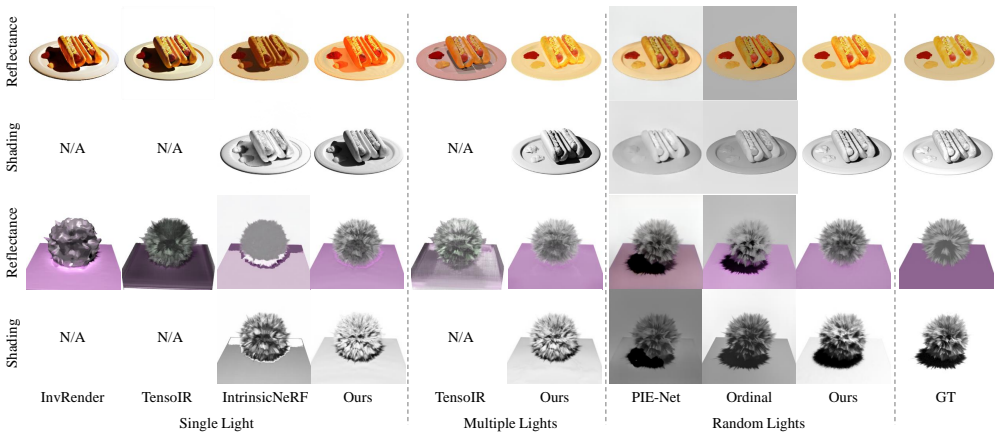
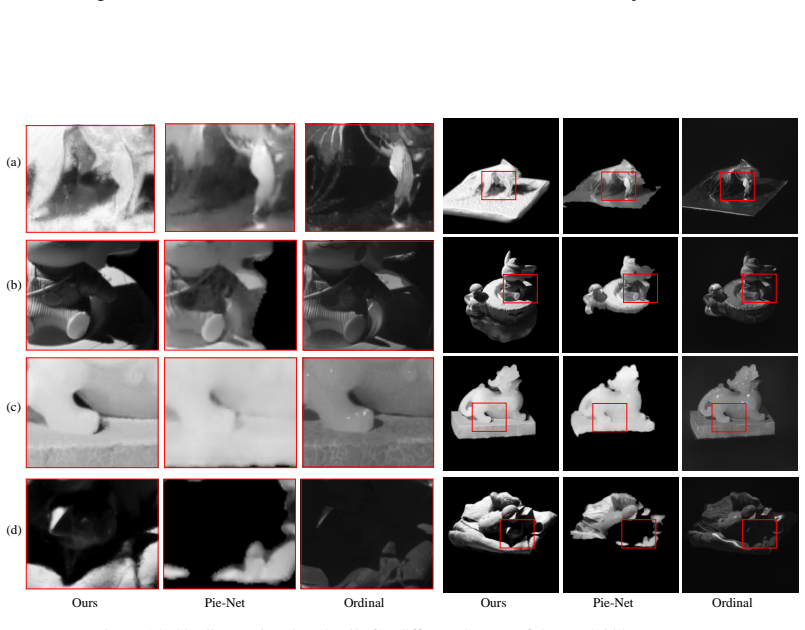
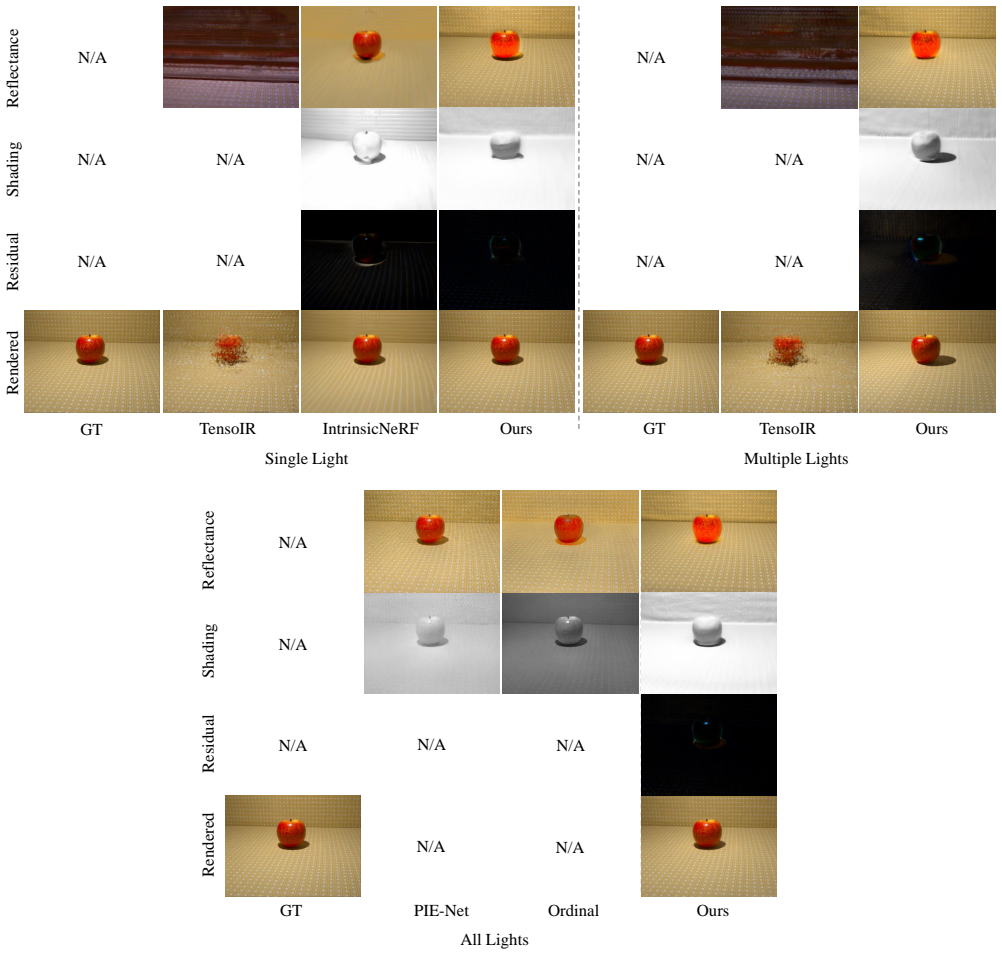
MLI-NeRF claims that multiple light positions, combined with multi-view geometry, provide enough information to disentangle reflectance and shading without ground-truth intrinsic data. In Stage 1, a Neuralangelo-style SDF network takes light position as an extra input, producing a relightable scene representation. Post-processing then derives pseudo shading from the SDF normal and sphere-traced light visibility as $S^* = (\max(\vec{N}\cdot\vec{L},0)\otimes V)^\gamma$, and pseudo reflectance by per-light division $R = I \oslash S$ followed by a K-means merge across lights with hole filling. In Stage 2, separate MLPs predict reflectance (independent of light and view) and shading (conditioned on light position), supervised by these labels with reliability weight maps, while the residual term $Re$ is regularized toward zero so the image is explained by reflectance and shading. The paper's experiments on synthetic, real-object, and ReNe full-scene datasets report that this approach outperforms prior intrinsic decomposition and inverse rendering methods in reflectance and shading metrics, and performs competitively in relighting.
Load-bearing premise
The load-bearing premise is that real scene shading can be modeled as direct Lambertian illumination, with all indirect light and specular effects relegated to a residual term that regularization can suppress.
Editorial extensions
If this is right
- Intrinsic decomposition can be performed on real full scenes with backgrounds and cast shadows, where statistical-prior methods and inverse rendering methods struggle.
- Relighting and intrinsic decomposition can be learned in a single NeRF pipeline from multi-light captures without requiring ground-truth reflectance maps.
- A small number of light positions, around four, is sufficient to approach the quality achieved with many random light positions in the tested scenes.
- The learned decomposition enables editing applications such as reflectance editing, relighting, and shading editing on scenes from diverse datasets.
Reading between the lines
- The pseudo-shading formula assumes direct Lambertian illumination only; real interreflections and specular effects are pushed into the residual term, which the Stage 2 regularization tries to minimize, potentially corrupting estimated reflectance in scenes with significant indirect light. This is an inference about the method's behavior beyond the paper's own claims.
- Because Stage 1 is trained on known light positions, the same pseudo-label generation could in principle be applied to any relightable NeRF backbone, not just the Neuralangelo base; the paper notes the method is applicable to 'different similar baselines'.
- A testable extension would be to replace the K-means merge of pseudo reflectances with a learned fusion or a robust median that accounts for specular highlights, which might improve performance on scenes with glossy materials.
Editorial analysis
A structured set of objections, weighed in public.
Referee Report
Summary. The paper proposes MLI-NeRF, a two-stage neural radiance field method for intrinsic image decomposition (reflectance, shading, residual) that uses images captured under multiple known light positions. Stage 1 trains a relightable Neuralangelo-style SDF network conditioned on light position. Post-processing derives pseudo-shading from normals, light visibility (via sphere tracing), and a gamma-corrected Lambertian term, and pseudo-reflectance by dividing the input image by that pseudo-shading and merging across lights with K-means and hole-filling. Stage 2 freezes the geometry and adds reflectance and shading MLPs, supervised by the pseudo-labels with weight maps and a residual regularization term. The authors evaluate on a synthetic Blender dataset, a real object relighting dataset, and the real ReNe dataset, reporting strong quantitative results on synthetic intrinsic decomposition and NVS/relighting, and qualitative results on real scenes, plus editing applications.
Significance. If the pseudo-label strategy is robust, MLI-NeRF would be a meaningful advance: it replaces statistical priors for intrinsic decomposition with multi-light physics-based supervision inside a NeRF, and it targets full scenes rather than isolated objects. The paper includes a public code release, re-rendered synthetic data with ground truth intrinsic images, and comparisons against several baselines across multiple light settings. The main significance is therefore conditional on whether the direct-Lambertian pseudo-shading model is accurate enough for real scenes and whether the reported synthetic gains transfer beyond the same rendering protocol.
major comments (4)
- [§3.3, Eq. (5), Step C] The pseudo-reflectance label is computed as R* = I ⊘ S* while explicitly ignoring the residual term in Eq. (1). Under the paper's own model I = R⊗S + Re, this yields R* = R + Re/S*, so any specular highlight, interreflection, or penumbra that the direct-Lambertian shading model (Eq. 5) does not capture is baked into the pseudo-reflectance label. The synthetic evaluation in Table 1 uses scenes rendered under the same direct-light, gamma-corrected protocol, so it does not test this contamination, and the ReNe experiments in Sec. 4.6 report only qualitative intrinsic results. To support the claimed robustness on real-world data, the authors should provide either quantitative intrinsic evaluation on real scenes with measured or known albedo (e.g., OpenIllumination-style objects) or a controlled synthetic experiment with indirect illumination and specular materials, showing that the pseudo-labels and final decomposition remain accurate when Re is nonzero.
- [§3.3, Step C and §3.4, Eq. (7)] The pseudo-label generation pipeline relies on several under-specified heuristics: the gamma exponent γ in Eq. (5), the number of K-means clusters and initialization used for the pixel-level merge, the distance weights in the hole-filling strategy, and the construction of the weight maps W_R and W_S. These are load-bearing because they directly determine the supervision targets in Eq. (7), yet no values, sensitivity analysis, or ablation are reported. The authors should state all hyperparameters and provide an ablation showing how pseudo-label quality and final decomposition metrics vary with these choices, at least for the number of lights used in the merge and the gamma value.
- [§3.4, Stage 2] There is a self-distillation aspect to the training: the pseudo-shading S* is computed from the Stage-1 SDF normals and visibility, and Stage 2 trains a shading MLP on the same frozen geometry to reproduce S*. The pseudo-reflectance is then I ⊘ S*, so Stage 2 largely learns a function of Stage 1's geometry rather than being independently supervised. The paper does not report how accurate the pseudo-labels themselves are on the synthetic dataset (e.g., PSNR/LPIPS of S* and R* against the re-rendered ground truth), nor whether Stage 2 actually improves over the pseudo-labels. Adding these numbers would clarify how much of the final performance comes from the pseudo-label generation versus the Stage-2 network and would strengthen the claim that the decomposition is genuinely learned rather than inherited from the geometry.
- [§4.6, Fig. 6 and Table 3] The ReNe experiments are the primary evidence for real-world full-scene performance, but the intrinsic decomposition results there are qualitative only; Table 3 reports NVS metrics and does not include reflectance or shading error. Since the test set is not public and the validation set is used for inference, the authors should at least provide a quantitative intrinsic evaluation on a publicly available real multi-light dataset or on a held-out portion of ReNe with manual annotation, if available. As written, the claim of 'superior performance in intrinsic decomposition on real scenes' is not backed by numbers.
minor comments (5)
- [§4.2, 'Additional Lighting Setups'] In the multiple-light track, TensoIR is run with three lights while MLI-NeRF uses four, because TensoIR 'occasionally failed' with four; this should be stated as a limitation in the comparison fairness rather than only in the text.
- [§3.3, Eq. (5)] The paper calls γ 'gamma correction' but does not specify whether it is a fixed constant (e.g., 2.2) or a learned/estimated value; please clarify and justify the choice.
- [§4.3 and §3.2] The loss weights weik, wcurv, wintrinsic, wreg are listed with values, but there is no discussion of how they were chosen or whether results are sensitive to them; a brief note or supplementary ablation would help.
- [Fig. 2 and Fig. 6 captions] Some labels are inconsistent: 'NRHInts' appears in Fig. 5 and the supplementary, and 'MLPref lectance' appears in Sec. 3.4; please unify the notation.
- [Table 2] The NVS/relighting comparison in the Random setting reports slightly lower PSNR/SSIM for MLI-NeRF than NRHints but better LPIPS; the text says 'comparable performance,' which is fair, but the shading and reflectance errors are not reported there, so the intrinsic decomposition contribution to relighting quality is not visible.
Circularity Check
No circularity found: pseudo-labels are constructed from a forward physics model and the method is validated against external ground-truth benchmarks.
full rationale
The claimed derivation chain is feed-forward rather than circular. Stage 1 fits a multi-light neural scene representation from images; post-processing then evaluates explicit, non-learned formulas: Eq. (5) computes pseudo-shading S* from Stage-1 normals, light direction, visibility, and gamma correction, while Step C computes pseudo-reflectance R* = I / S* from the image and shading. These labels are not defined in terms of the Stage-2 networks, and Stage 2's reflectance and shading MLPs are trained to match them through Eq. (7), with the geometry network frozen. The fact that the Stage-2 shading MLP shares the frozen SDF features used to generate S* is a self-distillation property, not a circular reduction: neither equation sets the prediction equal to its own input, and the label construction includes an independent forward visibility/shading computation constrained by the multi-light images. The central claim is also externally falsifiable: the synthetic experiments compare against ground truth rendered in Blender and against multiple prior methods (PIE-Net, Ordinal, InvRender, TensoIR, IntrinsicNeRF), so the reported improvement is not forced by construction. The concern that indirect/specular light may be absorbed into the residual term is a modeling-validity risk for real scenes, not a circularity in the derivation, and the paper's own limitation section acknowledges the reliance on known light positions rather than concealing it.
Assumptions & free parameters
free parameters (4)
- Loss weights (weik, wcurv, wintrinsic, wreg) =
0.1, 5e-4, 1.0, 1.0
- Gamma correction exponent in pseudo-shading (Eq. 5) =
Not stated
- Number of light positions sampled for pseudo-reflectance merge =
4 for non-grid-sampled setups
- Weight-map parameters for W_R and W_S =
Not stated
assumptions (5)
- domain assumption Lambert's cosine law (S = N·L) as the shading model
- domain assumption Binary light visibility V from sphere tracing
- domain assumption Scene geometry from Stage 1 (Neuralangelo) is accurate enough for pseudo-label generation
- domain assumption The residual term Re captures all non-diffuse and indirect effects
- domain assumption Images follow the same gamma correction as assumed in Eq. (5)
Cite this review
Pith. "Pith review of MLI-NeRF: Multi-Light Intrinsic-Aware Neural Radiance Fields." pith.science (2026). https://pith.science/paper/DCUIRPL5
@misc{pith2026241117235,
  author       = {Pith},
  title        = {Pith review of: MLI-NeRF: Multi-Light Intrinsic-Aware Neural Radiance Fields},
  year         = {2026},
  howpublished = {\url{https://pith.science/paper/DCUIRPL5}},
  note         = {Machine review of arXiv:2411.17235}
}
read the original abstract
Current methods for extracting intrinsic image components, such as reflectance and shading, primarily rely on statistical priors. These methods focus mainly on simple synthetic scenes and isolated objects and struggle to perform well on challenging real-world data. To address this issue, we propose MLI-NeRF, which integrates \textbf{M}ultiple \textbf{L}ight information in \textbf{I}ntrinsic-aware \textbf{Ne}ural \textbf{R}adiance \textbf{F}ields. By leveraging scene information provided by different light source positions complementing the multi-view information, we generate pseudo-label images for reflectance and shading to guide intrinsic image decomposition without the need for ground truth data. Our method introduces straightforward supervision for intrinsic component separation and ensures robustness across diverse scene types. We validate our approach on both synthetic and real-world datasets, outperforming existing state-of-the-art methods. Additionally, we demonstrate its applicability to various image editing tasks. The code and data are publicly available.
Figures


Figures from the paper (15 more)




Reference graph
Works this paper leans on
-
[1]
Shape, illumination, and reflectance from shading
Jonathan T Barron and Jitendra Malik. Shape, illumination, and reflectance from shading. IEEE transactions on pattern analysis and machine intelligence , 37(8):1670–1687, 2014. 2
2014
-
[2]
Re- covering intrinsic scene characteristics
Harry Barrow, J Tenenbaum, A Hanson, and E Riseman. Re- covering intrinsic scene characteristics. Comput. Vis. Syst, 2 (3-26):2, 1978. 1, 2, 3
work page 1978
-
[3]
Nerd: Neural reflectance decomposition from image collections
Mark Boss, Raphael Braun, Varun Jampani, Jonathan T Bar- ron, Ce Liu, and Hendrik Lensch. Nerd: Neural reflectance decomposition from image collections. In Proceedings of the IEEE/CVF International Conference on Computer Vi- sion, pages 12684–12694, 2021. 2
2021
-
[4]
Mark Boss, Andreas Engelhardt, Abhishek Kar, Yuanzhen Li, Deqing Sun, Jonathan T. Barron, Hendrik P.A. Lensch, and Varun Jampani. SAMURAI: Shape And Material from Unconstrained Real-world Arbitrary Image collec- tions. In Advances in Neural Information Processing Sys- tems (NeurIPS), 2022. 2
work page 2022
-
[5]
Physically-based shading at disney
Brent Burley and Walt Disney Animation Studios. Physically-based shading at disney. In Acm Siggraph , pages 1–7. vol. 2012, 2012. 1
work page 2012
-
[6]
Intrinsic image decomposi- tion via ordinal shading
Chris Careaga and Ya ˘gız Aksoy. Intrinsic image decomposi- tion via ordinal shading. ACM Trans. Graph., 2023. 1, 2, 3, 5, 7, 8
work page 2023
-
[7]
Fast sun-aligned outdoor scene relight- ing based on tensorf
Yeonjin Chang, Yearim Kim, Seunghyeon Seo, Jung Yi, and Nojun Kwak. Fast sun-aligned outdoor scene relight- ing based on tensorf. In Proceedings of the IEEE/CVF Win- ter Conference on Applications of Computer Vision , pages 3626–3636, 2024. 2, 8
work page 2024
-
[8]
L-tracing: Fast light visibility estimation on neural surfaces by sphere tracing
Ziyu Chen, Chenjing Ding, Jianfei Guo, Dongliang Wang, Yikang Li, Xuan Xiao, Wei Wu, and Li Song. L-tracing: Fast light visibility estimation on neural surfaces by sphere tracing. In Proceedings of the European Conference on Com- puter Vision (ECCV), 2022. 2, 3
work page 2022
Show all 58 references
-
[9]
Pie-net: Pho- tometric invariant edge guided network for intrinsic image decomposition
Partha Das, Sezer Karaoglu, and Theo Gevers. Pie-net: Pho- tometric invariant edge guided network for intrinsic image decomposition. In IEEE Conference on Computer Vision and Pattern Recognition, (CVPR), 2022. 1, 2, 5, 7, 8
2022
-
[10]
Deep neural models for illumination estimation and relight- ing: A survey
Farshad Einabadi, Jean-Yves Guillemaut, and Adrian Hilton. Deep neural models for illumination estimation and relight- ing: A survey. In Computer Graphics Forum, pages 315–
-
[11]
Ntire 2021 depth guided image relighting chal- lenge
Majed El Helou, Ruofan Zhou, Sabine Susstrunk, and Radu Timofte. Ntire 2021 depth guided image relighting chal- lenge. In Proceedings of the IEEE/CVF Conference on Com- puter Vision and Pattern Recognition, pages 566–577, 2021. 2
2021
-
[12]
Revisiting deep intrinsic image decompositions
Qingnan Fan, Jiaolong Yang, Gang Hua, Baoquan Chen, and David Wipf. Revisiting deep intrinsic image decompositions. In Proceedings of the IEEE conference on computer vision and pattern recognition, pages 8944–8952, 2018. 3
2018
-
[13]
Deferred neural lighting: free-viewpoint re- lighting from unstructured photographs
Duan Gao, Guojun Chen, Yue Dong, Pieter Peers, Kun Xu, and Xin Tong. Deferred neural lighting: free-viewpoint re- lighting from unstructured photographs. ACM Transactions on Graphics (TOG), 39(6):258, 2020. 2, 5, 1
2020
-
[14]
A survey on intrinsic images: Delv- ing deep into lambert and beyond
Elena Garces, Carlos Rodriguez-Pardo, Dan Casas, and Jorge Lopez-Moreno. A survey on intrinsic images: Delv- ing deep into lambert and beyond. International Journal of Computer Vision, 130(3):836–868, 2022. 1, 2, 3
2022
-
[15]
Implicit geometric regularization for learning shapes
Amos Gropp, Lior Yariv, Niv Haim, Matan Atzmon, and Yaron Lipman. Implicit geometric regularization for learning shapes. In Proceedings of the 37th International Conference on Machine Learning, pages 3789–3799, 2020. 3
2020
-
[16]
Aim 2020: Scene relighting and illumination estimation challenge
Majed El Helou, Ruofan Zhou, Sabine S ¨usstrunk, Radu Tim- ofte, Mahmoud Afifi, Michael S Brown, Kele Xu, Hengxing Cai, Yuzhong Liu, Li-Wen Wang, et al. Aim 2020: Scene relighting and illumination estimation challenge. arXiv preprint arXiv:2009.12798, 2020. 2
2020 arXiv
-
[17]
Face relighting with geometrically consis- tent shadows
Andrew Hou, Michel Sarkis, Ning Bi, Yiying Tong, and Xiaoming Liu. Face relighting with geometrically consis- tent shadows. In Proceedings of the IEEE/CVF Conference on Computer Vision and Pattern Recognition , pages 4217– 4226, 2022. 2
2022
-
[18]
Tensoir: Tensorial inverse rendering
Haian Jin, Isabella Liu, Peijia Xu, Xiaoshuai Zhang, Song- fang Han, Sai Bi, Xiaowei Zhou, Zexiang Xu, and Hao Su. Tensoir: Tensorial inverse rendering. In Proceedings of the IEEE/CVF Conference on Computer Vision and Pattern Recognition (CVPR), 2023. 1, 5, 6, 8
2023
-
[19]
Lightit: Illumination modeling and control for diffusion models
Peter Kocsis, Julien Philip, Kalyan Sunkavalli, Matthias Nießner, and Yannick Hold-Geoffroy. Lightit: Illumination modeling and control for diffusion models. In CVPR, 2024. 2
2024
-
[20]
Un- supervised deep single-image intrinsic decomposition using illumination-varying image sequences
Louis Lettry, Kenneth Vanhoey, and Luc Van Gool. Un- supervised deep single-image intrinsic decomposition using illumination-varying image sequences. In Computer Graph- ics Forum, pages 409–419. Wiley Online Library, 2018. 2
2018
-
[21]
Learning intrinsic image de- composition from watching the world
Zhengqi Li and Noah Snavely. Learning intrinsic image de- composition from watching the world. In Computer Vision and Pattern Recognition (CVPR), 2018. 2
2018
-
[22]
Cgintrinsics: Better intrinsic image decomposition through physically-based rendering
Zhengqi Li and Noah Snavely. Cgintrinsics: Better intrinsic image decomposition through physically-based rendering. In European Conference on Computer Vision (ECCV), 2018. 2
2018
-
[23]
Learning intrinsic image de- composition from watching the world
Zhengqi Li and Noah Snavely. Learning intrinsic image de- composition from watching the world. In Proceedings of the IEEE conference on computer vision and pattern recogni- tion, pages 9039–9048, 2018. 2
2018
-
[24]
Neuralangelo: High-fidelity neural surface reconstruction
Zhaoshuo Li, Thomas M ¨uller, Alex Evans, Russell H Tay- lor, Mathias Unberath, Ming-Yu Liu, and Chen-Hsuan Lin. Neuralangelo: High-fidelity neural surface reconstruction. In IEEE Conference on Computer Vision and Pattern Recogni- tion (CVPR), 2023. 1, 3, 6, 8
2023
-
[25]
Shadowneus: Neural sdf reconstruction by shadow ray supervision, 2022
Jingwang Ling, Zhibo Wang, and Feng Xu. Shadowneus: Neural sdf reconstruction by shadow ray supervision, 2022. 1, 8 9
2022
-
[26]
Openillumination: A multi-illumination dataset for inverse rendering evaluation on real objects
Isabella Liu, Linghao Chen, Ziyang Fu, Liwen Wu, Haian Jin, Zhong Li, Chin Ming Ryan Wong, Yi Xu, Ravi Ra- mamoorthi, Zexiang Xu, and Hao Su. Openillumination: A multi-illumination dataset for inverse rendering evaluation on real objects. In Advances in Neural Information Proc...
-
[27]
Unsuper- vised learning for intrinsic image decomposition from a sin- gle image
Yunfei Liu, Yu Li, Shaodi You, and Feng Lu. Unsuper- vised learning for intrinsic image decomposition from a sin- gle image. In Proceedings of the IEEE/CVF Conference on Computer Vision and Pattern Recognition , pages 3248– 3257, 2020. 2
2020
-
[28]
Decoupled weight de- cay regularization
Ilya Loshchilov and Frank Hutter. Decoupled weight de- cay regularization. In International Conference on Learning Representations, 2018. 6
2018
-
[29]
Nerf: Representing scenes as neural radiance fields for view syn- thesis
Ben Mildenhall, Pratul P Srinivasan, Matthew Tancik, Jonathan T Barron, Ravi Ramamoorthi, and Ren Ng. Nerf: Representing scenes as neural radiance fields for view syn- thesis. Communications of the ACM, 65(1):99–106, 2021. 1, 2, 5
2021
-
[30]
Instant neural graphics primitives with a multires- olution hash encoding
Thomas M ¨uller, Alex Evans, Christoph Schied, and Alexan- der Keller. Instant neural graphics primitives with a multires- olution hash encoding. ACM Trans. Graph. , 41(4):102:1– 102:15, 2022. 3
2022
-
[31]
A dataset of multi-illumination images in the wild
Lukas Murmann, Michael Gharbi, Miika Aittala, and Fredo Durand. A dataset of multi-illumination images in the wild. In Proceedings of the IEEE/CVF International Conference on Computer Vision, pages 4080–4089, 2019. 2
2019
-
[32]
Learning physics-guided face re- lighting under directional light
Thomas Nestmeyer, Jean-Franc ¸ois Lalonde, Iain Matthews, and Andreas Lehrmann. Learning physics-guided face re- lighting under directional light. In Proceedings of the IEEE/CVF Conference on Computer Vision and Pattern Recognition, pages 5124–5133, 2020. 2
2020
-
[33]
Total relighting: learning to relight portraits for background replacement
Rohit Pandey, Sergio Orts-Escolano, Chloe Legendre, Chris- tian Haene, Sofien Bouaziz, Christoph Rhemann, Paul E De- bevec, and Sean Ryan Fanello. Total relighting: learning to relight portraits for background replacement. ACM Trans. Graph., 40:43–1, 2021. 2
2021
-
[34]
Pedregosa, G
F. Pedregosa, G. Varoquaux, A. Gramfort, V . Michel, B. Thirion, O. Grisel, M. Blondel, P. Prettenhofer, R. Weiss, V . Dubourg, J. Vanderplas, A. Passos, D. Cournapeau, M. Brucher, M. Perrot, and E. Duchesnay. Scikit-learn: Machine learning in Python. Journal of Machine Learni...
2011
-
[35]
Wdrn: A wavelet decomposed relightnet for image relighting.arXiv preprint arXiv:2009.06678, 2020
Densen Puthussery, Melvin Kuriakose, Jiji C V , et al. Wdrn: A wavelet decomposed relightnet for image relighting.arXiv preprint arXiv:2009.06678, 2020. 2
2009 arXiv
-
[36]
Nerf for outdoor scene relighting
Viktor Rudnev, Mohamed Elgharib, William Smith, Lingjie Liu, Vladislav Golyanik, and Christian Theobalt. Nerf for outdoor scene relighting. In European Conference on Com- puter Vision (ECCV), 2022. 2
2022
-
[37]
Nerv: Neural reflectance and visibility fields for relighting and view synthesis
Pratul P Srinivasan, Boyang Deng, Xiuming Zhang, Matthew Tancik, Ben Mildenhall, and Jonathan T Barron. Nerv: Neural reflectance and visibility fields for relighting and view synthesis. In Proceedings of the IEEE/CVF Con- ference on Computer Vision and Pattern Recognition, pag...
2021
-
[38]
Single image portrait relighting
Tiancheng Sun, Jonathan T Barron, Yun-Ta Tsai, Zexiang Xu, Xueming Yu, Graham Fyffe, Christoph Rhemann, Jay Busch, Paul E Debevec, and Ravi Ramamoorthi. Single image portrait relighting. ACM Trans. Graph., 38(4):79–1,
-
[39]
Relight my nerf: A dataset for novel view synthesis and relighting of real world objects
Marco Toschi, Riccardo De Matteo, Riccardo Spezialetti, Daniele De Gregorio, Luigi Di Stefano, and Samuele Salti. Relight my nerf: A dataset for novel view synthesis and relighting of real world objects. In Proceedings of the IEEE/CVF Conference on Computer Vision and Pattern ...
2023
-
[40]
Deep relighting networks for image light source manipulation
Li-Wen Wang, Wan-Chi Siu, Zhi-Song Liu, Chu-Tak Li, and Daniel PK Lun. Deep relighting networks for image light source manipulation. arXiv preprint arXiv:2008.08298,
2008 arXiv
-
[41]
Learning unified decompositional and compositional nerf for editable novel view synthesis
Yuxin Wang, Wayne Wu, and Dan Xu. Learning unified decompositional and compositional nerf for editable novel view synthesis. In ICCV, 2023. 1
2023
-
[42]
Image quality assessment: from error visibility to structural similarity
Zhou Wang, Alan C Bovik, Hamid R Sheikh, and Eero P Si- moncelli. Image quality assessment: from error visibility to structural similarity. IEEE transactions on image processing, 13(4):600–612, 2004. 6
2004
-
[43]
Sire-ir: Inverse rendering for brdf reconstruction with shadow and illumi- nation removal in high-illuminance scenes
Ziyi Yang, Yanzhen Chen, Xinyu Gao, Yazhen Yuan, Yu Wu, Xiaowei Zhou, and Xiaogang Jin. Sire-ir: Inverse rendering for brdf reconstruction with shadow and illumi- nation removal in high-illuminance scenes. arXiv preprint arXiv:2310.13030, 2023. 1, 2
-
[44]
IntrinsicNeRF: Learning Intrinsic Neural Radiance Fields for Editable Novel View Synthesis
Weicai Ye, Shuo Chen, Chong Bao, Hujun Bao, Marc Polle- feys, Zhaopeng Cui, and Guofeng Zhang. IntrinsicNeRF: Learning Intrinsic Neural Radiance Fields for Editable Novel View Synthesis. In Proceedings of the IEEE/CVF Interna- tional Conference on Computer Vision , 2023. 1, 2,...
2023
-
[45]
Relighting neural radiance fields with shadow and highlight hints
Chong Zeng, Guojun Chen, Yue Dong, Pieter Peers, Hongzhi Wu, and Xin Tong. Relighting neural radiance fields with shadow and highlight hints. In ACM SIGGRAPH 2023 Con- ference Proceedings, 2023. 1, 2, 5, 7, 8
2023
-
[46]
PhySG: Inverse rendering with spherical gaussians for physics-based material editing and relighting
Kai Zhang, Fujun Luan, Qianqian Wang, Kavita Bala, and Noah Snavely. PhySG: Inverse rendering with spherical gaussians for physics-based material editing and relighting. In The IEEE/CVF Conference on Computer Vision and Pat- tern Recognition (CVPR), 2021. 2
2021
-
[47]
The unreasonable effectiveness of deep features as a perceptual metric
Richard Zhang, Phillip Isola, Alexei A Efros, Eli Shecht- man, and Oliver Wang. The unreasonable effectiveness of deep features as a perceptual metric. In Proceedings of the IEEE conference on computer vision and pattern recogni- tion, pages 586–595, 2018. 6
2018
-
[48]
Ner- factor: Neural factorization of shape and reflectance under an unknown illumination
Xiuming Zhang, Pratul P Srinivasan, Boyang Deng, Paul De- bevec, William T Freeman, and Jonathan T Barron. Ner- factor: Neural factorization of shape and reflectance under an unknown illumination. ACM Transactions on Graphics (ToG), 40(6):1–18, 2021. 1, 2
2021
-
[49]
Modeling indirect illumination for inverse rendering
Yuanqing Zhang, Jiaming Sun, Xingyi He, Huan Fu, Rongfei Jia, and Xiaowei Zhou. Modeling indirect illumination for inverse rendering. In CVPR, 2022. 1, 2, 3, 5, 6
2022
-
[50]
Deep single-image portrait relighting
Hao Zhou, Sunil Hadap, Kalyan Sunkavalli, and David W Ja- cobs. Deep single-image portrait relighting. In Proceedings 10 of the IEEE International Conference on Computer Vision , pages 7194–7202, 2019. 2 11 MLI-NeRF: Multi-Light Intrinsic-Aware Neural Radiance Fields Supplemen...
2019
-
[52]
More results on the Synthetic Dataset
-
[53]
More results on the Real Object Dataset
-
[54]
We have also submitted a supplementary video to showcase the results of our method on all datasets
More results on the ReNe Dataset. We have also submitted a supplementary video to showcase the results of our method on all datasets
-
[55]
7 to Fig
More results on the Synthetic Dataset From Fig. 7 to Fig. 10, we present additional qualitative results with all settings including Single Light, Multiple Lights, and Random Lights on the Synthetic Dataset. In the Synthetic Dataset, we conduct experiments on four scenes: Hotdo...
-
[56]
Overall, since the camera view used in comparisons is the same, the reflectance should have the same GT across all settings
fails to produce satisfactory results, with residual cast shadows mixing into the reflectance. Overall, since the camera view used in comparisons is the same, the reflectance should have the same GT across all settings. Our predicted reflectance consistently outper- forms othe...
-
[57]
More results on the Real Object Dataset We present different results for the 4 scenes of the Real Ob- ject Dataset, including Fish, Pikachu, Pixiu, and FurScene [13, 45]. In Fig. 11, we show additional results on further scenes. In Fig. 12, we present the results of reflectanc...
-
[58]
15 to Fig
More results on the ReNe Dataset Fig. 15 to Fig. 18 present more detailed results on the ReNe dataset, where the four scenes are labeled as apple, cube, garden, and savannah in the original dataset. Similar to our observations on the Synthetic Dataset, our method outper- forms...
-
[331]
Wiley Online Library, 2021. 2
2021
Reviewed August 12, 2026 · model on record in the stance chip above.
Discussion (0). Continue with ORCID to comment.