REVIEW 4 major objections 4 minor 24 references
Chanel-Orderer: A Channel-Ordering Predictor for Tri-Channel Natural Images
T0 review · 4 major / 4 minor · reviewed 2026-08-12 · deepseek-v4-flash
Pith's one-line read A ranking model with semantic color priors can predict the original channel order of randomly permuted tri-channel images, reaching 98.51% on SiftFlow and 75.74% on PASCAL-Context.
desk verdict Interesting ranking-based channel-order idea, but the central evaluation is compromised by an unspecified mask source at test time; the claim of image-only inference is not yet supported. read the letter →
The pith
A machine-rendered reading of the paper's core claim, the machinery that carries it, and where it could break.
The reading
What carries the argument
The load-bearing mechanism is pairwise rank-based scoring of channels. Each channel $I_i$ is independently passed through a U-Net to produce a feature map $F_i$; element-wise multiplication with segmentation masks $M^1,\dots,M^N$ followed by mean pooling yields a semantic color vector $c_i$, and the channel score is the inner product $s_i = \alpha^T c_i$ with a learned per-object weight vector $\alpha$. The training loss is a sum of three binary cross-entropy terms over the channel pairs $(1,2)$, $(1,3)$, and $(2,3)$, where the predicted probability is $p_{ij} = 1/(1+\exp(-\tanh(s_i-s_j)/T))$ with $T=0.1$, and the target $y_{ij}$ encodes the partial order $R \succ G \succ B$. Theorem 2.1 proves this loss is monotonically decreasing when the preferred channel scores higher and increasing otherwise, which justifies the inference rule: largest score means red, middle means green, smallest means blue.
What would settle it
Re-run the SiftFlow and PASCAL-Context experiments with segmentation masks produced by a pretrained segmentation model applied to the permuted input, so no ground-truth layout is used, and feed the same masks to the softmax and histogram baselines; if Chanel-Orderer's accuracy drops toward the baselines (or toward chance), the claim that it works on 'a typical 3-channel image' is falsified. Disclosing the mask source used in the original experiments is the minimal check.
Extended reading notes
Core claim
The central discovery is that channel order is recoverable through semantics rather than low-level pixel statistics: objects in natural scenes have stable color priors (skin is warm, mountains are greenish, sky is blue), and a model that attends to those priors can tell which channel is red, green, or blue even when the channels are randomly permuted. Chanel-Orderer computes a score for each channel by passing it through a U-Net, multiplying the resulting feature map by semantic segmentation masks, mean-pooling to obtain a per-object color representation, and taking an inner product with a learned object-prior weight vector α. Training enforces R≻G≻B through three pairwise binary ranking losses; Theorem 2.1 shows the loss is monotone in each score difference, so inference reduces to labeling the highest-scoring channel red and the lowest blue. The paper reports 98.51% accuracy on SiftFlow, 75.74% on PASCAL-Context, and 93.85% on the RGB/BGR discrimination task, with the ranking model clearly ahead of softmax and color-histogram baselines.
Load-bearing premise
The load-bearing premise is that for every test image the model is given the image's semantic segmentation layout (the object masks) without leaking the answer, and the paper never states whether those masks came from ground-truth labels or from a pretrained segmentation network; if they came from ground truth, the comparison against baselines that see only permuted pixels would not support the central claim.
Editorial extensions
If this is right
- A deployed version could automatically detect and correct BGR/RGB mis-display, removing a common source of wrong colors in imaging tools and pipelines.
- The same score differences give a threshold-based near-grayscale detector, so the model covers two correction tasks without extra supervision.
- Ranking-based inductive biases outperform classification-based ones on this permutation task, suggesting that pairwise ranking is a better prior for order-sensitive vision problems.
- Because the scoring function is per-channel and permutation-invariant, the approach is not tied to a specific input order and could be adapted to other color spaces or channel configurations.
Reading between the lines
- My inference: the reported 98.51% and 75.74% numbers are only interpretable if the segmentation masks used at inference come from the same information available to the baselines; if ground-truth masks were used, the comparison is not apples-to-apples. The paper leaves this unspecified.
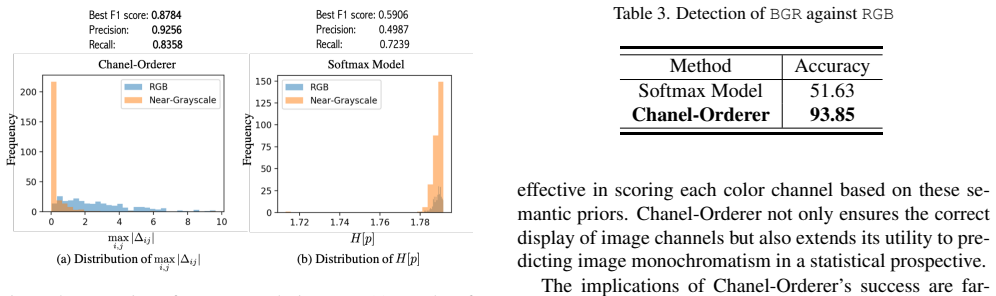
- My inference: the near-grayscale detector's threshold $\tau$ (set to 0.4) and the softmax entropy threshold are selected after the fact; reporting ROC curves or threshold-averaged AUROC would give a fairer comparison.
- My inference: a minimal baseline that pools per-channel means over ground-truth object regions and then ranks them could isolate how much of the gain comes from the learned U-Net features versus from the semantic mask pooling itself.
- My inference: the claim that the model 'mimics human visual coloring' is testable by comparing its score rankings against human judgments of which of the six permutations looks most natural; such a study is not in the paper.
Editorial analysis
A structured set of objections, weighed in public.
Referee Report
Summary. The paper proposes Chanel-Orderer, a ranking-based model that predicts the original channel order of a tri-channel image whose channels have been randomly permuted. The model scores each channel independently using a U-Net, pools features with semantic segmentation masks, and combines the per-object color representations with a learned weight vector; a pairwise ranking loss with a partial order R > G > B is used. The paper reports high overall accuracy on SiftFlow (98.51%) and PASCAL-Context (75.74%) for the six-permutation task, 93.85% for RGB/BGR detection on a custom face dataset, and F1=0.8784 for near-grayscale detection. A softmax classifier and a gradient-boosted shallow model are used as baselines.
Significance. The idea of exploiting semantic color priors for channel-order restoration is interesting and the ranking formulation with pairwise comparisons is clearly presented. The near-grayscale detection as a byproduct is also a plausible application. If the reported accuracies were obtained from the image content alone, the paper would make a useful proof-of-concept. However, the empirical validation has a critical gap: the source of the segmentation masks at evaluation time is unspecified, and both benchmark datasets provide ground-truth labels that could leak the semantic layout to the proposed model while the baselines see only pixels. The ablation results show that removing the masks drastically reduces accuracy, so the missing protocol detail is load-bearing. The paper also omits the train/test split, making the reported numbers hard to interpret.
major comments (4)
- [§2.2.2, §3.2, Tables 1–2] The manuscript never states whether the segmentation masks M^n used at evaluation time are ground-truth labels or outputs of a pretrained segmentation model. Since both SiftFlow and PASCAL-Context provide pixel-level annotations, the reported 98.51% and 75.74% accuracies may be obtained by giving the model the semantic layout of each test image, information the softmax and wo-Seg baselines do not receive. The ablation in Tables 1 and 2 shows the model's sensitivity to masks (SiftFlow 98.51→83.21, PASCAL-Context 75.74→58.45), so the missing protocol detail is load-bearing; the central claim in the abstract that the model works 'given a typical 3-channel image' is not supported without specifying the mask source.
- [§3.2, Tables 1–2] No train/test split is described for either dataset. With 2,688 SiftFlow images and 100 training epochs, the uniform 98.51% accuracy across all six permutations in Table 1 could reflect overfitting or memorization rather than a generalizable ordering rule; the paper must report the split and ideally repeat with cross-validation or a held-out set.
- [§2.5, Figure 4] The near-grayscale threshold τ=0.4 and the softmax entropy threshold 1.79 appear to be selected on the test-set distributions shown in Figure 4. Since the manuscript gives no validation procedure for these thresholds, the reported F1-scores (0.8784 vs 0.5906) may be optimistically biased; the threshold selection must be described on training/validation data only.
- [§3.3.1, §3.2] The PASCAL-Context experiments mention a 59-class subset, but the number of segmentation masks N and the semantic classes over which the weight vector α is defined are not specified, nor is it stated whether a single pretrained segmenter is used for all images; without this information the comparison across methods is not fully reproducible.
minor comments (4)
- [Title and throughout] The name 'Chanel-Orderer' appears to be a misspelling of 'Channel-Orderer'; this should be corrected consistently.
- [§2.4] The sentence 'we first unpacks it into three channels' contains a grammatical error; also 'scenerio' and 'classifer' are typos.
- [§3.4] The section heading 'Model Behavoir Analysis' contains a typo; it should read 'Model Behavior Analysis'.
- [Eq. (11)] The claim that Ii = Ij implies Δij = 0 because 'the scoring function f is permutation-invariant' is unclear; permutation invariance with respect to channel order would not by itself force equal scores for different input channels, so this step needs clarification.
Circularity Check
No circularity: central claim is a standard supervised ranking result, not an input/output tautology.
full rationale
The central derivation is a supervised ranking model. Equations (2)-(6) define scores s_i and a pairwise logistic loss against labels y_ij derived from the human partial order (1); the inference rule in Algorithm 2 (largest score -> Red, smallest -> Blue) follows from the gradient property in Theorem 2.1. Nothing in this chain defines the channel-order label as a function of the model's own output. The segmentation masks are auxiliary inputs that provide semantic location, not channel identity, so using ground-truth masks (if that is what Sec. 3.2 did) would change the evaluation setting but would not make the predicted order a restatement of the input. The near-grayscale detector thresholds max|Δij| with τ=0.4; this is a decision rule on model outputs, not a fitted parameter being renamed a prediction, because the paper does not describe fitting τ to the evaluation data. The only self-citation, [24], supports interpreting softmax entropy as epistemic uncertainty for the baseline; it is not load-bearing for the channel-order claim. No uniqueness theorem or prior-work ansatz is imported. Therefore no circular step is exhibited.
Assumptions & free parameters
free parameters (3)
- temperature T =
0.1
- monochromatism threshold tau =
0.4
- object prior weight alpha =
learned
assumptions (4)
- ad hoc to paper Partial order R > G > B
- domain assumption Semantic classes have consistent color priors
- domain assumption Ground-truth or pretrained semantic segmentation masks are available at test time
- standard math g is monotonically increasing, differentiable, and g(0)=0
Cite this review
Pith. "Pith review of Chanel-Orderer: A Channel-Ordering Predictor for Tri-Channel Natural Images." pith.science (2026). https://pith.science/paper/DD7E5Q7V
@misc{pith2026241113021,
  author       = {Pith},
  title        = {Pith review of: Chanel-Orderer: A Channel-Ordering Predictor for Tri-Channel Natural Images},
  year         = {2026},
  howpublished = {\url{https://pith.science/paper/DD7E5Q7V}},
  note         = {Machine review of arXiv:2411.13021}
}
read the original abstract
This paper shows a proof-of-concept that, given a typical 3-channel images but in a randomly permuted channel order, a model (termed as Chanel-Orderer) with ad-hoc inductive biases in terms of both architecture and loss functions can accurately predict the channel ordering and knows how to make it right. Specifically, Chanel-Orderer learns to score each of the three channels with the priors of object semantics and uses the resulting scores to predict the channel ordering. This brings up benefits into a typical scenario where an \texttt{RGB} image is often mis-displayed in the \texttt{BGR} format and needs to be corrected into the right order. Furthermore, as a byproduct, the resulting model Chanel-Orderer is able to tell whether a given image is a near-gray-scale image (near-monochromatic) or not (polychromatic). Our research suggests that Chanel-Orderer mimics human visual coloring of our physical natural world.
Figures


Figures from the paper (1 more)
Reference graph
Works this paper leans on
-
[1]
Efficient self-ensemble for semantic segmenta- tion
Walid Bousselham, Guillaume Thibault, Lucas Pagano, Archana Machireddy, Joe Gray, Young Hwan Chang, and Xubo Song. Efficient self-ensemble for semantic segmenta- tion. arXiv preprint arXiv:2111.13280, 2021. 4
arXiv 2021
-
[2]
John Bridle. Training stochastic model recognition algo- rithms as networks can lead to maximum mutual information estimation of parameters. Advances in neural information processing systems, 2, 1989. 6
work page 1989
-
[3]
Learning to rank using gradient descent
Chris Burges, Tal Shaked, Erin Renshaw, Ari Lazier, Matt Deeds, Nicole Hamilton, and Greg Hullender. Learning to rank using gradient descent. In Proceedings of the 22nd in- ternational conference on Machine learning , pages 89–96,
-
[4]
Yuxuan Cai, Yizhuang Zhou, Qi Han, Jianjian Sun, Xiang- wen Kong, Jun Li, and Xiangyu Zhang. Reversible col- umn networks. In The Eleventh International Conference on Learning Representations, 2023. 4
work page 2023
-
[5]
Vision transformer adapter for dense predictions
Zhe Chen, Yuchen Duan, Wenhai Wang, Junjun He, Tong Lu, Jifeng Dai, and Yu Qiao. Vision transformer adapter for dense predictions. In The Eleventh International Conference on Learning Representations, 2023
work page 2023
-
[6]
Masked-attention mask transformer for universal image segmentation
Bowen Cheng, Ishan Misra, Alexander G Schwing, Alexan- der Kirillov, and Rohit Girdhar. Masked-attention mask transformer for universal image segmentation. In Proceed- ings of the IEEE/CVF conference on computer vision and pattern recognition, pages 1290–1299, 2022
2022
-
[7]
Eva: Exploring the limits of masked visual representa- tion learning at scale
Yuxin Fang, Wen Wang, Binhui Xie, Quan Sun, Ledell Wu, Xinggang Wang, Tiejun Huang, Xinlong Wang, and Yue Cao. Eva: Exploring the limits of masked visual representa- tion learning at scale. In Proceedings of the IEEE/CVF Con- ference on Computer Vision and Pattern Recognition, pages 19358–19369, 2023. 4
work page 2023
-
[8]
Dropout as a bayesian approximation: Representing model uncertainty in deep learning
Yarin Gal and Zoubin Ghahramani. Dropout as a bayesian approximation: Representing model uncertainty in deep learning. In international conference on machine learning , pages 1050–1059. PMLR, 2016. 8
work page 2016
Show all 24 references
-
[9]
Wichmann, and Wieland Brendel
Robert Geirhos, Patricia Rubisch, Claudio Michaelis, Matthias Bethge, Felix A. Wichmann, and Wieland Brendel. Imagenet-trained cnns are biased towards texture; increas- ing shape bias improves accuracy and robustness. CoRR, abs/1811.12231, 2018. 1
2018 arXiv
-
[10]
On calibration of modern neural networks
Chuan Guo, Geoff Pleiss, Yu Sun, and Kilian Q Weinberger. On calibration of modern neural networks. In International conference on machine learning, pages 1321–1330. PMLR,
-
[11]
Semask: Se- mantically masked transformers for semantic segmentation
Jitesh Jain, Anukriti Singh, Nikita Orlov, Zilong Huang, Ji- achen Li, Steven Walton, and Humphrey Shi. Semask: Se- mantically masked transformers for semantic segmentation. In Proceedings of the IEEE/CVF International Conference on Computer Vision, pages 752–761, 2023. 4
2023
-
[12]
Segment any- thing
Alexander Kirillov, Eric Mintun, Nikhila Ravi, Hanzi Mao, Chloe Rolland, Laura Gustafson, Tete Xiao, Spencer White- head, Alexander C Berg, Wan-Yen Lo, et al. Segment any- thing. In Proceedings of the IEEE/CVF International Con- ference on Computer Vision, pages 4015–4026, 2023
2023
-
[13]
Mask dino: Towards a unified transformer-based framework for object detection and segmentation
Feng Li, Hao Zhang, Huaizhe Xu, Shilong Liu, Lei Zhang, Lionel M Ni, and Heung-Yeung Shum. Mask dino: Towards a unified transformer-based framework for object detection and segmentation. In Proceedings of the IEEE/CVF Con- ference on Computer Vision and Pattern Recognition, pa...
2023
-
[14]
Nonparamet- ric scene parsing: Label transfer via dense scene alignment
Ce Liu, Jenny Yuen, and Antonio Torralba. Nonparamet- ric scene parsing: Label transfer via dense scene alignment. In 2009 IEEE Conference on Computer Vision and Pattern Recognition, pages 1972–1979. IEEE, 2009. 5
2009
-
[15]
The role of context for object detection and semantic segmentation in the wild
Roozbeh Mottaghi, Xianjie Chen, Xiaobai Liu, Nam-Gyu Cho, Seong-Whan Lee, Sanja Fidler, Raquel Urtasun, and Alan Yuille. The role of context for object detection and semantic segmentation in the wild. In Proceedings of the IEEE conference on computer vision and pattern recogni...
2014
-
[16]
Anatomy of a color histogram
Carol L Novak, Steven A Shafer, et al. Anatomy of a color histogram. In CVPR, pages 599–605, 1992. 6
1992
-
[17]
Under- standing softmax confidence and uncertainty
Tim Pearce, Alexandra Brintrup, and Jun Zhu. Under- standing softmax confidence and uncertainty. arXiv preprint arXiv:2106.04972, 2021. 8
2021 arXiv
-
[18]
Sam 2: Segment anything in images and videos
Nikhila Ravi, Valentin Gabeur, Yuan-Ting Hu, Ronghang Hu, Chaitanya Ryali, Tengyu Ma, Haitham Khedr, Roman R¨adle, Chloe Rolland, Laura Gustafson, et al. Sam 2: Segment anything in images and videos. arXiv preprint arXiv:2408.00714, 2024. 4
2024 arXiv
-
[19]
U-net: Convolutional networks for biomedical image segmentation
Olaf Ronneberger, Philipp Fischer, and Thomas Brox. U-net: Convolutional networks for biomedical image segmentation. CoRR, abs/1505.04597, 2015. 4, 6
2015 arXiv
-
[20]
Towards all-in-one pre-training via maximizing multi-modal mutual information
Weijie Su, Xizhou Zhu, Chenxin Tao, Lewei Lu, Bin Li, Gao Huang, Yu Qiao, Xiaogang Wang, Jie Zhou, and Jifeng Dai. Towards all-in-one pre-training via maximizing multi-modal mutual information. In Proceedings of the IEEE/CVF Con- ference on Computer Vision and Pattern Recognit...
2023
-
[21]
One-peace: Exploring one general representa- tion model toward unlimited modalities
Peng Wang, Shijie Wang, Junyang Lin, Shuai Bai, Xi- aohuan Zhou, Jingren Zhou, Xinggang Wang, and Chang Zhou. One-peace: Exploring one general representa- tion model toward unlimited modalities. arXiv preprint arXiv:2305.11172, 2023
2023 arXiv
-
[22]
Image as a foreign language: Beit pretraining for all vision and vision- language tasks
Wenhui Wang, Hangbo Bao, Li Dong, Johan Bjorck, Zhil- iang Peng, Qiang Liu, Kriti Aggarwal, Owais Khan Mo- hammed, Saksham Singhal, Subhojit Som, et al. Image as a foreign language: Beit pretraining for all vision and vision- language tasks. arXiv preprint arXiv:2208.10442, 2022
2022 arXiv
-
[23]
Internimage: Exploring large-scale vi- sion foundation models with deformable convolutions
Wenhai Wang, Jifeng Dai, Zhe Chen, Zhenhang Huang, Zhiqi Li, Xizhou Zhu, Xiaowei Hu, Tong Lu, Lewei Lu, Hongsheng Li, et al. Internimage: Exploring large-scale vi- sion foundation models with deformable convolutions. In Proceedings of the IEEE/CVF conference on computer vi- si...
2023
-
[24]
Probabilistic knowledge distillation of face ensembles
Jianqing Xu, Shen Li, Ailin Deng, Miao Xiong, Jiaying Wu, Jiaxiang Wu, Shouhong Ding, and Bryan Hooi. Probabilistic knowledge distillation of face ensembles. In Proceedings of the IEEE/CVF Conference on Computer Vision and Pattern Recognition (CVPR), pages 3489–3498, 2023. 7 9
2023
Reviewed August 12, 2026 · model on record in the stance chip above.
Discussion (0). Continue with ORCID to comment.