REVIEW 5 major objections 6 minor 49 references
Egocentric Event-Based Vision for Ping Pong Ball Trajectory Prediction
T0 review · 5 major / 6 minor · reviewed 2026-08-07 · deepseek-v4-flash
Pith's one-line read An egocentric event-camera system predicts ping pong trajectories at 200 Hz with a worst-case total latency of 4.5 ms, beating frame-based updates by 4.4 cm at the impact point.
desk verdict A genuinely useful egocentric event-camera system and dataset, but the headline 8.4 cm learning-based improvement is a cross-model comparison that the experiments do not support. read the letter →
The pith
A machine-rendered reading of the paper's core claim, the machinery that carries it, and where it could break.
The reading
What carries the argument
The load-bearing mechanism is foveated event windowing: events are kept only inside an $80\times80$ pixel region around the reprojection of the wearer's eye gaze, then ego-motion is compensated with gyroscope data, a normalized timestamp image is thresholded to remove static background, DBSCAN clustering groups the remaining dynamic events, and the cluster whose convex hull best matches a circle (circularity $\gamma_j = P^2/(4\pi A)$) is declared the ball. Depth is recovered from the fitted radius by Eq. (6), and the resulting range measurements are regressed with monotonic polynomial fits and fed to a differential-equation predictor with drag; an EKF bootstraps the initial state. The same measurements can instead be fed to a DCGN, a deep conditional generative model that learns the distribution of future trajectories.
What would settle it
Record a held-out rally with motion capture, run the published pipeline, and compare the depth estimates from Eq. (6) to the measured 3D positions; the claim would be falsified if the spread of depth residuals from radius fitting is as large as the 4.4-8.4 cm accuracy gaps that the 200 Hz rate is said to create.
Extended reading notes
Core claim
On its own terms, the discovery is that egocentric event-based perception is enough for real-time ball trajectory forecasting: a monocular event camera on the head, using only events in a gaze-centered window, can produce 200 Hz state measurements whose physics-based future impact prediction is more accurate than the same predictor with 30 Hz frame-rate updates. The depth channel comes from the apparent radius of the ball via $Z = f W_{\mathrm{metric}}/\hat r$ after fitting a circle to three convex-hull points, and trajectories are propagated with gravity and quadratic drag, optionally bootstrapped by an extended Kalman filter. The system reaches a 92.59% ball detection rate and a 4.5 ms ideal worst-case total latency, and the paper reports that foveated cropping alone reduces the average number of processed events from 7157 to 735 per detection window.
Load-bearing premise
The load-bearing premise is that a circle fitted to three points on the event cluster accurately gives the ball's apparent radius, which at 2-3 m turns a one-pixel radius error into tens of centimeters of depth error, a sensitivity the paper acknowledges but never quantifies.
Editorial extensions
If this is right
- At 200 Hz the physics-based predictor reduces impact-point RMSE to 0.1472 m, a 4.4 cm improvement over the 30 Hz version of the same pipeline; with DCGN the improvement is 8.4 cm.
- The detection pipeline's worst-case total latency, 4.5 ms including perception and computation, is below the 10-50 ms window cited for human visual reaction, and far below the 66 ms perception-only latency of a 30 FPS camera.
- Foveated cropping lowers the number of events processed per detection from 7157 to 735, a 10.81x reduction, while raising detection rate from 81.48% to 92.59%.
- Short prediction windows up to 33 ms favor physics-based fitting over DCGN, while longer horizons and online re-estimation favor DCGN, which reaches 0.1072 m in online forecasting.
Reading between the lines
- Because depth depends on a one-pixel-accurate radius estimate at 2-3 m, the paper's acknowledged but unquantified radius sensitivity may be the real bottleneck; a higher-resolution event sensor or a stereo depth check would likely improve impact-point error more than further event-rate increases.
- The gaze-follows-ball assumption means the system will fail when a player briefly looks away; an audio-based opponent-hit trigger, which the paper mentions as future work, could widen or re-center the ROI before the ball is in view.
- Neglecting spin is a deliberate simplification; if spin were co-estimated from the event stream, the bounce model and longer-horizon predictions would have a new error source and a new opportunity.
- The 4.5 ms latency number is an ideal worst case from CPU-only processing on one laptop platform; deploying on embedded glasses hardware will likely move the computational latency, even if the event-rate advantage remains.
Editorial analysis
A structured set of objections, weighed in public.
Referee Report
Summary. The paper presents a real-time egocentric table-tennis ball trajectory prediction system built on an event camera mounted on Meta Project Aria glasses. The pipeline uses eye-gaze-based region-of-interest cropping, motion compensation, DBSCAN clustering, and circle fitting to detect the ball and estimate its monocular depth from the apparent ball radius. Trajectory prediction is performed by monotonically constrained polynomial regression, an Extended Kalman Filter, and a physics-based differential-equation model (with drag and a simplified bounce model). The authors contribute a synchronized multi-sensor dataset with OptiTrack ground truth, report a 92.59% ball detection rate, a mean computation latency of 1.5 ms and an 'ideal worst-case total latency' of 4.5 ms, and claim that 200 Hz event-based updates reduce impact-point RMSE by 4.8 cm compared with 30 Hz frame-based updates for physics-based prediction, and by 8.4 cm when using a learning-based predictor.
Significance. If the quantitative claims held up, this would be a useful first demonstration of egocentric event-based table-tennis perception, with the additional value of a public dataset and open-source code. The use of OptiTrack ground truth, literature-based aerodynamic constants, and a real event-camera platform are concrete strengths. However, the paper's central quantitative contributions are currently weakened by small-sample evaluation, selection of detection thresholds on the evaluation data, an unsupported cross-model comparison behind the 8.4 cm claim, an unmeasured 'worst-case' latency figure, and an acknowledged but unquantified sensitivity of monocular depth to radius estimation errors. These issues are fixable but require additional experiments and re-analysis before the claims can be considered robust.
major comments (5)
- [Section 1 and Table 6] The sentence in the contributions list that learning-based prediction methods [16] improve the error reduction to 8.4 cm is not supported by the reported experiments. Table 6 contains a DCGN run at 200 Hz (0.1072 m) and a differential-equation run at 30 Hz (0.1915 m), but no DCGN baseline at 30 Hz or any frame-based update rate appears in the paper or the supplementary material. The 8.4 cm gap is therefore a cross-model comparison, not a demonstration that the event camera's 200 Hz update rate improves a learning-based predictor. The authors should either add a DCGN model fed with 30 Hz measurements or remove and rephrase this claim.
- [Section 5.2, Tables 3 and 4] The detection threshold θ1 is selected by scanning values on the same evaluation sequences used to report the 92.59% detection rate, so the reported rate is a training-set maximum rather than an unbiased estimate. The percentages in Table 3 correspond to 27 trajectories (92.59% = 25/27, 88.88% = 24/27, 59.26% = 16/27), and no confidence interval or significance test is provided; the cropping gain in Table 4 (92.59% vs 81.48%) is a difference of three sequences. A validation split or cross-validation, together with bootstrap confidence intervals, is needed before the detection claims can be considered load-bearing.
- [Section 4 and Table 2] The claim of a 'worst-case total latency of 4.5 ms' is not supported by the measurements. Table 2 reports the mean computation time (1.497 ms, σ = 0.696 ms), not a worst case, and the 4.5 ms value appears to combine this mean with an ideal theoretical sensing latency derived in Supplementary Section 9 under idealized assumptions about event generation. No measured end-to-end latency from event arrival to predicted output is reported. The authors should report the actual maximum or a high percentile of computation time and, if possible, measured end-to-end latency, and should avoid calling the theoretical composite a worst case.
- [Section 3.2, Eq. (6), and Supplementary Section 13] The entire 3D trajectory estimate rests on monocular depth computed from the apparent ball radius via Z = f W_metric / r_hat, where r_hat is obtained by fitting a circle to three points on the convex hull. Supplementary Section 13 acknowledges that at 2–3 m distance and VGA resolution, a one-pixel error in the estimated radius changes depth by several centimeters, but the paper never quantifies this sensitivity or its propagation into the impact-point RMSE. Without an error-propagation or ablation analysis, it is unclear whether the claimed 4.8 cm and 8.4 cm improvements are robust to the dominant depth-error source. Please add a quantitative sensitivity analysis or explicit covariance modeling.
- [Section 5.2, Tables 5 and 6] The reported differences between methods are given as mean ± standard deviation over a small number of trajectories, and the standard deviations overlap substantially (e.g., Diff. Eq. 200 Hz at 0.1472 ± 0.0938 m versus Diff. Eq. 30 Hz at 0.1915 ± 0.1705 m). No paired significance tests or effect sizes are reported, so the central claim that 200 Hz updates outperform 30 Hz updates is not statistically established. The authors should add paired tests across the same trajectories or otherwise quantify the uncertainty of the differences.
minor comments (6)
- [Section 1 and Table 6] The contribution bullet says the event-based pipeline reduces error by 4.8 cm compared with frame-based updates, but Table 6 gives 0.1915 − 0.1472 = 4.3 cm for the non-EKF variant and 0.1915 − 0.1432 = 4.8 cm for the EKF variant. Please specify which variant is used so the number is reproducible.
- [Table 5, DCGN row] The update frequency for DCGN is listed as '–'; please specify whether DCGN is fed with event-derived noisy states or ground-truth states, and at what rate, since this affects interpretation of its relative performance.
- [Supplementary Section 11, Figure 7 caption] The caption contains the typo 'DCGM'; it should read 'DCGN'.
- [Supplementary Table 7 and Figure 6] The table lists a horizon of 0.12 s, while the text refers to T = 0.1 s; please harmonize these values.
- [Section 3] The sentence 'On overview of the method is displayed in Figure 3' should read 'An overview of the method is displayed in Figure 3'.
- [Supplementary Section 8 and Section 3.1] The values of the geometric bounds P_min, P_max, A_min, A_max, the number of batches M, the polynomial degree d, and the EKF noise covariances are not reported; providing these would improve reproducibility.
Circularity Check
No circular derivation found: predictions are evaluated against independent OptiTrack ground truth, physics constants are external, and the event/frame comparison is an honest, though confounded, ablation.
full rationale
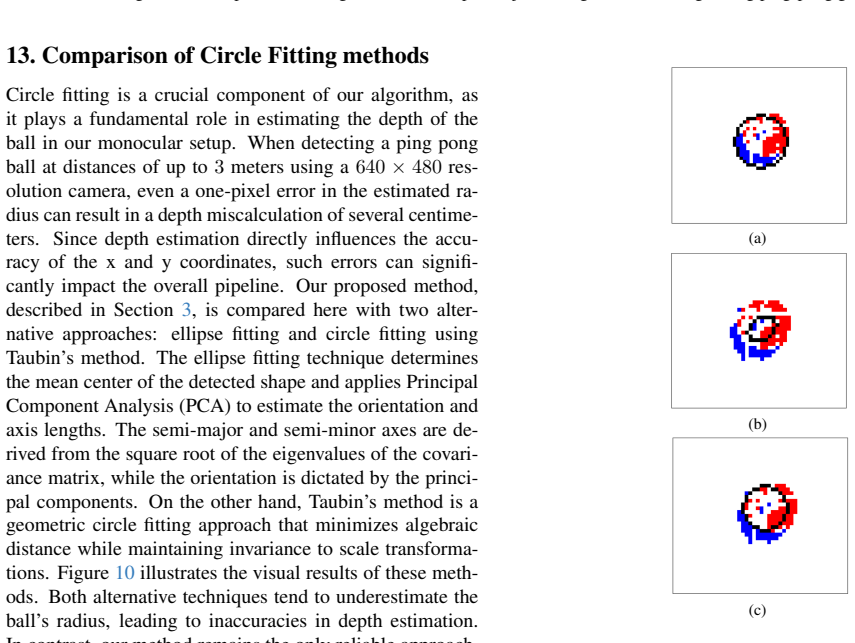
I walked the derivation chain from event clustering (Sec. 3.1) through depth-from-radius (Eq. 6), monotone polynomial regression (Eq. 7), EKF bootstrapping (Eq. 10), and physics propagation (Eqs. 8-9). Each stage consumes sensor measurements or externally fixed constants (gravity, ball mass/radius, C_d=0.4, air density) and is evaluated against OptiTrack ground truth, not against the pipeline's own outputs. The depth equation Z=f*W_metric/r_hat is the perspective projection relation, not a quantity fitted to the target impact-point error. The monotonic-decrease constraint on Z is a domain assumption about post-strike ball motion, not a fitted parameter. The DCGN baseline is an external method trained on ground truth, and the 30Hz 'Diff. Eq.' version is a legitimate subsampling of the same physics pipeline. The paper does cite prior same-group work ([6], [7], [8]) for motion compensation and latency analysis, but those citations supply standard algorithms and benchmark comparisons, not the paper's central claim, so they are not load-bearing circularity. The closest issue is experimental design, not circularity: the 8.4cm 'improvement' attributed to event-camera update frequency in Sec. 1 subtracts a 200Hz DCGN error from a 30Hz differential-equation error, and no 30Hz DCGN condition is reported; likewise the 4.8cm figure compares the 30Hz no-EKF result with the 200Hz EKF result, confounding update rate with EKF bootstrapping. These are unsupported comparative claims but they do not reduce any prediction to its inputs. Section 13's acknowledged one-pixel-radius depth sensitivity is a robustness limitation, not a circular step. I therefore find no circularity and score 0.
Assumptions & free parameters
free parameters (8)
- theta_1 (detection threshold slope) =
0.8
- theta_0 (detection threshold intercept) =
not reported
- w (ROI window width, in pixels) =
80
- Delta_t (event accumulation window) =
5 ms
- P_min, P_max, A_min, A_max (geometry bounds on the ball cluster) =
not reported
- M (number of temporal batches for circle fitting) =
not reported
- Polynomial degree d =
not reported
- EKF noise covariances =
not reported
assumptions (8)
- domain assumption The player's gaze is always directed toward the ball, so the ball lies inside the foveal ROI window.
- ad hoc to paper Ball depth is monotonically decreasing after the opponent's hit, so Z_dot(t) <= 0 can be enforced as a hard constraint.
- domain assumption The ball's projection is well approximated by a circle, and depth is recoverable from its radius via Z = f * W_metric / r_hat.
- ad hoc to paper Magnus force (spin) is negligible for trajectory prediction.
- domain assumption Ego-motion compensation using gyroscope-only rotation (Eq. 2) sufficiently removes static background events.
- domain assumption Standard aerodynamic constants (C_d = 0.4, air density 1.225 kg/m^3, ball mass 0.0027 kg, radius 0.02 m) are accurate for the ball used.
- domain assumption DBSCAN on normalized (x, y, t) features cleanly separates the ball from other moving objects.
- domain assumption Multi-sensor synchronization (OptiTrack, Aria audio, IMUs, event camera) is accurate to milliseconds.
Cite this review
Pith. "Pith review of Egocentric Event-Based Vision for Ping Pong Ball Trajectory Prediction." pith.science (2026). https://pith.science/paper/DDP7NNYT
@misc{pith2026250607860,
  author       = {Pith},
  title        = {Pith review of: Egocentric Event-Based Vision for Ping Pong Ball Trajectory Prediction},
  year         = {2026},
  howpublished = {\url{https://pith.science/paper/DDP7NNYT}},
  note         = {Machine review of arXiv:2506.07860}
}
read the original abstract
In this paper, we present a real-time egocentric trajectory prediction system for table tennis using event cameras. Unlike standard cameras, which suffer from high latency and motion blur at fast ball speeds, event cameras provide higher temporal resolution, allowing more frequent state updates, greater robustness to outliers, and accurate trajectory predictions using just a short time window after the opponent's impact. We collect a dataset of ping-pong game sequences, including 3D ground-truth trajectories of the ball, synchronized with sensor data from the Meta Project Aria glasses and event streams. Our system leverages foveated vision, using eye-gaze data from the glasses to process only events in the viewer's fovea. This biologically inspired approach improves ball detection performance and significantly reduces computational latency, as it efficiently allocates resources to the most perceptually relevant regions, achieving a reduction factor of 10.81 on the collected trajectories. Our detection pipeline has a worst-case total latency of 4.5 ms, including computation and perception - significantly lower than a frame-based 30 FPS system, which, in the worst case, takes 66 ms solely for perception. Finally, we fit a trajectory prediction model to the estimated states of the ball, enabling 3D trajectory forecasting in the future. To the best of our knowledge, this is the first approach to predict table tennis trajectories from an egocentric perspective using event cameras.
Figures


Figures from the paper (8 more)




Reference graph
Works this paper leans on
-
[16]
Sebastian Gomez-Gonzalez, Sergey Prokudin, Bernhard Sch¨olkopf, and Jan Peters. Real time trajectory prediction using deep conditional generative models.IEEE Robotics and Automation Letters, 5(2):970–976, 2020. 1, 2, 3, 7, 8
work page 2020
-
[1]
Jan Achterhold, Philip Tobuschat, Hao Ma, Dieter B ¨uchler, Michael Muehlebach, and Joerg Stueckler. Black-box vs. gray-box: A case study on learning table tennis ball trajec- tory prediction with spin and impacts. InProceedings of the Learning for Dynamics and Control Conference (L4DC),
-
[2]
Achieving human level competitive robot table tennis.arXiv preprint arXiv:2408.03906, 2024
David D’Ambrosio, Saminda Abeyruwan, Laura Graesser, Atil Iscen, Heni Ben Amor, Alex Bewley, Barney J Reed, Krista Reymann, Leila Takayama, Yuval Tassa, et al. Achieving human level competitive robot table tennis.arXiv preprint arXiv:2408.03906, 2024. 1
arXiv 2024
-
[3]
D’Ambrosio, Saminda Abeyruwan, Laura Graesser, Atil Iscen, Heni Ben Amor, Alex Bewley, Bar- ney J
David B. D’Ambrosio, Saminda Abeyruwan, Laura Graesser, Atil Iscen, Heni Ben Amor, Alex Bewley, Bar- ney J. Reed, Krista Reymann, Leila Takayama, Yuval Tassa, Krzysztof Choromanski, Erwin Coumans, Deepali Jain, Navdeep Jaitly, Natasha Jaques, Satoshi Kataoka, Yuheng Kuang, Nevena Lazic, Reza Mahjourian, Sherry Moore, Kenneth Oslund, Anish Shankar, Vikas S...
work page 2024
-
[4]
Project aria: A new tool for egocentric multi-modal ai research.arXiv preprint arXiv:2308.13561
Jakob Engel, Kiran Somasundaram, Michael Goesele, Albert Sun, Alexander Gamino, Andrew Turner, Arjang Talattof, Arnie Yuan, Bilal Souti, Brighid Meredith, et al. Project aria: A new tool for egocentric multi-modal ai research.arXiv preprint arXiv:2308.13561. Accessed: 14 April 2025, 2023. 1
arXiv 2025
-
[5]
Robotic table tennis: A case study into a high speed learning system
David D’Ambrosio et al. Robotic table tennis: A case study into a high speed learning system. InRobotics: Science and Systems XIX. Robotics: Science and Systems Foundation,
-
[6]
Davide Falanga, Krzysztof Kleber, and Davide Scaramuzza. How fast is too fast? the role of perception latency in high- speed sense and avoid.IEEE Robotics and Automation Let- ters, 4(2):1880–1887, 2019. 2, 1
work page 2019
-
[7]
Dy- namic obstacle avoidance for quadrotors with event cameras
Davide Falanga, Kevin Kleber, and Davide Scaramuzza. Dy- namic obstacle avoidance for quadrotors with event cameras. Science Robotics, 2020. 2, 3, 4, 6
work page 2020
Show all 49 references
-
[8]
Event-based agile object catching with a quadrupedal robot
Andras Forrai, Daniel Gehrig, Karl Schindler, and Da- vide Scaramuzza. Event-based agile object catching with a quadrupedal robot. InProceedings of the IEEE International Conference on Robotics and Automation (ICRA), 2023. 2, 3, 6
2023
-
[9]
Unified temporal and spatial calibration for multi-sensor systems
Paul Furgale, Joern Rehder, and Roland Siegwart. Unified temporal and spatial calibration for multi-sensor systems. In2013 IEEE/RSJ International Conference on Intelligent Robots and Systems, pages 1280–1286, 2013. 6
2013
-
[10]
Evaluation of combined time-offset estimation and hand-eye calibration on robotic datasets
Fadri Furrer, Marius Fehr, Tonci Novkovic, Hannes Som- mer, Igor Gilitschenski, and Roland Siegwart. Evaluation of combined time-offset estimation and hand-eye calibration on robotic datasets. InField and Service Robotics: Results of the 11th International Conference, pages 76...
2017
-
[11]
Davison, Jorg Conradt, Kostas Daniilidis, and Davide Scaramuzza
Guillermo Gallego, Tobi Delbruck, Garrick Orchard, Chiara Bartolozzi, Brian Taba, Andrea Censi, Stefan Leutenegger, Andrew J. Davison, Jorg Conradt, Kostas Daniilidis, and Davide Scaramuzza. Event-based vision: A survey.IEEE Transactions on Pattern Analysis and Machine Intelli...
2022
-
[12]
A model- free approach to stroke learning for robotic table tennis
Yapeng Gao, Jonas Tebbe, and Andreas Zell. A model- free approach to stroke learning for robotic table tennis. In 2022 International Joint Conference on Neural Networks (IJCNN), pages 1–8, 2022. 1
2022
-
[13]
Event-driven ball detec- tion and gaze fixation in clutter
Arren Glover and Chiara Bartolozzi. Event-driven ball detec- tion and gaze fixation in clutter. In2016 IEEE/RSJ Interna- tional Conference on Intelligent Robots and Systems (IROS), pages 2203–2208, 2016. 2
2016
-
[14]
Tracking the spin on a ping pong ball with the quaternion bingham filter
Jared Glover and Leslie Pack Kaelbling. Tracking the spin on a ping pong ball with the quaternion bingham filter. In2014 IEEE International Conference on Robotics and Automation (ICRA), pages 4133–4140, 2014. 3
2014
-
[15]
Imaging for all-day wearable smart glasses.arXiv preprint, 2025
Michael Goesele, Daniel Andersen, Yujia Chen, Simon Green, Eddy Ilg, Chao Li, Johnson Liu, Grace Kuo, Logan Wan, and Richard Newcombe. Imaging for all-day wearable smart glasses.arXiv preprint, 2025. 1
2025
-
[17]
Spindoe: A ball spin estimation method for table tennis robot
Thomas Gossard, Jonas Tebbe, Andreas Ziegler, and An- dreas Zell. Spindoe: A ball spin estimation method for table tennis robot. In2023 IEEE/RSJ International Conference on Intelligent Robots and Systems (IROS). IEEE, 2023. 1, 3
2023
-
[18]
Table tennis ball spin estimation with an event camera.2024 IEEE/CVF Conference on Com- puter Vision and Pattern Recognition Workshops (CVPRW), pages 3347–3356, 2024
Thomas Gossard, Julian Krismer, Andreas Ziegler, Jonas Tebbe, and Andreas Zell. Table tennis ball spin estimation with an event camera.2024 IEEE/CVF Conference on Com- puter Vision and Pattern Recognition Workshops (CVPRW), pages 3347–3356, 2024. 2, 3
2024
-
[19]
avattar: Table tennis stroke training with embodied and detached visualiza- tion in augmented reality
Dizhi Ma, Xiyun Hu, Jingyu Shi, Mayank Patel, Rahul Jain, Ziyi Liu, Zhengzhe Zhu, and Karthik Ramani. avattar: Table tennis stroke training with embodied and detached visualiza- tion in augmented reality. InProceedings of the 37th Annual ACM Symposium on User Interface Softwar...
2024
-
[20]
Event-based moving object detection and tracking
Anton Mitrokhin, Cornelia Ferm ¨uller, Chethan Paramesh- wara, and Yiannis Aloimonos. Event-based moving object detection and tracking. In2018 IEEE/RSJ International Con- ference on Intelligent Robots and Systems (IROS), pages 1–9,
-
[21]
Fast trajectory end-point pre- diction with event cameras for reactive robot control
Marco Monforte, Luna Gava, Massimiliano Iacono, Arren Glover, and Chiara Bartolozzi. Fast trajectory end-point pre- diction with event cameras for reactive robot control. In 2023 IEEE/CVF Conference on Computer Vision and Pat- tern Recognition Workshops (CVPRW), pages 4036–4044,
2023
-
[22]
A direct demon- stration of perceptual asynchrony in vision.Proceedings of the Royal Society of London
Konstantinos Moutoussis and Semir Zeki. A direct demon- stration of perceptual asynchrony in vision.Proceedings of the Royal Society of London. Series B: Biological Sciences, 264(1380):393–399, 1997. 5
1997
-
[23]
Event-based ball spin es- timation in sports
Takuya Nakabayashi, Kyota Higa, Masahiro Yamaguchi, Ryo Fujiwara, and Hideo Saito. Event-based ball spin es- timation in sports. InProceedings of the IEEE/CVF Confer- ence on Computer Vision and Pattern Recognition (CVPR) Workshops, pages 3367–3375, 2024. 2, 3
2024
-
[24]
Springer International Publishing,
Irene Perez-Salesa, Rodrigo Aldana-L ´opez, and Carlos Sag¨u´es.Event-Based Visual Tracking in Dynamic Environ- ments, page 175–186. Springer International Publishing,
-
[25]
Real-time computer vision with opencv.Commu- nications of the ACM, 55(6):61–69, 2012
Kari Pulli, Anatoly Baksheev, Kirill Kornyakov, and Victor Eruhimov. Real-time computer vision with opencv.Commu- nications of the ACM, 55(6):61–69, 2012. 5
2012
-
[26]
Table tennis and physics.Simulation Modeling, page 265, 2022
Ralf Schneider, Lars Lewerentz, Stefan Kemnitz, and Chris- tian Schultz. Table tennis and physics.Simulation Modeling, page 265, 2022. 1
2022
-
[27]
Spin measurement system for table tennis balls based on asynchronous non-high-speed cameras.International Jour- nal of Computer Science in Sport, 23(1):37–53, 2024
Sho Tamaki, Satoshi Yamagata, and Sachiko Hashizume. Spin measurement system for table tennis balls based on asynchronous non-high-speed cameras.International Jour- nal of Computer Science in Sport, 23(1):37–53, 2024. 3
2024
-
[28]
Measuring ball spin by image registration
Toru Tamaki, Takahiko Sugino, and Masanobu Yamamoto. Measuring ball spin by image registration. InProceedings of the 17th International Conference on Pattern Recognition (ICPR), pages II–795–II–798, 2004. 1, 3
2004
-
[29]
Estimating the spin of a ta- ble tennis ball using inverse compositional image alignment
Toru Tamaki, Haoming Wang, Bisser Raytchev, Kazufumi Kaneda, and Yukihiko Ushiyama. Estimating the spin of a ta- ble tennis ball using inverse compositional image alignment. In2012 IEEE International Conference on Acoustics, Speech and Signal Processing (ICASSP), pages 1457–14...
2012
-
[30]
A table tennis robot system using an industrial kuka robot arm
Jonas Tebbe, Yapeng Gao, Marc Sastre-Rienietz, and An- dreas Zell. A table tennis robot system using an industrial kuka robot arm. InGerman Conference on Pattern Recogni- tion, 2018. 1
2018
-
[31]
Spin detection in robotic table tennis
Jonas Tebbe, Lukas Klamt, Yapeng Gao, and Andreas Zell. Spin detection in robotic table tennis. In2020 IEEE Inter- national Conference on Robotics and Automation (ICRA), pages 9694–9700, 2020. 3
2020
-
[32]
Speed of processing in the human visual system.Nature, 381(6582): 520–522, 1996
Simon Thorpe, Denis Fize, and Catherine Marlot. Speed of processing in the human visual system.Nature, 381(6582): 520–522, 1996. 5
1996
-
[33]
Ttnet: Real-time temporal and spatial video analysis of ta- ble tennis.2020 IEEE/CVF Conference on Computer Vision and Pattern Recognition Workshops (CVPRW), pages 3866– 3874, 2020
Roman V oeikov, Nikolay S Falaleev, and Ruslan Baikulov. Ttnet: Real-time temporal and spatial video analysis of ta- ble tennis.2020 IEEE/CVF Conference on Computer Vision and Pattern Recognition Workshops (CVPRW), pages 3866– 3874, 2020. 1, 3
2020
-
[34]
Hodgins, and Jungdam Won
Jiashun Wang, Jessica K. Hodgins, and Jungdam Won. Strat- egy and skill learning for physics-based table tennis anima- tion.CoRR, abs/2407.16210, 2024. 1
2024 arXiv
-
[35]
Spikemot: Event-based multi-object track- ing with sparse motion features.IEEE Access, 13:214–230,
Song Wang, Zhu Wang, Can Li, Xiaojuan Qi, and Hayden Kwok-Hay So. Spikemot: Event-based multi-object track- ing with sparse motion features.IEEE Access, 13:214–230,
-
[36]
A novel trajectory-based ball spin estimation method for table tennis robot.IEEE Transactions on Indus- trial Electronics, 71(8):9244–9254, 2024
Yuxin Wang, Zhiyong Sun, Yongle Luo, Haibo Zhang, Wen Zhang, Kun Dong, Qiyu He, Qiang Zhang, Erkang Cheng, and Bo Song. A novel trajectory-based ball spin estimation method for table tennis robot.IEEE Transactions on Indus- trial Electronics, 71(8):9244–9254, 2024. 3
2024
-
[37]
Taylor, Kostas Daniilidis, M
Ziyun Wang, Fernando Cladera, Anthony Bisulco, Daewon Lee, Camillo J. Taylor, Kostas Daniilidis, M. Ani Hsieh, Daniel D. Lee, and V olkan Isler. Ev-catcher: High-speed object catching using low-latency event-based neural net- works.IEEE Robotics and Automation Letters, 7(4):87...
2022
-
[38]
Ball motion control in the table tennis robot system using time-series deep reinforcement learning.IEEE Access, 9: 99816–99827, 2021
Luo Yang, Haibo Zhang, Xiangyang Zhu, and Xinjun Sheng. Ball motion control in the table tennis robot system using time-series deep reinforcement learning.IEEE Access, 9: 99816–99827, 2021. 3
2021
-
[39]
Evtracker: An event-driven spatiotemporal method for dynamic object tracking.Sensors, 22(16), 2022
Shixiong Zhang, Wenmin Wang, Honglei Li, and Shenyong Zhang. Evtracker: An event-driven spatiotemporal method for dynamic object tracking.Sensors, 22(16), 2022. 2
2022
-
[40]
Ai brings transformative power for audi- ences, broadcasters and athletes.https://www.shine
Shenshen Zhu. Ai brings transformative power for audi- ences, broadcasters and athletes.https://www.shine. cn/biz/tech/2408064331/, 2024. 1
2024
-
[41]
An event-based perception pipeline for a table tennis robot.arXiv preprint arXiv: 2502.00749, 2025
Andreas Ziegler, Thomas Gossard, Arren Glover, and An- dreas Zell. An event-based perception pipeline for a table tennis robot.arXiv preprint arXiv: 2502.00749, 2025. 3
2025 arXiv
-
[42]
Fast moving table tennis ball tracking algorithm based on graph neural network.Scientific Reports, 14, 2024
Tianjian Zou, Wei Jiangning, Bo Yu, Xinzhu Qiu, Hao Zhang, Xu Du, and Jun Liu. Fast moving table tennis ball tracking algorithm based on graph neural network.Scientific Reports, 14, 2024. 3 Egocentric Event-Based Vision for Ping Pong Ball Trajectory Prediction Supplementary Material
2024
-
[43]
A standard ping-pong ball moving through the air experiences four pri- mary forces: gravitational force (F g), buoyancy force (Fb), drag force (F d), and Magnus force (F m)
The aerodynamics model of a ping-pong ball In this section, we provide an overview of the aerodynamics model of a ping pong ball used in the paper, focusing on the equations of motion that describe its trajectory. A standard ping-pong ball moving through the air experiences fo...
-
[44]
As described in [6], an obstacle is detected using an event camera when its edges generate an event
Sensing Latency Analysis We present an analysis of the sensing latency of our algo- rithm, which refers to the time window required to detect motion events and produce reliable results. As described in [6], an obstacle is detected using an event camera when its edges generate ...
-
[45]
has shown that an obstacle’s edge produces an event when its projection on the image plane moves by at least one pixel. As already shown in [6], the time required for an obstacle to traverse a pixel distance∆u= 1in the image plane is given by: τE = 1 ˆv ∆ud2 f ro + ∆ud (16) wh...
-
[46]
Deep Conditional Generative Network An overview of the variational autoencoder network intro- duced in [16], which is employed for trajectory prediction, and the outcomes of which have been discussed in Sec- tion 5, is provided in this paragraph. The work proposes a Deep Condi...
-
[47]
First, we present error plots obtained from the online trajectory prediction method, presented in Sec
Complementary Evaluation Plots In this section, we provide additional plots and evaluations of the entire pipeline. First, we present error plots obtained from the online trajectory prediction method, presented in Sec. 5. Figure 8 highlights the gradual improvement of the traj...
-
[48]
To segment long game sequences, we leveraged the microphone audio signals provided by the Project Aria glasses recordings, as shown in Figure 9
Audio Signals Peak Detection The evaluation of our pipeline has been carried out on se- quences beginning precisely at the moment the ball impacts the opponent’s racket. To segment long game sequences, we leveraged the microphone audio signals provided by the Project Aria glas...
-
[49]
Comparison of Circle Fitting methods Circle fitting is a crucial component of our algorithm, as it plays a fundamental role in estimating the depth of the ball in our monocular setup. When detecting a ping pong ball at distances of up to3meters using a640×480res- olution camer...
Reviewed August 7, 2026 · model on record in the stance chip above.
Discussion (0). Sign in to comment.