Sensing-Native Over-the-Air Federated Learning
Pith reviewed 2026-06-27 03:01 UTC · model grok-4.3
The pith
Over-the-air federated learning reuses local gradient signals for target distance estimation with zero extra overhead.
A machine-rendered reading of the paper's core claim, the machinery that carries it, and where it could break.
Core claim
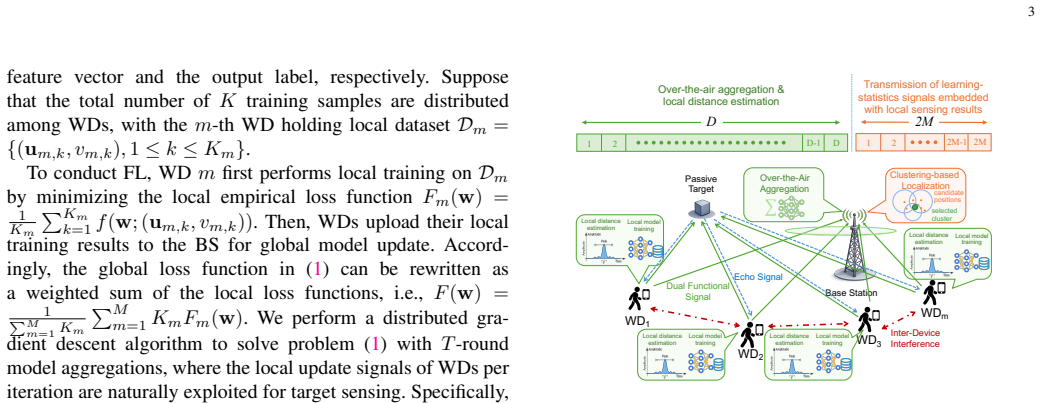
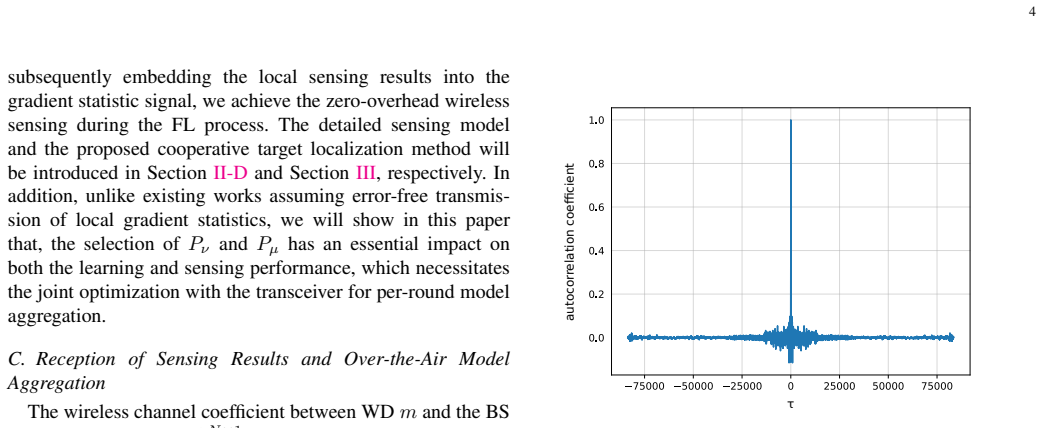
The sensing-native over-the-air FL framework concurrently leverages high-dimensional local gradient signals possessing favorable autocorrelation for target distance estimation via matched filtering, transmits locally sensed results through already-required gradient statistics, applies robust trilateration for positioning, and develops a statistics-aware communication-learning co-design that yields closed-form optimal power budgets and successive convex approximation beamforming to achieve simultaneous learning and sensing under imperfect aggregation.
What carries the argument
The sensing-native over-the-air FL framework that reuses local gradient signals for both model aggregation and distance estimation, with gradient statistics as the delivery mechanism for cooperative localization.
If this is right
- Zero overhead per model aggregation is achieved for the sensing task.
- A robust trilateration-based positioning method counters inter-device interference, channel fading, and communication noise.
- Closed-form optimal power budgets are allocated between local gradients and their statistics.
- An efficient successive convex approximation optimizes receiver beamforming under the joint objective.
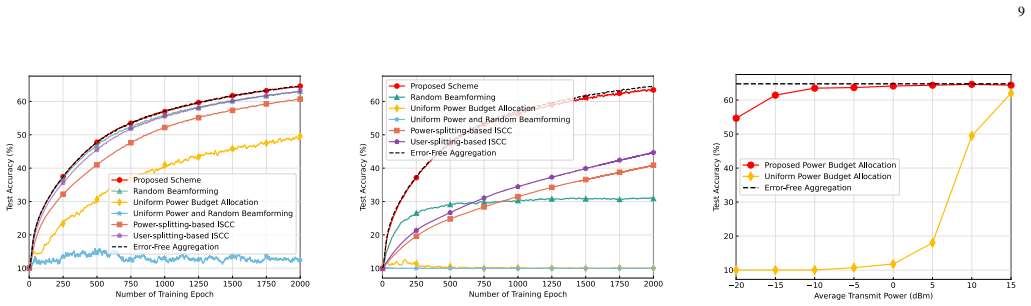
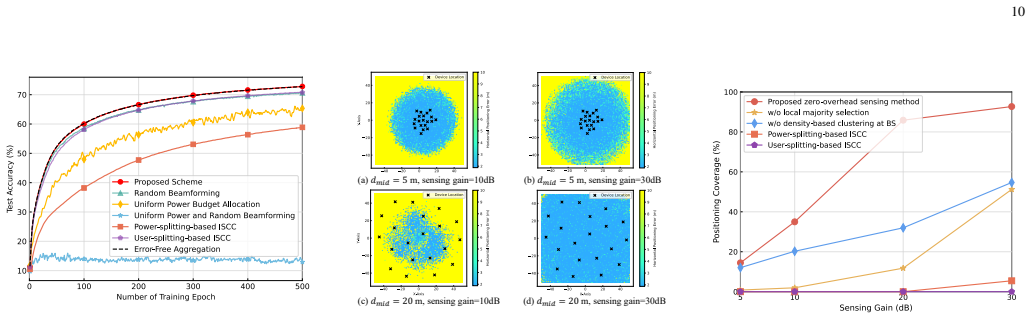
- Simulations demonstrate superior learning and sensing performance versus representative baselines.
Where Pith is reading between the lines
- The same reuse principle might apply to other signal types in distributed learning that already carry structured statistics.
- If gradient autocorrelation holds across common models, passive sensing could be added to existing over-the-air FL deployments without new hardware.
- The power-allocation and beamforming co-design could be tested on additional multi-task wireless objectives beyond localization.
Load-bearing premise
High-dimensional local gradient signals possess a favorable autocorrelation property that allows their simultaneous use for target distance estimation.
What would settle it
A measurement showing that local gradients lack sufficient autocorrelation for matched-filter distance estimation to succeed, resulting in sensing errors that cannot be offset by the learning performance gains.
Figures
read the original abstract
Over-the-air federated learning (FL) leverages the superposition property of multiple-access channels to enable communication-efficient distributed model training. Existing integrated sensing, communication, and computation (ISCC)-enabled over-the-air FL systems typically require dedicated resources for the sensing module, inevitably compromising FL performance due to resource competition. In this paper, we propose a sensing-native over-the-air FL framework that explores built-in distributed wireless sensing capability with zero overhead per model aggregation. Specifically, the high-dimensional local gradient signals possessing favorable autocorrelation property are concurrently leveraged for target distance estimation, while the gradient statistics already required for over-the-air FL serve as a ready-made gateway to deliver locally-sensed results to the edge server for cooperative localization. To combat inter-device interference, channel fading, and communication noise, we put forth a robust trilateration-based target positioning method building upon an efficient matched-filtering-based distance estimation. Then, by explicitly characterizing the impact of imperfect model aggregation and noisy gradient-statistics transmission on the sensing-native over-the-air FL convergence, we develop a statistics-aware communication-learning co-design approach. We first derive the closed-form optimal power budgets allocated to local gradients and their statistics, based on which an efficient successive convex approximation method is proposed for receiver beamforming optimization. Simulation results show that the proposed framework simultaneously achieves superior learning and sensing performance compared to representative baselines.
Editorial analysis
A structured set of objections, weighed in public.
Referee Report
Summary. The paper proposes a sensing-native over-the-air federated learning framework that uses high-dimensional local gradient signals (asserted to have favorable autocorrelation) for simultaneous model aggregation and matched-filter target distance estimation with zero overhead, employs gradient statistics for trilateration-based localization, derives closed-form optimal power allocation for gradients and statistics, applies successive convex approximation for receiver beamforming, and characterizes convergence under imperfect aggregation and noisy statistics transmission, claiming superior joint learning and sensing performance versus baselines.
Significance. If the autocorrelation property holds across tasks and the sensing accuracy is robust, the zero-overhead ISCC design could eliminate resource competition in OTA-FL systems and enable cooperative localization as a byproduct of standard gradient exchanges.
major comments (2)
- [Abstract] Abstract: the central claim that local gradients 'possessing favorable autocorrelation property' enable reliable matched-filter distance estimation (and thus the entire sensing module) is asserted without derivation, bounds, or empirical verification that this property holds for back-propagation gradients on standard models/datasets; this assumption is load-bearing because the subsequent power allocation, SCA beamforming, and convergence analysis all presuppose that distance estimates are already accurate.
- [Abstract] Abstract (convergence characterization paragraph): the impact of imperfect model aggregation and noisy gradient-statistics transmission is characterized to derive the statistics-aware co-design, yet no explicit coupling is shown between the quality of the matched-filter distance estimates (which depends on autocorrelation and inter-device interference) and the learning convergence bound; if sensing degrades, it is unclear whether the claimed joint superiority still holds.
minor comments (1)
- The abstract refers to 'simulation results' demonstrating superiority but provides no visible details on network architectures, datasets, channel models, number of devices, or exact baseline implementations, hindering assessment of the reported gains.
Simulated Author's Rebuttal
We thank the referee for the constructive and detailed comments. We address each major comment below and indicate the revisions we will make to the manuscript.
read point-by-point responses
-
Referee: [Abstract] Abstract: the central claim that local gradients 'possessing favorable autocorrelation property' enable reliable matched-filter distance estimation (and thus the entire sensing module) is asserted without derivation, bounds, or empirical verification that this property holds for back-propagation gradients on standard models/datasets; this assumption is load-bearing because the subsequent power allocation, SCA beamforming, and convergence analysis all presuppose that distance estimates are already accurate.
Authors: We agree that the abstract asserts the autocorrelation property without supporting details, and that this is a load-bearing assumption. In the revised manuscript we will expand the abstract to briefly reference the derivation of the property for high-dimensional gradient signals (based on their statistical structure) together with bounds on the resulting matched-filter performance. We will also add explicit empirical verification using standard models (e.g., CNN/ResNet) and datasets (MNIST/CIFAR-10) in the simulation section. The power-allocation and SCA analyses already incorporate estimation error through the imperfect-aggregation model; the revision will make this robustness explicit in the abstract as well. revision: yes
-
Referee: [Abstract] Abstract (convergence characterization paragraph): the impact of imperfect model aggregation and noisy gradient-statistics transmission is characterized to derive the statistics-aware co-design, yet no explicit coupling is shown between the quality of the matched-filter distance estimates (which depends on autocorrelation and inter-device interference) and the learning convergence bound; if sensing degrades, it is unclear whether the claimed joint superiority still holds.
Authors: The convergence bound is derived under an imperfect-aggregation model whose error term is a direct function of the distance-estimation quality (via matched-filter output, autocorrelation, and residual interference after beamforming). The statistics-aware power allocation and SCA beamforming are optimized precisely to balance this error against learning performance. Nevertheless, we acknowledge that the explicit dependence is not highlighted in the abstract. In revision we will add a clarifying sentence to the abstract and a short remark in the convergence section that traces how degradation in matched-filter accuracy propagates into the bound and how the co-design compensates, thereby confirming that joint superiority is preserved under the stated conditions. revision: yes
Circularity Check
Derivation chain self-contained with no reductions by construction
full rationale
The paper assumes high-dimensional local gradients possess favorable autocorrelation for matched-filter sensing and uses this as an input property to enable zero-overhead sensing alongside FL. Convergence characterization, optimal power budgets, and SCA-based beamforming are derived from explicit models of imperfect aggregation, channel fading, and noise; these steps do not reduce to fitted parameters or self-citations by construction. No self-definitional loops, fitted-input predictions, or load-bearing self-citations appear in the abstract or described chain. The autocorrelation assumption is external to the derivations rather than smuggled in or renamed from prior results.
Axiom & Free-Parameter Ledger
Reference graph
Works this paper leans on
-
[1]
Integrated distributed wireless sensing with over-the-air federated learning,
S. Gao, J. Yan, and G. B. Giannakis, “Integrated distributed wireless sensing with over-the-air federated learning,” inIEEE International Geoscience and Remote Sensing Symposium, 2023
2023
-
[2]
Communication-efficient learning of deep networks from decentralized data,
B. McMahan, E. Moore, D. Ramage, S. Hampson, and B. A. y Arcas, “Communication-efficient learning of deep networks from decentralized data,” inArtificial intelligence and statistics, 2017
2017
-
[3]
Computation over multiple-access channels,
B. Nazer and M. Gastpar, “Computation over multiple-access channels,” IEEE Transactions on information theory, vol. 53, no. 10, pp. 3498– 3516, 2007
2007
-
[4]
Broadband analog aggregation for low-latency federated edge learning,
G. Zhu, Y . Wang, and K. Huang, “Broadband analog aggregation for low-latency federated edge learning,”IEEE transactions on wireless communications, vol. 19, no. 1, pp. 491–506, 2019
2019
-
[5]
Federated learning via over- the-air computation,
K. Yang, T. Jiang, Y . Shi, and Z. Ding, “Federated learning via over- the-air computation,”IEEE transactions on wireless communications, vol. 19, no. 3, pp. 2022–2035, 2020
2022
-
[6]
Over-the-air federated learning from heterogeneous data,
T. Sery, N. Shlezinger, K. Cohen, and Y . C. Eldar, “Over-the-air federated learning from heterogeneous data,”IEEE Transactions on Signal Processing, vol. 69, pp. 3796–3811, 2021
2021
-
[7]
Learning rate optimization for federated learning exploiting over-the-air computation,
C. Xu, S. Liu, Z. Yang, Y . Huang, and K.-K. Wong, “Learning rate optimization for federated learning exploiting over-the-air computation,” IEEE Journal on Selected Areas in Communications, vol. 39, no. 12, pp. 3742–3756, 2021
2021
-
[8]
Optimized power control design for over-the-air federated edge learning,
X. Cao, G. Zhu, J. Xu, Z. Wang, and S. Cui, “Optimized power control design for over-the-air federated edge learning,”IEEE Journal on Selected Areas in Communications, vol. 40, no. 1, pp. 342–358, 2022
2022
-
[9]
Transmission power control for over- the-air federated averaging at network edge,
X. Cao, G. Zhu, J. Xu, and S. Cui, “Transmission power control for over- the-air federated averaging at network edge,”IEEE Journal on Selected Areas in Communications, vol. 40, no. 5, pp. 1571–1586, 2022
2022
-
[10]
Reconfigurable intelligent surface enabled federated learning: A unified communication-learning design approach,
H. Liu, X. Yuan, and Y .-J. A. Zhang, “Reconfigurable intelligent surface enabled federated learning: A unified communication-learning design approach,”IEEE Transactions on Wireless Communications, vol. 20, no. 11, pp. 7595–7609, 2021
2021
-
[11]
Integrated sensing, computation, and communication enabled federated edge learn- ing,
Y . Zhou, Q. An, Z. Wang, H. Shan, Y . Shi, and H. Zhou, “Integrated sensing, computation, and communication enabled federated edge learn- ing,”IEEE Transactions on Wireless Communications, vol. 25, pp. 7117– 7131, 2026
2026
-
[12]
UA V aided integrated sensing, communication and computing: Optimization via federated learning,
C. Liu, J. Zhao, J. Li, D. Wang, and F. R. Yu, “UA V aided integrated sensing, communication and computing: Optimization via federated learning,”IEEE Transactions on Vehicular Technology, 2025
2025
-
[13]
Integrated sensing, computation, and communication for UA V-assisted federated edge learning,
Y . Tang, G. Zhu, W. Xu, M. H. Cheung, T.-M. Lok, and S. Cui, “Integrated sensing, computation, and communication for UA V-assisted federated edge learning,”IEEE Transactions on Wireless Communica- tions, 2025
2025
-
[14]
To- ward ambient intelligence: Federated edge learning with task-oriented sensing, computation, and communication integration,
P. Liu, G. Zhu, S. Wang, W. Jiang, W. Luo, H. V . Poor, and S. Cui, “To- ward ambient intelligence: Federated edge learning with task-oriented sensing, computation, and communication integration,”IEEE journal of selected topics in signal processing, vol. 17, no. 1, pp. 158–172, 2022
2022
-
[15]
Multi-task learning resource allocation in federated integrated sensing and com- munication networks,
X. Liu, H. Zhang, C. Ren, H. Li, C. Sun, and V . C. Leung, “Multi-task learning resource allocation in federated integrated sensing and com- munication networks,”IEEE Transactions on Wireless Communications, vol. 23, no. 9, pp. 11 612–11 623, 2024
2024
-
[16]
Dif- ferentially private wireless federated learning with integrated sensing and communication,
S. Hu, X. Yuan, W. Ni, X. Wang, E. Hossain, and H. Vincent Poor, “Dif- ferentially private wireless federated learning with integrated sensing and communication,”IEEE Transactions on Wireless Communications, vol. 24, no. 8, pp. 6690–6704, 2025
2025
-
[17]
Communication-and-energy efficient over-the-air federated learning,
Y . Liang, Q. Chen, G. Zhu, H. Jiang, Y . C. Eldar, and S. Cui, “Communication-and-energy efficient over-the-air federated learning,” IEEE Transactions on Wireless Communications, vol. 24, no. 1, pp. 767– 782, 2025
2025
-
[18]
Integrated sensing, communication, and computation for over-the-air federated learning in 6G wireless networks,
M. Du, H. Zheng, M. Gao, X. Feng, J. Hu, and Y . Chen, “Integrated sensing, communication, and computation for over-the-air federated learning in 6G wireless networks,”IEEE Internet of Things Journal, vol. 11, no. 21, pp. 35 551–35 567, 2024
2024
-
[19]
Over-the-air federated learning client selection in integrated sensing, computing and com- munication,
P. Zheng, Y . Zhu, H. Yulin, and A. Schmeink, “Over-the-air federated learning client selection in integrated sensing, computing and com- munication,” inIEEE International Conference on Communications Workshops (ICC Workshops), 2024
2024
-
[20]
Signal processing for passive radar using OFDM waveforms,
C. R. Berger, B. Demissie, J. Heckenbach, P. Willett, and S. Zhou, “Signal processing for passive radar using OFDM waveforms,”IEEE Journal of Selected Topics in Signal Processing, vol. 4, no. 1, pp. 226– 238, 2010
2010
-
[21]
A density-based algorithm for discovering clusters in large spatial databases with noise,
M. Ester, H.-P. Kriegel, J. Sander, X. Xuet al., “A density-based algorithm for discovering clusters in large spatial databases with noise,” inkdd, vol. 96, no. 34, 1996, pp. 226–231
1996
-
[22]
Learning and generalization in overparameterized neural networks, going beyond two layers,
Z. Allen-Zhu, Y . Li, and Y . Liang, “Learning and generalization in overparameterized neural networks, going beyond two layers,”Advances in neural information processing systems, vol. 32, 2019
2019
-
[23]
On the convergence of fedavg on non-iid data,
X. Li, K. Huang, W. Yang, S. Wang, and Z. Zhang, “On the convergence of fedavg on non-iid data,”arXiv preprint arXiv:1907.02189, 2019
-
[24]
Local SGD Converges Fast and Communicates Little
S. U. Stich, “Local SGD converges fast and communicates little,”arXiv preprint arXiv:1805.09767, 2018
work page internal anchor Pith review Pith/arXiv arXiv 2018
-
[25]
Gradient methods for solving equations and inequalities,
B. T. Polyak, “Gradient methods for solving equations and inequalities,” USSR Computational Mathematics and Mathematical Physics, vol. 4, no. 6, pp. 17–32, 1964
1964
-
[26]
Linear convergence of gradient and proximal-gradient methods under the polyak-łojasiewicz condition,
H. Karimi, J. Nutini, and M. Schmidt, “Linear convergence of gradient and proximal-gradient methods under the polyak-łojasiewicz condition,” inJoint European conference on machine learning and knowledge discovery in databases, 2016, pp. 795–811
2016
-
[27]
Optimized power control design for over-the-air federated edge learning,
X. Cao, G. Zhu, J. Xu, Z. Wang, and S. Cui, “Optimized power control design for over-the-air federated edge learning,”IEEE Journal on Selected Areas in Communications, vol. 40, no. 1, pp. 342–358, 2021
2021
-
[28]
Cvx: Matlab software for disciplined convex programming,
M. Grant, S. Boyd, and Y . Ye, “Cvx: Matlab software for disciplined convex programming,” 2008
2008
-
[29]
Spatial multiplexing with limited rf chains: Generalized beamspace modulation (GBM) for mmwave massive mimo,
S. Gao, X. Cheng, and L. Yang, “Spatial multiplexing with limited rf chains: Generalized beamspace modulation (GBM) for mmwave massive mimo,”IEEE Journal on Selected Areas in Communications, vol. 37, no. 9, pp. 2029–2039, 2019
2029
-
[30]
Opti- mal precoder design for mimo-ofdm-based joint automotive radar- communication networks,
C. D. Ozkaptan, E. Ekici, C.-H. Wang, and O. Altintas, “Opti- mal precoder design for mimo-ofdm-based joint automotive radar- communication networks,” in19th international symposium on modeling and optimization in mobile, ad hoc, and wireless networks (WiOpt), 2021
2021
-
[31]
Learning multiple layers of features from tiny images,
A. Krizhevskyet al., “Learning multiple layers of features from tiny images,” 2009
2009
discussion (0)
Sign in with ORCID, Apple, or X to comment. Anyone can read and Pith papers without signing in.