Observational signatures of misaligned double-ring and double-torus configurations around a Schwarzschild black hole
Pith reviewed 2026-05-14 18:25 UTC · model grok-4.3
The pith
Two non-coplanar emitting structures around a Schwarzschild black hole produce multi-peak spectral profiles and asymmetric bolometric flux distributions.
A machine-rendered reading of the paper's core claim, the machinery that carries it, and where it could break.
Core claim
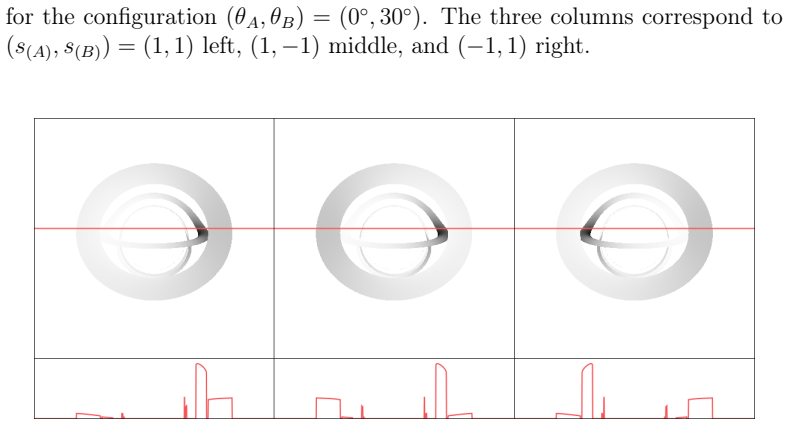
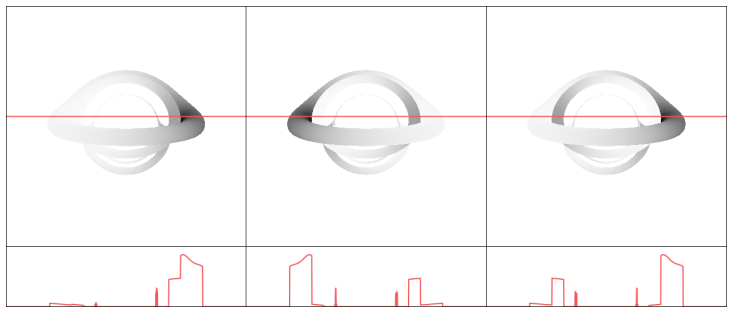
We show that the presence of two non-coplanar emitting structures produces characteristic multi-peak spectral profiles and asymmetric bolometric-flux distributions. These signatures are imprinted both in the line-profile morphology and in the α-profiles of the bolometric flux, providing simple diagnostic features of non-coplanar multi-component accretion structures.
What carries the argument
General-relativistic ray tracing of frequency-shift and bolometric-flux maps from two mutually inclined, symmetric emitting rings or tori around a Schwarzschild black hole.
If this is right
- Line profiles transition from the usual single or double peaks of equatorial disks to multiple distinct peaks when a second inclined component is present.
- Bolometric flux maps on the observer screen become visibly asymmetric rather than left-right symmetric.
- Alpha profiles of the bolometric flux acquire additional structure that directly encodes the mutual inclination angle.
- These morphological changes can be used as simple, model-independent indicators to distinguish coplanar from non-coplanar accretion geometries.
Where Pith is reading between the lines
- The same ray-tracing approach could be applied to time-variable sources to predict how the multi-peak structure evolves as the inclination changes.
- If such signatures are detected, they would constrain the possible origins of warped or misaligned inner disks in X-ray binaries and active galactic nuclei.
- Extension to spinning black holes would add frame-dragging effects that might further modulate the observed peak separations and asymmetries.
Load-bearing premise
The two emitting components are idealized, perfectly symmetric double-ring or double-torus structures with fixed mutual inclination and no interaction or turbulence.
What would settle it
High-resolution spectra and flux maps of a candidate multi-component accretion source that display only single-peak lines and perfectly symmetric bolometric distributions would contradict the predicted signatures.
Figures



read the original abstract
We investigate the observational signatures of an idealized double-ring and double-torus system orbiting a Schwarzschild black hole, allowing the two emitting components to have mutually inclined symmetry axes. Using general-relativistic ray tracing, we construct frequency-shift maps, bolometric flux maps on the observer's screen, and the corresponding spectral line profiles of the emitted radiation. The single equatorial torus is used as a reference configuration in order to isolate the effect of the second emitting component and of the mutual misalignment of the two structures. We show that the presence of two non-coplanar emitting structures produces characteristic multi-peak spectral profiles and asymmetric bolometric-flux distributions. These signatures are imprinted both in the line-profile morphology and in the $\alpha$-profiles of the bolometric flux, providing simple diagnostic features of non-coplanar multi-component accretion structures.
Editorial analysis
A structured set of objections, weighed in public.
Referee Report
Summary. The manuscript uses general-relativistic ray tracing to model idealized, symmetric double-ring and double-torus configurations with fixed mutual inclination around a Schwarzschild black hole. It constructs frequency-shift maps, bolometric-flux maps, and spectral line profiles, taking the single equatorial torus as reference to isolate the effects of the second component and misalignment. The central claim is that non-coplanar structures produce characteristic multi-peak line profiles and asymmetric bolometric-flux distributions that serve as simple observational diagnostics.
Significance. If the reported signatures hold under the stated idealizations, the work supplies concrete, directly constructed examples of how misalignment imprints on line morphology and flux asymmetry, extending single-component models and offering potential diagnostics for multi-component accretion flows.
major comments (1)
- Abstract and results section: the central claim that the configurations produce 'characteristic multi-peak spectral profiles' and 'simple diagnostic features' rests on visual inspection of the maps and profiles without quantitative metrics (e.g., peak separations, relative amplitudes, or asymmetry indices) or direct numerical comparison to the single-torus reference case, leaving the distinctiveness of the signatures unquantified.
minor comments (2)
- The α-profiles of the bolometric flux are mentioned without an explicit definition or computational procedure, which obscures how the asymmetry is quantified.
- The manuscript does not report ray-tracing resolution, convergence tests, or error estimates on the constructed maps and profiles.
Simulated Author's Rebuttal
We thank the referee for the constructive comment, which highlights an opportunity to strengthen the quantitative support for our claims. We address the point below and will revise the manuscript accordingly.
read point-by-point responses
-
Referee: Abstract and results section: the central claim that the configurations produce 'characteristic multi-peak spectral profiles' and 'simple diagnostic features' rests on visual inspection of the maps and profiles without quantitative metrics (e.g., peak separations, relative amplitudes, or asymmetry indices) or direct numerical comparison to the single-torus reference case, leaving the distinctiveness of the signatures unquantified.
Authors: We agree that the current presentation relies primarily on visual inspection of the frequency-shift maps, bolometric-flux maps, and line profiles. To address this, the revised manuscript will incorporate quantitative metrics: (i) peak separations and relative amplitudes for the multi-peak line profiles, (ii) asymmetry indices (e.g., flux-weighted centroid shifts and skewness measures) for the bolometric flux distributions, and (iii) direct numerical comparisons to the single equatorial torus reference case, including differences in line-profile moments and flux asymmetry parameters. These will be added to the results section with tabulated values and updated figure captions. revision: yes
Circularity Check
No significant circularity; derivation follows directly from ray-tracing
full rationale
The paper constructs frequency-shift maps, bolometric flux maps, and spectral line profiles via standard general-relativistic ray-tracing applied to explicitly stated idealized geometries (double-ring and double-torus with fixed mutual inclination). The single equatorial torus is used only as a comparative reference to isolate misalignment effects, with no fitted parameters, self-definitional relations, or load-bearing self-citations. All reported multi-peak profiles and asymmetric α-profiles emerge by direct computation from the input models without reduction to prior results by the same authors or renaming of known patterns.
Axiom & Free-Parameter Ledger
axioms (1)
- domain assumption Schwarzschild metric describes the spacetime around a non-rotating black hole
Reference graph
Works this paper leans on
-
[1]
K. Akiyama et al. First M87 event horizon telescope results. I. the shadow of the supermassive black hole.The Astrophysical Journal Let- ters, 875(1):L1, 2019
work page 2019
-
[2]
K. Akiyama et al. First sagittarius A* event horizon telescope results. I. the shadow of the supermassive black hole in the center of the milky way.The Astrophysical Journal Letters, 930(2):L12, 2022
work page 2022
-
[3]
K. Akiyama et al. First M87 event horizon telescope results. V. phys- ical origin of the asymmetric ring.The Astrophysical Journal Letters, 875(1):L5, 2019. 22
work page 2019
-
[4]
K. Akiyama et al. First sagittarius A* event horizon telescope results. V. testing astrophysical models of the galactic center black hole.The Astrophysical Journal Letters, 930(2):L16, 2022
work page 2022
-
[5]
M. Mościbrodzka and C. F. Gammie. IPOLE: semi-analytic scheme for relativistic polarized radiative transport.Monthly Notices of the Royal Astronomical Society, 475(1):43–54, 2018
work page 2018
-
[6]
N. I. Shakura and R. A. Sunyaev. Black holes in binary systems. obser- vational appearance.Astronomy and Astrophysics, 24:337–355, 1973
work page 1973
-
[7]
I. D. Novikov and K. S. Thorne. Astrophysics of black holes. In C. De- Witt and B. S. DeWitt, editors,Black Holes, pages 343–450. Gordon and Breach, New York, 1973
work page 1973
-
[8]
J. E. Pringle and M. J. Rees. Accretion disc models for compact x-ray sources.Astronomy and Astrophysics, 21:1–9, 1972
work page 1972
-
[9]
C. T. Cunningham. The effects of redshifts and focusing on the spectrum ofanaccretiondiskaroundaKerrblackhole.The Astrophysical Journal, 202:788–802, 1975
work page 1975
-
[10]
A. C. Fabian, M. J. Rees, L. Stella, and N. E. White. X-ray fluores- cence from the inner disc in cygnus X-1.Monthly Notices of the Royal Astronomical Society, 238(3):729–736, 1989
work page 1989
-
[11]
A. Laor. Line profiles from a disk around a rotating black hole.The Astrophysical Journal, 376:90–94, 1991
work page 1991
-
[12]
V. Karas and V. Sochora. Extremal energy shifts of radiation from a ring near a rotating black hole.The Astrophysical Journal, 725(2):1507– 1515, 2010
work page 2010
-
[13]
V. Sochora, V. Karas, J. Svoboda, and M. Dovčiak. Black hole accretion ringsrevealedbyfuturex-rayspectroscopy.Monthly Notices of the Royal Astronomical Society, 418(1):276–283, 2011
work page 2011
-
[14]
L. G. Fishbone and V. Moncrief. Relativistic fluid disks in orbit around Kerr black holes.The Astrophysical Journal, 207:962–976, 1976
work page 1976
-
[15]
M. A. Abramowicz, M. Jaroszyński, and M. Sikora. Relativistic, accret- ing disks.Astronomy and Astrophysics, 63:221–224, 1978. 23
work page 1978
-
[16]
M. Kozłowski, M. Jaroszyński, and M. A. Abramowicz. The analytic theory of fluid disks orbiting the Kerr black hole.Astronomy and As- trophysics, 63:209–220, 1978
work page 1978
-
[17]
S.-M. Wu and T.-G. Wang. Iron line profiles and self-shadowing from relativistic thick accretion discs.Monthly Notices of the Royal Astro- nomical Society, 378(3):841–851, 2007
work page 2007
-
[18]
D. Pugliese and Z. Stuchlík. Ringed accretion disks: Evolution of double toroidal configurations.The Astrophysical Journal Supplement Series, 229(2):40, 2017
work page 2017
-
[19]
D. Pugliese and Z. Stuchlík. Ringed accretion disks: Equilibrium con- figurations.The Astrophysical Journal Supplement Series, 221(2):25, 2015
work page 2015
-
[20]
D. Bardiev, M. Kološ, D. Pugliese, and Z. Stuchlík. GRMHD evolution of interacting double accretion tori orbiting a central black hole.The Astrophysical Journal, 941(2):173, 2022
work page 2022
-
[21]
J. Dexter and P. C. Fragile. Observational signatures of tilted black hole accretion disks from simulations.The Astrophysical Journal, 730(1):36, 2011
work page 2011
- [22]
- [23]
-
[24]
D. Pugliese and Z. Stuchlík. Limiting effects in clusters of misaligned toroids orbiting static SMBHs.Monthly Notices of the Royal Astronom- ical Society, 493(3):4229–4255, 2020
work page 2020
-
[25]
D. Pugliese and Z. Stuchlík. Embedded BHs and multipole globules: clustered misaligned thick accretion disks around static SMBHs.Clas- sical and Quantum Gravity, 37(19):195025, 2020
work page 2020
-
[26]
J. Schee and Z. Stuchlík. Profiled spectral lines generated in the field of Kerr superspinars.Journal of Cosmology and Astroparticle Physics, 2013(04):005, 2013. 24
work page 2013
-
[27]
J. Schee and Z. Stuchlík. Appearance of keplerian discs orbiting on both sides of reflection-symmetric wormholes.Journal of Cosmology and Astroparticle Physics, 2022(01):054, 2022. 25
work page 2022
discussion (0)
Sign in with ORCID, Apple, or X to comment. Anyone can read and Pith papers without signing in.