REVIEW 2 major objections 6 minor 117 references
ALMA millimetre-wavelength imaging of HD 138965: New constraints on the debris dust composition and presence of planetary companions
T0 review · 2 major / 6 minor · reviewed 2026-08-07 · deepseek-v4-flash
Pith's one-line read First ALMA millimetre imaging of HD 138965 resolves its cool outer debris belt at 150 au and, combined with radiative-transfer modelling, limits any companion to 2.3 Jupiter masses.
desk verdict Credible first resolved mm view of HD 138965's outer belt; radius robust, width and composition model-dependent, but worth refereeing with fixes. read the letter →
The pith
A machine-rendered reading of the paper's core claim, the machinery that carries it, and where it could break.
The reading
What carries the argument
The argument runs through three pieces of machinery. First, a Gaussian-belt model of the ALMA visibilities, generated with a radiative-transfer code and sampled by a Markov chain Monte Carlo ensemble, yields the belt's radius, width, and orientation. Second, the paper's Stardust model redistributes dust grains under gravity, radiation pressure, Poynting–Robertson drag, and a simple collisional lifetime, predicting the spectral energy distribution for each grain composition, with model comparison by the Bayesian Information Criterion. Third, a literature single-planet sculpting relation converts the measured belt inner edge into a companion mass limit, and an established albedo formula turns the HST scattered-light non-detection into $\omega \le 0.09$.
What would settle it
Spatially resolving the inner belt would settle the question: JWST/MIRI imaging at about $10$ $\mu$m or longer-baseline ALMA at 1.3 mm could reach the ~0.25 arcsec separation of a 20 au inner belt, and showing its radius, width, or mass differs from the assumed values would directly test whether the outer-belt silicate preference is an artefact of the fixed inner-belt model. A second check is detecting water-ice or carbon spectral features in the outer belt's SED, since the model currently rules out 50% ice mixes and all tested carbon mixes.
Extended reading notes
Core claim
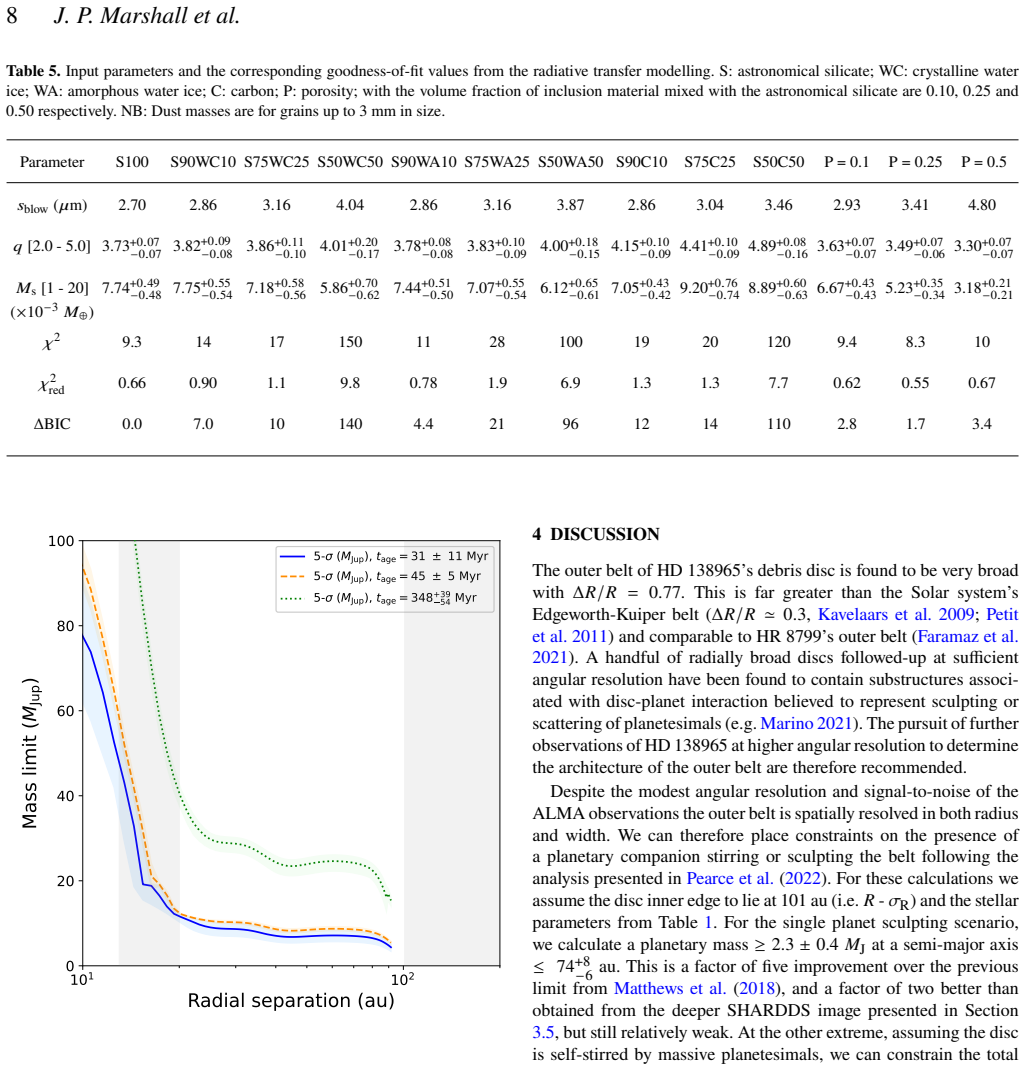
The central claim is that HD 138965's outer debris belt is spatially resolved at millimetre wavelengths for the first time, with a peak radius of $150^{+10}_{-7}$ au and a Gaussian width of $49^{+7}_{-6}$ au (fractional width $\Delta R/R = 0.77$), at an inclination of $49.9^{+3.3}_{-3.7}$ degrees. From this resolved structure, the authors find that astronomical silicate is the best-fitting dust composition for the outer belt among the tested inclusion mixtures, while scenarios with at least 10% crystalline or amorphous water ice cannot be rejected and 50% ice or any carbon mix is eliminated. Combining the ALMA image with the HST optical non-detection, they derive the scattering albedo upper limit $\omega \le 0.09$; and using a single-planet sculpting model on the belt's inner edge at 101 au, they place a companion mass limit of $2.3 \pm 0.4$ Jupiter masses for separations $a \le 78$ au.
Load-bearing premise
The ranking of outer-belt dust compositions depends on fixing the unresolved inner belt's radius ($13.7$ au), width ($1.75$ au), minimum grain size ($12$ $\mu$m), size distribution index ($q = 3.5$), and mass ($0.154 \times 10^{-3}$ Earth masses) from an initial Stardust fit that assumed the outer belt is pure astronomical silicate; if those inner-belt values are different, the BIC preference for silicate could change.
Editorial extensions
If this is right
- The outer belt's fractional width of 0.77 places HD 138965 among the most radially extended resolved debris discs, comparable to HR 8799's belt, making it a candidate for hidden substructure that current data cannot resolve.
- The companion mass limit of $2.3 \pm 0.4$ Jupiter masses interior to 78 au is about a factor of two tighter than the deepest direct-imaging limit at that separation, showing the power of belt morphology.
- The non-detection in scattered light, combined with the resolved ALMA shape, yields an optical albedo upper limit of 0.09, which implies the disc would become detectable with roughly a factor of four deeper imaging.
- The CO(2–1) upper limit of $2.7 \times 10^{-23}$ W m$^{-2}$ is about three times the level predicted for a gas mass of $8.6 \times 10^{-7}$ Earth masses, so gas is not ruled out but at present is unconstrained.
Reading between the lines
- If the star's true age is closer to 350 Myr rather than the assumed Argus age of 31 Myr, the direct-imaging mass limits at 80 au weaken to roughly 15 Jupiter masses, which would make the architecture-based limit of 2.3 Jupiter masses the only meaningful constraint.
- If future JWST/MIRI imaging places the inner belt at a radius different from the assumed 13.7 au, then the inner-belt grain temperature and mass would need to change to fit the same mid-infrared excess, which could shift the outer-belt composition preference.
- The residual image shows a 2σ brightness asymmetry between the two ansae; if real, this could indicate an eccentric ring or pericentre glow, which deeper or higher-resolution ALMA imaging could confirm.
- The discrepancy between the HST albedo limit (≤0.09) and the SED-inferred albedo (~0.56 for the smallest grains) suggests the outer-belt grains may be porous, icy, or strongly forward-scattering, which future polarimetric observations could test.
Editorial analysis
A structured set of objections, weighed in public.
Referee Report
Summary. The paper presents ALMA Band 6 millimetre-wavelength imaging of HD 138965, a young A star in the Argus association, and models the debris disc as a single Gaussian belt in the visibility plane. The authors report a resolved outer belt with peak radius 150^{+10}_{-7} au, width sigma_R = 49^{+7}_{-6} au (Delta R/R = 0.77), inclination 49.9 degrees, and position angle 173.3 degrees, with no constraint on the vertical scale height. They combine this geometry with an SED model (Stardust) to infer that astronomical silicate is the preferred outer-belt dust composition, while 10% water-ice inclusions cannot be excluded; from the HST non-detection they derive a scattering albedo limit omega <= 0.09; and from the belt architecture they place a companion mass limit of 2.3 +/- 0.4 M_Jup interior to about 78 au. They also report a non-detection of CO(2-1) emission.
Significance. If the reported geometry holds, this is the first millimetre-wavelength spatial resolution of the outer belt of HD 138965 and it anchors an independent dust-composition ranking, an albedo upper limit, and a companion-mass constraint that improves on direct imaging limits. The paper uses a standard and largely reproducible methodology (MCMC visibility fitting with RADMC-3D and Galario, BIC model comparison) and is appropriately explicit about several limiting assumptions, notably the unconstrained scale height and the degeneracy in the inner-belt parameters. The results are incremental rather than transformative, but they are a solid observational contribution to the debris-disc literature and the strengths of the analysis are the clear separation of the measurement (ALMA geometry) from the derived constraints (composition, albedo, companion mass).
major comments (2)
- [3.2, Table 2, Appendix B] The quoted width sigma_R = 49^{+7}_{-6} au is not robust against the unconstrained vertical scale height and the assumed single-Gaussian radial profile. The scale-height posterior is flat and uninformative (Appendix B), and Section 3.2 states that a broad range of scale heights fits the observations. At i ~= 50 degrees, a vertically thick belt can broaden the projected emission, and this broadening can be absorbed by sigma_R in a Gaussian model. Since sigma_R is subsequently used to set the outer-belt inner edge at R - sigma_R = 101 au for the companion limit (Section 4) and is fixed as an input to the SED modelling (Section 3.4), the width needs a robustness test: repeat the visibility fit with h fixed at the extremes (for example 0.01 and 0.30) and with an alternative radial profile (for example a sharp-edged ring or a power-law surface density) to establish that Delta R/R = 0.77 is not an artefact of the model family. The 2-sigma NW/SE residual asymmetry in Figure 1 reinforces the need for such a test.
- [3.4, Table 4] The outer-belt composition ranking is conditional on fixed inner-belt parameters (r_m = 13.7 au, sigma_r = 1.75 au, s_min = 12 micron, q = 3.5, M_s = 0.154 x 10^-3 M_Earth) that were obtained from an initial Stardust fit assuming a pure-silicate outer belt. The text explicitly acknowledges that this may bias the outer-belt comparison toward astronomical silicate, but the inner-belt parameters are not marginalised over or varied in the composition fits. The Delta BIC margins separating S100 from S90WC10 (7.0) and from S90WA10 (4.4) are modest, so a plausible change in the inner-belt parameters could alter the ranking. I request a sensitivity test in which the inner-belt radius, s_min, q, or mass are varied within their posterior ranges, or a joint fit, to show that the silicate preference is not an artefact of the initial assumption.
minor comments (6)
- [3.2, Table 2 vs Figure B1] The disc flux density is reported as 1.460 +/- 0.230 mJy in Table 2 but as 1.46^{+0.08}_{-0.07} mJy in Figure B1; if the larger uncertainty includes the weather-related calibration systematic described in Section 2.1, this should be stated explicitly, since the SED fit uses the +/- 0.23 mJy value.
- [3.4, Table 4] The initial MCMC analysis is reported in the text to give an inner-belt mean radius of 15^{+3}_{-2} au, while Table 4 lists r_m = 13.7 au; please state which value (posterior median or maximum likelihood) was adopted for the fixed inner-belt model.
- [3.4, Table 5, Abstract] The sentence in Section 3.4 saying that the best-fit results correspond to the porosity scenarios and to a strong candidate with 90:10 crystalline water ice appears to contradict the BIC table and the abstract, which identify pure astronomical silicate as the best fit; please reconcile the wording.
- [Abstract, Section 4] The companion mass limit is quoted as a <= 78 au in the abstract but as a <= 74^{+8}_{-6} au in Section 4, and the improvement factor is stated as a factor of two in the abstract but as a factor of five over Matthews et al. (2018) and a factor of two over the SHARDDS image in Section 4; unify these numbers and specify the baseline.
- [3.5, Table 5] The SED-derived albedo of 0.56 is computed for 'dirty ice' grains at 1.6 micron, whereas the preferred composition in Table 5 is pure astronomical silicate and the HST limit is at 0.6 micron; recompute the comparison at the HST wavelength for the best-fit composition, or present it explicitly as an illustrative consistency check rather than as a tension.
- [Appendix B] The caption says the posterior distributions are based on '10,0000 realisations', which appears to be a typo, and Figure B1 omits the scale-height posterior; since h is unconstrained, please show at least the h-sigma_R covariance or state explicitly that it was not stored.
Circularity Check
ALMA geometry, HST albedo limit, and companion mass limit are self-contained; the only circular chain is the acknowledged coupling between the assumed outer-belt silicate composition and the fixed inner-belt parameters used in the SED composition ranking.
-
fitted input called prediction
[Section 3.4 (SED modelling), Tables 4 and 5; see also Section 4 Discussion]
"We performed an initial analysis using Stardust to estimate the inner belt characteristics. ... To pin down the radial component of the inner belt, we ran Stardust with the following assumptions for the inner belt: minimum grain size of 12 μm, size distribution component to be 3.5 ... and the disc fractional width (Δr/r) to be 0.3. ... It should be noted that the emission from the inner belt is fixed following the initial modelling where the outer belt grains are assumed to be solely astronomical silicate."
The outer-belt composition ranking (Table 5) is evaluated with the inner-belt parameters (r_m = 13.7 au, σ_r = 1.75 au, s_min = 12 μm, q = 3.5, M_s = 0.154×10^-3 M_Earth; Table 4) held fixed. Those parameters were obtained from an initial Stardust SED fit that assumed the outer belt is pure astronomical silicate. The BIC comparison then ranks pure astronomical silicate as the best outer-belt composition using an inner-belt model that was itself tuned under exactly that composition hypothesis. The paper explicitly acknowledges the bias but does not marginalize over the inner-belt parameters, so the composition ranking is partly an input: the fixed inner belt is not composition-neutral.
full rationale
The core empirical claims are self-contained. The ALMA visibility fit measures R_peak = 150+10/-7 au and σ_R = 49+7/-6 au directly from the data (Section 3.2, Table 2), independent of any composition or companion model. The HST-based albedo limit ω ≤ 0.09 uses an external non-detection and the measured disc geometry, not the SED fit. The companion mass limit is a forward application of Pearce et al. (2022) stirring/sculpting models to the measured inner edge R - σ_R = 101 au. The one genuine circular chain is in the dust-composition analysis: the inner-belt parameters are fixed using an initial Stardust fit that assumes the outer belt is pure astronomical silicate, and those fixed parameters are then used in the BIC ranking that selects pure astronomical silicate for the outer belt. The authors flag this bias in Section 3.4 and again in Section 4, but the ranking is nevertheless not fully independent. The unconstrained vertical scale height and single-Gaussian profile are model-assumption concerns that affect the robustness of the width measurement, but they are not circularity: the width is an empirical fit, and using that fit as an input to later SED and companion calculations is standard practice rather than an identity. Overall, the central ALMA measurement and the derived albedo and companion limits stand on their own; only the composition ranking carries a moderate, acknowledged coupling, giving a score of 3.
Assumptions & free parameters
free parameters (12)
- Outer belt peak radius R_peak =
150 +10/-7 au
- Outer belt width sigma_R =
49 +7/-6 au
- Outer belt inclination i =
49.9 +3.3/-3.7 deg
- Position angle phi =
173.3 +3.7/-4.1 deg
- Outer belt flux density f_disc =
1.46 ± 0.23 mJy
- Inner belt radius =
13.7 au
- Inner belt width =
1.75 au
- Inner belt minimum grain size =
12 μm
- Inner belt size distribution exponent q =
3.5
- Inner belt dust mass =
0.154 ×10^-3 M_Earth
- Outer belt size distribution exponent q =
3.49 to 4.89 depending on composition
- Outer belt dust mass =
3.18 to 9.20 ×10^-3 M_Earth
assumptions (8)
- standard math Grains are spherical and emit/absorb according to Mie theory
- domain assumption The debris disc is optically thin and gas-free
- domain assumption Grain size distribution is a power law with index q between 2 and 5
- ad hoc to paper Maximum grain size is 3000 μm
- ad hoc to paper The inner belt parameters derived from an initial fit with pure-silicate outer belt are correct
- domain assumption The star is young with age 31 ± 11 Ma
- domain assumption The Pearce et al. (2022) single-planet stirring model applies
- domain assumption Fractional luminosity is a proxy for optical depth in the collisional lifetime calculation
Cite this review
Pith. "Pith review of ALMA millimetre-wavelength imaging of HD 138965: New constraints on the debris dust composition and presence of planetary companions." pith.science (2026). https://pith.science/paper/DE55ACKI
@misc{pith2026250611726,
  author       = {Pith},
  title        = {Pith review of: ALMA millimetre-wavelength imaging of HD 138965: New constraints on the debris dust composition and presence of planetary companions},
  year         = {2026},
  howpublished = {\url{https://pith.science/paper/DE55ACKI}},
  note         = {Machine review of arXiv:2506.11726}
}
abstract
HD 138965 is a young A type star and member of the nearby young Argus association. This star is surrounded by a broad, bright debris disc with two temperature components that was spatially resolved at far-infrared wavelengths by Herschel. Here we present ALMA millimetre-wavelength imaging of the cool outer belt. These reveal its radial extent to be $150^{+10}_{-7}$ au with a width ($\sigma$) of 49$^{+7}_{-6}$ au (${\Delta}R/R$ = 0.77), at a moderate inclination of 49$\fdeg$9^{+3.3}_{-3.7}$. Due to the limited angular resolution, signal-to-noise, and inclination we have no constraint on the disc's vertical scale height. We modelled the disc emission with both gravitational and radiation forces acting on the dust grains. As the inner belt has not been spatially resolved, we fixed its radius and width prior to modelling the outer belt. We find astronomical silicate is the best fit for the dust composition. However, we could not reject possible scenarios where there are at least 10 \% water-ice inclusions. Combining the spatially resolved imaging by ALMA with non-detection at optical wavelengths by HST, we obtain a limit on the scattering albedo $\omega \leq 0.09$ for the debris dust in the outer belt. Analysis of the outer belt's architecture in conjunction with simple stirring models places a mass limit of $2.3~\pm~0.4 M_{\rm Jup}$ on a companion interior to the belt ($a \leq 78$ au), a factor of two improvement over constraints from high contrast imaging.
Figures


Figures from the paper (1 more)
Reference graph
Works this paper leans on
-
[1]
Allard F., Hauschildt P. H., Alexander D. R., Tamanai A., Schweitzer A., 2001, @doi [ ] 10.1086/321547 , https://ui.adsabs.harvard.edu/abs/2001ApJ...556..357A 556, 357
doi:10.1086/321547 2001
-
[2]
Allard F., Homeier D., Freytag B., 2012, @doi [Philosophical Transactions of the Royal Society of London Series A] 10.1098/rsta.2011.0269 , https://ui.adsabs.harvard.edu/abs/2012RSPTA.370.2765A 370, 2765
arXiv 2012
-
[3]
Astropy Collaboration et al., 2013, @doi [ ] 10.1051/0004-6361/201322068 , https://ui.adsabs.harvard.edu/#abs/2013A&A...558A..33A 558, A33
-
[4]
Astropy Collaboration et al., 2018, @doi [ ] 10.3847/1538-3881/aabc4f , http://adsabs.harvard.edu/abs/2018AJ....156..123A 156, 123
-
[5]
Astropy Collaboration et al., 2022, @doi [ ] 10.3847/1538-4357/ac7c74 , https://ui.adsabs.harvard.edu/abs/2022ApJ...935..167A 935, 167
-
[6]
Augereau J. C., Beust H., 2006, @doi [ ] 10.1051/0004-6361:20054250 , https://ui.adsabs.harvard.edu/abs/2006A&A...455..987A 455, 987
-
[7]
Babusiaux C., et al., 2023, @doi [ ] 10.1051/0004-6361/202243790 , https://ui.adsabs.harvard.edu/abs/2023A&A...674A..32B 674, A32
-
[8]
A., Neugebauer G., Habing H
Beichman C. A., Neugebauer G., Habing H. J., Clegg P. E., Chester T. J., eds, 1988, Infrared Astronomical Satellite (IRAS) Catalogs and Atlases.Volume 1: Explanatory Supplement. 1 Vol. 1
1988
Show all 117 references
-
[9]
L., et al., 2019, @doi [ ] 10.1051/0004-6361/201935251 , https://ui.adsabs.harvard.edu/abs/2019A&A...631A.155B 631, A155
Beuzit J. L., et al., 2019, @doi [ ] 10.1051/0004-6361/201935251 , https://ui.adsabs.harvard.edu/abs/2019A&A...631A.155B 631, A155
2019 doi
-
[10]
F., Huffman D
Bohren C. F., Huffman D. R., 1998, Absorption and Scattering of Light by Small Particles . John Wiley & Sons
1998
- [11]
-
[12]
Bressan A., Marigo P., Girardi L., Salasnich B., Dal Cero C., Rubele S., Nanni A., 2012, @doi [ ] 10.1111/j.1365-2966.2012.21948.x , https://ui.adsabs.harvard.edu/abs/2012MNRAS.427..127B 427, 127
2012
-
[13]
P., Anderson D
Burnham K. P., Anderson D. R., 2004, @doi [Sociological Methods & Research] 10.1177/0049124104268644 , 33, 261
2004 doi
-
[14]
A., Lamy P
Burns J. A., Lamy P. L., Soter S., 1979, @doi [ ] 10.1016/0019-1035(79)90050-2 , http://adsabs.harvard.edu/abs/1979Icar...40....1B 40, 1
1979 doi
-
[15]
H., Mittal T., Kuchner M., Forrest W
Chen C. H., Mittal T., Kuchner M., Forrest W. J., Lisse C. M., Manoj P., Sargent B. A., Watson D. M., 2014a, @doi [ ] 10.1088/0067-0049/211/2/25 , https://ui.adsabs.harvard.edu/abs/2014ApJS..211...25C 211, 25
-
[16]
Chen Y., Girardi L., Bressan A., Marigo P., Barbieri M., Kong X., 2014b, @doi [ ] 10.1093/mnras/stu1605 , https://ui.adsabs.harvard.edu/abs/2014MNRAS.444.2525C 444, 2525
-
[17]
Chen Y., Bressan A., Girardi L., Marigo P., Kong X., Lanza A., 2015, @doi [ ] 10.1093/mnras/stv1281 , https://ui.adsabs.harvard.edu/abs/2015MNRAS.452.1068C 452, 1068
2015 doi
-
[18]
Choquet \'E ., et al., 2017, @doi [ ] 10.3847/2041-8213/834/2/L12 , http://adsabs.harvard.edu/abs/2017ApJ...834L..12C 834, L12
2017 doi
-
[19]
Choquet \'E ., et al., 2018, @doi [ ] 10.3847/1538-4357/aaa892 , https://ui.adsabs.harvard.edu/abs/2018ApJ...854...53C 854, 53
2018 doi
-
[20]
F., et al., 2021, @doi [ ] 10.1093/mnras/stab1237 , https://ui.adsabs.harvard.edu/abs/2021MNRAS.504.4497C 504, 4497
Cronin-Coltsmann P. F., et al., 2021, @doi [ ] 10.1093/mnras/stab1237 , https://ui.adsabs.harvard.edu/abs/2021MNRAS.504.4497C 504, 4497
2021 doi
-
[21]
F., Kennedy G
Cronin-Coltsmann P. F., Kennedy G. M., Kral Q., Lestrade J.-F., Marino S., Matr \`a L., Wyatt M. C., 2023, @doi [ ] 10.1093/mnras/stad3083 , https://ui.adsabs.harvard.edu/abs/2023MNRAS.526.5401C 526, 5401
2023 doi
-
[22]
A., et al., 2024, @doi [ ] 10.3847/1538-4357/ad0e69 , https://ui.adsabs.harvard.edu/abs/2024ApJ...961..245C 961, 245
Crotts K. A., et al., 2024, @doi [ ] 10.3847/1538-4357/ad0e69 , https://ui.adsabs.harvard.edu/abs/2024ApJ...961..245C 961, 245
2024 doi
-
[23]
H., et al., 2022, @doi [ ] 10.1051/0004-6361/202244145 , https://ui.adsabs.harvard.edu/abs/2022A&A...666A..33D 666, A33
Dahlqvist C. H., et al., 2022, @doi [ ] 10.1051/0004-6361/202244145 , https://ui.adsabs.harvard.edu/abs/2022A&A...666A..33D 666, A33
2022 doi
-
[24]
Daley C., et al., 2019, @doi [ ] 10.3847/1538-4357/ab1074 , https://ui.adsabs.harvard.edu/abs/2019ApJ...875...87D 875, 87
2019 doi
-
[25]
J., Hillenbrand L
David T. J., Hillenbrand L. A., 2015, @doi [ ] 10.1088/0004-637X/804/2/146 , https://ui.adsabs.harvard.edu/abs/2015ApJ...804..146D 804, 146
2015 doi
-
[26]
S., 1969, @doi [ ] 10.1029/JB074i010p02531 , http://adsabs.harvard.edu/abs/1969JGR....74.2531D 74, 2531
Dohnanyi J. S., 1969, @doi [ ] 10.1029/JB074i010p02531 , http://adsabs.harvard.edu/abs/1969JGR....74.2531D 74, 2531
1969 doi
-
[27]
T., 2003, @doi [ ] 10.1086/379118 , http://adsabs.harvard.edu/abs/2003ApJ...598.1017D 598, 1017
Draine B. T., 2003, @doi [ ] 10.1086/379118 , http://adsabs.harvard.edu/abs/2003ApJ...598.1017D 598, 1017
2003 doi
-
[28]
Dullemond C. P., Juhasz A., Pohl A., Sereshti F., Shetty R., Peters T., Commercon B., Flock M., 2012, RADMC-3D: A multi-purpose radiative transfer tool , Astrophysics Source Code Library, record ascl:1202.015
2012
-
[29]
Eiroa C., et al., 2013, @doi [ ] 10.1051/0004-6361/201321050 , https://ui.adsabs.harvard.edu/abs/2013A&A...555A..11E 555, A11
2013 doi
-
[30]
M., et al., 2020, @doi [ ] 10.3847/1538-3881/ab9199 , https://ui.adsabs.harvard.edu/abs/2020AJ....160...24E 160, 24
Esposito T. M., et al., 2020, @doi [ ] 10.3847/1538-3881/ab9199 , https://ui.adsabs.harvard.edu/abs/2020AJ....160...24E 160, 24
2020 doi
-
[31]
Faramaz V., et al., 2021, @doi [ ] 10.3847/1538-3881/abf4e0 , https://ui.adsabs.harvard.edu/abs/2021AJ....161..271F 161, 271
2021 doi
-
[32]
Foreman-Mackey D., 2016, @doi [The Journal of Open Source Software] 10.21105/joss.00024 , 24
2016 doi
-
[33]
W., Lang D., Goodman J., 2013, @doi [ ] 10.1086/670067 , https://ui.adsabs.harvard.edu/abs/2013PASP..125..306F 125, 306
Foreman-Mackey D., Hogg D. W., Lang D., Goodman J., 2013, @doi [ ] 10.1086/670067 , https://ui.adsabs.harvard.edu/abs/2013PASP..125..306F 125, 306
2013 doi
-
[34]
Fouesneau M., 2022, "pyphot", https://github.com/mfouesneau/pyphot
2022
-
[35]
Gagn \'e J., et al., 2018, @doi [ ] 10.3847/1538-4357/aaae09 , https://ui.adsabs.harvard.edu/abs/2018ApJ...856...23G 856, 23
2018 doi
-
[36]
Gaia Collaboration et al., 2016, @doi [ ] 10.1051/0004-6361/201629272 , https://ui.adsabs.harvard.edu/abs/2016A&A...595A...1G 595, A1
2016 doi
-
[37]
Gaia Collaboration et al., 2023, @doi [ ] 10.1051/0004-6361/202243940 , https://ui.adsabs.harvard.edu/abs/2023A&A...674A...1G 674, A1
2023 doi
-
[38]
R., et al., 2020, @doi [Nature] 10.1038/s41586-020-2649-2 , 585, 357
Harris C. R., et al., 2020, @doi [Nature] 10.1038/s41586-020-2649-2 , 585, 357
2020 doi
-
[39]
M., Eiroa C., del Burgo C., Marshall J
Heras A. M., Eiroa C., del Burgo C., Marshall J. P., Montesinos B., 2025, @doi [ ] 10.1051/0004-6361/202449826 , https://ui.adsabs.harvard.edu/abs/2025A&A...694A.325H 694, A325
2025 doi
-
[40]
H g E., et al., 2000, , https://ui.adsabs.harvard.edu/abs/2000A&A...355L..27H 355, L27
2000
-
[41]
S., et al., 2017, @doi [ ] 10.1093/mnras/stx1378 , https://ui.adsabs.harvard.edu/abs/2017MNRAS.470.3606H 470, 3606
Holland W. S., et al., 2017, @doi [ ] 10.1093/mnras/stx1378 , https://ui.adsabs.harvard.edu/abs/2017MNRAS.470.3606H 470, 3606
2017 doi
-
[42]
Horner J., et al., 2020, @doi [ ] 10.1088/1538-3873/ab8eb9 , https://ui.adsabs.harvard.edu/abs/2020PASP..132j2001H 132, 102001
2020 doi
-
[43]
M., Sandford S
Hudgins D. M., Sandford S. A., Allamandola L. J., Tielens A. G. G. M., 1993, @doi [ ] 10.1086/191796 , https://ui.adsabs.harvard.edu/abs/1993ApJS...86..713H 86, 713
1993 doi
-
[44]
M., Duch \^e ne G., Matthews B
Hughes A. M., Duch \^e ne G., Matthews B. C., 2018, @doi [ ] 10.1146/annurev-astro-081817-052035 , https://ui.adsabs.harvard.edu/abs/2018ARA&A..56..541H 56, 541
2018 doi
-
[45]
D., 2007, @doi [Computing in Science and Engineering] 10.1109/MCSE.2007.55 , https://ui.adsabs.harvard.edu/#abs/2007CSE.....9...90H 9, 90
Hunter J. D., 2007, @doi [Computing in Science and Engineering] 10.1109/MCSE.2007.55 , https://ui.adsabs.harvard.edu/#abs/2007CSE.....9...90H 9, 90
2007 doi
-
[46]
Ishihara D., et al., 2010, @doi [ ] 10.1051/0004-6361/200913811 , https://ui.adsabs.harvard.edu/abs/2010A&A...514A...1I 514, A1
2010 doi
-
[47]
C., Greaves J
Kains N., Wyatt M. C., Greaves J. S., 2011, @doi [ ] 10.1111/j.1365-2966.2011.18566.x , https://ui.adsabs.harvard.edu/abs/2011MNRAS.414.2486K 414, 2486
2011
-
[48]
J., et al., 2009, @doi [ ] 10.1088/0004-6256/137/6/4917 , https://ui.adsabs.harvard.edu/abs/2009AJ....137.4917K 137, 4917
Kavelaars J. J., et al., 2009, @doi [ ] 10.1088/0004-6256/137/6/4917 , https://ui.adsabs.harvard.edu/abs/2009AJ....137.4917K 137, 4917
2009 doi
-
[49]
M., Wyatt M
Kennedy G. M., Wyatt M. C., 2013, @doi [ ] 10.1093/mnras/stt900 , https://ui.adsabs.harvard.edu/abs/2013MNRAS.433.2334K 433, 2334
2013 doi
-
[50]
M., et al., 2018, @doi [ ] 10.1093/mnras/sty492 , https://ui.adsabs.harvard.edu/abs/2018MNRAS.476.4584K 476, 4584
Kennedy G. M., et al., 2018, @doi [ ] 10.1093/mnras/sty492 , https://ui.adsabs.harvard.edu/abs/2018MNRAS.476.4584K 476, 4584
2018 doi
-
[51]
Klaassen P., et al., 2024, @doi [Open Research Europe] 10.12688/openreseurope.17450.1 , https://ui.adsabs.harvard.edu/abs/2024ORE.....4..112K 4, 112
2024 doi
-
[52]
Kla c ka J., Kocifaj M., P \'a stor P., Petr z ala J., 2007, @doi [ ] 10.1051/0004-6361:20066132 , https://ui.adsabs.harvard.edu/abs/2007A&A...464..127K 464, 127
2007 doi
-
[53]
J., 2021, @doi [ ] 10.1016/j.icarus.2021.114613 , https://ui.adsabs.harvard.edu/abs/2021Icar..36814613K 368, 114613
Kossacki K. J., 2021, @doi [ ] 10.1016/j.icarus.2021.114613 , https://ui.adsabs.harvard.edu/abs/2021Icar..36814613K 368, 114613
2021
-
[54]
C., Kennedy G
Kral Q., Matr \`a L., Wyatt M. C., Kennedy G. M., 2017, @doi [ ] 10.1093/mnras/stx730 , https://ui.adsabs.harvard.edu/abs/2017MNRAS.469..521K 469, 521
2017 doi
-
[55]
E., et al., 2010, @doi [ ] 10.1088/0004-6256/140/4/1051 , https://ui.adsabs.harvard.edu/abs/2010AJ....140.1051K 140, 1051
Krist J. E., et al., 2010, @doi [ ] 10.1088/0004-6256/140/4/1051 , https://ui.adsabs.harvard.edu/abs/2010AJ....140.1051K 140, 1051
2010 doi
-
[56]
V., 2010, @doi [Research in Astronomy and Astrophysics] 10.1088/1674-4527/10/5/001 , http://adsabs.harvard.edu/abs/2010RAA....10..383K 10, 383
Krivov A. V., 2010, @doi [Research in Astronomy and Astrophysics] 10.1088/1674-4527/10/5/001 , http://adsabs.harvard.edu/abs/2010RAA....10..383K 10, 383
2010 doi
-
[57]
V., Booth M., 2018, @doi [ ] 10.1093/mnras/sty1607 , https://ui.adsabs.harvard.edu/abs/2018MNRAS.479.3300K 479, 3300
Krivov A. V., Booth M., 2018, @doi [ ] 10.1093/mnras/sty1607 , https://ui.adsabs.harvard.edu/abs/2018MNRAS.479.3300K 479, 3300
2018 doi
-
[58]
V., Wyatt M
Krivov A. V., Wyatt M. C., 2021, @doi [ ] 10.1093/mnras/staa2385 , https://ui.adsabs.harvard.edu/abs/2021MNRAS.500..718K 500, 718
2021 doi
-
[59]
u ller S., L \
Krivov A. V., M \"u ller S., L \"o hne T., Mutschke H., 2008, @doi [ ] 10.1086/591507 , http://adsabs.harvard.edu/abs/2008ApJ...687..608K 687, 608
2008 doi
-
[60]
J., Stark C
Kuchner M. J., Stark C. C., 2010, @doi [ ] 10.1088/0004-6256/140/4/1007 , https://ui.adsabs.harvard.edu/abs/2010AJ....140.1007K 140, 1007
2010 doi
-
[61]
J., Spoon H
Lebouteiller V., Barry D. J., Spoon H. W. W., Bernard-Salas J., Sloan G. C., Houck J. R., Weedman D. W., 2011, @doi [ ] 10.1088/0067-0049/196/1/8 , https://ui.adsabs.harvard.edu/abs/2011ApJS..196....8L 196, 8
2011 doi
-
[62]
F., Wyatt M
Lestrade J. F., Wyatt M. C., Bertoldi F., Menten K. M., Labaigt G., 2009, @doi [ ] 10.1051/0004-6361/200912306 , https://ui.adsabs.harvard.edu/abs/2009A&A...506.1455L 506, 1455
2009 doi
-
[63]
Liu Q., Wang T., Jiang P., 2014, @doi [ ] 10.1088/0004-6256/148/1/3 , https://ui.adsabs.harvard.edu/abs/2014AJ....148....3L 148, 3
2014 doi
-
[64]
V., Booth M., Lestrade J.-F., 2020, @doi [ ] 10.1093/mnras/staa2608 , https://ui.adsabs.harvard.edu/abs/2020MNRAS.499.3932L 499, 3932
Luppe P., Krivov A. V., Booth M., Lestrade J.-F., 2020, @doi [ ] 10.1093/mnras/staa2608 , https://ui.adsabs.harvard.edu/abs/2020MNRAS.499.3932L 499, 3932
2020 doi
-
[65]
A., et al., 2016, @doi [ ] 10.3847/0004-637X/823/2/79 , https://ui.adsabs.harvard.edu/abs/2016ApJ...823...79M 823, 79
MacGregor M. A., et al., 2016, @doi [ ] 10.3847/0004-637X/823/2/79 , https://ui.adsabs.harvard.edu/abs/2016ApJ...823...79M 823, 79
2016 doi
-
[66]
Marino S., 2021, @doi [ ] 10.1093/mnras/stab771 , https://ui.adsabs.harvard.edu/abs/2021MNRAS.503.5100M 503, 5100
2021 doi
-
[67]
P., et al., 2014, @doi [ ] 10.1051/0004-6361/201424517 , https://ui.adsabs.harvard.edu/abs/2014A&A...570A.114M 570, A114
Marshall J. P., et al., 2014, @doi [ ] 10.1051/0004-6361/201424517 , https://ui.adsabs.harvard.edu/abs/2014A&A...570A.114M 570, A114
2014 doi
-
[68]
P., Maddison S
Marshall J. P., Maddison S. T., Thilliez E., Matthews B. C., Wilner D. J., Greaves J. S., Holland W. S., 2017, @doi [ ] 10.1093/mnras/stx645 , https://ui.adsabs.harvard.edu/abs/2017MNRAS.468.2719M 468, 2719
2017 doi
-
[69]
P., Milli J., Choquet \'E ., del Burgo C., Kennedy G
Marshall J. P., Milli J., Choquet \'E ., del Burgo C., Kennedy G. M., Matr \`a L., Ertel S., Boccaletti A., 2018, @doi [ ] 10.3847/1538-4357/aaec6a , https://ui.adsabs.harvard.edu/abs/2018ApJ...869...10M 869, 10
2018 doi
-
[70]
P., Wang L., Kennedy G
Marshall J. P., Wang L., Kennedy G. M., Zeegers S. T., Scicluna P., 2021, @doi [ ] 10.1093/mnras/staa3917 , https://ui.adsabs.harvard.edu/abs/2021MNRAS.501.6168M 501, 6168
2021 doi
-
[71]
P., et al., 2023a, @doi [ ] 10.1093/mnras/stad913 , https://ui.adsabs.harvard.edu/abs/2023MNRAS.521.5940M 521, 5940
Marshall J. P., et al., 2023a, @doi [ ] 10.1093/mnras/stad913 , https://ui.adsabs.harvard.edu/abs/2023MNRAS.521.5940M 521, 5940
-
[72]
P., Cotton D
Marshall J. P., Cotton D. V., Bott K., Bailey J., Kedziora-Chudczer L., Brown E. L., 2023b, @doi [ ] 10.1093/mnras/stad979 , https://ui.adsabs.harvard.edu/abs/2023MNRAS.522.2777M 522, 2777
-
[73]
Matr \`a L., et al., 2025, @doi [ ] 10.1051/0004-6361/202451397 , https://ui.adsabs.harvard.edu/abs/2025A&A...693A.151M 693, A151
2025 doi
-
[74]
Matthews E., et al., 2018, @doi [ ] 10.1093/mnras/sty1778 , https://ui.adsabs.harvard.edu/abs/2018MNRAS.480.2757M 480, 2757
2018 doi
-
[75]
Montesinos B., et al., 2016, @doi [ ] 10.1051/0004-6361/201628329 , https://ui.adsabs.harvard.edu/abs/2016A&A...593A..51M 593, A51
2016 doi
-
[76]
Y., et al., 2009, @doi [ ] 10.1088/0004-637X/699/2/1067 , https://ui.adsabs.harvard.edu/abs/2009ApJ...699.1067M 699, 1067
Morales F. Y., et al., 2009, @doi [ ] 10.1088/0004-637X/699/2/1067 , https://ui.adsabs.harvard.edu/abs/2009ApJ...699.1067M 699, 1067
2009 doi
-
[77]
Y., Bryden G., Werner M
Morales F. Y., Bryden G., Werner M. W., Stapelfeldt K. R., 2016, @doi [ ] 10.3847/0004-637X/831/1/97 , https://ui.adsabs.harvard.edu/abs/2016ApJ...831...97M 831, 97
2016 doi
-
[78]
A., Marshall J
Mu \ n oz-Guti \'e rrez M. A., Marshall J. P., Peimbert A., 2023, @doi [ ] 10.1093/mnras/stad218 , https://ui.adsabs.harvard.edu/abs/2023MNRAS.520.3218M 520, 3218
2023 doi
-
[79]
D., Min M., Dominik C., Debes J
Mulders G. D., Min M., Dominik C., Debes J. H., Schneider G., 2013, @doi [ ] 10.1051/0004-6361/201219522 , https://ui.adsabs.harvard.edu/abs/2013A&A...549A.112M 549, A112
2013 doi
-
[80]
u ller S., L \
M \"u ller S., L \"o hne T., Krivov A. V., 2010, @doi [ ] 10.1088/0004-637X/708/2/1728 , https://ui.adsabs.harvard.edu/abs/2010ApJ...708.1728M 708, 1728
2010 doi
-
[81]
J., Wyatt M
Mustill A. J., Wyatt M. C., 2009, @doi [ ] 10.1111/j.1365-2966.2009.15360.x , https://ui.adsabs.harvard.edu/abs/2009MNRAS.399.1403M 399, 1403
2009
-
[82]
R., Kenyon S
Najita J. R., Kenyon S. J., Bromley B. C., 2022, @doi [ ] 10.3847/1538-4357/ac37b6 , https://ui.adsabs.harvard.edu/abs/2022ApJ...925...45N 925, 45
2022 doi
-
[83]
J., et al., 2021, @doi [ ] 10.1093/mnras/stab1901 , https://ui.adsabs.harvard.edu/abs/2021MNRAS.507.3139N 507, 3139
Norfolk B. J., et al., 2021, @doi [ ] 10.1093/mnras/stab1901 , https://ui.adsabs.harvard.edu/abs/2021MNRAS.507.3139N 507, 3139
2021 doi
-
[84]
E., 2012, @doi [ ] 10.1088/0004-637X/747/2/113 , https://ui.adsabs.harvard.edu/abs/2012ApJ...747..113P 747, 113
Pan M., Schlichting H. E., 2012, @doi [ ] 10.1088/0004-637X/747/2/113 , https://ui.adsabs.harvard.edu/abs/2012ApJ...747..113P 747, 113
2012 doi
-
[85]
M., Willson L
Patten B. M., Willson L. A., 1991, @doi [ ] 10.1086/115879 , https://ui.adsabs.harvard.edu/abs/1991AJ....102..323P 102, 323
1991 doi
-
[86]
V., Marshall J
Pawellek N., Krivov A. V., Marshall J. P., Montesinos B., \'A brah \'a m P., Mo \'o r A., Bryden G., Eiroa C., 2014, @doi [ ] 10.1088/0004-637X/792/1/65 , https://ui.adsabs.harvard.edu/abs/2014ApJ...792...65P 792, 65
2014 doi
-
[87]
D., et al., 2022, @doi [ ] 10.1051/0004-6361/202142720 , https://ui.adsabs.harvard.edu/abs/2022A&A...659A.135P 659, A135
Pearce T. D., et al., 2022, @doi [ ] 10.1051/0004-6361/202142720 , https://ui.adsabs.harvard.edu/abs/2022A&A...659A.135P 659, A135
2022 doi
-
[88]
M., et al., 2011, @doi [ ] 10.1088/0004-6256/142/4/131 , https://ui.adsabs.harvard.edu/abs/2011AJ....142..131P 142, 131
Petit J. M., et al., 2011, @doi [ ] 10.1088/0004-6256/142/4/131 , https://ui.adsabs.harvard.edu/abs/2011AJ....142..131P 142, 131
2011 doi
-
[89]
H., 1903, , https://ui.adsabs.harvard.edu/abs/1903MNRAS..64A...1P 64, 1
Poynting J. H., 1903, , https://ui.adsabs.harvard.edu/abs/1903MNRAS..64A...1P 64, 1
1903
-
[90]
W., Henning T., 1993, , https://ui.adsabs.harvard.edu/abs/1993A&A...279..577P 279, 577
Preibisch T., Ossenkopf V., Yorke H. W., Henning T., 1993, , https://ui.adsabs.harvard.edu/abs/1993A&A...279..577P 279, 577
1993
-
[91]
B., et al., 2023, @doi [ ] 10.1051/0004-6361/202245458 , https://ui.adsabs.harvard.edu/abs/2023A&A...672A.114R 672, A114
Ren B. B., et al., 2023, @doi [ ] 10.1051/0004-6361/202245458 , https://ui.adsabs.harvard.edu/abs/2023A&A...672A.114R 672, A114
2023 doi
-
[92]
H., Song I., Zuckerman B., McElwain M., 2007, @doi [ ] 10.1086/509912 , https://ui.adsabs.harvard.edu/abs/2007ApJ...660.1556R 660, 1556
Rhee J. H., Song I., Zuckerman B., McElwain M., 2007, @doi [ ] 10.1086/509912 , https://ui.adsabs.harvard.edu/abs/2007ApJ...660.1556R 660, 1556
2007 doi
-
[93]
Riello M., et al., 2021, @doi [ ] 10.1051/0004-6361/202039587 , https://ui.adsabs.harvard.edu/abs/2021A&A...649A...3R 649, A3
2021 doi
-
[94]
P., 1937, @doi [ ] 10.1093/mnras/97.6.423 , https://ui.adsabs.harvard.edu/abs/1937MNRAS..97..423R 97, 423
Robertson H. P., 1937, @doi [ ] 10.1093/mnras/97.6.423 , https://ui.adsabs.harvard.edu/abs/1937MNRAS..97..423R 97, 423
1937 doi
-
[95]
Schwarz G., 1978, @doi [The Annals of Statistics] 10.1214/aos/1176344136 , 6, 461
1978
-
[96]
M., Wyatt M
Sibthorpe B., Kennedy G. M., Wyatt M. C., Lestrade J. F., Greaves J. S., Matthews B. C., Duch \^e ne G., 2018, @doi [ ] 10.1093/mnras/stx3188 , https://ui.adsabs.harvard.edu/abs/2018MNRAS.475.3046S 475, 3046
2018 doi
-
[97]
F., et al., 2006, @doi [ ] 10.1086/498708 , https://ui.adsabs.harvard.edu/abs/2006AJ....131.1163S 131, 1163
Skrutskie M. F., et al., 2006, @doi [ ] 10.1086/498708 , https://ui.adsabs.harvard.edu/abs/2006AJ....131.1163S 131, 1163
2006 doi
-
[98]
Tang J., Bressan A., Rosenfield P., Slemer A., Marigo P., Girardi L., Bianchi L., 2014, @doi [ ] 10.1093/mnras/stu2029 , https://ui.adsabs.harvard.edu/abs/2014MNRAS.445.4287T 445, 4287
2014 doi
-
[99]
Tazzari M., Beaujean F., Testi L., 2018, @doi [ ] 10.1093/mnras/sty409 , https://ui.adsabs.harvard.edu/abs/2018MNRAS.476.4527T 476, 4527
2018 doi
-
[100]
D., et al., 2014, @doi [ ] 10.1093/mnras/stu1864 , https://ui.adsabs.harvard.edu/abs/2014MNRAS.445.2558T 445, 2558
Thureau N. D., et al., 2014, @doi [ ] 10.1093/mnras/stu1864 , https://ui.adsabs.harvard.edu/abs/2014MNRAS.445.2558T 445, 2558
2014 doi
-
[101]
Virtanen P., et al., 2020, @doi [Nature Methods] 10.1038/s41592-019-0686-2 , https://rdcu.be/b08Wh 17, 261
2020 doi
-
[102]
V., Kobayashi H., L \"o hne T., 2012, @doi [ ] 10.1051/0004-6361/201118551 , https://ui.adsabs.harvard.edu/abs/2012A&A...540A..30V 540, A30
Vitense C., Krivov A. V., Kobayashi H., L \"o hne T., 2012, @doi [ ] 10.1051/0004-6361/201118551 , https://ui.adsabs.harvard.edu/abs/2012A&A...540A..30V 540, A30
2012 doi
-
[103]
Wahhaj Z., et al., 2016, @doi [ ] 10.1051/0004-6361/201321887 , http://cdsads.u-strasbg.fr/abs/2016arXiv161105866W 596, L4
2016 doi
-
[104]
G., Brandt R
Warren S. G., Brandt R. E., 2008, @doi [Journal of Geophysical Research (Atmospheres)] 10.1029/2007JD009744 , https://ui.adsabs.harvard.edu/abs/2008JGRD..11314220W 113, D14220
2008 doi
-
[105]
Wenger M., et al., 2000, @doi [ ] 10.1051/aas:2000332 , https://ui.adsabs.harvard.edu/abs/2000A&AS..143....9W 143, 9
2000 doi
-
[106]
A., 2003, @doi [ ] 10.1086/377638 , http://adsabs.harvard.edu/abs/2003ApJ...596..603W 596, 603
Wolf S., Hillenbrand L. A., 2003, @doi [ ] 10.1086/377638 , http://adsabs.harvard.edu/abs/2003ApJ...596..603W 596, 603
2003 doi
-
[107]
L., et al., 2010, @doi [ ] 10.1088/0004-6256/140/6/1868 , https://ui.adsabs.harvard.edu/abs/2010AJ....140.1868W 140, 1868
Wright E. L., et al., 2010, @doi [ ] 10.1088/0004-6256/140/6/1868 , https://ui.adsabs.harvard.edu/abs/2010AJ....140.1868W 140, 1868
2010 doi
-
[108]
S., et al., 2023, @doi [ ] 10.1088/1538-3873/acbe66 , https://ui.adsabs.harvard.edu/abs/2023PASP..135d8003W 135, 048003
Wright G. S., et al., 2023, @doi [ ] 10.1088/1538-3873/acbe66 , https://ui.adsabs.harvard.edu/abs/2023PASP..135d8003W 135, 048003
2023 doi
- [109]
-
[110]
C., 2008b, @doi [ ] 10.1146/annurev.astro.45.051806.110525 , https://ui.adsabs.harvard.edu/abs/2008ARA&A..46..339W 46, 339
Wyatt M. C., 2008b, @doi [ ] 10.1146/annurev.astro.45.051806.110525 , https://ui.adsabs.harvard.edu/abs/2008ARA&A..46..339W 46, 339
-
[111]
C., Smith R., Su K
Wyatt M. C., Smith R., Su K. Y. L., Rieke G. H., Greaves J. S., Beichman C. A., Bryden G., 2007, @doi [ ] 10.1086/518404 , https://ui.adsabs.harvard.edu/abs/2007ApJ...663..365W 663, 365
2007 doi
-
[112]
M., Rix H.-W., 2023, @doi [ ] 10.1093/mnras/stad1941 , https://ui.adsabs.harvard.edu/abs/2023MNRAS.524.1855Z 524, 1855
Zhang X., Green G. M., Rix H.-W., 2023, @doi [ ] 10.1093/mnras/stad1941 , https://ui.adsabs.harvard.edu/abs/2023MNRAS.524.1855Z 524, 1855
2023 doi
-
[113]
Zuckerman B., 2019, @doi [ ] 10.3847/1538-4357/aaee66 , https://ui.adsabs.harvard.edu/abs/2019ApJ...870...27Z 870, 27
2019 doi
-
[114]
Zuckerman B., Song I., 2004, @doi [ ] 10.1146/annurev.astro.42.053102.134111 , https://ui.adsabs.harvard.edu/abs/2004ARA&A..42..685Z 42, 685
2004
-
[115]
del Burgo C., Allende Prieto C., 2016, @doi [ ] 10.1093/mnras/stw2005 , https://ui.adsabs.harvard.edu/abs/2016MNRAS.463.1400D 463, 1400
2016 doi
-
[116]
del Burgo C., Allende Prieto C., 2018, @doi [ ] 10.1093/mnras/sty1371 , https://ui.adsabs.harvard.edu/abs/2018MNRAS.479.1953D 479, 1953
2018 doi
-
[117]
write newline
" write newline "" before.all 'output.state := FUNCTION fin.entry write newline FUNCTION new.block output.state before.all = 'skip after.block 'output.state := if FUNCTION new.sentence output.state after.block = 'skip output.state before.all = 'skip after.sentence 'output.stat...
Reviewed August 7, 2026 · model on record in the stance chip above.
Discussion (0). Continue with ORCID to comment.