Identical-Particle Symmetry-Enabled Complete Coherent Control of Ultracold Atomic and Molecular Collisions
Pith reviewed 2026-07-03 02:36 UTC · model grok-4.3
The pith
Exchange symmetry in identical particles enforces phase synchronization that enables complete coherent control of scattering cross sections and final-state parity.
A machine-rendered reading of the paper's core claim, the machinery that carries it, and where it could break.
Core claim
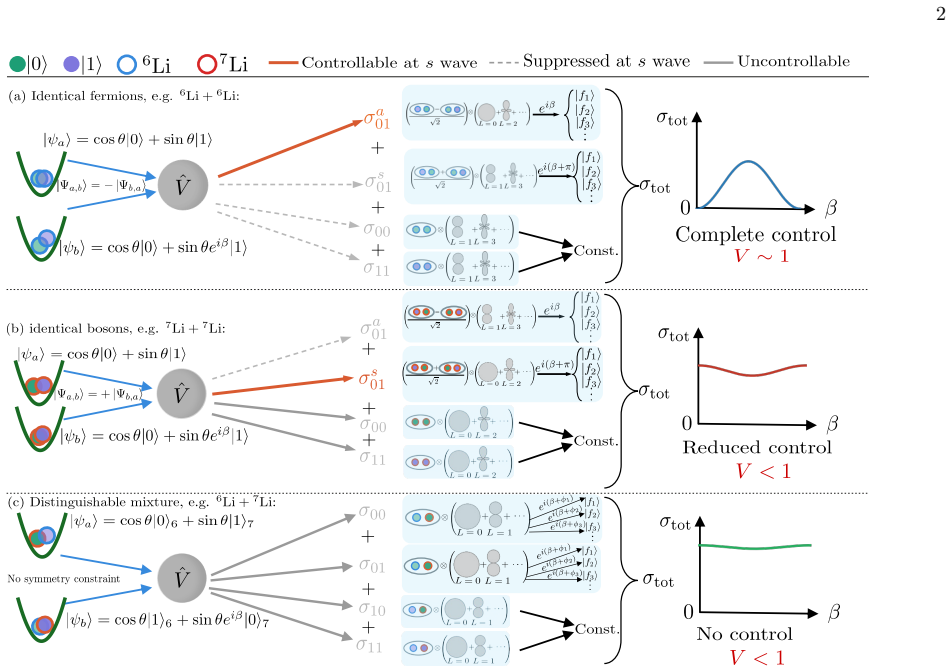
Exchange symmetry in identical-particle collisions enables symmetry-protected coherent control of the total scattering cross section. For identical fermions, antisymmetrization enforces complete phase synchronization of the contributing scattering channels, yielding maximal control visibility. For identical bosons, synchronization persists but with reduced visibility due to additional exchange contributions. In the identical particle cases, symmetry-enforced synchronization enables full control over the parity of the final state at any collisional energy.
What carries the argument
Exchange symmetry (antisymmetrization or symmetrization) that imposes phase synchronization among contributing scattering channels.
If this is right
- Identical fermions achieve maximal control visibility through enforced phase synchronization.
- Identical bosons retain synchronization but with reduced visibility from satellite exchange terms.
- Symmetry alone permits full parity control of the final state at arbitrary collision energies.
- The same mechanism applies directly to homonuclear molecular collisions where DC fields and microwave shielding cannot be used.
Where Pith is reading between the lines
- The symmetry effect could be checked in other pairs of identical atoms or molecules to test generality beyond lithium.
- It may offer a route to control in systems where external fields are impractical, such as certain homonuclear dimers.
- One could examine whether the same phase-locking appears in few-body or reactive identical-particle processes.
Load-bearing premise
The coupled-channel scattering calculations correctly implement exchange symmetry for the lithium systems without approximations that would destroy the phase synchronization.
What would settle it
An experiment finding equal or higher control visibility in 6Li-7Li collisions compared with 6Li-6Li or 7Li-7Li collisions would contradict the claim that symmetry provides the advantage.
Figures
read the original abstract
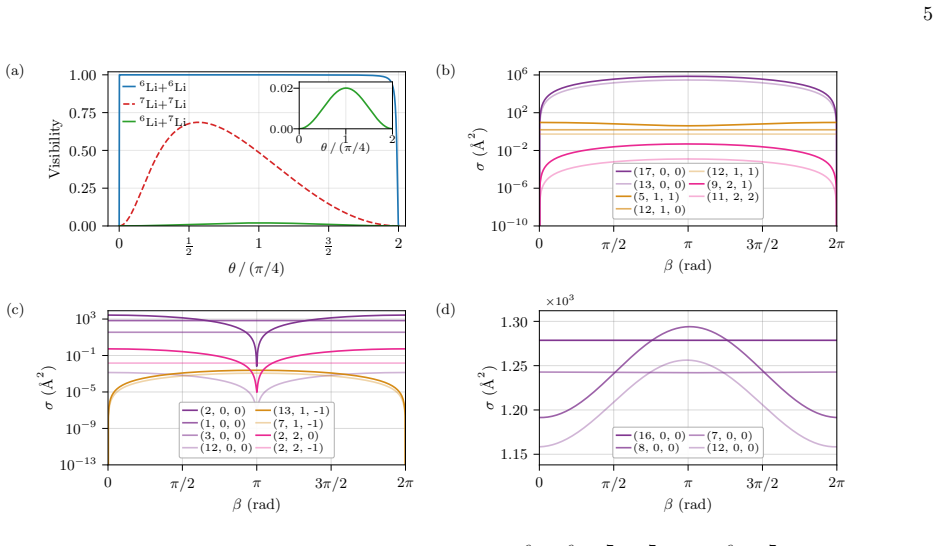
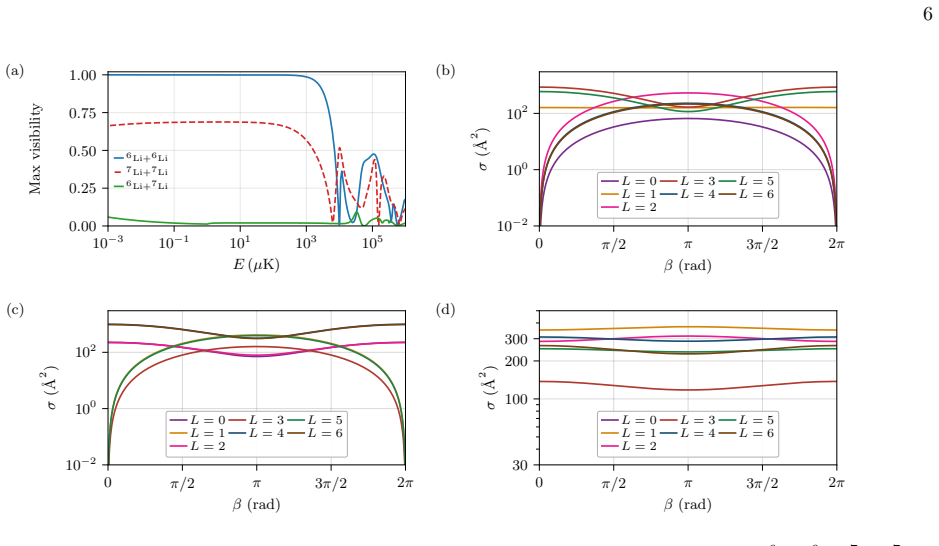
We show that exchange symmetry in collisions of identical particles enables symmetry-protected coherent control of the total scattering cross section. For identical fermions, antisymmetrization enforces complete phase synchronization of the contributing scattering channels, yielding maximal control visibility. For identical bosons, synchronization persists but with reduced visibility due to additional exchange (satellite) contributions. Collisions of distinguishable particles lack this symmetry-imposed phase locking, leading to lower controllability and visibility. We elucidate these principles through coupled-channel quantum-scattering calculations for lithium-lithium collisions, comparing the $^{6}\mathrm{Li}$-$^{6}\mathrm{Li}$ (identical fermions), $^{7}\mathrm{Li}$-$^{7}\mathrm{Li}$ (identical bosons), and $^{6}\mathrm{Li}$-$^{7}\mathrm{Li}$ (distinguishable) systems. Furthermore, in the identical particle cases, symmetry-enforced synchronization enables full control over the parity of the final state at any collisional energy. This mechanism is broadly applicable to identical-particle collisions, including homonuclear molecules for which established approaches -- DC electric fields, or microwave shielding -- are ineffective or unavailable.
Editorial analysis
A structured set of objections, weighed in public.
Referee Report
Summary. The manuscript claims that exchange symmetry for identical particles enforces complete phase synchronization of scattering channels (with a fixed relative phase of π for fermions), enabling maximal coherent control of the total cross section and full control over the parity of the final state at any collision energy. This is contrasted with reduced visibility for bosons (due to exchange satellite terms) and lower controllability for distinguishable particles; the principles are illustrated via coupled-channel quantum-scattering calculations on the 6Li-6Li, 7Li-7Li, and 6Li-7Li systems.
Significance. If the result holds, the work identifies a parameter-free, symmetry-protected mechanism for achieving maximal control visibility in ultracold identical-particle collisions. This is broadly applicable to homonuclear molecules where DC electric fields or microwave shielding are ineffective, and the symmetry argument rests on standard antisymmetrization rather than dynamical approximations or fitted parameters.
minor comments (3)
- The abstract and main text refer to 'control visibility' and 'maximal control' without an explicit definition or formula for how visibility is computed from the scattering amplitudes (e.g., contrast ratio or similar metric).
- The coupled-channel calculations are presented as illustrations, but the manuscript should include a brief statement confirming that the basis functions and scattering matrix are constructed to enforce the correct exchange symmetry (antisymmetric for fermions, symmetric for bosons) without additional approximations.
- Figure captions and axis labels in the results section would benefit from explicit mention of the collision energy range and the specific control parameter (if any) being varied to demonstrate the parity control.
Simulated Author's Rebuttal
We thank the referee for their supportive assessment of the manuscript, recognition of its significance for symmetry-protected coherent control, and recommendation of minor revision. No specific major comments were raised.
Circularity Check
No significant circularity: derivation rests on standard exchange symmetry
full rationale
The paper's central claim follows directly from the requirement that the two-particle wave function for identical fermions must be antisymmetric (or symmetric for bosons) under particle exchange. This imposes a fixed relative phase of π between scattering channels by the structure of the Hilbert space, independent of any dynamical model or fitted parameters. The coupled-channel calculations for Li-Li systems serve only as numerical illustrations of this symmetry-enforced phase locking and do not constitute predictions that reduce to inputs by construction. No self-citations are invoked as load-bearing uniqueness theorems, no ansatzes are smuggled via prior work, and no known results are merely renamed. The argument is self-contained against external benchmarks of quantum mechanics and is not circular.
Axiom & Free-Parameter Ledger
axioms (2)
- standard math The total wavefunction of two identical fermions must be antisymmetric under particle exchange.
- standard math The total wavefunction of two identical bosons must be symmetric under particle exchange.
Reference graph
Works this paper leans on
-
[1]
Comparing Eqs
Visibility is high when one contribution dominates (e.g., in the ultracold regime) and vanishes whenσ s 01 ≈σ a 01, reflecting the competition between symmetric and antisymmetric contributions. Comparing Eqs. (4)–(5) for non-identical particles with Eqs. (6)–(7) for identical particles shows that exchange symmetry removes key limitations of coherent contr...
2025
-
[2]
Gross and I
C. Gross and I. Bloch, Quantum simulations with ultra- cold atoms in optical lattices, Science357, 995 (2017)
2017
-
[3]
S. L. Cornish, M. R. Tarbutt, and K. R. A. Hazzard, Quantum computation and quantum simulation with ul- tracold molecules, Nature Physics20, 730 (2024)
2024
-
[4]
Karman, M
T. Karman, M. Tomza, and J. P´ erez-R´ ıos, Ultracold chemistry as a testbed for few-body physics, Nature Physics20, 722 (2024)
2024
-
[5]
L. D. Carr, D. DeMille, R. V. Krems, and J. Ye, Cold and ultracold molecules: science, technology and appli- cations, New J. Phys.11, 055049 (2009)
2009
-
[6]
J. L. Bohn, A. M. Rey, and J. Ye, Cold molecules: Progress in quantum engineering of chemistry and quan- tum matter, Science357, 1002 (2017)
2017
-
[7]
C. Chin, R. Grimm, P. Julienne, and E. Tiesinga, Fesh- bach resonances in ultracold gases, Rev. Mod. Phys.82, 1225 (2010)
2010
-
[8]
J. J. Park, Y.-K. Lu, A. O. Jamison, T. V. Tscherbul, and W. Ketterle, A feshbach resonance in collisions between triplet ground-state molecules, Nature614, 54 (2023)
2023
-
[9]
Liu and K.-K
Y. Liu and K.-K. Ni, Bimolecular chemistry in the ultra- cold regime, Annu. Rev. Phys. Chem.73, 73 (2022)
2022
-
[10]
T. V. Tscherbul and R. V. Krems, Tuning bimolecu- lar chemical reactions by electric fields, Phys. Rev. Lett. 115, 023201 (2015)
2015
-
[11]
Qu´ em´ ener and P
G. Qu´ em´ ener and P. S. Julienne, Ultracold molecules un- der control!, Chemical Reviews112, 4949 (2012)
2012
-
[12]
K.-K. Ni, S. Ospelkaus, D. Wang, G. Qu´ em´ ener, B. Neyenhuis, M. H. G. de Miranda, J. L. Bohn, D. S. Jin, and J. Ye, Dipolar collisions of polar molecules in the quantum regime, Nature464, 1324 (2010)
2010
-
[13]
M.-G. Hu, Y. Liu, D. D. Grimes, Y.-W. Lin, A. H. Gheorghe, R. Vexiau, N. Bouloufa-Maafa, O. Dulieu, T. Rosenband, and K.-K. Ni, Direct observation of bi- molecular reactions of ultracold KRb molecules, Science 366, 1111 (2019)
2019
-
[14]
R. V. Krems, Cold controlled chemistry, Phys. Chem. Chem. Phys.10, 4079 (2008). 7
2008
-
[15]
Shapiro and P
M. Shapiro and P. Brumer,Quantum control of Molecular Processes(Wiley-VCH, 2012)
2012
-
[16]
J. Gong, M. Shapiro, and P. Brumer, Entanglement- assisted coherent control in nonreactive diatom–diatom scattering, J. Chem. Phys.118, 2626 (2003)
2003
-
[17]
Devolder, T
A. Devolder, T. V. Tscherbul, and P. Brumer, Robust coherent control of two-body collisions beyond the ultra- cold regime, Phys. Rev. Research5, L042025 (2023)
2023
-
[18]
Devolder, T
A. Devolder, T. V. Tscherbul, and P. Brumer, Leverag- ing reactant entanglement in the coherent control of ul- tracold bimolecular chemical reactions, Phys. Rev. Lett. 135, 233401 (2025)
2025
-
[19]
J. Luke, L. Zhu, Y.-X. Liu, and K.-K. Ni, Reaction in- terferometry with ultracold molecules, Faraday Discuss. 251, 63 (2024)
2024
-
[20]
Y.-X. Liu, L. Zhu, J. Luke, J. J. A. Houwman, M. C. Babin, M.-G. Hu, and K.-K. Ni, Quantum interference in atom-exchange reactions, Science384, 1117 (2024)
2024
-
[21]
Devolder, T
A. Devolder, T. V. Tscherbul, and P. Brumer, Time- reversal symmetry-protected coherent control of ultra- cold molecular collisions, J. Phys. Chem. Lett.16, 2808 (2025)
2025
-
[22]
Karman and J
T. Karman and J. M. Hutson, Microwave shielding of ultracold polar molecules, Phys. Rev. Lett.121, 163401 (2018)
2018
-
[23]
Lassabliere and G
L. Lassabliere and G. Quemener, Controlling the scat- tering length of ultracold dipolar molecules, Phys. Rev. Lett.121, 163402 (2018)
2018
-
[24]
Anderegg, S
L. Anderegg, S. Burchesky, Y. Bao, S. Yu, T. Karman, E. Chae, K.-K. Ni, W. Ketterle, and J. M. Doyle, Ob- servation of microwave shielding of ultracold molecules, Science373, 779 (2021)
2021
-
[25]
Bigagli, W
N. Bigagli, W. Yuan, S. Zhang, B. Bulatovic, T. Kar- man, I. Stevenson, and S. Will, Observation of Bose– Einstein condensation of dipolar molecules, Nature631, 289 (2024)
2024
-
[26]
Karman, N
T. Karman, N. Bigagli, W. Yuan, S. Zhang, I. Stevenson, and S. Will, Double microwave shielding, PRX Quantum 6, 020358 (2025)
2025
- [27]
-
[28]
Y.-X. Liu, L. Zhu, J. Luke, M. C. Babin, M. Gronowski, H. Ladjimi, M. Tomza, J. L. Bohn, T. V. Tscherbul, and K.-K. Ni, Hyperfine-to-rotational energy transfer in ul- tracold atom–molecule collisions of Rb and KRb, Nature Chemistry17, 688 (2025)
2025
-
[29]
Wurtz, T
P. Wurtz, T. Gericke, A. Vogler, and H. Ott, Ultracold atoms as a target: absolute scattering cross-section mea- surements, New J. Phys.12, 065033 (2010)
2010
-
[30]
A. P. P. van der Poel and H. L. Bethlem, A detailed ac- count of the measurements of cold collisions in a molecu- lar synchrotron, EPJ Techniques and Instrumentation5, 6 (2018)
2018
-
[31]
Devolder, T
A. Devolder, T. V. Tscherbul, and P. Brumer, Coherent multichannel optical theorem: Quantum control of the total scattering cross section, Phys. Rev. A105, 052808 (2022)
2022
-
[32]
Devolder, T
A. Devolder, T. V. Tscherbul, and P. Brumer, Coherent control of ultracold molecular collisions: The role of res- onances, The Journal of Physical Chemistry Letters14, 2171 (2023)
2023
-
[33]
Brumer, K
P. Brumer, K. Bergmann, and M. Shapiro, Identical col- lision partners in the coherent control of bimolecular re- actions, J. Chem. Phys.113, 2053 (2000)
2053
-
[34]
Brumer, A
P. Brumer, A. Abrashkevich, and M. Shapiro, Laboratory conditions in the coherent control of reactive scattering, Faraday Discussion113, 291 (1999)
1999
-
[35]
Y. Bao, S. S. Yu, L. Anderegg, E. Chae, W. Ketterle, K.-K. Ni, and J. M. Doyle, Dipolar spin-exchange and entanglement between molecules in an optical tweezer ar- ray, Science382, 1138 (2023)
2023
-
[36]
L. R. B. Picard, A. J. Park, G. E. Patenotte, S. Gebret- sadkan, D. Wellnitz, A. M. Rey, and K.-K. Ni, Entangle- ment and iSWAP gate between molecular qubits, Nature 637, 821 (2025)
2025
-
[37]
D. K. Ruttley, T. R. Hepworth, A. Guttridge, and S. L. Cornish, Long-lived entanglement of molecules in magic- wavelength optical tweezers, Nature637, 827 (2025)
2025
-
[38]
See Supplemental Material at [URL will be inserted by publisher] for details of the coupled-channel calcu- lations and interaction potentials, the general coherent control scattering matrix formalism, coherent control in the unsymmetrized basis, quantification of parity control, a comparison of product versus entangled initial-state preparations, and the ...
-
[39]
Frishman, M
E. Frishman, M. Shapiro, and P. Brumer, Optimized im- ploding waves in the coherent control of bimolecular pro- cesses: Atom-rotor scattering, J. Phys. Chem. A103, 10333 (1999)
1999
-
[40]
Devolder, T
A. Devolder, T. V. Tscherbul, and P. Brumer, Interfer- ence is in the eye of the beholder: Application to the coherent control of collisional processes, The Journal of Chemical Physics160, 174304 (2024)
2024
-
[41]
J. J. Omiste, J. Floβ, and P. Brumer, Coherent control of penning and associative ionization: Insights from sym- metries, Phys. Rev. Lett.121, 163405 (2018)
2018
-
[42]
Devolder, P
A. Devolder, P. Brumer, and T. V. Tscherbul, Complete quantum coherent control of ultracold molecular colli- sions, Phys. Rev. Lett.126, 153403 (2021)
2021
-
[43]
J. M. Hutson and C. R. Le Sueur, MOLSCAT: A pro- gram for non-reactive quantum scattering calculations on atomic and molecular collisions, Computer Physics Com- munications241, 9–18 (2019)
2019
-
[44]
Zhang, P
J.-C. Zhang, P. Julienne, and Y. Liu, Characterization of feshbach resonances in a 6Li−7Li mixture using improved interaction potentials, Phys. Rev. A113, 062802 (2026). Supplemental Material: Identical-Particle Symmetry-Enabled Complete Coherent Control of Ultracold Atomic and Molecular Collisions Jing-Chen Zhang(张京晨), 1, 2, 3 Adrien Devolder,4 Timur V. ...
2026
-
[45]
DETAILS OF COUPLED-CHANNEL CALCULATIONS Hamiltonian and interaction potentials The Hamiltonian describing the relative motion of two Li atoms in their electronic ground state is ˆH=− ℏ2 2µ 1 R d2 dR2 R+ ˆL2 2µR2 + ˆha + ˆhb + ˆV(R),(S1) whereµis the reduced mass,Ris the internuclear sepa- ration, and ˆLis the relative orbital angular momentum operator. Th...
-
[46]
GENERAL INTRODUCTION OF COHERENT CONTROL OF COLLISIONS Coherent control of molecular collisions relies on the preparation of initial states as coherent superpositions of internal molecular degrees of freedom[S8]. In general, such a state can be expressed as |Ψini⟩= Ni,AX iA=1 Ni,BX iB =1 aiA,iB |iA, iB⟩,(S7) wherea iA,iB ∈Care complex probability amplitud...
-
[47]
GENERAL COHERENT CONTROL SCATTERING MATRIX FORMALISM [S1, S2] First, consider the situation in which the two molecules are prepared in a well-defined initial internal state|Ψini⟩=|i A, iB⟩where|i A⟩and|i B⟩denote the in- ternal quantum states of molecules A and B, respectively. Within the standard quantum scattering formalism, the total cross section is o...
-
[48]
COHERENT CONTROL OF IDENTICAL PARTICLE COLLISION IN UNSYMMETRIZED BASIS In the main text, we developed a formalism describing coherent control of collisions between identical particles using a basis adapted to exchange symmetry. This sym- metrized representation naturally separates the dynamics into distinct symmetry sectors and provides a convenient fram...
-
[49]
Therefore, control is not limited by partial distinguishability between pathways
Moreover, for both contributions individually one findsC ′ 22 =C ′ 33, reflecting that the two paths are indistinguishable at the level of the transformed basis. Therefore, control is not limited by partial distinguishability between pathways. Summing the even- and odd-parity contributions yields C ′ = σ0,0 0 0 0 0 σs 0,1+σa 0,1 2 σs 0,1−σa 0,1 2 0...
-
[50]
INITIAL-STATE PREPARATION: PRODUCT VERSUS ENTANGLED SUPERPOSITIONS In addition to the product-state superposition |Ψini⟩= cos θ 2 |0⟩+e iβ sin θ 2 |1⟩ a ⊗ cos θ 2 |0⟩+e iβ sin θ 2 |1⟩ b (S25) analyzed in the main text, one can prepare entangled states that populate exclusively the symmetric and anti- symmetric combinations in the symmetrized basis: Ψini =...
-
[51]
IDENTICAL PARTICLE CASE WITH DIFFERENT STATES IN THE SUPERPOSITION OF THE TWO MOLECULES Consider the scenario where the first molecule is pre- pared in a superposition of states|0⟩and|1⟩and the second molecule is prepared in a superposition of states |1⟩and|2⟩: Ψ1 = cosθ|0⟩+ sinθ|1⟩(S31) 0 π/4 π/2 θ (rad) 0.0 0.2 0.4 0.6 0.8 1.0 Visibility V (θ) V(8,8) V(...
-
[52]
4 of the main text
BEHAVIORS OF STATE TO STATE CROSS SECTIONS AT HIGHER COLLISION ENERGIES In this section, we analyze the mechanism responsible for the reduced control visibility of the total scattering cross sections shown in Fig. 4 of the main text. We show that, for identical particles, the loss of visibility arises pri- marily from the incoherent summation of contribut...
1999
discussion (0)
Sign in with ORCID, Apple, or X to comment. Anyone can read and Pith papers without signing in.