REVIEW 3 major objections 4 minor 35 references
Efficient training for large-scale optical neural network using an evolutionary strategy and attention pruning
T0 review · 3 major / 4 minor · reviewed 2026-08-15 · deepseek-v4-flash
Pith's one-line read A CMA-ES plus attention-pruning training algorithm for block optical neural networks prunes 60-80% of parameters with under 5% accuracy loss and shows improved noise robustness.
desk verdict The pruning contribution is real and worth peer review, but the robustness advantage over CMA-ES is not supported by the reported metrics. read the letter →
The pith
A machine-rendered reading of the paper's core claim, the machinery that carries it, and where it could break.
The reading
On MNIST, the method removes 60 percent of parameters while losing 3.3 percentage points of accuracy. On Fashion-MNIST, it removes 80 percent while losing 4.7 points. These losses are smaller than those from random pruning. Under a simulated noise model for phase shifters, the pruned network degrades less than two comparison training algorithms. The authors also ran a small hardware experiment with a 4x4 interferometer chip on a simplified MNIST task and reached 88.5 percent accuracy at 60 percent pruning, close to the no-noise simulation.
The main caveat is that the results are on small datasets and a simplified experimental setup. The robustness comparison also depends on the assumed noise model rather than measured noisy hardware. The paper is a practical step for making optical neural networks easier to train and compress, not a conceptual breakthrough.
Extended reading notes
Core claim
The paper asserts that 'the CAP algorithm can prune 60% and 80% of the parameters for MNIST and Fashion-MNIST datasets, respectively, while only degrades the performance by 3.289% and 4.693%', and that under dynamic phase-shifter noise with standard deviation 0.5, CAP's performance degradation (22.327% MNIST, 24.019% Fashion-MNIST) is the smallest among BAT (43.963%, 41.074%) and CMA-ES (25.757%, 32.871%). This robustness ordering is the central load-bearing claim.
Load-bearing premise
The robustness comparison relies on the assumption, introduced in Section 3.2, that dynamic phase-shifter error is an additive Gaussian random variable with mean zero and standard deviation sigma_P, and that static error is captured by the extinction ratio of the directional coupler. The headline advantage of CAP over BAT and CMA-ES is demonstrated under this simulated noise model, not under measured noise on the fabricated chip. If real chip noise is correlated, non-Gaussian, or drift-dominated, the reported robustness ordering may not transfer to hardware.
Signed reviews
Editorial analysis
A structured set of objections, weighed in public.
Referee Report
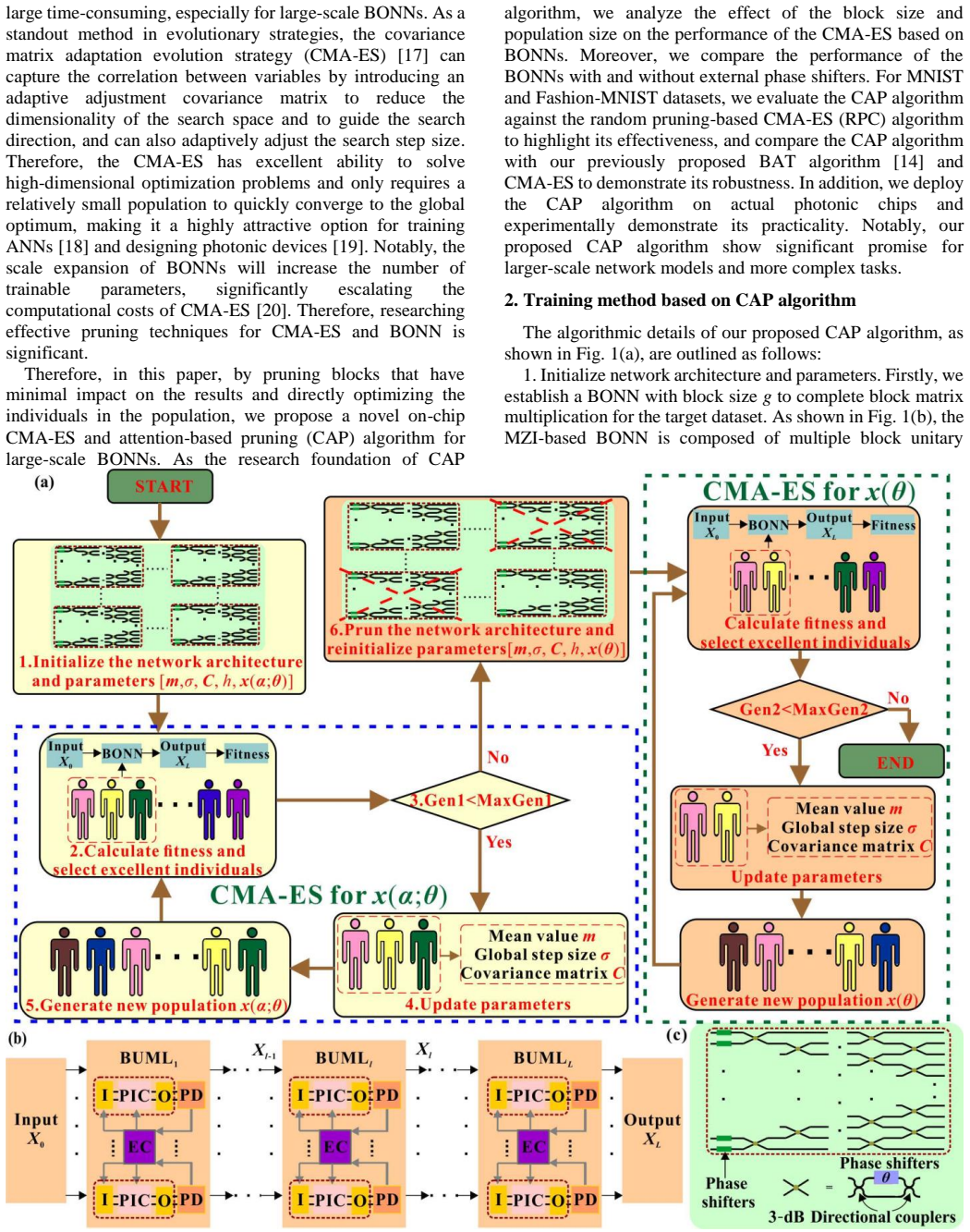
Summary. The paper proposes CAP, an on-chip training algorithm for large-scale MZI-based block optical neural networks (BONNs) that combines CMA-ES with attention-based block pruning. Learning attention coefficients for each matrix block, the method prunes low-attention blocks and then retrains the remaining phase shifters with CMA-ES. The authors report that CAP can prune 60% and 80% of parameters on MNIST and Fashion-MNIST with test-accuracy degradation of 3.289% and 4.693%, respectively. Under simulated dynamic Gaussian phase-shifter noise with standard deviation 0.5, they report that CAP exhibits smaller accuracy degradation (22.327% MNIST, 24.019% Fashion-MNIST) than their previously reported BAT algorithm (43.963%, 41.074%) and CMA-ES (25.757%, 32.871%). They also experimentally train a 4x4 MZI PIC on a simplified MNIST task, achieving 88.5% accuracy with 60% pruning, close to the noiseless simulation value of 92.1%, and they demonstrate that omitting external phase shifters reduces parameter count without major accuracy loss.
Significance. If the central robustness ordering holds, CAP would be a meaningful practical contribution to on-chip training of optical neural networks, combining evolutionary optimization with attention-based structural pruning in a setting where gradient signals are noisy and chip area is constrained. The paper includes a genuine hardware experiment, which supports the feasibility of online evolutionary training on a fabricated PIC. The population-based approach is a reasonable alternative to gradient-based methods for noisy hardware. However, the statistical support for the headline robustness claim is weak, and the noise model is assumed rather than measured, so the significance of the claimed advantage over CMA-ES on MNIST in particular is not established. The pruning results are directionally interesting but are also selected on test-set accuracy without a validation split or repeated trials.
major comments (3)
- [Section 3.2, Fig. 4(d), Abstract] The headline robustness advantage of CAP over CMA-ES on MNIST is not supported by the reported data. The performance-degradation metric in the abstract is computed relative to different noiseless baselines: CAP's pruned baseline is 89.896% (Fig. 4(a), S=40%) while CMA-ES's unpruned baseline is 93.185% (Fig. 2(a)). At sigma_P=0.5, CAP's absolute avg10acc is 67.569% and CMA-ES's absolute avg10acc is 93.185% - 25.757% = 67.428%, a gap of only 0.14 percentage points. No error bars or repeated-seed statistics are reported for CAP or CMA-ES; the only multi-trial band shown is for BAT (Fig. 4(d)). A 0.14-point separation is well within run-to-run variation for evolutionary training, so the claim that CAP is more robust than CMA-ES on MNIST is not statistically established. On Fashion-MNIST the absolute gap is larger (56.519% vs 52.36%), but even there no error bars are given. The paper should either report absolute noisy accuracies with uncertainty or restrict the robustness claim to Fashion-MNIST with appropriate error characterization.
- [Section 3.2, noise model; Section 3.3, experiment] The entire robustness comparison relies on the assumption introduced in Section 3.2 that dynamic phase-shifter error is an additive Gaussian random variable with mean zero and standard deviation sigma_P, and that static error is fully captured by the extinction ratio of the directional coupler. The hardware experiment in Section 3.3 does not measure this noise distribution on the fabricated chip, nor does it inject calibrated dynamic noise to validate the simulation model. The authors attribute the small simulation-experiment gap for the BONN without external phase shifters to external phase-shifter noise, but no noise characterization is provided. Consequently, the transferability of the reported robustness ordering to real hardware is not demonstrated, and the claim that CAP is 'strongest robustness' under real device conditions remains an extrapolation from an unvalidated model.
- [Sections 3.1 and 3.2, hyperparameter selection] The hyperparameters S (attention-training ratio), R (pruning ratio), and population size h are all selected using avg10acc, which is the test-set accuracy, and no validation split is used. For example, S=40% is chosen because it gives the highest avg10acc on the MNIST test set (Fig. 4(a)), and the reported pruning degradations (3.289% and 4.693%) are the results at the selected R and S. This creates an optimistic bias in the headline numbers, since the same test set is used for both model selection and evaluation. In addition, no repeated trials are reported for CAP or CMA-ES, so the reported gaps (e.g., the 4.159 percentage-point advantage on Fashion-MNIST) cannot be distinguished from noise. The authors should use a validation set for hyperparameter selection, report means and standard deviations over multiple independent runs, and state the number of seeds.
minor comments (4)
- [Abstract and throughout] There are numerous grammatical errors and typos, e.g., 'have increasingly drawn attentions', 'the CAP algorithm show excellent potential', and inconsistent spacing in equations. A thorough language edit is needed.
- [References [7] and [8]] In the Introduction, the statement that MNIST requires around one thousand ports and CIFAR-10 requires thousands or tens of thousands of ports is cited to references [7] and [8], which are papers about coin betting optimization and mixing Adam/SGD, respectively. These citations appear incorrect and should be replaced with appropriate sources.
- [Equation (7)] The cross-entropy fitness formula appears garbled in the typeset equation; the softmax normalization and logarithm are not clearly expressed. Please rewrite the equation and define all symbols explicitly.
- [Figures 4 and 5] The figures show solid lines for CAP and CMA-ES without error bars, while the sand-colored bands are only for BAT. Adding shading or error bars for all methods would make the comparison more transparent. Also, the x-axis labels for Fig. 4(d) and Fig. 5(d) should clearly state whether the curves correspond to training with noise or testing an already-trained network under noise, since the text discusses both settings.
Circularity Check
No significant circularity; the CAP claims are empirical results benchmarked against external data and baselines, with no equation-level reduction to inputs.
full rationale
The paper's central claims are empirical: CAP's pruning performance (3.289% degradation for MNIST at 60% pruning and 4.693% for Fashion-MNIST at 80% pruning) and robustness (22.327% and 24.019% degradation under dynamic phase-shifter noise with sigma_P = 0.5) are measured from simulations and an experiment, not derived from a definition. The attention coefficient alpha is a learned parameter fitted from the training data; using it to choose blocks for pruning is a standard learned-importance procedure, and the paper compares CAP against random pruning (RPC), so the pruning advantage is not forced by construction. The robustness comparison adds dynamic Gaussian phase-shifter noise and static directional-coupler error to trained networks; these noise terms are inputs of the experiment, not fitted parameters that predetermine the claimed ordering. The use of the authors' earlier BAT algorithm and their earlier work [23] is as a comparison baseline and a design heuristic, respectively, and both are independently verified within this paper: Fig. 2(c) directly compares BAT, CMA-ES, and BANN, and Fig. 6(c) compares simulation with experiment for the external-phase-shifter-free BONN. No uniqueness theorem or ansatz is imported from self-citations to justify the CAP choice. The assumed Gaussian dynamic-noise model limits external validity to that model, but it is not circular because the model is stated as an assumption rather than fitted to make CAP win. Therefore no circular step can be exhibited using the paper's own equations.
Assumptions & free parameters
free parameters (5)
- block size g =
12
- population size h =
100 (MNIST), 120 (Fashion-MNIST), 20 (experiment)
- attention-training ratio S =
0.4
- initial CMA-ES step size sigma0 =
0.1
- noise standard deviation sigma_P =
0.5
assumptions (5)
- domain assumption An arbitrary real-valued weight matrix can be decomposed into a product of unitary matrices and a diagonal matrix, and each unitary block can be realized by a Clements MZI mesh (Refs [21,22]).
- domain assumption Replacing full real-valued weight matrices with block-unitary matrices causes acceptable performance loss.
- domain assumption The PD array acts as a quadratic nonlinearity after each block, providing enough nonlinearity for classification.
- ad hoc to paper Dynamic phase-shifter error is additive Gaussian noise with zero mean; static error is captured by extinction ratio.
- domain assumption Neuroptica simulator accurately models the MZI mesh and noise behavior.
Cite this review
Pith. "Pith review of Efficient training for large-scale optical neural network using an evolutionary strategy and attention pruning." pith.science (2026). https://pith.science/paper/DEIPAPVX
@misc{pith2026250512906,
  author       = {Pith},
  title        = {Pith review of: Efficient training for large-scale optical neural network using an evolutionary strategy and attention pruning},
  year         = {2026},
  howpublished = {\url{https://pith.science/paper/DEIPAPVX}},
  note         = {Machine review of arXiv:2505.12906}
}
read the original abstract
MZI-based block optical neural networks (BONNs), which can achieve large-scale network models, have increasingly drawn attentions. However, the robustness of the current training algorithm is not high enough. Moreover, large-scale BONNs usually contain numerous trainable parameters, resulting in expensive computation and power consumption. In this article, by pruning matrix blocks and directly optimizing the individuals in population, we propose an on-chip covariance matrix adaptation evolution strategy and attention-based pruning (CAP) algorithm for large-scale BONNs. The calculated results demonstrate that the CAP algorithm can prune 60% and 80% of the parameters for MNIST and Fashion-MNIST datasets, respectively, while only degrades the performance by 3.289% and 4.693%. Considering the influence of dynamic noise in phase shifters, our proposed CAP algorithm (performance degradation of 22.327% for MNIST dataset and 24.019% for Fashion-MNIST dataset utilizing a poor fabricated chip and electrical control with a standard deviation of 0.5) exhibits strongest robustness compared with both our previously reported block adjoint training algorithm (43.963% and 41.074%) and the covariance matrix adaptation evolution strategy (25.757% and 32.871%), respectively. Moreover, when 60% of the parameters are pruned, the CAP algorithm realizes 88.5% accuracy in experiment for the simplified MNIST dataset, which is similar to the simulation result without noise (92.1%). Additionally, we simulationally and experimentally demonstrate that using MZIs with only internal phase shifters to construct BONNs is an efficient way to reduce both the system area and the required trainable parameters. Notably, our proposed CAP algorithm show excellent potential for larger-scale network models and more complex tasks.
Figures
Reference graph
Works this paper leans on
-
[1]
C. Teng, X. Tang, Y. Huang, W. Du, W. He, A. Ren, J. W u, Z. Wang, A high -stability all-optical nonlinear activator for optical computing, J . Lightw. Technol. 41(21) (2023) 6817 -6823, http://dx.doi.org/10.1109/JLT.2023.3290021
arXiv 2023
-
[2]
Y. Shen, N .C. Harris, S. Skirlo, M. Prabhu, T. Baehr -Jones, M. Hochberg, X. Sun, S. Zhao, H. Larochelle, D. Englund, Deep learning with coherent nanophotonic circuits, Nat . Photon. 11(7) (2017) 441-446, http://dx.doi.org/10.1038/NPHOTON.2017.93
-
[3]
Z. Fan, J. Lin, J. Dai, T. Zhang, K. Xu, Photonic Hopfield neural network for the Ising problem, Opt . Express 31(13) (2023) 21340-21350, http://dx.doi.org/10.1364/OE.491554
-
[4]
M.B. On, Y. -J. Lee, L.E. Srouji, M. Abdelghany, S.B. Yoo, Improving Scalability of Mach -Zehnder Interferometer Based Photonic Computers via Algorithm-Hardware Codesign, J. Lightw. Technol. 42(22) (2024) 8014-8023
work page 2024
-
[5]
H. Bagherian, S. Skirlo, Y. Shen, H. Meng, V. Ceperic, M. Soljacic, On-chip optical convolutional neural networks, a rXiv preprint arXiv:1808.03303 (2018), http://dx.doi.org/10.48550/arXiv.1808.03303
- [6]
-
[7]
F. Orabona, T. Tommasi, Training deep networks without learning rates through coin betting, Advances in Neural Information Processing Systems 30 (2017)
work page 2017
-
[8]
Mixing ADAM and SGD: a Combined Optimization Method
N. Landro, I. Gallo, R. La Grassa, Mixing Adam and SGD: A combined optimization method, arXiv preprint arXiv:2011.08042 (2020), https://doi.org/10.48550/arXiv.2011.08042
work page Pith review arXiv doi:10.48550/arxiv.2011.08042 2020
Show all 35 references
-
[9]
J. Gu, H. Zhu, C. Feng, Z. Jiang, R. Chen, D. Pan, L2ight: Enabling on-chip learning for optical neural networks via effi cient in-situ subspace optimization, Advances in Neural Information Processing Systems 34 (2021) 8649-8661
2021
-
[10]
C. Feng, J. Gu, H. Zhu, Z. Ying, Z. Zhao, D.Z. Pan, R.T. Chen, A Compact Butterfly-Style Silicon Photonic–Electronic Neural Chip for Hardware-Efficient Deep Learning, Acs Photon. 9(12) (2022) 3906-3916, http://dx.doi.org/10.1021/acsphotonics.2c01188
2022 doi
-
[11]
C. Ding, S. Liao, Y. Wang, Z. Li, N. Liu, Y. Zhuo, C. Wang, X. Qian, Y. Bai, G. Yuan, Circnn: accelerating and compressing deep neural networks using block -circulant weight matrices, Proceedings of the 50th Annual IEEE/ACM International Symposium on Microarchitecture (2017) 395-408
2017
-
[12]
S. Liao, Z. Li, X. Lin, Q. Qiu, Y. Wang, B. Yuan, Energy-efficient, high-performance, highly-compressed deep neural network design using block -circulant matrices, 2017 IEEE/ACM International Conference on Computer-Aided Design (ICCAD) (2017) 458-465
2017
- [13]
-
[14]
Z. Yang, T. Zhang, J. Dai, K. Xu, Efficient on -chip training of large-scale optical neural network through block adjoint training algorithm, Opt . Express 32(26) (2024) 46633 -46648, https://doi.org/10.1364/OE.537813
2024 doi
- [15]
-
[16]
Zhang, J
T. Zhang, J. Wang, Y. Dan, Y. Lanqiu, J. Dai, X. Han, X. Sun, K. Xu, Efficient training and design of photonic neural network through neuroevolution, Opt. Express 27(26) (2019) 37150-37163, http://dx.doi.org/10.1364/OE.27.037150
2019 doi
-
[17]
Hansen, S.D
N. Hansen, S.D. Mü ller, P. Koumoutsakos, Reducing the time complexity of the derandomized evolution strategy with covariance matrix adaptation (CMA -ES), Evolutionary computation 11(1) (2003) 1 -18, http://dx.doi.org/10.1162/106365603321828970
2003 doi
-
[18]
Chang, K
H. Chang, K. Futagami, Reinforcement learning with convolutional reservoir computing, Appl . Intell. 50(8) (2020) 2400-2410, http://dx.doi.org/10.1007/s10489-020-01679-3
2020 doi
-
[19]
Miyatake, K
Y. Miyatake, K. Toprasertpong, S. Takagi, M. Takenaka, Design of compact and low-loss S-bends by CMA-ES, Opt. Express 31(26) (2023) 43850-43863, http://dx.doi.org/10.1364/OE.504866
2023 doi
-
[20]
Y. Su, Z. Chen, F. Xu, Y. Ye, X. Jiang, W. Liu, Y. Xie, A Multi-Objective Particle Swarm Optimization Pruning on Photonic Neural Networks, J. Lightw. Technol. 43(5) (2025) 2213 - 2225, http://dx.doi.org/10.1109/JLT.2024.3486718
2025
-
[21]
Lawson, R.J
C.L. Lawson, R.J. Hanson, Solving least squares problems, SIAM1995
-
[22]
Clements, P.C
W.R. Clements, P.C. Humphreys, B.J. Metcalf, W.S. Kolthammer, I.A. Walmsley, Optimal design for universal multiport interferometers, Optica 3(12) (2016) 1460 -1465, http://dx.doi.org/10.1364/OPTICA.3.001460
2016 doi
-
[23]
Z. Yang, T. Zhang, J. Dai, K. Xu, Tunable -bias based optical neural network for reinforcement learning in path planning, Opt . Express 32(10) (2024) 18099 -18112, http://dx.doi.org/10.1364/OE.516173
2024 doi
-
[24]
Bartlett, M
B. Bartlett, M. Minkov, T. Hughes, I. Williamson, Neuroptica: an optical neural network simulator, https://github.com/fancompute/neuroptica (2019)
2019
-
[25]
Shokraneh, M.S
F. Shokraneh, M.S. Nezami, O. Liboiron -Ladouceur, Theoretical and experimental analysis of a 4× 4 reconfigurable MZI -based linear optical processor, J . Lightw. Technol. 38(6) (2020) 1258-1267, http://dx.doi.org/10.1109/JLT.2020.2966949
2020
-
[26]
Vivien, A
L. Vivien, A. Polzer, D. Marris -Morini, J. Osmond, J.M. Hartmann, P. Crozat, E. Cassan, C. Kopp, H. Zimmermann, J.M. Fé dé li, Zero-bias 40Gbit/s germanium waveguide photodetector on silicon, Opt. Express 20(2) (2012) 1096 -1101, http://dx.doi.org/10.1364/OE.20.001096
2012 doi
-
[27]
Autere, H
A. Autere, H. Jussila, Y. Dai, Y. Wang, H. Lipsanen, Z . Sun, Nonlinear optics with 2D layered materials, Adv . Mater. 30(24) (2018) 1705963, http://dx.doi.org/10.1002/adma.201705963
2018 doi
-
[28]
Shorten, T.M
C. Shorten, T.M. Khoshgoftaar, B. Furht, Text data augmentation for deep learning, J . big Data 8(1) (2021) 101, http://dx.doi.org/10.1186/s40537-021-00492-0
2021 doi
-
[29]
LeCun, The MNIST database of handwritten digits, http://yann
Y. LeCun, The MNIST database of handwritten digits, http://yann. lecun. com/exdb/mnist/ (1998)
1998
- [30]
- [31]
- [32]
-
[33]
Banerjee, M
S. Banerjee, M. Nikdast, S. Pasric ha, K. Chakrabarty, Pruning coherent integrated photonic neural networks, IEEE J . Sel. Top. Quant. 29(2) (2023) 1 -13, http://dx.doi.org/10.1109/JSTQE.2023.3242992
2023
-
[34]
R. Shao, G. Zhang, X. Gong, Generalized robust training scheme using genetic algorithm for optical neural networks with imprecise components, Photon. Res. 10(8) (2022) 1868 -1876, http://dx.doi.org/10.1364/PRJ.449570
2022 doi
-
[35]
Z. Fan, Y. Dan, J. Lin, T. Zhang, J. Dai, K. Xu, Rapid configuring method for a programmable photonic integrated circuit based on a tandem neural network, Opt. Lett., 50(5) (2025) 1731-1734, https://doi.org/10.1364/OL.551119
2025 doi
Reviewed August 15, 2026 · model on record in the stance chip above.
Discussion (0). Continue with ORCID to comment.