REVIEW 3 major objections 5 minor 36 references
Gravitational Potential from small-scale clustering in action space: Application to Gaia DR2
T0 review · 3 major / 5 minor · reviewed 2026-08-14 · deepseek-v4-flash
Pith's one-line read Maximizing small-scale clustering in action space recovers the Milky Way's gravitational potential and measures its dark-matter halo from Gaia DR2.
desk verdict The action-space clustering idea is interesting and the simulations show the score works, but Eq. 17 is not the derived likelihood — it's a heuristic, so the quoted errors are not to be trusted. read the letter →
The pith
A machine-rendered reading of the paper's core claim, the machinery that carries it, and where it could break.
The reading
What carries the argument
The central object is the normalized action-space distance D = sqrt[(ΔJ_R/σ_JR)^2 + (ΔJ_φ/σ_Jφ)^2 + (ΔJ_z/σ_Jz)^2] between stellar pairs, computed from actions estimated by the Stäckel approximation. The load-bearing identity is the likelihood ln L = N_pairs ∫_{-∞}^{ln Dmax} P(ln D) ln[1+ξ(ln D)] d ln D, where P(ln D) is the observed pair-distance distribution and ξ(ln D) = P/P_uniform − 1 is the two-point correlation function; this follows from marginalizing over a Gaussian random field that models small-scale clustering on top of a uniform background (Wick's theorem plus a mean-field approximation). This identity ties the gravitational potential to a purely statistical observable — pair clustering in action space — and it is the quantity maximized to infer f_h and α.
What would settle it
Run the same likelihood pipeline on a large cosmological or Milky-Way-scale simulation with a known gravitational potential and a realistic mix of disk and halo stars; if the recovered f_h and α deviate from the true values by more than the reported 1%–4% systematic errors, or if the best-fit parameters shift significantly when the sample is split by kinematics or by D_max, the uniform-background-plus-Gaussian-field assumption fails. A cheaper check is to compute the same likelihood on mock Gaia-like catalogs built from a known potential with deliberately non-Gaussian action-space counts and see whether the likelihood peak moves.
Extended reading notes
Core claim
The paper's central claim is that the correct gravitational potential maximizes small-scale clustering in action space, and that the likelihood for a potential is an integral over the two-point correlation function of the pair-distance distribution. Under the model that stars are a Poisson sampling of a uniform action-space background plus a correlated Gaussian random field, the log-likelihood reduces to N_pairs times the expectation of ln(1+ξ(ln D)) over pairs, where ξ is measured relative to a uniform distribution and D is the distance between pairs normalized by the action dispersions. The paper verifies on simulated tidal streams that this likelihood recovers the input halo parameters, and on Gaia DR2 it yields the quoted constraints on the dark-matter halo's radial force fraction f_h and power-law slope α of its density profile. It also shows that the potential maximizing the likelihood indeed gives the most compact action-space distribution for both simulations and real data, and that the implied circular-velocity curve is consistent with earlier measurements though 5–10% lower than maser and globular-cluster estimates.
Load-bearing premise
The likelihood assumes the distribution of stars in action space is a uniform background plus a Gaussian random field whose correlation function depends only on the normalized pair distance D; if real action-space structure is driven by something else, such as a strongly non-uniform disk background or unrelaxed components, the log-likelihood in Eq. 17 is not the correct likelihood and maximizing it can bias the recovered halo parameters.
Editorial extensions
If this is right
- The method measures the Milky Way's dark-matter halo parameters without assuming virial equilibrium, circular motion, or identifying streams beforehand.
- The circular velocity curve derived from the best-fit potential is consistent with measurements from Eilers et al. (2019) but 5–10% lower than maser- and globular-cluster-based curves.
- The likelihood statistic scales with the number of stellar pairs, so future Gaia data releases with more stars will tighten constraints.
- The same approach can be applied to other galaxies or to constrain the disk potential if its parameters are varied along with the halo.
Reading between the lines
- If the method holds up across independent data, it offers a way to weigh dark matter in dwarf galaxies or the Milky Way's outer halo, where equilibrium assumptions are weakest.
- The likelihood's dependence on the chosen maximum pair separation D_max is a hidden free choice; a principled model-selection criterion for D_max could remove the largest subjective element in the analysis.
- One could replace the Gaussian-field assumption with a more general marked point process or Cox process to see whether the halo constraints shift substantially, providing a direct test of the paper's most load-bearing assumption.
Signed reviews
Editorial analysis
A structured set of objections, weighed in public.
Referee Report
Summary. The paper proposes and applies a new method to constrain the Milky Way gravitational potential by maximizing small-scale clustering of stars in action space, avoiding equilibrium or circular-motion assumptions. The authors derive a log-likelihood expressed through the two-point correlation function ξ(ln D) of action-space pair distances (Eq. 17), validate it on simulated tidal streams with known potentials (§5.1, Appendix C), and apply it to two Gaia DR2 radial samples, obtaining (f_h, α) = (0.391±0.009, 1.835±0.092) at 9–11 kpc and (0.351±0.012, 1.687±0.079) at 11.5–15 kpc. They translate the constraints into a circular-velocity curve and compare it with other Milky Way mass measurements. The paper's central claim is that the correct potential is the one maximizing the likelihood derived from action-space clustering.
Significance. If the derivation and statistical interpretation are correct, the method is a genuinely new probe of the Galactic potential: it uses full 6D phase-space information, does not require equilibrium, circular orbits, or identification of streams, and the simulation tests in §5.1 and Appendix C demonstrate that the proposed statistic can locate an input potential with systematic offsets of about 1% in f_h and 4% in α. The Gaia DR2 application and the comparison with independent rotation-curve measurements are valuable demonstrations, and the paper is clearly written with useful consistency checks. However, the claim that Eq. (17) is the likelihood of the assumed model is not supported by the derivation (major comment 1), and the final error budget involves post hoc and self-calibrated choices; the quoted halo constraints should therefore be regarded as conditional on these caveats until the derivation and calibration are repaired.
major comments (3)
- [Appendix A, Eqs. (A2)–(A6) and Eq. (17)] Appendix A, Eqs. (A2)–(A6) and Eq. (17): the Wick expansion given in Eq. (A5) is not the Gaussian expectation of the model in Eq. (A2). Expanding ∏_k (1+χ_{a_k}) and applying Wick's theorem gives a monomer–dimer sum, E[∏_k(1+χ_{a_k})] = 1 + Σ_{i<j} ξ_{ij} + Σ_{ij,kl disjoint} ξ_{ij}ξ_{kl} + ..., with unpaired stars allowed. This is not equal to Σ_{perfect pairings} ∏_{pairs}(1+ξ_pair): for N=4 stars the exact expectation is 1+Σξ+Σξξ, whereas the paper's expression evaluates to 3+2Σξ+Σξξ. The subsequent replacement of the log of the sum by an average over pairings of Σ ln(1+ξ) in Eq. (A6) is an uncontrolled mean-field approximation. As a result, Eq. (17) is not the likelihood of the stated generative model but a heuristic clustering score. The simulations in §5.1 and Appendix C test the score itself, so they support its use as an empirical estimator, but they do not validate the likelihood interpretation or the Gaussian error bars quoted in Tables 2–4.
- [Section 5.2 and Section 6 (choice of ln D_max)] Section 5.2 and Section 6 (choice of ln D_max): The final choice ln D_max = −1.14 is made after inspecting the likelihood constraints on the same Gaia data, including the jump in f_h near ln D_max ≈ −1.5 in the 11.5–15 kpc sample; the authors then select the value with the smallest uncertainties. This is a post hoc selection on the target data, so the reported posteriors and 68% intervals do not include the selection effect, and the stability criterion proposed in Section 6 is calibrated on the same curves. A pre-specified selection rule, or a mock test that repeats the entire D_max-selection procedure, is needed before the quoted precision can be taken at face value.
- [Section 6, Appendix C, and Tables 2–4] Section 6, Appendix C, and Tables 2–4: the systematic-error calibration does not validate the load-bearing assumption of a uniform background plus Gaussian fluctuations against the non-Gaussian, non-uniform backgrounds that real galactic data contain. The background simulation in Appendix C is constructed by adding Gaussian scatter to the action-space positions of the same Gaia sample under the assumed model, so it cannot detect violations of that assumption; the 7–11% shift in α between the |z|>1 kpc and no-cut samples (Tables 2–4) and the disk-star contamination discussed in Section 6 show that such violations are potentially material. The authors should test the estimator on realistic (e.g., cosmological/hydrodynamical) simulations of a Milky Way-like galaxy, or otherwise show that the score's peak is unbiased for non-Gaussian backgrounds; until then, the systematic errors in Table 4 (which are also partly calibrated on the observed cut/no-cut differences via Appendix D) are not end-to-end validated.
minor comments (5)
- [Section 4, after Eq. (17)] Section 4, after Eq. (17): the statement that Npairs is the total number of pairs, i.e., half of the number of stars in the sample, is inconsistent with the standard definition N(N−1)/2; please clarify whether Npairs is defined in the pairing-average convention.
- [Section 5.2 and Table 2 caption] Section 5.2 and Table 2 caption: the maximum-likelihood values quoted in the text (f_h=0.376, α=1.974 for 9–11 kpc) differ from the caption values (f_h=0.375, α=1.967); these should be reconciled.
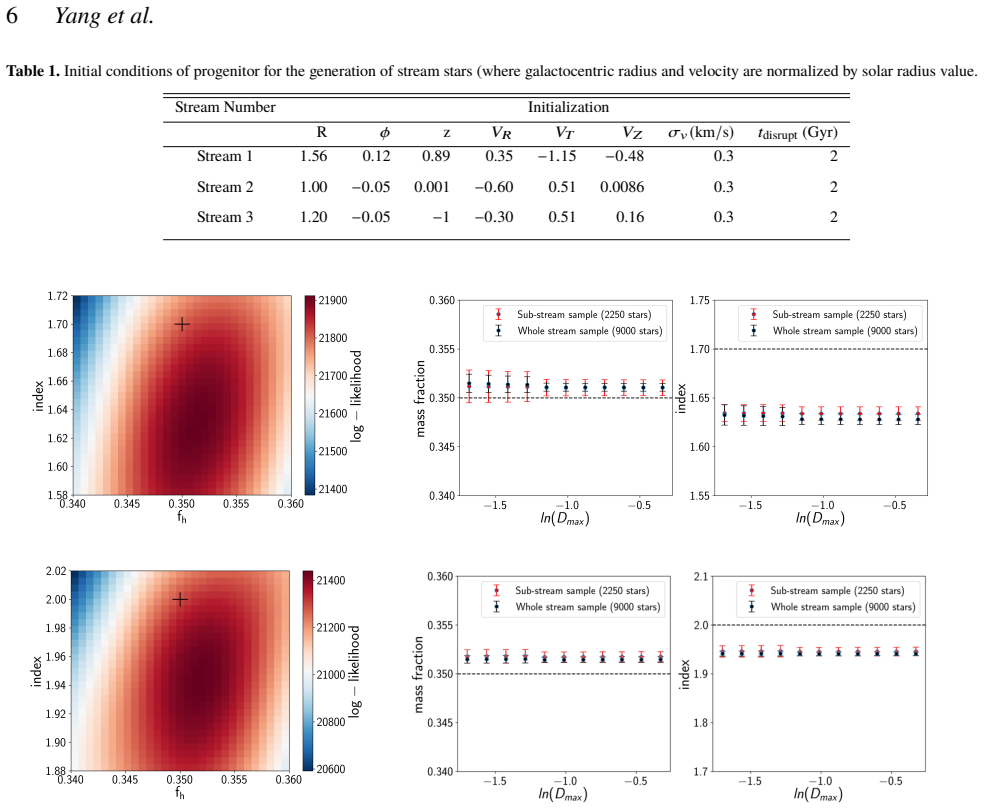
- [Table 1 caption] Table 1 caption: the text says galactocentric radius and velocity are normalized by the solar radius value, but velocity cannot be normalized by a radius; specify the normalization convention for each column.
- [Footnote 6] Footnote 6: the claim that the disk is 'a mixture of correlated structures and uniform background' is not obviously compatible with the model assumption of a Poisson-sampled uniform background plus Gaussian fluctuations; this point should be expanded or reworded.
- [Figure 1 and Eq. (16)] Figure 1 and Eq. (16): please state explicitly how D_max enters the estimate of P(ln D)/D^3 in the plotted curve, so the reader can distinguish the raw pair-count distribution from the normalized correlation function.
Circularity Check
No significant circularity: the method is benchmarked on external simulations and no central claim reduces to its inputs by construction.
full rationale
The paper's central claim is that the correct Galactic potential maximizes a likelihood built from the two-point correlation function in action space (Eq. 17). This claim is not circular: the statistic is not defined in terms of the fitted parameters, and the method is tested on mock stellar streams with known input potentials (Section 5.1 and Appendices B, C), so the maximum-likelihood recovery of (f_h, alpha) is an independent benchmark rather than a restatement of inputs. Equation (18) identifies lnL/N_pairs with the relative entropy of the pair-distance distribution; that identity is definitional, but the physical assertion that the true potential maximizes this statistic is validated against simulations, not assumed. The citation to Afshordi et al. (2009) is a historical reference for the action-space clustering idea and is not load-bearing because the subsequent simulations and Gaia analysis stand independently. The choice of lnDmax as a stability/least-uncertainty point is a nuisance calibration, not a fitted parameter renamed as a prediction; Appendix D's systematic-error combination is likewise an honest propagation of cut-induced discrepancies. The most serious issue in the paper is mathematical, not circular: the Wick-contraction step in Appendix A does not appear to yield the perfect-matching product in Eq. (A5), so Eq. (17) may be an ansatz rather than a derived likelihood. That would be a correctness/falsifiability problem, but it is not a circularity, because Eq. (17) is not equivalent to the model by construction and is tested on external simulations.
Assumptions & free parameters
free parameters (3)
- ln D_max =
-1.14
- sigma_sys,max (f_h) =
0.02
- sigma_sys,max (alpha) =
0.2
assumptions (6)
- domain assumption The stellar distribution in action space is a uniform background plus a Gaussian random field with correlation function that depends only on normalized distance D.
- domain assumption Stars are Poisson samples of the underlying action-space density.
- domain assumption Actions are computed with the Stäckel approximation via galpy and are conserved for these stars.
- domain assumption The bulge and disk gravitational potentials are known and fixed to MWPotential2014 parameter values; only the dark matter halo is varied.
- ad hoc to paper The prior ranges 0.5 < alpha < 2.5 and 0.25 < f_h < 0.55 are appropriate.
- ad hoc to paper The maximum pair separation scale Dmax can be chosen such that the likelihood is stable; the chosen value is valid for both radial bins.
Cite this review
Pith. "Pith review of Gravitational Potential from small-scale clustering in action space: Application to Gaia DR2." pith.science (2026). https://pith.science/paper/DEL7EGNC
@misc{pith2026190802336,
  author       = {Pith},
  title        = {Pith review of: Gravitational Potential from small-scale clustering in action space: Application to Gaia DR2},
  year         = {2026},
  howpublished = {\url{https://pith.science/paper/DEL7EGNC}},
  note         = {Machine review of arXiv:1908.02336}
}
abstract
Most measurements of mass in Astronomy that use kinematics of stars or gas rely on assumptions of equilibrium that are often hard to verify. Instead, we develop a novel idea that uses the clustering in action space, as a probe of underlying gravitational potential: the correct potential should maximize small-scale clustering in the action space. We provide a first-principle derivation of likelihood using the two-point correlation function in action space, and test it against simulations of stellar streams. We then apply this method to the 2nd data release of Gaia, and use it to measure the radial force fraction $f_h$ and logarithmic slope $\alpha$ of dark matter halo profile. We investigate stars within 9-11 kpc and 11.5-15 kpc from Galactic centre, and find $(f_h,\alpha)= (0.391\pm 0.009, 1.835\pm 0.092) $ and $(0.351\pm 0.012,1.687\pm 0.079)$, respectively. We also confirm that the set of parameters that maximize the likelihood function do correspond to the most clustering in the action space. The best-fit circular velocity curve for Milky Way potential is consistent with past measurements (although it is $\sim$ 5-10\% lower than previous methods that use masers or globular clusters). Our work provides a clear demonstration of the full statistical power that lies in the full phase space information, relieving the need for {\it ad hoc} assumptions such as virial equilibrium, circular motion, or steam-finding algorithms.
Figures


Figures from the paper (6 more)


Reference graph
Works this paper leans on
-
[1]
Afshordi N., Mohayaee R., Bertschinger E., 2009, @doi [ ] 10.1103/PhysRevD.79.083526 , https://ui.adsabs.harvard.edu/abs/2009PhRvD..79h3526A 79, 083526
-
[2]
Astraatmadja T. L., Bailer-Jones C. A. L., 2016, @doi [ ] 10.3847/0004-637X/832/2/137 , https://ui.adsabs.harvard.edu/abs/2016ApJ...832..137A 832, 137
-
[3]
Binney J., 2010, @doi [ ] 10.1111/j.1365-2966.2009.15845.x , https://ui.adsabs.harvard.edu/abs/2010MNRAS.401.2318B 401, 2318
arXiv 2010
-
[5]
Binney J., McMillan P. J., 2016, @doi [ ] 10.1093/mnras/stv2734 , https://ui.adsabs.harvard.edu/abs/2016MNRAS.456.1982B 456, 1982
-
[6]
Bonaca A., Conroy C., Wetzel A., Hopkins P. F., Kere s D., 2017, @doi [ ] 10.3847/1538-4357/aa7d0c , https://ui.adsabs.harvard.edu/abs/2017ApJ...845..101B 845, 101
-
[7]
Bovy J., 2014, @doi [ ] 10.1088/0004-637X/795/1/95 , http://adsabs.harvard.edu/abs/2014ApJ...795...95B 795, 95
-
[8]
Bovy J., 2015, @doi [ ] 10.1088/0067-0049/216/2/29 , http://adsabs.harvard.edu/abs/2015ApJS..216...29B 216, 29
-
[9]
Bovy J., Rix H.-W., 2013, @doi [ ] 10.1088/0004-637X/779/2/115 , http://adsabs.harvard.edu/abs/2013ApJ...779..115B 779, 115
Show all 36 references
-
[10]
R., Hogg D
Buckley M. R., Hogg D. W., Price-Whelan A. M., 2019, arXiv e-prints, https://ui.adsabs.harvard.edu/abs/2019arXiv190700987B p. arXiv:1907.00987
2019 arXiv
-
[11]
S., Boylan-Kolchin M., 2017, @doi [ ] 10.1146/annurev-astro-091916-055313 , https://ui.adsabs.harvard.edu/abs/2017ARA&A..55..343B 55, 343
Bullock J. S., Boylan-Kolchin M., 2017, @doi [ ] 10.1146/annurev-astro-091916-055313 , https://ui.adsabs.harvard.edu/abs/2017ARA&A..55..343B 55, 343
2017 doi
-
[12]
arXiv:1804.09369
Cropper M., et al., 2018, arXiv e-prints, https://ui.adsabs.harvard.edu/abs/2018arXiv180409369C p. arXiv:1804.09369
2018 arXiv
-
[13]
Del Popolo A., Le Delliou M., 2017, @doi [Galaxies] 10.3390/galaxies5010017 , https://ui.adsabs.harvard.edu/abs/2017Galax...5...17D 5, 17
2017 doi
-
[14]
W., Rix H.-W., Ness M
Eilers A.-C., Hogg D. W., Rix H.-W., Ness M. K., 2019, @doi [ ] 10.3847/1538-4357/aaf648 , https://ui.adsabs.harvard.edu/abs/2019ApJ...871..120E 871, 120
2019 doi
-
[15]
Gaia Collaboration et al., 2016, @doi [ ] 10.1051/0004-6361/201629272 , https://ui.adsabs.harvard.edu/abs/2016A&A...595A...1G 595, A1
2016 doi
-
[16]
Gaia Collaboration et al., 2018, @doi [ ] 10.1051/0004-6361/201833051 , https://ui.adsabs.harvard.edu/abs/2018A&A...616A...1G 616, A1
2018 doi
-
[17]
Gravity Collaboration et al., 2018, @doi [ ] 10.1051/0004-6361/201833718 , https://ui.adsabs.harvard.edu/abs/2018A&A...615L..15G 615, L15
2018 doi
-
[18]
A., Tian H., Sales L
Helmi A., Veljanoski J., Breddels M. A., Tian H., Sales L. V., 2017, @doi [ ] 10.1051/0004-6361/201629990 , https://ui.adsabs.harvard.edu/abs/2017A&A...598A..58H 598, A58
2017 doi
-
[19]
A., 1951, @doi [Ann
Kullback S., Leibler R. A., 1951, @doi [Ann. Math. Statist.] 10.1214/aoms/1177729694 , 22, 79
1951
-
[20]
Magorrian J., 2014, @doi [ ] 10.1093/mnras/stt2031 , https://ui.adsabs.harvard.edu/abs/2014MNRAS.437.2230M 437, 2230
2014 doi
-
[21]
J., 2017, @doi [ ] 10.1093/mnras/stw2759 , https://ui.adsabs.harvard.edu/abs/2017MNRAS.465...76M 465, 76
McMillan P. J., 2017, @doi [ ] 10.1093/mnras/stw2759 , https://ui.adsabs.harvard.edu/abs/2017MNRAS.465...76M 465, 76
2017 doi
-
[22]
C., White S., 2010, Galaxy Formation and Evolution
Mo H., van den Bosch F. C., White S., 2010, Galaxy Formation and Evolution
2010
-
[23]
C., Evans N
Myeong G. C., Evans N. W., Belokurov V., Amorisco N. C., Koposov S. E., 2018a, @doi [ ] 10.1093/mnras/stx3262 , https://ui.adsabs.harvard.edu/abs/2018MNRAS.475.1537M 475, 1537
-
[24]
C., Evans N
Myeong G. C., Evans N. W., Belokurov V., Sand ers J. L., Koposov S. E., 2018b, @doi [ ] 10.3847/2041-8213/aad7f7 , https://ui.adsabs.harvard.edu/abs/2018ApJ...863L..28M 863, L28
-
[25]
F., Frenk C
Navarro J. F., Frenk C. S., White S. D. M., 1996, @doi [ ] 10.1086/177173 , https://ui.adsabs.harvard.edu/abs/1996ApJ...462..563N 462, 563
1996 doi
-
[26]
arXiv:1807.02519
Necib L., Lisanti M., Belokurov V., 2018, arXiv e-prints, https://ui.adsabs.harvard.edu/abs/2018arXiv180702519N p. arXiv:1807.02519
2018 arXiv
-
[27]
E., Walker M
Pe \ n arrubia J., Koposov S. E., Walker M. G., 2012, @doi [ ] 10.1088/0004-637X/760/1/2 , https://ui.adsabs.harvard.edu/abs/2012ApJ...760....2P 760, 2
2012 doi
-
[28]
Sanders J., 2012, @doi [ ] 10.1111/j.1365-2966.2012.21698.x , https://ui.adsabs.harvard.edu/abs/2012MNRAS.426..128S 426, 128
2012
-
[29]
L., Binney J., 2013, @doi [ ] 10.1093/mnras/stt816 , https://ui.adsabs.harvard.edu/abs/2013MNRAS.433.1826S 433, 1826
Sanders J. L., Binney J., 2013, @doi [ ] 10.1093/mnras/stt816 , https://ui.adsabs.harvard.edu/abs/2013MNRAS.433.1826S 433, 1826
2013 doi
-
[30]
E., Helmi A., Hogg D
Sanderson R. E., Helmi A., Hogg D. W., 2015, @doi [ ] 10.1088/0004-637X/801/2/98 , https://ui.adsabs.harvard.edu/abs/2015ApJ...801...98S 801, 98
2015 doi
-
[31]
E., Hartke J., Helmi A., 2017, @doi [ ] 10.3847/1538-4357/aa5eb4 , http://adsabs.harvard.edu/abs/2017ApJ...836..234S 836, 234
Sanderson R. E., Hartke J., Helmi A., 2017, @doi [ ] 10.3847/1538-4357/aa5eb4 , http://adsabs.harvard.edu/abs/2017ApJ...836..234S 836, 234
2017 doi
-
[32]
Sch \"o nrich R., Aumer M., 2017, @doi [ ] 10.1093/mnras/stx2189 , https://ui.adsabs.harvard.edu/abs/2017MNRAS.472.3979S 472, 3979
2017 doi
-
[33]
Sch \"o nrich R., McMillan P., Eyer L., 2019, @doi [ ] 10.1093/mnras/stz1451 , https://ui.adsabs.harvard.edu/abs/2019MNRAS.487.3568S 487, 3568
2019 doi
-
[34]
Vasiliev E., 2019, @doi [ ] 10.1093/mnras/stz171 , https://ui.adsabs.harvard.edu/abs/2019MNRAS.484.2832V 484, 2832
2019 doi
-
[35]
write newline
" write newline "" before.all 'output.state := FUNCTION fin.entry write newline FUNCTION new.block output.state before.all = 'skip after.block 'output.state := if FUNCTION new.sentence output.state after.block = 'skip output.state before.all = 'skip after.sentence 'output.stat...
-
[36]
N., 2013, Journal of Improbable Astronomy, 1, 1
Author A. N., 2013, Journal of Improbable Astronomy, 1, 1
2013
-
[37]
Others S., 2012, Journal of Interesting Stuff, 17, 198
2012
Reviewed August 14, 2026 · model on record in the stance chip above.
Discussion (0). Continue with ORCID to comment.