REVIEW 3 major objections 5 minor 29 references
Noble gases in carbonate melts: constraints on the solubility and the surface tension by molecular dynamics simulation
T0 review · 3 major / 5 minor · reviewed 2026-08-14 · deepseek-v4-flash
Pith's one-line read Carbonate melts dissolve noble gases no better than silicate melts at mantle pressures.
desk verdict First MD solubility data for noble gases in carbonate melts, with a pressure series to 6 GPa and surface tensions; the mantle-degassing takeaway is plausible but rests on an untested transferability assumption for the noble-gas force field. read the letter →
The pith
A machine-rendered reading of the paper's core claim, the machinery that carries it, and where it could break.
The reading
What carries the argument
The calculation rests on two complementary simulation routes. In the test-particle method, a ghost noble-gas atom is inserted many times into equilibrated melt configurations; the averaged Boltzmann factor of its insertion energy gives the excess chemical potential, and from it the Henry constant at low pressure. In the explicit interface method, a slab of melt is put in contact with a noble-gas reservoir and the saturated concentration is read off the density profile; this works at high pressure. Both methods rely on a force field whose key ingredient is a set of Lennard-Jones parameters for noble-gas interactions with cations and oxygens, transferred from earlier silicate-melt work under the assumption of melt-to-melt transferability, with noble-gas interactions with carbon atoms set to zero because carbon is screened by surrounding oxygens.
What would settle it
A diamond-anvil cell measurement of He or Ar solubility in a Ca-Mg carbonate melt at 3 to 6 GPa and 1600-1700 K would settle the claim: if the measured mol fractions deviate from the 1-10 mol% range, or if He keeps rising instead of passing through a maximum near 2 GPa, the transferred force field fails.
Extended reading notes
Core claim
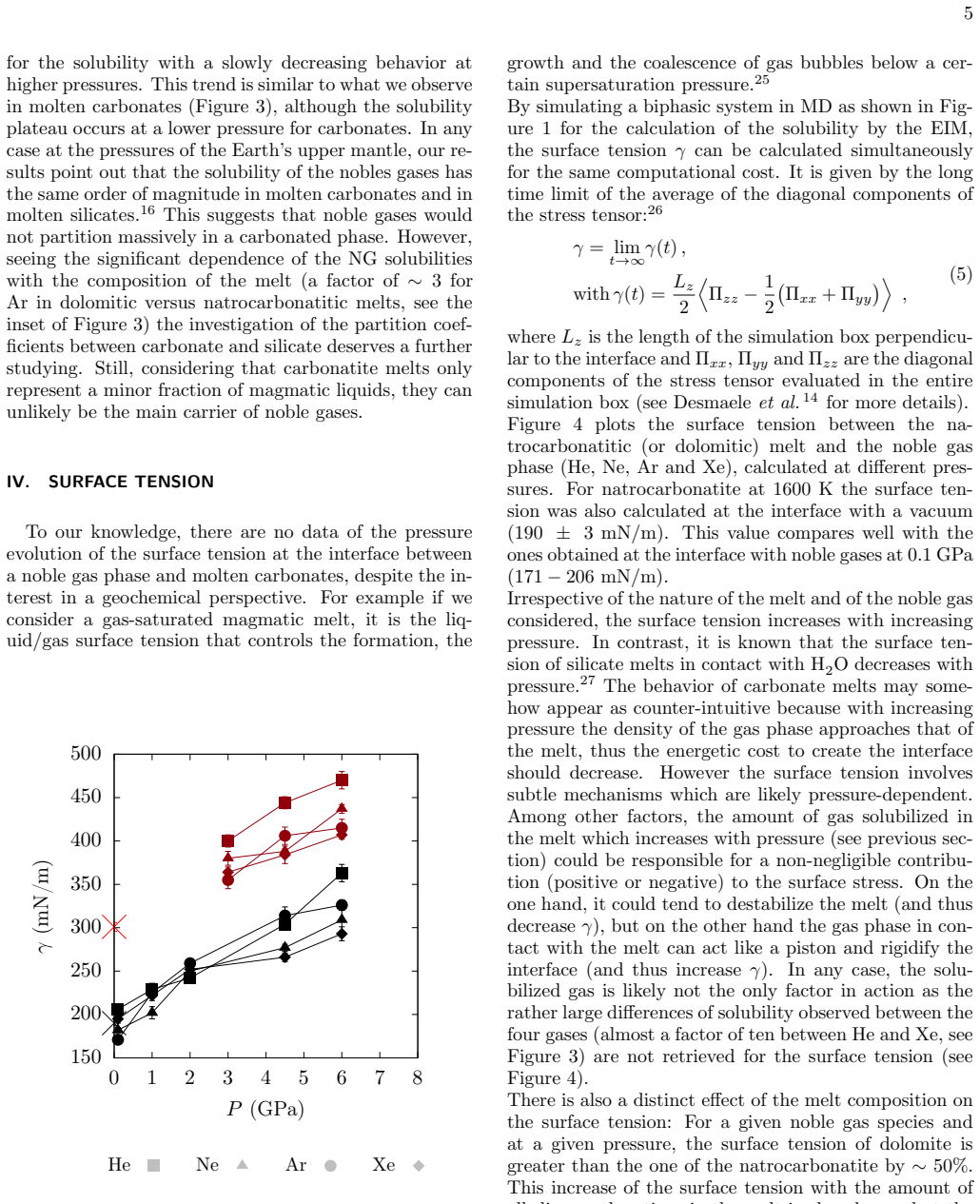
Starting from a force field validated on carbonate melt thermodynamics and on noble-gas solubility in silicate melts, the study computes solubilities in K2CO3-CaCO3 mixtures at 1 bar and reproduces the measured values once the known helium-loss problem of the experiments is taken into account. Under pressure, the solubility in natrocarbonatite follows Henry's law only up to about 0.1 GPa; above one GPa it levels off, with helium passing through a maximum near 2 GPa and argon near 4 GPa. In molten dolomite the solubility is nearly independent of pressure between 3 and 6 GPa. The result is that all four gases dissolve in carbonate melts at mantle conditions at concentrations comparable to those in silicates, so carbonatitic melts are not enriched in noble gases relative to coexisting mantle melts. The surface tension between carbonate melt and noble-gas fluid increases by about a factor of two as pressure goes from 0 to 6 GPa, independent of melt and gas composition.
Load-bearing premise
Everything at high pressure depends on the idea that Lennard-Jones parameters fitted to noble-gas interactions with silicate melts describe noble-gas atoms in carbonate melts just as well, and that noble-gas/carbon interactions can be ignored; only a 1-bar comparison for K2CO3-CaCO3 mixtures checks that transfer.
Editorial extensions
If this is right
- Carbonatitic melts at depth will not fractionate noble gases strongly from silicate melts, so noble gas abundances in such melts should track the coexisting silicate melt; the composition dependence, roughly a factor of three for argon, still requires case-by-case evaluation.
- Low-pressure Henry's law cannot be extrapolated to mantle pressures: in natrocarbonatite the linear regime stops near 0.1 GPa, and extrapolating to several GPa would overestimate the helium and argon contents by a factor of several.
- The pressure-driven doubling of surface tension at carbonate melt/noble-gas interfaces will affect bubble nucleation, growth, and coalescence in carbonatite magmas, in the opposite direction to hydrous silicate melts where water lowers surface tension.
- Melt composition controls solubility as much as pressure: K-rich carbonate melts dissolve an order of magnitude more helium than pure CaCO3 at 1 bar, and natrocarbonatite holds more noble gas than dolomite at all studied pressures.
Reading between the lines
- If carbonate melts are not noble-gas carriers, then noble gas budgets of deep Earth carbon reservoirs may be carried by silicate melts or fluids instead, making carbonatites effectively invisible to helium and argon isotope tracers.
- The predicted crossover at high pressure, where He and Ne converge and Xe approaches Ar, could serve as a barometer for the depth at which a carbonatite magma trapped its gas, if confirmed by experiment.
- A targeted ab initio simulation of one noble gas in natrocarbonatite would test whether neglecting noble-gas/carbon interactions and electronic polarization shifts the mantle-pressure solubilities by more than the reported error bars.
- The same interfacial method could be applied to CO2 in carbonate melts; since CO2 is the actual mantle volatile and is much more abundant than noble gases, its surface tension behavior would directly affect carbonatite degassing models.
Signed reviews
Editorial analysis
A structured set of objections, weighed in public.
Referee Report
Summary. The manuscript reports molecular dynamics simulations of the solubility of He, Ne, Ar, and Xe in carbonate melts, using a force field previously developed for carbonate melts and Lennard-Jones parameters for noble-gas interactions that were fitted for silicate and CO2-bearing silicate melts. Solubilities are computed by the Test Particle Method at low pressure and by an Explicit Interface Method at high pressure, with a comparison to the only available experimental data (Burnard et al., 2010) for K2CO3-CaCO3 mixtures at 1 bar. The authors then extend the calculations to natrocarbonatite at 1600 K and dolomite at 1673 K up to 6 GPa, finding that noble-gas solubilities are of the same order of magnitude as in molten silicates at mantle pressures, which suggests that carbonatitic melts are not preferential carriers of noble gases. The paper also reports the pressure evolution of the melt/noble-gas surface tension, which increases with pressure for all compositions and gases.
Significance. If the results hold, this is the first quantitative simulation-based estimate of noble-gas solubilities in carbonate melts at mantle pressures, filling a gap where experimental data are sparse. The finding that carbonatitic melts do not strongly fractionate noble gases relative to silicates is geochemically relevant for interpreting noble-gas systematics in carbonatite-sourced magmas. The paper benefits from standard, well-established methods (TPM and EIM) with convergence checks (Fig. B.2) and explicit error bars, and it transparently states the transferability assumption. However, the validation against experiment is partial: helium data are lower limits, and no quantitative comparison is given for argon. The central mantle-pressure conclusion therefore rests on a force-field transferability that is only weakly constrained.
major comments (3)
- [Section II.A and Section III.A, Fig. 2] The a posteriori justification of force-field transferability is weaker than presented. The paper states in Section II.A that the NG-melt interactions are assumed transferable and 'justified a posteriori' by agreement with Burnard et al. However, as acknowledged in Section III.A, the experimental helium data are lower limits because of gas loss during quenching; agreement with these data only establishes that the simulated He solubility is greater than or equal to the measured values, not that the force field is accurate. For argon, no numerical comparison is tabulated, only a qualitative statement of better agreement. Since the high-pressure predictions in Section III.B and the conclusion about non-preferential noble-gas transport rest entirely on this transferability, the validation is insufficient. I recommend adding a quantitative comparison for Ar (and, where possible, Ne and Xe if experimental data exist) and performing a sensitivity test in which the NG-O and NG-cation Lennard-Jones parameters are scaled by a plausible factor (e.g., ±10% in epsilon or sigma) to show that the mantle-pressure conclusion (order-of-magnitude similarity to silicates) is robust.
- [Section III.B vs. Table C.1 and Table C.2] There is a temperature inconsistency for the dolomite melt. The main text (Section III.B) and the caption of Fig. 3 state 1673 K for dolomite, but the appendix tables (Table C.1 and Table C.2) report dolomite at 1623 K. This discrepancy must be resolved because the reported solubility and surface-tension values depend on the actual thermodynamic state. Please correct the inconsistency and state clearly which temperature was used in the simulations.
- [Section II.A and Table A.3] The neglect of NG-carbon interactions, justified by the screening of carbon by oxygen, is plausible for large noble gases but is not tested for helium. Helium is small enough to approach the central carbon atom of the carbonate ion, and the experimental He data are lower limits, so they cannot validate this choice for He. The paper's prediction of a helium solubility maximum near 2 GPa in natrocarbonatite (Fig. 3) could be sensitive to this approximation. A concrete test would be to compute He solubility with a non-zero NG-C interaction (or a repulsive potential) and quantify the change in the predicted solubility and its pressure dependence.
minor comments (5)
- [Section III.A] The text says 'K2CO3–Na2CO3 mixtures' but the studied system and Fig. 2 caption refer to K2CO3–CaCO3 mixtures; this appears to be a typo and should be corrected.
- [Table B.1] For xK2CO3 = 0, the reported Xe solubility parameter is 0.059 ± 0.05, with an uncertainty nearly equal to the value itself. Please check this entry; it may be a typographical error or an indication that the TPM calculation is poorly converged for Xe in pure CaCO3.
- [Fig. 2] The axis label 'X (10□4 mol%)' is unclear because of the missing superscript and ambiguous multiplier. Please specify the units explicitly, e.g., 'molar fraction (10^-4 mol%)' or use mole fraction directly, to avoid confusion.
- [Section IV] The abstract and conclusion state that the surface tension increases 'by a factor ~2' from 0 to 6 GPa. From Fig. 4 and Table C.2, the increase is closer to a factor of about 1.5 to 1.8 for most gas/melt pairs (e.g., 206 to 363 mN/m for He in natrocarbonatite). Please adjust the wording to reflect the actual range.
- [Conclusion] The connection between the calculated solubility ratio and the 4He/40Ar ratio measured at Ol Doinyo Lengai (Fischer et al., 2009) is stated without quantitative elaboration. A brief explanation of how the solubility results translate into a predicted He/Ar fractionation would make the geochemical argument more transparent.
Circularity Check
No significant circularity: prior force-field parameters are independent inputs, and the low-pressure benchmark is external.
full rationale
The derivation chain is force field -> MD simulation -> solubility/surface tension -> geochemical conclusion. The NG-melt Lennard-Jones parameters are taken from prior papers by the same group (Guillot and Sator 2012; Aubry et al. 2013), where they were calibrated for silicate and CO2-bearing silicate systems; they are not fitted to the carbonate solubility data reported here. The solubility is computed via the standard Widom test-particle method, Eqs. (1)-(4), without any parameter adjustment to the target results. The only in-paper empirical check is the comparison with Burnard et al.'s 1-bar K2CO3-CaCO3 measurements, which is an independent external dataset. The paper explicitly states that the transferability of the potentials is an assumption justified a posteriori, and it acknowledges that the He data are lower limits. That makes the high-pressure predictions dependent on an unverified assumption, but it is a modeling limitation rather than a circular reduction of output to input. The conclusion that carbonate and silicate solubilities are of the same order of magnitude is a computed outcome of the simulation, not an identity forced by the choice of parameters. No equation is defined in terms of the result, no fitted parameter is renamed as a prediction, and no uniqueness theorem is imported from the authors' prior work. Therefore no significant circularity is present.
Assumptions & free parameters
free parameters (4)
- NG-cation Lennard-Jones parameters (epsilon, sigma) for Mg, Ca, Na, K =
Table A.3 (e.g. He-Mg epsilon=1.554 kJ/mol, sigma=2.076 A)
- NG-oxygen Lennard-Jones parameters (epsilon, sigma) =
Table A.3 (He-O epsilon=0.525 kJ/mol, sigma=2.81 A)
- Carbonate melt force field (Buckingham A, rho, C, partial charges) =
Table A.2 (e.g. Mg-O A=243000 kJ/mol, rho=0.24335 A, C=1439 A^6/mol, qMg=+1.64202 e)
- NG-NG Buckingham parameters =
Table A.1 (He A=132917 kJ/mol, rho=0.2051 A, C=109.84 A^6/mol)
assumptions (4)
- domain assumption The NG-melt interaction potentials from silicate and CO2-bearing silicate systems are transferable to carbonate melts.
- domain assumption The carbon atom in carbonate is fully screened by its surrounding oxygens, so NG-carbon interactions can be set to zero.
- domain assumption Classical molecular dynamics with empirical pairwise potentials accurately captures solubility thermodynamics at mantle pressures.
- domain assumption NVE production runs of 10 ns with the stated equilibration are sufficient to converge solubility and surface tension averages.
Cite this review
Pith. "Pith review of Noble gases in carbonate melts: constraints on the solubility and the surface tension by molecular dynamics simulation." pith.science (2026). https://pith.science/paper/DEPPXHGQ
@misc{pith2026190803745,
  author       = {Pith},
  title        = {Pith review of: Noble gases in carbonate melts: constraints on the solubility and the surface tension by molecular dynamics simulation},
  year         = {2026},
  howpublished = {\url{https://pith.science/paper/DEPPXHGQ}},
  note         = {Machine review of arXiv:1908.03745}
}
read the original abstract
Although they are rare elements in the Earth's mantle, noble gases (NG) owe to their strongly varying masses contrasting physical behaviors making them important geochemical tracers. When partial melting occurs at depth, the partitioning of NGs between phases is controlled by a distribution coefficient that can be determined from the solubility of the NGs in each phase. Here we report quantitative calculations of the solubility of He, Ne, Ar and Xe in carbonate melts based on molecular dynamics simulations. The NG solubilities are first calculated in K2CO3-CaCO3 mixtures at 1 bar and favorably compared to the only experimental data available to date. Then we investigate the effect of pressure (up to 6 GPa), focusing on two melt compositions: a dolomitic one and a natrocarbonatitic one (modeling the lava of Ol Doinyo Lengai). The solubility decreases with the amount of alkaline-earth cation in the melt and with the size of the noble gas. In the natrocarbonatitic melt, Henry's law is fulfilled at low pressures (up to ~ 0.1 GPa). At higher pressures the solubility levels off or even starts to diminish smoothly. In contrast, in molten dolomite the effect of pressure is negligible on the studied P range (3-6 GPa). At the pressures of the Earth's mantle, the solubilities of noble gases in carbonate melts are still of the same order of magnitude as the ones in molten silicates (~ 1-10 mol%). This suggests that carbonatitic melts at depth are not preferential carriers of noble gases, even if the dependence with the melt composition is not negligible and has to be evaluated on a case-by-case basis. Finally we evaluate the surface tension at the interface between carbonate melts and noble gases and its evolution with pressure. Whatever the composition of the melt and of the NG phase, the surface tension increases when P increases from 0 to 6 GPa.
Figures


Reference graph
Works this paper leans on
-
[1]
author author B. Marty ,\ title title The origins and concentrations of water, carbon, nitrogen and noble gases on E arth , \ https://doi.org/10.1016/j.epsl.2011.10.040 journal journal Earth Planet. Sci. Lett. \ volume 313-314 ,\ pages 56--66 ( year 2012 ) NoStop
-
[2]
author author M. Moreira ,\ title title Noble gas constraints on the origin and evolution of E arth's volatiles , \ 10.7185/geochempersp.2.2 journal journal Geochem. Perspect. \ volume 2 ,\ pages I--IV ( year 2013 ) NoStop
-
[3]
author author T. Fischer , author P. Burnard , author B. Marty , author D. Hilton , author E. Füri , author F. Palhol , author Z. Sharp , \ and\ author F. Mangasini ,\ title title Upper-mantle volatile chemistry at O ldoinyo L engai volcano and the origin of carbonatites , \ https://doi.org/10.1038/nature07977 journal journal Nature \ volume 459 ,\ pages ...
-
[4]
author author B. S. \ White , author M. Brearley , \ and\ author A. Montana ,\ title title Solubility of argon in silicate liquids at high pressures , \ https://pubs.geoscienceworld.org/msa/ammin/article-abstract/74/5-6/513/42226 journal journal Am. Mineral. \ volume 74 ,\ pages 513--529 ( year 1989 ) NoStop
work page 1989
-
[5]
author author A. Montana , author Q. Guo , author S. Boettcher , author B. S. \ White , \ and\ author M. Brearley ,\ title title Xe and Ar in high-pressure silicate liquids , \ https://pubs.geoscienceworld.org/msa/ammin/article-abstract/78/11-12/1135/42714 journal journal Am. Mineral. \ volume 78 ,\ pages 1135--1142 ( year 1993 ) NoStop
work page 1993
-
[6]
author author M. R. \ Carroll \ and\ author E. M. \ Stolper ,\ title title Noble gas solubilities in silicate melts and glasses: New experimental results for argon and the relationship between solubility and ionic porosity , \ https://doi.org/10.1016/0016-7037(93)90606-W journal journal Geochim. Cosmochim. Acta \ volume 57 ,\ pages 5039--5051 ( year 1993 ) NoStop
-
[7]
author author E. Chamorro-Perez , author P. Gillet , \ and\ author A. Jambon ,\ title title Argon solubility in silicate melts at very high pressures. experimental set-up and preliminary results for silica and anorthite melts , \ https://doi.org/10.1016/S0012-821X(96)00188-4 journal journal Earth Planet. Sci. Lett. \ volume 145 ,\ pages 97--107 ( year 199...
-
[8]
author author B. C. \ Schmidt \ and\ author H. Keppler ,\ title title Experimental evidence for high noble gas solubilities in silicate melts under mantle pressures , \ 10.1016/S0012-821X(01)00584-2 journal journal Earth Planet. Sci. Lett. \ volume 195 ,\ pages 277--290 ( year 2002 ) NoStop
Show all 29 references
-
[9]
Bouhifd , author A
author author M. Bouhifd , author A. Jephcoat , \ and\ author S. Kelley ,\ title title Argon solubility drop in silicate melts at high pressures: a review of recent experiments , \ 10.1016/j.chemgeo.2008.06.041 journal journal Chem. Geol. \ volume 256 ,\ pages 252--258 ( year ...
2008 doi
-
[10]
Dasgupta \ and\ author M
author author R. Dasgupta \ and\ author M. M. \ Hirschmann ,\ title title Melting in the E arth's deep upper mantle caused by carbon dioxide , \ 10.1038/nature04612 journal journal Nature \ volume 440 ,\ pages 659--662 ( year 2006 ) NoStop
-
[11]
Dasgupta \ and\ author M
author author R. Dasgupta \ and\ author M. M. \ Hirschmann ,\ title title The deep carbon cycle and melting in E arth's interior , \ 10.1016/j.epsl.2010.06.039 journal journal Earth Planet. Sci. Lett. \ volume 298 ,\ pages 1--2 ( year 2010 ) NoStop
2010 doi
-
[12]
Burnard , author M
author author P. Burnard , author M. J. \ Toplis , \ and\ author S. Medynski ,\ title title Low solubility of He and Ar in carbonatitic liquids: Implications for decoupling noble gas and lithophile isotope systems , \ 10.1016/j.gca.2009.11.031 journal journal Geochim. Cosmochi...
-
[13]
Hammouda \ and\ author S
author author T. Hammouda \ and\ author S. Keshav ,\ title title Melting in the mantle in the presence of carbon: Review of experiments and discussion on the origin of carbonatites , \ 10.1016/j.chemgeo.2015.05.018 journal journal Chem. Geol. \ volume 418 ,\ pages 171--188 ( y...
2015 doi
-
[14]
Desmaele , author N
author author E. Desmaele , author N. Sator , author R. Vuilleumier , \ and\ author B. Guillot ,\ title title Atomistic simulations of molten carbonates: Thermodynamic and transport properties of the Li 2 CO 3 – Na 2 CO 3 – K 2 CO 3 system , \ 10.1063/1.5082731 journal journal...
-
[15]
Desmaele , author N
author author E. Desmaele , author N. Sator , author R. Vuilleumier , \ and\ author B. Guillot ,\ title title The Mg CO 3 – Ca CO 3 – Li 2 CO 3 – Na 2 CO 3 – K 2 CO 3 melts: Thermodynamics and transport properties by atomistic simulations , \ 10.1063/1.5099015 journal journal ...
-
[16]
Guillot \ and\ author N
author author B. Guillot \ and\ author N. Sator ,\ title title Noble gases in high-pressure silicate liquids: A computer simulation study , \ 10.1016/j.gca.2011.11.040 journal journal Geochim. Cosmochim. Acta \ volume 80 ,\ pages 51--69 ( year 2012 ) NoStop
2011 doi
-
[17]
Tang \ and\ author J
author author K. Tang \ and\ author J. Toennies ,\ title title The van der W aals potentials between all the rare gas atoms from He to Rn , \ 10.1063/1.1543944 journal journal J. Chem. Phys. \ volume 118 ,\ pages 4976--4983 ( year 2003 ) NoStop
-
[18]
Aubry , author N
author author G. Aubry , author N. Sator , \ and\ author B. Guillot ,\ title title Vesicularity, bubble formation and noble gas fractionation during morb degassing , \ 10.1016/j.chemgeo.2013.02.006 journal journal Chem. Geol. \ volume 343 ,\ pages 85--98 ( year 2013 ) NoStop
2013 doi
-
[19]
Widom ,\ title title Some topics in the theory of fluids , \ 10.1063/1.1734110 journal journal J
author author B. Widom ,\ title title Some topics in the theory of fluids , \ 10.1063/1.1734110 journal journal J. Chem. Phys. \ volume 39 ,\ pages 2808--2812 ( year 1963 ) NoStop
1963 doi
-
[20]
Guillot \ and\ author N
author author B. Guillot \ and\ author N. Sator ,\ title title Carbon dioxide in silicate melts: A molecular dynamics simulation study , \ http://dx.doi.org/10.1016/j.gca.2011.01.004 journal journal Geochim. Cosmochim. Acta \ volume 75 ,\ pages 1829--1857 ( year 2011 ) NoStop
2011 doi
-
[21]
Smith \ and\ author B
author author S. Smith \ and\ author B. Kennedy ,\ title title The solubility of noble gases in water and in NaCl brine , \ 10.1016/0016-7037(83)90273-9 journal journal Geochim. Cosmochim. Acta \ volume 47 ,\ pages 503--515 ( year 1983 ) NoStop
-
[22]
Guillot \ and\ author Y
author author B. Guillot \ and\ author Y. Guissani ,\ title title Temperature dependence of the solubility of non-polar gases in liquids , \ https://doi.org/10.1080/00268979300101071 journal journal Mol. Phys. \ volume 79 ,\ pages 53--75 ( year 1993 ) NoStop
-
[23]
Keller \ and\ author A
author author J. Keller \ and\ author A. N. \ Zaitsev ,\ title title Geochemistry and petrogenetic significance of natrocarbonatites at O ldoinyo L engai, T anzania: Composition of lavas from 1988 to 2007 , \ 10.1016/j.lithos.2012.05.022 journal journal Lithos \ volume 148 ,\ ...
1988 doi
-
[24]
Niwa , author C
author author K. Niwa , author C. Miyakawa , author T. Yagi , \ and\ author J. ichi Matsuda ,\ title title Argon solubility in SiO 2 melt under high pressures: A new experimental result using laser-heated diamond anvil cell , \ https://doi.org/10.1016/j.epsl.2012.12.014 journa...
-
[25]
Mangan \ and\ author T
author author M. Mangan \ and\ author T. Sisson ,\ title title Evolution of melt-vapor surface tension in silicic volcanic systems: Experiments with hydrous melts , \ 10.1029/2004JB003215 journal journal J. Geophys. Res. \ volume 110 ,\ pages B01202 ( year 2005 ) ,\ note b01202 NoStop
-
[26]
author author J. G. \ Kirkwood \ and\ author F. P. \ Buff ,\ title title The statistical mechanical theory of surface tension , \ 10.1063/1.1747248 journal journal J. Chem. Phys. \ volume 17 ,\ pages 338--343 ( year 1949 ) NoStop
1949 doi
-
[27]
Colucci , author M
author author S. Colucci , author M. Battaglia , \ and\ author R. Trigila ,\ title title A thermodynamical model for the surface tension of silicate melts in contact with H 2 O gas , \ 10.1016/j.gca.2015.10.037 journal journal Geochim. Cosmochim. Acta \ volume 175 ,\ pages 113...
2015 doi
-
[28]
Desmaele ,\ title Physicochemical Properties of Molten Carbonates from Atomistic Simulations ,\ https://hal.archives-ouvertes.fr/tel-01767010/ Ph.D
author author E. Desmaele ,\ title Physicochemical Properties of Molten Carbonates from Atomistic Simulations ,\ https://hal.archives-ouvertes.fr/tel-01767010/ Ph.D. thesis ,\ school Sorbonne Universit\'e ( year 2017 ) NoStop
2017
-
[29]
Smith \ and\ author T
author author W. Smith \ and\ author T. Forester ,\ title title DL\_POLY\_2.0 : A general-purpose parallel molecular dynamics simulation package , \ 10.1016/S0263-7855(96)00043-4 journal journal J. Mol. Graphics \ volume 14 ,\ pages 136--141 ( year 1996 ) NoStop
Reviewed August 14, 2026 · model on record in the stance chip above.
Discussion (0). Continue with ORCID to comment.