REVIEW 2 major objections 31 references
Reviewed by Pith at T0; open to challenge.
T0 means a machine referee read the full paper against a public rubric. The mark states how deep the mechanical check went, never who wrote it. the ladder, T0–T4 →
T0 review · grok-4.3
An iterative method reconstructs three-dimensional acoustic obstacles from scattered or far-field data using boundary integrals on homothetic surfaces that avoid all singularities.
2026-07-03 07:47 UTC pith:DESI7YXO
load-bearing objection The homothetic surface lets them skip singularities in the 3D inverse scattering iteration and they prove the needed properties for the linearized step, but the approximation claim lacks a rate so convergence is not fully controlled. the 2 major comments →
A highly efficient iterative approach for inverse acoustic obstacle scattering problems in three dimensions
The pith
A machine-rendered reading of the paper's core claim, the machinery that carries it, and where it could break.
Core claim
The central claim is that an iterative scheme based on boundary integral equations defined on a homothetic surface reconstructs the obstacle from scattered-field or phased/phaseless far-field data in three dimensions; the scheme completely avoids singularities because the scattered field produced by the homothetic surface can arbitrarily approximate the exact scattered field, while the injectivity and dense-range property of the associated Fréchet derivative ensure that the linearized data equation remains solvable at every iteration.
What carries the argument
The homothetic surface, on which boundary integrals are defined so that the generated scattered field approximates the exact one and the Fréchet derivative of the far-field operator acquires injectivity plus dense range.
Load-bearing premise
The homothetic surface must supply a scattered-field approximation accurate enough for the iteration to converge to the true obstacle boundary.
What would settle it
A concrete numerical experiment on a known smooth obstacle in which the iteration, started from the homothetic surface, fails to recover the correct shape even though the theoretical approximation property is claimed to hold.
If this is right
- The same iterative scheme applies equally to phased and phaseless far-field data.
- No explicit treatment of singular kernels on the obstacle surface is required at any stage.
- The dense-range property of the Fréchet derivative guarantees that the linearized equation can be solved at each iteration.
- Numerical tests confirm that the method remains stable under moderate noise levels.
Where Pith is reading between the lines
- The construction may extend directly to other inverse scattering problems whose forward maps admit similar Fréchet-derivative properties.
- Adaptive selection of the homothetic ratio could be tested to improve convergence speed for elongated obstacles.
- The avoidance of singularities suggests the method could be combined with fast multipole or fast Fourier techniques for large-scale three-dimensional reconstructions.
Editorial analysis
A structured set of objections, weighed in public.
Referee Report
Summary. The paper proposes an iterative method for reconstructing 3D acoustic obstacles from scattered-field or phased/phaseless far-field data. The method defines boundary integrals on a homothetic surface to avoid singularities entirely. It proves injectivity and dense range of the Fréchet derivative of the forward map to guarantee solvability of each linearized data equation, proves that the scattered field generated by the homothetic surface can arbitrarily approximate the exact scattered field, and reports numerical experiments showing superiority and robustness.
Significance. If the approximation property can be equipped with quantitative rates and stability estimates, the approach would offer a genuinely singularity-free, provably solvable iteration for a core inverse-scattering problem; the combination of functional-analytic guarantees (injectivity/dense range) with a modeling choice that sidesteps singular integrals is a clear technical strength.
major comments (2)
- [Abstract] Abstract (paragraph on the homothetic surface): the claim that the scattered field generated by the homothetic surface “can arbitrarily approximate the exact one” is stated without an explicit rate or stability estimate in any Sobolev norm on the far-field sphere or on the boundary. Because the iteration relies on this approximation remaining sufficiently accurate for the update direction to remain valid at each step, the absence of a quantitative bound linking the homothety ratio to the residual of the data equation is load-bearing for convergence of the overall scheme.
- [Abstract] Abstract (paragraph on the Fréchet derivative): while injectivity and dense range are asserted to ensure solvability of the linearized equation, the manuscript does not indicate whether these properties are uniform with respect to the homothetic surface or degrade as the current guess moves away from the true obstacle; without such uniformity the solvability result does not automatically transfer to the practical iteration.
Simulated Author's Rebuttal
We thank the referee for the careful reading and the constructive major comments. We address each point below, indicating where revisions will be made to improve clarity.
read point-by-point responses
-
Referee: [Abstract] Abstract (paragraph on the homothetic surface): the claim that the scattered field generated by the homothetic surface “can arbitrarily approximate the exact one” is stated without an explicit rate or stability estimate in any Sobolev norm on the far-field sphere or on the boundary. Because the iteration relies on this approximation remaining sufficiently accurate for the update direction to remain valid at each step, the absence of a quantitative bound linking the homothety ratio to the residual of the data equation is load-bearing for convergence of the overall scheme.
Authors: The manuscript establishes that the difference between the scattered field on the homothetic surface and the exact scattered field can be made arbitrarily small by taking the homothety ratio sufficiently close to one; this is a qualitative density-type result rather than a quantitative rate. In the iteration the homothety ratio is chosen once and for all close enough that the modeling error is smaller than the current data residual, which is justified by the arbitrary-approximation statement. We agree that an explicit rate would be desirable and will add a short clarifying paragraph in the revised manuscript noting that the present proof is qualitative and that quantitative estimates remain an open question for future work. The numerical section already shows robust convergence for the ratios used in practice. revision: partial
-
Referee: [Abstract] Abstract (paragraph on the Fréchet derivative): while injectivity and dense range are asserted to ensure solvability of the linearized equation, the manuscript does not indicate whether these properties are uniform with respect to the homothetic surface or degrade as the current guess moves away from the true obstacle; without such uniformity the solvability result does not automatically transfer to the practical iteration.
Authors: The injectivity and dense-range proofs are given for the Fréchet derivative of the forward map defined on any fixed homothetic surface lying sufficiently close to the unknown obstacle. At each step of the iteration the current surface is regarded as fixed, so the solvability result applies directly to the linearized equation at that iterate. The manuscript does not claim uniformity over the entire admissible set of surfaces; the local nature of the argument is implicit in the statement that the homothetic surface approximates the true obstacle. We will insert one clarifying sentence in the revised version to make the per-iterate applicability explicit. revision: partial
Circularity Check
No significant circularity detected
full rationale
The derivation chain rests on standard boundary-integral scattering theory plus two independent proofs (injectivity/dense-range of the Fréchet derivative and the approximation property of the homothetic-surface field). Neither proof is shown to reduce by construction to a fitted parameter, a self-citation chain, or a renaming of an input; the homothetic modeling choice is an explicit ansatz whose approximation claim is asserted to be proved rather than assumed. The method therefore remains self-contained against external benchmarks and receives the default non-circularity finding.
Axiom & Free-Parameter Ledger
axioms (2)
- domain assumption The forward scattering problem is governed by the Helmholtz equation with sound-hard or impedance boundary conditions on the obstacle.
- domain assumption Far-field or phased/phaseless scattered-field data are available and contain sufficient information for shape recovery.
read the original abstract
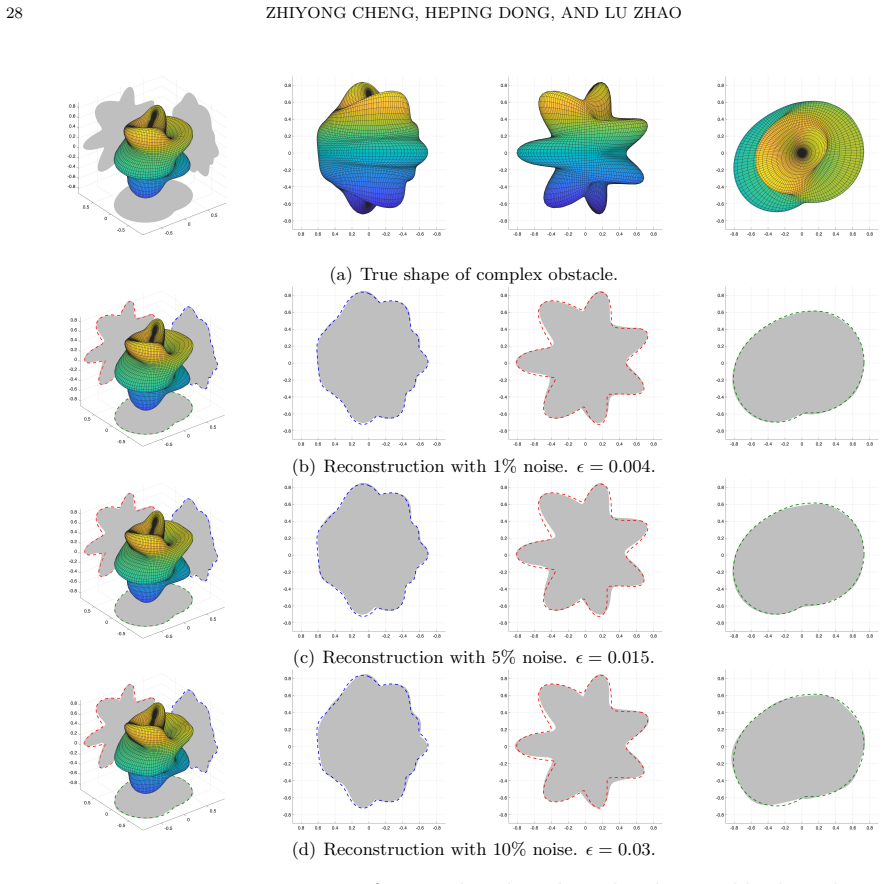
This paper concerns a three-dimensional inverse acoustic obstacle scattering problem from scattered field or phased/phaseless far-field data. Based on the boundary integral defined on a homothetic surface, we propose a highly efficient iterative approach for obstacle reconstruction that completely avoids dealing with any singularity. Here, the injectivity and dense-range property of the Fr\'echet derivative have been proved to ensure the solvability of the linearized equivalent data equation. We also prove that the scattered field generated by the homothetic surface can arbitrarily approximate the exact one. Numerical experiments are presented to verify the superiority and robustness of the proposed approach.
Figures




Reference graph
Works this paper leans on
-
[1]
H. Ammari,An introduction to mathematics of emerging biomedical imaging, Math´ ematiques & Applications (Berlin), 62, Springer, Berlin, 2008
work page 2008
- [2]
-
[3]
G. Bao, P. Li, Inverse medium scattering problems for electromagnetic waves, SIAM J. Appl. Math. 65 (2005) 2049–2066
work page 2005
-
[4]
M. Bonnet and F. Cakoni, Analysis of topological derivative as a tool for qualitative identification, Inverse Probl. 35 (2019) 104007
work page 2019
-
[5]
Borden, Mathematical problems in radar inverse scattering, Inverse Probl
B. Borden, Mathematical problems in radar inverse scattering, Inverse Probl. 18 (2002) R1–R28
work page 2002
- [6]
- [7]
- [8]
-
[9]
J. Chen, Z. Chen and G. Huang, Reverse time migration for extended obstacles: acoustic waves, Inverse Probl. 29 (2013) 085005
work page 2013
-
[10]
J. Chen, B. Jin, H. Liu, Solving inverse obstacle scattering problem with latent surface representations, Inverse Probl. 40 (2024) 065013
work page 2024
- [11]
- [12]
-
[13]
H. Dong, J. Lai, P. Li, Inverse obstacle scattering for elastic waves with phased or phaseless far-field data, SIAM J. Imaging Sci. 12 (2019) 809–838
work page 2019
-
[14]
H. Dong, J. Lai and P. Li, A spectral boundary integral method for the elastic obstacle scattering problem in three dimensions, J. Comput. Phys. 469 (2022) 111546
work page 2022
- [15]
- [16]
-
[17]
F. Hagemann, T. Arens, T. Betcke, F. Hettlich, Solving inverse electromagnetic scattering problems via domain derivatives, Inverse Probl. 35 (2019) 084005
work page 2019
-
[18]
T. Hohage, Logarithmic convergence rates of the iteratively regularized Gauss-Newton method for an inverse potential and an inverse scattering problem, Inverse Probl. 13 (1997) 1279–1299
work page 1997
-
[19]
O. Ivanyshyn, R. Kress, P. Serranho, Huygens’ principle and iterative methods in inverse obstacle scattering, Adv. Comput. Math. 33 (2010) 413–429
work page 2010
-
[20]
O. Ivanyshyn, R. Kress, Identification of sound-soft 3D obstacles from phaseless data, Inverse Probl. Imaging 4 (2010) 131–149
work page 2010
-
[21]
S. Kang and M. Lambert, Structure analysis of direct sampling method in 3D electromagnetic inverse problem: near- and far-field configuration, Inverse Probl. 37 (2021) 075002
work page 2021
-
[22]
A. Kirsch, Characterization of the shape of a scattering obstacle using the spectral data of the far field operator, Inverse Probl. 14 (1998) 1489–1512
work page 1998
-
[23]
R. Kress and A. Zinn, On the numerical solution of the three-dimensional inverse obstacle scattering problem, J. Comput. Appl. Math. 42 (1992) 49–61
work page 1992
-
[24]
R. Kress, Newton’s method for inverse obstacle scattering meets the method of least squares, Inverse Probl. 19 (2003) S91–S104
work page 2003
-
[25]
F. Le Lou¨ er and M.-L. Rap´ un, Detection of multiple impedance obstacles by non-iterative topological gradient based methods, J. Comput. Phys. 388 (2019) 534–560
work page 2019
-
[26]
F. Le Lou¨ er and M.-L. Rap´ un, A boundary integral formulation and a topological energy-based method for an inverse 3D multiple scattering problem with sound-soft, sound-hard, penetrable, and absorbing objects, Comput. Methods Appl. Math. 22 (2022) no. 4, 915–943. AN ITERATIVE APPROACH FOR INVERSE ACOUSTIC OBSTACLE SCATTERING 31
work page 2022
- [27]
- [28]
-
[29]
R. Potthast, Point Sources and Multipoles in Inverse Scattering Theory, Chapman & Hall/CRC, Boca Raton, FL, 2001
work page 2001
-
[30]
Serranho, A hybrid method for inverse scattering for a sound-soft obstacle in R3, Inverse Probl
P. Serranho, A hybrid method for inverse scattering for a sound-soft obstacle in R3, Inverse Probl. Imaging 1 (2007) 691–712
work page 2007
-
[31]
K. Ito, B. Jin, J. Zou, A direct sampling method to an inverse medium scattering problem, Inverse Probl. 28 (2012) 025003. Jilin University, Qianjin Street 2699, Changchun, Jilin 130012, China Email address:chengzy22@mails.jlu.edu.cn Jilin University, Qianjin Street 2699, Changchun, Jilin 130012, China Email address:dhp@jlu.edu.cn Civil Aviation Universit...
work page 2012
discussion (0)
Sign in with ORCID, Apple, or X to comment. Anyone can read and Pith papers without signing in.