REVIEW 3 major objections 4 minor 76 references
Electroweak Corrections to Dark Matter Direct Detection in a Vector Dark Matter Model
T0 review · 3 major / 4 minor · reviewed 2026-08-14 · deepseek-v4-flash
Pith's one-line read The paper shows that next-to-leading-order electroweak corrections to vector dark matter direct detection can shift the predicted cross section by up to a factor of 2.5, moving allowed parameter points above the XENON1T limit.
desk verdict A serious NLO direct-detection calculation for a minimal vector dark matter model with an unusually honest limitations section, but the headline XENON1T-exclusion claim leans on a two-loop box approximation that is not validated for m_phi > m_t. read the letter →
The pith
A machine-rendered reading of the paper's core claim, the machinery that carries it, and where it could break.
The reading
What carries the argument
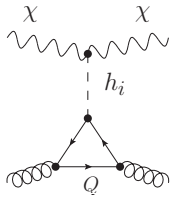
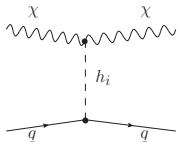
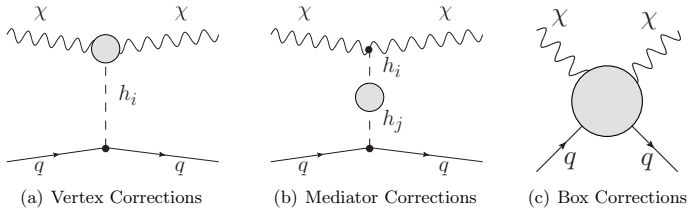
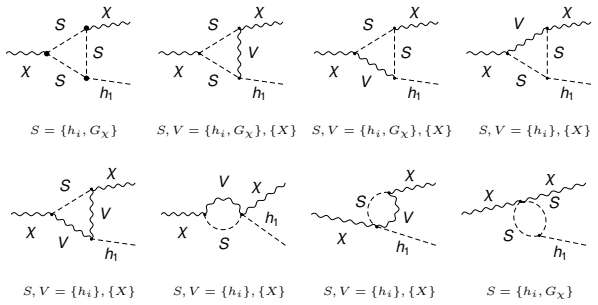
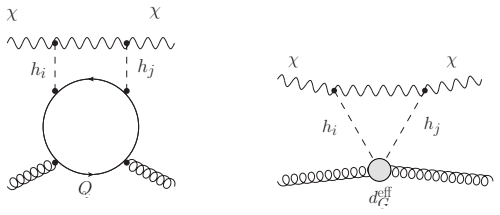
The machinery is the effective Lagrangian for spin-independent DM–nucleon scattering, whose Wilson coefficients $f_q$, $g_q$, and $f_G$ receive one-loop vertex, mediator, and box corrections. The model renormalisation combines on-shell mass and field renormalisation, an $\overline{\text{MS}}$ counterterm for the dark gauge coupling $g_\chi$, and three schemes for the scalar mixing angle $\alpha$: the KOSY scheme, an $\overline{\text{MS}}$ scheme, and a process-dependent scheme. The two-loop gluon-box contribution is treated with the Fock–Schwinger gauge effective two-Higgs–two-gluon coupling adapted from Ref. [13]. The K-factor $\sigma_{\rm NLO}/\sigma_{\rm LO}$ quantifies the net size of the corrections and is the central output for the phenomenological analysis.
What would settle it
A full two-loop calculation of the gluon-box contribution to the spin-independent cross section for a benchmark point with $m_\phi > m_t$ and $K>1$ would settle the reliability of the approximation used here; if the exact box form factor were not more than two orders of magnitude below the vertex form factor, the predicted K-factors and the inferred exclusion or recovery of parameter points would change.
Extended reading notes
Core claim
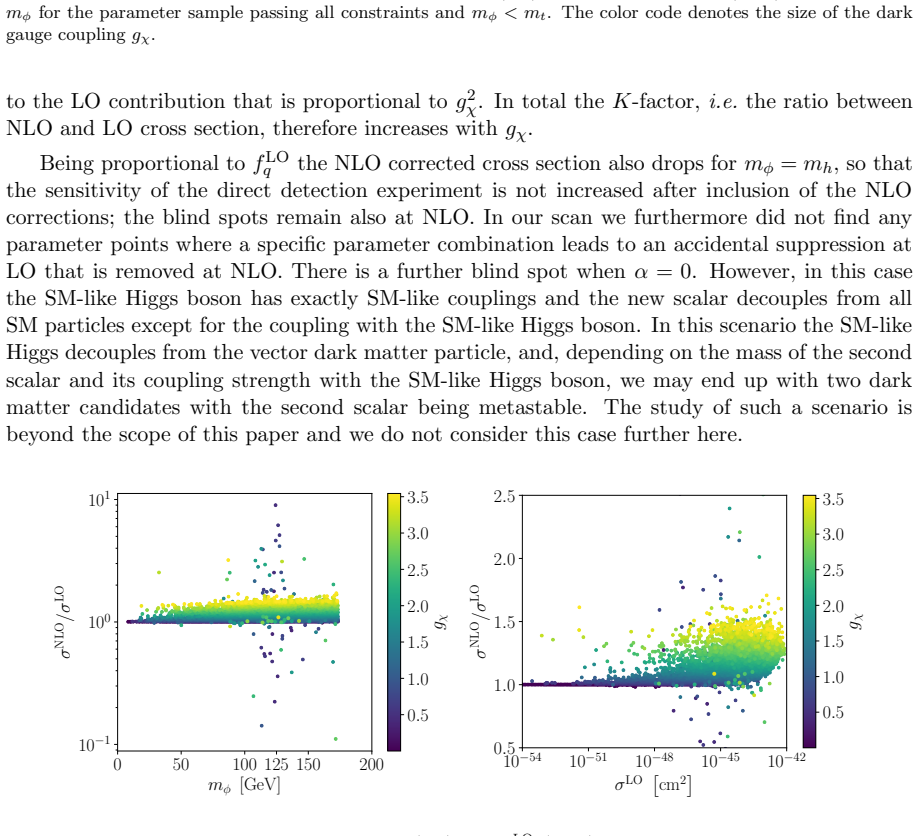
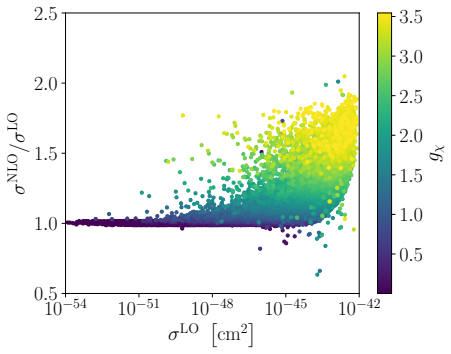
The paper's central claim is that the one-loop electroweak corrections to the spin-independent direct detection cross section in the vector dark matter model are large enough to change the model's experimental status: K-factors, the ratio of NLO to LO cross sections, reach values of about 2.5, and the corrections can either enhance or suppress the cross section. The NLO contributions are dominated by vertex corrections to the $\chi\chi h_i$ couplings and grow with the cube of the dark gauge coupling $g_\chi$, while mediator and box corrections play a smaller role. For a sizeable number of parameter points that pass all theoretical constraints and the XENON1T limit at leading order, the NLO cross section exceeds the bound, so the model's allowed parameter space shrinks; for others the NLO suppression recovers points that would be excluded at LO. These results are obtained from the effective operator basis for spin-independent scattering, with the two-loop gluon box contribution approximated by an effective Higgs–gluon coupling in Fock–Schwinger gauge, and the paper explicitly verifies that the box form factor stays more than two orders of magnitude below the vertex form factor for the $K>1$ sample.
Load-bearing premise
The load-bearing approximation is that the two-loop gluon-box contribution, computed with the Fock–Schwinger gauge effective coupling based on Ref. [13] and validated there for mediator masses below the top-quark mass, also holds for mediator masses above $m_t$; the paper states it cannot judge the goodness of the approximation in that region, and its conclusion relies on the box form factor being subdominant, a property verified only for the $K>1$ sample.
Editorial extensions
If this is right
- Leading-order-only comparisons with XENON1T are insufficient for the VDM model; the NLO correction must be included to determine whether a parameter point is excluded.
- For parameter points with $m_\phi\approx m_h$, the NLO perturbative expansion breaks down and a full two-loop calculation is needed; the paper excludes these points from its conclusions.
- Larger dark gauge couplings $g_\chi$ give larger K-factors, so future direct detection bounds will be most sensitive to the strongly coupled regions of the model.
- The renormalisation scheme choice for the mixing angle is decisive: KOSY gives moderate corrections, while the $\overline{\text{MS}}$ and process-dependent schemes give unphysically large ones and are unsuitable for phenomenology.
- If NLO corrections indeed move allowed points above the XENON1T limit, then current exclusion plots for this model understate the probed parameter space, and a dedicated NLO reinterpretation of direct detection limits is required.
Reading between the lines
- A similar NLO enhancement should occur in other simplified models where a scalar mediator couples a vector dark matter particle to quarks, because the $g_\chi^3$ scaling of the vertex corrections is a generic feature; the same effective-operator machinery could be applied to test this.
- The gauge dependence of the KOSY-scheme result, though small numerically, could become relevant if future direct detection experiments probe the predicted cross sections; a pinched or physical scheme would remove this residual ambiguity.
- Because NLO corrections can also suppress the cross section, some parameter points that appear excluded at leading order may actually be viable; reinterpreting existing exclusion limits with NLO cross sections could reveal viable regions not previously considered.
Editorial analysis
A structured set of objections, weighed in public.
Referee Report
Summary. The manuscript computes the next-to-leading-order (NLO) electroweak corrections to the spin-independent direct-detection cross section in a minimal vector dark matter (VDM) model, consisting of the Standard Model extended by a dark U(1)χ gauge boson χ and a complex SM-singlet scalar S. The authors set up the model, present its renormalisation (including the MS renormalisation of the dark gauge coupling gχ and three schemes for the scalar mixing angle α: KOSY, MS, and a process-dependent scheme), and construct the nucleon-level effective Lagrangian at NLO by separating vertex, mediator, and box corrections. A two-loop gluon contribution is included using the Fock-Schwinger effective-coupling approach of Ref. [13]. The numerical analysis uses a ScannerS-based parameter scan with theoretical, Higgs, collider, relic-density, indirect-detection, and LO direct-detection constraints, and presents K-factors, gauge-dependence checks, renormalisation-scheme comparisons, and XENON1T limit plots. The central claim is that NLO corrections reach K-factors up to about 2.5 and can move otherwise allowed parameter points above the XENON1T exclusion limit, implying that LO-only comparisons with direct-detection limits are insufficient for this model.
Significance. If the quantitative results are robust, this is a timely and useful calculation: it is one of the few complete NLO direct-detection computations in a renormalisable vector dark matter model, and it demonstrates a concrete phenomenological mechanism by which NLO corrections change the interpretation of XENON1T data. The paper is methodologically careful in several respects that deserve credit: the renormalisation is described in detail, the gauge dependence of the default KOSY scheme is studied explicitly and shown to be at the few-percent level for representative points, and the limitations of the two-loop gluon treatment and of the mφ≈mh region are stated openly rather than hidden. The phenomenological significance is, however, conditional on the unvalidated Fock-Schwinger extrapolation to mediator masses mφ>mt and on the absence of a numerical uncertainty estimate in the default renormalisation scheme; both points weaken the reliability of the headline K-factor and exclusion claims.
major comments (3)
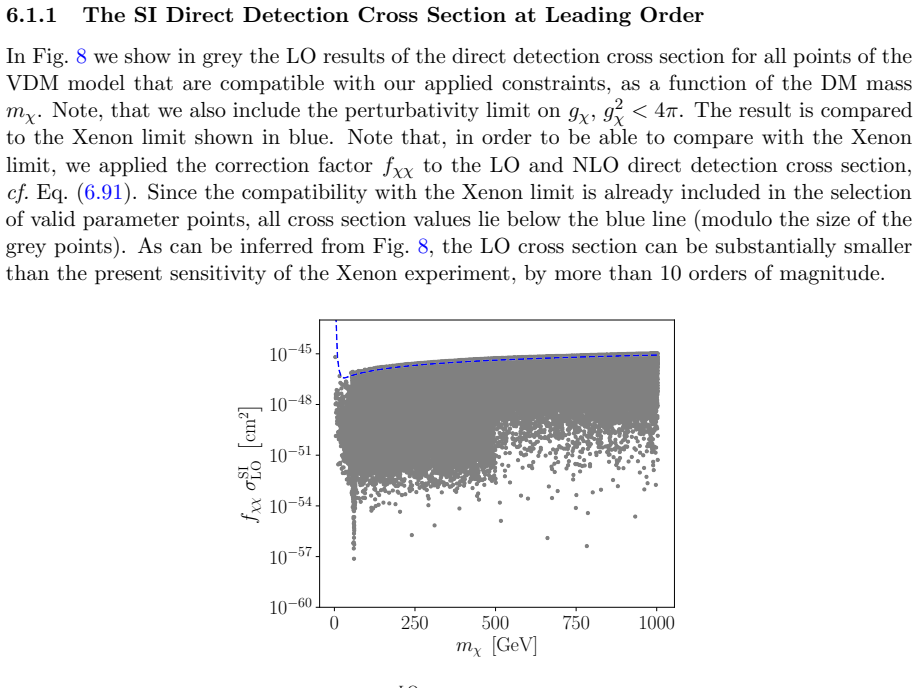
- [Section 6.1.3 and Eq. (5.85c)] A load-bearing part of the numerical analysis uses the Fock-Schwinger effective-coupling result of Ref. [13] for mediator masses mφ>mt, a region in which that approximation was not validated and in which the authors state in Section 6.1.3 that they cannot judge its goodness. The scan of Table 1 includes mφ up to 1000 GeV, and the XENON1T comparison in Section 6.1.6 (Fig. 15) is not restricted to mφ<mt, so the claims that NLO corrections are important and that some points cross the XENON1T bound inherit exactly this unvalidated region. The supporting checks are not sufficient: the extrapolation of Fig. 4 of Ref. [13] to 1 TeV is an estimate, and the subdominance of fbox_q documented in footnote 8 does not directly control the gluonic form factor ftop_G that enters Eq. (5.85c). I ask the authors to either restrict the XENON1T and K-factor claims to mφ<mt, or provide a quantitative error estimate for ftop_G in the mφ>mt region, for example by computing the two-loop contribution at representative points or by bounding the neglected terms.
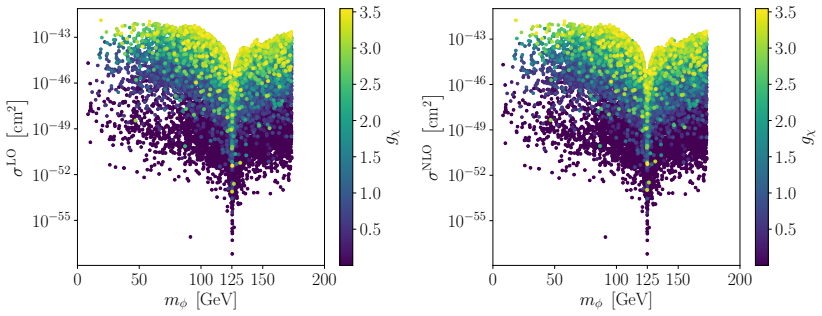
- [Section 6.1.2] The analysis removes points with mφ≈mh and all points with |K|>2.5 before presenting the plots, as stated in the paragraph after Fig. 10. The paper does not report how many points are removed, whether the negative-cross-section points are confined to the immediate mφ≈mh neighbourhood, or how many of the points that cross the XENON1T limit in Fig. 15 would fall into this excluded category. Since the headline K-factor range 'up to about 2.5' is defined on the surviving sample, this selection is part of the result and needs to be quantified; otherwise the reader cannot assess how much of the phenomenological impact is driven by the cut rather than by the physics. The conservative motivation is understandable, but the quantitative claims require a documentation of the removed fraction and its effect on the exclusion plot.
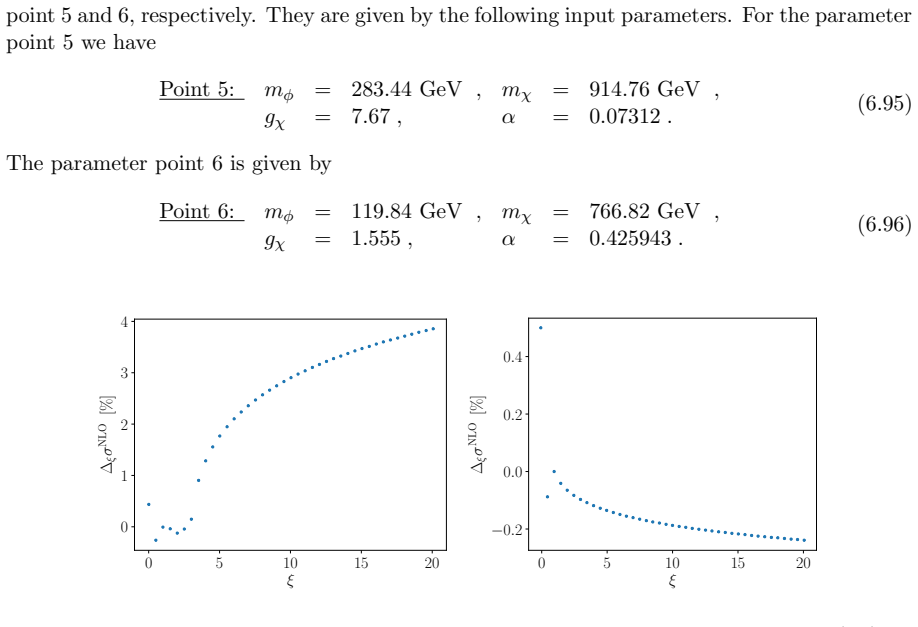
- [Section 6.1.5] No theoretical uncertainty estimate is provided for the default KOSY-scheme results, because the KOSY scheme does not allow a scale variation; the paper states this explicitly. For an NLO prediction whose main message is that K-factors reach about 2.5 and change the exclusion status of parameter points, the absence of any error estimate makes it difficult to judge whether the upper end of the K-factor range is meaningful. At minimum, the authors should estimate the size of neglected higher-order terms from the dominant vertex contribution, for example by comparing the relative size of virtual and counterterm parts, or by using the residual gauge dependence shown in Fig. 13 as a proxy, and should state the resulting uncertainty alongside the K-factors.
minor comments (4)
- [Table 1] The maximum value of vS is printed as '10 7'; please clarify that this is 10^7 GeV.
- [Section 6.1.2] The text refers to the 'Xenon limit' and to 'XENON1T' interchangeably; standardising the nomenclature would avoid confusion.
- [Section 5.3] The statement that the results of Ref. [13] 'should be applicable' to this model because the mediator is scalar would be easier to evaluate if the differences between the fermionic DM of Ref. [13] and the vector DM considered here were spelled out at the level of the Fock-Schwinger derivation.
- [Conclusions] The conclusion that the two-loop box contribution is 'two orders of magnitude below the leading vertex corrections' is stronger than what is documented, since the explicit check in footnote 8 is for fbox_q and only for the K>1 sample; please soften the conclusion or add the missing check for ftop_G.
Circularity Check
No significant circularity: the NLO direct-detection cross sections are genuine predictions from scanned model parameters; the acknowledged Fock-Schwinger approximation is a correctness risk, not a circular reduction.
full rationale
No circularity found. The LO and NLO spin-independent cross sections are computed from scanned Lagrangian parameters (mchi, mphi, vS, alpha, gchi) with no parameter fitted to the direct-detection observable; Eq. (5.87) is a straightforward one-loop expansion of the effective form factors in Eqs. (5.84)-(5.85). The preselection of sample points by the LO XENON1T bound (Section 6: 'The sample was generated taking into account the experimental bounds on the DM nucleon SI cross section at LO') does not feed back into the NLO calculation and therefore does not force the K-factors or the number of points crossing the XENON1T line. The two-loop gluon-box treatment adopts the Fock-Schwinger gauge ansatz of the external Ref. [13] (Section 5.3); this is an uncontrolled approximation for mphi > mt, explicitly acknowledged in Section 6.1.3 ('We cannot judge the goodness of the approximation ...'), and is a correctness risk rather than a circular reduction. The KOSY renormalisation scheme and the statements about gauge and scheme dependence cite the authors' prior works Refs. [33,37], but the central NLO computation is new and the scheme choice is also justified by the paper's own Fig. 14; the self-citation is minor and not load-bearing. No fitted input is renamed as a prediction, and no equation reduces to its own input by construction.
Assumptions & free parameters
free parameters (4)
- mχ (dark vector mass) =
scanned 1-1000 GeV
- mφ (non-SM-like Higgs mass) =
scanned 1-1000 GeV
- α (scalar mixing angle) =
scanned [-π/4, π/4]
- gχ (dark gauge coupling) =
derived as mχ/vS with gχ²<4π
assumptions (5)
- domain assumption The VDM model with U(1)χ gauge symmetry, complex singlet S, and Z2 stabilization is the correct low-energy description of dark matter.
- domain assumption The effective operator basis for spin-independent direct detection (Eq. 4.56) from Ref. [49] captures all relevant contributions; the gluon twist-2 operator is neglected.
- domain assumption Vertex corrections to the hi q qbar coupling are not computed; they are assumed to be encoded in the nucleon matrix elements.
- ad hoc to paper The Fock-Schwinger gauge approximation of Ref. [13] for the two-loop gluon interaction applies to this model and remains valid for mφ > mt.
- domain assumption Renormalization of gχ in the MS scheme and of α in the KOSY scheme yields physically sensible counterterms; MS and process-dependent schemes are discarded because they give spuriously large corrections.
invented entities (2)
-
Dark vector boson χµ
independent evidence
-
Complex SM-singlet scalar S
independent evidence
Cite this review
Pith. "Pith review of Electroweak Corrections to Dark Matter Direct Detection in a Vector Dark Matter Model." pith.science (2026). https://pith.science/paper/DEX5TK4J
@misc{pith2026190809249,
  author       = {Pith},
  title        = {Pith review of: Electroweak Corrections to Dark Matter Direct Detection in a Vector Dark Matter Model},
  year         = {2026},
  howpublished = {\url{https://pith.science/paper/DEX5TK4J}},
  note         = {Machine review of arXiv:1908.09249}
}
read the original abstract
Although many astrophysical and cosmological observations point towards the existence of Dark Matter (DM), the nature of the DM particle has not been clarified to date. In this paper, we investigate a minimal model with a vector DM (VDM) candidate. Within this model, we compute the cross section for the scattering of the VDM particle with a nucleon. We provide the next-to-leading order (NLO) cross section for the direct detection of the DM particle. Subsequently, we study the phenomenological implications of the NLO corrections, in particular with respect to the sensitivity of the direct detection DM experiments. We further investigate more theoretical questions such as the gauge dependence of the results and the remaining theoretical uncertainties due to the applied approximations.
Figures

Figures from the paper (12 more)




Reference graph
Works this paper leans on
- [13]
-
[1]
Zwicky, Helv
F. Zwicky, Helv. Phys. Acta 6, 110 (1933), [Gen. Rel. Grav.41,207(2009)]
1933
- [2]
-
[3]
M. W. Goodman and E. Witten, Phys. Rev. D31, 3059 (1985), [,325(1984)]
work page 1985
-
[4]
On the importance of loop-induced spin-independent interactions for dark matter direct detection
U. Haisch and F. Kahlhoefer, JCAP 1304, 050 (2013), 1302.4454
work page Pith review arXiv 2013
-
[5]
New Constraints on Dark Matter Effective Theories from Standard Model Loops
A. Crivellin, F. D’Eramo, and M. Procura, Phys. Rev. Lett. 112, 191304 (2014), 1402.1173
work page Pith review arXiv 2014
-
[6]
R. J. Hill and M. P. Solon, Phys. Rev. D91, 043504 (2015), 1401.3339
arXiv 2015
- [7]
Show all 76 references
-
[8]
Klasen, K
M. Klasen, K. Kovarik, and P. Steppeler, Phys. Rev. D94, 095002 (2016), 1607.06396
2016 arXiv
-
[9]
Azevedo et al., JHEP 01, 138 (2019), 1810.06105
D. Azevedo et al., JHEP 01, 138 (2019), 1810.06105
2019 arXiv
- [10]
- [11]
-
[12]
T. Abe, M. Fujiwara, and J. Hisano, JHEP 02, 028 (2019), 1810.01039
2019 arXiv
- [14]
-
[15]
Lebedev, H
O. Lebedev, H. M. Lee, and Y. Mambrini, Phys. Lett. B707, 570 (2012), 1111.4482
2012 arXiv
- [16]
-
[17]
S. Baek, P. Ko, W.-I. Park, and E. Senaha, JHEP 05, 036 (2013), 1212.2131. 28
2013 arXiv
-
[18]
S. Baek, P. Ko, and W.-I. Park, Phys. Rev. D90, 055014 (2014), 1405.3530
2014 arXiv
-
[19]
M. Duch, B. Grzadkowski, and M. McGarrie, JHEP 09, 162 (2015), 1506.08805
2015 arXiv
- [20]
- [21]
- [22]
- [23]
- [24]
- [25]
-
[26]
Shtabovenko, R
V. Shtabovenko, R. Mertig, and F. Orellana, Comput. Phys. Commun. 207, 432 (2016), 1601.01167
2016 arXiv
-
[27]
Mertig, M
R. Mertig, M. Bohm, and A. Denner, Comput. Phys. Commun. 64, 345 (1991)
1991
-
[28]
Passarino and M
G. Passarino and M. J. G. Veltman, Nucl. Phys. B160, 151 (1979)
1979
-
[29]
Denner, S
A. Denner, S. Dittmaier, and L. Hofer, Comput. Phys. Commun. 212, 220 (2017), 1604.06792
2017 arXiv
- [30]
- [31]
- [32]
-
[33]
Krause, R
M. Krause, R. Lorenz, M. Muhlleitner, R. Santos, and H. Ziesche, JHEP 09, 143 (2016), 1605.04853
2016 arXiv
-
[34]
Bojarski, G
F. Bojarski, G. Chalons, D. Lopez-Val, and T. Robens, JHEP 02, 147 (2016), 1511.08120
2016 arXiv
-
[35]
Denner, L
A. Denner, L. Jenniches, J.-N. Lang, and C. Sturm, JHEP 09, 115 (2016), 1607.07352
2016 arXiv
-
[36]
Krause, M
M. Krause, M. Muhlleitner, R. Santos, and H. Ziesche, Phys. Rev. D95, 075019 (2017), 1609.04185
2017 arXiv
-
[37]
Krause, D
M. Krause, D. Lopez-Val, M. Muhlleitner, and R. Santos, JHEP 12, 077 (2017), 1708.01578
2017 arXiv
- [38]
- [39]
-
[40]
M. Fox, W. Grimus, and M. L¨ oschner, Int. J. Mod. Phys.A33, 1850019 (2018), 1705.09589
2018 arXiv
-
[41]
Denner, S
A. Denner, S. Dittmaier, and J.-N. Lang, Journal of High Energy Physics 2018, 104 (2018)
2018
- [42]
- [43]
- [44]
- [45]
-
[46]
Kanemura, Y
S. Kanemura, Y. Okada, E. Senaha, and C. P. Yuan, Phys. Rev. D70, 115002 (2004), hep-ph/0408364
2004 arXiv
-
[47]
’t Hooft and M
G. ’t Hooft and M. J. G. Veltman, Nucl. Phys. B44, 189 (1972)
1972
-
[48]
’t Hooft, Nucl
G. ’t Hooft, Nucl. Phys. B61, 455 (1973)
1973
-
[49]
Hisano, K
J. Hisano, K. Ishiwata, N. Nagata, and M. Yamanaka, Prog. Theor. Phys. 126, 435 (2011), 1012.5455
2011 arXiv
-
[50]
Hisano, K
J. Hisano, K. Ishiwata, and N. Nagata, Phys. Rev. D82, 115007 (2010), 1007.2601
2010 arXiv
- [51]
-
[52]
M. A. Shifman, A. I. Vainshtein, and V. I. Zakharov, Phys. Lett. 78B, 443 (1978)
1978
-
[53]
Coimbra, M
R. Coimbra, M. O. P. Sampaio, and R. Santos, Eur. Phys. J. C73, 2428 (2013), 1301.2599
2013 arXiv
-
[54]
Costa, M
R. Costa, M. M¨ uhlleitner, M. O. P. Sampaio, and R. Santos, JHEP 06, 034 (2016), 1512.05355
2016 arXiv
-
[55]
Aad et al., Phys
ATLAS, CMS, G. Aad et al., Phys. Rev. Lett. 114, 191803 (2015), 1503.07589
2015 arXiv
-
[56]
Bechtle, O
P. Bechtle, O. Brein, S. Heinemeyer, G. Weiglein, and K. E. Williams, Comput. Phys. Commun. 181, 138 (2010), 0811.4169
2010 arXiv
-
[57]
Bechtle, O
P. Bechtle, O. Brein, S. Heinemeyer, G. Weiglein, and K. E. Williams, Comput. Phys. Commun. 182, 2605 (2011), 1102.1898
2011 arXiv
- [58]
- [59]
-
[60]
Djouadi, J
A. Djouadi, J. Kalinowski, and M. Spira, Comput. Phys. Commun. 108, 56 (1998), hep- ph/9704448
1998
-
[61]
Djouadi, J
A. Djouadi, J. Kalinowski, M. Muehlleitner, and M. Spira, Comput. Phys. Commun. 238, 214 (2019), 1801.09506
2019 arXiv
-
[62]
Belanger, F
G. Belanger, F. Boudjema, A. Pukhov, and A. Semenov, Comput. Phys. Commun. 176, 367 (2007), hep-ph/0607059
2007 arXiv
-
[63]
Belanger, F
G. Belanger, F. Boudjema, A. Pukhov, and A. Semenov, Comput.Phys.Commun. 177, 894 (2007)
2007
- [64]
-
[65]
Belanger, F
G. Belanger, F. Boudjema, A. Pukhov, and A. Semenov, Comput. Phys. Commun. 185, 960 (2014), 1305.0237. 30
2014 arXiv
-
[66]
Planck, P. A. R. Ade et al., Astron. Astrophys. 594, A13 (2016), 1502.01589
2016 arXiv
-
[67]
Ackermann et al., Phys
Fermi-LAT, M. Ackermann et al., Phys. Rev. Lett. 115, 231301 (2015), 1503.02641
2015 arXiv
-
[68]
Aguilar et al., Phys
AMS, M. Aguilar et al., Phys. Rev. Lett. 113, 221102 (2014)
2014
-
[69]
Accardo et al., Phys
AMS, L. Accardo et al., Phys. Rev. Lett. 113, 121101 (2014)
2014
-
[70]
G. Elor, N. L. Rodd, T. R. Slatyer, and W. Xue, JCAP 1606, 024 (2016), 1511.08787
2016 arXiv
-
[71]
Aprile et al., Phys
XENON, E. Aprile et al., Phys. Rev. Lett. 119, 181301 (2017), 1705.06655
2017 arXiv
- [72]
-
[73]
Angloher et al., Eur
CRESST, G. Angloher et al., Eur. Phys. J. C76, 25 (2016), 1509.01515
2016 arXiv
-
[74]
Agnese et al., Phys
SuperCDMS, R. Agnese et al., Phys. Rev. Lett. 116, 071301 (2016), 1509.02448
2016 arXiv
-
[75]
B´ elanger, F
G. B´ elanger, F. Boudjema, A. Goudelis, A. Pukhov, and B. Zaldivar, Comput. Phys. Commun. 231, 173 (2018), 1801.03509
2018 arXiv
-
[76]
Pumplin et al., JHEP 07, 012 (2002), hep-ph/0201195
J. Pumplin et al., JHEP 07, 012 (2002), hep-ph/0201195. 31
2002 arXiv
Reviewed August 14, 2026 · model on record in the stance chip above.
Discussion (0). Continue with ORCID to comment.