REVIEW 5 major objections 4 minor 31 references
Blast Radius
T0 review · 5 major / 4 minor · reviewed 2026-08-10 · deepseek-v4-flash
Pith's one-line read The paper claims that reversible eviction of dead context cuts token consumption in agentic coding loops by 17–26% while remaining byte-exact recoverable.
desk verdict Reversible burial plus recurrence-class RDM is a genuinely useful idea, but the reported 17-26% and the bounded-downside theorem are not supported by the deployed system or the evaluation as described. read the letter →
The pith
A machine-rendered reading of the paper's core claim, the machinery that carries it, and where it could break.
The reading
What carries the argument
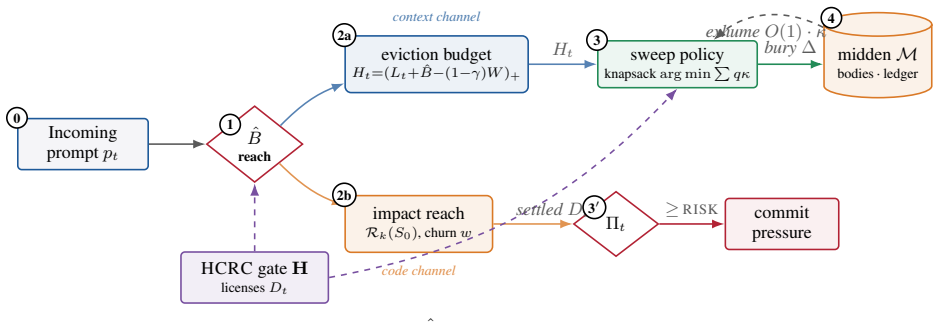
The load-bearing mechanism is the reversible sweep operator, NECROPHORESIS. A body is not deleted but 'buried': it is archived verbatim to an on-device store and replaced in the active context by a compact scent skeleton (a mission name, file list, and archival key at fixed cost $\sigma \ll \tau$). Exhumation is a single keyed O(1) read that restores the body byte-exact, at bounded token overhead $\kappa$. The sweep is chosen as a min-cost knapsack cover over the gate-licensed candidate set, with greedy efficiency $e(b) = (\tau(b)-\sigma)/(q(b)\kappa+\varepsilon)$; recurrence classes are estimated by Laplace's rule of succession, $\hat{q}_c = (e_c+1)/(k_c+2)$, so routine transcripts that die every turn are buried on sight. Theorem 7.1 is the engine: it converts this operator into an asymmetric bet with bounded downside.
What would settle it
Construct episodes where a later feature request silently depends on a file read many turns earlier, run the policy, and count exhumations; if the realized exhumation rate exceeds the threshold $(\tau(b)-\sigma)\bar{m}/\kappa$ from Corollary 7.2, the domination claim is violated in that setting.
Extended reading notes
Core claim
The paper's central claim is that in an agentic coding loop, reversible forgetting dominates carrying dead context. The argument is Theorem 7.1: if a body with token cost $\tau$ is buried and replaced by a $\sigma$-token skeleton, the sweep policy's ledger relative to carry-all is $(\tau-\sigma)m' - \kappa\cdot\mathbf{1}[m<\infty]$, where $m'$ is the number of turns buried and $\kappa$ the cost of one exhumation; the worst case is a constant $-\kappa$, while savings grow linearly with burial duration. Therefore, by Corollary 7.2, burial has non-negative expected value whenever the body's resurrection probability $q(b)$ satisfies $q(b) \le (\tau(b)-\sigma)\bar{m}/\kappa$, a threshold the system measures from the burial/exhumation ledger. The paper further claims the mechanism works in practice: across seven OpenAI models, the full Blast Radius plus Recurring Dead Matter policy cut median tokens per task from 43,053 to 34,518 (17–26% per model), matched the token economy of truncation while remaining byte-exact reversible, produced the lowest overflow rate, and recorded zero exhumations among 450 buried bodies, 378 of them recurring dead matter.
Load-bearing premise
The entire saving rests on trusting the gate's verdict that a buried body is truly dead: the licensed candidates must carry essentially no information about the correct next action, and the experiments scripted tasks in which old context was provably dead, so a body wrongly labeled dead and later needed would not have been detected.
Editorial extensions
If this is right
- Agentic coding sessions can reclaim 17–26% of submitted tokens per model, matching the token economy of lossy truncation while retaining byte-exact reversibility.
- A wrong eviction costs at most one bounded exhumation of $\kappa$ tokens, regardless of how long the body was buried, so misclassifying live context as dead is cheap rather than catastrophic.
- Recurring routine transcripts—build logs, test reruns, version-control checks—can be buried on sight via the Laplace rule of succession, because their estimated resurrection probability falls as $1/(n+2)$ with recurrence count.
- The burial/exhumation ledger gives a running estimate of the realized resurrection rate, so the policy can detect when its deadness assumption is wrong and shrink the candidate set.
- The two-channel reach estimate (temporal and structural) is formulated over a Polish space of context objects, so the same operators apply to other agentic settings beyond coding.
Reading between the lines
- Our reading: the zero-exhumation result is an artifact of the scripted task suite, where old context was provably dead by construction; in unscripted coding, the gate's precision—not the burial operator—will determine whether the 17–26% saving survives.
- Our reading: the Laplace rule of succession converts a subjective death judgment into a measured, self-correcting probability, and the decisive test of the method is whether exhumation telemetry stays near zero when tasks are not designed to make context dead.
- Our reading: the Polish-space formulation points to a natural next step the paper leaves implicit—replace the hard $q=0$ classifier with a learned estimator trained on exhumation telemetry, allowing graded deadness.
- Our reading: if reversibility is as cheap as claimed, token-billing plans could offer reversible memory as a product, reclaiming tokens today with a bounded-fee resurrection guarantee; that is a direct economic corollary of Theorem 7.1.
Editorial analysis
A structured set of objections, weighed in public.
Referee Report
Summary. The paper proposes Blast Radius, a memory-management layer for agentic coding loops, together with NECROPHORESIS, a reversible eviction operator that archives dead context verbatim and replaces it with a compact skeleton, and Recurring Dead Matter (RDM), which buries near-identical repeated transcripts using Laplace's rule of succession. A Polish-space formulation is used to present retention, recurrence, and eviction as measurable objects, and Theorem 7.1 argues that reversible forgetting has bounded downside: a mistaken burial costs at most one exhumation κ, while correct burial saves (τ−σ) per resident turn. The experimental section compares five context policies across seven OpenAI models and reports a 17–26% token reduction, the lowest overflow rate, and zero exhumations among 450 buried bodies. The paper concludes that reversible forgetting makes carrying dead context dominated and that Blast Radius is a safe scoping layer beneath the HCRC gate.
Significance. If the central claims held, the paper would make a useful contribution: reversible eviction with a bounded worst-case cost is a principled alternative to lossy truncation and summarization, and the authors have built a real implementation with a released harness and preregistered research questions. The accounting identity in Theorem 7.1 is sound conditional on its assumptions, and the archival design (byte-exact storage, ledger, transactional burial) is a sensible engineering contribution. However, the load-bearing guarantee is not established for the deployed system: the shipped census has no exhumation trigger, the ε-deadness assumption is imported from a self-cited technical report and is not validated by the evaluation, and the reported empirical numbers largely come from a harness-only variant that is not deployed. As it stands, the paper overclaims its central result.
major comments (5)
- [Theorem 7.1 / §8] The bounded-downside guarantee is not realized by the deployed system because that system has no exhumation trigger. The proof of Theorem 7.1 assumes that if b is required at turn t+m, 'the sweep policy performs exactly one exhumation' before that turn runs, but Section 8 describes a reactive census with hard qt(b)=0 and no estimator that detects when a buried body becomes needed. If a body is mislabeled dead, the ledger never records an exhumation (Remark 7.3 counts only exhumations the system actually performs), and the realized cost is a failed turn, a missed constraint, or an overflow—not the bounded κ of the theorem. The abstract's 'remained byte-exact reversible' and the conclusion's 'bounded-downside bet' therefore apply to the theoretical operator, not to the shipped system.
- [Assumption 7.4 / §9] The ε-deadness assumption on the HCRC-licensed candidate set is imported from the self-cited technical report [1] and is never independently validated, and the reported evaluation cannot validate it. Section 9 scripts the task suite so that early context is 'provably dead' by construction and every task is answerable from recent context; P2 explicitly concedes that success was 100% everywhere and the suite did not stress correctness. Under that design, zero exhumations in 450 burials (Table 3) is a property of the script, not evidence about the accuracy of the HCRC deadness judgment or about the mutual information I(Dt; A* | Ct\Dt) in Assumption 7.4. A test that could discriminate would need episodes in which a later turn actually requires a body that was buried; without such episodes, RQ3's 'calibration' conclusion is vacuous.
- [Corollary 7.2 / §7] The domination threshold is vacuous in the regime the paper itself says 'typically' holds. Corollary 7.2 states that burial has non-negative expected value whenever q(b) ≤ (τ(b)-σ)m̄/κ, and then observes that the right-hand side 'typically exceeds 1,' in which case the inequality holds for every q(b)∈[0,1]. In that regime the threshold imposes no constraint, Proposition 4.8's licensing condition is satisfied by every candidate regardless of liveness, and the zero exhumation rate in Table 3 cannot be read as confirmation that the system is below a meaningful threshold. The paper should either report the actual value of (τ-σ)m̄/κ for the deployed geometry or stop describing the condition as a measured, falsifiable threshold.
- [§9 (RQ2) / §8] The preregistered RQ2—estimator accuracy |B̂−B|—is not reported anywhere in Section 9, even though Definition 4.1 and the abstract describe Blast Radius as a predictive estimator. Section 8 states that the deployed eviction budget is 'reactive rather than predictive' and triggers on measured backlog Dt, so the paper provides no evidence for the predictive component at all. Either report the RQ2 results or remove the predictive claim from the abstract and introduction.
- [Abstract / §8 'Status of RDM'] The abstract's headline numbers are attributed to the shipped Blast Radius, but they come from condition E, whose RDM mechanism is not deployed. Section 8 says integration of RDM into Chalk's shipped census and radar 'is underway,' and Table 2 shows the deployed census alone (D) achieves only a 39,568 vs 43,053 token median (8%) and has a higher overflow rate (5.14) than summarization (4.07). The 17-26% reduction and lowest-overflow claim are therefore results of the harness-only full policy, not of the system described in Section 8. The claims should be re-scoped or the system description updated.
minor comments (4)
- [Theorem 7.1] The burial-duration count m′ appears to include the turn at which the body is required; if exhumation occurs before turn t+m, only m−1 turns of skeleton-vs-body savings accrue. The worst-case −κ bound is unchanged, but the displayed formula should be corrected.
- [Table 3] The column dE[q]=0 conflates the realized exhumation frequency with the posterior mean; for a class with e_c=0, Proposition 6.6 gives q̂_c=1/(n_c+2)>0, so the text should distinguish the empirical rate from the estimator.
- [§9 / Table 2] The episode count is inconsistent: the text says '56 episode-runs' while Table 2's caption says '70 episode-runs,' and Figure 5 says 'both episodes.' Please reconcile the number of runs and report bootstrap intervals as promised in the metrics paragraph, since Tables 2-3 contain no uncertainty measures.
- [Definition 6.5] The ε-ball recurrence class of Definition 6.5 is not shown to coincide with or approximate the deployed normalization Σ-equivalence used in Definition 4.6; the paper asserts d(b,b′)=0 on the quotient but does not establish that the composite metric degenerates exactly on Σ-equivalent transcripts.
Circularity Check
Token-ledger arithmetic is self-contained, but the lossless-guarantee rests on Assumption 7.4, whose deadness judgment is imported from the same-authors' HCRC report [1] and whose zero-exhumation validation is scripted by the task design.
-
self citation load bearing
[Sec. 7.1, Assumption 7.4 and following paragraph; cf. Sec. 2 'Blast Radius is deployed under HCRC [1]']
"Assumption 7.4 (ε-dead candidates). The HCRC-licensed candidate set D_t carries near-zero information about the correct next action: I(D_t; A*_{t+1} | C_t \ D_t) ≤ ε. ... Assumption 7.4 is exactly what the HCRC gate is for: it licenses a body into D_t only when verification has settled the sub-task the body records ... Blast Radius does not re-establish deadness; it consumes the gate's judgment."
Proposition 7.5, the formal bound that sweeping the HCRC-licensed set costs at most ε of task-relevant information, is I(Φ_S(C_t); A*) ≥ I(C_t; A*) − ε, which is true only under Assumption 7.4. The paper does not derive or independently validate ε-deadness; the only cited source is [1], a same-author technical report. Remark 7.3 claims the threshold is 'measured, not assumed' via exhumation telemetry, but Table 3's zero exhumations come from a task suite where early context is 'provably dead' and P2 admits every task is answerable from recent context, so the telemetry cannot test the assumption. The bounded-information-loss guarantee therefore reduces to the HCRC gate's self-cited judgment rather than to an independent derivation.
full rationale
The central accounting identity is not circular. Theorem 7.1 is a direct token-ledger computation: each buried turn saves τ(b)−σ and each required body costs one exhumation κ, so net saving is (τ(b)−σ)m′ − κ·1[m<∞] given the midden axioms and an actual exhumation before the needed turn. Corollary 7.2 is the expectation of that identity, and Proposition 4.8 is the standard Beta-Bernoulli posterior mean, not a fitted parameter. The 17–26% token reduction is read from measured submitted-token counts under fixed task conditions, so it is an external empirical result rather than a consequence of the equations. The circularity is localized to the information-loss-free guarantee. Proposition 7.5's bound holds only under Assumption 7.4, which asserts the HCRC-licensed candidate set is ε-dead; that assertion is imported from [1], a same-authors technical report, and the paper states it consumes the gate rather than re-establishing deadness. Remark 7.3's claim that the threshold is 'measured, not assumed' is weakened by the evaluation design: the task suite makes old context provably dead and P2 concedes success was 100% because each task is answerable from recent context, so zero exhumations is created by the script, not discovered. This is one load-bearing self-citation for the safety half of the claim, while the token-savings accounting retains independent content, so the score is 4 rather than higher.
Assumptions & free parameters
free parameters (11)
- K (protected window) =
3
- candidacy floor =
800 chars
- scent skeleton cost σ =
≈60 tokens
- sweep threshold θ =
4000 tokens
- radar map constants (a, c, rmax) =
(22, 3.1, 126)
- churn tiers (θMED, θHIGH, θRISK, θDEADLY) =
(50, 200, 500, 1000)
- safety margin γ =
unspecified
- metric weights α, β, γ, δ =
unspecified
- λ tuning constant =
unspecified
- token ratio τ(b) ≈ |b|/4 =
0.25 token/char
- exhumation cost κ =
small constant
assumptions (8)
- domain assumption Midden axioms: byte-exact archival (A2), auditability (A5), redaction (A7), bounded exhumation cost κ.
- domain assumption ε-dead candidates: HCRC-licensed candidate set Dt has near-zero mutual information with the correct next action.
- standard math Correct next action and mutual information are well-defined for a session.
- standard math Beta-Bernoulli posterior mean with uniform prior (Laplace rule of succession).
- ad hoc to paper The context space X is Polish with product decomposition and composite metric.
- standard math Data-processing inequality applies to the skeleton transformation.
- domain assumption Dependency graph G and AST are available and correctly parsed.
- domain assumption Token cost τ(b) is proportional to character count with ratio 1/4.
invented entities (5)
-
NECROPHORESIS eviction operator
-
Recurring Dead Matter (RDM) classification
-
Midden (on-device archive)
-
Scent skeleton
-
Blast Radius estimator B
Cite this review
Pith. "Pith review of Blast Radius." pith.science (2026). https://pith.science/paper/DF5LGM5R
@misc{pith2026260807440,
  author       = {Pith},
  title        = {Pith review of: Blast Radius},
  year         = {2026},
  howpublished = {\url{https://pith.science/paper/DF5LGM5R}},
  note         = {Machine review of arXiv:2608.07440}
}
read the original abstract
Agentic coding faces growing problems of affordability and wasted tokens. We introduce Blast Radius, a predictive memory management layer that estimates an incoming prompt's reach through coupled context and code channels. NECROPHORESIS enables reversible eviction by archiving dead context verbatim, while Recurring Dead Matter (RDM) identifies and buries repeatedly occurring transcripts. We formulate reversible context eviction over a Polish context space, providing a measurable foundation for retention, recurrence, and eviction while connecting context entropy to resurrection probability. Across seven OpenAI models, Blast Radius reduced token consumption by 17-26%, achieved the lowest overflow rate among tested policies, and remained byte exact reversible. Of 450 buried bodies, 378 were recurring dead matter and zero were recalled. Blast Radius operates beneath HCRC, determining which records to bury and how far an incoming prompt may reach into the codebase. This work contributes to the broader goal of Algosophy: making large language models and agentic coding more reusable and sustainable.
Figures


Figures from the paper (4 more)


Reference graph
Works this paper leans on
-
[1]
M. Y . Pitsane and H. Mogale. Heaviside Continuity of Rolling Coefficients for Eliminating Epistemic Entropy in Large Language Models. Technical report, Mankind Research Labs, 2026
work page 2026
-
[2]
G. Xiao, Y . Tian, B. Chen, S. Han, and M. Lewis. Efficient Streaming Language Models with Attention Sinks. InInternational Conference on Learning Representations (ICLR), 2024
work page 2024
- [3]
-
[4]
Z. Liu, A. Desai, F. Liao, W. Wang, V . Xie, Z. Xu, A. Kyrillidis, and A. Shrivastava. Scissorhands: Exploiting the Persistence of Importance Hypothesis for LLM KV Cache Compression at Test Time. In Advances in Neural Information Processing Systems (NeurIPS), 2023
work page 2023
-
[5]
S. Ge, Y . Zhang, L. Liu, M. Zhang, J. Han, and J. Gao. Model Tells You What to Discard: Adaptive KV Cache Compression for LLMs.arXiv preprint arXiv:2310.01801, 2023
arXiv 2023
-
[6]
T. Fu, H. Huang, X. Ning, G. Zhang, B. Chen, T. Wu, H. Wang, Z. Huang, S. Li, S. Yan, and G. Dai. Mixture of Attention Spans: Optimizing LLM Inference Efficiency with Heterogeneous Sliding-Window Lengths.arXiv preprint arXiv:2406.14909, 2024
arXiv 2024
-
[7]
Y . Ding, L. L. Zhang, C. Zhang, Y . Xu, N. Shang, J. Xu, F. Yang, and M. Yang. LongRoPE: Extending LLM Context Window Beyond 2 Million Tokens.arXiv preprint arXiv:2402.13753, 2024
arXiv 2024
-
[8]
Y . Wu, Y . Zhang, S. Ghosh, S. Basu, A. Deoras, J. Huan, and G. Gupta. ContextWeaver: Selective and Dependency-Structured Memory Construction for LLM Agents.arXiv preprint arXiv:2604.23069, 2026
arXiv 2026
Show all 31 references
-
[9]
Packer, S
C. Packer, S. Wooders, K. Lin, V . Fang, S. G. Patil, I. Stoica, and J. E. Gonzalez. MemGPT: Towards LLMs as Operating Systems.arXiv preprint arXiv:2310.08560, 2023
2023 arXiv
-
[10]
Chhikara, D
P. Chhikara, D. Khant, S. Aryan, T. Singh, and D. Yadav. Mem0: Building Production-Ready AI Agents with Scalable Long-Term Memory.arXiv preprint arXiv:2504.19413, 2025
2025 arXiv
-
[11]
S. Wang, E. Yu, O. Love, T. Zhang, T. Wong, S. Scargall, and C. Fan. MemMachine: A Ground-Truth- Preserving Memory System for Personalized AI Agents.arXiv preprint arXiv:2604.04853, 2026
2026 arXiv
-
[12]
Y . Wang, S. Cao, Y . Sun, H. Liu, Z. Hou, and X. Huang. Recursively Summarizing Enables Long-Term Dialogue Memory in Large Language Models.arXiv preprint arXiv:2308.15022, 2023. 17
2023 arXiv
-
[13]
Lewis, E
P. Lewis, E. Perez, A. Piktus, F. Petroni, V . Karpukhin, N. Goyal, H. Küttler, M. Lewis, W. Yih, T. Rock- täschel, S. Riedel, and D. Kiela. Retrieval-Augmented Generation for Knowledge-Intensive NLP Tasks. In Advances in Neural Information Processing Systems (NeurIPS), 2020
2020
-
[14]
Arslan, H
M. Arslan, H. Ghanem, S. Munawar, and C. Cruz. A Survey on RAG with LLMs.Procedia Computer Science, 246:3781–3790, 2024
2024
-
[15]
Cuconasu, G
F. Cuconasu, G. Trappolini, F. Siciliano, S. Filice, C. Campagnano, Y . Maarek, N. Tonellotto, and F. Silvestri. The Power of Noise: Redefining Retrieval for RAG Systems. InProceedings of the 47th International ACM SIGIR Conference on Research and Development in Information Re...
2024
-
[16]
Klesel and H
M. Klesel and H. F. Wittmann. Retrieval-Augmented Generation (RAG).Business & Information Systems Engineering, 67(4):551–561, 2025
2025
-
[17]
Y . Gao, Y . Xiong, Y . Zhong, Y . Bi, M. Xue, and H. Wang. Synergizing RAG and Reasoning: A Systematic Review.arXiv preprint arXiv:2504.15909, 2025
2025 arXiv
-
[18]
A. Asai, Z. Wu, Y . Wang, A. Sil, and H. Hajishirzi. Self-RAG: Learning to Retrieve, Generate, and Critique through Self-Reflection. InInternational Conference on Learning Representations (ICLR), pages 9112–9141, 2024
2024
-
[19]
R. S. Arnold and S. A. Bohner. Impact Analysis: Towards a Framework for Comparison. InProceedings of the International Conference on Software Maintenance, 1993
1993
-
[20]
Zimmermann, A
T. Zimmermann, A. Zeller, P. Weissgerber, and S. Diehl. Mining Version Histories to Guide Software Changes. InInternational Conference on Software Engineering (ICSE), 2004
2004
-
[21]
J. J. Flannery. The Relative Effectiveness of Some Common Graduated Point Symbols in the Presentation of Quantitative Data.Cartographica, 8(2):96–109, 1971
1971
-
[22]
Mogale and M
H. Mogale and M. Esiefarienrhe. Training and Optimizing Music Recommendation Algorithms Using Self-Similarity Matrices. EasyChair Preprint 7880, 2022
2022
-
[23]
M. Y . Pitsane, H. Mogale, and J. T. Janse van Rensburg. Improving Accuracy of Credit Card Fraud Detection Using Supervised Machine Learning Models and Dimension Reduction. InInternational Conference on Intelligent and Innovative Computing Applications (ICONIC), 2022
2022
-
[24]
H. Mogale. High Performance Canny Edge Detector using Parallel Patterns for Scalability on Modern Multicore Processors.arXiv preprint arXiv:1710.07745, 2017
2017 arXiv
-
[25]
C. E. Shannon. A Mathematical Theory of Communication.Bell System Technical Journal, 27(3):379–423, 1948
1948
-
[26]
J. Shi, Y . Zhu, X. Wang, Y . Kang, L. Wu, and T. Bai. Intrinsic Entropy of Context Length Scaling in Large Language Models.arXiv preprint arXiv:2502.01481, 2025
2025
-
[27]
Zhang, Y
Z. Zhang, Y . Wang, X. Huang, T. Fang, H. Zhang, C. Deng, S. Li, and D. Yu. Attention Entropy is a Key Factor: An Analysis of Parallel Context Encoding with Full-attention-based Pre-trained Language Models. InProceedings of the 63rd Annual Meeting of the ACL, pages 9840–9855, 2025
2025
-
[28]
Jiang, Q
H. Jiang, Q. Wu, X. Luo, C. Lin, Y . Yang, and L. Qiu. LLMLingua: Compressing Prompts for Accelerated Inference of Large Language Models. InProceedings of EMNLP, pages 13382–13403, 2023
2023
-
[29]
H. Li, Y . Zhang, N. Koto, Y . Qiang, Z. Yin, Y . Zhou, and I. W. Tsang. Compressing Context to Enhance Inference Efficiency of Large Language Models. InProceedings of EMNLP, pages 9715–9733, 2023
2023
-
[30]
L. Kuhn, S. Gal, and Y . Gal. Semantic Uncertainty: Linguistic Invariances for Uncertainty Estimation in Natural Language Generation. InInternational Conference on Learning Representations (ICLR), 2023
2023
-
[31]
Abbasi, M
R. Abbasi, M. G. Bellemare, R. Scandolo, and P. D. Velázquez. To Believe or Not to Believe Your LLM. arXiv preprint arXiv:2406.02543, 2024. 18
2024 arXiv
Reviewed August 10, 2026 · model on record in the stance chip above.
Discussion (0). Continue with ORCID to comment.