Bianchi IX dynamics with a phantom field
Pith reviewed 2026-06-26 09:33 UTC · model grok-4.3
The pith
A massless phantom field in Bianchi IX spacetime permits two Kasner indices to be negative simultaneously during BKL oscillations.
A machine-rendered reading of the paper's core claim, the machinery that carries it, and where it could break.
Core claim
Filling the Bianchi IX metric with a massless phantom field modifies the Kasner map so that the conditions on the indices p1, p2, p3 allow two of them to satisfy pi < 0 simultaneously while still obeying the sum and sum-of-squares constraints adjusted for the phantom stress-energy. This regime produces volume oscillations whose period and amplitude differ from vacuum Bianchi IX, and it permits arbitrarily large negative indices that drive extreme contractions in one direction followed by rapid expansions in others.
What carries the argument
The modified BKL map for the three Kasner exponents under phantom-field stress-energy, which relaxes the usual positivity constraints on the indices and thereby enlarges the set of admissible transitions between Kasner epochs.
If this is right
- Volume oscillations become possible with periods set by the phantom-driven Kasner bounces rather than the vacuum ones.
- The approach to the singularity can feature epochs in which two directions contract while the third expands, or vice versa, on scales forbidden without the phantom source.
- The sequence of Kasner transitions can include cycles that avoid the usual vacuum fixed-point structure.
- Large negative indices allow one spatial direction to undergo arbitrarily strong contraction before the next bounce.
Where Pith is reading between the lines
- The same phantom source might change the statistics of how often isotropic phases appear in a Bianchi IX patch.
- If phantom fields are present near the Planck regime, classical singularity resolutions that rely on vacuum BKL behavior would need re-examination.
- The altered index ranges could be checked by evolving initial data with small phantom contributions and tracking whether the two-negative regime appears before other matter dominates.
Load-bearing premise
The spacetime contains nothing except a massless phantom field obeying its standard negative-kinetic-energy equation of motion inside the Bianchi IX geometry.
What would settle it
A numerical integration of the Bianchi IX equations with the phantom field that never produces a Kasner epoch in which two indices are simultaneously negative.
Figures
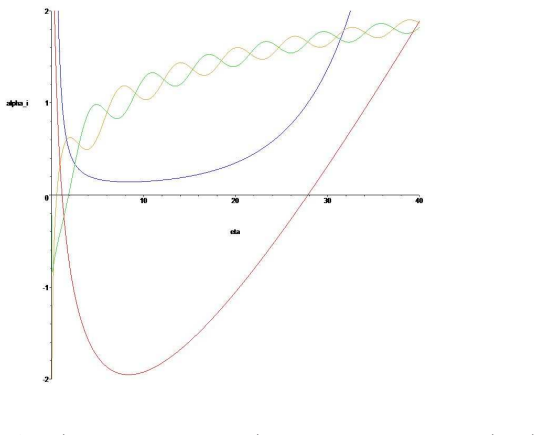
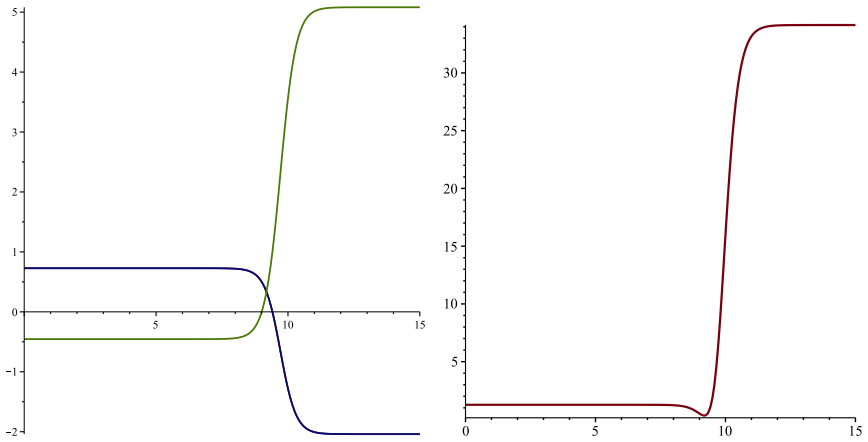
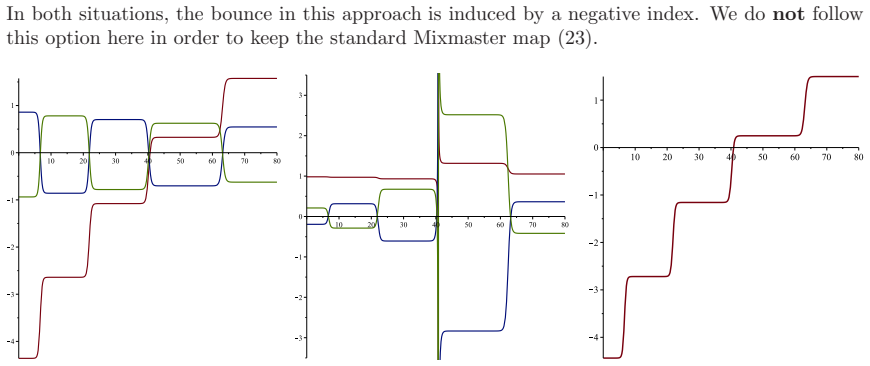
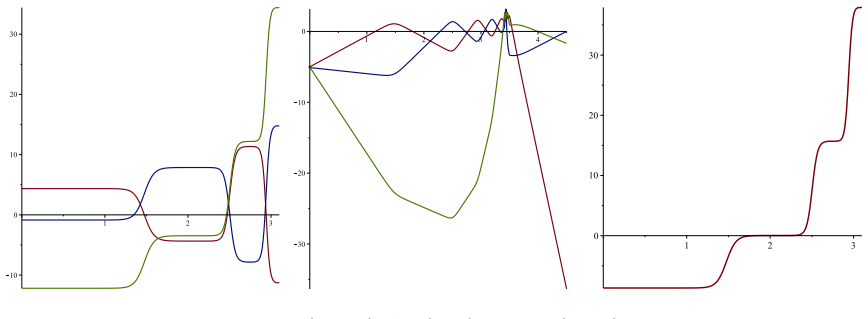
read the original abstract
We consider Bianchi IX dynamics of a Universe filled with a massless phantom field. Such an exotic matter source enables regimes impossible in vacuum or with a standard scalar field. In particular, two Kasner indices of BKL oscillations can be simultaneously negative, and the absolute value of a negative index can be large. We describe the consequences of these features and explain the nature of volume oscillations recently discovered in such a system by numerical methods.
Editorial analysis
A structured set of objections, weighed in public.
Referee Report
Summary. The manuscript studies Bianchi IX cosmology sourced by a massless phantom scalar field (negative kinetic term). It derives modified Kasner relations from the Hamiltonian constraint that permit BKL oscillations with two simultaneously negative indices and arbitrarily large |p_negative|, regimes forbidden in vacuum or with a canonical scalar field. The work analytically accounts for the volume oscillations previously seen in numerical integrations of this system.
Significance. If the derivations hold, the result demonstrates how a single exotic matter source can qualitatively enlarge the space of allowed anisotropic cosmologies, furnishing a parameter-free explanation for novel BKL regimes and their associated volume behavior. The explicit link between the generalized Kasner map and the observed oscillations constitutes a clear advance over purely numerical explorations.
minor comments (2)
- The abstract and introduction would benefit from a single sentence stating the precise form of the phantom-field stress-energy tensor used in the Hamiltonian constraint.
- Figure captions should explicitly note the initial conditions and integration tolerances employed for the volume-oscillation plots so that readers can reproduce the reported behavior.
Simulated Author's Rebuttal
We thank the referee for the positive assessment of our manuscript, the clear summary of its contributions, and the recommendation to accept.
Circularity Check
No significant circularity; derivation self-contained
full rationale
The paper derives modified BKL/Kasner regimes in Bianchi IX from the Einstein equations with a massless phantom field (negative kinetic term) inserted into the Hamiltonian constraint. This directly alters the relations among the three Kasner indices without any parameter fitting, self-referential definitions, or load-bearing self-citations. The volume-oscillation explanation follows from the same modified dynamics, and the setup is explicitly limited to this source with no additional matter. No step reduces to its own input by construction.
Axiom & Free-Parameter Ledger
Reference graph
Works this paper leans on
-
[1]
Khalatnikov and E
I. Khalatnikov and E. Lifshitz, Phys. Re. Lett. 24, 76 (1970)
1970
-
[2]
Ch. Misner. Phys. Rev. Lett 22, 1071 (1969)
1969
-
[3]
Barrow Phys
J. Barrow Phys. Rep. 85, 1 (1982)
1982
-
[4]
Chernoff and J
D. Chernoff and J. Barrow Phys. Rev. Lett. 50, 134 (1983) 16
1983
-
[5]
Mark Heinzle, Claes Uggla, Mixmaster: Fact and Belief, Class.Qua nt.Grav.26:075016,2009
J. Mark Heinzle, Claes Uggla, Mixmaster: Fact and Belief, Class.Qua nt.Grav.26:075016,2009
2009
-
[6]
Belinskii and I
V. Belinskii and I. Khalatnikov, Sov. Phys. JETP 36, 591 (1973)
1973
-
[7]
Horndeski, IJTP 10, 363 (1974)
G. Horndeski, IJTP 10, 363 (1974)
1974
-
[8]
Starobinsky, S
A. Starobinsky, S. Sushkov and M. Volkov, Phys. Rev. D101, 064039 (2020)
2020
-
[9]
Volkov, Chaos in Horndeski cosmologies, arXiv:2509.04590
M. Volkov, Chaos in Horndeski cosmologies, arXiv:2509.04590
-
[10]
Belinskii, I.M
V.A. Belinskii, I.M. Khalatnikov and E.M. Lifshitz, Adv. Phys. 19, 525 (1970)
1970
-
[11]
Lin and R
X. Lin and R. Wald, Phys. Rev D 40 , 3280 (1989)
1989
-
[12]
Lin and R
X. Lin and R. Wald, Phys. Rev D 41 , 2444 (1990) 17
1990
discussion (0)
Sign in with ORCID, Apple, or X to comment. Anyone can read and Pith papers without signing in.