REVIEW 4 major objections 5 minor 7 references
Synthesis of single-crystalline lead sulfide nanoframes and nanorings
T0 review · 4 major / 5 minor · reviewed 2026-08-14 · deepseek-v4-flash
Pith's one-line read Heating PbS nanosheets with halide ions reshapes them into single-crystalline nanorings through a facet-selective ripening process.
desk verdict A solid synthesis paper that adds PbS to the short list of materials formable as colloidal nanorings, with a plausible but under-supported halide-driven ripening mechanism. read the letter →
The pith
A machine-rendered reading of the paper's core claim, the machinery that carries it, and where it could break.
The reading
What carries the argument
The load-bearing object is the halide-modified, temperature-driven ripening of a faceted PbS nanosheet: a two-dimensional galena crystal with {100} basal planes and edges bounded by low-index facets with lead-rich {111} character. Halide ions (Cl⁻, Br⁻, I⁻) are the active agent: they exchange with oleate at the surface, bind preferentially to lead-terminated {111} facets according to the paper's DFT adsorption energies, and simultaneously destabilize the {100} faces. That combination makes the thin central region dissolve while the passivated edges grow thicker, and the reactivity series Cl⁻ < Br⁻ < I⁻ sets the etching power; 1-bromotetradecane is used as a time-release bromide source. The same ligand competition also explains why excess oleic acid changes nanoframe dimensions and why halide-free conditions yield only irregular holes without thicker edges.
What would settle it
Watch a single PbS nanosheet in a liquid-cell transmission electron microscope while heating it to 220 °C with bromide present; if the flat central region is not the first place to thin, or if edges thicken before the center starts to dissolve, the proposed facet-selective ripening mechanism is wrong.
Extended reading notes
Core claim
The paper's central claim is that the transformation from PbS nanosheets to nanoframes to nanorings is a thermally induced, facet-selective ripening controlled by competing ligands. Oleic acid and oleate template the initial nanosheet and passivate the lead-rich {111} edges, while chloride or bromide ions penetrate the ligand layer, coordinate surface lead, and lower the stability of the {100} top and bottom faces. At 220 °C the now-unstable central faces dissolve, releasing Pb/S monomers that feed growth in height at the edges; the process is called etching only to name the step, but it is dissolution and growth happening at different locations. The result is a single-crystalline galena ring, demonstrated by TEM, AFM, XRD, STEM tomography, and XEDS, and the outer diameter can be tuned by the oleic acid amount used to grow the starting nanoframes.
Load-bearing premise
The whole shape transformation depends on halide ions selectively weakening the flat top and bottom faces of the nanosheets while protecting the edges; this selectivity is inferred from calculated binding energies and final product shapes, not from direct observation of where material dissolves or of bromide release.
Editorial extensions
If this is right
- PbS nanorings of cubic galena phase can now be made colloidally, with outer diameter tuned from about 300 nm to 1 µm by adjusting the oleic acid amount in the nanoframe step.
- The final ring thickness is set by the ripening balance, not by the starting sheet: all etched rings end up 25–30 nm thick because dissolved center material redeposits on the edges.
- Halide identity controls the outcome: chloride etches weakly, bromide gives the highest ring yield, and iodide overshoots to stick-like fragments under comparable conditions.
- Nanoframes are stable isolable intermediates, so the two-step route allows separate optimization of lateral size and of the etching step that opens the hole.
- Because the rings are single-crystalline and toroidal, they are plausible testbeds for excitonic Aharonov-Bohm-type behavior in a cubic semiconductor.
Reading between the lines
- A testable extension: if the facet-selective halide mechanism is generic, the same recipe should convert other sheet-like semiconductors (PbSe, PbTe, CdSe) into nanorings by choosing a halide salt of matching reactivity.
- The paper does not decouple hole diameter from outer diameter; a slow-release halide precursor with different release kinetics than 1-bromotetradecane may do so, which is an inference, not a demonstrated result.
- The reported final edge height of 25–30 nm suggests a ripening balance set by ligand coverage; measuring ring height as a function of halide concentration would show whether that balance is tunable.
- If single-crystalline rings confine carriers, low-temperature magneto-optical measurements should show the predicted chiral or Aharonov-Bohm signatures in a cubic material—an experiment the paper motivates but does not perform.
Signed reviews
Editorial analysis
A structured set of objections, weighed in public.
Referee Report
Summary. The manuscript reports a colloidal synthesis route to single-crystalline PbS nanorings. The synthesis starts from 2D PbS nanosheets, which are transformed into nanoframes and then nanorings via a thermally induced ripening in the presence of halide ions. The authors propose that halide ions destabilize the {100} top/bottom facets while passivating the edges, so that the central region dissolves and the edges grow thicker. The structures are characterized by TEM, AFM, XRD, STEM tomography, and XEDS, and control experiments with varying oleic acid and lithium chloride amounts support a role for halides in frame formation. The lateral size of the rings is tunable from about 300 nm to 1 µm by varying the oleic acid amount.
Significance. If the claims are substantiated, this would be the first colloidal synthesis of cubic galena-phase PbS nanorings and would provide a useful platform for studying toroidal quantum confinement in a narrow-gap semiconductor. The paper's strengths include a clear and reproducible synthesis protocol, extensive morphological characterization (including STEM tomography and element mapping), and well-designed control experiments showing that chloride ions are necessary for frame formation. The proposed mechanism is physically plausible and connects to existing literature on facet-dependent ligand binding. However, the central mechanistic claim rests on indirect evidence, and the 'single-crystalline' descriptor for the final rings is not directly demonstrated by diffraction from individual rings. These gaps are addressable with additional experiments, so the work is publishable after major revision.
major comments (4)
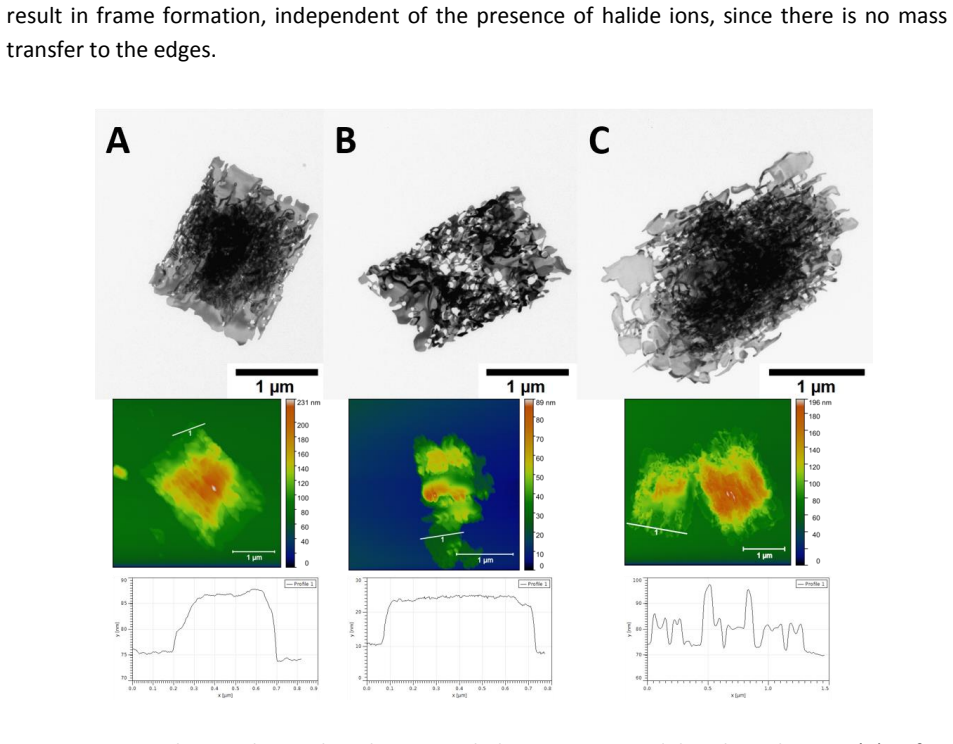
- [Results and Discussion, 'For the etching...'; Table S1] The proposed mechanism states that halide ions 'result in a destabilization of the {100} top and down facets,' but the DFT results in Table S1 report only adsorption energies, with the strongest binding to the lead-terminated {111} facet. Adsorption energies alone do not demonstrate that halide coverage lowers the barrier to dissolution of {100} relative to other facets. Please provide facet-resolved dissolution measurements, surface-energy calculations under halide coverage, or in situ observations that directly support {100} destabilization. Without this, the mechanism remains a hypothesis.
- [Results and Discussion, 'For the etching...' and Experimental section] The etching step relies on 1-bromotetradecane (BTD) releasing bromide ions gradually over time at 220 °C, yet no data are presented that characterize the release kinetics or the bromide concentration during the 5-minute etching window. The claim that BTD provides a 'moderate etching strength' is inferred from the final products. Please quantify bromide release (e.g., ion chromatography, NMR, or a control with a known bromide salt) or directly compare BTD with LiBr under identical conditions to demonstrate the timed-release benefit.
- [Results and Discussion, Figure 3] The control experiments show that adding LiCl after nanosheet formation produces thicker edges, but they do not exclude a generic salt or polarity effect on the oleic acid micellar template. The authors themselves later state that 'salt addition... influence[s] the polarity of the medium and that of the micellar soft template.' A control using a non-halide salt such as lithium acetate or lithium nitrate under otherwise identical conditions is needed to attribute the edge-thickening specifically to halide ions rather than ionic strength or cation effects.
- [Results and Discussion, Figure 4 and Summary] The title and abstract claim 'single-crystalline' PbS nanorings, but no individual-ring electron diffraction or high-resolution TEM is presented. XRD verifies the galena phase of the ensemble, and STEM tomography verifies the ring morphology, but neither establishes that each ring is a single crystal. Please add SAED from individual rings or HRTEM images with corresponding FFTs, or soften the claim to 'highly crystalline' if single-crystallinity is only inferred from the nanoframe precursor.
minor comments (5)
- [Throughout] The manuscript uses '1-bromtetradecan' and '1-bromotetradecane' inconsistently; please standardize the spelling to 1-bromotetradecane.
- [Results and Discussion, 'For the etching...'] The phrase 'top and down facets' should be 'top and bottom facets' for clarity.
- [Experimental, Binding energy simulations] The DFT section does not state how the PbS surface slabs were constructed (termination, thickness, vacuum spacing) or how charged ions were treated in the periodic or cluster model. Please provide these details and note the limitations of LDA for adsorption energetics.
- [Results and Discussion, Figure 4] No yield statistics or size-distribution histograms are reported for the nanoframes or nanorings. Reporting at least representative yields and lateral-size distributions for the best sample would strengthen the 'tunable dimensions' claim.
- [Supporting Information] The text references Figure S4A for XRD data and Figure S4E for stick-fragment morphology; please verify these callouts match the actual figures in the SI, as the numbering appears inconsistent with the main-text description.
Circularity Check
No circularity: the synthesis and proposed mechanism rest on independent characterization and control experiments, not on self-referential fits or citations.
full rationale
The paper's central claim is an empirical synthesis route: PbS nanosheets transform to nanoframes and then nanorings under halide-assisted thermal ripening. No equation in the paper is fitted to the target outcome, and no claimed prediction is defined in terms of the result it is supposed to support. The proposed mechanism (halide ions destabilizing {100} top/bottom facets while passivating edges) is inferred from TEM, AFM, STEM tomography, XEDS, XRD, and control experiments such as increased OA suppressing frames and added halides restoring them (Figures 2, 3, S3), in addition to DFT adsorption energies (Table S1). These are independent inputs; the DFT computes adsorption energies on fixed facets and is not used to fit ring or frame dimensions. The paper does cite prior work from the same group on PbS nanosheet synthesis (refs. 32, 33, 48, 52) and oleic-acid templating, but those citations provide the starting material and background, not the load-bearing claim of frame/ring formation or the halide mechanism. There is no self-citation chain invoked to forbid alternatives, no uniqueness theorem imported from the authors' other papers, and no ansatz smuggled in solely by citation. The weakest element—unmeasured bromide release from BTD and the absence of direct facet-resolved dissolution data—is a scientific-evidence limitation, not circularity. The mechanism is post hoc rather than predicted, but an after-the-fact explanation is not a circular derivation. Thus the paper is self-contained with respect to its empirical claims and warrants a non-circular verdict.
Assumptions & free parameters
assumptions (4)
- domain assumption Oleic acid/lead oleate forms a lamellar soft template that directs oriented attachment of PbS nuclei into single-crystalline nanosheets.
- domain assumption Halide ions bind preferentially to lead-terminated {111} facets and, by ligand exchange, destabilize {100} facets.
- ad hoc to paper 1-bromotetradecane releases bromide ions over time at 220 degrees Celsius, providing a moderate etch that can be stopped.
- domain assumption Non-oxidative dissolution of galena is faster on {110} and {111} than on {100}, so the thin center dissolves first.
Cite this review
Pith. "Pith review of Synthesis of single-crystalline lead sulfide nanoframes and nanorings." pith.science (2026). https://pith.science/paper/DFJQEU6U
@misc{pith2026190802030,
  author       = {Pith},
  title        = {Pith review of: Synthesis of single-crystalline lead sulfide nanoframes and nanorings},
  year         = {2026},
  howpublished = {\url{https://pith.science/paper/DFJQEU6U}},
  note         = {Machine review of arXiv:1908.02030}
}
read the original abstract
We present a colloidal synthesis strategy to obtain single-crystalline PbS nanorings. By controlling the ripening process in the presence of halide ions, a transformation of initial PbS nanosheets to frame-like structures and finally to nanorings was achieved. We found that the competing ligands oleic acid, oleate and halide ions play an important role in the formation of these nanostructures. Therefore, we propose a formation mechanism based on a thermally induced ripening of crystal facets dependent on the surface passivation. With this method, it became possible to synthesize colloidal nanorings of cubic crystal phase galena PbS. The synthesis was followed via TEM and the products are characterized by XRD, AFM and STEM tomography. Control of the initial nanoframe morphology allows adjusting the later nanoring dimensions.
Figures
Reference graph
Works this paper leans on
-
[1]
Two-Dimensional Colloidal Nanocrystals
(1) Nasilowski, M.; Mahler, B.; Lhuillier, E.; Ithurria, S.; Dubertret, B. Two-Dimensional Colloidal Nanocrystals. Chem. Rev. 2016, 116 (18), 10934–10982. (2) Talapin, D. V.; Lee, J. S.; Kovalenko, M. V.; Shevchenko, E. V. Prospects of Colloidal Nanocrystals for Electronic and Optoelectronic Applications. Chem. Rev. 2010, 110 (1), 389–458. (3) Lorke, A.; ...
work page 2016
-
[78]
18 (45) Vosko, S. H.; Wilk, L.; Nusair, M. Accurate Spin -Dependent Electron Liquid Correlation Energies for Local Spin Density Calculations: A Critical Analysis. Can. J. Phys. 1980, 58 (8), 1200–1211. (46) Wadt, W. R.; Hay, P. J. Ab Initio Effective Core Potentials for Molecular Calculations. Potentials for Main Group Elements Na to Bi. J. Chem. Phys. 19...
work page 1980
-
[1888]
Phase Behavior in the Biologically Important Oleic Acid/Sodium Oleate/Water System
(59) Mele, S.; Söderman, O.; Ljusberg -Wahrén, H.; Thuresson, K.; Monduzzi, M.; Nylan der, T. Phase Behavior in the Biologically Important Oleic Acid/Sodium Oleate/Water System. Chem. Phys. Lipids 2018, 211, 30–36. (60) Janke, J. J.; Bennett, W. F. D.; Tieleman, D. P. Oleic Acid Phase Behavior from Molecular Dynamics Simulations. Langmuir 2014, 30 (35), 1...
work page 2018
-
[2226]
Significance of Electromagnetic Potentials in the Quantum Theory
(4) Aharonov, Y.; Bohm, D. Significance of Electromagnetic Potentials in the Quantum Theory. Phys. Rev. 1959, 115 (3), 485–491. 15 (5) Song, J.; Ulloa, S. E. Magnetic Field Effects on Quantum Ring Excitons. Phys. Rev. B 2001, 63 (12), 125302. (6) Hu, H.; Zhu, J.-L.; Li, D.-J.; Xiong, J.-J. Aharonov-Bohm Effect of Excitons in Nanorings. Phys. Rev. B 2001, ...
work page 1959
-
[3297]
Tailoring the Height of Ultrathin PbS Nanosheets and Their Application as Field-Effect Transistors
(48) Bielewicz, T.; Dogan, S.; Klinke, C. Tailoring the Height of Ultrathin PbS Nanosheets and Their Application as Field-Effect Transistors. Small 2015, 11 (7), 826–833. (49) Ji, X.; Copenhaver, D.; Sichmeller, C.; Peng, X. Ligand Bonding and Dynamics on Colloidal Nanocrystals at Room Temperature: The Case of Alkylamines on CdSe Nanocrystals. J. Am. Chem...
work page 2015
-
[3789]
(42) Ramin Moayed, M. M.; Bielewicz, T.; Zöllner, M. S.; Herrmann, C.; Klinke, C. Towards Colloidal Spintronics through Rashba Spin -Orbit Interaction in Lead Sulphide Nanosheets. Nat. Commun. 2017, 8, 15721. (43) Ramin Moayed, M. M.; Bielewicz, T.; Noei, H.; Stierle, A.; Klinke, C. High -Performance n- and p -Type Field -Effect Transistors Based on Hybri...
work page 2017
-
[5019]
(32) Schliehe, C.; Juarez, B. H.; Pelletier, M.; Jander, S.; Greshnykh, D.; Nagel, M.; Meyer, A.; Foerster, S.; Kornowski, A.; Klinke, C.; Weller, H. Ultrathin PbS Sheets by Two-Dimensional Oriented Attachment. Science 2010, 329 (5991), 550–553. (33) Bielewicz, T.; Ramin Moayed, M. M.; Lebedeva, V.; Strelow, C.; Rieckmann, A.; Klinke, C. From Dots to Stri...
work page 2010
Reviewed August 14, 2026 · model on record in the stance chip above.
Discussion (0). Continue with ORCID to comment.