REVIEW 4 major objections 5 minor 69 references
Exotic superconductivity in the doped Kitaev quantum spin liquid
T0 review · 4 major / 5 minor · reviewed 2026-08-08 · deepseek-v4-flash
Pith's one-line read Hole doping a Kitaev quantum spin liquid produces ferromagnetic triplet p-wave superconductivity, with singlet d+id pairing appearing for antiferromagnetic Kitaev coupling.
desk verdict A well-executed mVMC study with genuinely new pairing-selection results, though the 'robust superconductivity' claim outruns the finite-cluster variational evidence; still deserves a serious referee. read the letter →
The pith
A machine-rendered reading of the paper's core claim, the machinery that carries it, and where it could break.
The reading
What carries the argument
The machinery is the many-variable variational Monte Carlo method applied to a projected pair-product (Pfaffian) wave function, $|\Psi\rangle = P_J P_G^\infty |\phi_{\mathrm{pair}}\rangle$, with pair matrix $F_{IJ}$ and Jastrow factors $v_{ij}$ optimized by stochastic reconfiguration. The key identity is that the Kitaev quantum spin liquid at half filling is exactly a Gutzwiller-projected BCS state, so the same variational family can represent both the spin liquid and doped superconducting phases. Superconductivity is diagnosed by equal-time pairing correlations in singlet and triplet channels, decomposed into four honeycomb form factors ($s/f$, $d_{xy}/p_x$, $d_{x^2-y^2}/p_y$, $d+id/p+ip$), with the long-range average $P^\eta_\alpha$ over distances $d \ge L/2$ used as the order parameter.
What would settle it
On an $L=12$ cluster at $K/t=-1$ and $\delta\simeq 0.2$, compute the variational energy of a charge-density-wave or stripe ansatz with a doubled unit cell; if its energy is below the reported triplet $p$-wave state, the central claim that triplet $p$-wave superconductivity is the ground state in that window collapses, whereas observing the $p_y$ triplet correlation plateau to decay with system size would falsify long-range pairing order.
Extended reading notes
Core claim
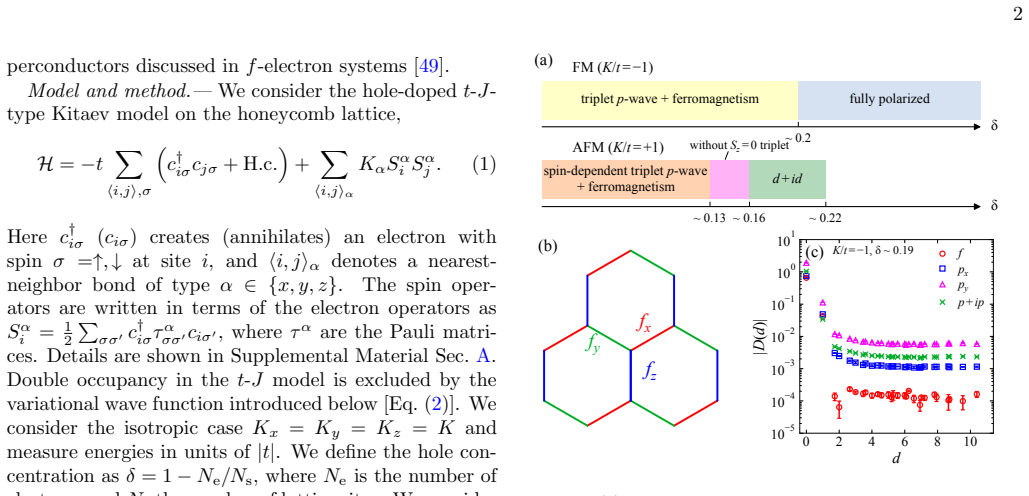
The central discovery is that the hole-doped $t$-$J$-type Kitaev model, studied with a projected pair-product wave function that exactly represents the undoped Kitaev quantum spin liquid, supports spin-triplet superconducting order. For $K<0$, the long-range-averaged $p_y$ triplet pairing correlation rises with doping, peaks around $\delta\simeq 0.2$, and coexists with a finite uniform magnetization; both are suppressed as the magnetization saturates to the fully polarized value. For $K>0$, a spin- and form-factor-selective triplet $p$-wave state at low doping—where only specific equal-spin and $S^z=0$ components are enhanced—gives way to a singlet $d+id$ state at intermediate doping, with negligible magnetization in the singlet regime. At fixed $\delta\simeq 0.11$ and $K<0$, the triplet correlation peaks at $|K|/t\simeq 0.5$, nonmonotonically, while the magnetization decreases monotonically. The paper interprets the suppression of triplet pairing at full polarization as evidence that spin fluctuations are needed to mediate the pairing.
Load-bearing premise
The results assume that the optimized variational state, restricted to translationally invariant pair-product amplitudes and local density-density Jastrow factors, is the true ground state at every doping; a lower-energy state outside this ansatz class—such as a charge-ordered or enlarged-unit-cell magnetic or pairing state—would change the phase diagram.
Editorial extensions
If this is right
- For ferromagnetic Kitaev coupling, triplet $p$-wave superconductivity and ferromagnetism coexist over a low-to-intermediate doping window, with the superconducting correlation vanishing as magnetization saturates.
- For antiferromagnetic coupling, doping drives a transition from spin-dependent triplet $p$-wave to singlet $d+id$ pairing, and the singlet regime has no spontaneous magnetization.
- Triplet pairing strength depends nonmonotonically on $|K|/t$ at fixed low doping, peaking around $|K|/t\simeq 0.5$, while magnetization decreases monotonically.
- These results give experimental guidance: carrier-doped Kitaev candidate materials such as heterostructures of $\alpha$-RuCl$_3$ with graphene or graphite may realize triplet superconductivity coexisting with ferromagnetism.
- The doped Kitaev model offers a microscopic realization of spin-triplet superconductor / ferromagnet coexistence previously studied mainly in uranium-based $f$-electron compounds.
Reading between the lines
- A natural next test is to enlarge the variational unit cell and allow charge-density-wave or stripe orders; if such a state wins near $\delta\simeq 0.2$, the reported phase boundaries would shift, but the qualitative coexistence scenario may survive.
- The spin- and form-factor-selective triplet pairing at low doping suggests a pairing state that breaks lattice rotational symmetry; determining its topological invariant (e.g., via Chern number or edge states) would settle whether it is a chiral topological superconductor.
- For experiments, the nonmonotonic coupling dependence implies that stronger Kitaev character is not always better for triplet pairing; samples with intermediate $K$ may be the best targets for detecting triplet order.
- Extending the method to multi-orbital Hubbard models from ab initio calculations could reveal whether the predicted phases survive in real materials beyond the $t$-$J$ approximation.
Signed reviews
Editorial analysis
A structured set of objections, weighed in public.
Referee Report
Summary. The manuscript studies hole doping of the Kitaev honeycomb model using the many-variable variational Monte Carlo (mVMC) method with a projected pair-product (Pfaffian) wave function. The authors consider the t-J-type Kitaev model on isotropic clusters with L=8, 10, and 12, and report two main phase diagrams: for ferromagnetic Kitaev interaction (K/t=-1), triplet p-wave superconductivity coexists with ferromagnetism at low-to-intermediate doping and is suppressed near full spin polarization; for antiferromagnetic interaction (K/t=+1), the dominant pairing changes from spin-dependent triplet p-wave at low doping to singlet d+id at intermediate doping. They also report a nonmonotonic dependence of the triplet correlation on |K|/t at fixed low doping. The half-filling wave function is benchmarked against exact Majorana and exact-diagonalization results to roughly 10^-5 per site up to L=20.
Significance. If the reported phase diagrams are correct, the paper provides the first beyond-mean-field variational phase diagram for the hole-doped t-J-type Kitaev model on isotropic two-dimensional clusters, including a coexistence regime of triplet superconductivity and ferromagnetism that has not been identified in earlier slave-boson mean-field studies. The strengths of the paper are the exact representation of the Kitaev quantum spin liquid at half filling, systematic use of three cluster sizes, multiple initial states for the optimization, and absence of any parameter fitted to reproduce the reported pairing correlations. The main significance is limited by the variational ansatz, which is restricted to translationally invariant pairing amplitudes and a local density-density Jastrow factor; the paper's own summary acknowledges that enlarged-unit-cell and charge-order states are not included. The central claims therefore hold only within this variational class unless additional tests are provided.
major comments (4)
- [Model and method, Eq. (2); Summary and discussion] The variational wave function (2) imposes translational invariance on both F_IJ and v_ij, and the Jastrow factor is restricted to a density-density form. Consequently, charge-density-wave, stripe, and enlarged-unit-cell magnetic states are not representable. The authors themselves state in the Summary that 'allowing competing magnetic and charge orders in enlarged-unit-cell wave functions' is future work. Given that DMRG studies (Refs. [39], [41], [44]) report charge-density-wave and competing pairing tendencies in doped Kitaev systems, the absence of these variational degrees of freedom is load-bearing for the central claim that the retained state is the ground state. Please either extend the ansatz (e.g., allow period-2 modulations of F_IJ and v_ij) or explicitly restrict the conclusions to the chosen variational class.
- [Results, Eq. (7)] The long-range average P^eta_alpha in Eq. (7) is an average of Re D^eta_alpha(r) over distances d >= L/2, not an extrapolated order parameter. The plateau in the distance profile is used to infer long-range order, but no finite-size scaling analysis is presented: Figures 2(a) and 3(a) show P for L=8, 10, and 12 without an extrapolation or a statement of how P would behave in the thermodynamic limit. Because the pair-product ansatz can produce long-range pairing correlations by construction, the plateau in the optimized variational state does not by itself establish that the Hamiltonian ground state has off-diagonal long-range order. I request a finite-size scaling of P (e.g., versus 1/L) or an independent cross-check (e.g., DMRG on one doping) before the word 'robust' is used.
- [Supplemental Sec. B and Table SI] For the antiferromagnetic Kitaev case, the low-doping triplet regime is obtained from initial states generated from the 'simple' representation of the KQSL, and the paper states that the spin-dependent triplet pairing 'reflects the gap structure of the simple representation' (Table SI). Because the optimization is initialized from this state, the final symmetry may be inherited from the initial condition rather than selected by energy. To establish that this spin- and form-factor-selective triplet pairing is an intrinsic low-doping phase, the authors should show that independent initializations (e.g., from the symmetric representation or from states with reversed spin-channel weights) converge to the same energy and pairing correlations. Without this test, the claimed new phase is not fully supported.
- [Supplemental Sec. A, Eq. (A14); Supplemental Sec. B] The gauge-pinning penalty parameter lambda in Eq. (A14) enters the construction of the KQSL and pSC2 initial states, and the channel decomposition in Table SI depends on lambda (e.g., the 'simple' entries contain (3K/4+2lambda)^2 and 16 lambda^2). No numerical value of lambda is reported, and no sensitivity to lambda is discussed. Since the selection of the lowest-energy state is performed among these initial conditions, the chosen lambda could influence which basin of attraction the optimization reaches, especially in the antiferromagnetic case. Please specify lambda (and the procedure for fixing it) and show that the phase diagram is stable under reasonable variations of lambda.
minor comments (5)
- [Figure 2(b) and text] The dashed line is labeled '(1-delta)/2' but the text calls it the fully polarized value; please clarify that this is the full-polarization value per site in the presence of holes. Several data points near delta=0.12, 0.2, and 0.3 deviate strongly from this line; the text explains this, but the figure would benefit from marking those points.
- [Figure 1(a)] The phase boundaries are estimated from L=12 results, but no criterion (e.g., crossing of P or M values) is specified. Please state the criterion used to draw the schematic boundaries.
- [Results, second paragraph] The sentence 'A few points near delta=0.12, 0.2, and 0.3 in Fig. 2(b) show strongly reduced magnetization' refers to competing nearly unpolarized states; this competition is size dependent and could affect the phase diagram. Consider presenting these points with distinct markers or discussing the energy differences.
- [Eq. (4) and Table SI] The triplet pairing operator in Eq. (4) includes a 1/sqrt(2) normalization, while Table SI defines Delta^T_rho without the sqrt(2) normalization. Please state this convention explicitly near Eq. (4) to avoid confusion in comparing bare amplitudes with correlation functions.
- [Abstract and Summary] The term 'robust triplet p-wave superconductivity' is used in the Abstract and Summary. Given the finite-size and ansatz caveats, consider replacing 'robust' with 'variational evidence for' or a similar formulation unless the requested finite-size and enlarged-unit-cell tests are provided.
Circularity Check
No fitted-parameter or self-citation circularity; the only circularity-adjacent element is that the low-doping pairing symmetries are seeded from the KQSL Majorana-representation ansatze and then reported as findings.
-
other
[Supplemental Material Appendix B, 'Superconducting ansätze for initial states', final paragraph; main-text 'Results' for the antiferromagnetic case.]
"For the antiferromagnetic Kitaev interaction, the states in the low-doping regime are derived from the simple representation of the KQSL. The spin-dependent triplet pairing in this regime, whose form factors differ between the up- and down-spin sectors, reflects the gap structure of the simple representation shown in Table SI."
The main text advertises as a new result the low-doping spin- and form-factor-selective triplet pairing for K>0 ('This spin- and form-factor-selective triplet pairing was not identified in previous mean-field phase diagrams'). Supplemental Appendix B states that the winning state in this regime was produced by seeding the variational optimization with the simple-representation KQSL BdG state, and that the reported pairing 'reflects the gap structure' of that seed. Because the state-selection protocol retains the lowest-energy state only among the seeded candidates (simple/symmetric KQSL, pSC2, d+id), and because the optimized state in this regime is explicitly 'derived from' that seed, the dominant pairing symmetry is inherited from the initial ansatz rather than independently predicted.
full rationale
The core calculation is variational energy minimization over projected pair-product states with all F_IJ and v_ij optimized, and the reported phases are selected by comparing optimized energies across multiple initial states. No parameter was fitted to reproduce the reported pairing, and the half-filling benchmark against exact and Majorana-diagonalization results anchors the representation. The only self-citations are to the mVMC and HPhi codes, which are implementation references rather than load-bearing arguments. The one circularity-adjacent element is documented in Supplemental Appendix B: for each sign of K, the low-doping triplet state is seeded from a specific KQSL Majorana representation (simple for the antiferromagnetic case, symmetric for the ferromagnetic case), and the paper states that the resulting spin- and form-factor-selective pairing 'reflects the gap structure' of that seed. Since the retained state is the lowest-energy candidate among those seeded ansatze, the reported dominant pairing symmetry is partly inherited from the initial-state construction. This warrants a low nonzero circularity score. The Summary's concession that future work must allow competing magnetic and charge orders in enlarged-unit-cell wave functions is a correctness limitation, not an additional circular step.
Assumptions & free parameters
free parameters (2)
- Initial BdG pairing amplitude Delta0 = t1 = 5 =
5
- Gauge-pinning penalty lambda =
not specified
assumptions (5)
- domain assumption The t-J-type Kitaev model Eq. (1) is a valid effective description of carrier-doped Kitaev candidate materials.
- domain assumption The projected pair-product wavefunction exactly represents the Kitaev quantum spin liquid at half filling.
- domain assumption The variational ansatz space contains the true ground state at every doping.
- domain assumption A plateau in the equal-time pairing correlation at large distance indicates long-range superconducting order.
- standard math The Majorana representation and gauge-fixed Hamiltonian of the Kitaev model are valid.
Cite this review
Pith. "Pith review of Exotic superconductivity in the doped Kitaev quantum spin liquid." pith.science (2026). https://pith.science/paper/DFK4PSKS
@misc{pith2026260803024,
  author       = {Pith},
  title        = {Pith review of: Exotic superconductivity in the doped Kitaev quantum spin liquid},
  year         = {2026},
  howpublished = {\url{https://pith.science/paper/DFK4PSKS}},
  note         = {Machine review of arXiv:2608.03024}
}
abstract
We investigate superconductivity in a doped Kitaev quantum spin liquid by applying the many-variable variational Monte Carlo method to the hole-doped $t$-$J$-type Kitaev model. Using a projected pair-product wave function that can exactly represent the Kitaev quantum spin liquid, we examine the stability of superconducting phases on isotropic two-dimensional clusters. For the ferromagnetic Kitaev interaction, robust triplet $p$-wave superconductivity coexists with ferromagnetism in the low-to-intermediate doping regime but is suppressed as the system approaches the fully polarized ferromagnetic phase. For the antiferromagnetic Kitaev interaction, superconductivity exhibits a change in the dominant pairing symmetry from spin-dependent triplet $p$-wave at low doping to singlet $d+id$ at intermediate doping. By varying the strength of the ferromagnetic Kitaev interaction at fixed doping, we show that the triplet superconductivity increases together with the ferromagnetic moment and becomes strongest slightly below full polarization. Our results provide a theoretical basis for experimental searches for unconventional superconductivity, such as triplet superconductivity coexisting with ferromagnetism, in carrier-doped Kitaev candidate materials.
Figures


Reference graph
Works this paper leans on
-
[39]
C. Peng, Y.-F. Jiang, T. P. Devereaux, and H.-C. Jiang, Precursor of pair-density wave in doping Kitaev spin liq- uid on the honeycomb lattice, npj Quantum Mater.6, 64 (2021)
work page 2021
-
[41]
P. Laurell, B. Pandey, G. B. Hal´ asz, S. Okamoto, G. Al- varez, and E. Dagotto, Pairing tendencies in the doped Kitaev-Heisenberg model, Phys. Rev. B110, 224518 (2024)
work page 2024
- [44]
-
[2]
Baskaran, S
G. Baskaran, S. Mandal, and R. Shankar, Exact Results for Spin Dynamics and Fractionalization in the Kitaev Model, Phys. Rev. Lett.98, 247201 (2007)
2007
-
[3]
Kitaev, Fault-tolerant quantum computation by anyons, Ann
A. Kitaev, Fault-tolerant quantum computation by anyons, Ann. Phys.303, 2 (2003)
2003
-
[4]
M. Freedman, A. Kitaev, M. Larsen, and Z. Wang, Topo- logical quantum computation, Bull. Am. Math. Soc.40, 31 (2003)
work page 2003
-
[5]
Jackeli and G
G. Jackeli and G. Khaliullin, Mott Insulators in the Strong Spin-Orbit Coupling Limit: From Heisenberg to a Quantum Compass and Kitaev Models, Phys. Rev. Lett. 102, 017205 (2009)
2009
-
[6]
S. M. Winter, A. A. Tsirlin, M. Daghofer, J. van den Brink, Y. Singh, P. Gegenwart, and R. Valent ´ ı, Mod- els and materials for generalized Kitaev magnetism, J. Phys.: Condens. Matter29, 493002 (2017)
work page 2017
Show all 69 references
-
[7]
Takagi, T
H. Takagi, T. Takayama, G. Jackeli, G. Khaliullin, and S. E. Nagler, Concept and realization of Kitaev quantum spin liquids, Nat. Rev. Phys.1, 264 (2019)
2019
-
[8]
Trebst and C
S. Trebst and C. Hickey, Kitaev materials, Phys. Rep. 950, 1 (2022)
2022
-
[9]
Matsuda, T
Y. Matsuda, T. Shibauchi, and H.-Y. Kee, Kitaev quan- tum spin liquids, Rev. Mod. Phys.97, 045003 (2025)
2025
-
[10]
Motome and J
Y. Motome and J. Nasu, Hunting Majorana Fermions in Kitaev Magnets, J. Phys. Soc. Jpn.89, 012002 (2020)
2020
-
[11]
Kasahara, T
Y. Kasahara, T. Ohnishi, Y. Mizukami, O. Tanaka, S. Ma, K. Sugii, N. Kurita, H. Tanaka, J. Nasu, Y. Mo- tome, T. Shibauchi, and Y. Matsuda, Majorana quanti- zation and half-integer thermal quantum Hall effect in a Kitaev spin liquid, Nature559, 227 (2018)
2018
-
[12]
Yokoi, S
T. Yokoi, S. Ma, Y. Kasahara, S. Kasahara, T. Shibauchi, N. Kurita, H. Tanaka, J. Nasu, Y. Motome, C. Hickey, S. Trebst, and Y. Matsuda, Half-integer quantized anomalous thermal Hall effect in the Kitaev material can- didateα-RuCl 3, Science373, 568 (2021)
2021
-
[13]
Yamashita, J
M. Yamashita, J. Gouchi, Y. Uwatoko, N. Kurita, and H. Tanaka, Sample dependence of half-integer quantized thermal Hall effect in the Kitaev spin-liquid candidate α-RuCl3, Phys. Rev. B102, 220404 (2020)
2020
-
[14]
Hentrich, M
R. Hentrich, M. Roslova, A. Isaeva, T. Doert, W. Brenig, B. B¨ uchner, and C. Hess, Large thermal Hall effect inα−RuCl 3: Evidence for heat transport by Kitaev- Heisenberg paramagnons, Phys. Rev. B99, 085136 (2019)
2019
-
[15]
Lefran¸ cois, G
E. Lefran¸ cois, G. Grissonnanche, J. Baglo, P. Lampen- Kelley, J.-Q. Yan, C. Balz, D. Mandrus, S. E. Nagler, S. Kim, Y.-J. Kim, N. Doiron-Leyraud, and L. Taillefer, Evidence of a Phonon Hall Effect in the Kitaev Spin Liq- uid Candidateα-RuCl 3, Phys. Rev. X12, 021025 (2022)
2022
-
[16]
Czajka, T
P. Czajka, T. Gao, M. Hirschberger, P. Lampen-Kelley, A. Banerjee, N. Quirk, D. G. Mandrus, S. E. Nagler, and N. P. Ong, Planar thermal Hall effect of topological bosons in the Kitaev magnetα-RuCl 3, Nat. Mater.22, 36 (2023)
2023
-
[17]
P. W. Anderson, The Resonating Valence Bond State in La 2CuO4 and Superconductivity, Science235, 1196 (1987)
1987
-
[18]
P. A. Lee, N. Nagaosa, and X.-G. Wen, Doping a Mott in- sulator: Physics of high-temperature superconductivity, Rev. Mod. Phys.78, 17 (2006)
2006
-
[21]
J. Fu, J. Knolle, and N. B. Perkins, Three types of rep- 6 resentation of spin in terms of Majorana fermions and an alternative solution of the Kitaev honeycomb model, Phys. Rev. B97, 115142 (2018)
2018
-
[23]
Mashhadi, Y
S. Mashhadi, Y. Kim, J. Kim, D. Weber, T. Taniguchi, K. Watanabe, N. Park, B. V. Lotsch, J. H. Smet, M. Burghard, and K. Kern, Spin-split band hybridiza- tion in graphene proximitized withα-RuCl 3 nanosheets, Nano Lett.19, 4659 (2019)
2019
-
[24]
B. Zhou, J. Balgley, P. Lampen-Kelley, J. Q. Yan, D. G. Mandrus, and E. A. Henriksen, Evidence for charge transfer and proximate magnetism in graphene–α-RuCl 3 heterostructures, Phys. Rev. B100, 165426 (2019)
2019
-
[25]
Y. Wang, J. Balgley, E. Gerber, M. Gray, N. Kumar, X. Lu, J.-Q. Yan, A. Fereidouni, R. Basnet, S. J. Yun, D. Suri, H. Kitadai, T. Taniguchi, K. Watanabe, X. Ling, J. Moodera, Y. H. Lee, H. O. H. Churchill, J. Hu, L. Yang, E.-A. Kim, D. G. Mandrus, E. A. Henrik- sen, and K. S. ...
2020
-
[26]
D. J. Rizzo, B. S. Jessen, Z. Sun, F. L. Ruta, J. Zhang, J. Q. Yan, L. Xian, A. S. McLeod, M. E. Berkowitz, K. Watanabe, T. Taniguchi, S. E. Nagler, D. G. Man- drus, A. Rubio, M. M. Fogler, A. J. Millis, J. C. Hone, C. R. Dean, and D. N. Basov, Charge-transfer plasmon polarito...
2020
-
[27]
Rossi, C
A. Rossi, C. Johnson, J. Balgley, J. C. Thomas, L. Fran- caviglia, R. Dettori, A. K. Schmid, K. Watanabe, T. Taniguchi, M. Cothrine, D. G. Mandrus, C. Jozwiak, A. Bostwick, E. A. Henriksen, A. Weber-Bargioni, and E. Rotenberg, Direct visualization of the charge trans- fer in a...
2023
-
[28]
Zheng, K
X. Zheng, K. Jia, J. Ren, C. Yang, X. Wu, Y. Shi, K. Tanigaki, and R.-R. Du, Tunneling spectroscopic sig- natures of charge doping and associated Mott transition inα-RuCl 3 in proximity to graphite, Phys. Rev. B107, 195107 (2023)
2023
-
[29]
Zheng, Z.-X
X. Zheng, Z.-X. Liu, C. Zhang, H. Zhou, C. Yang, Y. Shi, K. Tanigaki, and R.-R. Du, Incommensurate charge super-modulation and hidden dipole order in lay- ered Kitaev materialα-RuCl 3, Nat. Commun.15, 7658 (2024)
2024
-
[30]
Biswas, Y
S. Biswas, Y. Li, S. M. Winter, J. Knolle, and R. Va- lent ´ ı, Electronic properties ofα-RuCl3 in proximity to graphene, Phys. Rev. Lett.123, 237201 (2019)
2019
-
[31]
Gerber, Y
E. Gerber, Y. Yao, T. A. Arias, and E.-A. Kim, Ab ini- tio mismatched interface theory of graphene onα-RuCl 3: Doping and magnetism, Phys. Rev. Lett.124, 106804 (2020)
2020
-
[32]
Mei, Possible Fermi liquid in the lightly doped Ki- taev spin liquid, Phys
J.-W. Mei, Possible Fermi liquid in the lightly doped Ki- taev spin liquid, Phys. Rev. Lett.108, 227207 (2012)
2012
-
[33]
G. B. Hal´ asz, J. T. Chalker, and R. Moessner, Doping a topological quantum spin liquid: Slow holes in the Kitaev honeycomb model, Phys. Rev. B90, 035145 (2014)
2014
-
[38]
Kadow, H.-K
W. Kadow, H.-K. Jin, J. Knolle, and M. Knap, Single- hole spectra of Kitaev spin liquids: From dynamical Na- gaoka ferromagnetism to spin-hole fractionalization, npj Quantum Mater.9, 32 (2024)
2024
-
[40]
H.-K. Jin, W. Kadow, M. Knap, and J. Knolle, Kinetic ferromagnetism and topological magnons of the hole- doped Kitaev spin liquid, npj Quantum Mater.9, 65 (2024)
2024
-
[42]
M. G. Sousa, O. ´Avalos-Ovando, E. Vernek, and S. E. Ulloa, Charge fluctuations and topological phases in Kitaev-Heisenberg ladders, arXiv:2512.17596 (2025)
2025
-
[43]
C. E. Agrapidis and S. Nishimoto, Ground state proper- ties of the doped Kitaev-Heisenberg chain: Topological superconducting and Mott insulating phases driven by magnetic frustration, Phys. Rev. B114, L051109 (2026)
2026
-
[45]
Tahara and M
D. Tahara and M. Imada, Variational Monte Carlo method combined with quantum-number projection and multi-variable optimization, J. Phys. Soc. Jpn.77, 114701 (2008)
2008
-
[46]
Misawa, K
T. Misawa, K. Yoshimi, Y. Tada, Y. Nomura, S. Naka- mura, Y. Yamaji, H. Shinaoka, and M. Imada, mVMC—Open-source software for many-variable varia- tional Monte Carlo method, Comput. Phys. Commun. 235, 447 (2019)
2019
-
[48]
[56, 57]
See Supplemental Material for how to construct initial states in mVMC calculations and detailed analysis of pairing correlations including Refs. [56, 57]
-
[49]
D. Aoki, K. Ishida, and J. Flouquet, Review of U-based Ferromagnetic Superconductors: Comparison between UGe2, URhGe, and UCoGe, J. Phys. Soc. Jpn.88, 022001 (2019)
2019
-
[50]
Kurita, Y
M. Kurita, Y. Yamaji, S. Morita, and M. Imada, Varia- tional Monte Carlo method in the presence of spin-orbit interaction and its application to Kitaev and Kitaev- Heisenberg models, Phys. Rev. B92, 035122 (2015)
2015
-
[51]
M. C. Gutzwiller, Effect of correlation on the ferromag- netism of transition metals, Phys. Rev. Lett.10, 159 (1963). 7
1963
-
[52]
Jastrow, Many-body problem with strong forces, Phys
R. Jastrow, Many-body problem with strong forces, Phys. Rev.98, 1479 (1955)
1955
-
[53]
Capello, F
M. Capello, F. Becca, M. Fabrizio, S. Sorella, and E. Tosatti, Variational description of Mott insulators, Phys. Rev. Lett.94, 026406 (2005)
2005
-
[54]
Sorella, Generalized Lanczos algorithm for variational quantum Monte Carlo, Phys
S. Sorella, Generalized Lanczos algorithm for variational quantum Monte Carlo, Phys. Rev. B64, 024512 (2001)
2001
-
[55]
X. Y. Xu, S. Wessel, and Z. Y. Meng, Competing pairing channels in the doped honeycomb lattice Hubbard model, Phys. Rev. B94, 115105 (2016)
2016
-
[57]
Exotic superconductivity in the doped Kitaev quantum spin liquid
K. Ido, M. Kawamura, Y. Motoyama, K. Yoshimi, Y. Ya- maji, S. Todo, N. Kawashima, and T. Misawa, Update ofHΦ: Newly added functions and methods in versions 2 and 3, Comput. Phys. Commun.298, 109093 (2024). 8 Supplemental Material for “Exotic superconductivity in the doped Kita...
2024
-
[58]
Mapping between Abrikosov and Majorana fermions We start from the Kitaev model on the honeycomb lattice [5], HK = X ⟨i,j⟩α KαSα i Sα j ,(A1) whereS α i is theαcomponent of the spin-1/2 operator at siteiand⟨i, j⟩ α denotes a nearest-neighbor bond of type α∈ {x, y, z}. To connec...
-
[59]
Substituting Eq
Mapping onto the Bogoliubov–de Gennes (BdG) Hamiltonian In the extended Hilbert space, the Kitaev Hamilto- nian can be written as a quadratic Hamiltonian for one Majorana species coupled to staticZ 2 gauge fields uα ij =ib α i bα j =±1 on eachαbond, where the bond⟨i, j⟩ α is o...
-
[60]
Pair-product (Pfaffian) wave function from BdG The BdG ground state can be written as a generalized BCS state [6], |ψBCS(F)⟩= exp X I,J FIJ c† I c† J |0⟩, F=−F T. (A17) For a Bogoliubov transformation written asγ=V Tc+ U Tc†, the pairing matrix is obtained as F= 1 2 U V...
-
[61]
At half filling (spin model), we impose the single-occupancy constraint (A3), |ΦKQSL⟩=P ∞ G |ϕpair(FKQSL)⟩,(A20) whereF KQSL can be chosen from the BdG solution of ˜H(λ)
Kitaev quantum spin liquid in mVMC The variational wave function for the Kitaev quan- tum spin liquid (KQSL) is constructed by projecting |ϕpair(F)⟩onto the physical Hilbert space and is used as the starting point for the doped problem. At half filling (spin model), we impose ...
-
[62]
These superconducting states are obtained by diagonalizing BdG Hamiltonians with nearest-neighbor hopping and the following pairing amplitudes
Definitions of the initial superconducting states In addition to the KQSL initial states constructed from the simple and symmetric representations, we employ two superconducting states proposed in mean-field studies of the doped Kitaev model [9–12], namely the singletd+id stat...
-
[63]
(2 + √ 3)(t2 1 + 3t2 2) pSC2 (K <0)↓↓2t 2 1 2(t2 1 +t 2
-
[64]
(2− √ 3)(t2 1 + 3t2 2)
-
[65]
Symmetry of the gap structures Table SI summarizes the bare nearest-neighbor pairing amplitudes of the simple, symmetric, andpSC 2 initial states. We define the channel decomposition Aη α = X ρ f α ρ ∆η ρ,(B5) whereρruns over the three nearest-neighbor bond types {x, y, z}andf...
-
[66]
(6), we parameterize the displacement asr=d xa1 + dya2, wherea 1 = (1,0) anda 2 = (1/2, √ 3/2)
Representative real-space pairing correlations For the distance-resolved pairing correlatorD η α(r) in Eq. (6), we parameterize the displacement asr=d xa1 + dya2, wherea 1 = (1,0) anda 2 = (1/2, √ 3/2). After independently reducingd x andd y to (−L/2, L/2], we as- sign the dis...
-
[67]
F ullp-wave triplet-channel decomposition Figure 3(a) in the main text shows only the representa- tive pairing channels that become dominant in each dop- ing regime. Figure S3 presents the complete decomposi- tion of thep x- andp y-wave triplet correlations into all six spin- ...
-
[68]
F. J. Burnell and C. Nayak, SU(2) slave fermion solution of the Kitaev honeycomb lattice model, Phys. Rev. B84, 125125 (2011)
2011
-
[69]
Schaffer, S
R. Schaffer, S. Bhattacharjee, and Y. B. Kim, Quantum phase transition in Heisenberg-Kitaev model, Phys. Rev. B86, 224417 (2012)
2012
-
[70]
J. Fu, J. Knolle, and N. B. Perkins, Three types of rep- resentation of spin in terms of Majorana fermions and an alternative solution of the Kitaev honeycomb model, Phys. Rev. B97, 115142 (2018)
2018
-
[71]
Udagawa, Theoretical scheme for finite-temperature dynamics of Kitaev’s spin liquids, J
M. Udagawa, Theoretical scheme for finite-temperature dynamics of Kitaev’s spin liquids, J. Phys.: Condens. Matter33, 254001 (2021)
2021
-
[72]
Kitaev, Anyons in an exactly solved model and be- yond, Ann
A. Kitaev, Anyons in an exactly solved model and be- yond, Ann. Phys.321, 2 (2006)
2006
-
[73]
Becca and S
F. Becca and S. Sorella,Quantum Monte Carlo Ap- proaches for Correlated Systems(Cambridge University Press, Cambridge, England, 2017)
2017
-
[74]
Kawamura, K
M. Kawamura, K. Yoshimi, T. Misawa, Y. Yamaji, S. Todo, and N. Kawashima, Quantum lattice model solverHΦ, Comput. Phys. Commun.217, 180 (2017)
2017
-
[75]
K. Ido, M. Kawamura, Y. Motoyama, K. Yoshimi, Y. Ya- maji, S. Todo, N. Kawashima, and T. Misawa, Update ofHΦ: Newly added functions and methods in versions 2 and 3, Comput. Phys. Commun.298, 109093 (2024)
2024
-
[76]
Y.-Z. You, I. Kimchi, and A. Vishwanath, Doping a spin- orbit Mott insulator: Topological superconductivity from the Kitaev-Heisenberg model and possible application to (Na2/Li2)IrO3, Phys. Rev. B86, 085145 (2012)
2012
-
[77]
Hyart, A
T. Hyart, A. R. Wright, G. Khaliullin, and B. Rosenow, Competition betweend-wave and topologicalp-wave su- perconducting phases in the doped Kitaev-Heisenberg model, Phys. Rev. B85, 140510 (2012)
2012
-
[78]
Okamoto, Global phase diagram of a doped Kitaev- Heisenberg model, Phys
S. Okamoto, Global phase diagram of a doped Kitaev- Heisenberg model, Phys. Rev. B87, 064508 (2013)
2013
-
[79]
D. D. Scherer, M. M. Scherer, G. Khaliullin, C. Hon- erkamp, and B. Rosenow, Unconventional pairing and electronic dimerization instabilities in the doped Kitaev- Heisenberg model, Phys. Rev. B90, 045135 (2014)
2014
Reviewed August 8, 2026 · model on record in the stance chip above.
Discussion (0). Continue with ORCID to comment.