REVIEW 4 major objections 6 minor 44 references
The New High-entropy Compound RhMnFeCoGe4 with Cubic Non-centrosymmetric B20 Structure
T0 review · 4 major / 6 minor · reviewed 2026-08-05 · deepseek-v4-flash
Pith's one-line read The paper reports that a four-metal high-entropy compound, RhMnFeCoGe4, forms in the non-centrosymmetric cubic B20 structure and orders ferromagnetically at 146 K with a spontaneous moment of 2.5 μB per formula unit; compression initially r
desk verdict New B20 high-entropy germanide with a plausible 146 K ferromagnetic transition, but the unsubtracted Fe1.67Ge impurity and circular critical-exponent analysis mean the quantitative claims need a second pass. read the letter →
The pith
A machine-rendered reading of the paper's core claim, the machinery that carries it, and where it could break.
The reading
What carries the argument
The central object is the B20 structure: a cubic, non-centrosymmetric arrangement of two interpenetrating tetrahedra, one of four transition-metal atoms and one of four germanium atoms. In RhMnFeCoGe4 the 4a metal site is randomly occupied by Rh, Mn, Fe and Co, which is what makes the compound high-entropy. This site disorder and the accompanying lattice distortion are the mechanism the authors invoke to produce a ferromagnetic ground state with a relatively high Curie temperature and a positive pressure shift of TC, contrasting with the pressure-suppressed magnetism of the parent binaries.
What would settle it
Collect neutron-diffraction or element-selective magnetization data on the same high-pressure sample across 100–200 K. If the magnetic Bragg peaks index to the Fe1.67Ge (Ni2In-type) impurity rather than to the B20 lattice, or if a sample from which the impurity has been removed loses the 146 K transition, the central claim fails. A simpler check is to synthesize Fe1.67Ge alone and compare its magnetization, TC, and pressure shift with the signal assigned to the B20 phase.
Extended reading notes
Core claim
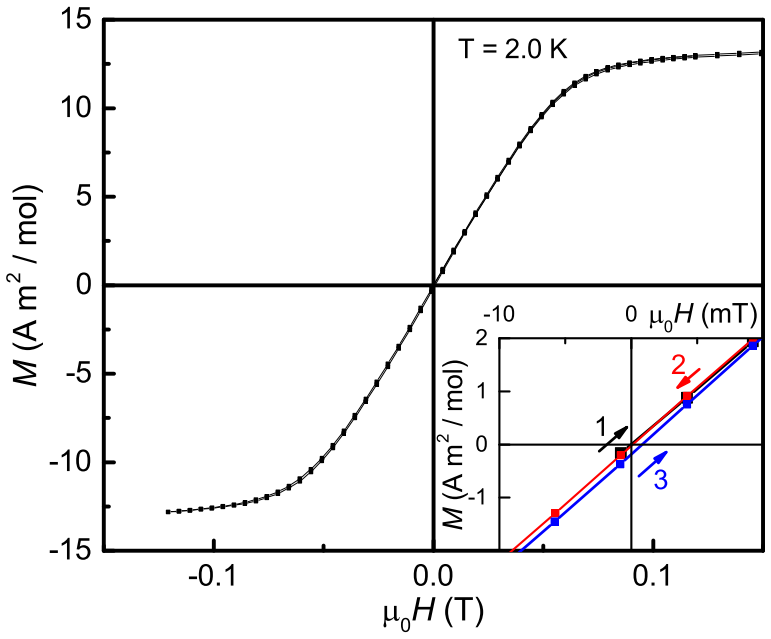
At 8 GPa and high temperature, the authors synthesized the compound RhMnFeCoGe4 with the cubic B20 structure, in which Rh, Mn, Fe and Co share the 4a transition-metal site with equal probability while Ge occupies the other 4a site. Magnetization and susceptibility show a ferromagnetic transition at TC = 146 ± 1 K with a spontaneous moment of 2.5 μB per formula unit at 2 K and essentially no hysteresis; a modified Arrott-plot analysis gives β = 0.337, γ = 1.121, and δ = 4.326 via the Widom relation, with short-range order appearing above TC near 250 K. Zero-field NMR identifies Mn and Co moments of about 2.2 and 0.5 μB, and ab initio calculations give a lattice constant about 1% smaller than
Load-bearing premise
The load-bearing premise is that the ferromagnetic transition at 146 K and the pressure response belong to the B20 RhMnFeCoGe4 phase itself, rather than to the few weight-percent Fe1.67Ge impurity phase whose peaks appear in the same X-ray pattern.
Editorial extensions
If this is right
- If the 146 K transition is intrinsic, non-centrosymmetric B20 magnets can be made with four metals on one site, extending the search space for chiral magnets beyond binary and pseudobinary compounds.
- The measured critical exponents place the transition near 3D Ising behavior, so the random-site compound behaves as a disordered Ising-like ferromagnet rather than a mean-field one.
- The positive initial dTC/dP = 1.9 K/GPa, opposite to FeGe and MnGe, means chemical substitution into the B20 sublattice can reverse the pressure response of magnetism.
- The kink at μ0HC2 ≈ 60 mT in low-field magnetization, analogous to MnSi's Hc2, suggests a helical or skyrmion-host candidate in this high-entropy system, though neutron scattering is needed to confirm.
- NMR and density-functional theory together give a site-resolved picture dominated by Mn and Fe moments, making the compound a benchmark for high-entropy B20 systems.
Reading between the lines
- Beyond the paper: if the intrinsic ferromagnetism is confirmed on a phase-pure sample, varying the Co/Fe ratio on the four-metal sublattice is a direct test of whether TC and dTC/dP can be tuned continuously in B20 high-entropy compounds.
- Beyond the paper: the few weight-percent Fe1.67Ge impurity flagged in the X-ray pattern could contribute a magnetic signal near 146 K; element-selective magnetization or neutron diffraction on the same sample would settle whether the reported exponents belong to the B20 phase.
- Beyond the paper: the positive pressure coefficient, if it reflects magnetovolume coupling in a disordered lattice, suggests that chemical pressure from larger substituents might raise TC further without applying external pressure.
- Beyond the paper: the absence of hysteresis and the very low coercivity at 2 K suggest possible use as a soft magnet or spin-source layer if thin films of this B20 phase can be grown.
Editorial analysis
A structured set of objections, weighed in public.
Referee Report
Summary. The paper reports the high-pressure synthesis of a new high-entropy compound, RhMnFeCoGe4, in the cubic non-centrosymmetric B20 structure, and characterizes it by X-ray diffraction, magnetization, AC susceptibility, resistivity, zero-field 55Mn NMR, and ab initio calculations. The main claims are that the compound is a ferromagnet with TC = 146 K, a spontaneous moment of 2.5 μB/f.u. at 2 K, critical exponents β = 0.337, γ = 1.121, and δ = 4.326, a positive initial pressure coefficient dTC/dP = 1.9 K/GPa, and Mn/Co moments of 2.2 μB and 0.5 μB from NMR. DFT calculations reproduce the lattice constant and give a moment of 3.2 μB/f.u., close to the experimental value.
Significance. If the central claims are correct, the paper introduces a new B20 high-entropy chiral magnet, extending high-entropy alloys to a non-centrosymmetric host and providing a platform for skyrmion physics. The combination of high-pressure synthesis, bulk characterization, NMR, and DFT is a useful approach, and the structural refinement and band-structure calculations are concrete contributions. However, the quantitative magnetic results — TC, the ordered moment, the critical exponents, and the pressure effect — are extracted from bulk measurements on a sample that the paper itself reports contains a few wt.% of the magnetic impurity Fe1.67Ge. The critical-exponent analysis is also partly circular. These load-bearing issues must be resolved before the phenomenological claims can be accepted; the paper's value currently lies more in the synthesis and structural identification than in the magnetic characterization.
major comments (4)
- [§3.1–§3.4] The paper first states the samples are “single-phase” (Sec. 3.1) and then immediately reports “few wt. % of the impurity phase of Fe1.67Ge.” All quantitative magnetic results — TC = 146 K, Ms = 2.5 μB/f.u., dTC/dP = 1.9 K/GPa, and the critical exponents — are bulk magnetization/susceptibility values measured on this composite. Fe1.67Ge is a known magnetic iron germanide (Refs. 22–24); even a few weight percent can produce a substantial low-field signal, a spurious transition-like feature, or a significant offset in the spontaneous moment. No impurity-subtracted data, reference measurement on Fe1.67Ge, or element-specific magnetic probe (e.g., XMCD, neutron diffraction) is provided to separate the contributions. Therefore the intrinsic nature of TC = 146 K and the other quantitative magnetic claims is not established.
- [§3.4, Eqs. (1)–(3)] The critical exponents are obtained by an iterative self-consistent fit of the same M(H,T) isotherms: a modified Arrott plot with β and γ is used to extract MS(T) and χ−1(T), which are then fitted to Eqs. (1) and (2) to obtain new β and γ. This is a recognized technique, but the reported uncertainties (β = 0.337±0.001, γ = 1.121±0.001) are the convergence tolerance of the iteration, not statistical uncertainties from fitting; no goodness-of-fit criteria or confidence intervals are reported. Moreover, δ = 4.326 is computed from the Widom relation and then “verified” by comparing Eq. (3) with the M(μ0H) isotherm at T = 145 K from the same dataset. This verification is circular because both the exponent and the isotherm are outputs of the same fitting procedure. A global scaling analysis (M = ε^β f±(H/ε^{β+γ})) with proper error propagation, and an independent isotherm fit at TC to obtain δ
- [§3.5] The NMR-derived moments are model-dependent. The Mn moment of 2.2 μB is obtained by scaling the 55Mn resonance frequency with the hyperfine constant A = −106 kOe/μB taken from MnGe, with no quantitative discussion of how the high-entropy local environment changes A. The Co moment of 0.5 μB is obtained using a generic constant A ≈ −100 kOe/μB per 3d electron, which is an order-of-magnitude estimate. These assumptions are acknowledged, but the resulting moments are then compared with DFT and presented as experimental support. The comparison is not a validation. The moments should be labeled as model-dependent estimates, or complemented by an independent determination (e.g., XMCD or neutron diffraction).
- [§3.3 and Fig. 3] The spontaneous magnetization is extracted by intersecting a tangent line to the M(μ0H) curve at 9 T with the ordinate axis. This is a nonstandard procedure, and because the magnetization does not fully saturate (Fig. 3a), the value 2.5 μB/f.u. carries an unquantified systematic uncertainty. The observed spontaneous magnetization below 250 K and the 60 mT kink (Figs. 3b and 5) are derived from the same bulk data. In a sample containing a few wt.% of Fe1.67Ge, these features cannot be assigned to the B20 phase without phase-specific measurements or an explicit impurity subtraction.
minor comments (6)
- [§3.1] The term “single-phase” is inconsistent with the reported Fe1.67Ge peaks; rephrase to “majority B20 phase with a few wt.% Fe1.67Ge impurity.”
- [Figures 2–12] Many figure captions and axis labels contain garbled LaTeX/macros (e.g., “/s48”, “/s109”), making them unreadable in the preprint. The figures should be regenerated cleanly.
- [§3.6] The resistivity derivative is said to show a “sharp transition at TC = 150 K,” while the magnetic TC is 146 K (Sec. 3.4) and 146–150 K elsewhere. Clarify the definition and whether the difference is within uncertainty.
- [§3.7] TC under pressure is defined by a “sharp rise” in the susceptibility, which may differ from the critical-analysis TC. State the criterion explicitly and estimate the associated systematic error.
- [References] Ref. [39] (a photocatalytic oxidation paper) appears unrelated to the hyperfine constant A = −110 kOe/μB cited in Sec. 3.5; please verify. Ref. [22] has an incomplete title.
- [§3.4] The phrase “excellent precision... a consequence of the convergence” is misleading; convergence tolerances are not statistical uncertainties. Please replace with proper fit uncertainties.
Circularity Check
Critical-exponent verification reduces to the same magnetization fit; central synthesis and ferromagnetism claims remain independent.
-
fitted input called prediction
[Section 3.4, Eqs. (1)-(3), Fig. 9]
"The critical exponents β and γ are related to the third critical exponent δ through the Widom relation: δ = 1 + γ/β. Accordingly, the value of δ for the RhMnFeCoGe4 compound can be determined to be 4.326 ± 0.001. ... Figure 9 illustrates the magnetization curve M(µ0H) of the RhMnFeCoGe4 compound at T = 145 K (black line). The red line represents a calculated curve generated using the equation 3 with δ = 4.326. ... It can be seen that the equation 3 accurately describes the experimental M(µ0H) data at T = TC in high magnetic fields, as expected."
β and γ were not independent inputs but were obtained from the very same magnetization isotherms by iterative modified-Arrott fitting (25 iterations until convergence of β, γ and TC). With those fitted values, the modified-Arrott form at T = TC already forces M ∝ H^{β/(β+γ)} = H^{1/δ} for δ = 1 + γ/β. Therefore the red curve in Fig. 9 generated from Eq. (3) with δ = 4.326 is a restatement of the same fitted scaling, not a separate prediction. The agreement with the black M(H) isotherm is a self-consistency check, so the conclusion 'the Widom relation is an effective tool' is not supported by independent evidence.
full rationale
Most of the paper is a self-contained experimental and DFT study of a newly synthesized B20 high-entropy phase. The synthesis, XRD structural assignment, bulk ferromagnetic transition, pressure dependence, and DFT band structure are not circular: they are new measurements and calculations compared with prior binary B20 data. The one genuinely self-referential link is in the critical-behavior section: β, γ, and TC are obtained by iterative modified-Arrott fits to the magnetization isotherms, and δ is then computed from β and γ via the Widom relation; the 'calculated curve' of Eq. (3) using that δ is overlaid on the same isotherms and presented as confirmation. Since the modified-Arrott equation at TC with the fitted β and γ algebraically implies the same H^{1/δ} law, this is a consistency check rather than an independent verification. The NMR-derived moments also rely on an assumed hyperfine constant borrowed from MnGe, but this is an explicit assumption, not a circular derivation. The admitted few wt.% Fe1.67Ge impurity is a serious attribution risk for the bulk magnetic quantities, but it is a validity/contamination concern, not a circularity. Overall, the central discovery claim has independent content; only the critical-exponent 'verification' is internally self-supporting, giving a partial-circularity score of 4.
Assumptions & free parameters
free parameters (3)
- Manganese hyperfine constant A_Mn =
-106 kOe/µB (assumed from MnGe)
- Cobalt hyperfine constant A_Co =
~ -100 kOe/µB (taken from Freeman-Watson estimate)
- Critical exponents and TC =
β = 0.337, γ = 1.121, TC = 146 K
assumptions (6)
- domain assumption Magnetization isotherms in the critical region obey the scaling equation of state underlying modified Arrott plots.
- standard math The Widom relation δ = 1 + γ/β holds for this transition.
- domain assumption Rh, Mn, Fe, and Co occupy the B20 4a site with equal probabilities in a random high-entropy configuration.
- domain assumption The Fe1.67Ge impurity (few wt.%) does not materially affect the measured magnetization and TC.
- domain assumption The MnGe hyperfine constant A_Mn applies to RhMnFeCoGe4.
- domain assumption DFT with PBE-GGA and an idealized ordered structure captures the essential magnetic ground state.
Cite this review
Pith. "Pith review of The New High-entropy Compound RhMnFeCoGe4 with Cubic Non-centrosymmetric B20 Structure." pith.science (2026). https://pith.science/paper/DFPC2NGG
@misc{pith2026260803523,
  author       = {Pith},
  title        = {Pith review of: The New High-entropy Compound RhMnFeCoGe4 with Cubic Non-centrosymmetric B20 Structure},
  year         = {2026},
  howpublished = {\url{https://pith.science/paper/DFPC2NGG}},
  note         = {Machine review of arXiv:2608.03523}
}
abstract
A novel high-entropy compound, RhMnFeCoGe$_4$, with a cubic non-centrosymmetric B20 struc- ture, has been synthesized under conditions of high pressure and temperature. The electrical transport and magnetic properties of the obtained compound at both ambient and elevated pres- sures have been investigated. In addition, nuclear magnetic resonance (NMR) spectra were obtained at 4.2 K and ab initio calculations were performed. The new material exhibits ferromag- netic behavior with a critical temperature of $T_C$ = 146 K and a spontaneous moment of 2.5 $\mu_B$ per formula unit. The magnetization data obtained at the critical region yielded the critical temperature and exponents, which were found to be $T_C$ = 146(1) K, $\beta$ = 0.337(1), $\gamma$ = 1.121(1), and $\delta$ = 4.326(1). The magnetic moments of Mn and Co were determined from NMR spectra to be 2.2 $\mu_B$ and 0.5 $\mu_B$, respectively. Ab initio calculations yielded reasonable values for the lattice parameter and the magnetic moments of all constituents. The density of states and band structure are determined for both paramagnetic and ferromagnetic states. Lattice compression results in the increase in the $T_C$.
Figures


Figures from the paper (11 more)


Reference graph
Works this paper leans on
-
[1]
T. Adams, S. Mühlbauer, C. Pfleiderer, F. Jonietz, A. Bauer, A. Neubauer, R. Georgii, P. Böni, U. Keiderling, K. Everschor, M. Garst, A. Rosch, Long-Range Crystalline Nature of the Skyrmion Lattice in MnSi, Phys. Rev. Lett. 107 (2011) 217206. doi:10.1103/PhysRevLett.107.217206
-
[2]
A. Tonomura, X. Yu, K. Yanagisawa, T. Matsuda, Y. Onose, N. Kanazawa, H. S. Park, Y. Tokura, Real-Space Observation of Skyrmion Lattice in Helimagnet MnSi Thin Samples, Nano Letters 12 (3) (2012) 1673–1677, pMID: 22360155. doi:10.1021/nl300073m
-
[3]
X. Yu, N. Kanazawa, Y. Onose, K. Kimoto, W. Zhang, S. Ishiwata, Y. Matsui, Y. Tokura, Near room-temperature formation of a skyrmion crystal in thin-films of the helimagnet FeGe, Nature materials 10 (2) (2011) 106–109. doi:10.1038/nmat2916
doi:10.1038/nmat2916 2011
-
[4]
C. Pfleiderer, G. J. McMullan, S. R. Julian, G. G. Lonzarich, Magnetic quantum phase transition in MnSi under hydrostatic pressure, Phys. Rev. B 55 (1997) 8330–8338. doi:10.1103/PhysRevB.55. 8330
-
[5]
P. Pedrazzini, H. Wilhelm, D. Jaccard, T. Jarlborg, M. Schmidt, M. Hanfland, L. Akselrud, H. Q. Yuan, U. Schwarz, Y. Grin, F. Steglich, Metallic State in Cubic FeGe Beyond Its Quantum Phase Transition, Phys. Rev. Lett. 98 (2007) 047204. doi:10.1103/PhysRevLett.98.047204
-
[6]
M. Deutsch, O. L. Makarova, T. C. Hansen, M. T. Fernandez-Diaz, V. A. Sidorov, A. V. Tsvyashchenko, L. N. Fomicheva, F. Porcher, S. Petit, K. Koepernik, U. K. Rößler, I. Mirebeau, Two-step pressure-induced collapse of magnetic order in the MnGe chiral magnet, Phys. Rev. B 89 (2014) 180407. doi:10.1103/PhysRevB.89.180407
-
[7]
N. Martin, M. Deutsch, J.-P. Itié, J.-P. Rueff, U. K. Rössler, K. Koepernik, L. N. Fomicheva, A. V. Tsvyashchenko, I. Mirebeau, Magnetovolume effect, macroscopic hysteresis, and moment collapse in the paramagnetic state of cubic MnGe under pressure, Phys. Rev. B 93 (2016) 214404. doi:10.1103/PhysRevB.93.214404
-
[8]
P. Tang, Q. Zhou, S.-C. Zhang, Multiple Types of Topological Fermions in Transition Metal Silicides, Phys. Rev. Lett. 119 (2017) 206402. doi:10.1103/PhysRevLett.119.206402
Show all 44 references
-
[9]
Tsvyashchenko, V
A. Tsvyashchenko, V. Sidorov, A. Petrova, L. Fomicheva, I. Zibrov, V. Dmitrienko, Superconduc- tivity and magnetism in noncentrosymmetric RhGe, Journal of Alloys and Compounds 686 (2016) 431–437. doi:10.1016/j.jallcom.2016.06.048
2016 doi
-
[10]
Beille, J
J. Beille, J. Voiron, F. Towfiq, M. Roth, Z. Y. Zhang, Helimagnetic structure of the Fe 1−xCoxSi alloys, Journal of Physics F: Metal Physics 11 (10) (1981) 2153. doi:10.1088/0305-4608/11/10/026
1981 doi
-
[11]
S. V. Grigoriev, S.-A. Siegfried, E. V. Altynbayev, N. M. Potapova, V. Dyadkin, E. V. Moskvin, D. Menzel, A. Heinemann, S. N. Axenov, L. N. Fomicheva, A. V. Tsvyashchenko, Flip of spin helix chirality and ferromagnetic state in Fe 1−xCoxGe compounds, Phys. Rev. B 90 (2014) 174...
2014 doi
-
[12]
J. Guo, H. Wang, F. von Rohr, Z. Wang, S. Cai, Y. Zhou, K. Yang, A. Li, S. Jiang, Q. Wu, R. J. Cava, L. Sun, Robust zero resistance in a superconducting high-entropy alloy at pressures up to 190 GPa, Proceedings of the National Academy of Sciences 114 (50) (2017) 13144–13147. ...
2017 doi
-
[13]
M. R. Kasem, Y. Nakahira, H. Yamaoka, R. Matsumoto, A. Yamashita, H. Ishii, N. Hiraoka, Y. Takano, Y. Goto, Y. Mizuguchi, Robustness of superconductivity to external pressure in high- entropy-alloy-type metal telluride AgInSnPbBiTe 5, Scientific Reports 12 (1) (2022). doi:10.1...
2022
-
[14]
Cheng, J
Z. Cheng, J. Sun, X. Gao, Y. Wang, J. Cui, T. Wang, H. Chang, Irradiation effects in high- entropy alloys and their applications, Journal of Alloys and Compounds 930 (2023) 166768. doi: 10.1016/j.jallcom.2022.166768
2023
-
[15]
Z. Su, J. Ding, M. Song, L. Jiang, T. Shi, Z. Li, S. Wang, F. Gao, D. Yun, E. Ma, C. Lu, Enhancing the radiation tolerance of high-entropy alloys via solute-promoted chemical heterogeneities, Acta Materialia 245 (2023) 118662. doi:10.1016/j.actamat.2022.118662
2023
-
[16]
S. Tang, H. Dong, Z. Huang, B. Chen, H. Tang, Exploring the magnetic behavior of a magnetic high-entropy alloy with dual-phase B20 crystal structure, Journal of Superconductivity and Novel Magnetism 36 (7) (2023) 1673–1682. doi:10.1007/s10948-023-06610-8 . 20
2023 doi
-
[17]
S. J. Kim, K. N. Yoon, W.-S. Ko, E. S. Park, Entropy-stabilized silicides: Expanding the b20 single- phase region from mono-silicide to high-entropy silicide, APL Materials 10 (12) (2022) 121105. doi:10.1063/5.0123794
2022 doi
-
[18]
A. E. Petrova, V. A. Sidorov, S. M. Stishov, High-pressure helium gas apparatus and hydrostatic toroid cell for low-temperatures applications, Physica B: Condensed Matter 359-361 (2005) 1463– 1465, proceedings of the International Conference on Strongly Correlated Electron Sys...
2005 doi
-
[19]
Kresse, D
G. Kresse, D. Joubert, From ultrasoft pseudopotentials to the projector augmented-wave method, Phys. Rev. B 59 (1999) 1758–1775. doi:10.1103/PhysRevB.59.1758
1999 doi
-
[20]
Kresse, J
G. Kresse, J. Furthmüller, Efficient iterative schemes for ab initio total-energy calculations using a plane-wave basis set, Phys. Rev. B 54 (1996) 11169–11186. doi:10.1103/PhysRevB.54.11169
1996 doi
-
[21]
J. P. Perdew, K. Burke, M. Ernzerhof, Generalized gradient approximation made simple, Phys. Rev. Lett. 77 (1996) 3865–3868. doi:10.1103/PhysRevLett.77.3865
1996 doi
-
[22]
Richardson, The partial equilibrium diagram of the Fe-Ge system in the range 40-72 at
M. Richardson, The partial equilibrium diagram of the Fe-Ge system in the range 40-72 at. chemical transport reactions, Acta Chemica Scandinavica 21 (1967) 2305–2317. doi:10.3891/acta.chem.scand. 21-2305
1967 doi
-
[23]
Yasukōchi, K
K. Yasukōchi, K. Kanematsu, T. Ohoyama, Magnetic properties of intermetallic compounds in iron- germanium system : Fe 1.67Ge and FeGe 2, Journal of the Physical Society of Japan 16 (3) (1961) 429–433. doi:10.1143/JPSJ.16.429
1961 doi
-
[24]
Oleszak, E
D. Oleszak, E. Jartych, A. Antolak, M. Pekała, M. Szymańska, M. Budzyński, Structure, hyperfine interactions and magnetization studies of mechanically alloyed Fe 50Ge50 and Fe 62Ge38, Journal of Alloys and Compounds 400 (1) (2005) 23–28. doi:10.1016/j.jallcom.2005.03.054
2005 doi
-
[25]
Narozhnyi, V
V. Narozhnyi, V. Krasnorussky, Specific features of magnetic phase diagram of an MnSi he- limagnet, Journal of Experimental and Theoretical Physics 116 (2013) 785–790. doi:10.1134/ S1063776113050087
2013
-
[26]
Bloch, J
D. Bloch, J. Voiron, V. Jaccarino, J. Wernick, The high field-high pressure magnetic properties of MnSi, Physics Letters A 51 (5) (1975) 259–261. doi:10.1016/0375-9601(75)90438-7
1975 doi
-
[27]
DiTusa, S
J. DiTusa, S. Zhang, K. Yamaura, Y. Xiong, J. Prestigiacomo, B. Fulfer, P. Adams, M. Brickson, D. Browne, C. Capan, et al., Magnetic, thermodynamic, and electrical transport properties of the noncentrosymmetric B 20 germanides MnGe and CoGe, Physical Review B 90 (14) (2014) 14...
2014 doi
-
[28]
Arrott, Criterion for Ferromagnetism from Observations of Magnetic Isotherms, Phys
A. Arrott, Criterion for Ferromagnetism from Observations of Magnetic Isotherms, Phys. Rev. 108 (1957) 1394–1396. doi:10.1103/PhysRev.108.1394
1957 doi
-
[29]
Shimizu, H
K. Shimizu, H. Maruyama, H. Yamazaki, H. Watanabe, Effect of spin fluctuations on magnetic properties and thermal expansion in pseudobinary system Fe xCo1−xSi, Journal of the Physical So- ciety of Japan 59 (1) (1990) 305–318. doi:10.1143/JPSJ.59.305
1990 doi
-
[30]
Kaul, Static critical phenomena in ferromagnets with quenched disorder, Journal of magnetism and magnetic materials 53 (1-2) (1985) 5–53
S. Kaul, Static critical phenomena in ferromagnets with quenched disorder, Journal of magnetism and magnetic materials 53 (1-2) (1985) 5–53. doi:10.1016/0304-8853(85)90128-3
1985 doi
-
[31]
Chattopadhyay, P
M. Chattopadhyay, P. Arora, S. Roy, Magnetic properties of the field-induced ferromagnetic state in MnSi, Journal of Physics: Condensed Matter 21 (29) (2009) 296003. doi:10.1088/0953-8984/21/ 29/296003
2009 doi
-
[32]
Krasnorussky, A
V. Krasnorussky, A. Semeno, M. Anisimov, D. Salamatin, A. Bokov, N. Chtchelkatchev, M. Magnit- skaya, V. Sidorov, A. Bogach, A. Tsvyashchenko, Study of magnetic, thermodynamic and transport properties of laves phase NdRh 2, Journal of Magnetism and Magnetic Materials 610 (2024...
2024
-
[33]
Muellner, J
W. Muellner, J. Kouvel, Critical magnetic behavior of giant moments in Ni-Rh, Solid State Com- munications 15 (2) (1974) 441–444. doi:10.1016/0038-1098(74)90795-9
1974 doi
-
[34]
M. E. Fisher, The theory of equilibrium critical phenomena, Reports on Progress in Physics 30 (2) (1967) 615. doi:10.1088/0034-4885/30/2/306
1967 doi
-
[35]
Allodi, R
G. Allodi, R. De Renzi, G. Guidi, F. Licci, M. W. Pieper, Electronic phase separation in lanthanum manganites: Evidence from 55Mn NMR, Phys. Rev. B 56 (1997) 6036–6046. doi:10.1103/PhysRevB. 56.6036
1997 doi
-
[36]
C. P. Slichter, Principles of magnetic resonance, Vol. 1, Springer Science & Business Media, 2013
2013
-
[37]
O. L. Makarova, A. V. Tsvyashchenko, G. Andre, F. Porcher, L. N. Fomicheva, N. Rey, I. Mirebeau, Neutron diffraction study of the chiral magnet MnGe, Phys. Rev. B 85 (2012) 205205. doi:10.1103/ PhysRevB.85.205205
2012
-
[38]
Yasuoka, V
H. Yasuoka, V. Jaccarino, R. C. Sherwood, J. H. Wernick, NMR and susceptibility studies of MnSi above Tc, Journal of the Physical Society of Japan 44 (3) (1978) 842–849. doi:10.1143/JPSJ.44.842
1978 doi
-
[39]
T. K. Ghorai, S. Pramanik, P. Pramanik, Synthesis and photocatalytic oxidation of different organic 21 dyes by using Mn 2O3/TiO2 solid solution and visible light, Applied surface science 255 (22) (2009) 9026–9031. doi:10.1016/j.apsusc.2009.06.086
2009 doi
-
[40]
A. J. Freeman, R. E. Watson, Hyperfine interactions in magnetic materials, Magnetism IIA (1965) 167–305
1965
-
[41]
S.-H. Baek, V. A. Sidorov, A. V. Nikolaev, T. Klimczuk, F. Ronning, A. V. Tsvyashchenko, Possible quadrupole-order-driven commensurate-incommensurate phase transition in B20 CoGe, Phys. Rev. B 105 (2022) 165132. doi:10.1103/PhysRevB.105.165132
2022 doi
-
[42]
V. A. Sidorov, A. E. Petrova, N. M. Chtchelkatchev, M. V. Magnitskaya, L. N. Fomicheva, D. A. Salamatin, A. V. Nikolaev, I. P. Zibrov, F. Wilhelm, A. Rogalev, A. V. Tsvyashchenko, Magnetic, electronic, and transport properties of the high-pressure-synthesized chiral magnets Mn...
2018 doi
-
[43]
D. A. Salamatin, V. A. Sidorov, Z. Surowiec, A. V. Bokov, M. V. Magnitskaya, N. M. Chtchelkachev, M. Wiertel, M. Budzynski, A. V. Tsvyashchenko, The hyperfine magnetic fields and the effect of high pressure on the magnetic transition temperatures of the noncentrosymmetric FeRh...
2022 doi
-
[44]
Blaha, K
P. Blaha, K. Schwarz, F. Tran, R. Laskowski, G. K. H. Madsen, L. D. Marks, Wien2k: An apw+lo program for calculating the properties of solids, The Journal of Chemical Physics 152 (7) (2020) 074101. doi:10.1063/1.5143061. 22
2020 doi
Reviewed August 5, 2026 · model on record in the stance chip above.
Discussion (0). Continue with ORCID to comment.