REVIEW 3 major objections 5 minor 28 references
Fast PET Reconstruction with Variance Reduction and Prior-Aware Preconditioning
T0 review · 3 major / 5 minor · reviewed 2026-08-07 · deepseek-v4-flash
Pith's one-line read Regularized PET reconstruction can be made both fast and stable by folding the prior's curvature into the preconditioner.
desk verdict Useful heuristic and a clear account of the PETRIC win, but the key comparative claim rests on single-run inverse-crime curves and needs more evidence. read the letter →
The pith
A machine-rendered reading of the paper's core claim, the machinery that carries it, and where it could break.
The reading
What carries the argument
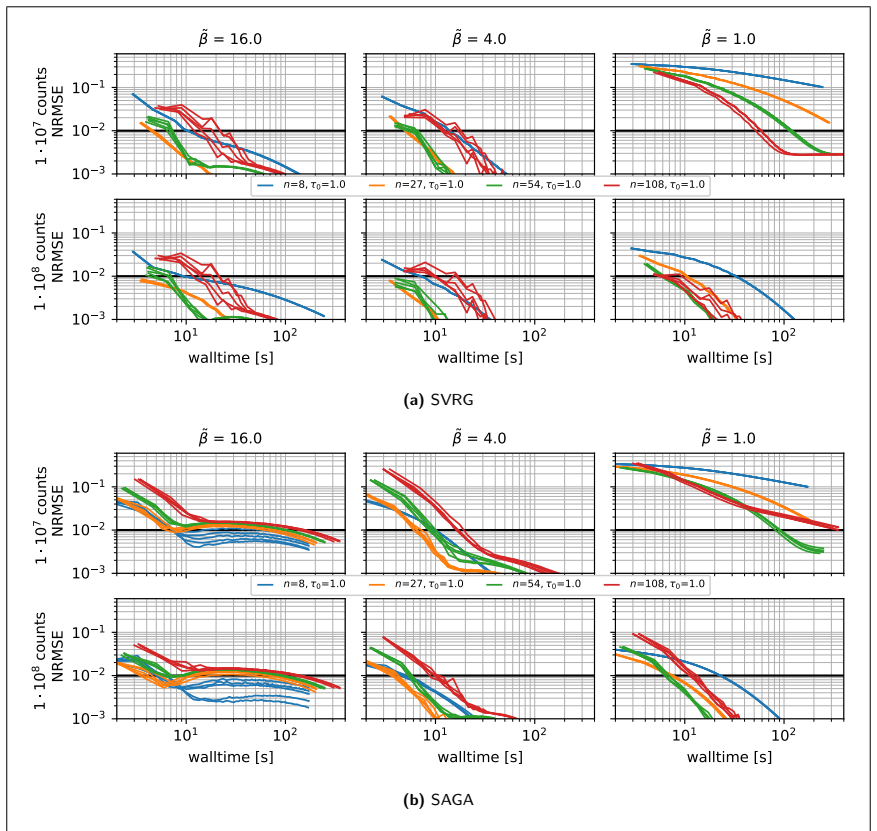
The central object is the harmonic-mean preconditioner: a diagonal matrix $D(x)$ obtained from the harmonic mean $h(a,b)=2/(1/a+1/b)$ of the MLEM preconditioner $D_{\mathrm{MLEM}}(x)=\mathrm{diag}\big((x+\delta)/(A^\top 1)\big)$ and the inverse diagonal Hessian of the relative difference prior $D_{\beta S}(x)=\mathrm{diag}(1/\mathrm{diag}(H_{\beta S}(x)))$, with a strength parameter $\alpha$ controlling how much prior curvature enters. It is cheap: only the diagonal of the Hessian of the RDP is needed, and the paper finds it need only be updated in the first three to six epochs. The mechanism by which it carries the argument is that it approximates the inverse Hessian of the full smooth objective, thereby stabilizing unit stepsizes across different counts and regularization strengths, while the MLEM-only preconditioner underestimates curvature when the prior is strong. The other ingredients—SVRG's variance reduction and a moderate number of subsets ($n\approx 27$)—matter, but the paper identifies the preconditioner as the element that made the other choices robust.
What would settle it
A decisive check is to run the submitted SVRG algorithm on a PETRIC test dataset such as Vision600 Hoffman with the harmonic-mean preconditioner replaced by the classic MLEM preconditioner, tuning the initial stepsize and decay schedule to whatever values are best; if the MLEM-preconditioned run reaches all PETRIC convergence thresholds (whole-object NRMSE below $10^{-2}$ and the VOI error thresholds) in equal or less wall time than the harmonic-mean version, the paper's central claim that prior-aware preconditioning is the decisive factor would be contradicted.
Extended reading notes
Core claim
The paper's central claim is that the decisive design choice for fast, stable RDP-regularized PET reconstruction is a preconditioner that includes information about the regularizer. Concretely, it uses the (scaled) harmonic mean of the standard MLEM preconditioner and the inverse diagonal Hessian of the relative difference prior, $$D(x)=\left(D_{\mathrm{MLEM}}^{-1}(x)+\$\alpha$\,D_{\$\beta$ S}^{-1}(x)\right)^{-1},$$ so that regions where the prior contributes large curvature receive proportionally smaller updates. The paper reports that with this preconditioner, SVRG converges reliably at $\tau^{(0)}=1$ with mild decay in every count and regularization regime it tested, whereas the MLEM-only preconditioner diverges or converges extremely slowly under strong regularization ($\tilde{\beta}=16$). It further claims that SVRG slightly outperforms SAGA, that both clearly outperform plain SGD, and that about 27 subsets give the fastest wall-time convergence; these choices, embedded in three submitted algorithms, consistently reached the PETRIC convergence thresholds on real test datasets. The conclusion is that variance reduction plus a prior-aware preconditioner removes the need for per-dataset stepsize tuning.
Load-bearing premise
The load-bearing premise is that the inverse-crime simulations of Section 3.1, in which the same simulated scanner and projector are used to generate the data and to reconstruct it, are faithful enough to real PET acquisitions that the algorithm rankings and the best settings found there—SVRG over SGD, about 27 subsets, the harmonic-mean preconditioner, and the stepsize schedule—also hold on the clinical PETRIC datasets. If real scanner geometry, noise correlations, or resolution effects shift the ordering, the derived design choices may not transfer.
Editorial extensions
If this is right
- If the claim is right, RDP-regularized PET reconstruction can be run at a unit initial stepsize with only mild decay, without scanner-specific or count-specific stepsize tuning.
- SVRG (or SAGA) with roughly 25–30 subsets will beat plain SGD in wall-time to practical convergence across clinically relevant count and regularization regimes.
- The harmonic-mean preconditioner is the component that makes these speed-ups reliable: removing it reintroduces divergence or very slow convergence under strong regularization.
- The three submitted algorithms reach the PETRIC convergence thresholds on all test datasets, with whole-object NRMSE being the last metric to converge, meaning practical runtime is bounded by that metric.
- Fast inverse-crime simulations are a sufficient development loop: design choices found there transferred directly to real scanner data in the challenge.
Reading between the lines
- Editorial inference: the harmonic-mean construction is generic — any smooth regularizer with a cheap diagonal Hessian (total generalized variation, anatomical priors, learned regularizers) could be folded into the same preconditioner, potentially extending the result beyond RDP.
- Editorial inference: because the preconditioner uses only the diagonal Hessian and the MLEM scaling, the recipe should transfer to other Poisson inverse problems where MLEM-type scaling is standard, such as single-photon emission CT or list-mode PET.
- Editorial inference: a conservative reading of the paper's evidence is that updating the preconditioner only in the first few epochs is sufficient in inverse-crime settings; on very low-count or non-ToF real data, more frequent updates could in principle help, which is a testable extension the paper did not explore.
Editorial analysis
A structured set of objections, weighed in public.
Referee Report
Summary. This paper reports the winning contribution of the MaGeZ team to the 2024 PET Rapid Image Reconstruction Challenge (PETRIC). The authors study stochastic subset-based optimization methods (SGD, SAGA, SVRG) for RDP-regularized PET reconstruction, with emphasis on a diagonal preconditioner combining the classical MLEM preconditioner and the inverse diagonal Hessian of the RDP via a scaled harmonic mean (Eq. 9). Through fast inverse-crime simulations, they conclude that this prior-aware preconditioner is essential for stable convergence at initial stepsize tau^(0) approximately 1, that SVRG is slightly preferable to SAGA, and that n approximately 27 subsets is near-optimal. These insights are translated into three submitted algorithms (ALG1-3), all using SVRG with the harmonic preconditioner, which are validated on real PETRIC datasets and achieve the fastest convergence overall.
Significance. The paper is a strong empirical contribution: it documents a reproducible winning challenge entry, provides extensive ablation experiments, and proposes a simple, computationally cheap preconditioning heuristic that addresses a real practical problem (stepsize tuning under strong regularization). The availability of code and data is a notable strength. However, the headline claim—that the harmonic preconditioner is crucial—rests on single-run comparisons in simulations and is never ablated on the real PETRIC data, so the evidence is not yet fully commensurate with the strength of the claim.
major comments (3)
- [§3.2, Fig. 2; §3.3] The claim that the MLEM preconditioner 'diverges or converges extremely slowly' at beta-tilde = 16 and that the harmonic-mean preconditioner is 'essential' is based on a single run per configuration, as stated in the Fig. 2 caption. Figure 4 provides five-seed stability only for the harmonic preconditioner, not for the MLEM comparison that the claim depends on. Please provide repeated runs (e.g., five seeds) for the MLEM preconditioner at least in the critical beta-tilde = 16, tau^(0) = 1 cases, with shaded ranges or error bars, so that the central comparative claim is statistically supported.
- [§2.3, Eq. (9)] The scaling parameter alpha in the harmonic-mean preconditioner and the stabilization constant delta in D_MLEM are never specified for the experiments. Because the behavior of the harmonic preconditioner depends critically on alpha, and the comparison to the MLEM preconditioner depends on delta, the reader cannot determine whether the comparison is tuned fairly or reproduce the results. Please report the values used for alpha, delta, and the RDP parameters gamma and epsilon.
- [§4.1, Figs. 7-8] The PETRIC validation uses only the three submitted algorithms, all of which employ the harmonic preconditioner. The assertion that this preconditioner is 'essential' is never tested on the actual target domain: an ablation replacing the harmonic preconditioner with the MLEM preconditioner on at least one real dataset is needed to confirm the design choice in the setting where it matters.
minor comments (5)
- [§1.1] 'nonnegativity constrains' should be 'nonnegativity constraints'.
- [§2.3, Eq. (9)] The expression 'D(x) = 1/2 h(D_MLEM, alpha^{-1}D_betaS)' is a nonstandard use of the harmonic mean; consider defining the scaled harmonic mean directly to avoid confusion with the conventional harmonic mean.
- [Appendix A.2, Algorithm 1] The condition 'k mod (omega n) = 0' uses the iteration index k, while Table 1 refers to 'preconditioner update epochs'; please clarify whether update_pc_iters contains iteration indices or epoch numbers and align the notation with the text.
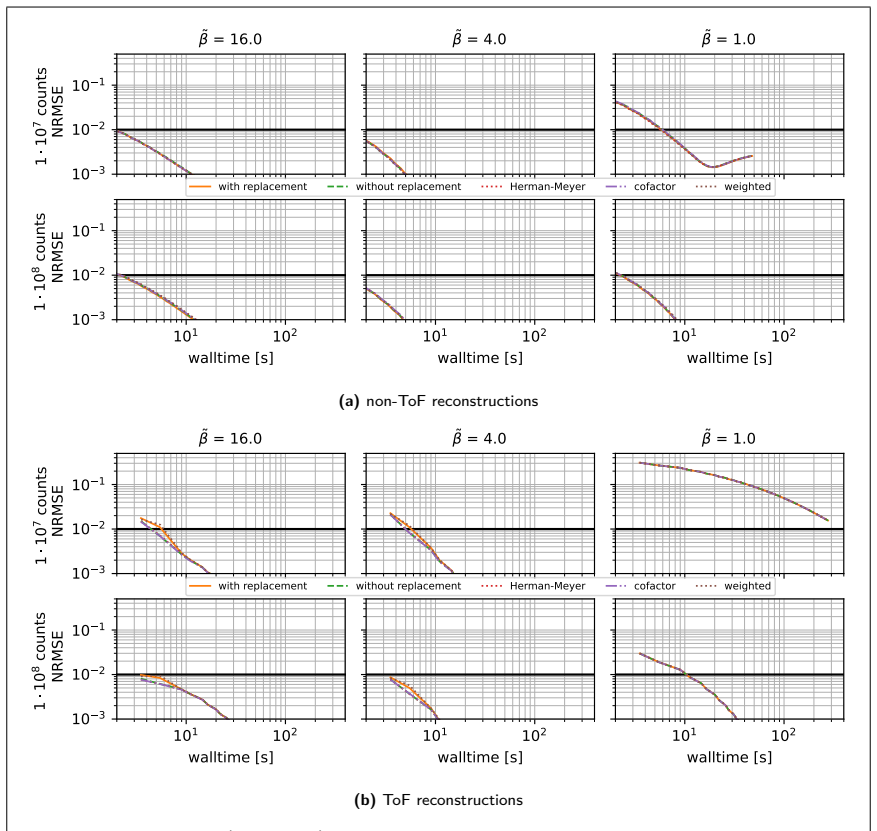
- [§2.4] The cofactor order is introduced as a novel sampling rule, but Figure 5 shows it yields negligible differences; the paper should state explicitly whether it is retained only for its marginal benefit or for ALG3's robustness.
- [§4.1, Figs. 7-8] The vertical lines indicating convergence times are hard to distinguish across algorithms; a table of wall-clock convergence times per dataset and run would improve readability.
Circularity Check
No significant circularity: the central design conclusions are empirical comparisons against external benchmarks, and the harmonic preconditioner is a Newton-type approximation rather than a restatement of the results.
full rationale
This is an empirical algorithm paper, not a derivation chain whose conclusions are encoded in its inputs. The three load-bearing design conclusions—(i) SVRG/SAGA over SGD, (ii) n≈27 subsets, (iii) the harmonic-mean preconditioner of Eq. (9) enabling τ(0)≈1—come from controlled simulations in Section 3 with NRMSE measured against independently computed L-BFGS-B references, followed by evaluation on the external PETRIC test datasets in Section 4. Equation (9) is derived as a Newton-type diagonal preconditioner: when D_MLEM and α^{-1}D_βS are exact inverse-Hessian diagonals of the data and prior terms, D=(D_MLEM^{-1}+αD_βS^{-1})^{-1} is the inverse of the sum Hessian, so the construction is not defined in terms of the conclusion it supports. The PETRIC leaderboard citation [28] is co-authored by one of the present authors, but it is an externally governed, publicly falsifiable benchmark rather than an imported uniqueness theorem, and the paper also displays its own test-data convergence curves. Remaining concerns—inverse-crime simulation (same projector for generation and reconstruction), single-run curves in Fig. 2, and undisclosed α in Eq. (9)—affect external validity and statistical robustness, not circularity. No fitted parameter is renamed as a prediction and no load-bearing claim reduces to a self-citation.
Assumptions & free parameters
free parameters (7)
- alpha (scaling in harmonic-mean preconditioner) =
not reported
- delta (regularization in MLEM preconditioner) =
not reported
- initial stepsize tau^(0) =
0.3, 1.0, 1.5 (grid)
- stepsize decay eta =
0.02
- number of subsets n =
8, 27, 54, 108
- preconditioner update epochs =
[1,2,3] for ALG1; [1,2,4,6] for ALG2/3
- regularization strength beta tilde =
1, 4, 16
assumptions (6)
- standard math KL divergence is separable in the estimated data and can be split into subset functions as in Eq. (2)
- standard math SAGA and SVRG converge for Lipschitz-smooth objectives with constant stepsizes
- ad hoc to paper The harmonic mean of DMLEM and alpha^-1 D_betaS approximates the inverse Hessian of the combined smooth objective
- domain assumption The inverse-crime simulation with a simulated cylindrical scanner is representative of real PET acquisitions
- domain assumption NRMSE relative to a 500-iteration L-BFGS-B reconstruction is a valid convergence measure and the 0.01 threshold matches clinical image quality
- domain assumption Walltime on a single NVIDIA RTX A4500 GPU is a representative measure of clinical reconstruction speed
Cite this review
Pith. "Pith review of Fast PET Reconstruction with Variance Reduction and Prior-Aware Preconditioning." pith.science (2026). https://pith.science/paper/DGEYXKBB
@misc{pith2026250604976,
  author       = {Pith},
  title        = {Pith review of: Fast PET Reconstruction with Variance Reduction and Prior-Aware Preconditioning},
  year         = {2026},
  howpublished = {\url{https://pith.science/paper/DGEYXKBB}},
  note         = {Machine review of arXiv:2506.04976}
}
read the original abstract
We investigate subset-based optimization methods for positron emission tomography (PET) image reconstruction incorporating a regularizing prior. PET reconstruction methods that use a prior, such as the relative difference prior (RDP), are of particular relevance, as they are widely used in clinical practice and have been shown to outperform conventional early-stopped and post-smoothed ordered subsets expectation maximization (OSEM). Our study evaluates these methods on both simulated data and real brain PET scans from the 2024 PET Rapid Image Reconstruction Challenge (PETRIC), where the main objective was to achieve RDP-regularized reconstructions as fast as possible, making it an ideal benchmark. Our key finding is that incorporating the effect of the prior into the preconditioner is crucial for ensuring fast and stable convergence. In extensive simulation experiments, we compare several stochastic algorithms -- including Stochastic Gradient Descent (SGD), Stochastic Averaged Gradient Amelior\'e (SAGA), and Stochastic Variance Reduced Gradient (SVRG) -- under various algorithmic design choices and evaluate their performance for varying count levels and regularization strengths. The results show that SVRG and SAGA outperformed SGD, with SVRG demonstrating a slight overall advantage. The insights gained from these simulations directly contributed to the design of our submitted algorithms, which formed the basis of the winning contribution to the PETRIC 2024 challenge.
Figures


Figures from the paper (5 more)


Reference graph
Works this paper leans on
-
[1]
Johan Nuyts, Dirk Bequé, Patrick Dupont, and Luc Mortelmans. A concave prior penalizing relative differences for maximum-a-posteriori reconstruction in emission tomography.IEEE Transactions on nuclear science , 49(1):56–60, 2002
work page 2002
-
[2]
Casper da Costa-Luis, Matthias J. Ehrhardt, Christoph Kolbitsch, Evgueni Ovtchinnikov, Edoardo Pasca, Kris Thielemans, and Charalampos Tsoumpas. Petric: Pet rapid image re- construction challenge, 2025
work page 2025
-
[3]
Eugene J. Teoh, Daniel R. McGowan, Ruth E. Macpherson, Kevin M. Bradley, and Fergus V. Gleeson. Phantom and clinical evaluation of the bayesian penalized likelihood reconstruction algorithm q.clear on an lyso pet/ct system.Journal of Nuclear Medicine , 56(9):1447–1452, July 2015
work page 2015
-
[4]
Eugene J. Teoh, Daniel R. McGowan, Kevin M. Bradley, Elizabeth Belcher, Edward Black, and Fergus V. Gleeson. Novel penalised likelihood reconstruction of pet in the assessment of histologically verified small pulmonary nodules.European Radiology, 26(2):576–584, May 2015
work page 2015
-
[5]
Sangtae Ahn, Steven G Ross, Evren Asma, Jun Miao, Xiao Jin, Lishui Cheng, Scott D Wollenweber, and Ravindra M Manjeshwar. Quantitative comparison of osem and penalized likelihood image reconstruction using relative difference penalties for clinical pet.Physics in Medicine and Biology, 60(15):5733–5751, July 2015
work page 2015
-
[6]
Sangtae Ahn and Jeffrey A Fessler. Globally convergent image reconstruction for emission tomography using relaxed ordered subsets algorithms.IEEE transactions on medical imaging , 22(5):613–626, 2003
work page 2003
-
[7]
Robert Twyman, Simon Arridge, Zeljko Kereta, Bangti Jin, Ludovica Brusaferri, Sangtae Ahn, Charles W Stearns, Brian F Hutton, Irene A Burger, Fotis Kotasidis, et al. An inves- tigation of stochastic variance reduction algorithms for relative difference penalized 3d pet image reconstruction. IEEE Transactions on Medical Imaging , 42(1):29–41, 2022. 18
work page 2022
-
[8]
Sirf: synergistic image reconstruction framework.Computer Physics Communications, 249:107087, 2020
Evgueni Ovtchinnikov, Richard Brown, Christoph Kolbitsch, Edoardo Pasca, Casper da Costa-Luis, Ashley G Gillman, Benjamin A Thomas, Nikos Efthimiou, Johannes Mayer, Palak Wadhwa, et al. Sirf: synergistic image reconstruction framework.Computer Physics Communications, 249:107087, 2020
work page 2020
Show all 28 references
-
[9]
Malcolm Hudson and Richard S
H. Malcolm Hudson and Richard S. Larkin. Accelerated image reconstruction using ordered subsets of projection data.IEEE transactions on medical imaging , 13(4):601–609, 1994
1994
-
[10]
Faster pet recon- struction with non-smooth priors by randomization and preconditioning.Physics in Medicine & Biology, 64(22):225019, 2019
Matthias J Ehrhardt, Pawel Markiewicz, and Carola-Bibiane Schönlieb. Faster pet recon- struction with non-smooth priors by randomization and preconditioning.Physics in Medicine & Biology, 64(22):225019, 2019
2019
-
[11]
Stochastic em methods with variance reduction for penalised pet reconstructions
Željko Kereta, Robert Twyman, Simon Arridge, Kris Thielemans, and Bangti Jin. Stochastic em methods with variance reduction for penalised pet reconstructions. Inverse Problems, 37(11):115006, 2021
2021
-
[12]
Georg Schramm and Martin Holler. Fast and memory-efficient reconstruction of sparse poisson data in listmode with non-smooth priors with application to time-of-flight pet.Physics in Medicine & Biology, 67(15):155020, 2022
2022
-
[13]
A guide to stochastic optimisation for large-scale inverse problems.Inverse Problems, 2024
Matthias Joachim Ehrhardt, Zeljko Kereta, Jingwei Liang, and Junqi Tang. A guide to stochastic optimisation for large-scale inverse problems.Inverse Problems, 2024
2024
-
[14]
Stochastic optimisation framework using the core imaging library and synergistic image reconstruction framework for pet reconstruction
Evangelos Papoutsellis, Casper da Costa-Luis, Daniel Deidda, Claire Delplancke, Margaret Duff, Gemma Fardell, Ashley Gillman, Jakob S Jørgensen, Zeljko Kereta, Evgueni Ovtchin- nikov, et al. Stochastic optimisation framework using the core imaging library and synergistic image...
2024 arXiv
-
[15]
Total generalized variation.SIAM Journal on Imaging Sciences , 3(3):492–526, 2010
Kristian Bredies, Karl Kunisch, and Thomas Pock. Total generalized variation.SIAM Journal on Imaging Sciences , 3(3):492–526, 2010
2010
-
[16]
Joint mr-pet reconstruction using a multi-channel image regularizer
Florian Knoll, Martin Holler, Thomas Koesters, Ricardo Otazo, Kristian Bredies, and Daniel K Sodickson. Joint mr-pet reconstruction using a multi-channel image regularizer. IEEE transactions on medical imaging , 36(1):1–16, 2016
2016
-
[17]
Pet reconstruction with an anatomical mri prior using parallel level sets.IEEE transactions on medical imaging, 35(9):2189–2199, 2016
Matthias J Ehrhardt, Pawel Markiewicz, Maria Liljeroth, Anna Barnes, Ville Kolehmainen, John S Duncan, Luis Pizarro, David Atkinson, Brian F Hutton, Sebastien Ourselin, et al. Pet reconstruction with an anatomical mri prior using parallel level sets.IEEE transactions on medica...
2016
-
[18]
Generative adversarial network based regularized image reconstruction for pet.Physics in Medicine & Biology , 65(12):125016, 2020
Zhaoheng Xie, Reheman Baikejiang, Tiantian Li, Xuezhu Zhang, Kuang Gong, Mengxi Zhang, Wenyuan Qi, Evren Asma, and Jinyi Qi. Generative adversarial network based regularized image reconstruction for pet.Physics in Medicine & Biology , 65(12):125016, 2020
2020
-
[19]
Score-based generative models for pet image recon- struction
Imraj RD Singh, Alexander Denker, Riccardo Barbano, Željko Kereta, Bangti Jin, Kris Thiele- mans, Peter Maass, and Simon Arridge. Score-based generative models for pet image recon- struction. Machine Learning for Biomedical Imaging , 2:547–585, 2024
2024
-
[20]
Benefits of using a spatially-variant penalty strength with anatomical priors in pet reconstruction.IEEE Transactions on Medical Imaging, 39(1):11–22, 2019
Yu-Jung Tsai, Georg Schramm, Sangtae Ahn, Alexandre Bousse, Simon Arridge, Johan Nuyts, Brian F Hutton, Charles W Stearns, and Kris Thielemans. Benefits of using a spatially-variant penalty strength with anatomical priors in pet reconstruction.IEEE Transactions on Medical Imag...
2019
-
[21]
Saga: A fast incremental gradient method with support for non-strongly convex composite objectives
Aaron Defazio, Francis Bach, and Simon Lacoste-Julien. Saga: A fast incremental gradient method with support for non-strongly convex composite objectives. InAdvances in Neural Information Processing Systems, volume 2, pages 1646–1654, 2014
2014
-
[22]
Accelerating stochastic gradient descent using predictive vari- ance reduction
Rie Johnson and Tong Zhang. Accelerating stochastic gradient descent using predictive vari- ance reduction. In C J C Burges, L Bottou, M Welling, Z Ghahramani, and K Q Weinberger, editors, Advances in Neural Information Processing Systems , volume 26, 2013
2013
-
[23]
Barzilai-borwein step size for stochastic gradient descent.Advances in neural information processing systems , 29, 2016
Conghui Tan, Shiqian Ma, Yu-Hong Dai, and Yuqiu Qian. Barzilai-borwein step size for stochastic gradient descent.Advances in neural information processing systems , 29, 2016. 19
2016
-
[24]
Dog is sgd’s best friend: A parameter-free dynamic step size schedule
Maor Ivgi, Oliver Hinder, and Yair Carmon. Dog is sgd’s best friend: A parameter-free dynamic step size schedule. InInternational Conference on Machine Learning , pages 14465– 14499. PMLR, 2023
2023
-
[25]
Painless stochastic gradient: Interpolation, line-search, and convergence rates
Sharan Vaswani, Aaron Mishkin, Issam Laradji, Mark Schmidt, Gauthier Gidel, and Simon Lacoste-Julien. Painless stochastic gradient: Interpolation, line-search, and convergence rates. Advances in neural information processing systems , 32, 2019
2019
-
[26]
Herman and Lorraine B
Gabor T. Herman and Lorraine B. Meyer. Algebraic reconstruction techniques can be made computationally efficient (positron emission tomography application).IEEE Transactions on Medical Imaging, 12(3):600–609, 1993
1993
-
[27]
PARALLELPROJ–an open-source framework for fast calculation of projections in tomography
Georg Schramm and Kris Thielemans. PARALLELPROJ–an open-source framework for fast calculation of projections in tomography. Frontiers in Nuclear Medicine , Volume 3 - 2023, 2024
2023
-
[28]
Ehrhardt, Christoph Kolbitsch, Evgueni Ovtchinnikov, Edoardo Pasca, Kris Thielemans, and Charalampos Tsoumpas
Casper da Costa-Luis, Matthias J. Ehrhardt, Christoph Kolbitsch, Evgueni Ovtchinnikov, Edoardo Pasca, Kris Thielemans, and Charalampos Tsoumpas. Petric: Pet rapid image re- construction challenge - leaderboard, 2025. 20
2025
Reviewed August 7, 2026 · model on record in the stance chip above.
Discussion (0). Sign in to comment.