REVIEW 2 major objections 5 minor 61 references
Electron-Transfer-Induced Thermal and Thermoelectric Rectification
T0 review · 2 major / 5 minor · reviewed 2026-08-14 · deepseek-v4-flash
Pith's one-line read Electron transfer between molecular sites with unequal reorganization energies produces thermal and thermoelectric rectification under a temperature gradient.
desk verdict A genuine new non-phononic thermal rectification mechanism, with an overclaimed universal quantifier that a concrete counterexample refutes; the core result survives. read the letter →
The pith
A machine-rendered reading of the paper's core claim, the machinery that carries it, and where it could break.
The reading
The authors then attach the two molecules to metal leads and allow three states: electron on the left, on the right, or on neither. They find the voltage bias that makes the electric current zero at a given temperature difference. In ordinary coherent conductors this bias is an odd function of the temperature difference. Here it is not, and it can even stay nearly unchanged when the temperature bias is reversed, a signature of thermoelectric rectification.
All results come from analytic formulas and illustrative parameter values. No experiment is reported. The main assumptions, negligible direct phonon heat flow between sites and thermal equilibrium of each local environment, are stated in the text and are the conditions under which the predictions hold.
Extended reading notes
Core claim
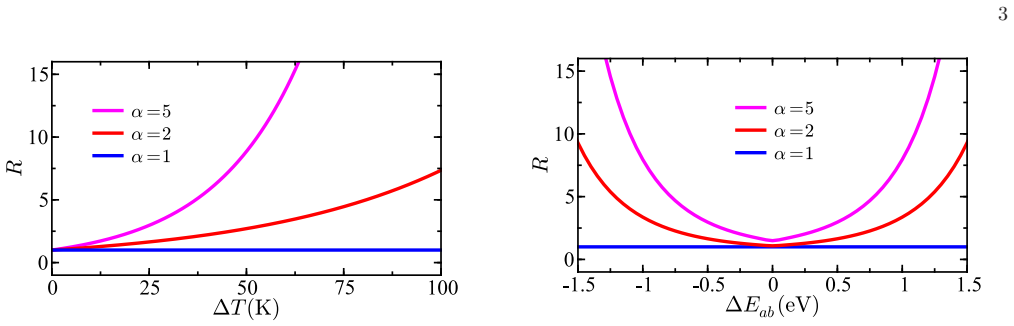
From the abstract and Eqs. (4)-(5): for an asymmetric electron transfer reaction (ERA differs from ERB) between environments at different temperatures, |J_Q+(Delta T)| differs from |J_Q-(-Delta T)| for all nonzero Delta T, so electron transfer alone generates thermal rectification; and in a junction, the zero-current voltage satisfies Phi(Delta T) not equal to -Phi(-Delta T), giving thermoelectric rectification. If true, the paper establishes a non-phononic molecular thermal rectification mechanism.
Load-bearing premise
Footnote 33 states: 'We furthermore assume that the distance between the sites is large enough such that the contribution from phononic heat transfer between the two sites vanishes in the harmonic approximation.' The entire predicted thermal rectification is computed for electron-transfer heat only; if phononic channels cannot be suppressed or the local vibrational modes do not equilibrate at TA and TB, the effect would be masked or altered.
Signed reviews
Editorial analysis
A structured set of objections, weighed in public.
Referee Report
Summary. The manuscript proposes a new mechanism for thermal rectification in molecular systems, based on electron transfer (ET) between molecular sites in environments at different temperatures. Using a bithermal version of Marcus theory, the authors derive a heat current for ET events and show that when the partial reorganization energies of the two environments differ, the heat current magnitude can be asymmetric with respect to reversal of the temperature bias. They extend the model to a molecular junction with metal leads, showing that the zero-current Seebeck voltage is not odd under bias reversal, i.e., thermoelectric rectification. Numerical examples illustrate the rectification ratios and voltage asymmetries for illustrative parameter choices.
Significance. If the central claims hold, the paper would establish a non-phononic thermal rectification mechanism in purely molecular environments, contrasting with the usual requirement of anharmonicity for phononic thermal diodes. The mechanism is physically transparent and the paper provides falsifiable predictions for rectification ratios and Seebeck asymmetries. The calculations are explicit and the formulas for the rates and currents are taken from prior well-established work; the novelty lies in the rectification application. The paper is well written and the numerical examples clearly illustrate the effects.
major comments (2)
- [After Eq. (4)] The statement that for α ≠ 1, |J_Q^±(ΔT)| ≠ |J_Q^±(−ΔT)| for all ΔT ≠ 0 is not implied by Eqs. (2)–(5). For ΔE_ab = 0, the rectification ratio in Eq. (5) can be evaluated analytically. With x = ΔT/T, c = (E_RB − E_RA)/(2E_R), and r = E_R/(k_B T), one obtains ln R = (3/2) ln[(1 − cx)/(1 + cx)] + r c x/[2(1 − c^2x^2)]. This expression crosses zero at a finite positive x for sufficiently small r and large c; for example, with T = 300 K, E_RA = 1 meV, E_RB = 100 meV (α = 100), R = 1 at ΔT ≈ 420 K, with T_A ≈ 90 K and T_B ≈ 510 K, both physically positive. Thus the universal inequality fails, while the mechanism still produces rectification for most parameters. The claim should be replaced by a qualified statement, e.g., 'generically' or 'for the parameter regimes shown.'
- [Footnote 33] The assumption that phononic heat transfer between the two sites vanishes because of large inter-site distance is central to isolating the electron-transfer heat current, but no quantitative estimate is provided. In molecular systems, phononic transport is typically the dominant heat channel, and whether it can be suppressed relative to the ET contribution is not obvious. The paper should either provide a quantitative criterion (e.g., inter-site distance or vibrational coupling strength) under which the phononic contribution is negligible, or explicitly state that the predictions apply only to systems engineered to suppress phononic conductance, promoting the footnote to a main-text limitation.
minor comments (5)
- [Title] The title contains a typo: 'Re ctification' should be 'Rectification'.
- [Fig. 5 discussion] The claim that Φ(ΔT) ≠ −Φ(−ΔT) for all ΔT ≠ 0 is stated without proof and may be subject to exceptions analogous to those in the thermal rectification claim; it should be qualified.
- [Eq. (4)] The derivation of Eq. (4) is not shown in the text; a brief derivation or an explicit pointer to the supplemental material would improve the manuscript.
- [Figures] The axes in Figs. 2, 3, and 5 are not always labeled with units; please add units (e.g., K for ΔT, eV for ΔE_ab and Φ).
- [Introduction] The phrase 'in contradiction with the traditional posit' is overly strong; 'in contrast to' would be more accurate.
Circularity Check
No significant circularity: the rectification prediction is computed from previously derived bithermal Marcus rates and heat-current expressions, with no parameter fitted to the target result.
full rationale
The paper's derivation chain does not reduce to its own conclusion. Equations (2) and (4) are taken from prior work by the same authors (refs. 23, 25, 40), but they are stated as previously derived rate and heat-current results, not as assumptions equivalent to rectification. The new content is the algebraic consequence that for ERA ≠ ERB the steady-state heat current satisfies |J_Q^+(ΔT)| ≠ |J_Q^+(−ΔT)|, and the numerical evaluation of the rectification ratio R defined in Eq. (5). No parameter is fitted to make rectification appear: ERA, ERB, ΔE_ab, V_mn, and T are model inputs, and the figures are illustrative scans over those inputs. The junction thermoelectric rectification is obtained by solving the same bithermal rate equations under the zero-current condition, again with no fitted parameter. The self-citations to refs. 23 and 25 are load-bearing in the sense that the paper builds on the ETIHT formalism, but this is standard scientific building on prior published results, not a derivation that assumes its own target claim; the rectification asymmetry is a new consequence not stated in those earlier papers. The assertion about the universal inequality ∀ΔT≠0 may be open to mathematical counterexample (the skeptical note gives a finite ΔT where R=1), but that is a correctness concern about an overstrong claim, not circularity. Footnote 33's assumption that phononic heat transfer vanishes is an explicit physical modeling assumption, not a self-referential justification. No instance of self-definition, fitted input renamed as prediction, or self-citation used to forbid alternatives is present. The manuscript is therefore self-contained in the sense relevant to circularity analysis.
Assumptions & free parameters
free parameters (6)
- ERA (partial reorganization energy of environment A) =
0.15 eV
- alpha = ERA / ERB =
1, 2, 5
- Delta E_ab (reaction free energy) =
0.5 eV in Fig. 2, varied in Fig. 3
- Delta E_MA (molecule-metal reaction free energy) =
plus or minus 0.25 eV
- V_ab (electronic coupling between molecular sites) =
0.01 eV in Fig. 5
- Reference temperature T =
300 K
assumptions (5)
- domain assumption Bithermal Marcus rate formula, Eq. (2), valid in the strong electron-phonon coupling and high temperature limit.
- domain assumption Each molecular environment's vibrational modes are equilibrated at its local temperature TA or TB during electron transfer.
- domain assumption Phononic heat transfer between the two sites is negligible due to large intersite distance and harmonic approximation.
- standard math Steady-state master equation kinetics describe occupation probabilities and fluxes.
- domain assumption Marcus interfacial electron-transfer rates describe molecule-metal charge exchange.
Cite this review
Pith. "Pith review of Electron-Transfer-Induced Thermal and Thermoelectric Rectification." pith.science (2026). https://pith.science/paper/DGFNDGYG
@misc{pith2026190800495,
  author       = {Pith},
  title        = {Pith review of: Electron-Transfer-Induced Thermal and Thermoelectric Rectification},
  year         = {2026},
  howpublished = {\url{https://pith.science/paper/DGFNDGYG}},
  note         = {Machine review of arXiv:1908.00495}
}
read the original abstract
Controlling the direction and magnitude of both heat and electronic currents using rectifiers has significant implications for the advancement of molecular circuit design. In order to facilitate the implementation of new transport phenomena in such molecular structures, we examine thermal and thermoelectric rectification effects that are induced by an electron transfer process that occurs across a temperature gradient between molecules. Historically, the only known heat conduction mechanism able to generate thermal rectification in purely molecular environments is phononic heat transport. Here, we show that electron transfer between molecular sites with different local temperatures can also generate a thermal rectification effect and that electron hopping through molecular bridges connecting metal leads at different temperatures gives rise to asymmetric Seebeck effects, that is, thermoelectric rectification, in molecular junctions.
Figures


Figures from the paper (1 more)

Reference graph
Works this paper leans on
-
[1]
temperatures, thermal rectification effects can be induced solely from the transfer of electrons
15 eV, ERB = αE RA, and T = 300 K. temperatures, thermal rectification effects can be induced solely from the transfer of electrons. It is clear from Eq. (4) that in general J + Q ⁄= J − Q . This asymmetry is analogous to that reported for an anhar- monic vibrational mode, specifically a two-level system, bridging two bosonic reservoirs with different tempera...
-
[2]
A. Aviram and M. A. Ratner, Chem. Phys. Lett. 29, 277 (1974), doi:10.1016/0009-2614(74)85031-1
-
[3]
B. G. Streetman and S. Banerjee, Solid State Electronic Devices (Prentice Hall, 2005)
work page 2005
-
[4]
V. Coropceanu, J. Cornil, D. A. da Silva Filho, Y. Olivier , R. Silbey, and J.-L. Br´ edas, Chem. Rev.107, 926 (2007)
work page 2007
-
[5]
D. Xiang, X. Wang, C. Jia, T. Lee, and X. Guo, Chem. Rev. 116, 4318 (2016), doi:10.1021/acs.chemrev.5b00680
-
[6]
T. S. Plett, W. Cai, M. Le Thai, I. V. Vlassiouk, R. M. Penner, and Z. S. Siwy, J. Phys. Chem. C 121, 6170 (2017), doi:10.1021/acs.jpcc.7b00258
-
[7]
N. Li, J. Ren, L. Wang, G. Zhang, P. H¨ anggi, and B. Li, Rev. Mod. Phys. 84, 1045 (2012), doi:10.1103/RevModPhys.84.1045
-
[8]
S. Narayana and Y. Sato, Phys. Rev. Lett. 108, 214303 (2012), doi:10.1103/PhysRevLett.108.214303
Show all 61 references
-
[9]
Maldovan, Nature 503, 209 (2013), doi:10.1038/nature12608
M. Maldovan, Nature 503, 209 (2013), doi:10.1038/nature12608
2013 doi
-
[10]
Terraneo, M
M. Terraneo, M. Peyrard, and G. Casati, Phys. Rev. Lett. 88, 094302 (2002), doi:10.1103/PhysRevLett.88.094302
2002 doi
-
[11]
B. Li, L. Wang, and G. Casati, Phys. Rev. Lett. 93, 184301 (2004), doi:10.1103/PhysRevLett.93.184301
2004 doi
-
[12]
Segal and A
D. Segal and A. Nitzan, Phys. Rev. Lett. 94, 034301 (2005), doi:10.1103/PhysRevLett.94.034301
2005 doi
-
[13]
C. W. Chang, D. Okawa, A. Majumdar, and A. Zettl, Science 314, 1121 (2006), doi:10.1126/science.1132898
2006 doi
-
[14]
Segal, Phys
D. Segal, Phys. Rev. Lett. 100, 105901 (2008), doi:10.1103/PhysRevLett.100.105901
2008 doi
-
[15]
A. L. Cottrill and M. S. Strano, Adv. Energy Mater. 5, 1500921 (2015), doi:10.1002/aenm.201500921
2015 doi
-
[16]
S. Wang, A. L. Cottrill, Y. Kunai, A. R. Toland, P. Liu, W.-J. Wang, and M. S. Strano, Phys. Chem. Chem. Phys. 19, 13172 (2017), doi:10.1039/C7CP02445B
2017 doi
-
[17]
B. Li, L. Wang, and G. Casati, Appl. Phys. Lett. 88, 143501 (2006), doi:10.1063/1.2191730
2006 doi
-
[18]
Ben-Abdallah and S.-A
P. Ben-Abdallah and S.-A. Biehs, Phys. Rev. Lett. 112, 044301 (2014), doi:10.1103/PhysRevLett.112.044301
2014 doi
-
[19]
Joulain, J
K. Joulain, J. Drevillon, Y. Ezzahri, and J. Ordonez- Miranda, Phys. Rev. Lett. 116, 200601 (2016), doi:10.1103/PhysRevLett.116.200601
2016 doi
-
[20]
Wang and B
L. Wang and B. Li, Phys. Rev. Lett. 101, 267203 (2008), doi:10.1103/PhysRevLett.101.267203
2008 doi
-
[21]
Wang and B
L. Wang and B. Li, Phys. Rev. Lett. 99, 177208 (2007), doi:10.1103/PhysRevLett.99.177208
2007 doi
-
[22]
D. M.-T. Kuo and Y.-C. Chang, Phys. Rev. B 81, 205321 (2010), doi:10.1103/PhysRevB.81.205321
2010 doi
-
[23]
Z. H. Zhang, Y. S. Gui, L. Fu, X. L. Fan, J. W. Cao, D. S. Xue, P. P. Freitas, D. Houssameddine, S. Hemour, K. Wu, et al., Phys. Rev. Lett. 109, 037206 (2012), doi:10.1103/PhysRevLett.109.037206
2012 doi
-
[24]
G. T. Craven and A. Nitzan, Proc. Natl. Acad. Sci. 113, 9421 (2016), doi:10.1073/pnas.1609141113
2016 doi
-
[25]
R. Chen, G. T. Craven, and A. Nitzan, J. Chem. Phys. 147, 124101 (2017), doi:10.1063/1.4990410
2017 doi
-
[26]
G. T. Craven and A. Nitzan, Phys. Rev. Lett. 118, 207201 (2017), doi:10.1103/PhysRevLett.118.207201
2017 doi
-
[27]
R. A. Marcus, J. Chem. Phys. 24, 966 (1956), doi:10.1063/1.1742723
1956 doi
-
[28]
R. A. Marcus, Rev. Mod. Phys. 65, 599 (1993), doi:10.1103/RevModPhys.65.599
1993 doi
-
[29]
A. M. Kuznetsov and J. Ulstrup, Electron Transfer in Chemistry and Biology: An Introduction to the Theory (John Wiley & Sons, Ltd., 1999)
1999
-
[30]
N. Hush, J. Chem. Phys. 28, 962 (1958), doi:http://dx.doi.org/10.1063/1.1744305
1958 doi
- [31]
-
[32]
This model is equivalent to the standard polaron model [34]
-
[33]
Galperin, M
M. Galperin, M. A. Ratner, and A. Nitzan, J. Phys.: Condens. Matter 19, 103201 (2007)
2007
-
[34]
We furthermore assume that the distance between the sites is large enough such that the contribution from phononic heat transfer between the two sites vanishes in the harmonic approximation
-
[35]
See the Supplemental Material for a detailed descripti on of the calculations. 6
-
[36]
S. H. Lin, J. Chem. Phys. 44, 3759 (1966), doi:10.1063/1.1726531
1966 doi
-
[37]
S. H. Lin, C. H. Chang, K. K. Liang, R. Chang, Y. J. Shiu, J. M. Zhang, T.-S. Yang, M. Hayashi, and F. C. Hsu, Adv. Chem. Phys. 121, 1 (2002), doi:10.1002/0471264318.ch1
2002 doi
-
[38]
Nitzan, Chemical Dynamics in Condensed Phases: Relaxation, Transfer, and Reactions in Condensed Molec- ular Systems (Oxford University Press, 2006)
A. Nitzan, Chemical Dynamics in Condensed Phases: Relaxation, Transfer, and Reactions in Condensed Molec- ular Systems (Oxford University Press, 2006)
2006
-
[39]
P. Vath, M. B. Zimmt, D. V. Matyushov, and G. A. Voth, J. Phys. Chem. B 103, 9130 (1999), doi:10.1021/jp990494q
1999 doi
-
[40]
D. L. Derr and C. M. Elliott, J. Phys. Chem. A 103, 7888 (1999), doi:10.1021/jp991755z
1999 doi
-
[41]
The heat transferred per electron is ∼ 0
The typical magnitude of the electron-transfer-induc ed heat current in a single-molecule device is in the range µ eV/ ps to meV/ ps [24]. The heat transferred per electron is ∼ 0. 01 eV
-
[42]
Lehmann, G.-L
J. Lehmann, G.-L. Ingold, and P. H¨ anggi, Chem. Phys. 281, 199 (2002), doi:10.1016/S0301-0104(02)00344-0
2002 doi
-
[43]
N. F. Polizzi, S. S. Skourtis, and D. N. Beratan, Faraday Discuss. 155, 43 (2012), doi:10.1039/C1FD00098E
2012 doi
-
[44]
R. A. Marcus, J. Chem. Phys. 43, 679 (1965), doi:10.1063/1.1696792
1965 doi
-
[45]
M. A. C ¸ ipilo˘ glu, S. Turgut, and M. Tomak, Phys. Status Solidi 241, 2575 (2004), doi:10.1002/pssb.200402058
2004 doi
-
[46]
S´ anchez and R
D. S´ anchez and R. L´ opez, Phys. Rev. Lett. 110, 026804 (2013), doi:10.1103/PhysRevLett.110.026804
2013 doi
-
[47]
In general, the magnitude of thermal rectification will be large in systems where biasing of the chemical po- tentials significantly alters the molecule-to-molecule el ec- tronic flux, and will be small in the opposite limit
-
[48]
This effect arises because constant ∆ EMA implies con- stant E′ a which means that variation of ∆ Eab is synony- mous with variation of E′ b, and thus the energy gaps be- tween the biased chemical potential at each electrode and the corresponding molecular energy level are not ...
-
[49]
Kir˘ sanskas, Q
G. Kir˘ sanskas, Q. Li, K. Flensberg, G. C. Solomon, and M. Leijnse, Appl. Phys. Lett. 105, 233102 (2014), doi:10.1063/1.4903340
2014 doi
-
[50]
Q. Li, M. Strange, I. Duchemin, D. Donadio, and G. C. Solomon, J. Phys. Chem. C 121, 71757182 (2017), doi:10.1021/acs.jpcc.7b02005
2017 doi
-
[51]
Hedstr¨ om, A
S. Hedstr¨ om, A. J. Matula, and V. S. Batista, J. Phys. Chem. C 121, 19053 (2017), doi:10.1021/acs.jpcc.7b05749
2017 doi
-
[52]
Sadat, A
S. Sadat, A. Tan, Y. J. Chua, and P. Reddy, Nano Lett. 10, 2613 (2010), doi:10.1021/nl101354e
2010 doi
-
[53]
Menges, H
F. Menges, H. Riel, A. Stemmer, and B. Gotsmann, Nano Lett. 12, 596 (2012), doi:10.1021/nl203169t
2012 doi
-
[54]
Menges, P
F. Menges, P. Mensch, H. Schmid, H. Riel, A. Stem- mer, and B. Gotsmann, Nat. Commun. 7, 10874 (2016), doi:10.1038/ncomms10874
2016 doi
-
[55]
Mecklenburg, W
M. Mecklenburg, W. A. Hubbard, E. R. White, R. Dhall, S. B. Cronin, S. Aloni, and B. C. Regan, Science 347, 629 (2015), doi:10.1126/science.aaa2433
2015 doi
-
[56]
Capozzi, J
B. Capozzi, J. Xia, O. Adak, E. J. Dell, Z.-F. Liu, J. C. Taylor, J. B. Neaton, L. M. Campos, and L. Venkataraman, Nature Nanotech. 10, 522 (2015), doi:10.1038/nnano.2015.97
2015 doi
-
[57]
Reddy, S.-Y
P. Reddy, S.-Y. Jang, R. A. Segalman, and A. Majumdar, Science 315, 1568 (2007), doi:10.1126/science.1137149
2007 doi
-
[58]
A. Tan, J. Balachandran, S. Sadat, V. Gavini, B. D. Dunietz, S.-Y. Jang, and P. Reddy, J. Am. Chem. Soc. 133, 8838 (2011), doi:10.1021/ja202178k
2011 doi
-
[59]
W. Lee, K. Kim, W. Jeong, L. A. Zotti, F. Pauly, J. C. Cuevas, and P. Reddy, Nature 498, 209 (2013), doi:10.1038/nature12183
2013 doi
-
[60]
Y. Kim, W. Jeong, K. Kim, W. Lee, and P. Reddy, Nature Nanotech. 9, 881 (2014), doi:10.1038/nnano.2014.209
2014 doi
-
[61]
L. Cui, W. Jeong, S. Hur, M. Matt, J. C. Kl¨ ockner, F. Pauly, P. Nielaba, J. C. Cuevas, E. Meyhofer, and P. Reddy, Science (2017), doi:10.1126/science.aam6622
2017 doi
Reviewed August 14, 2026 · model on record in the stance chip above.
Discussion (0). Continue with ORCID to comment.