REVIEW 4 major objections 5 minor 3 cited by
LLM-based Text Simplification and its Effect on User Comprehension and Cognitive Load
T0 review · 4 major / 5 minor · reviewed 2026-08-16 · deepseek-v4-flash
Pith's one-line read In a randomized trial with 4,563 participants, reading LLM-simplified versions of technical texts raised comprehension multiple-choice accuracy by 3.9 percentage points over reading the originals, with the largest gain—14.6 points—on…
desk verdict Large RCT with a real signal, but the 'simplification' effect is confounded with added definitions; accept with heavy revision. read the letter →
The pith
A machine-rendered reading of the paper's core claim, the machinery that carries it, and where it could break.
The reading
What carries the argument
The load-bearing mechanism is an automated self-refinement loop. A fast LLM produces simplified rewrites from a prompt with few-shot examples; two autoeval models score each rewrite, one for readability on a 1-10 scale and one for fidelity by decomposing the original into atomic claims and weighting completeness and entailment errors; then a refinement model revises the prompt to maximize readability minus weighted error. The loop ran 824 iterations. This is what turns "write this more simply" into a minimally-lossy rewrite, and the study's randomized design is what tests whether that rewrite changes reader outcomes.
What would settle it
Rerun the comprehension test with a paraphrase-only arm in which the LLM is forbidden to add any definition, gloss, or context sentence beyond the original's content. If the paraphrase-only arm shows no accuracy advantage over the original text, the paper's attribution of the benefit to simplification is falsified, and the effect is instead due to added information.
Extended reading notes
Core claim
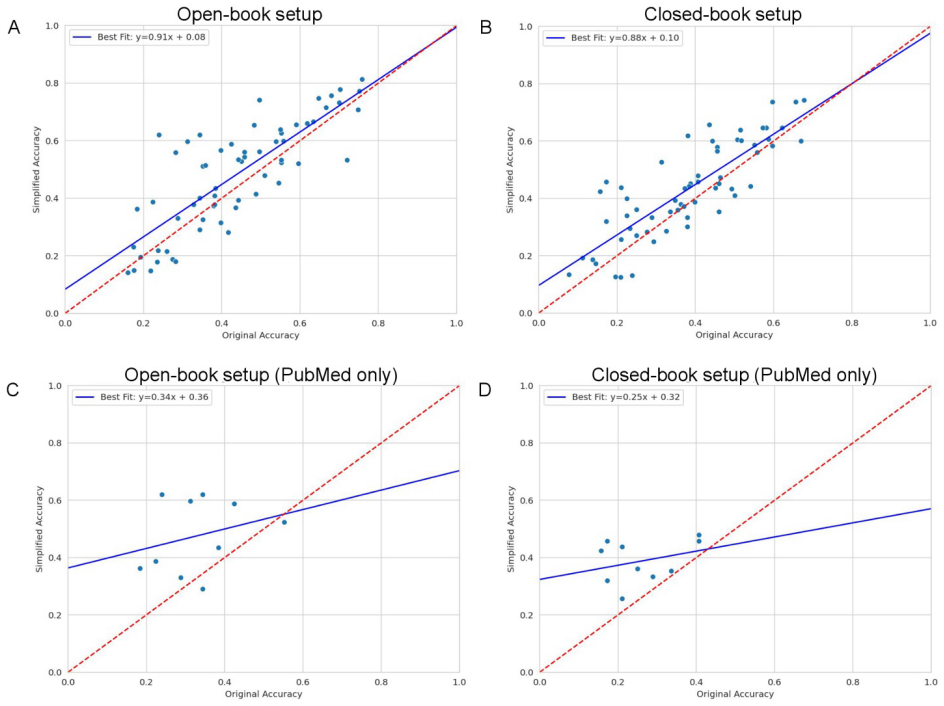
The paper's central discovery is that an LLM-based "minimally lossy" simplification pipeline produces text that improves comprehension in a randomized controlled setting. Averaged over 31 texts and 49,582 answers, simplified-text readers scored 48.2% versus 44.3% on the original (3.9% absolute gain, 95% CI 1.6 to 6.3). The gains were robust to closed-book conditions, where accuracy dropped by about 9% in both arms, and the largest effect appeared in PubMed texts (14.6%). The authors interpret this as evidence that simplification can carry the informational content of expert writing while making it accessible, and they read the persistence in closed-book conditions as a sign that comprehension and short-term retention, not just lookup, improve.
Load-bearing premise
The study assumes the measured comprehension gain comes from making the language simpler, but the simplified texts also add definitions and explanatory context absent from the originals, and the design never isolates rewording from added information.
Editorial extensions
If this is right
- If the result generalizes, publishing LLM-simplified versions alongside technical documents could lift non-expert comprehension by a few percentage points on average and much more for dense biomedical material.
- Because the benefit survives closed-book testing, simplified text appears to support memory and understanding, not just faster on-page reference.
- The largest gains on questions where original accuracy was lowest suggest simplification helps most where readers are most likely to fail, though this pattern is a trend in per-question scatter plots rather than a separate hypothesis test.
- Self-reported ease and confidence improve even in domains where accuracy gains were small, so simplification may also reduce the effort barrier to engaging with expert text.
- The prompt-refinement and autoeval pipeline is presented as generalizable to other text-generation tasks that need both quality and fidelity constraints.
Reading between the lines
- The main rival mechanism is information addition: the simplified texts in Table 3 insert definitions and context (e.g., "hepatocytes, which are liver cells") that the originals lack. If that extra context, not simpler syntax or vocabulary, drives the accuracy gain, then pure lexical and syntactic simplification systems would show a smaller effect.
- The closed-book persistence could be due to the inserted definitions serving as retrieval cues at test time rather than deeper encoding; a delayed recall test would separate those possibilities.
- The per-question pattern of larger gains where original accuracy is low may partly reflect ceiling effects on easy items; matching items on difficulty before comparing conditions would sharpen the claim.
- The confidence and ease gains suggest a separate product use: simplification may increase willingness to attempt difficult material even when measurable learning is unchanged.
Signed reviews
Editorial analysis
A structured set of objections, weighed in public.
Referee Report
Summary. This paper describes a system for LLM-based text simplification developed through iterative prompt refinement with Gemini-based readability and fidelity autoevaluations, and evaluates it in a randomized study with 4,563 participants across six subject areas. Participants read original or simplified texts in open-book or closed-book conditions and answered multiple-choice comprehension questions; the authors report a 3.9% absolute improvement in MCQ accuracy for simplified texts (95% CI 1.6–6.3, p<0.05), the largest gain for PubMed, and significant improvements in self-reported confidence and perceived ease. The manuscript concludes that minimally lossy LLM text simplification can enhance comprehension of expert information.
Significance. The study's strengths include the large sample, random assignment, blinded MCQ writing, the open/closed-book replication, and the reporting of confidence intervals. If the effect were cleanly attributable to simplification, this would be an important contribution to the text simplification and information accessibility literature. However, as presented, the intervention conflates rewording with the addition of factual content, and the 'minimally lossy' claim is not supported by the autoeval design, so the current support for the central claim is incomplete.
major comments (4)
- [Table 3; Supplementary Data] The simplified texts add factual content absent from the originals; for example, Table 3 includes 'hepatocytes, which are liver cells', 'semaglutide, a medicine', and 'NAc, a part of the brain involved in reward and motivation'. Because participants in the simplified arm received both reworded text and these elaborations, the observed 3.9% overall accuracy gain (and the 14.6% PubMed gain) cannot be attributed to simplification per se. The authors should add a control arm that holds propositional content constant, or re-frame the intervention as simplification-plus-elaboration and temper the causal language in the abstract and Discussion accordingly.
- [Figure 1; Methods: Autoeval system] The system's stated objective is to simplify while 'avoiding either adding or losing information' (Figure 1), yet the fidelity autoeval only assigns error weights to 'unfactual' (weight 4) and 'off topic' (weight 1) information gains; factual on-topic additions such as the glosses in Table 3 are not penalized. This makes the 'minimally lossy' claim internally inconsistent with the evaluation procedure. The authors should either penalize all information gain in the autoeval, validate the weights against human fidelity judgments, or revise the 'minimally lossy' characterization.
- [Methods: Statistical analysis; Results] The accuracy analysis uses per-participant proportion correct, but responses are also nested within 31 texts and six topic areas, and participants who read the same text are correlated. Ignoring this clustering can yield overconfident standard errors and p-values for the overall and per-topic effects. The authors should fit a mixed-effects model with random intercepts for text and participant (and possibly topic) to confirm the 3.9% effect and the per-topic estimates.
- [Results] Per-topic effects are compared across six topic areas without multiple-comparison correction, while the text describes '4 or 5' of these as significant. At alpha=0.05, six tests imply a non-trivial false-positive risk; the authors should report adjusted p-values or clearly designate per-topic results as exploratory, reserving confirmatory status for the pre-specified overall comparison.
minor comments (5)
- [Table 2] Consider adding a balance table of participant characteristics by experimental arm, since the targeted recruitment quotas make it easy to confirm that randomization produced comparable groups.
- [Results] Throughout the results, exact p-values and test statistics are omitted in favor of 'p<0.05'; reporting the regression coefficients, standard errors, and exact p-values would improve reproducibility.
- [Methods] The 'simplified NASA Task Load Index' is a single bipolar Likert item rather than the full NASA-TLX; consider calling it a single-item task-load rating to avoid overstating the measure.
- [Discussion] The sentence 'the same 4 of 5 topics (as the confidence results)' is ambiguous because there are six topic areas; specify which topics were significant.
- [Table 3] In the typeset version, the second row of Table 3 appears split across cells, making the original and simplified texts difficult to compare; please fix the table formatting.
Circularity Check
Comprehension result is externally benchmarked; only the 'minimally lossy' fidelity claim is self-referential, giving minor circularity.
-
self definitional
[Methods, 'Autoeval system' and 'Prompt refinement system']
"The fidelity autoeval uses Gemini 1.5 Pro with a custom step-by-step reasoning prompt to understand completeness and entailment... The final overall error score was a weighted sum based on each error’s weight, and divided by 10... These weights were determined empirically based on subjective judgement on the relative severity of each type of error. ... The prompt’s score was defined as the averaged readability score minus the averaged error scores, and the best prompts were tracked based on this score."
The 'minimally lossy' property is not established by any external fidelity benchmark; it is operationalized by the same Gemini-based fidelity autoeval whose subjective weights define the error score. That error score is also the optimization objective used to select the final prompt ('averaged readability score minus the averaged error scores'). So the claim that the final model is 'minimally lossy' reduces, by construction, to the autoeval's own subjective criterion. The human MCQ comprehension result is not part of this loop—MCQs were written blinded to simplified outputs—so the central empirical claim remains externally benchmarked; only the fidelity claim is self-referential.
full rationale
The central claim—that simplified text improves MCQ accuracy—is supported by a randomized human study that is external to the autoeval optimization loop. MCQs were authored while blinded to the simplified outputs, participants were randomized to original vs. simplified text, and accuracy was measured directly from their answers. Thus the 3.9% comprehension gain is not forced by the prompt-refinement objective or by any fitted parameter. The only self-referential element is the 'minimally lossy' label: the fidelity autoeval's error score, with subjectively chosen weights, was both the optimization target during prompt selection and the evidence for minimal lossiness, and no independent human fidelity validation is reported. This is a modest circularity confined to the fidelity claim, not to the comprehension outcome. The separate concern that simplified texts add definitions and context absent from the originals (e.g., Table 3 glosses such as 'hepatocytes, which are liver cells') is a construct-validity confound rather than a circular-derivation issue under the stated criteria.
Assumptions & free parameters
free parameters (1)
- Autoeval fidelity error weights =
Information loss [2], specificity [1], nuance [2], unfactual [4], off topic [1], loss in factuality [4], significant…
assumptions (4)
- domain assumption Multiple-choice questions measure comprehension of the text content
- domain assumption Random assignment balanced participant characteristics across arms
- domain assumption Participants read the assigned texts as intended
- standard math Standard statistical assumptions for linear regression and t-test
Cite this review
Pith. "Pith review of LLM-based Text Simplification and its Effect on User Comprehension and Cognitive Load." pith.science (2026). https://pith.science/paper/DGH2TEGH
@misc{pith2026250501980,
  author       = {Pith},
  title        = {Pith review of: LLM-based Text Simplification and its Effect on User Comprehension and Cognitive Load},
  year         = {2026},
  howpublished = {\url{https://pith.science/paper/DGH2TEGH}},
  note         = {Machine review of arXiv:2505.01980}
}
read the original abstract
Information on the web, such as scientific publications and Wikipedia, often surpasses users' reading level. To help address this, we used a self-refinement approach to develop a LLM capability for minimally lossy text simplification. To validate our approach, we conducted a randomized study involving 4563 participants and 31 texts spanning 6 broad subject areas: PubMed (biomedical scientific articles), biology, law, finance, literature/philosophy, and aerospace/computer science. Participants were randomized to viewing original or simplified texts in a subject area, and answered multiple-choice questions (MCQs) that tested their comprehension of the text. The participants were also asked to provide qualitative feedback such as task difficulty. Our results indicate that participants who read the simplified text answered more MCQs correctly than their counterparts who read the original text (3.9% absolute increase, p<0.05). This gain was most striking with PubMed (14.6%), while more moderate gains were observed for finance (5.5%), aerospace/computer science (3.8%) domains, and legal (3.5%). Notably, the results were robust to whether participants could refer back to the text while answering MCQs. The absolute accuracy decreased by up to ~9% for both original and simplified setups where participants could not refer back to the text, but the ~4% overall improvement persisted. Finally, participants' self-reported perceived ease based on a simplified NASA Task Load Index was greater for those who read the simplified text (absolute change on a 5-point scale 0.33, p<0.05). This randomized study, involving an order of magnitude more participants than prior works, demonstrates the potential of LLMs to make complex information easier to understand. Our work aims to enable a broader audience to better learn and make use of expert knowledge available on the web, improving information accessibility.
Figures


Figures from the paper (3 more)


Forward citations
Cited by 3 Pith papers
-
An Exploratory Evaluation of LLM-Assisted Rewriting of Moderate-Complexity Financial Sentences for DisCoCat-Based Sentiment Analysis
LLM-guided rewriting of moderate-complexity financial sentences reduces DisCoCat circuit size by over 70 percent and yields a modest, not statistically tested, accuracy gain over a low-complexity baseline.
-
A Human-in-the-Loop Corpus for LLM-Based Simplification of Scientific Summaries
A human-in-the-loop corpus of scientific-summary simplifications with original, GPT-simplified, reader-annotated, and expert-edited versions for training and benchmarking simplification systems.
-
LLM-Guided Planning and Summary-Based Scientific Text Simplification: DS@GT at CLEF 2025 SimpleText
An LLM-based system that plans sentence simplifications and summarizes documents before rewriting scientific text, entered in the CLEF 2025 SimpleText task.
Reference graph
Works this paper leans on
-
[1]
s common, especially in areas with few resources. Rapid diagnostic tests, or RDTs, were introduced as a better option, giving results faster and being easier to use, especially where labs are not great. RDTs work by finding specific proteins, called antigens, that the malaria parasite, Plasmodium, makes in the blood. For example, histidine-rich protein 2,...
-
[1980]
The PLS was built to measure the speed and direction of the solar wind while Voyager 1 was inside the What was the main challenge the Voyager science team faced in confirming that Voyager 1 had entered interstellar space? a) The spacecraft was too far away to communicate with effectively. b) The spacecraft's instruments were damaged by the harsh condition...
work page 1950
-
[1998]
b) Discovering a new way to control genetic information. c) Discovering how proteins are made in plants and animals. d) Discovering how genetic information flows between generations of plants and animals. e) Modifying genes for cancer and hepatitis. b What is RNA interference? a) How RNA can interact to stop protein production from RNA. b) How plants and ...
work page 1995
-
[2009]
Why do we need to try and avoid future price increases for energy bills? a) Because it is already high. b) Because the cost of generating energy is expected to increase. c) Because people don't want to pay more. d) Because the energy companies are getting fined more. e) Because companies are working together to increase prices. b When will energy bills fa...
work page 2012
-
[2010]
Meanwhile, a study done in early September 2009 by Consumer Focus, a consumer protection organization, suggested that energy companies were charging customers too much, about 100 pounds or 162 dollars every year. A spokesperson for Ofgem, a government agency that regulates the energy market, said there was no proof that the companies were working together...
work page 2009
-
[2014]
Mark Zandi, the chief economist at Moody's Economy.com, a company that analyzes the economy, said that the recovery is weak and uncertain. He also said that government officials need to do more to help the economy. a) Households reducing debt. b) Households borrowing more money. c) More people unable to find jobs. d) Companies not paying their real estate...
work page 2010
Reviewed August 16, 2026 · model on record in the stance chip above.
Discussion (0). Continue with ORCID to comment.