REVIEW 2 major objections 7 minor 1 cited by
Pauli web of the $|Y\rangle$ state surface code injection
T0 review · 2 major / 7 minor · reviewed 2026-08-10 · deepseek-v4-flash
Pith's one-line read This paper shows that the Pauli web generated by the Y-state injection protocol on a rotated surface code is exactly the code's logical Y correlator, and that the protocol's prescribed initial states are what make this work.
desk verdict A clean diagrammatic consistency check of the Lao-Criger Y-injection, but the paper's generalisation beyond d=5 single-round is asserted, not shown. read the letter →
The pith
A machine-rendered reading of the paper's core claim, the machinery that carries it, and where it could break.
The reading
What carries the argument
The central object is the Pauli web, a way of decorating a ZX-diagram by highlighting legs in red or green to track how a Pauli operator propagates; a spider with $\pm \pi/2$ phase must have an odd number of its own-colour highlighted legs and all legs highlighted in the opposite colour, while phase-less spiders follow the $k\pi$ rules for even numbers of own-colour highlights and all-or-none opposite-colour highlights. The argument starts the decoration at the $\pi/2$ $Y$-state spider and propagates these colours through the encoder circuit; a correct logical $Y$ correlator corresponds to the decoration agreeing with the product of the logical $X$ and $Z$ correlators. The triangular pattern of $|+\rangle$ and $|0\rangle$ initial states is the load-bearing detail that makes the web close on the boundary.
What would settle it
Apply the same Pauli-web decoration to a distance-5 encoder with a second full round of parity measurements (or to a distance-7 encoder) and compare the resulting web with the logical $Y$ correlator of that longer circuit; if the decoration no longer coincides, for instance because the extra rounds change where the red and green highlights terminate on the boundary, the paper's generalization claim would be false.
Extended reading notes
Core claim
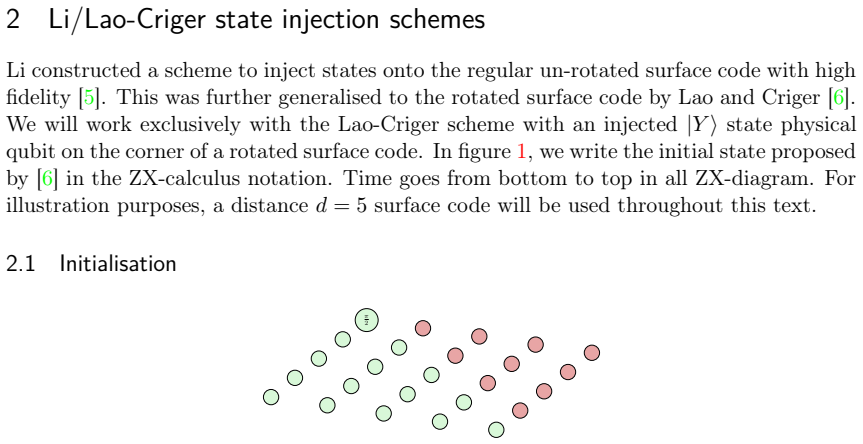
The central claim is that the rotated-surface-code $Y$-state injection scheme, written as a ZX-diagram, has a decorated Pauli web equal to the logical $Y$ correlator of the surface code. Starting from the $\pi/2$ phase Z-spider at the upper-left corner and applying the Pauli web colouring rules for Z-spiders, the authors obtain a green web and a red web whose combined decoration is exactly the logical $Y$ correlator, i.e. the product of the logical $X$ and logical $Z$ correlators. The paper also claims the triangular initial-state pattern is necessary: if any initial state in the two highlighted rectangular regions is changed or given the opposite colour, the logical $Y$ Pauli web fails to terminate properly, so the scheme would not prepare the intended logical state.
Load-bearing premise
The load-bearing premise is that one error-free round of parity measurement on a distance-5 code represents the full injection protocol, so the Pauli web found there still matches the logical $Y$ correlator when later rounds, post-selection, and larger distances are included.
Editorial extensions
If this is right
- The $Y$-state injection protocol on a rotated surface code really does prepare the logical $Y$ operator: the Pauli web decoration matches the logical $X$-and-$Z$ combined correlator.
- The triangular pattern of $|+\rangle$ and $|0\rangle$ initial states is forced by the correlator structure; changing any highlighted state breaks the logical $Y$ web.
- The single-round, error-free picture is claimed to propagate straightforwardly to later parity-measurement rounds and larger code distances, so the same web should describe the logical $Y$ correlator in the full protocol.
- The diagrammatic reading makes the post-selection rule visible: invalid check cubes around the $|Y\rangle$ corner give random $\pm 1$ outcomes, so one post-selects on $+1$ in the labelled plaquettes to avoid misidentifying the logical $Y$ Pauli frame.
- The same ZX/Pauli-web treatment should extend to $\pi/4$ phase ($|T\rangle$) injection under suitable rule modifications, giving a visual handle on magic-state injection protocols.
Reading between the lines
- If the single-round equivalence holds at all distances, the Pauli web construction becomes a quick diagrammatic check for any proposed injection pattern: run the decoration and see whether it closes on the desired logical operator.
- The same technique could be used to search for alternative injection layouts: any initial-state pattern whose decorated web matches the desired logical correlator should be valid, potentially exposing schemes beyond the triangular one.
- A concrete stress test is to apply the decoration to a multi-round circuit with an inserted data-qubit error and check whether the logical $Y$ web still closes; if not, the 'straightforward propagation' claim needs qualification.
Editorial analysis
A structured set of objections, weighed in public.
Referee Report
Summary. The manuscript uses ZX-calculus and Pauli webs to analyze the Li/Lao-Criger |Y> state injection scheme on a rotated surface code. For a distance-5, single-round, error-free encoder circuit, the authors decorate the combined initialization and encoding ZX-diagram with red and green Pauli webs and claim that the resulting web coincides with the logical Y correlator, i.e., the combination of the logical X and Z correlators. They further claim that changing any initial state in the highlighted triangular rectangles destroys the logical Y correlator, and they present a stabilizer-based argument for why certain parity-check cubes in the injection protocol are invalid and should be post-selected on a +1 outcome.
Significance. If the central diagrammatic claim is fully supported, the paper offers a clear visual explanation of why the Li/Lao-Criger initialization pattern works and demonstrates the utility of Pauli webs for understanding surface-code state injection. The distance-5 single-round derivation is coherent: the decoration rules are applied explicitly, and the stabilizer probability calculation for the invalid parity-check cube in Section 4.3 is correct. The paper is not circular, since it takes the circuit from Li/Lao-Criger, the decoration rules from Rodatz et al., and the correlator definitions from Bombin et al., and checks consistency against the known logical Y correlator. The significance is limited, however, because the generalization to multiple rounds and arbitrary distances is asserted rather than demonstrated, and the necessity claim about the highlighted initial states rests on inspection of a single configuration.
major comments (2)
- [Section 2.3 and Figure 6] The paper's central claim is stated generally for the Li/Lao-Criger |Y> state injection scheme, but the only evidence is the distance-5, single-round, error-free web in Figure 6. Section 2.3 explicitly drops the additional parity-measurement rounds, post-selection, and distance growth, and Section 4 asserts without derivation that propagation to future rounds and larger distances is 'straight forward.' Because the Pauli-web decoration rules are local constraints at every spider, the existence of a valid web at d=5 does not by itself establish the same web at d=7 or for stacked encoder layers, where the boundary pattern of |+> and |0> states changes. The authors should either provide an explicit construction or proof for general d and multiple rounds, or explicitly restrict the central claim to the distance-5 single-round diagram.
- [Section 4, Figure 7] The claim that changing any initial state in the yellow highlighted rectangles 'breaks' the logical Y correlator is asserted from inspection of a single configuration. No enumeration of alternative initial states or stabilizer/Pauli-web argument is given to show that no alternate valid web exists for other choices. As written, this is a necessity claim that is load-bearing for the paper's explanation of the initialization pattern. It should be either proved by exhaustive decoration of the finitely many relevant configurations, or weakened to a statement about the particular configuration shown.
minor comments (7)
- [Introduction] The text contains a typo: 'theses procedures' should be 'these procedures.'
- [Section 2.3] 'Straight forward' should be 'straightforward,' and the claim that propagation to future rounds is straightforward is not derived anywhere in the manuscript.
- [Section 2.2] The phrase 'Measuring all the XXXX / XX plaquettes parity measurements' is grammatically awkward; consider 'Measuring all XXXX/XX plaquette parity checks.'
- [Figure 3 caption] The caption 'logical (Z and X respectively) operators' is unclear; 'logical Z and X correlators, respectively' would be more readable.
- [Section 4.1] The phrase 'the final half full-round of parity measurements omitted for simplicity' should be 'the final half-round of parity measurements is omitted for simplicity.'
- [Section 4.3] Using a cyan-colored letter 'A' for data-qubit labels is potentially confusing because it resembles an algebraic variable; consider using labels such as 'q_i' or a distinct notation.
- [Footnote 1] The equality 'iY = ZX' is correct, but it would be clearer to write 'iY = ZX, where Y is the Pauli-Y operator' for readers not working with the matrix representation.
Circularity Check
No circularity: the Pauli-web recovery of the logical Y correlator is a consistency check against external definitions, not a derivation that assumes its conclusion.
full rationale
The derivation chain is: take the Li/Lao-Criger initialisation pattern and encoder circuit from Refs. [5,6], apply the Pauli-web decoration rules quoted from Ref. [10], and compare the resulting red/green web with the logical Y correlator formed from the logical X and Z correlators of Ref. [9]. Each ingredient is external to this paper and none is defined in terms of the target logical-Y statement; the conclusion is obtained by constructing the web, not by fiat. No parameters are fitted, no quantity is renamed as a prediction, and there are no author self-citations carrying load. The paper explicitly frames the result as confirming what is expected (Section 1: 'does indeed recover the logical Y correlator ... as expected'), which is a benchmark check rather than a circular derivation. The remaining weaknesses are scope claims, not circularity: Section 2.3 drops multi-round parity measurements and post-selection, and Section 4 asserts that propagation to further rounds and distances is 'straight forward' without a proof; likewise the necessity claim about the yellow rectangles is asserted from inspection. These are unverified extrapolations or missing proofs, which belong to correctness and rigour assessment, and they do not make the central d=5 check circular.
Assumptions & free parameters
assumptions (4)
- domain assumption The Pauli web decoration rules from Rodatz et al., definition 2.7, correctly describe how the phase spider and phase-less spiders propagate logical operators through the ZX-diagram.
- domain assumption The Li/Lao-Criger initialisation pattern and encoder circuit implement the rotated surface code and the Y-state injection protocol.
- ad hoc to paper A single round of error-free parity measurement on a distance-5 code is representative of the full multi-round, post-selected, larger-distance protocol.
- standard math ZX-calculus graphical equalities are a sound representation of stabilizer circuits.
Cite this review
Pith. "Pith review of Pauli web of the $|Y\rangle$ state surface code injection." pith.science (2026). https://pith.science/paper/DGSDPEJ5
@misc{pith2026250115566,
  author       = {Pith},
  title        = {Pith review of: Pauli web of the $|Y\rangle$ state surface code injection},
  year         = {2026},
  howpublished = {\url{https://pith.science/paper/DGSDPEJ5}},
  note         = {Machine review of arXiv:2501.15566}
}
abstract
We employ ZX-calculus and Pauli web to understand the $|Y\rangle$ state injection on the rotated surface code.
Figures


Figures from the paper (4 more)


Forward citations
Cited by 1 Pith paper
-
Pauli webs spun by transversal $|Y\rangle$ state initialisation
A diagrammatic verification, using Pauli webs, that the CCLP fold-transversal S gate maps the logical X correlator to the logical Y correlator.
Reference graph
Works this paper leans on
-
[1]
Stabilizer codes and quantum error correction, 1997
Daniel Gottesman. Stabilizer codes and quantum error correction, 1997. URLhttps: //arxiv.org/abs/quant-ph/9705052
arXiv 1997
-
[2]
Improved simulation of stabilizer circuits
Scott Aaronson and Daniel Gottesman. Improved simulation of stabilizer circuits. 9 Physical Review A, 70(5), November 2004. ISSN 1094-1622. DOI: 10.1103/phys- reva.70.052328. URL http://dx.doi.org/10.1103/PhysRevA.70.052328
doi:10.1103/phys- 2004
-
[3]
Eric Dennis, Alexei Kitaev, Andrew Landahl, and John Preskill. Topological quantum memory. Journal of Mathematical Physics, 43(9):4452–4505, September 2002. ISSN 1089-7658. DOI: 10.1063/1.1499754. URLhttp://dx.doi.org/10.1063/1.1499754
-
[4]
Fowler, Matteo Mariantoni, John M
Austin G. Fowler, Matteo Mariantoni, John M. Martinis, and Andrew N. Cleland. Surface codes: Towards practical large-scale quantum computation.Physical Review A, 86(3), September 2012. ISSN 1094-1622. DOI: 10.1103/physreva.86.032324. URL http://dx.doi.org/10.1103/PhysRevA.86.032324
-
[5]
Ying Li. A magic state’s fidelity can be superior to the operations that created it.New JournalofPhysics, 17(2):023037, February 2015. ISSN 1367-2630. DOI: 10.1088/1367- 2630/17/2/023037. URL http://dx.doi.org/10.1088/1367-2630/17/2/023037
doi:10.1088/1367- 2015
-
[6]
Magic state injection on the rotated surface code
Lingling Lao and Ben Criger. Magic state injection on the rotated surface code. In Proceedings of the 19th ACM International Conference on Computing Frontiers, CF ’22, page 113–120, New York, NY, USA, 2022. Association for Computing Machinery. ISBN 9781450393386. DOI: 10.1145/3528416.3530237. URL https://doi.org/10. 1145/3528416.3530237
arXiv 2022
-
[7]
Interacting quantum observables: categorical algebra and diagrammatics
Bob Coecke and Ross Duncan. Interacting quantum observables: categorical algebra and diagrammatics. New Journal of Physics, 13(4):043016, April 2011. ISSN 1367-
2011
-
[8]
Zx-calculus for the working quantum computer scientist, 2020
John van de Wetering. Zx-calculus for the working quantum computer scientist, 2020. URL https://arxiv.org/abs/2012.13966
arXiv 2020
Show all 14 references
-
[9]
Unifying flavors of fault tolerance with the zx calculus.Quantum, 8:1379, June 2024
Hector Bombin, Daniel Litinski, Naomi Nickerson, Fernando Pastawski, and Sam Roberts. Unifying flavors of fault tolerance with the zx calculus.Quantum, 8:1379, June 2024. ISSN 2521-327X. DOI: 10.22331/q-2024-06-18-1379. URL http://dx. doi.org/10.22331/q-2024-06-18-1379
2024 doi
-
[10]
Floquetifying stabiliser codes with distance-preserving rewrites, 2024
Benjamin Rodatz, Boldizsár Poór, and Aleks Kissinger. Floquetifying stabiliser codes with distance-preserving rewrites, 2024. URLhttps://arxiv.org/abs/2410.17240
2024 arXiv
-
[11]
Simulating quantum circuits with zx- calculus reduced stabiliser decompositions
Aleks Kissinger and John van de Wetering. Simulating quantum circuits with zx- calculus reduced stabiliser decompositions. Quantum Science and Technology, 7(4): 044001, July 2022. ISSN 2058-9565. DOI: 10.1088/2058-9565/ac5d20. URL http: //dx.doi.org/10.1088/2058-9565/ac5d20
2022 doi
-
[12]
Pymatching: A python package for decoding quantum codes with minimum-weight perfect matching, 2021
Oscar Higgott. Pymatching: A python package for decoding quantum codes with minimum-weight perfect matching, 2021. URL https://arxiv.org/abs/2105. 13082
2021
-
[13]
Sparse blossom: correcting a million errors per core second with minimum-weight matching, 2025
Oscar Higgott and Craig Gidney. Sparse blossom: correcting a million errors per core second with minimum-weight matching, 2025. URLhttps://arxiv.org/abs/2303. 15933. 10
2025
-
[2630]
URL http://dx.doi.org/10.1088/ 1367-2630/13/4/043016
DOI: 10.1088/1367-2630/13/4/043016. URL http://dx.doi.org/10.1088/ 1367-2630/13/4/043016
Reviewed August 10, 2026 · model on record in the stance chip above.
Discussion (0). Continue with ORCID to comment.