Quasi-1D Spin Textures: From Chiral Soliton Lattice to Fan State
Pith reviewed 2026-06-26 14:04 UTC · model grok-4.3
The pith
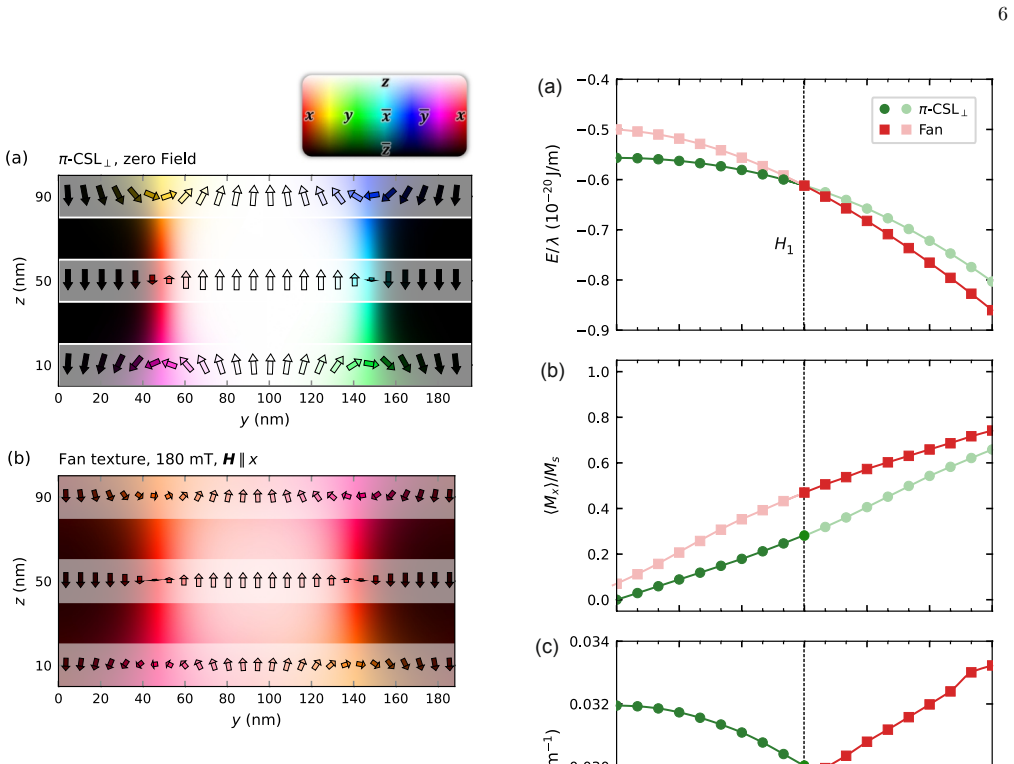
Crystal symmetry in Mn1.4PtSn keeps spin modulation transverse to a perpendicular field, transforming the chiral soliton lattice into a fan-like state where modulation length shrinks continuously toward the polarized state.
A machine-rendered reading of the paper's core claim, the machinery that carries it, and where it could break.
Core claim
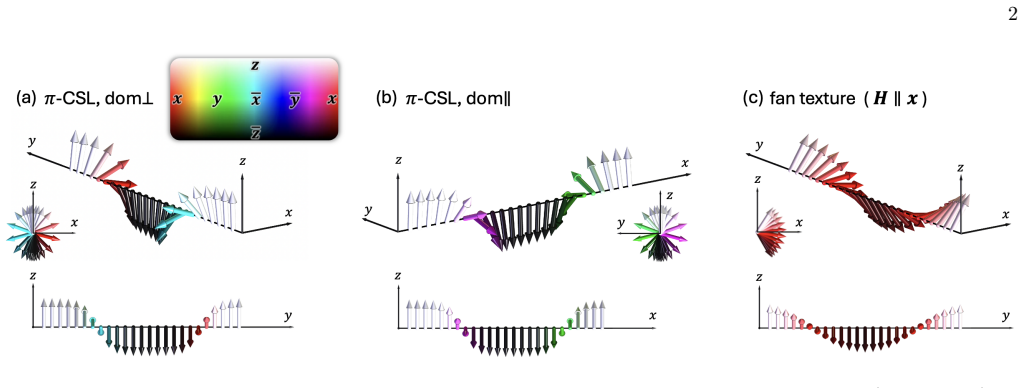
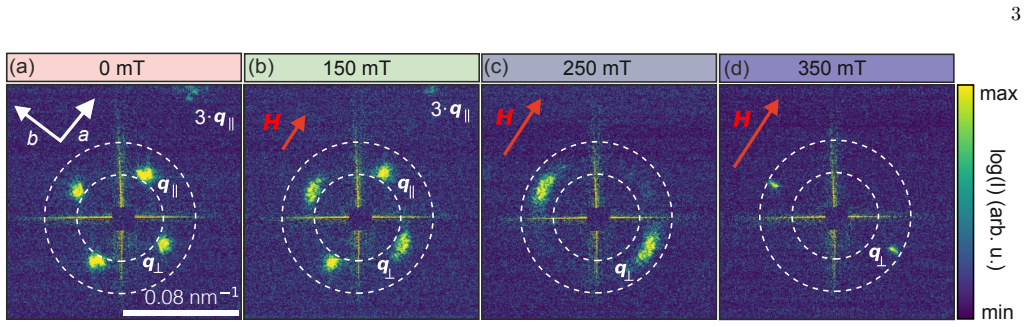
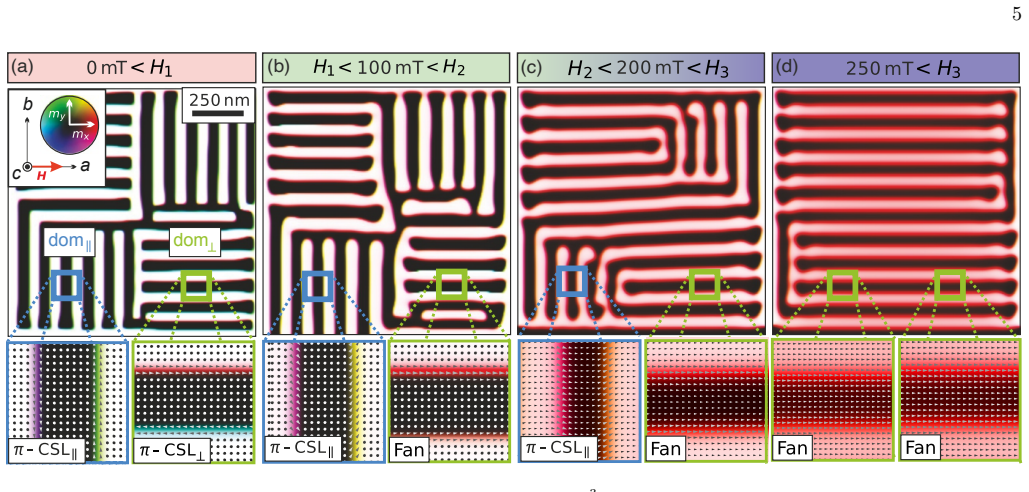
In Mn1.4PtSn, crystal symmetry constrains the propagation direction of the spin modulation to remain along a fixed chiral crystallographic axis. When a magnetic field is applied perpendicular to this axis, resonant X-ray scattering shows the zero-field π-chiral soliton lattice transforming into a fan-like state. In this state the propagation vector stays transverse to the field and the spins oscillate about the field direction. The modulation length decreases continuously with field strength and approaches the field-polarized configuration. Simulations indicate that magnetostatic interactions in finite samples are essential for stabilizing the observed sequence.
What carries the argument
Crystal-symmetry-constrained propagation direction of the helical modulation, which remains fixed while a perpendicular field drives the transition from π-chiral soliton lattice to fan-like state.
If this is right
- The fan-like state keeps its propagation direction transverse to the applied field throughout the magnetization process.
- Modulation length decreases continuously with increasing field and merges smoothly into the field-polarized state.
- Magnetostatic interactions inside finite samples are required to stabilize the fan-like sequence.
- Field orientation relative to the crystal axes can be used to select between conical and fan-like regimes in chiral magnets.
Where Pith is reading between the lines
- The continuous shortening of the modulation period offers a route to field-tunable one-dimensional spin textures without abrupt reorientation.
- Analogous fan states may appear in other anisotropic chiral magnets whose symmetry similarly pins the propagation direction.
- Varying sample size or shape in simulations or experiments could isolate the precise contribution of magnetostatic energy to the fan-state stability.
Load-bearing premise
Crystal symmetry is strong enough to keep the spin-modulation propagation direction fixed along the chiral axis even when a magnetic field is applied perpendicular to it.
What would settle it
If resonant elastic X-ray scattering under a perpendicular field showed the modulation wavevector rotating to align with the field direction instead of remaining transverse, the constrained-regime claim would be falsified.
Figures

read the original abstract
In most helimagnets, an applied magnetic field aligns the propagation direction of a helical spin texture with the field, resulting in a conical state and obscuring the unwinding process. Here, we access a complementary regime in the anisotropic chiral magnet Mn$_{1.4}$PtSn, where crystal symmetry constrains the propagation direction of the spin modulation. Using resonant elastic X-ray scattering in a vector magnet, we track the evolution of quasi-one-dimensional spin textures that propagate along a chiral crystallographic axis while the magnetic field is applied perpendicular to this direction. Together with micromagnetic simulations, our measurements reveal a transformation from the zero-field $\pi$-chiral soliton lattice into a fan-like state. In this state, the propagation direction remains transverse to the applied field, while the spins oscillate about the field direction. During magnetization, the modulation length decreases continuously with the field and approaches the field-polarized state. Simulations indicate that magnetostatic interactions in finite samples play a key role in stabilizing this behavior. Our results provide evidence for a fan-like regime in a chiral magnet and highlight how field orientation can be used to control one-dimensional spin textures.
Editorial analysis
A structured set of objections, weighed in public.
Referee Report
Summary. The manuscript reports resonant elastic X-ray scattering measurements on the anisotropic chiral magnet Mn1.4PtSn in which a magnetic field is applied perpendicular to a fixed chiral axis. It claims that crystal symmetry prevents reorientation of the helical propagation vector, allowing observation of a continuous transformation from the zero-field π-chiral soliton lattice into a fan-like state whose modulation length decreases with field until the system approaches the field-polarized state; micromagnetic simulations attribute the behavior to magnetostatic interactions in finite samples.
Significance. If the invariance of the propagation vector is experimentally verified, the work supplies direct evidence for a fan regime in a chiral magnet and illustrates how field orientation can be used to access quasi-1D spin textures that are otherwise obscured by conical states. The combination of vector-magnet scattering with simulations is a strength, though the result remains largely observational.
major comments (2)
- [Experimental results / abstract] The central claim that crystal symmetry fixes the propagation vector along the chiral axis even under perpendicular field (abstract and § on experimental geometry) is load-bearing, yet the manuscript provides no quantitative rocking-curve or reciprocal-space maps demonstrating that the modulation wavevector remains strictly transverse throughout the field sweep; any undetected rotation would collapse the claimed complementary regime.
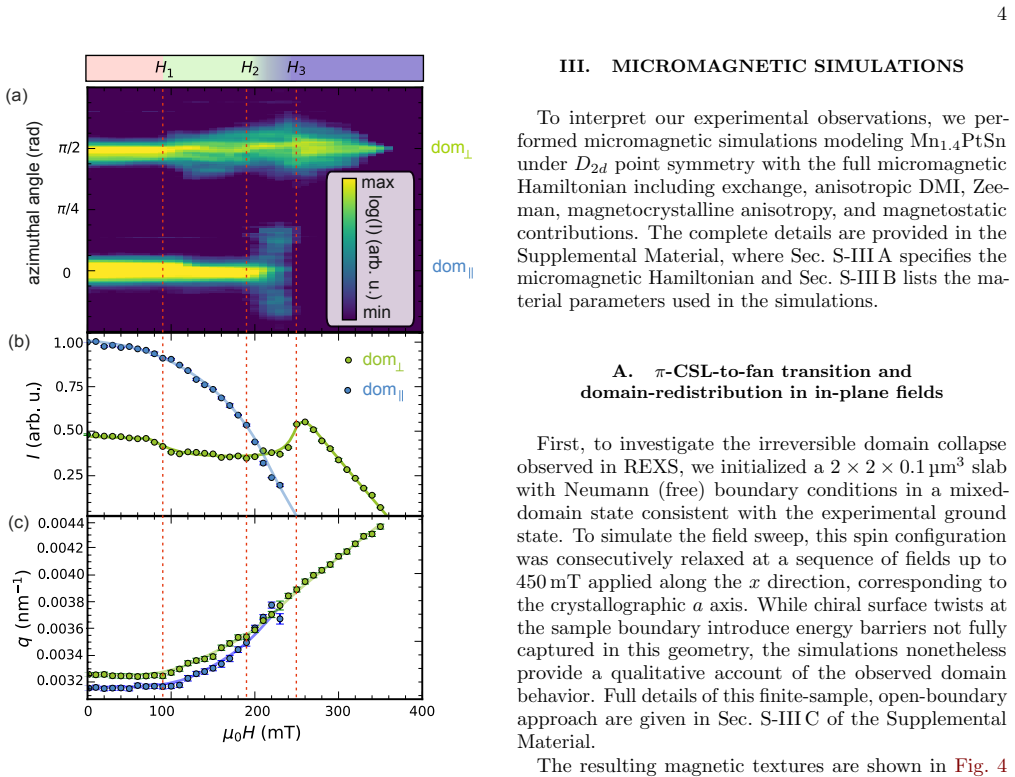
- [Results and simulations] The continuous decrease of modulation length and the identification of the fan state rest on the scattering peak positions and widths; without reported error bars, field-step resolution, or explicit comparison of measured versus simulated peak trajectories (e.g., in the figure showing field dependence), it is unclear whether the data unambiguously exclude a conical component or sample-to-sample variation.
minor comments (2)
- [Introduction] Notation for the π-chiral soliton lattice versus conventional CSL should be clarified in the introduction to avoid confusion with prior literature on MnSi or Cu2OSeO3.
- [Figures] Figure captions should explicitly state the field orientation relative to the scattering plane and the chiral axis for each panel.
Simulated Author's Rebuttal
We thank the referee for their careful reading of the manuscript and for the constructive comments. We address each major point below and will revise the manuscript accordingly.
read point-by-point responses
-
Referee: [Experimental results / abstract] The central claim that crystal symmetry fixes the propagation vector along the chiral axis even under perpendicular field (abstract and § on experimental geometry) is load-bearing, yet the manuscript provides no quantitative rocking-curve or reciprocal-space maps demonstrating that the modulation wavevector remains strictly transverse throughout the field sweep; any undetected rotation would collapse the claimed complementary regime.
Authors: The central role of crystal symmetry in fixing the propagation vector is discussed in the experimental geometry section and is the basis for accessing the complementary regime. We agree that quantitative experimental confirmation would strengthen the presentation. In the revised manuscript we will include reciprocal-space maps and rocking-curve data acquired at representative fields to demonstrate that the modulation wavevector remains transverse throughout the sweep. revision: yes
-
Referee: [Results and simulations] The continuous decrease of modulation length and the identification of the fan state rest on the scattering peak positions and widths; without reported error bars, field-step resolution, or explicit comparison of measured versus simulated peak trajectories (e.g., in the figure showing field dependence), it is unclear whether the data unambiguously exclude a conical component or sample-to-sample variation.
Authors: We acknowledge that explicit error bars, field-step details, and direct experimental-simulation comparisons would improve rigor. In the revised manuscript we will add error bars to the modulation-length data, state the field-step resolution used in the experiment, and include an overlay or supplementary panel comparing measured and simulated peak trajectories to support the identification of the fan state and the exclusion of a conical component. revision: yes
Circularity Check
No circularity: experimental observations and simulations are independent of self-referential fits or definitions
full rationale
The paper reports resonant elastic X-ray scattering measurements tracking the evolution of spin textures in Mn1.4PtSn under perpendicular field, combined with micromagnetic simulations to interpret the transition from π-chiral soliton lattice to fan-like state. No equations, derivations, or first-principles results are claimed that reduce to inputs by construction; the propagation direction constraint is a stated crystal symmetry property used to interpret data, not a fitted parameter renamed as prediction. Central claims rest on measured scattering patterns and external simulation outputs rather than self-citation chains or self-definitional loops. This is self-contained experimental work with no load-bearing circular steps.
Axiom & Free-Parameter Ledger
Reference graph
Works this paper leans on
-
[1]
Nagaosa and Y
N. Nagaosa and Y. Tokura, Nat. Nanotechnol.8, 899 (2013)
2013
-
[2]
A. Fert, V. Cros, and J. Sampaio, Nat. Nanotechnol.8, 152 (2013)
2013
-
[3]
S. Koraltan, C. Abert, M. Albrecht, M. Azhar, C. Back, H. B´ ea, M. T. Birch, S. Bl¨ ugel, O. Boulle, F. B¨ uttner, P. Che, V. Cros, E. Darwin, L. Desplat, C. Donnelly, H. Du, K. Everschor-Sitte, A. Fern´ andez- Pacheco, S. Finizio, G. Finocchio, M. Garst, R. Gru- ber, D. Grundler, S. Hayami, T. Hesjedal, A. Hoffmann, A. Hrabec, H. J. Hug, H. Jani, J. Jen...
arXiv 2026
-
[4]
Zhang, J
C. Zhang, J. Zhang, C. Liu, S. Zhang, Y. Yuan, P. Li, Y. Wen, Z. Jiang, B. Zhou, Y. Lei, D. Zheng, C. Song, 9 Z. Hou, W. Mi, U. Schwingenschl¨ ogl, A. Manchon, Z. Q. Qiu, H. N. Alshareef, Y. Peng, and X. X. Zhang, Adv. Mater.33, 2101131 (2021)
2021
-
[5]
A. K. Nayak, V. Kumar, T. Ma, P. Werner, E. Pippel, R. Sahoo, F. Damay, U. K. R¨ oßler, C. Felser, and S. S. P. Parkin, Nature548, 561 (2017)
2017
-
[6]
T. Ma, A. K. Sharma, R. Saha, A. K. Srivastava, P. Werner, P. Vir, V. Kumar, C. Felser, and S. S. P. Parkin, Adv. Mater.32, 2002043 (2020)
2020
-
[7]
L. Peng, R. Takagi, W. Koshibae, K. Shibata, K. Naka- jima, T. h. Arima, N. Nagaosa, S. Seki, X. Yu, and Y. Tokura, Nat. Nanotechnol.15, 181 (2020)
2020
-
[8]
L. Peng, K. V. Iakoubovskii, K. Karube, Y. Taguchi, Y. Tokura, and X. Yu, Adv. Sci.9, 2202950 (2022)
2022
-
[9]
Winter, F
M. Winter, F. J. Goncalves, I. Soldatov, Y. He, B. E. C´ espedes, P. Milde, K. Lenz, S. Hamann, M. Uhlarz, P. Vir, M. K¨ onig, P. J. Moll, R. Schlitz, S. T. Goen- nenwein, L. M. Eng, R. Sch¨ afer, J. Wosnitza, C. Felser, J. Gayles, and T. Helm, Commun. Mater.3, 1 (2022)
2022
-
[10]
B. E. Zuniga Cespedes, P. Vir, P. Milde, C. Felser, and L. M. Eng, Phys. Rev. B103, 184411 (2021)
2021
-
[11]
J. Jena, B. G¨ obel, T. Ma, V. Kumar, R. Saha, I. Mertig, C. Felser, and S. S. Parkin, Nat. Commun.11, 1 (2020)
2020
-
[12]
J. Jena, B. G¨ obel, T. Hirosawa, S. A. D´ iaz, D. Wolf, T. Hinokihara, V. Kumar, I. Mertig, C. Felser, A. Lubk, D. Loss, and S. S. Parkin, Nat. Commun.13, 2348 (2022)
2022
-
[13]
J. Jena, S. Koraltan, F. Bruckner, K. Holst, M. Tangi, C. Abert, C. Felser, D. Suess, and S. S. P. Parkin, Adv. Funct. Mater. , 2403358 (2024)
2024
-
[14]
A. S. Sukhanov, V. Ukleev, P. Vir, P. Gargiani, M. Valvi- dares, J. S. White, C. Felser, and D. S. Inosov, Phys. Rev. B106, L140402 (2022)
2022
-
[15]
M. Winter, A. Pignedoli, M. C. Rahn, A. S. Sukhanov, B. Achinuq, J. R. Bollard, M. Azhar, K. Everschor- Sitte, D. Pohl, S. Schneider, A. Tahn, V. Ukleev, M. Valvidares, A. Thomas, D. Wolf, P. Vir, T. Helm, G. van der Laan, T. Hesjedal, J. Geck, C. Felser, and B. Rellinghaus, arXiv 10.48550/arXiv.2508.10640 (2025), arXiv:2508.10640 [cond-mat.mtrl-sci]
-
[16]
Y. A. Izyumov, Sov. Phys. Usp.27, 845 (1984)
1984
-
[17]
Yoshimori, J
A. Yoshimori, J. Phys. Soc. Jpn.14, 807 (1959)
1959
-
[18]
Ishikawa, T
Y. Ishikawa, T. Komatsubara, and E. Hirahara, Phys. Rev. Lett.23, 532 (1969)
1969
-
[19]
S. A. Osorio, V. Laliena, J. Campo, and S. Bustingorry, Phys. Rev. B108, 054414 (2023)
2023
-
[20]
S. K. Karna, M. Marshall, W. Xie, L. Debeer-Schmitt, D. P. Young, I. Vekhter, W. A. Shelton, A. Kov´ acs, M. Charilaou, and J. F. Ditusa, Nano Lett.21, 1205 (2021)
2021
-
[21]
A. E. Hall, J. C. Loudon, P. A. Midgley, A. C. Twitchett- Harrison, S. J. Holt, D. A. Mayoh, J. P. Tidey, Y. Han, M. R. Lees, and G. Balakrishnan, Phys. Rev. Mater.6, 024407 (2022)
2022
-
[22]
M. Shinozaki, S. Hoshino, Y. Masaki, A. N. Bogdanov, A. O. Leonov, J. Kishine, and Y. Kato, arXiv preprint arXiv:1705.07778 (2017), arXiv:1705.07778 [cond-mat.str- el]
Pith/arXiv arXiv 2017
-
[23]
Brearton, S
R. Brearton, S. H. Moody, L. A. Turnbull, P. D. Hatton, A. ˇStefanˇ ciˇ c, G. Balakrishnan, G. van der Laan, and T. Hesjedal, Adv. Phys. Res.2, 2200116 (2023)
2023
-
[24]
Okamura, Y
Y. Okamura, Y. Yamasaki, D. Morikawa, T. Honda, V. Uk- leev, H. Nakao, Y. Murakami, K. Shibata, F. Kagawa, S. Seki, T. Arima, and Y. Tokura, Phys. Rev. B96, 174417 (2017)
2017
-
[25]
Ukleev, Y
V. Ukleev, Y. Yamasaki, O. Utesov, K. Shibata, N. Kanazawa, N. Jaouen, H. Nakao, Y. Tokura, and T. H. Arima, Phys. Rev. B102, 014416 (2020)
2020
-
[26]
Togawa, T
Y. Togawa, T. Koyama, K. Takayanagi, S. Mori, Y. Kousaka, J. Akimitsu, S. Nishihara, K. Inoue, A. S. Ovchinnikov, and J. Kishine, Phys. Rev. Lett.108, 107202 (2012)
2012
-
[28]
A. O. Leonov, Y. Togawa, T. L. Monchesky, A. N. Bog- danov, J. Kishine, Y. Kousaka, M. Miyagawa, T. Koyama, J. Akimitsu, T. Koyama, K. Harada, S. Mori, D. Mc- Grouther, R. Lamb, M. Krajnak, S. McVitie, R. L. Stamps, and K. Inoue, Phys. Rev. Lett.117, 087202 (2016)
2016
-
[29]
Schneider, D
S. Schneider, D. Wolf, M. J. Stolt, S. Jin, D. Pohl, B. Rellinghaus, M. Schmidt, B. B¨ uchner, S. T. B. Goen- nenwein, K. Nielsch, and A. Lubk, Phys. Rev. Lett.120, 217201 (2018)
2018
-
[30]
D. Wolf, S. Schneider, U. K. Rossler, A. Kovacs, M. Schmidt, R. E. Dunin-Borkowski, B. Buechner, B. Rellinghaus, and A. Lubk, Nat. Nanotechnol.17, 250 (2022). Supplemental Material for Quasi-1D Spin Textures: From Chiral Soliton Lattice to Fan State M. Winter, A. Pignedoli, A. S. Sukhanov, M. Azhar, A. Tahn, B. Achinuq, J. R. Bollard, V. Ukleev, C. Luo, F...
2022
-
[31]
Nolle, M
D. Nolle, M. Weigand, P. Audehm, E. Goering, U. Wiesemann, C. Wolter, E. Nolle, and G. Sch¨ utz, Rev. Sci. Instrum.83 (2012). 4
2012
-
[32]
A. N. Bogdanov and D. A. Yablonskii, J. Exp. Theor. Phys.68, 101 (1989)
1989
-
[33]
Bogdanov and A
A. Bogdanov and A. Hubert, J. Magn. Magn. Mater.195, 182 (1999)
1999
-
[34]
I. E. Dzyaloshinskii, Sov. Phys. JETP19, 960 (1964)
1964
-
[35]
L. Peng, R. Takagi, W. Koshibae, K. Shibata, K. Nakajima, T. h. Arima, N. Nagaosa, S. Seki, X. Yu, and Y. Tokura, Nat. Nanotechnol.15, 181 (2020)
2020
-
[36]
M. J. Donahue and D. G. Porter 10.6028/nist.ir.6376 (1999)
-
[37]
M. Beg, M. Lang, and H. Fangohr, IEEE Trans. Magn.58, 10.1109/tmag.2021.3078896 (2022)
discussion (0)
Sign in with ORCID, Apple, or X to comment. Anyone can read and Pith papers without signing in.