REVIEW 3 major objections 4 minor 58 references
Spinning generalizations of Majumdar-Papapetrou multi-black hole spacetimes: light rings, lensing and shadows
T0 review · 3 major / 4 minor · reviewed 2026-08-09 · deepseek-v4-flash
Pith's one-line read The paper argues that a two-centre Teo-Wan binary — a rotating, conical-singularity-free generalization of the Majumdar-Papapetrou spacetime — supports only 4, 6, or 8 light rings whenever either black hole spins, and that opposite-charge…
desk verdict First null-geodesic analysis of the Teo-Wan binary, with a solid topological charge treatment, but the 'always 4/6/8 light rings' claim outruns the equal-mass scans that support it. read the letter →
The pith
A machine-rendered reading of the paper's core claim, the machinery that carries it, and where it could break.
The reading
What carries the argument
The load-bearing object is the pair of effective potentials $H_{\pm}^{\rm TW} = 1/(\pm \rho \sqrt{H_+ H_-} - \omega^0_\varphi)$ defined on the half-plane $(\rho,z)$, whose critical points are light rings. The vector fields $v_\pm$ obtained from their normalised gradients carry a winding number, the topological charge: $+1$ at maxima or minima and $-1$ at saddles. The paper uses the theorem that for two collinear black holes each potential's total charge is $-2$, independent of parameters, which fixes the allowed recombination pattern: light rings can only appear or disappear by coalescence of opposite charges. The Teo-Wan metric itself, built from two harmonic functions $f$ and $g$ on flat $\mathbb{E}^3$, is what makes the analysis tractable.
What would settle it
Numerically continue the critical points of $H_{\pm}^{\rm TW}$ on a dense grid that includes unequal masses and unequal charges, monitoring the winding of $v_\pm$. Any configuration with five light rings from a single potential, or a total outside $\{4,6,8\}$, would refute the central counting claim; an analytic bound on the number of zeros of $v_\pm$ would settle it as a theorem.
Extended reading notes
Core claim
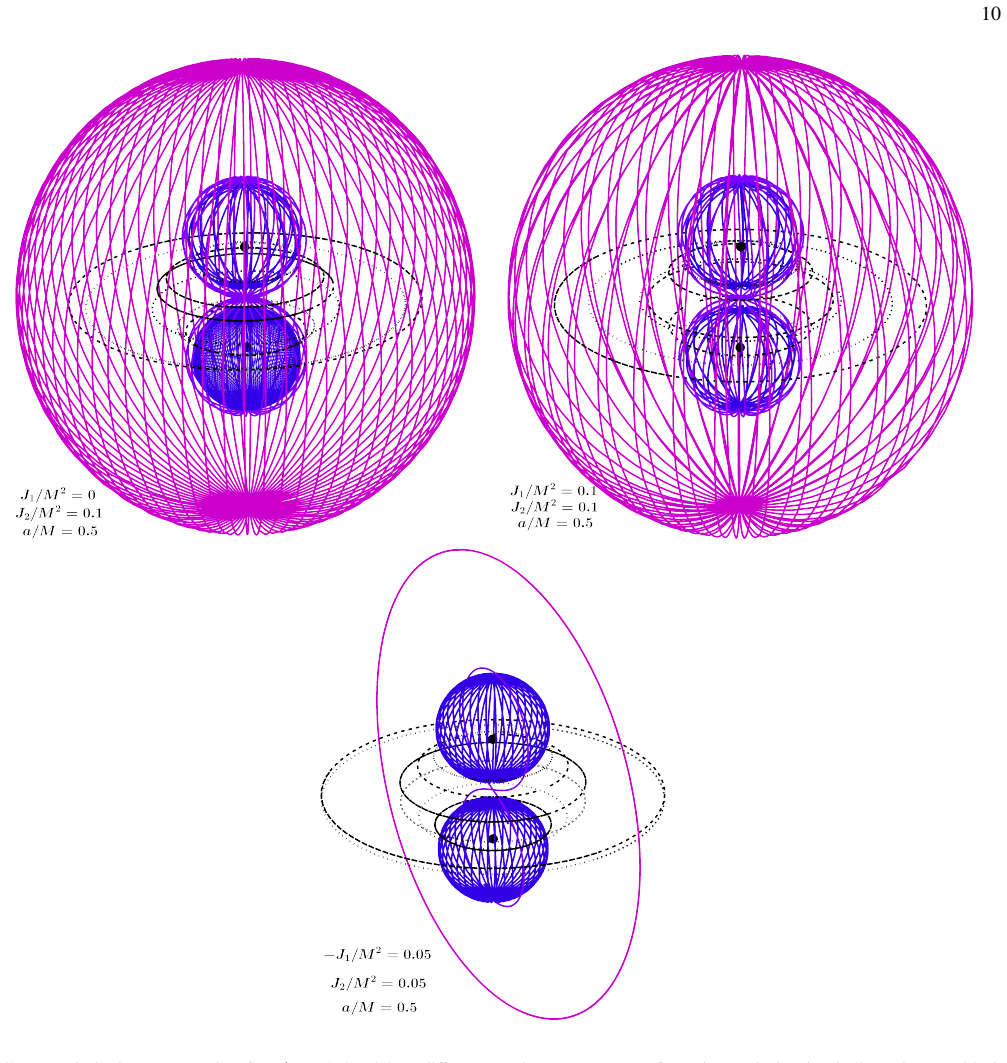
The central claim is that the two-centre Teo-Wan solution, a conical-singularity-free rotating generalisation of the Majumdar-Papapetrou binary in Kaluza-Klein theory, has a discretely constrained light-ring content. Each of the two effective potentials $H_{\rm TW}^{\pm}$ can host between 2 and 4 light rings, so the total is always 4, 6, or 8 whenever $J_1 \neq 0$ or $J_2 \neq 0$. Rotation splits each static light ring into co-rotating and counter-rotating versions; when a $+1$ topological charge meets a $-1$ charge, the pair merges and annihilates, dropping the count by two. For equal-mass centres the paper maps the regions of parameter space in $(a,J)$ realising each count, and notes that in the oppositely rotating case the symmetry forces the $+$ and $-$ potentials to contribute equal numbers, excluding 6. Backward ray-tracing shows nested 'eyebrow' shadows, a fractal-like shadow structure, and D-shaped images close to those of double-Kerr.
Load-bearing premise
The counting claim assumes the finite numerical scans in the $(a,J)$ parameter plane catch every saddle-node bifurcation, so no rigorous bound rules out additional critical points of $H_{\pm}^{\rm TW}$ in unexamined regions; it also assumes the equal-charge, extremal under-rotating branch is representative of the full Teo-Wan family.
Editorial extensions
If this is right
- Every rotating two-centre Teo-Wan configuration within the extremal parameter range has 4, 6, or 8 light rings, so its photon-capture and shadow structure changes only through discrete reorganisations.
- Equal-mass, oppositely spinning binaries never produce 6 light rings: the reflection symmetry makes the two effective potentials contribute equal numbers, so the count is either 4 or 8.
- The parameter-space boundaries where light rings annihilate are genuine critical transitions, and they mark where shadows and lensing patterns should change most sharply.
- Because the Teo-Wan metric is simpler than double-Kerr and free of conical singularities, its shadow patterns can stand in for double-Kerr in quasi-static models of pre-merger binary images.
Reading between the lines
- A natural testable extension is to relax equal charges and masses; if the two-potential structure persists, the {4,6,8} counting may be generic for extremal Kaluza-Klein binaries, not an accident of the symmetric branch.
- The annihilation mechanism suggests a conservation-law reading of light-ring content: in axisymmetric binaries, photon rings can only be created or destroyed in charge-neutral pairs, so the parity of the total count is fixed by the boundary topology.
- The close shadow resemblance to double-Kerr reinforces the known image-degeneracy problem: very different exact binary spacetimes can produce nearly identical shadows, so observations alone may not distinguish the underlying solution.
- A direct numerical test of the paper's final suggestion would compare Teo-Wan snapshot images with fully dynamical binary black-hole simulations; agreement would elevate this exact solution into a practical template for interpreting pre-merger images.
Editorial analysis
A structured set of objections, weighed in public.
Referee Report
Summary. The manuscript studies null geodesics, light rings (LRs), shadows, and lensing in the Teo-Wan (TW) two-black-hole spacetime, a charged, spinning Kaluza-Klein generalization of the Majumdar-Papapetrou solution. The authors define the effective potentials H_TW+ and H_TW- and their associated vector fields, compute light-ring positions and topological charges, and use backward ray-tracing to produce shadow and lensing images for equal-mass binaries in three angular-momentum alignments. The main claimed result is that, for J1≠0 or J2≠0, each of the two potentials has between 2 and 4 light rings, so the total number of light rings is always 4, 6, or 8, with changes driven by annihilation of opposite-charge light rings. The paper also revisits the MP light-ring structure, presents fundamental photon orbits, and compares the shadows with those of double-Kerr spacetimes.
Significance. If the central counting claim is established rigorously, this would be a nice demonstration of the topological-charge formalism in an exact multi-black-hole setting: it would give discrete light-ring counts, explicit annihilation mechanisms, and concrete shadow/lensing predictions for a rotating binary. The paper is also useful for its explicit formulas for H_TW± and v_TW±, its parameter-space maps, and its systematic numerical images. However, the universal 'always 4/6/8' claim currently rests on finite scans over restricted parameter slices rather than on a proof of an upper bound on the number of critical points, so the main quantitative conclusion is not yet fully supported.
major comments (3)
- [Sec. IV B, Eqs. (30)–(31) and Fig. 10] The statement 'The TW solution allows for a minimum of 2 LRs and a maximum of 4 LRs for each potential, H_TW±. Consequently, the total number of LRs, for J1≠0 or J2≠0, will always be 4, 6, or 8' is not established by the evidence provided. The only systematic scans are in Fig. 10, which are restricted to equal-mass binaries and the three angular-momentum alignments (i)–(iii); the text itself acknowledges that the full five-parameter space is 'significantly more challenging.' The topological charge theorem fixes the total charge per potential at −2, but that does not bound the number of zeros: a planar vector field with total index −2 can have any even number of zeros (for example, one +1 and k −1 zeros gives index 1−k, so arbitrarily many zeros). Thus unequal masses or other (J1,J2) combinations could, in principle, produce more than four light rings for one potential and totals outside {4,6,8}. An analytic upper bound on the number of critical points of H_TW±, or an exhaustive argument covering the full parameter space, is required; at minimum, the 'always' claim must be explicitly restricted to the scanned subfamilies.
- [Sec. IV B] The asserted minimum of two light rings per potential is also not a consequence of the total topological charge. A smooth planar vector field with total index −2 can have a single zero of index −2, so the existence of at least two zeros for each H_TW± needs a separate argument based on the boundary behavior of v_TW±. If such an argument is intended, it should be stated; if the minimum is only an observation from the scanned parameter regions, the text should say so and avoid presenting it as a general property.
- [Sec. IV B and Sec. VI] The heuristic explanation that 'the angular momentum splits each LR of the static case into two... resulting in a maximum of 8 LRs' is not by itself a proof of the maximum. The MP spacetime already has either 2 or 4 light rings depending on the separation parameter a, so the static-case starting point is parameter-dependent, and the maximum of 8 follows only from the unproven maximum of 4 per potential. This reinforces that the universal count needs a rigorous bound, not just a plausible splitting picture.
minor comments (4)
- [Sec. V A] There is a typo in the text: 'Althought the shadows...' should read 'Although the shadows...'.
- [Sec. II B] Shortly after Eq. (8), the text refers to 'Fig. Extremal'; this appears to be a formatting error and should read 'Fig. 1'.
- [Fig. 13 caption] The caption contains 'rapdily rotating'; this should be 'rapidly rotating'.
- [Fig. 10] The axes in Fig. 10 have numerical tick marks but no explicit axis labels in the figure as rendered; adding labels such as a/M and J/M^2 would improve readability.
Circularity Check
No circularity: the light-ring counts are computed from the Teo–Wan metric by solving the vector-field equations, not fitted or defined into existence.
full rationale
The paper's central results—the light-ring counts 4, 6, or 8 and their annihilation behavior—are obtained by writing the effective potentials H_TW± in Eq. (30) directly from the Teo–Wan metric, constructing the vector fields v_TW± in Eq. (31), and locating their zeros numerically over the parameter space. No parameter is fitted to the reported light-ring counts, and no observable is defined in terms of the conclusion it is supposed to support. The topological-charge theorem of Ref. [36] is imported to fix the total charge of each potential to −2, but this constraint alone does not determine the maximum number of light rings; it is used as a consistency check and to interpret coalescence events, not to force the 4/6/8 totals. The claimed maximum of four light rings per potential rests on the finite scans in Fig. 10, so the universal wording of Sec. IV B is an extrapolation beyond the scanned equal-mass, three-alignment cases—a rigor gap about parameter coverage, not a circularity. Similarly, the comparison of shadows to the double-Kerr spacetime is an observational analogy, not a derivation that assumes its conclusion. The self-citations to the topological-charge formalism are to mathematical results with stated assumptions independent of the present paper's fitted values, so they do not make the derivation circular.
Assumptions & free parameters
assumptions (3)
- standard math Total topological charge of each H± is -N for N collinear BHs (from [36])
- domain assumption The Teo-Wan metric (14) describes two asymptotically flat extremal black holes in equilibrium with no conical singularities
- standard math Every light ring of the spacetime corresponds to a critical point of the potentials H±, and the vector fields v± detect all of them
Cite this review
Pith. "Pith review of Spinning generalizations of Majumdar-Papapetrou multi-black hole spacetimes: light rings, lensing and shadows." pith.science (2026). https://pith.science/paper/DHBQMYQF
@misc{pith2026250201759,
  author       = {Pith},
  title        = {Pith review of: Spinning generalizations of Majumdar-Papapetrou multi-black hole spacetimes: light rings, lensing and shadows},
  year         = {2026},
  howpublished = {\url{https://pith.science/paper/DHBQMYQF}},
  note         = {Machine review of arXiv:2502.01759}
}
read the original abstract
A generalization of the Majumdar-Papapetrou multi-black hole spacetime was recently constructed by Teo and Wan [1], describing charged and spinning (extremal) balanced black holes in asymptotically flat spacetime. We explore the dynamics of null geodesics on this geometry, focusing on the two-center solution. Using the topological charge formalism, we show that various light ring arrangements arise from different choices of individual angular momenta: light rings with opposite topological charges can merge and annihilate each other, resulting in configurations with a total of 4, 6, or 8 light rings. Using backward ray-tracing, we obtained the shadow and lensing of these spacetimes. The former, in particular, closely resembles those for the double-Kerr metric.
Figures


Figures from the paper (10 more)




Reference graph
Works this paper leans on
- [1]
-
[2]
In the overlapping regions, both potentials yield 4 LRs each. For the case𝐽1= 0, 𝐽2=𝐽, and−𝐽1=𝐽2=𝐽 we notice that the boundary is composed of three different smooth pieces. This boundary represents critical values of (𝑎,𝐽) where the number of LRs contributed by one potential changes from 2 to ▲ ▲ △ △ ● ● -1.0 -0.5 0.0 0.5 1.0 ▲ ▲ ▲▼ ▼ △ △ ● ● -1.0 -0.5 0....
-
[3]
B. P. Abbott et al. (LIGO Scientific, Virgo), Observation of Gravitational Waves from a Binary Black Hole Merger, Phys. Rev. Lett.116, 061102 (2016), arXiv:1602.03837 [gr-qc]
arXiv 2016
-
[4]
R. Abbott et al. (KAGRA, VIRGO, LIGO Scientific), GWTC- 3: Compact Binary Coalescences Observed by LIGO and Virgo during the Second Part of the Third Observing Run, Phys. Rev. X 13, 041039 (2023), arXiv:2111.03606 [gr-qc]
arXiv 2023
-
[5]
A. G. Abac et al. (LIGO Scientific, Virgo,, KAGRA, VIRGO), Observation of Gravitational Waves from the Coalescence of a 2.5–4.5 M⊙ Compact Object and a Neutron Star, Astrophys. J. Lett. 970, L34 (2024), arXiv:2404.04248 [astro-ph.HE]
arXiv 2024
-
[6]
G. L. Bunting and A. K. M. Masood-ul Alam, Nonexistence of multiple black holes in asymptotically euclidean static vacuum space-time, General relativity and gravitation 19, 147 (1987)
work page 1987
-
[7]
M. S. Costa, C. A. R. Herdeiro, and C. Rebelo, Dynamical and Thermodynamical Aspects of Interacting Kerr Black Holes, Phys. Rev. D79, 123508 (2009), arXiv:0903.0264 [gr-qc]
work page Pith review arXiv 2009
-
[8]
Stationary two-black-hole configurations: A non-existence proof
G. Neugebauer and J. Hennig, Stationary two-black-hole config- urations: A non-existence proof, J. Geom. Phys.62, 613 (2012), arXiv:1105.5830 [gr-qc]
work page Pith review arXiv 2012
Show all 58 references
-
[9]
Hennig and G
J. Hennig and G. Neugebauer, Non-existence of stationary two- black-hole configurations: The degenerate case, Gen. Rel. Grav. 43, 3139 (2011), arXiv:1103.5248 [gr-qc]
2011 arXiv
-
[10]
Bach and H
R. Bach and H. Wevl, Neue l¨osungen der einsteinschen gravita- tionsgleichungen: B. explizite aufstellung statischer axialsym- metrischer felder, Mathematische Zeitschrift 13, 134 (1922)
1922
-
[11]
Kramer and G
D. Kramer and G. Neugebauer, The superposition of two kerr solutions, Physics Letters A 75, 259 (1980)
1980
-
[12]
C. A. R. Herdeiro and E. Radu, Two Schwarzschild-like black holes balanced by their scalar hair, Phys. Rev. D 107, 064044 (2023), arXiv:2302.00016 [gr-qc]
2023 arXiv
-
[13]
C. A. R. Herdeiro and E. Radu, Two Spinning Black Holes Balanced by Their Synchronized Scalar Hair, Phys. Rev. Lett. 131, 121401 (2023), arXiv:2305.15467 [gr-qc]
2023 arXiv
-
[14]
Astorino and A
M. Astorino and A. Vigano, Binary black hole system at equi- librium, Phys. Lett. B 820, 136506 (2021), arXiv:2104.07686 [gr-qc]
2021 arXiv
-
[15]
O. J. C. Dias, G. W. Gibbons, J. E. Santos, and B. Way, Static Black Binaries in de Sitter Space, Phys. Rev. Lett.131, 131401 (2023), arXiv:2303.07361 [gr-qc]
2023 arXiv
-
[16]
S. D. Majumdar, A class of exact solutions of Einstein’s field equations, Phys. Rev.72, 390 (1947)
1947
-
[17]
Papaetrou, A Static solution of the equations of the gravita- tional field for an arbitrary charge distribution, Proc
A. Papaetrou, A Static solution of the equations of the gravita- tional field for an arbitrary charge distribution, Proc. Roy. Irish Acad. A 51, 191 (1947)
1947
-
[18]
Israel and G
W. Israel and G. A. Wilson, A class of stationary electromagnetic vacuum fields, J. Math. Phys. 13, 865 (1972)
1972
-
[19]
Perjes, Solutions of the coupled Einstein Maxwell equations representing the fields of spinning sources, Phys
Z. Perjes, Solutions of the coupled Einstein Maxwell equations representing the fields of spinning sources, Phys. Rev. Lett. 27, 1668 (1971)
1971
-
[20]
J. B. Hartle and S. W. Hawking, Solutions of the Einstein- Maxwell equations with many black holes, Commun. Math. Phys. 26, 87 (1972)
1972
-
[21]
Rasheed, The Rotating dyonic black holes of Kaluza-Klein theory, Nucl
D. Rasheed, The Rotating dyonic black holes of Kaluza-Klein theory, Nucl. Phys. B 454, 379 (1995), arXiv:hep-th/9505038
1995 arXiv
-
[22]
Larsen, Rotating Kaluza-Klein black holes, Nucl
F. Larsen, Rotating Kaluza-Klein black holes, Nucl. Phys. B 575, 211 (2000), arXiv:hep-th/9909102
2000 arXiv
-
[23]
Akiyama et al
K. Akiyama et al. (Event Horizon Telescope), First M87 Event Horizon Telescope Results. I. The Shadow of the Su- permassive Black Hole, Astrophys. J. Lett. 875, L1 (2019), arXiv:1906.11238 [astro-ph.GA]
2019 arXiv
-
[24]
Akiyama et al
K. Akiyama et al. (Event Horizon Telescope), First Sagittar- ius A* Event Horizon Telescope Results. I. The Shadow of the Supermassive Black Hole in the Center of the Milky Way, Astro- phys. J. Lett.930, L12 (2022), arXiv:2311.08680 [astro-ph.HE]
2022 arXiv
-
[25]
Chowdhuri and A
A. Chowdhuri and A. Bhattacharyya, Shadow analysis for ro- tating black holes in the presence of plasma for an expanding universe, Phys. Rev. D 104, 064039 (2021), arXiv:2012.12914 [gr-qc]
2021 arXiv
-
[26]
Bad´ıa and E
J. Bad´ıa and E. F. Eiroa, Shadows of rotating Einstein-Maxwell- dilaton black holes surrounded by a plasma, Phys. Rev. D 107, 124028 (2023), arXiv:2210.03081 [gr-qc]
2023 arXiv
-
[27]
Gao, T.-T
X.-J. Gao, T.-T. Sui, X.-X. Zeng, Y.-S. An, and Y.-P. Hu, In- vestigating shadow images and rings of the charged Horndeski black hole illuminated by various thin accretions, Eur. Phys. J. C 83, 1052 (2023), arXiv:2311.11780 [gr-qc]
2023 arXiv
-
[28]
M. A. A. de Paula, H. C. D. Lima Junior, P. V. P. Cunha, and L. C. B. Crispino, Electrically charged regular black holes in nonlinear electrodynamics: Light rings, shadows, and gravitational lensing, Phys. Rev. D 108, 084029 (2023), arXiv:2305.04776 [gr-qc]
2023 arXiv
-
[29]
H. C. D. L. Junior, P. V. P. Cunha, C. A. R. Herdeiro, and L. C. B. Crispino, Shadows and lensing of black holes immersed in strong magnetic fields, Phys. Rev. D 104, 044018 (2021), arXiv:2104.09577 [gr-qc]
2021 arXiv
-
[30]
Sengo, P
I. Sengo, P. V. P. Cunha, C. A. R. Herdeiro, and E. Radu, Kerr black holes with synchronised Proca hair: lensing, shadows and EHT constraints, JCAP 01, 047, arXiv:2209.06237 [gr-qc]
-
[31]
H. C. D. L. Junior, J.-Z. Yang, L. C. B. Crispino, P. V. P. Cunha, and C. A. R. Herdeiro, Einstein-Maxwell-dilaton neu- tral black holes in strong magnetic fields: Topological charge, 16 shadows, and lensing, Phys. Rev. D 105, 064070 (2022), arXiv:2112.10802 [gr-qc]
2022 arXiv
-
[32]
J. a. P. A. Novo, P. V. P. Cunha, and C. A. R. Herdeiro, Hypershadows of higher dimensional black objects: a case study of cohomogeneity-one d=5 Myers-Perry, JHEP 11, 171, arXiv:2410.05390 [gr-qc]
-
[33]
S. V. M. C. B. Xavier, H. C. D. Lima, Junior., and L. C. B. Crispino, Shadows of black holes with dark matter halo, Phys. Rev. D 107, 064040 (2023), arXiv:2303.17666 [gr-qc]
2023 arXiv
-
[34]
Y. Hou, Z. Zhang, H. Yan, M. Guo, and B. Chen, Image of a Kerr-Melvin black hole with a thin accretion disk, Phys. Rev. D 106, 064058 (2022), arXiv:2206.13744 [gr-qc]
2022 arXiv
-
[35]
F. W. Dyson, A. S. Eddington, and C. Davidson, A Determina- tion of the Deflection of Light by the Sun’s Gravitational Field, from Observations Made at the Total Eclipse of May 29, 1919, Phil. Trans. Roy. Soc. Lond. A220, 291 (1920)
1920
-
[36]
P. V. P. Cunha and C. A. R. Herdeiro, Stationary black holes and light rings, Phys. Rev. Lett. 124, 181101 (2020), arXiv:2003.06445 [gr-qc]
2020 arXiv
-
[37]
P. V. P. Cunha, C. A. R. Herdeiro, and J. a. P. A. Novo, Light rings on stationary axisymmetric spacetimes: Blind to the topol- ogy and able to coexist, Phys. Rev. D 109, 064050 (2024), arXiv:2401.05495 [gr-qc]
2024 arXiv
-
[38]
P. V. P. Cunha, E. Berti, and C. A. R. Herdeiro, Light-Ring Stability for Ultracompact Objects, Phys. Rev. Lett.119, 251102 (2017), arXiv:1708.04211 [gr-qc]
2017 arXiv
-
[39]
S. V. M. C. B. Xavier, C. A. R. Herdeiro, and L. C. B. Crispino, Traversable wormholes and light rings, Phys. Rev. D 109, 124065 (2024), arXiv:2404.02208 [gr-qc]
2024 arXiv
-
[40]
P. V. P. Cunha, C. A. R. Herdeiro, and E. Radu, Fundamental photon orbits: black hole shadows and spacetime instabilities, Phys. Rev. D96, 024039 (2017), arXiv:1705.05461 [gr-qc]
2017 arXiv
-
[41]
Olivares, Z
H. Olivares, Z. Younsi, C. M. Fromm, M. De Laurentis, O. Porth, Y. Mizuno, H. Falcke, M. Kramer, and L. Rezzolla, How to tell an accreting boson star from a black hole, Mon. Not. Roy. Astron. Soc. 497, 521 (2020), arXiv:1809.08682 [gr-qc]
2020 arXiv
-
[42]
H. C. D. Lima, Junior., L. C. B. Crispino, P. V. P. Cunha, and C. A. R. Herdeiro, Can different black holes cast the same shadow?, Phys. Rev. D 103, 084040 (2021), arXiv:2102.07034 [gr-qc]
2021 arXiv
-
[43]
C. A. R. Herdeiro, A. M. Pombo, E. Radu, P. V. P. Cunha, and N. Sanchis-Gual, The imitation game: Proca stars that can mimic the Schwarzschild shadow, JCAP 04, 051, arXiv:2102.01703 [gr-qc]
-
[44]
J. a. L. Rosa and D. Rubiera-Garcia, Shadows of boson and Proca stars with thin accretion disks, Phys. Rev. D106, 084004 (2022), arXiv:2204.12949 [gr-qc]
2022 arXiv
-
[45]
Sengo, P
I. Sengo, P. V. P. Cunha, C. A. R. Herdeiro, and E. Radu, The imitation game reloaded: effective shadows of dynamically robust spinning Proca stars, JCAP 05, 054, arXiv:2402.14919 [gr-qc]
-
[46]
Berger, A panoramic view of Riemannian geometry (Springer, 2003)
M. Berger, A panoramic view of Riemannian geometry (Springer, 2003)
2003
-
[47]
J. F. M. Delgado, C. A. R. Herdeiro, and E. Radu, Viola- tions of the Kerr and Reissner-Nordstr ¨om bounds: Horizon versus asymptotic quantities, Phys. Rev. D 94, 024006 (2016), arXiv:1606.07900 [gr-qc]
2016 arXiv
-
[48]
G. W. Gibbons and C. A. R. Herdeiro, Supersymmetric rotating black holes and causality violation, Class. Quant. Grav.16, 3619 (1999), arXiv:hep-th/9906098
1999 arXiv
-
[49]
Clement, Rotating Kaluza-Klein Monopoles and Dyons, Phys
G. Clement, Rotating Kaluza-Klein Monopoles and Dyons, Phys. Lett. A 118, 11 (1986)
1986
-
[50]
Mazharimousavi and M
S. Mazharimousavi and M. Halilsoy, Revisiting the dyonic Majumdar-Papapetrou black holes, Turk. J. Phys.40, 163 (2016), arXiv:1003.5108 [gr-qc]
2016 arXiv
-
[51]
Shipley and S
J. Shipley and S. R. Dolan, Binary black hole shadows, chaotic scattering and the Cantor set, Class. Quant. Grav. 33, 175001 (2016), arXiv:1603.04469 [gr-qc]
2016 arXiv
-
[52]
Z. S. Moreira, C. A. R. Herdeiro, and L. C. B. Crispino, Twisting shadows: Light rings, lensing, and shadows of black holes in swirling universes, Phys. Rev. D 109, 104020 (2024), arXiv:2401.05658 [gr-qc]
2024 arXiv
-
[53]
P. V. P. da Cunha, Black hole shadows-Sombras de buracos negros, Master’s thesis, Universidade de Coimbra (Portugal) (2015)
2015
-
[54]
P. V. P. Cunha, J. Grover, C. Herdeiro, E. Radu, H. Runarsson, and A. Wittig, Chaotic lensing around boson stars and Kerr black holes with scalar hair, Phys. Rev. D 94, 104023 (2016), arXiv:1609.01340 [gr-qc]
2016 arXiv
-
[55]
P. V. P. Cunha, C. A. R. Herdeiro, and M. J. Rodriguez, Does the black hole shadow probe the event horizon geometry?, Phys. Rev. D97, 084020 (2018), arXiv:1802.02675 [gr-qc]
2018 arXiv
-
[56]
P. V. P. Cunha, C. A. R. Herdeiro, and M. J. Rodriguez, Shadows of Exact Binary Black Holes, Phys. Rev. D 98, 044053 (2018), arXiv:1805.03798 [gr-qc]
2018 arXiv
-
[57]
Yumoto, D
A. Yumoto, D. Nitta, T. Chiba, and N. Sugiyama, Shadows of Multi-Black Holes: Analytic Exploration, Phys. Rev. D 86, 103001 (2012), arXiv:1208.0635 [gr-qc]
2012 arXiv
-
[58]
Nitta, T
D. Nitta, T. Chiba, and N. Sugiyama, Shadows of Colliding Black Holes, Phys. Rev. D84, 063008 (2011), arXiv:1106.2425 [gr-qc]
2011 arXiv
Reviewed August 9, 2026 · model on record in the stance chip above.
Discussion (0). Continue with ORCID to comment.