REVIEW 3 major objections 4 minor 15 references
Flow-matching vision-language-action policies can be made to stream in real time by caching the timestep-invariant parts of the network and recomputing only the dynamic flow state.
Reviewed by Pith at T0; open to challenge. T0 means a machine referee read the full paper against a public rubric. the ladder, T0–T4 →
T0 review · deepseek-v4-flash
2026-08-02 01:20 UTC pith:DHE4TIOD
load-bearing objection Reflex is a solid systems paper with a clean caching idea and honest scoping; the main risk is an under-specified timestep-invariance assumption, and the '50Hz' headline overstates the effective policy rate. the 3 major comments →
Reflex: Real-Time VLA Control through Streaming Inference
The pith
A machine-rendered reading of the paper's core claim, the machinery that carries it, and where it could break.
Core claim
The paper's central claim is that the timestep-invariance of perception encoders in two-stage flow-matching VLA models is a resource, not a limitation. Because the visual and language encoders are functionally independent of the denoising timestep t, their key/value states can be pinned and reused while the action expert's dynamic suffix is recomputed at each denoising step. This partitioned attention is proven to produce outputs identical to full-batch attention for a fixed observation window and fixed inputs, with O(1) incremental cache updates. To make this work in continuous deployment, Reflex adds AdaRMSNorm, which computes normalization statistics in FP32 and gates the RMSNorm scale on
What carries the argument
Partitioned Attention: the context is divided into a static prefix (instruction tokens, computed once and pinned), a sliding history (the last N visual frames, updated by FIFO eviction and incremental prefill), and a dynamic suffix (flow state and timestep embeddings, reset each denoising cycle). The timestep-invariance property—that the observation encoder satisfies ∂Enc/∂t_k = 0—is what makes the non-dynamic partitions cacheable; without it, the cached keys and values would be stale and the O(1) claim would fail. The identity that carries the argument is Eq. (1), which treats attention over the concatenated [static; sliding; dynamic] keys and values as exactly equal to pooled attention ove
Load-bearing premise
The load-bearing assumption is timestep-invariance: the key and value representations of language and observation tokens computed before denoising remain exactly valid while the denoising timestep changes—if timestep conditioning reaches those representations through the action expert or any other path, the cached values are stale and the O(1) speedup, together with the exact-equivalence guarantee, collapses.
What would settle it
Compare the dynamic-suffix hidden states produced by Reflex's partitioned attention to a full-batch recomputation on identical inputs while sweeping the denoising timestep t; any nonzero difference in the outputs beyond numerical noise falsifies the exactness claim. A direct probe is to cache the language and vision keys at t=0, recompute them at t>0 through the action expert, and measure whether they diverge—if they diverge, the timestep-invariance assumption fails.
If this is right
- Real-time control becomes feasible for heavy VLA models: stable 50 Hz streaming rather than 10–20 Hz blocking inference, with up to 54% lower reaction latency in the reported experiments.
- A fixed observation window and fixed inputs yield attention outputs reported to match full-batch attention exactly (MSE 0.00), so the speedup does not trade semantic correctness for latency.
- Memory stays flat over time because only the newest frame is encoded and old frames are evicted (27% lower peak VRAM on LIBERO, 24% on Kinetix).
- Larger models benefit as much or more: the reported speedup rises from 2.58x on the smaller model to 2.73x on the larger one.
- The reported 0% stall rate across LIBERO and Kinetix implies the 'act while thinking' loop can be realized in practice, not only in simulation.
Where Pith is reading between the lines
- Editorial: The exact-equivalence proof is stated only for a fixed observation window and fixed inputs; whether the equivalence survives across window slides (new frames arriving between denoising cycles) is not proven, and that regime is what truly indefinite streaming would need.
- Editorial: The timestep-invariance assumption is verified only for two-stage architectures where timestep conditioning bypasses the encoder; a unified architecture that injects t into the vision stack would need a different factorization, as the paper itself notes.
- Editorial: Because the future-state predictor approximates the robot's future state by the last commanded action, its validity depends on low-level tracking accuracy; in high-slip or contact-rich tasks, the latency compensation could introduce oscillation—this is the riskiest engineering assumption beyond the formal proof.
- Editorial: A testable extension is to apply the same cache partitioning to other iterative generative policies, such as diffusion-based action generation, and to variable-rate observation streams, checking whether O(1) per-step updates and output equivalence hold outside flow matching.
Editorial analysis
A structured set of objections, weighed in public.
Referee Report
Summary. The paper proposes Reflex, an inference system for flow-matching Vision-Language-Action (VLA) models. Its central idea is to partition the attention context into a pinned instruction prefix, a sliding window of visual observations, and a per-step dynamic flow suffix; under a "timestep-invariance" assumption, the K/V of the first two partitions are cached so that each denoising step avoids re-encoding observations. Appendix A.1 gives a proof that partitioned softmax equals full softmax when the same K/V blocks are used. The paper also introduces AdaRMSNorm for BFloat16 stability, an asynchronous vision/action pipeline with a future-state predictor, and fused CUDA kernels. Experiments on LIBERO/Kinetix and a real robot report about 2.5x latency reduction, memory savings, and success-rate parity or gains relative to a synchronous baseline.
Significance. If the timestep-invariance premise holds for the Pi0 family, the system contribution is nontrivial: exact partition-based caching plus asynchronous scheduling gives a plausible path to high-frequency control without degrading task success. The paper is commendably explicit that the exactness claim (G1) covers only fixed inputs and a fixed observation window, and that asynchronous scheduling, future-state prediction, and mixed-precision behavior are empirical. The proof itself is essentially a restatement of softmax partition equivariance; the load-bearing architectural fact is the timestep-invariance of the cached K/V. The latency breakdown, ablations, and stress tests are extensive and, conditional on that premise, support the main claims.
major comments (3)
- [§3.1, Appendix A.1] The proof of Proposition A.1 does not establish the premise that makes the equivalence meaningful. The final sentence asserts that timestep-invariance ensures cached Ks, Vs, Kl, Vl are valid at inference time t, but the derivative ∂Enc/∂t_k=0 concerns only the observation encoder, not the action expert. The action expert receives t, and §3.4 mentions FusedAdaLN, indicating adaptive layers inside the expert; if those layers transform the context tokens before K/V projection, the cached context K/V are t-dependent and the speedup is not output-equivalent to full-batch attention. The scope exclusion in §3.1 excludes only t entering the vision encoder. The manuscript needs either an architectural argument that the context-token path in the Pi0/Pi0.5 action expert is t-independent, or a direct drift measurement of cached K/V across denoising steps.
- [§4.2, Table 4] The reported MSE=0.00 is not yet a verification of exactness. If the "full-batch attention oracle" reuses the same cached K/V as Partitioned Attention, the equality holds by construction and does not test timestep-invariance. The text should state explicitly whether the oracle recomputes all action-expert layers at every flow step, and should report, for each cached partition, the difference between K/V computed at t=0 and K/V recomputed at later t. Without that, the deterministic consistency check is not evidence for the central correctness claim in deployments where the cached context passes through t-conditioned expert layers.
- [§4.6, Table 5 vs Table 3] There is an internal inconsistency in the stability story. Table 5 says the BFloat16 baseline collapses after 120–220 steps, while LIBERO episodes last 300–500 steps and Table 3 reports 68–85% success for the "Standard" baseline. If "Standard" runs in FP32 or a different precision, this must be stated and the AdaRMSNorm comparison should be made against an equally fair precision baseline. If it runs in BFloat16, the success numbers are unexplained. Additionally, "BF16 + FP32 norm-only" already extends stability to 700–1200 steps, so the marginal contribution of the adaptive gating beyond FP32 RMS statistics should be isolated.
minor comments (4)
- [§3.1, Appendix A.1] The symbol t is used both for observation time and for the flow-matching denoising timestep; in Eq. (1) and in the proof, "computed at t=0" and "inference time t" conflate the two. This makes the invariance assumption hard to parse.
- [§3.1] "O(1) incremental cache updates" is imprecise: Eq. (1) still performs full attention over the concatenated context at every denoising step. The complexity reduction is relative to re-encoding a growing history under a fixed context window, not to the per-step attention computation itself. The phrasing should be qualified.
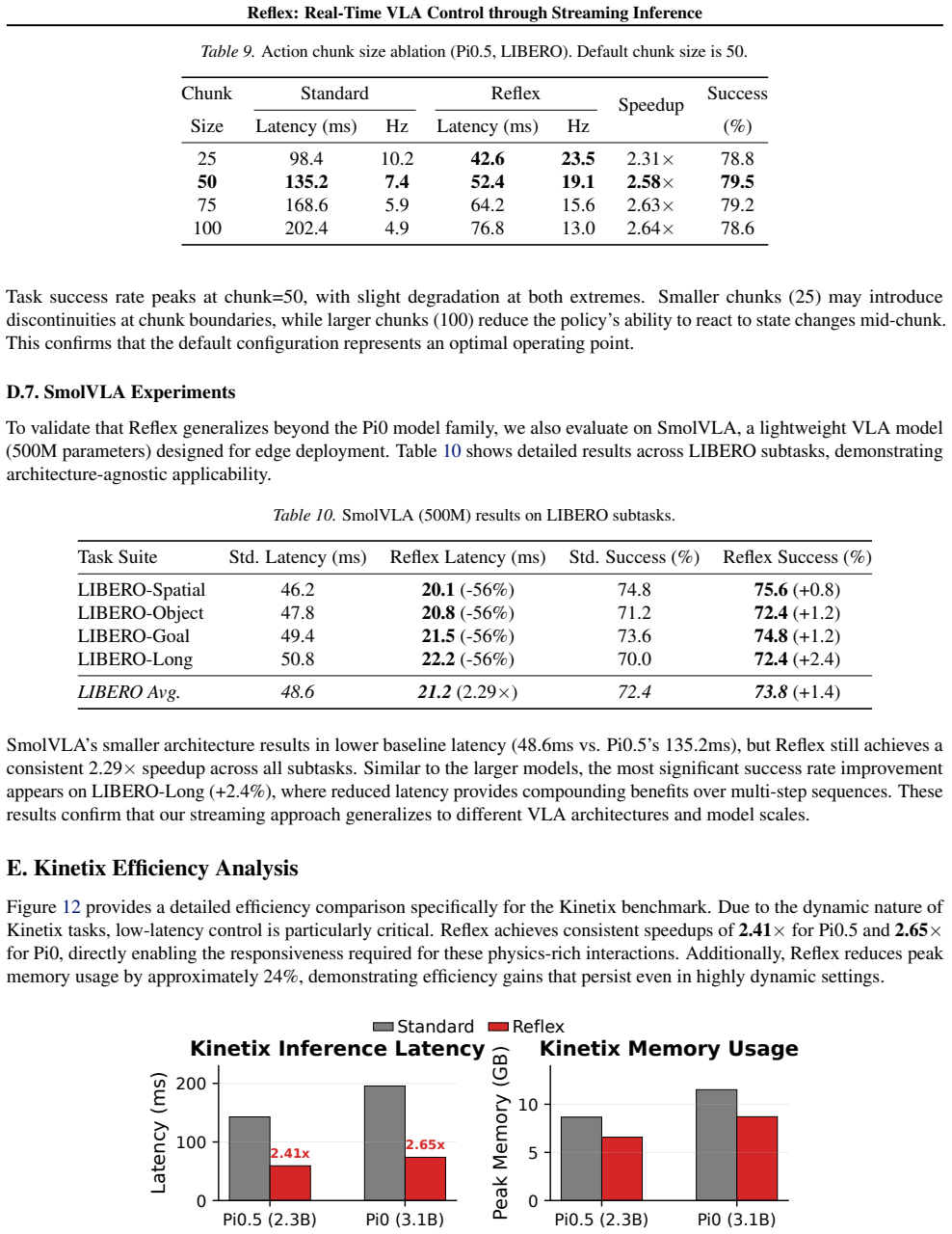
- [Figure 7] The numeric labels (79.5, 68.6, 81.8, 71.2) are not clearly tied to a specific bar in the figure; for Pi0.5, the LIBERO average for Reflex in Table 3 is 79.5, so the figure should label it explicitly. Also, the reported "50Hz stable streaming" in the abstract conflicts with the effective control frequencies in Table 9 (19.1 Hz for chunk size 50); explain the relationship between action chunk streaming and effective control frequency.
- [Table 5] "Max Stable Steps >2000" should report the actual test horizon and the variance across seeds; the table currently gives a single range without stating how stability is defined (e.g., first NaN, first Inf, or first success drop).
Circularity Check
No significant circularity; exactness is a conditional theorem, with the unverified timestep-invariance premise being a correctness risk rather than a circular reduction.
full rationale
Reflex's central correctness claim is Proposition A.1: partitioned attention equals full-batch attention when the observation encoder is timestep-invariant. The proof is a standard softmax-partition identity and is not fitted to data; the reported MSE=0.00 (Table 4) is an implementation consistency check against a full recomputation oracle, not a fitted curve renamed as prediction. The only load-bearing premise is timestep invariance (∂Enc/∂t_k=0), stated in §3.1 and used in A.1. That premise is an architectural assumption about Pi0-family models and is explicitly scoped ('Reflex applies to VLA architectures whose perception encoder is timestep-invariant... outside the current scope'); the paper does not prove it from experiments, and the final sentence of A.1 asserts rather than derives that cached action-expert K/V remain valid. This is a correctness/verification gap, not circularity: the conditional theorem would be valid if the premise holds, and no parameter is fit to make the equality true. There is no load-bearing self-citation: all cited results (FlashAttention, PagedAttention, prior VLA caching works) are external and used as related work. AdaRMSNorm, async pipelining, and future-state prediction are explicitly evaluated empirically and are not presented as derivations from the exactness theorem. Consequently, I find no step in the claimed derivation chain that reduces to its own inputs by construction.
Axiom & Free-Parameter Ledger
free parameters (4)
- Context window size N =
10
- Action chunk size =
50
- Flow matching steps =
10
- AdaRMSNorm gate MLP parameters =
unspecified (learned?)
axioms (5)
- domain assumption Perception encoder is timestep-invariant: ∂Enc/∂t_k = 0
- domain assumption Cached K/V of static and sliding regions are not altered by the action expert's t-conditioned layers
- domain assumption Policy depends only on the last N observations (FIFO eviction discards older frames without changing outputs)
- standard math Softmax is invariant to partitioning of key/value blocks when all logits are present
- domain assumption The low-level controller tracks commanded actions well enough for future-state approximation ŝ ≈ a_cmd
invented entities (1)
-
AdaRMSNorm
no independent evidence
read the original abstract
Flow matching Vision-Language-Action (VLA) models promise precise continuous control, but their iterative denoising nature introduces fundamental incompatibilities with real-time robotics: global timestep injection invalidates KV-caching, forcing a choice between slow $O(N^2)$ re-computation or mathematically incorrect cache reuse. We present \textbf{Reflex}, a framework that enables \textit{real-time streaming inference} for flow matching policies by exploiting the \textit{Timestep-Invariance Property} -- that perception encoders are functionally independent of the denoising loop. Reflex partitions the attention context into static, sliding, and dynamic regions, enabling $O(1)$ incremental cache updates while preserving full-batch-equivalent attention outputs for fixed inputs. To ensure stability under continuous high-frequency inference, we introduce \textit{AdaRMSNorm}, an adaptive normalization layer that prevents BFloat16 numerical collapse by gating on flow phase. We further maximize throughput through an \textit{async pipeline} that decouples visual encoding from action generation, combined with \textit{operator fusion} that reduces kernel overhead. On LIBERO and Kinetix benchmarks, Reflex achieves a 2.58$\times$ inference speedup and 50Hz stable streaming, reducing reaction latency by up to 54\% and enabling efficient deployment without performance degradation.
Figures


Reference graph
Works this paper leans on
-
[1]
GR00T N1: An open foundation model for generalist humanoid robots.arXiv preprint arXiv:2503.14734,
Bjorck, J., Casta˜neda, F., Cherniadev, N., Da, X., Ding, R., Fan, L., Fang, Y ., Fox, D., Hu, F., Huang, S., et al. GR00T N1: An open foundation model for generalist humanoid robots.arXiv preprint arXiv:2503.14734,
-
[5]
Gemini Robotics Team, Abdolmaleki, A., Abeyruwan, S., Ainslie, J., Alayrac, J.-B., Arenas, M
URL https://arxiv.org/abs/2303.03378. Gemini Robotics Team, Abdolmaleki, A., Abeyruwan, S., Ainslie, J., Alayrac, J.-B., Arenas, M. G., Balakrishna, A., Batchelor, N., Bewley, A., Bingham, J., Bloesch, M., Bousmalis, K., Brakel, P., Brohan, A., Buschmann, T., Byravan, A., Cabi, S., Caluwaerts, K., Casarini, F., Chan, C., Chang, O., Chappellet-V olpini, L....
-
[6]
Flow straight and fast: Learning to generate and transfer data with rectified flow
Liu, X., Gong, C., and Liu, Q. Flow straight and fast: Learning to generate and transfer data with rectified flow. arXiv preprint arXiv:2209.03003,
-
[8]
Running VLAs at real-time speed.arXiv preprint arXiv:2510.26742,
Ma, Y ., Zhou, Y ., Yang, Y ., Wang, T., and Fan, H. Running VLAs at real-time speed.arXiv preprint arXiv:2510.26742,
-
[9]
URL https://arxiv.org/abs/ 2410.23208. Micikevicius, P., Narang, S., Alben, J., Diamos, G., Elsen, E., Garcia, D., Ginsburg, B., Houston, M., Kuchaiev, O., Venkatesh, G., and Wu, H. Mixed precision training. In International Conference on Learning Representations,
-
[10]
URL https://arxiv.org/abs/2310.08864. Physical Intelligence, Black, K., Brown, N., Darpinian, J., Dhabalia, K., Driess, D., Esmail, A., Equi, M., Finn, C., Fusai, N., Galliker, M. Y ., Ghosh, D., Groom, L., Hausman, K., Ichter, B., Jakubczak, S., Jones, T., Ke, L., LeBlanc, D., Levine, S., Li-Bell, A., Mothukuri, M., Nair, S., Pertsch, K., Ren, A. Z., Shi...
-
[11]
URL https://arxiv. org/abs/2504.16054. Prasad, A., Lin, K., Wu, J., Zhou, L., and Bohg, J. Consis- tency policy: Accelerated visuomotor policies via con- sistency distillation. InRobotics: Science and Systems,
-
[13]
Shukor, M. et al. SmolVLA: A vision-language-action model for affordable and efficient robotics.arXiv preprint arXiv:2506.01844,
-
[14]
Tang, J. et al. VLASH: Real-time VLAs via future- state-aware asynchronous inference.arXiv preprint arXiv:2512.01031,
-
[15]
Vaswani, A., Shazeer, N., Parmar, N., Uszkoreit, J., Jones, L., Gomez, A
URL https://arxiv.org/abs/2410.23317. Vaswani, A., Shazeer, N., Parmar, N., Uszkoreit, J., Jones, L., Gomez, A. N., Kaiser, Ł., and Polosukhin, I. At- tention is all you need.Advances in neural information processing systems, 30,
-
[2018]
Dai, Y . et al. ActionFlow: A pipelined action accelera- tion for vision language models on edge.arXiv preprint arXiv:2512.20276,
-
[2022]
Liu, Y . et al. FASTer: Toward efficient autoregressive vision language action modeling via neural action tokenization. arXiv preprint arXiv:2512.04952,
-
[2023]
URL https: //arxiv.org/abs/2307.08691. Dao, T., Fu, D. Y ., Ermon, S., Rudra, A., and R´e, C. FlashAt- tention: Fast and memory-efficient exact attention with IO-awareness. InAdvances in Neural Information Pro- cessing Systems, volume 35,
-
[2024]
Sendai, K., Alvarez, M., Matsushima, T., Matsuo, Y ., and Iwasawa, Y . Leave no observation behind: Real- time correction for VLA action chunks.arXiv preprint arXiv:2509.23224,
-
[2025]
9 Reflex: Real-Time VLA Control through Streaming Inference Black, K., Brown, N., Driess, D., Esmail, A., Equi, M. R., Finn, C., Fusai, N., Groom, L., Hausman, K., Ichter, B., Jakubczak, S., Jones, T., Ke, L., Levine, S., Li-Bell, A., Mothukuri, M., Nair, S., Pertsch, K., Shi, L. X., Smith, L., Tanner, J., Vuong, Q., Walling, A., Wang, H., and Zhilin- sky...
discussion (0)
Sign in with ORCID, Apple, or X to comment. Anyone can read and Pith papers without signing in.