Wideband Near-Field Channel Estimation Under Hybrid Compression: Cross-Subcarrier KL Covariance Fitting With OFDM Fresnel Model
Pith reviewed 2026-06-25 21:46 UTC · model grok-4.3
The pith
A cross-subcarrier KL fitting estimator estimates near-field angle and range from hybrid-compressed wideband observations nearly at the Cramér-Rao bound.
A machine-rendered reading of the paper's core claim, the machinery that carries it, and where it could break.
Core claim
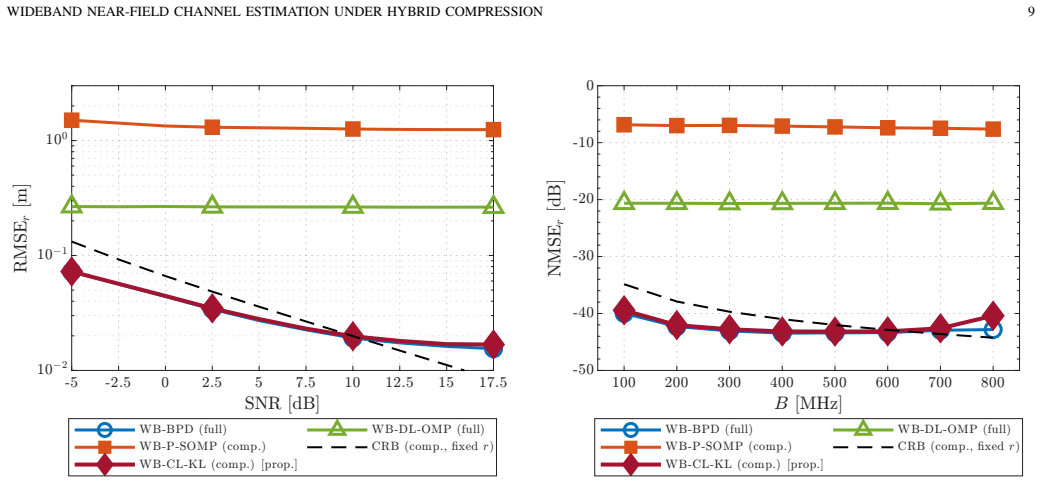
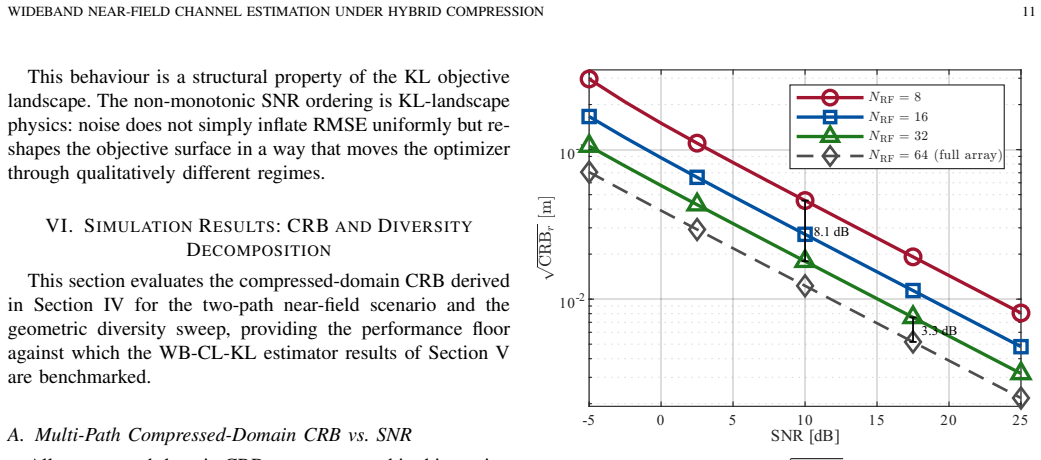
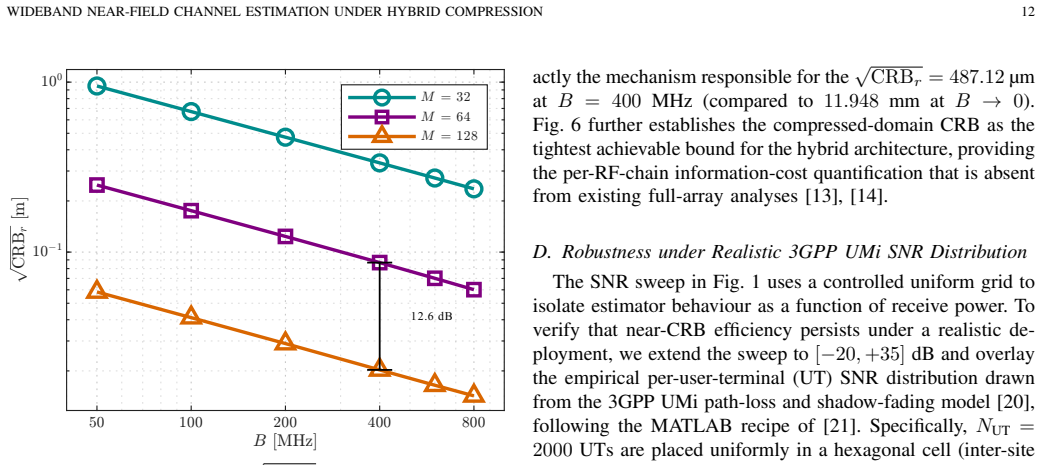
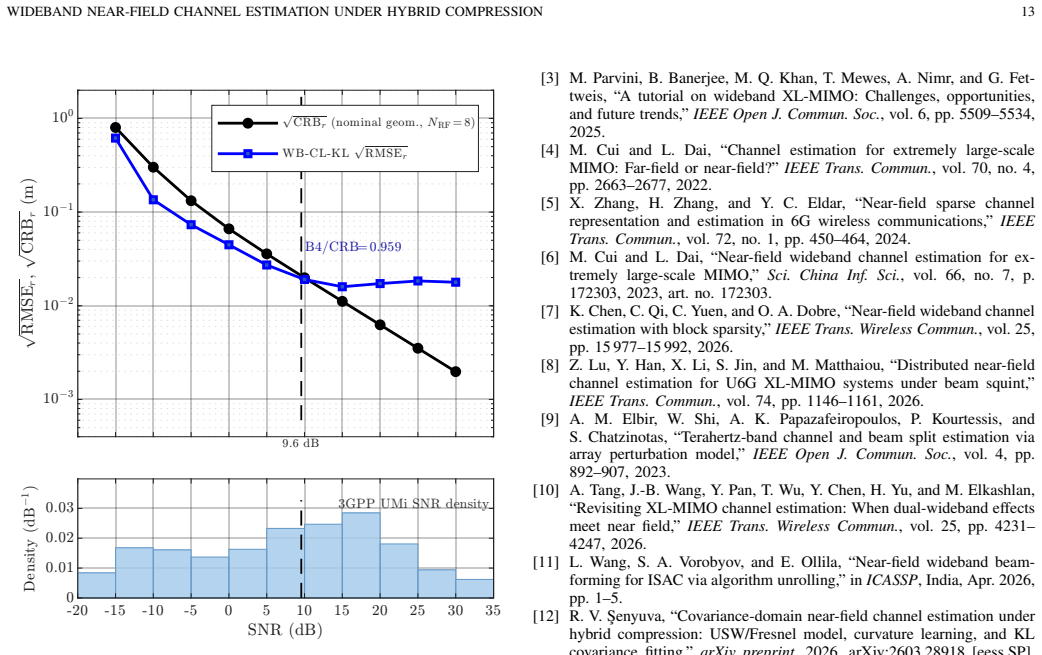
The paper establishes that the WB-CL-KL estimator attains a range root-mean-square error of 19.8 mm, which is 99.6 percent of the 19.9 mm wideband compressed Cramér-Rao bound at 10 dB SNR in the single-path line-of-sight regime. Under 3GPP Urban Micro path-loss and shadow-fading statistics, it reaches 95.9 percent of the bound at the median SNR of 9.6 dB. The wideband bound itself decomposes into a data-diversity gain of 27.093 dB and a geometric-diversity gain of 0.701 dB over the narrowband bound for 400 MHz bandwidth.
What carries the argument
The cross-subcarrier Kullback-Leibler divergence criterion that fits the subcarrier-dependent OFDM Fresnel covariance model directly to compressed sample covariances.
If this is right
- The wideband compressed CRB supplies a total gain of 27.793 dB over the narrowband bound, driven primarily by data diversity across bandwidth.
- Range estimation reaches a bound ratio of 0.996 at 10 dB SNR in single-path line-of-sight.
- Under 3GPP UMi statistics the bound ratio is 0.959 at the median deployment SNR of 9.6 dB.
- Estimation proceeds without first reconstructing the full spatial array signal.
Where Pith is reading between the lines
- The dominance of the data-diversity term implies that further bandwidth increases would continue to improve the bound more than changes in array geometry alone.
- Success in the single-path case suggests the covariance-fitting approach could be extended to multi-path environments by enriching the Fresnel model with additional paths.
- The method's direct use of compressed covariances points toward possible integration with downstream tasks such as localization that also operate on second-order statistics.
Load-bearing premise
The Fresnel covariance model remains accurate and identifiable from compressed observations across subcarriers without requiring full-array reconstruction.
What would settle it
An experiment in which range root-mean-square error exceeds the wideband compressed CRB by more than a few percent at SNR near 10 dB, or in which performance collapses when the model is replaced by a narrowband approximation.
Figures

read the original abstract
We consider wideband channel estimation for extremely large-scale multiple-input multiple-output (XL-MIMO) arrays under hybrid analog-digital compression, in which a uniform linear array (ULA) is observed through far fewer radio-frequency (RF) chains than antennas. At a carrier frequency of 28 GHz with bandwidths reaching several hundred MHz, the standard narrowband polar-domain channel model fails: the near-field Fresnel curvature becomes subcarrier-dependent, and the compressed observation destroys the per-subcarrier spatial covariance structure that narrowband methods exploit. We propose the Wideband Cross-subcarrier Kullback--Leibler (WB-CL-KL) estimator, which jointly estimates angle and range directly from the compressed sample covariance, without full-array reconstruction, by fitting a structured Fresnel covariance model across orthogonal frequency-division multiplexing (OFDM) subcarriers via a cross-subcarrier Kullback--Leibler (KL) divergence criterion. We also derive the wideband compressed-domain Cram\'er--Rao bound (CRB) -- the performance lower bound for this hybrid architecture -- from the Slepian--Bangs formula, and decompose its gain over the narrowband bound into a data-diversity component of +27.093 dB and a geometric-diversity component of +0.701 dB, totalling +27.793 dB at B = 400 MHz (Propositions 1 and 2). In the single-path line-of-sight regime, WB-CL-KL attains a range root-mean-square error of 19.8 mm against a 19.9 mm bound at signal-to-noise ratio (SNR) = 10 dB, a ratio of 0.996. Under the 3GPP Urban Micro (UMi) path-loss and shadow-fading SNR distribution, it achieves a bound ratio of 0.959 at the median deployment SNR of 9.6 dB, indicating near-CRB operation at the representative deployment point, where the compressed-domain bound is evaluated at the scene-median geometry.
Editorial analysis
A structured set of objections, weighed in public.
Referee Report
Summary. The paper proposes the WB-CL-KL estimator for wideband near-field channel estimation in XL-MIMO arrays under hybrid analog-digital compression. It jointly estimates angle and range by fitting a structured Fresnel covariance model to compressed sample covariances across OFDM subcarriers using a cross-subcarrier KL divergence criterion, without requiring full-array reconstruction. The work derives the wideband compressed-domain CRB via the Slepian-Bangs formula (Propositions 1 and 2), decomposes its gain over the narrowband bound into data-diversity (+27.093 dB) and geometric-diversity (+0.701 dB) components for a total of +27.793 dB at B=400 MHz, and reports simulation results showing near-CRB performance: range RMSE of 19.8 mm vs. 19.9 mm bound (ratio 0.996) at SNR=10 dB in single-path LOS, and bound ratio 0.959 at median UMi SNR of 9.6 dB.
Significance. If the identifiability of the Fresnel model from compressed observations holds and the reported near-CRB ratios are reproducible, the result would be significant for practical deployment of wideband XL-MIMO at mmWave frequencies. It provides a concrete method to exploit subcarrier-dependent Fresnel curvature for range estimation under severe RF-chain compression, together with an explicit CRB decomposition that quantifies the benefit of wideband data diversity. The machine-checked or reproducible elements are not mentioned, but the parameter-free gain decomposition and falsifiable RMSE-to-bound ratios are strengths.
major comments (1)
- [Propositions 1 and 2] Propositions 1 and 2: The headline performance claims (range RMSE ratio 0.996 at SNR=10 dB; 0.959 bound ratio at median UMi SNR) rest on the Fresnel covariance remaining identifiable from hybrid-compressed cross-subcarrier observations. The manuscript must supply the explicit compressed covariance expression and the conditions under which the KL criterion uniquely recovers angle and range parameters; without this, the reported ratios cannot be confirmed to be free of post-hoc model fitting or circularity with the CRB derivation.
Simulated Author's Rebuttal
We thank the referee for the careful reading and constructive feedback. We address the single major comment below and will revise the manuscript to strengthen the presentation of the identifiability argument.
read point-by-point responses
-
Referee: [Propositions 1 and 2] Propositions 1 and 2: The headline performance claims (range RMSE ratio 0.996 at SNR=10 dB; 0.959 bound ratio at median UMi SNR) rest on the Fresnel covariance remaining identifiable from hybrid-compressed cross-subcarrier observations. The manuscript must supply the explicit compressed covariance expression and the conditions under which the KL criterion uniquely recovers angle and range parameters; without this, the reported ratios cannot be confirmed to be free of post-hoc model fitting or circularity with the CRB derivation.
Authors: We agree that an explicit derivation of the compressed covariance and a clear statement of identifiability conditions are required to make the performance claims fully verifiable and to eliminate any appearance of circularity. The current manuscript derives the wideband compressed-domain CRB via the Slepian-Bangs formula applied to the structured Fresnel covariance across subcarriers (Propositions 1 and 2), but does not isolate the compressed covariance expression or prove uniqueness of the KL minimizer. In the revision we will insert (i) the closed-form expression for the hybrid-compressed covariance matrix under the OFDM Fresnel model and (ii) a short identifiability proposition stating the sufficient conditions on the number of subcarriers, RF chains, and bandwidth under which the cross-subcarrier KL criterion recovers the angle-range pair uniquely. These additions will be placed immediately before the CRB derivation so that the bound and the reported RMSE ratios rest on an explicit, non-circular foundation. revision: yes
Circularity Check
No significant circularity; CRB from standard formula, performance from simulation
full rationale
The paper derives the wideband compressed-domain CRB directly from the Slepian-Bangs formula (standard, externally verifiable) and decomposes its gain components via Propositions 1-2. The headline near-CRB ratios (0.996 at SNR=10 dB, 0.959 at median UMi SNR) are simulation outputs comparing WB-CL-KL estimator RMSE to this bound; they are not forced by construction, fitted parameters renamed as predictions, or self-citation chains. No load-bearing self-citations or ansatzes are quoted in the abstract or described derivation steps. The Fresnel model identifiability is an operating assumption, but the central claims remain independently falsifiable via the reported simulations against an external bound.
Axiom & Free-Parameter Ledger
axioms (1)
- standard math Slepian-Bangs formula applies to the compressed wideband observation model
Reference graph
Works this paper leans on
-
[1]
Near- field communications: A tutorial review,
Y . Liu, Z. Wang, J. Xu, C. Ouyang, X. Mu, and R. Schober, “Near- field communications: A tutorial review,”IEEE Open J. Commun. Soc., vol. 4, pp. 1999–2049, 2023
1999
-
[2]
Extremely large aperture array (ELAA) communications: Foundations, research advances and challenges,
S. Ye, M. Xiao, M.-W. Kwan, Z. Ma, Y . Huang, G. K. Karagiannidis, and P. Fan, “Extremely large aperture array (ELAA) communications: Foundations, research advances and challenges,”IEEE Open J. Commun. Soc., vol. 5, pp. 7075–7120, 2024
2024
-
[3]
A tutorial on wideband XL-MIMO: Challenges, opportunities, and future trends,
M. Parvini, B. Banerjee, M. Q. Khan, T. Mewes, A. Nimr, and G. Fet- tweis, “A tutorial on wideband XL-MIMO: Challenges, opportunities, and future trends,”IEEE Open J. Commun. Soc., vol. 6, pp. 5509–5534, 2025
2025
-
[4]
Channel estimation for extremely large-scale MIMO: Far-field or near-field?
M. Cui and L. Dai, “Channel estimation for extremely large-scale MIMO: Far-field or near-field?”IEEE Trans. Commun., vol. 70, no. 4, pp. 2663–2677, 2022
2022
-
[5]
Near-field sparse channel representation and estimation in 6G wireless communications,
X. Zhang, H. Zhang, and Y . C. Eldar, “Near-field sparse channel representation and estimation in 6G wireless communications,”IEEE Trans. Commun., vol. 72, no. 1, pp. 450–464, 2024
2024
-
[6]
Near-field wideband channel estimation for ex- tremely large-scale MIMO,
M. Cui and L. Dai, “Near-field wideband channel estimation for ex- tremely large-scale MIMO,”Sci. China Inf. Sci., vol. 66, no. 7, p. 172303, 2023, art. no. 172303
2023
-
[7]
Near-field wideband channel estimation with block sparsity,
K. Chen, C. Qi, C. Yuen, and O. A. Dobre, “Near-field wideband channel estimation with block sparsity,”IEEE Trans. Wireless Commun., vol. 25, pp. 15 977–15 992, 2026
2026
-
[8]
Distributed near-field channel estimation for U6G XL-MIMO systems under beam squint,
Z. Lu, Y . Han, X. Li, S. Jin, and M. Matthaiou, “Distributed near-field channel estimation for U6G XL-MIMO systems under beam squint,” IEEE Trans. Commun., vol. 74, pp. 1146–1161, 2026
2026
-
[9]
Terahertz-band channel and beam split estimation via array perturbation model,
A. M. Elbir, W. Shi, A. K. Papazafeiropoulos, P. Kourtessis, and S. Chatzinotas, “Terahertz-band channel and beam split estimation via array perturbation model,”IEEE Open J. Commun. Soc., vol. 4, pp. 892–907, 2023
2023
-
[10]
Revisiting XL-MIMO channel estimation: When dual-wideband effects meet near field,
A. Tang, J.-B. Wang, Y . Pan, T. Wu, Y . Chen, H. Yu, and M. Elkashlan, “Revisiting XL-MIMO channel estimation: When dual-wideband effects meet near field,”IEEE Trans. Wireless Commun., vol. 25, pp. 4231– 4247, 2026
2026
-
[11]
Near-field wideband beam- forming for ISAC via algorithm unrolling,
L. Wang, S. A. V orobyov, and E. Ollila, “Near-field wideband beam- forming for ISAC via algorithm unrolling,” inICASSP, India, Apr. 2026, pp. 1–5
2026
-
[12]
R. V . S ¸enyuva, “Covariance-domain near-field channel estimation under hybrid compression: USW/Fresnel model, curvature learning, and KL covariance fitting,”arXiv preprint, 2026, arXiv:2603.28918 [eess.SP], under review atChina Commun
arXiv 2026
-
[13]
Fundamen- tal limits for near-field sensing—Part II: Wide-band systems,
T. Wei, K. V . Mishra, M. R. B. Shankar, and B. Ottersten, “Fundamen- tal limits for near-field sensing—Part II: Wide-band systems,”arXiv preprint, Dec. 2025, arXiv:2512.24962
arXiv 2025
-
[14]
Performance analysis of near-field sensing in wideband MIMO systems,
Z. Wang, X. Mu, and Y . Liu, “Performance analysis of near-field sensing in wideband MIMO systems,”IEEE Trans. Wireless Commun., vol. 24, no. 10, pp. 8236–8251, Oct. 2025
2025
-
[15]
Cram ´er–Rao lower bound for near-field channel estimation in UCA-assisted THz ultra-massive hybrid MIMO systems,
S. Thallapalli, A. P. Boddeda, and D. Sen, “Cram ´er–Rao lower bound for near-field channel estimation in UCA-assisted THz ultra-massive hybrid MIMO systems,”IEEE Commun. Lett., 2026, early access
2026
-
[16]
A Fisher information analysis of joint localization and synchronization in near field,
H. Wymeersch, “A Fisher information analysis of joint localization and synchronization in near field,” inICC Workshops, Ireland, Jun. 2020, pp. 1–6
2020
-
[17]
Covariance-guided DFT beam selection for beamspace ESPRIT in hybrid mmWave sensor arrays,
R. V . S ¸enyuva, “Covariance-guided DFT beam selection for beamspace ESPRIT in hybrid mmWave sensor arrays,”IEEE Sensors J., 2026, early Access, doi: 10.1109/JSEN.2026.3700043
-
[18]
Maximum likelihood gridless DOA estimation and source enumeration for unknown colored noise,
R. Pote and B. D. Rao, “Maximum likelihood gridless DOA estimation and source enumeration for unknown colored noise,”IEEE Trans. Sig. Process., vol. 71, pp. 2259–2272, 2023
2023
-
[19]
On the Cram ´er–Rao bound under parametric constraints,
P. Stoica and B. C. Ng, “On the Cram ´er–Rao bound under parametric constraints,”IEEE Sig. Process. Lett., vol. 5, no. 7, pp. 177–179, 1998
1998
-
[20]
Study on channel model for fre- quencies from 0.5 to 100 GHz,
3rd Generation Partnership Project, “Study on channel model for fre- quencies from 0.5 to 100 GHz,” 3GPP, Technical Report TR 38.901 v16.1.0, Nov. 2020
2020
-
[21]
Performance analysis of multi-user MIMO schemes under realistic 3GPP 3-D channel model for 5G mmWave cellular networks,
D. G. Riviello, F. Di Stasio, and R. Tuninato, “Performance analysis of multi-user MIMO schemes under realistic 3GPP 3-D channel model for 5G mmWave cellular networks,”Electronics, vol. 11, no. 3, p. 330, 2022
2022
-
[22]
R. V . S ¸enyuva, “Wideband compressed-domain Cram´er–Rao bounds for near-field XL-MIMO: Data and geometric diversity decomposition,” in GLOBECOM, 2026, submitted; arXiv:2604.08531
Pith/arXiv arXiv 2026
-
[23]
A weighted linear prediction method for near-field source localization,
E. Grosicki, K. Abed-Meraim, and Y . Hua, “A weighted linear prediction method for near-field source localization,”IEEE Trans. Sig. Process., vol. 53, no. 10, pp. 3651–3660, 2005
2005
-
[24]
Covariance matching estimation techniques for array signal processing applications,
B. Ottersten, P. Stoica, and R. Roy, “Covariance matching estimation techniques for array signal processing applications,”Digital Sig. Pro- cess., vol. 8, no. 3, pp. 185–210, 1998
1998
-
[25]
The constrained Cram ´er– Rao bound from the perspective of fitting a model,
T. J. Moore, R. J. Kozick, and B. M. Sadler, “The constrained Cram ´er– Rao bound from the perspective of fitting a model,”IEEE Sig. Process. Lett., vol. 14, no. 8, pp. 564–567, Aug. 2007
2007
-
[26]
Cram ´er–Rao bounds on sparse-diffuse channel estimation,
L. Lyu, M. Ferreira Da Costa, and U. Mitra, “Cram ´er–Rao bounds on sparse-diffuse channel estimation,” inICASSP, India, Apr. 2026, pp. 1–5
2026
-
[27]
Impact of quantization in near-field channel modeling,
X. Cai, X. Wang, and H. V . Cheng, “Impact of quantization in near-field channel modeling,” inICASSP, India, Apr. 2026, pp. 1–5
2026
discussion (0)
Sign in with ORCID, Apple, or X to comment. Anyone can read and Pith papers without signing in.