REVIEW 2 major objections 5 minor 10 references
Work-distribution quantumness and irreversibility when crossing a quantum phase transition in finite time
T0 review · 2 major / 5 minor · reviewed 2026-08-14 · deepseek-v4-flash
Pith's one-line read Driving a Hubbard chain across the precursor to the metal–Mott-insulator transition flips the work distribution's skewness and makes entropy production dominate work fluctuations even at slow driving.
desk verdict Solid numerics and a genuinely interesting skewness signature, but the claimed 'reversal' of the open-system fluctuation-dissipation inequality (5) rests on comparing closed unitary dynamics to a bound that has not been shown to apply. read the letter →
The pith
A machine-rendered reading of the paper's core claim, the machinery that carries it, and where it could break.
The reading
What carries the argument
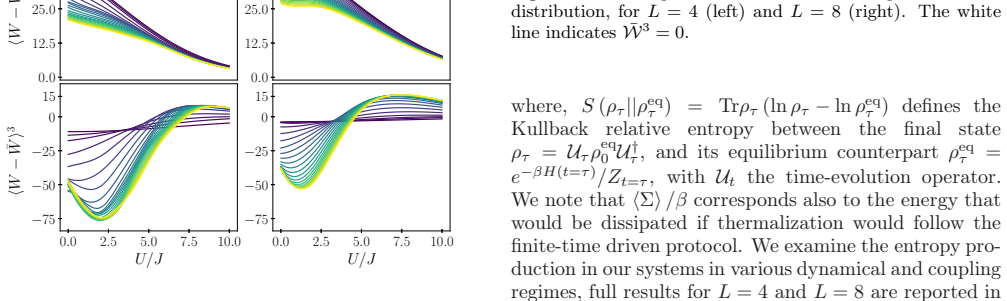
The load-bearing object is the two-point-measurement quantum work distribution $P(W)=\sum_{n,m} p_n^0 p_{m|n}^\tau \delta[W-(\varepsilon_m^\tau-\varepsilon_n^0)]$ for the driven Hubbard Hamiltonian with hopping $J$, on-site repulsion $U$, and a linear potential that ramps over time $\tau$. Its first three central moments carry the argument: the mean and variance give the work statistics, while the third moment (skewness) is shown to change sign across the pM-QPT and to track irreversibility. The quantitative reversal is carried by the dimensionless ratio $2\langle \Sigma\rangle / (\beta^2 \overline{W}_2)$, where $\langle \Sigma\rangle=S(\rho_\tau\|\rho_\tau^{\mathrm{eq}})$ is the relative-entropy entropy production and $\overline{W}_2$ is the work variance; the trace distance $D_{\mathrm{Tr}}(\rho_\tau,\rho_\tau^{\mathrm{eq}})$ is used to show the final state remains far from equilibrium. All results come from exact diagonalization of finite chains, so the machinery is fully microscopic.
What would settle it
Perform an exact-diagonalization or tensor-network finite-size scaling study of the skewness extrema and of $2\langle \Sigma\rangle/(\beta^2\langle (W-\langle W\rangle)^2\rangle)$ for chains $L=4,6,8,10,12$: if the extrema do not move systematically toward $U=0$ as $L$ grows, or if the reversal of the fluctuation–dissipation inequality disappears once finite-size artifacts are removed, the attribution of these signatures to crossing a quantum phase transition is falsified.
Extended reading notes
Core claim
The paper's central claim, stated in its conclusion, is that in the Mott-insulating phase entropy production dominates work fluctuations even for slow processes, in contrast with the classical work fluctuation–dissipation relation and with recent predictions for slowly driven open quantum systems. Concretely, for a half-filled Hubbard chain of length $L=4, 6, 8$ prepared in equilibrium at $\beta^{-1}=2.5J$ and driven by a linear potential ramp over times $0.2/J \leq \tau \leq 10/J$, exact diagonalization shows that the ratio $2\langle \Sigma \rangle / (\beta^2 \langle (W-\langle W\rangle)^2\rangle)$ exceeds one after the pM-QPT. The same calculations show the work distribution becomes nearly independent of driving rate in the insulating phase, its skewness changes sign across the transition for finite-time dynamics, and the trace distance from the equilibrium state peaks at the transition. These features are presented as signatures of the precursor to the metal–Mott-insulator quantum phase transition in finite chains.
Load-bearing premise
The paper's central attribution rests on treating the finite chains as undergoing a genuine precursor to the metal–Mott-insulator quantum phase transition at the interaction strengths studied, based on earlier work on short Hubbard chains; the paper itself computes no order parameter, critical exponent, or finite-size collapse, so if that precursor is only a generic finite-size crossover, the claimed QPT signatures would lose their special meaning.
Editorial extensions
If this is right
- The skewness of the work distribution can act as a finite-time witness of the pM-QPT, showing a clear sign change even for chains short enough for exact diagonalization.
- Sudden-quench protocols hide the dynamical part of the QPT signature; the effect only appears for finite-time driving with $\tau J\gtrsim 0.5$.
- In the Mott phase, slow near-adiabatic driving does not restore the classical fluctuation–dissipation balance: dissipation remains larger than work fluctuations.
- After crossing the transition, the driven system remains far from equilibrium, as measured by trace distance, even when the work distribution looks close to linear response.
- For weak interactions, increasing the chain length makes $P(W)$ more classical (bell-shaped), while the Mott phase restores strong quantum features regardless of size.
Reading between the lines
- A direct experimental translation would be to ramp cold atoms in an optical lattice across the Mott transition and measure the work distribution via projective number or energy measurements; the prediction is a skewness sign flip and a ratio $2\langle \Sigma\rangle/(\beta^2\overline{W}_2)>1$ in the insulating phase.
- If the reversal is generic for interaction-driven transitions, quantum thermal machines using strongly correlated media will carry an unavoidable dissipation that standard work-variance estimates miss; protocols could be designed to avoid crossing the transition.
- The drift of the extrema toward $U=0$ as $L$ grows hints that, in the thermodynamic limit, the skewness flip and the inequality reversal coincide with the Mott transition point itself; larger-scale numerical methods could test this.
Signed reviews
Editorial analysis
A structured set of objections, weighed in public.
Referee Report
Summary. The manuscript studies the statistics of quantum work and related irreversibility measures in finite half-filled Hubbard chains (L=4, 6, 8) driven by a time-dependent linear potential over finite times, from sudden quench to nearly adiabatic regimes. Work distributions are computed with the two-point measurement protocol using exact diagonalization and QuTiP. The authors analyze the first three central moments, the relative-entropy entropy production ⟨Σ⟩=S(ρτ||ρτ_eq), and trace distances to the final equilibrium and adiabatic states. Their central observations are that the skewness of the work distribution changes sign across the precursor to the metal–Mott insulator transition (pM-QPT) and that in the Mott-insulating regime the ratio 2⟨Σ⟩/(β^2 ⟨(W−⟨W⟩)^2⟩) exceeds 1, which they interpret as entropy production dominating work fluctuations and as a reversal of a fluctuation–dissipation inequality recently proposed for slow quantum processes in open systems. They propose the skewness as a witness of irreversibility and discuss implications for small-scale quantum technologies.
Significance. If the central claims were fully established, the paper would provide a concrete, finite-size example in which strong correlations and a phase-transition precursor alter the fluctuation–dissipation balance in finite-time quantum thermodynamics, with potential relevance for the design of driven nanoscale devices. The numerical work is carefully executed and transparent: the moments, entropy production, and trace distances are computed independently from the same exact-diagonalization data, without parameter fitting, and the code is made available through a GitHub repository. However, the headline comparison to inequality (5) is made with closed-system unitary dynamics, whereas the inequality is imported from a theory of slow processes in open quantum systems. This out-of-domain comparison leaves the main conclusion unsupported. The paper is therefore potentially significant, but it requires substantial additional argument before its central claim can be accepted.
major comments (2)
- [Entropy production and work fluctuation-dissipation relation; Eq. (5), Fig. 4] The central quantitative claim—that after the pM-QPT the ratio 2⟨Σ⟩/(β^2⟨(W−⟨W⟩)^2⟩) exceeds 1 and thereby reverses inequality (5)—is not supported by the simulations as presented. The simulations are closed-system unitary dynamics (footnote 50), while inequality (5) is stated to be a result for slow quantum processes in open systems, imported from ref. 32. The numerical ratio in the upper right panel of Fig. 4 is a valid fact for the unitary protocol, but because the hypotheses under which (5) was derived are not satisfied, the comparison is out of domain. The conclusion that entropy production dominates work fluctuations “in contrast to recent predictions for slowly-driven open quantum systems” therefore requires either an open-system simulation that meets the assumptions of ref. 32 or a proof that inequality (5) holds for closed unitary driving of the kind studied here.
- [Introduction, paragraph beginning 'Finite Hubbard chains may undergo a precursor...'; Fig. 4] The interpretation of the skewness sign change and of the fluctuation–dissipation reversal as signatures of crossing the precursor to the metal–Mott insulator transition rests on the assumption that the finite Hubbard chains studied here do undergo such a precursor, as suggested by refs. 39–41. The paper does not provide a direct characterization of the transition: no order parameter, no energy-gap or fidelity-susceptibility calculation, and no finite-size scaling collapse. The extrema of the computed quantities in Fig. 4 shift with L, but this alone does not establish a critical-point estimate or the existence of a quasi-QPT. Without such evidence, the statements that these are signatures of crossing a quantum phase transition lose their quantitative meaning.
minor comments (5)
- [Abstract and Introduction] The abstract uses the phrase “quasi quantum phase transition” while the body consistently uses “precursor to the metal–Mott insulator transition (pM-QPT)”; please unify the terminology and define pM-QPT at first use.
- [Fig. 3] The color scale in the skewness heatmaps is asymmetric and makes the white zero line difficult to locate for small τ; a symmetric diverging colormap would make the sign-change claim easier to verify.
- [Fig. 4] The two right-hand panels use different horizontal ranges (U/J up to 20 in the upper panel and up to 10 in the lower panel); aligning the ranges would make the comparison between the ratio and the trace distance to the adiabatic state more transparent.
- [Footnote 45] The supplemental material is hosted on a GitHub repository without a versioned DOI; for reproducibility, consider depositing a snapshot in a permanent archive.
- [References] Ref. 32 is cited as arXiv:1905.07328v1; if the work has been published in the interim, the final journal reference should be used, and the hypotheses of the published version should be checked against the present closed-system setup.
Circularity Check
No significant circularity: all reported quantities are computed independently from exact diagonalization, and no fitted parameter or self-citation chain grounds the central claims.
full rationale
The paper's quantitative derivation is self-contained: the work distribution P(W) is obtained from exact diagonalization of the driven Hubbard Hamiltonian (Eq. 2), and the moments (Eq. 3), entropy production (Eq. 4) as a relative entropy, and trace distances are distinct functionals of the same unitary evolution, evaluated independently. The ratio 2<Sigma>/(beta^2 <(W-<W>)^2>) and its comparison with inequality (5) involve no fitted parameters and are not equal by construction; the observation that this ratio exceeds one in the Mott phase is a numerical result, not an identity imposed by the definitions. The only self-citation is reference 41 (Zawadzki, D'Amico, and Oliveira) used alongside external references 39 and 40 for the existence of a precursor to the metal-Mott insulator transition; this is not load-bearing because external support exists and no uniqueness theorem or ansatz is imported from the authors' prior work. The potential objection that inequality (5) was derived for slow open systems while the simulations are closed unitary dynamics is a domain-of-applicability and validity concern, not a circularity: the bound is imported from an external source, not derived from the paper's own inputs. Similarly, reliance on a finite-size precursor without an order-parameter scaling collapse is a robustness concern, not a definitional reduction. No step satisfies the standard for circularity, so the score is 0.
Assumptions & free parameters
free parameters (2)
- Drive amplitude prefactor A =
10 J
- Initial temperature =
k_B T = 2.5 J
assumptions (6)
- domain assumption The two-point measurement scheme (Eq. 2) provides the correct quantum work distribution for this closed system.
- domain assumption The system evolves unitarily with no decoherence or relaxation during the protocol.
- domain assumption Finite half-filled Hubbard chains exhibit a precursor to the metal-Mott insulator QPT at the interaction strengths considered.
- domain assumption The relative entropy S(rho_tau || rho_eq_tau) equals the irreversible entropy production and its dissipation cost is given by <Sigma>/beta.
- domain assumption The inequality (5) from Miller et al. (ref 32) is a valid benchmark for the closed-system dynamics studied here.
- domain assumption QuTiP's time-evolution routine and the exact diagonalization are numerically reliable for the parameter ranges used.
Cite this review
Pith. "Pith review of Work-distribution quantumness and irreversibility when crossing a quantum phase transition in finite time." pith.science (2026). https://pith.science/paper/DHVLAWJ4
@misc{pith2026190806488,
  author       = {Pith},
  title        = {Pith review of: Work-distribution quantumness and irreversibility when crossing a quantum phase transition in finite time},
  year         = {2026},
  howpublished = {\url{https://pith.science/paper/DHVLAWJ4}},
  note         = {Machine review of arXiv:1908.06488}
}
read the original abstract
The thermodynamic behavior of out-of-equilibrium quantum systems in finite-time dynamics encompasses the description of energy fluctuations, which dictates a series of system's physical properties. In addition, strong interactions in many-body systems strikingly affect the energy-fluctuation statistics along a non-equilibrium dynamics. By driving transient currents to oppose the precursor to metal-Mott insulator transition in a diversity of dynamical regimes, we show how increasing correlations dramatically affect the statistics of energy fluctuations and consequently the quantum work distribution of finite Hubbard chains. Statistical properties of such distributions, as its skewness, that changes dramatically across the transition, can be related to irreversibility and entropy production. Even close to adiabaticity, the quasi quantum phase transition hinders equilibration, increasing the process irreversibility, and inducing strong quantum features in the quantum work distribution. In the Mott-insulating phase the work fluctuation-dissipation balance gets modified, with the irreversible entropy production dominating over work fluctuations. The effect of an interaction-driven quantum-phase-transition on thermodynamics quantities and irreversibility has to be considered in the design of protocols in small scale devices for application in quantum technology. Eventually, such many-body effects can also be employed in work extraction and refrigeration protocols at quantum scale.
Figures


Figures from the paper (1 more)

Reference graph
Works this paper leans on
-
[2]
0 2 . 5 5 . 0 7 . 5 10 . 0 U/J −75 −50 −25 0 15
-
[3]
2 2 . 5 5 . 0 7 . 5 10 . 0 τ × J Figure 2: First three moments of the quantum work distribu- tion (as labelled) versus U , for 0. 2/J ≤ τ ≤ 10/J , and chain length L = 4 (left) and L = 8 (right). in the Hilbert space, the behaviour across the transition is qualitatively independent from the system size, hinting to a possible scaling behaviour. The most st...
-
[5]
5 5 . 0 7 . 5 10 . 0 τ × J
-
[7]
60 DT r(ρτ, ρ eq τ )
-
[8]
0 2 . 5 5 . 0 7 . 5 10 . 0 U/J −75 −50 −25 0 15 ⟨W − ¯W ⟩3
-
[9]
5 2⟨Σ ⟩ β 2⟨W − ¯W ⟩2
-
[10]
0 −76. 45 −53. 28 −30. 12 −6. 95 16. 22 ⟨W − ¯W ⟩3 Figure 3: Heatmaps of the skewness of the quantum work distribution, for L = 4 (left) and L = 8 (right). The white line indicates ¯W 3 = 0. where, S (ρτ ||ρeq τ ) = Trρτ (ln ρτ − ln ρeq τ ) defines the Kullback relative entropy between the final state ρτ = Uτ ρeq 0 U † τ , and its equilibrium counterpart ρe...
-
[11]
0 5 . 0 10 . 0 15 . 0 20 . 0 U/J
Show all 10 references
-
[12]
The dashed black lines connect minima and maxima for increasing system size
0 DT r(ρτ, ρ adiab τ ) L = 4 L = 6 L = 8 Figure 4: Left panels: Trace distance DT r(ρτ , ρ eq τ )(top), en- tropy production ⟨Σ ⟩ (middle), and skewness ⟨W − ¯W ⟩3 (bot- tom), versus coupling strength U/J and for chains of size L = 4 , 6, 8 and τ × J = 10 . The dashed black li...
-
[13]
2, middle panels)
is a many-body effect: the pM-QPT dramatically reduces the system response to the applied field, and hence the width of the work distribution, for all rate of driving, including slow driving (see Fig. 2, middle panels). Conclusion — We discussed the effects of many-body interacti...
2013
Reviewed August 14, 2026 · model on record in the stance chip above.
Discussion (0). Continue with ORCID to comment.