REVIEW 4 major objections 5 minor 118 references
Phenomenology of scalar particles assisted by machine learning
T0 review · 4 major / 5 minor · reviewed 2026-08-06 · deepseek-v4-flash
Pith's one-line read Machine learning could make new scalars visible at the HL-LHC: a thesis claims 5σ discovery for charged-Higgs pairs and a flavon once boosted decision trees suppress background.
desk verdict Solid thesis, shaky headline numbers: the two published analyses hold up, but the new h→eµ projection and the 5σ claims rest on unreported post-cut yields and a numerical inversion in Sec. 5.1.1. read the letter →
The pith
A machine-rendered reading of the paper's core claim, the machinery that carries it, and where it could break.
The reading
What carries the argument
The load-bearing object is a boosted-decision-tree classifier trained on kinematic observables (transverse momenta, missing energy, transverse and invariant masses) that outputs a single score the thesis calls xgb; the analysis cuts at xgb>0.95 to separate signal from background. The other central machinery is the four-zero-texture Yukawa structure of the Type-III two-Higgs-doublet model, whose off-diagonal parameters χij control the charged-Higgs branching ratios, and the flavour-symmetry model's effective interactions where the flavon couples to a Higgs boson plus fermion pairs through a 1/Λ-suppressed operator.
What would settle it
Reproduce the analysis and print the number of signal and background events passing the xgb > 0.95 cut for each benchmark at the quoted luminosity; if more than a handful of background events survive at the claimed luminosity, or if systematic uncertainties are included, Z = S/√(S+B) will no longer reach 5σ. Alternatively, a null result from a dedicated 14 TeV search in the μνcb final state with 300 fb−1 in the 110–250 GeV mass window would contradict the claim.
Extended reading notes
Core claim
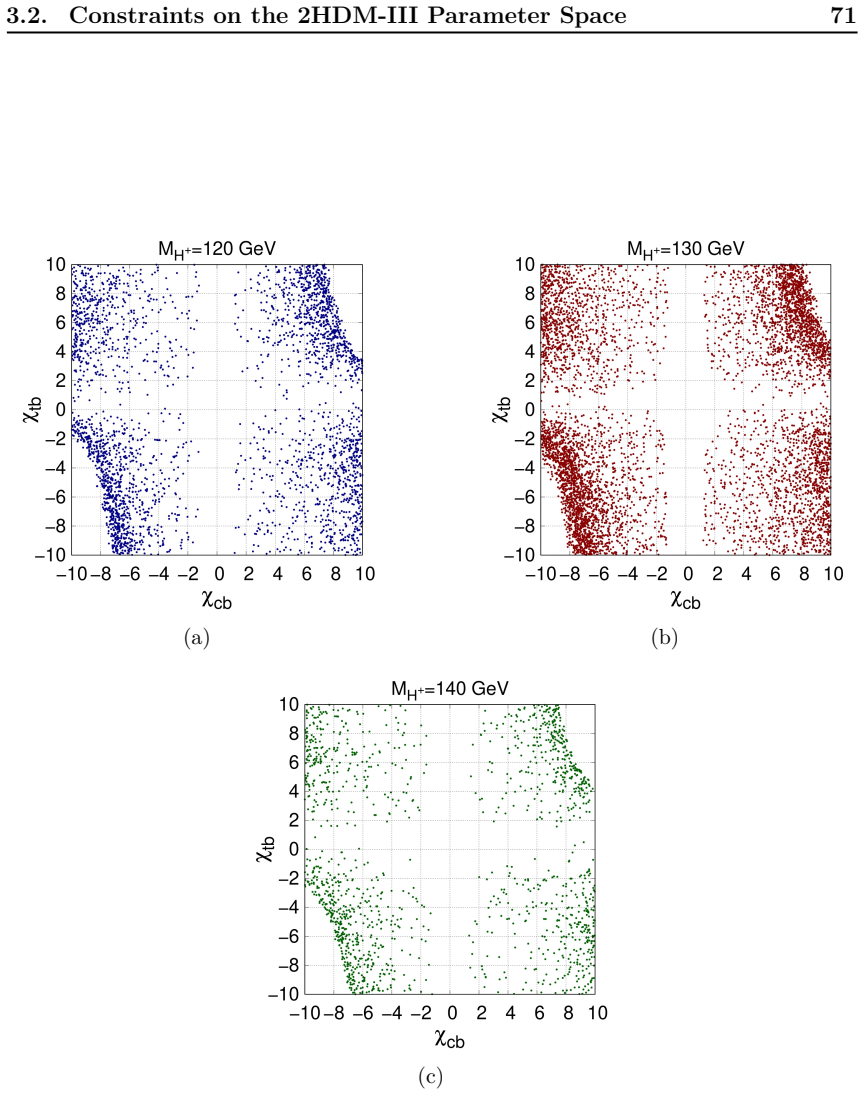
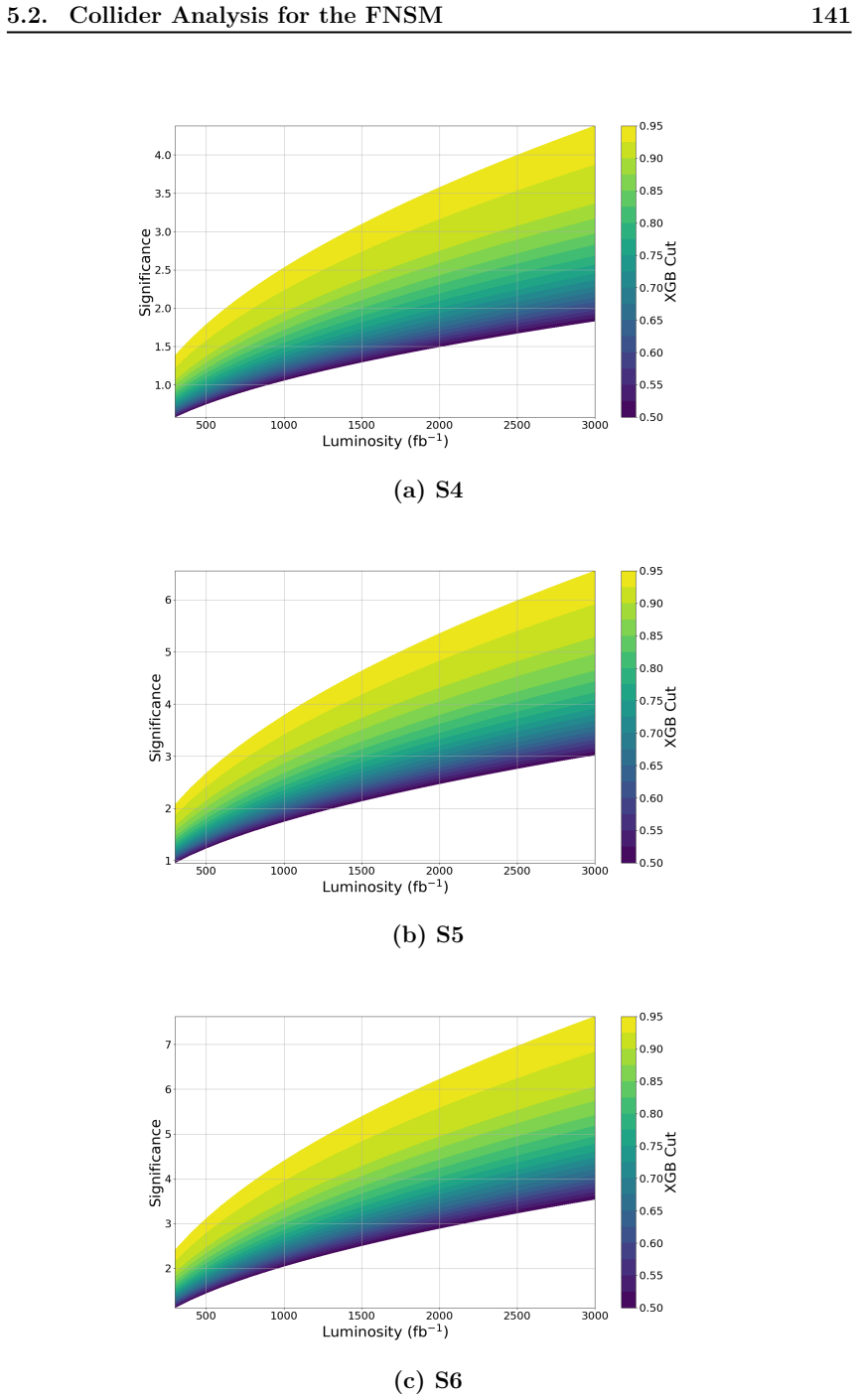
The central claim is that the process pp→H+H−→μνμcb in the Type-III two-Higgs-doublet model can be observed above 5σ for charged-Higgs masses in the window 110<M_H±<250 GeV at the HL-LHC, with scenario S2 needing about 250–300 fb−1 for the lower mass range and scenario S3 up to about 1000 fb−1 for the upper end; the dominant production is the on-shell decay of a heavy neutral scalar H of mass 500 GeV. In the same framework, a heavier neutral scalar (M_H=800 GeV) would require at least 2400 fb−1 and is sensitive to charged-Higgs masses between roughly 180 and 360 GeV. For the flavour-symmetry model, the thesis claims that the process pp→HF→hb\bar{b} with h→b\bar{b} reaches a signal significance of 3–5.6σ for flavon masses around 800–950 GeV at 3000 fb−1, and that the lepton-flavour-violating decay h→eμ reaches 5σ at 1300 fb−1 in scenario S6 (and 3σ at 700 fb−1 in scenario S5). The significance is computed as Z=S/√(S+B) after a boosted-decision-tree cut at xgb>0.95.
Load-bearing premise
The 5σ estimates assume that a machine-learning cut can suppress Standard Model backgrounds to the implied level without any systematic uncertainty entering the significance, and the thesis does not report how many background events remain after the cut.
Editorial extensions
If this is right
- Charged Higgs bosons with masses between 110 and 160 GeV would be discoverable with 250–300 fb−1 in scenario S2, so data already being collected at the LHC could start probing the parameter region that explains the t→H±b→cb excess.
- If scenario S3 holds, the search window extends to M_H±≈250 GeV with 220–1000 fb−1, covering the low-mass range where production proceeds through an on-shell heavy neutral scalar.
- For a heavier neutral scalar (M_H=800 GeV), the same final state needs at least about 2400 fb−1 and is sensitive only for M_H± between roughly 180 and 360 GeV.
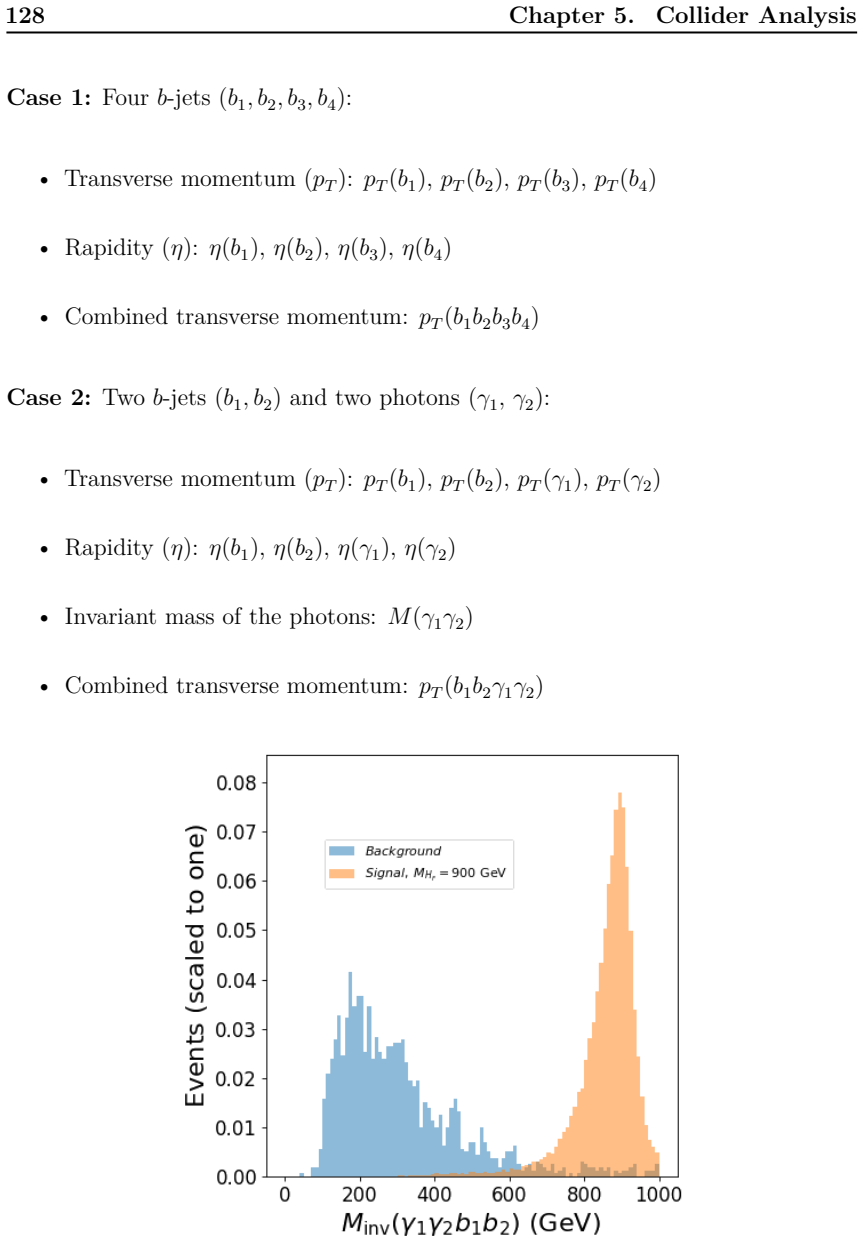
- In the flavour-symmetry model, the four-bottom final state from HF→hb\bar{b} with h→b\bar{b} would be visible at 3–5.6σ for flavon masses just below 1 TeV at 3000 fb−1, giving a concrete target for HL-LHC searches.
- The h→eμ channel is the most striking: scenario S6 reaches 5σ at 1300 fb−1, which is within reach of the HL-LHC, and would be evidence for charged-lepton-flavour violation in Higgs decays.
Reading between the lines
- Editorial inference: the claimed significance depends entirely on the classifier rejecting more than seven or eight orders of magnitude of background, and the thesis does not tabulate post-cut event counts; a re-analysis that reports those counts would be the decisive check.
- Editorial inference: if the low-mass charged-Higgs excess is real, the pair-production channel provides an independent cross-check, because the same χ_cb and χ_tb couplings that fit t→H±b→cb predict a measurable pp→H+H−→μνμcb rate in the same mass window.
- Editorial inference: the h→eμ analysis, with its resonance peak in the eμ invariant mass, is nearly free of hadronic background; if the quoted 5σ at 1300 fb−1 survives a full treatment with systematic uncertainties, it would constitute a discovery of lepton-flavour violation rather than just a hint.
Editorial analysis
A structured set of objections, weighed in public.
Referee Report
Summary. This thesis (arXiv:2507.15019) studies the collider phenomenology of two scalar extensions of the Standard Model. For the 2HDM-III it analyzes pp→H+H−→μνμcb after applying flavour and electroweak constraints, and claims a statistical significance above 5σ for charged Higgs masses around 100–250 GeV in benchmark scenarios S2 and S3 at L≈250–1000 fb−1. For the Froggatt-Nielsen singlet model it analyzes pp→HF→hbb with h→bb and h→γγ, and the LFV decay h→eμ, claiming up to 5σ at HL-LHC luminosities. The analysis uses MadGraph5/Pythia8/Delphes simulations, a BDT implemented with XGBoost, and a custom Python framework for LHCO processing.
Significance. If the numerical results were established, the work would provide concrete, testable targets for the HL-LHC and a reusable ML-based analysis pipeline. The thesis is also valuable for its systematic scan of low-energy constraints (B0s,d→μ+μ−, ℓi→ℓjγ, ℓi→3ℓj, b→sγ, oblique parameters) and for making the PrakritiMLPrep framework available. However, the central discovery claims are not derivable from the manuscript as written: the post-cut signal and background yields are absent, the significance formula is purely statistical, and the h→eμ benchmarks are chosen to produce the claimed significances. The quantitative conclusions therefore remain to be substantiated.
major comments (4)
- [§5.1.2, Eq. (4.0.1)] The 5σ claims for scenarios S2 and S3 are not reproducible because the post-cut yields S and B are never reported. Tables 5.1 and 5.2 provide only raw cross-sections; for example, for M_H±=150 GeV and L=3000 fb−1 the signal expectation is about 972 events while the raw Wjj+Wbb background is about 1.1×10^10 events, so the xgb>0.95 cut would need to suppress the background by roughly seven orders of magnitude. No acceptance, efficiency, or post-cut count is given for the 2HDM-III analysis (or for the h→eμ analysis in §5.2.2), so the reader cannot verify that Z=S/√(S+B) actually reaches 5.
- [§5.1.1] The text following Tables 5.1 and 5.2 states that for M_H±=100 GeV and M_H=500 GeV 'the signal cross-section exceeds the corresponding background production cross-section by up to seven orders of magnitude.' This is opposite to the numbers in the tables: σ(pp→μνμcb)≈0.189 fb while σ(Wjj+Wbb)≈3.75×10^6 fb, i.e., the background exceeds the signal by about seven orders of magnitude. This internal contradiction must be corrected or explained before the significance estimates can be evaluated.
- [§5.2.2, Table 5.8] For the h→eμ analysis, the LFV coupling Zeμ in scenarios S4, S5 and S6 is selected (subject only to the bound BR(h→eμ)<6.2×10⁻⁵) so that the event rate yields 3–5σ. The quoted significances are therefore the result of benchmark construction rather than a prediction from external constraints; this should be stated explicitly, or the analysis should be reframed as a sensitivity scan in the (vs, Zeμ) plane.
- [Eq. (4.0.1), §§5.1.2, 5.2.1, 5.2.2] The significance estimator Z=S/√(S+B) ignores systematic uncertainties. Since the 2HDM-III projection relies on background rejection by a factor of order 10^7, a small relative error on the background normalization can change the estimated significance substantially; a treatment of dominant systematic uncertainties (or an explicit statement that the quoted numbers are statistical only) is needed for the discovery claims to be meaningful.
minor comments (5)
- [Table 5.8] Table 5.8 appears to list two blocks of the same scenarios with different luminosities and significance levels; clarify the labeling (e.g., separate 3σ and 5σ tables) so the reader does not mistake the duplicated rows for separate benchmarks.
- [Chapter 6 vs §5.1.2] The Conclusions state that the charged Higgs reach extends to M_H±≈250 GeV with 300–1000 fb−1, while §5.1.2 quotes 250–300 fb−1 for S2 and 220–1000 fb−1 for S3; harmonize these statements.
- [Chapter 4] Chapter 4 contains long listings of LHCO examples and Python code that are not used in subsequent chapters; condensing this material would improve readability.
- [Eq. (5.2.4)] In Eq. (5.2.4), the lower/upper limits of x_b are written with an apparent typesetting artifact ('2(1−xa+xt, )'); please correct the formula and define the variables consistently.
- [Figure captions] Some figure captions, e.g. Fig. 5.8 ('scenarios S21') and Fig. 5.12 ('acceptance cuts'), should be checked for typos.
Circularity Check
Partial circularity: the h→eµ 5σ 'discovery' result is obtained by tuning the LFV coupling Zeµ and the luminosity to hit 5σ; the 2HDM-III and FNSM channels are benchmark calculations, with an additional unstated missing-yield limitation.
-
fitted input called prediction
[Sec. 5.2.2 (Lepton-Flavour-Violating Decays h→eµ), text immediately before and around Table 5.8]
"By scanning over different values of the model parameters (such ascosα, vs, and LFV couplings likeZeµ), as well as varying the assumed integrated luminosity, we can identify regions in which the LFV decayh→ eµ that could be observed with evidence-level (3σ) or discovery-level (5σ) significance. ... These parameters correspond to a significance of∼ 5σ."
The scenarios S4-S6 are not fixed, externally derived benchmarks: Zeµ is scanned/varied, and the luminosity is varied, until a 3σ/5σ significance is found. Since Z=S/sqrt(S+B) grows with the signal cross-section, and the text states that higher LFV couplings lead to larger cross-sections and thus higher significance, the quoted discovery significances (e.g., ~5σ for S6 at 1300 fb^-1) are the selection targets, not outputs of a model with independently fixed parameters. The experimental upper bound BR(h→eµ)<6.2e-5 only caps the scan; it does not determine Zeµ. The claimed discovery potential is therefore partly constructed from the desired significance.
full rationale
Only one step meets the exhibition standard for circularity. In Sec. 5.2.2 the LFV benchmarks are obtained by scanning Zeµ and luminosity until evidence-level or discovery-level significances appear, and the chosen parameters are then said to 'correspond to a significance of ~5σ'. This is a fitted input presented as a prediction. The 2HDM-III charged-Higgs analysis and the FNSM h→bb/γγ analyses are not circular under the strict definition: their benchmark points are selected from scans subject to LHC, flavour, and oblique constraints, and the significances are computed from simulated cross-sections and Eq. (4.0.1). One may question whether the BDT cut xgb>0.95 can actually suppress the seven-to-ten-order-larger backgrounds, but that is a validation and reporting gap, not an input-output equivalence; the thesis never tabulates the post-cut S and B for the 2HDM-III or h→eµ significances. The internal contradiction in Sec. 5.1.1, where the text says the signal exceeds the background by up to seven orders of magnitude while Tables 5.1 and 5.2 show the reverse, is a correctness/reproducibility issue rather than circularity. Citation [78] is peer-reviewed work by the same collaboration but is used only to motivate the FNSM mass range; it is not the load-bearing derivation of any significance claim. The score reflects only the h→eµ tuning step.
Assumptions & free parameters
free parameters (6)
- chi_cb (2HDM-III off-diagonal Yukawa) =
5 (S2), 1 (S3), scan [-10,10]
- chi_tb (2HDM-III) =
scan [-10,10], benchmark unspecified
- chi_mu_mu (2HDM-III) =
5 (S2), 1 (S3), scan [-10,10]
- chi_tt, chi_bb (2HDM-III) =
chi_tt=0.1, scan [-1,1] for both
- Z_e_mu (FNSM LFV coupling) =
0.0025 (S4), 0.005601 (S5), 0.009781 (S6)
- cos(alpha), v_s, Lambda, M_HF (FNSM) =
cos(alpha)=0.995 or -0.89/-0.95; v_s=1-2.5 TeV; Lambda=1-2.5 TeV; M_HF=800-1500 GeV
assumptions (7)
- standard math Standard Model gauge structure and particle content
- domain assumption Four-zero texture ansatz and Hermitian Yukawa matrices in the 2HDM-III
- domain assumption CP conservation in the 2HDM-III scalar potential
- domain assumption U(1)_F Froggatt-Nielsen mechanism with soft breaking
- ad hoc to paper Z2-derived theoretical constraints applied to Type-III
- domain assumption Significance formula Z=S/sqrt(S+B) with negligible systematic uncertainties
- domain assumption Fast detector simulation with Delphes ATLAS-like cards approximates real ATLAS and CMS performance
invented entities (2)
-
Flavon H_F (and CP-odd A_F)
-
Extra 2HDM-III scalars H, A and H±
Cite this review
Pith. "Pith review of Phenomenology of scalar particles assisted by machine learning." pith.science (2026). https://pith.science/paper/DIFPWXDW
@misc{pith2026250715019,
  author       = {Pith},
  title        = {Pith review of: Phenomenology of scalar particles assisted by machine learning},
  year         = {2026},
  howpublished = {\url{https://pith.science/paper/DIFPWXDW}},
  note         = {Machine review of arXiv:2507.15019}
}
abstract
In this thesis, we explore the phenomenology of scalar particles within Beyond Standard Model frameworks, using Machine Learning (ML) techniques to enhance sensitivity and discovery potential at current and future collider experiments, the Large Hadron Collider (LHC) and the High-Luminosity LHC (HL-LHC). Specifically, we study scalar extensions of the Standard Model such as the Two Higgs Doublet Model Type-III (2HDM-III) and the Froggatt-Nielsen Flavon model. We perform a detailed collider analysis focusing on charged Higgs boson pair production within the 2HDM-III, examining final states involving muons, neutrinos and quark jets. Our studies identify parameter regions consistent with recent experimental anomalies reported by ATLAS collaboration, particularly in charged Higgs decays involving charm-bottom quark transitions, and suggest concrete scenarios for achieving statistically significant signals of 5$\sigma$ at future luminosities. In the context of the Flavon model, we analyse potential signatures of a new scalar called Flavon decaying into a Higgs boson and a pair of bottom quarks, followed by the channels where the Higgs decays into a pair of bottom quarks or a pair of photons. Additionally, we analyse Lepton-Flavour-Violating processes, both of them achieving discovery level significances of up to $5\sigma$ at the HL-LHC. Using multivariate analysis techniques, specifically Boosted Decision Trees, we demonstrate a significant improvement in signal discrimination. Throughout this thesis, ML methodologies have been integral, notably enhancing the signal from background separation and significantly improving the robustness of phenomenological predictions. The methods and analyses presented here contribute to clarifying the flavour structure mysteries of the SM and offer actionable targets for future experimental searches.
Figures


Figures from the paper (44 more)






Reference graph
Works this paper leans on
-
[1]
M. E. Peskin and D. V. Schroeder,An Introduction to Quantum Field Theory. CRC Press, FL, EE. UU., student ed., 2015
2015
-
[2]
Mitra, S
M. Mitra, S. Saha, M. Spannowsky and M. Takeuchi,Probing right-handed neutrinos via trilepton signals at the hl-lhc, Phys. Rev. D111 (Jan, 2025) 015005
2025
-
[3]
A. D. Sakharov,Violation of CP Invariance, C asymmetry, and baryon asymmetry of the universe, Pisma Zh. Eksp. Teor. Fiz.5 (1967) 32–35
1967
-
[4]
White,The sakharov conditions, inElectroweak Baryogenesis (Second Edition), 2053-2563, pp
G. White,The sakharov conditions, inElectroweak Baryogenesis (Second Edition), 2053-2563, pp. 2–1 to 2–2. IOP Publishing, 2022. DOI
2022
-
[5]
Finkenberger,Search for a dark leptophilic scalar produced in association with taupair in electron-positron annihilation at center-of-mass energies near 10.58 gev.,
M. Finkenberger,Search for a dark leptophilic scalar produced in association with taupair in electron-positron annihilation at center-of-mass energies near 10.58 gev.,
-
[6]
Schwichtenberg,Gauge coupling unification without supersymmetry, European Physical Journal C79 (Apr., 2019) 351
J. Schwichtenberg,Gauge coupling unification without supersymmetry, European Physical Journal C79 (Apr., 2019) 351
2019
-
[7]
C. D. Froggatt and H. B. Nielsen,Hierarchy of Quark Masses, Cabibbo Angles and CP Violation, Nucl. Phys. B147 (1979) 277–298
1979
-
[8]
C. N. Yang and R. L. Mills,Conservation of isotopic spin and isotopic gauge invariance, Phys. Rev.96 (Oct, 1954) 191–195. 158 Bibliography
1954
Show all 118 references
-
[9]
J. H. Sánchez,Procesos y Decaimientos de Bosones de Higgs a 1-Loop Para Futuros Colisionadores, Ph.D. thesis, Universidad Autónoma de Puebla, Instituto de Física Luis Rivera Terrazas, 2001
2001
-
[10]
R. N. Papaqui,Supersimetría y el Problema de la Masa, Ph.D. thesis, Universidad Autónoma de Puebla, Instituto de Física Luis Rivera Terrazas, 2006
2006
-
[11]
J. F. Gunion, H. E. Haber, G. Kane and S. Dawson,The Higgs Hunter’s Guide. Westview Press, 2000
2000
-
[12]
Pich,The standard model of electroweak interactions, 2012
A. Pich,The standard model of electroweak interactions, 2012
2012
-
[13]
M. D. Schwartz,Quantum Field Theory and the Standard Model. Cambridge University Press, 3, 2014
2014
-
[14]
Chau and W.-Y
L.-L. Chau and W.-Y. Keung,Comments on the parametrization of the kobayashi-maskawa matrix, Phys. Rev. Lett.53 (Nov, 1984) 1802–1805
1984
-
[15]
Wolfenstein,Parametrization of the kobayashi-maskawa matrix, Phys
L. Wolfenstein,Parametrization of the kobayashi-maskawa matrix, Phys. Rev. Lett.51 (Nov, 1983) 1945–1947
1983
-
[16]
T. D. Lee,A theory of spontaneoust violation, Phys. Rev. D8 (Aug, 1973) 1226–1239
1973
-
[17]
Ma,Verifiable radiative seesaw mechanism of neutrino mass and dark matter, Phys
E. Ma,Verifiable radiative seesaw mechanism of neutrino mass and dark matter, Phys. Rev. D73 (Apr, 2006) 077301
2006
-
[18]
J. F. Gunion, H. E. Haber, G. L. Kane and S. Dawson,The Higgs Hunter’s Guide, Front. Phys.80 (2000) 1–404
2000
-
[19]
G. C. Branco, P. M. Ferreira, L. Lavoura, M. N. Rebelo, M. Sher and J. P. Silva, Theory and phenomenology of two-Higgs-doublet models, Phys. Rept. 516 (2012) 1–102, [1106.0034]. Bibliography 159
2012 arXiv
-
[20]
Branco, L
G. Branco, L. Lavoura and J. Silva,CP Violation. Oxford University Press, 07, 1999, 10.1093/oso/9780198503996.001.0001
1999
-
[21]
Hernández-Sánchez, S
J. Hernández-Sánchez, S. Moretti, R. Noriega-Papaqui and A. Rosado, Off-diagonal terms in yukawa textures of the type-iii 2-higgs doublet model and light charged higgs boson phenomenology, JHEP 1307 (2013) 044, [1212.6818]
2013 arXiv
-
[22]
D. K. Ghosh, K. Mukherjee and S. Mukherjee,Electroweak phase transition in two scalar singlet model with pngb dark matter, Journal of High Energy Physics 2025 (Jan., 2025)
2025
-
[23]
Carrillo-Monteverde, R
A. Carrillo-Monteverde, R. Ramírez, S. Gómez-Ávila and L. López-Lozano, Effective textures from a[su(3)]3 flavored scalar sector,
-
[24]
Collaboration,Search for a light charged higgs boson int→h±b decays, with h±→cb, in the lepton+jets final state in proton-proton collisions at √s = 13 tev with the atlas detector,
A. Collaboration,Search for a light charged higgs boson int→h±b decays, with h±→cb, in the lepton+jets final state in proton-proton collisions at √s = 13 tev with the atlas detector,
-
[25]
J. Kim, S. Lee, P. Sanyal, J. Song and D. Wang,Unveiling the unexplored decay mode of a light charged higgs boson to an off-shell top quark and a bottom quark,
-
[26]
K. S. Babu, S. Chakdar, N. Das, D. K. Ghosh and P. Ghosh,Fimp dark matter from flavon portals, Journal of High Energy Physics2023 (2023) 143
2023
-
[27]
Das,Flavonstrahlung in the b3 - l2 z’ model at current and future colliders, Journal of High Energy Physics2023 (Mar., 2023)
S. Das,Flavonstrahlung in the b3 - l2 z’ model at current and future colliders, Journal of High Energy Physics2023 (Mar., 2023)
2023
-
[28]
Li and C.-X
T.-Q. Li and C.-X. Yue,Flavons and lfv decays and productions of pseudoscalar mesons, Modern Physics Letters A34 (Nov., 2019) 1950288
2019
-
[29]
Datta,Theoretical perspective on flavour physics,
A. Datta,Theoretical perspective on flavour physics, . 160 Bibliography
-
[30]
Aad et al.,Observation of a new particle in the search for the Standard Model Higgs boson with the ATLAS detector at the LHC, Phys
ATLAScollaboration, G. Aad et al.,Observation of a new particle in the search for the Standard Model Higgs boson with the ATLAS detector at the LHC, Phys. Lett.B716 (2012) 1–29, [1207.7214]
2012 arXiv
-
[31]
Tonelli, CERN/INFN, U
G. Tonelli, CERN/INFN, U. of Pisa and C. Collaboration,Update on the SM Higgs Search with CMS, inCMS. 2011
2011
-
[32]
Weinberg,The Quantum Theory of Fields, vol
S. Weinberg,The Quantum Theory of Fields, vol. 2. Cambridge University Press, Cambridge, 1996
1996
-
[33]
Hernández-Sánchez, C
J. Hernández-Sánchez, C. G. Honorato, S. Moretti and S. Rosado-Navarro, Charged higgs boson production viacb-fusion at the large hadron collider, Phys. Rev. D102 (2020) 055008, [2003.06263]
2020 arXiv
-
[34]
M. A. Arroyo-Ureña, T. A. Valencia-Pérez, R. Gaitán, J. H. Montes De Oca and A. Fernández-Téllez,Flavor-changing decayh→τµ at super hadron colliders, JHEP 08 (2020) 170, [2002.04120]
2020 arXiv
-
[35]
M. A. Arroyo-Ureña, R. Gaitán, E. A. Herrera-Chacón, J. H. Montes de Oca Y. and T. A. Valencia-Pérez,Search for thet→ch decay at hadron colliders, JHEP 07 (2019) 041, [1903.02718]
2019 arXiv
-
[36]
M. A. Arroyo-Ureña, J. L. Diaz-Cruz, E. Díaz and J. A. Orduz-Ducuara, Flavor violating higgs signals in the texturized two-higgs doublet model (thdm-tx), Chin. Phys. C40 (2016) 123103, [1306.2343]
2016 arXiv
-
[37]
J. F. Gunion and H. E. Haber,The CP conserving two Higgs doublet model: The Approach to the decoupling limit, Phys. Rev.D67 (2003) 075019, [hep-ph/0207010]
2003 arXiv
-
[38]
Weinberg,Gauge theory ofCP nonconservation, Phys
S. Weinberg,Gauge theory ofCP nonconservation, Phys. Rev. Lett.37 (Sep,
-
[39]
S. P. Das, J. Hernández-Sánchez, S. Moretti, A. Rosado and R. Xoxocotzi, Flavor violating signatures of lighter and heavier higgs bosons within the two higgs doublet model type iii at the lhec, Phys. Rev. D94 (Sep, 2016) 055003
2016
-
[40]
CMS collaboration, A. M. Sirunyan et al.,Search for lepton flavour violating decays of the Higgs boson toµτ and eτ in proton-proton collisions at√s = 13 TeV, JHEP 06 (2018) 001, [1712.07173]
2018 arXiv
-
[41]
Aad et al.,Searches for lepton-flavour-violating decays of the higgs boson in√s = 13 tev pp collisions with the atlas detector, Phys
ATLAScollaboration, G. Aad et al.,Searches for lepton-flavour-violating decays of the higgs boson in√s = 13 tev pp collisions with the atlas detector, Phys. Lett. B800 (2020) 135069, [1907.06131]
2020 arXiv
-
[42]
Tumasyan et al.,Measurement of the b0 S→µ+µ− decay properties and search for the b0→µ+µ− decay in proton-proton collisions at √s = 13 tev, Phys
CMS collaboration, A. Tumasyan et al.,Measurement of the b0 S→µ+µ− decay properties and search for the b0→µ+µ− decay in proton-proton collisions at √s = 13 tev, Phys. Lett. B842 (2023) 137955, [2212.10311]
2023 arXiv
-
[43]
Particle Data Group collaboration, R. L. Workman et al.,Review of Particle Physics, PTEP 2022 (2022) 083C01
2022
-
[44]
Abi et al.,Measurement of the positive muon anomalous magnetic moment to 0.46 ppm, Phys
Muon g-2 collaboration, B. Abi et al.,Measurement of the positive muon anomalous magnetic moment to 0.46 ppm, Phys. Rev. Lett.126 (2021) 141801, [2104.03281]
2021
-
[45]
Aad et al.,Search for Higgs boson pair production in the two bottom quarks plus two photons final state inpp collisions at √s = 13 TeV with the ATLAS detector, Phys
ATLAScollaboration, G. Aad et al.,Search for Higgs boson pair production in the two bottom quarks plus two photons final state inpp collisions at √s = 13 TeV with the ATLAS detector, Phys. Rev. D106 (2022) 052001, [2112.11876]
2022 arXiv
-
[46]
Collaboration,Cern rpt
A. Collaboration,Cern rpt. atlas-conf-2017-055, tech. rep., CERN, 2017
2017
-
[47]
CMS collaboration, A. M. Sirunyan et al.,Search for additional neutral mssm higgs bosons in theττ final state in proton-proton collisions at√s = 13 tev, JHEP 1809 (2018) 007, [1803.06553]. 162 Bibliography
2018 arXiv
-
[48]
ATLAScollaboration, M. Aaboud et al.,Search for charged higgs bosons decaying viah±→τ±ντ in theτ+jets andτ+lepton final states with 36 fb−1 of pp collision data recorded at√s = 13 tev with the atlas experiment, JHEP 09 (2018) 139, [1807.07915]
2018 arXiv
-
[49]
ATLAScollaboration, G. Aad et al.,Search for a light charged higgs boson in t→h±b decays, withh±→cb, in the lepton+jets final state in proton-proton collisions at√s = 13 tev with the atlas detector, JHEP 09 (2023) 004, [2302.11739]
2023 arXiv
-
[50]
Ciuchini, G
M. Ciuchini, G. Degrassi, P. Gambino and G. F. Giudice,Next-to-leading qcd corrections tob→xsγ: Standard model and two higgs doublet model, Nucl. Phys. B527 (1998) 21, [hep-ph/9710335]
1998 arXiv
-
[51]
Misiak and M
M. Misiak and M. Steinhauser,Weak radiative decays of the b meson and bounds onmH± in the two-higgs-doublet model, Eur. Phys. J. C77 (2017) 201, [1702.04571]
2017 arXiv
-
[52]
M. D. Goodsell and F. Staub,Improved unitarity constraints in two-higgs-doublet-models, Physics Letters B788 (2019) 206–212
2019
-
[53]
T. A. collaboration,Measurements of the higgs boson production and decay rates and constraints on its couplings from a combined atlas and cms analysis of the lhc pp collision data at√s = 7 and 8 tev, Journal of High Energy Physics 2016 (2016) 45
2016
-
[54]
rep., CERN, Geneva, 2021
ATLAS Collaboration,Combined measurements of Higgs boson production and decay using up to139 fb−1 of proton-proton collision data at√s = 13 TeV collected with the ATLAS experiment, tech. rep., CERN, Geneva, 2021
2021
-
[55]
rep., CERN, Geneva, 2020
CMS Collaboration,Combined Higgs boson production and decay measurements with up to 137 fb-1 of proton-proton collision data at sqrts = 13 TeV, tech. rep., CERN, Geneva, 2020. Bibliography 163
2020
-
[56]
Beneke, C
M. Beneke, C. Bobeth and R. Szafron,Power-enhanced leading-logarithmic qed corrections tobq→µ+µ−, JHEP 10 (2019) 232, [1908.07011]
2019 arXiv
-
[57]
Tumasyan, W
A. Tumasyan, W. Adam, J. Andrejkovic and T. Bergauer,Measurement of the B0 s→µ+µ− decay properties and search for theB0→µ+µ− decay in proton-proton collisions at√s = 13 TeV, Physics Letters B842 (2023) 137955
2023
-
[58]
Bauer, T
M. Bauer, T. Schell and T. Plehn,Hunting the flavon, Physical Review D94 (Sept., 2016)
2016
-
[59]
A. J. Buras, J. Girrbach, D. Guadagnoli and G. Isidori,On the standard model prediction for br(bs,d to mu+ mu-), Eur. Phys. J. C72 (2012) 2172, [1208.0934]
2012 arXiv
-
[60]
Inami and C
T. Inami and C. S. Lim,Effects of superheavy quarks and leptons in low-energy weak processes k(l) —> mu anti-mu, k+ —> pi+ neutrino anti-neutrino and k0<—> anti-k0, Prog. Theor. Phys.65 (1981) 297
1981
-
[61]
Ilisie,New Barr-Zee contributions to(g−2)µ in Two-Higgs-Doublet Models, Journal of High Energy Physics2015 (2015) 77
V. Ilisie,New Barr-Zee contributions to(g−2)µ in Two-Higgs-Doublet Models, Journal of High Energy Physics2015 (2015) 77
2015
-
[62]
Harnik, J
R. Harnik, J. Kopp and J. Zupan,Flavor Violating Higgs Decays, JHEP 03 (2013) 026, [1209.1397]
2013 arXiv
-
[63]
Blankenburg, J
G. Blankenburg, J. Ellis and G. Isidori,Flavour-changing decays of a 125 gev higgs-like particle, Phys. Lett. B712 (2012) 386–390, [1202.5704]
2012 arXiv
-
[64]
M. A. Arroyo-Ureña, R. Gaitán and T. A. Valencia-Pérez,SpaceMath version 1.0 A Mathematica package for beyond the standard model parameter space searches, Rev. Mex. Fis. E19 (2022) 020206, [2008.00564]
2022 arXiv
-
[65]
ATLAScollaboration, G. Aad et al.,Search for heavy resonances decaying into a pair of Z bosons in theℓ+ℓ−ℓ′+ℓ′− and ℓ+ℓ−ν¯ν final states using 139 164 Bibliography fb−1 of proton–proton collisions at√s = 13TeV with the ATLAS detector, Eur. Phys. J. C81 (2021) 332, [2009.14791]
2021 arXiv
-
[66]
CMS collaboration, A. M. Sirunyan et al.,Search for a heavy Higgs boson decaying to a pair of W bosons in proton-proton collisions at√s = 13 TeV, JHEP 03 (2020) 034, [1912.01594]
2020 arXiv
-
[67]
Aad et al.,Search fort¯tH/A→t¯tt¯t production in proton-proton collisions at√s = 13 TeV with the ATLAS detector, 2408.17164
ATLAScollaboration, G. Aad et al.,Search fort¯tH/A→t¯tt¯t production in proton-proton collisions at√s = 13 TeV with the ATLAS detector, 2408.17164
-
[68]
Crivellin, C
A. Crivellin, C. Greub and A. Kokulu,Flavor-phenomenology of two-higgs-doublet models with generic yukawa structure, Phys. Rev. D87 (May, 2013) 094031
2013
-
[69]
F. M. Borzumati and C. Greub,Two higgs doublet model predictions for B→Xsγ in nlo qcd, Phys. Rev. D58 (Sep, 1998) 074004
1998
-
[70]
Navas et al.,Review of particle physics, Phys
Particle Data Group collaboration, S. Navas et al.,Review of particle physics, Phys. Rev. D110 (2024) 030001
2024
-
[71]
Grimus, L
W. Grimus, L. Lavoura, O. Ogreid and P. Osland,The oblique parameters in multi-higgs-doublet models, Nuclear Physics B801 (2008) 81–96
2008
-
[72]
Aad et al.,Search for nonresonant pair production of Higgs bosons in the bb¯bb¯ final state in pp collisions at s=13 TeV with the ATLAS detector, Phys
ATLAScollaboration, G. Aad et al.,Search for nonresonant pair production of Higgs bosons in the bb¯bb¯ final state in pp collisions at s=13 TeV with the ATLAS detector, Phys. Rev. D108 (2023) 052003, [2301.03212]
2023 arXiv
-
[73]
Aad et al.,Search for pair production of boosted Higgs bosons via vector-boson fusion in theb¯bb¯b final state usingpp collisions at√s = 13 TeV with the ATLAS detector, 2404.17193
ATLAScollaboration, G. Aad et al.,Search for pair production of boosted Higgs bosons via vector-boson fusion in theb¯bb¯b final state usingpp collisions at√s = 13 TeV with the ATLAS detector, 2404.17193
-
[74]
ATLAScollaboration, G. Aad et al.,Studies of new Higgs boson interactions through nonresonant HH production in thebbγγ final state in pp collisions at √s = 13 TeV with the ATLAS detector, JHEP 01 (2024) 066, [2310.12301]. Bibliography 165
2024 arXiv
-
[75]
ATLAScollaboration, G. Aad et al.,Search for the non-resonant production of Higgs boson pairs via gluon fusion and vector-boson fusion in theb¯bτ +τ− final state in proton-proton collisions at√s = 13 TeV with the ATLAS detector, 2404.12660
-
[76]
ATLAScollaboration, G. Aad et al.,Search for non-resonant Higgs boson pair production in the2b + 2ℓ +Emiss T final state in pp collisions at√s = 13 TeV with the ATLAS detector, JHEP 02 (2024) 037, [2310.11286]
2024 arXiv
-
[77]
Khan and S
N. Khan and S. Rakshit,Study of electroweak vacuum metastability with a singlet scalar dark matter, Phys. Rev. D90 (2014) 113008, [1407.6015]
2014 arXiv
-
[78]
and Chakraborty, Amit and Díaz-Cruz, J
Arroyo-Ureña, Marco A. and Chakraborty, Amit and Díaz-Cruz, J. Lorenzo and Ghosh, Dilip Kumar and Khan, Najimuddin and Moretti, Stefano,Flavon signatures at the HL-LHC, Phys. Rev. D108 (2023) 095026, [2205.12641]
2023 arXiv
-
[79]
Cynolter, E
G. Cynolter, E. Lendvai and G. Pocsik,Note on unitarity constraints in a model for a singlet scalar dark matter candidate, Acta Phys. Polon. B36 (2005) 827–832, [hep-ph/0410102]
2005 arXiv
-
[80]
Hastie, R
T. Hastie, R. Tibshirani and J. Friedman,The Elements of Statistical Learning. Springer, 2009, 10.1007/978-0-387-84858-7
2009 doi
-
[82]
Alwall, M
J. Alwall, M. Herquet, F. Maltoni, O. Mattelaer and T. Stelzer,Madgraph 5: going beyond, JHEP 06 (2011) 128
2011
-
[83]
Kasieczka, B
G. Kasieczka, B. Nachman, D. Shih, O. Amram, A. Andreassen, K. Benkendorfer et al.,The lhc olympics 2020 a community challenge for anomaly detection in high energy physics, Reports on Progress in Physics84 (dec, 2021) 124201. 166 Bibliography
2020
-
[84]
Lhco manual
“Lhco manual.”http://madgraph.phys.ucl.ac.be/Manual/lhco.html, n.d
-
[85]
Fowlie,Lhco_reader: A new code for reading and analyzing detector-level events stored in lhco format, arXiv: High Energy Physics - Phenomenology (2015)
A. Fowlie,Lhco_reader: A new code for reading and analyzing detector-level events stored in lhco format, arXiv: High Energy Physics - Phenomenology (2015)
2015
-
[86]
Python Language Reference, version 3
P. S. Foundation, “Python Language Reference, version 3.” https://www.python.org/, 2025
2025
-
[87]
Prakritimlprep
E. A. Herrera-Chacón and M. A. Arroyo-Ureña, “Prakritimlprep.” https://gitlab.com/ed_in/prakritimlprep, 2025
2025
-
[88]
O. D. Education,Calculating invariant mass, 2025
2025
-
[89]
Leo Breiman, Jerome Friedman, R. A. Olshen and Charles J. Stone, Classification and Regression Trees. Chapman and Hall/CRC, New York, 1st ed., 1984, 10.1201/9781315139470
1984 doi
-
[90]
Chen and C
T. Chen and C. Guestrin,Xgboost: A scalable tree boosting system, in Proceedings of the 22nd ACM SIGKDD International Conference on Knowledge Discovery and Data Mining, KDD ’16, (New York, NY, USA), p. 785–794, Association for Computing Machinery, 2016, DOI
2016
-
[91]
Higgs boson machine learning challenge, 2014
2014
-
[92]
Fawcett,An introduction to roc analysis, Pattern Recognition Letters27 (2006) 861–874
T. Fawcett,An introduction to roc analysis, Pattern Recognition Letters27 (2006) 861–874
2006
-
[93]
S. M. Ross,Introduction to Probability and Statistics for Engineers and Scientists. Academic Press, 5 ed., 2014
2014
-
[94]
Coadou,Boosted decision trees, inArtificial Intelligence for High Energy Physics (P
Y. Coadou,Boosted decision trees, inArtificial Intelligence for High Energy Physics (P. Calafiura, D. Rousseau and K. Terao, eds.). World Scientific Publishing, 2022. 2206.09645. DOI. Bibliography 167
2022 arXiv
-
[95]
Logic of an epp experiment
I. Roma, “Logic of an epp experiment.” Lecture slides, Experimental Elementary Particle Physics, 2017
2017
-
[96]
Alloul, N
A. Alloul, N. D. Christensen, C. Degrande, C. Duhr and B. Fuks,FeynRules 2.0 - A complete toolbox for tree-level phenomenology, Comput. Phys. Commun. 185 (2014) 2250–2300, [1310.1921]
2014 arXiv
-
[97]
R. D. Ball, V. Bertone, S. Carrazza, C. S. Deans, L. Del Debbio, S. Forte et al.,Parton distributions with lhc data, Nuclear Physics B867 (2013) 244–289
2013
-
[98]
Sjostrand,Pythia 8 status report, tech
T. Sjostrand,Pythia 8 status report, tech. rep., DESY, 2009. 10.3204/DESY-PROC-2009-02/41
2009 doi
-
[99]
de Favereau, C
J. de Favereau, C. Delaere, P. Demin, A. Giammanco, V. Lemaitre, A. Mertens et al.,Delphes 3, a modular framework for fast simulation of a generic collider experiment, JHEP 02 (2014) 057
2014
-
[100]
Cacciari, G
M. Cacciari, G. P. Salam and G. Soyez,FastJet User Manual, Eur. Phys. J. C 72 (2012) 1896, [1111.6097]
2012 arXiv
-
[101]
Cacciari, G
M. Cacciari, G. P. Salam and G. Soyez,The anti-kt jet clustering algorithm, JHEP 04 (2008) 063, [0802.1189]
2008 arXiv
-
[102]
Woodruff,Bdt tutorial, tech
K. Woodruff,Bdt tutorial, tech. rep., GitHub repository, 2018
2018
-
[103]
Conte, B
E. Conte, B. Fuks and G. Serret,MadAnalysis 5, A User-Friendly Framework for Collider Phenomenology, Comput. Phys. Commun.184 (2013) 222–256, [1206.1599]
2013 arXiv
-
[104]
C. P. Burgess,Introduction to Effective Field Theory: Thinking Effectively about Hierarchies of Scale. Cambridge University Press, 2020
2020
-
[105]
Plehn,Lectures on LHC Physics, Lect
T. Plehn,Lectures on LHC Physics, Lect. Notes Phys.844 (2012) 1–193, [0910.4182]. 168 Bibliography
2012 arXiv
-
[106]
A. Pak, M. Rogal and M. Steinhauser,Production of scalar and pseudo-scalar Higgs bosons to next-to-next-to-leading order at hadron colliders, JHEP 09 (2011) 088, [1107.3391]
2011 arXiv
-
[107]
de Florian et al.,Handbook of LHC Higgs Cross Sections: 4
LHC Higgs Cross Section Working Group collaboration, D. de Florian et al.,Handbook of LHC Higgs Cross Sections: 4. Deciphering the Nature of the Higgs Sector, 1610.07922
-
[108]
Alwall, R
J. Alwall, R. Frederix, S. Frixione, V. Hirschi, F. Maltoni, O. Mattelaer et al., The automated computation of tree-level and next-to-leading order differential cross sections, and their matching to parton shower simulations, JHEP 07 (2014) 079, [1405.0301]
2014 arXiv
-
[109]
Sjöstrand, S
T. Sjöstrand, S. Ask, J. R. Christiansen, R. Corke, N. Desai, P. Ilten et al., An introduction to PYTHIA 8.2, Comput. Phys. Commun.191 (2015) 159–177, [1410.3012]
2015 arXiv
-
[110]
de Favereau, C
DELPHES 3 collaboration, J. de Favereau, C. Delaere, P. Demin, A. Giammanco, V. Lemaître, A. Mertens et al.,DELPHES 3, A modular framework for fast simulation of a generic collider experiment, JHEP 02 (2014) 057, [1307.6346]
2014 arXiv
-
[111]
Aad et al.,Fast b-tagging at the high-level trigger of the ATLAS experiment in LHC Run 3, JINST 18 (2023) P11006, [2306.09738]
ATLAScollaboration, G. Aad et al.,Fast b-tagging at the high-level trigger of the ATLAS experiment in LHC Run 3, JINST 18 (2023) P11006, [2306.09738]
2023 arXiv
-
[112]
Bergstra, D
J. Bergstra, D. Yamins and D. D. Cox,Making a science of model search: Hyperparameter optimization in hundreds of dimensions for vision architectures, inProceedings of the 30th International Conference on Machine Learning (ICML 2013), pp. I–115–I–23, June, 2013, http://proceed...
2013
-
[113]
Bergstra, D
J. Bergstra, D. Yamins and D. Cox,Making a science of model search: Hyperparameter optimization in hundreds of dimensions for vision Bibliography 169 architectures, inProceedings of the 30th International Conference on Machine Learning (S. Dasgupta and D. McAllester, eds.), vo...
2013
-
[114]
Arkani-Hamed, T
N. Arkani-Hamed, T. Han, M. Mangano and L.-T. Wang,Physics opportunities of a 100 tev proton–proton collider, Physics Reports652 (2016) 1–49
2016
-
[115]
Selvaggi,Beta card for HL-LHC and HE-LHC studies, 2017
M. Selvaggi,Beta card for HL-LHC and HE-LHC studies, 2017
2017
-
[116]
Akiba, S
T. Akiba, S. Sano, T. Yanase, T. Ohta and M. Koyama,Optuna: A next-generation hyperparameter optimization framework, inProceedings of the 25th ACM SIGKDD International Conference on Knowledge Discovery & Data Mining, KDD ’19, (New York, NY, USA), p. 2623–2631, Association for ...
2019
-
[117]
G. Aad, B. Abbott, D. Abbott, A. Abed Abud and e. a. Abeling,Search for the higgs boson decaysh→ee and h→eµ in pp collisions at√s = 13 tev with the atlas detector, Physics Letters B801 (Feb., 2020) 135148
2020
-
[118]
Passarino and M
G. Passarino and M. Veltman,One-loop corrections for e+e− annihilation into µ+ +µ− in the Weinberg model, Nuclear Physics B160 (1979) 151–207
1979
-
[1976]
Bibliography 161
657–661. Bibliography 161
Reviewed August 6, 2026 · model on record in the stance chip above.
Discussion (0). Sign in to comment.