Leveraging Population Dynamics to Steer Efficient Search in Large-Scale Combinatorial Optimization
Pith reviewed 2026-06-25 21:38 UTC · model grok-4.3
The pith
An augmented population annealing Monte Carlo method adds stagnation-triggered temperature control and nonlocal cluster moves to steer search in large Max-Cut problems.
A machine-rendered reading of the paper's core claim, the machinery that carries it, and where it could break.
Core claim
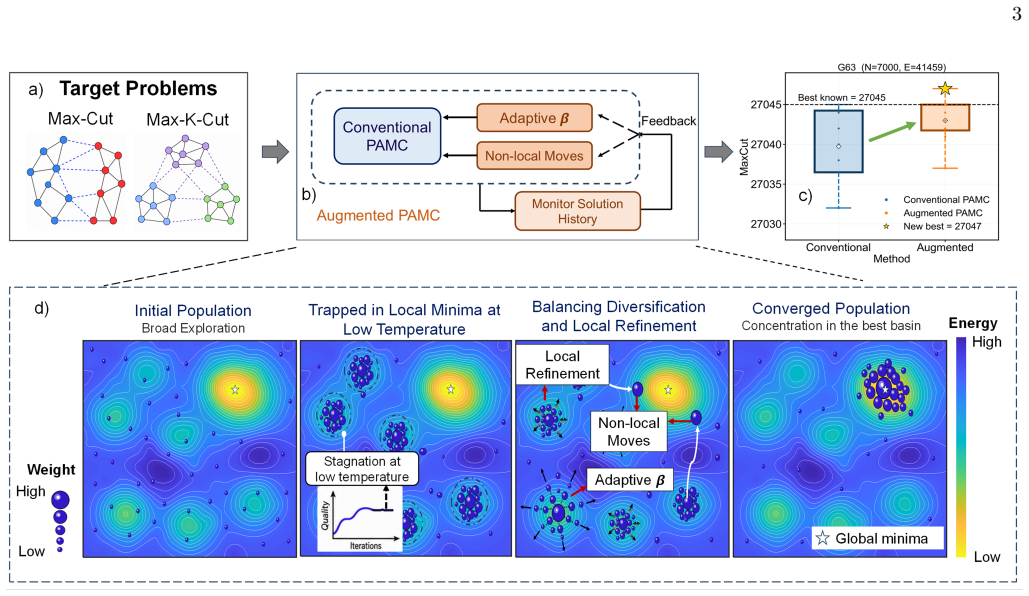
The augmented PAMC framework couples population-based resampling with stagnation-driven adaptive temperature control and energy-preserving nonlocal cluster moves. By using population-level optimization history as feedback, these mechanisms regulate the balance between exploration and refinement by reheating stalled populations and enabling collective transitions across locally confined regions of the solution space. This results in competitive time-to-solution and improved solution quality on large Max-Cut instances, including a new best-known solution for G63, and new best-known solutions on 36 G-set instances for Max-3-Cut, while scaling to 100,000-spin problems.
What carries the argument
The two stagnation-driven mechanisms—adaptive temperature control and energy-preserving nonlocal cluster moves—that use population-level optimization history as feedback to steer the search.
Load-bearing premise
The performance improvements come from the adaptive temperature control and nonlocal cluster moves themselves rather than from GPU optimizations or variations in baseline comparisons.
What would settle it
A controlled experiment re-implementing the two mechanisms in a different code base and comparing directly against the same baselines on the G-set instances with identical timing would show whether the gains persist.
Figures
read the original abstract
Combinatorial optimization problems pose substantial computational challenges because their feasible solution spaces grow exponentially with problem size. This paper presents a GPU-accelerated augmented Population Annealing Monte Carlo (PAMC) framework for large-scale graph-partitioning problems, with emphasis on Max-Cut and Max-K-Cut. The proposed framework extends conventional PAMC by coupling population-based resampling with two stagnation-driven mechanisms: adaptive temperature control and energy-preserving nonlocal cluster moves. By using population-level optimization history as feedback, these mechanisms regulate the balance between exploration and refinement by reheating stalled populations and enabling collective transitions across locally confined regions of the solution space. Experiments on G-set benchmark instances show that the augmented PAMC framework achieves competitive or lower time-to-solution than reported state-of-the-art baselines on several large Max-Cut instances, while matching or improving solution quality under comparable runtime budgets. The solver also discovers a new best-known solution for the G63 Max-Cut instance and scales to a fully connected 100,000-spin Ising instance. For Max-3-Cut, the same framework establishes new best-known solutions on 36 G-set instances, demonstrating its applicability beyond binary Ising formulations. These results indicate that feedback-controlled population dynamics provide an effective and scalable strategy for steering stochastic search in large-scale combinatorial optimization.
Editorial analysis
A structured set of objections, weighed in public.
Referee Report
Summary. The manuscript presents a GPU-accelerated augmented Population Annealing Monte Carlo (PAMC) framework for large-scale Max-Cut and Max-K-Cut problems. It extends standard PAMC by adding two stagnation-driven mechanisms—adaptive temperature control and energy-preserving nonlocal cluster moves—that use population-level optimization history as feedback to balance exploration and refinement. Experiments on G-set instances report competitive or superior time-to-solution and solution quality versus state-of-the-art baselines, new best-known solutions (including for G63 and 36 Max-3-Cut instances), and scaling to a 100,000-spin fully connected Ising instance.
Significance. If the performance improvements can be rigorously attributed to the proposed feedback mechanisms rather than hardware or implementation factors, the work would demonstrate a practical, scalable use of population dynamics for steering stochastic search in combinatorial optimization, with potential relevance to statistical physics simulations and large-scale discrete optimization.
major comments (2)
- [Experiments] Experiments section: the central claim that the two stagnation-driven mechanisms are responsible for the reported gains in time-to-solution and new best-known solutions is not supported by ablation experiments (PAMC with vs. without adaptive temperature control; with vs. without cluster moves). Without these controls, the contribution of the population-dynamics components cannot be isolated from GPU-specific optimizations or baseline timing differences.
- [Experiments] Experiments section: no re-implementation or re-timing of the cited state-of-the-art baselines on the same GPU platform is described, nor is there explicit normalization of wall-clock time, iteration counts, or convergence criteria. This leaves open the possibility that reported advantages arise from non-comparable experimental conditions rather than the augmented PAMC framework itself.
minor comments (1)
- The abstract and experiments would benefit from a brief statement of the precise definition of 'time-to-solution' (e.g., time to reach a target energy or to a fixed iteration budget) and how solution quality is quantified across runs.
Simulated Author's Rebuttal
We thank the referee for the constructive comments highlighting the need for stronger experimental isolation of the proposed mechanisms. We will revise the manuscript to address these points directly.
read point-by-point responses
-
Referee: [Experiments] Experiments section: the central claim that the two stagnation-driven mechanisms are responsible for the reported gains in time-to-solution and new best-known solutions is not supported by ablation experiments (PAMC with vs. without adaptive temperature control; with vs. without cluster moves). Without these controls, the contribution of the population-dynamics components cannot be isolated from GPU-specific optimizations or baseline timing differences.
Authors: We agree that ablation experiments are required to rigorously attribute performance gains to the stagnation-driven mechanisms rather than other factors. The current manuscript focuses on the complete augmented framework and its results against external baselines but does not include internal ablations against unmodified PAMC. In the revised version we will add these controls on representative G-set instances, reporting time-to-solution and solution quality for the full method versus variants with adaptive temperature disabled and with cluster moves disabled. This will isolate the contribution of each population-dynamics component. revision: yes
-
Referee: [Experiments] Experiments section: no re-implementation or re-timing of the cited state-of-the-art baselines on the same GPU platform is described, nor is there explicit normalization of wall-clock time, iteration counts, or convergence criteria. This leaves open the possibility that reported advantages arise from non-comparable experimental conditions rather than the augmented PAMC framework itself.
Authors: Comparisons rely on the wall-clock times and solution qualities reported in the original baseline publications, which is standard when re-implementing complex solvers is impractical. We acknowledge that hardware platforms, stopping criteria, and implementation details differ. The revised manuscript will add a dedicated subsection detailing the hardware, reported metrics, and convergence criteria from each baseline paper and will normalize comparisons using iteration or evaluation counts where possible. Full re-timing of all baselines on our GPU is outside the scope of this work, but the limitations of the cross-platform comparison will be stated explicitly. revision: partial
Circularity Check
No circularity: empirical benchmark results with no derivation chain
full rationale
The paper describes an augmented PAMC algorithm with two stagnation-driven mechanisms and reports its performance on G-set Max-Cut/Max-3-Cut instances, including new best-known solutions and scaling to 100k spins. No equations, fitted parameters, predictions, or first-principles derivations are present in the provided abstract or claimed results. Performance is presented strictly as measured wall-clock outcomes on external benchmarks rather than quantities defined in terms of the method itself. No self-citation load-bearing steps, uniqueness theorems, or ansatzes appear. The central claims rest on experimental comparison, which is self-contained against the stated benchmarks and does not reduce to any input by construction.
Axiom & Free-Parameter Ledger
Reference graph
Works this paper leans on
-
[1]
remains one of the strongest classical heuristics for generalKand provides an important benchmark for so- lution quality. In addition, Parameterized Local Search (PLS) has reported competitive Max-K-Cut results on benchmark instances, using both local-search based and ILP variants, making it a relevant classical baseline for evaluating solution quality [3...
2000
-
[2]
K. Seo, S. Hyun, and Y.-H. Kim. An edge-set rep- resentation based on a spanning tree for searching cut space.IEEE Transactions on Evolutionary Computation, 19(4):465–473, 2015
2015
-
[3]
Benlic and J.-K
U. Benlic and J.-K. Hao. A multilevel memetic approach for improving graph k-partitions.IEEE Transactions on Evolutionary Computation, 15(5):624–642, 2011
2011
-
[4]
Metropolis, A
N. Metropolis, A. W. Rosenbluth, M. N. Rosenbluth, A. H. Teller, and E. Teller. Equation of state calculations by fast computing machines.The Journal of Chemical Physics, 21(6):1087–1092, 1953
1953
-
[5]
Kirkpatrick, C
S. Kirkpatrick, C. D. Gelatt, and M. P. Vecchi. Optimiza- tion by simulated annealing.Science, 220(4598):671–680, 1983
1983
-
[6]
Y. Iba. Population Monte Carlo algorithms.Transac- tions of the Japanese Society for Artificial Intelligence, 16(2):279–286, 2001
2001
-
[7]
D. J. Earl and M. W. Deem. Parallel tempering: Theory, applications, and new perspectives.Physical Chemistry Chemical Physics, 7(23):3910–3916, 2005
2005
-
[8]
Hukushima and Y
K. Hukushima and Y. Iba. Population annealing and its application to a spin glass. InThe Monte Carlo Method in the Physical Sciences: Celebrating the 50th Anniversary of the Metropolis Algorithm, volume 690 ofAIP Confer- ence Proceedings, pages 200–206. American Institute of Physics, 2003
2003
-
[9]
Huang, C.-F
K.-P. Huang, C.-F. Nien, Y.-T. Zhang, C.-K. Lee, and Y.-C. Wang. GPU-based Ising machine for solving com- binatorial optimization problems with enhanced parallel tempering techniques. In2024 IEEE Asia Pacific Con- ference on Circuits and Systems (APCCAS), pages 636– 640, Taipei, Taiwan, 2024. IEEE
2024
-
[10]
Z. Zhu, C. Fang, and H. G. Katzgraber. borealis—A gen- eralized global update algorithm for Boolean optimiza- tion problems.Optimization Letters, 14(8):2495–2514, 2020
2020
-
[11]
Delacour, M
C. Delacour, M. M. H. Sajeeb, J. P. Hespanha, and K. Y. Camsari. Two-dimensional parallel temper- ing for constrained optimization.Physical Review E, 112(2):L023301, 2025
2025
-
[12]
Nikhar, S
S. Nikhar, S. Kannan, N. A. Aadit, S. Chowdhury, and K. Y. Camsari. All-to-all reconfigurability with sparse and higher-order Ising machines.Nature Communica- tions, 15(1):8977, 2024
2024
-
[13]
W. Wang, J. Machta, and H. G. Katzgraber. Comparing Monte Carlo methods for finding ground states of Ising spin glasses: Population annealing, simulated annealing, and parallel tempering.Physical Review E, 92(1):013303, 2015
2015
-
[14]
Amey and J
C. Amey and J. Machta. Analysis and optimization of population annealing.Physical Review E, 97(3):033301, 2018
2018
-
[15]
L. Yu. Barash, M. Weigel, M. Borovsk´ y, W. Janke, and L. N. Shchur. GPU accelerated population annealing al- gorithm.Computer Physics Communications, 220:341– 350, 2017
2017
-
[16]
Barzegar, F
A. Barzegar, F. Hamze, C. Amey, and J. Machta. Opti- mal schedules for annealing algorithms.Physical Review E, 109(6):065301, 2024
2024
-
[17]
Barzegar, C
A. Barzegar, C. Pattison, W. Wang, and H. G. Katz- graber. Optimization of population annealing Monte Carlo for large-scale spin-glass simulations.Physical Re- view E, 98(5):053308, 2018
2018
-
[18]
P. L. Ebert, D. Gessert, and M. Weigel. Weighted av- erages in population annealing: Analysis and general framework.Physical Review E, 106(4):045303, 2022
2022
-
[19]
Weigel, L
M. Weigel, L. Barash, L. Shchur, and W. Janke. Under- standing population annealing Monte Carlo simulations. Physical Review E, 103(5):053301, 2021
2021
-
[20]
Cirauqui, M
D. Cirauqui, M. ´A. Garc´ ıa-March, J. R. Mart´ ınez Saave- dra, M. Lewenstein, and P. R. Grzybowski. Population annealing with topological defect driven nonlocal updates for spin systems with quenched disorder.Physical Review B, 109(14):144202, 2024
2024
-
[21]
L. Ingber. Very fast simulated re-annealing.Mathemati- cal and Computer Modelling, 12(8):967–973, 1989
1989
-
[22]
Karabin and S
M. Karabin and S. J. Stuart. Simulated annealing with adaptive cooling rates.The Journal of Chemical Physics, 153(11):114103, 2020
2020
-
[23]
H. G. Katzgraber, S. Trebst, D. A. Huse, and M. Troyer. Feedback-optimized parallel tempering Monte Carlo. Journal of Statistical Mechanics: Theory and Experi- ment, 2006(03):P03018, 2006
2006
-
[24]
Miasojedow, E
B. Miasojedow, E. Moulines, and M. Vihola. An adaptive parallel tempering algorithm.Journal of Computational and Graphical Statistics, 22(3):649–664, 2013
2013
-
[25]
K. D. Boese and A. B. Kahng. Best-so-far vs. where- you-are: implications for optimal finite-time annealing. Systems & Control Letters, 22(1):71–78, 1994
1994
-
[26]
Houdayer
J. Houdayer. A cluster Monte Carlo algorithm for 2- dimensional spin glasses.The European Physical Journal B, 22(4):479–484, 2001
2001
-
[27]
Z. Zhu, A. J. Ochoa, and H. G. Katzgraber. Efficient cluster algorithm for spin glasses in any space dimension. Physical Review Letters, 115(7):077201, 2015
2015
-
[28]
Benlic and J.-K
U. Benlic and J.-K. Hao. Breakout local search for the Max-Cut problem.Engineering Applications of Artificial Intelligence, 26(3):1162–1173, 2013
2013
-
[29]
V. P. Shylo, F. Glover, and I. V. Sergienko. Teams of global equilibrium search algorithms for solving the weighted maximum cut problem in parallel.Cybernetics and Systems Analysis, 51(1):16–24, 2015
2015
-
[30]
Goudet, A
O. Goudet, A. Go¨ effon, and J.-K. Hao. A large pop- ulation island framework for the unconstrained binary quadratic problem.Computers & Operations Research, 168:106684, 2024
2024
-
[31]
Ma and J.-K
F. Ma and J.-K. Hao. A multiple search operator heuris- tic for the max-k-cut problem.Annals of Operations Re- search, 248(1):365–403, 2017
2017
-
[32]
J. Garvardt, N. Gr¨ uttemeier, C. Komusiewicz, and N. Morawietz. Parameterized local search for Maxc-Cut. arXiv preprintarXiv:2409.13380, 2024
arXiv 2024
-
[33]
H. Goto, K. Endo, M. Suzuki, Y. Sakai, T. Kanao, Y. Hamakawa, R. Hidaka, M. Yamasaki, and K. Tat- sumura. High-performance combinatorial optimiza- tion based on classical mechanics.Science Advances, 7(6):eabe7953, 2021
2021
-
[34]
K. M. Zick, N. Shukla, and A. Marakov. Cosm: Collec- tive switched motion for fast and accurate sparse Ising optimization.arXiv preprintarXiv:2605.30355, 2026
Pith/arXiv arXiv 2026
-
[35]
K. Y. Camsari, R. Faria, B. M. Sutton, and S. Datta. Stochasticp-bits for invertible logic.Physical Review X, 13 7(3):031014, 2017
2017
-
[36]
N. A. Aadit, A. Grimaldi, M. Carpentieri, L. Theogara- jan, J. M. Martinis, G. Finocchio, and K. Y. Camsari. Massively parallel probabilistic computing with sparse Ising machines.Nature Electronics, 5(7):460–468, 2022
2022
-
[37]
W. A. Borders, A. Z. Pervaiz, S. Fukami, K. Y. Cam- sari, H. Ohno, and S. Datta. Integer factorization using stochastic magnetic tunnel junctions.Nature, 573(7774):390–393, 2019
2019
-
[38]
S. Yang, A. Grimaldi, Y. Bao, E. Raimondo, J. Si, G. Finocchio, and H. Yang. 250 magnetic tun- nel junctions-based probabilistic Ising machine.arXiv preprintarXiv:2506.14590, 2025
arXiv 2025
-
[39]
M. K. Bashar, A. Hasan, and N. Shukla. Designing a K-state p-bit engine.arXiv preprintarXiv:2403.06436, 2024
arXiv 2024
-
[40]
Cheong, S
S. Cheong, S. H. Lee, J. Han, J.-Y. Park, D. H. Shin, Y. H. Jang, S. K. Shim, S. Kim, C. S. Hwang, and J.-K. Han. Multi-state probabilistic computing using floating- body MOSFETs based on the Potts model for solving complex combinatorial optimization problems.Advanced Materials, 38(16):e2516797, 2026
2026
-
[41]
Duffee, J
C. Duffee, J. Athas, A. Grimaldi, D. Volpe, G. Finoc- chio, E. Wei, and P. Khalili Amiri. P-dits: Probabilis- tic d-dimensional bits for extended-variable probabilistic computing.Physical Review Applied, 24:044077, 2025
2025
-
[42]
UVA Re- search Computing
University of Virginia Research Computing. UVA Re- search Computing. 2026. [Online]. Accessed: Jun. 21,
2026
-
[43]
Available:https://rc.virginia.edu/
-
[44]
Helmberg and F
C. Helmberg and F. Rendl. Gset: Max-cut bench- mark instances. 2000. Generated with the machine- independent graph generator RUDY by Giovanni Ri- naldi; hosted/maintained by Yinyu Ye. [Online]. Avail- able:https://web.stanford.edu/ ~yyye/yyye/Gset/
2000
-
[45]
N. Khan and N. Shukla. New best-known Max-Cut solu- tion for the G63 instance in the G-set benchmark.arXiv preprintarXiv:2510.21105, 2025
arXiv 2025
-
[46]
R. B. Potts. Some generalized order-disorder transforma- tions.Mathematical Proceedings of the Cambridge Philo- sophical Society, 48(1):106–109, 1952
1952
-
[47]
F. Y. Wu. The Potts model.Reviews of Modern Physics, 54(1):235–268, 1982. 14 SUPPLEMENT AR Y MA TERIAL A. Hamming Distance Computation to Measure Replica Diversity To quantify the diversity among replicas during the optimization process, we computed the pairwise Hamming distance between replica configurations at each stage. For an ensemble ofRreplicas, th...
1982
-
[48]
Comparison of the time-to-solution (TTS) of SBM and PAMC on se- lected G-set benchmark instances, using the solution reported by SBM as target solution quality
Max-Cut TABLE S1: Comparison of SBM and PAMC on benchmark graphs. Comparison of the time-to-solution (TTS) of SBM and PAMC on se- lected G-set benchmark instances, using the solution reported by SBM as target solution quality. For each graph, the table lists the best-known cut value, the SBM solution used as the target, and the corresponding TTS and succe...
2006
-
[49]
∆ =M3C Our-W ork−M3C Best-Known; “–” indicates that the solution to the instance was not reported in the work; MOH: Multi-Operator Heuristic; n: nodes;m: edges
Max-3-Cut TABLE S2: Comparative Max-3-Cut (M3C) results for G-set in- stances relative to the previously best-known Max-3-Cut solution. ∆ =M3C Our-W ork−M3C Best-Known; “–” indicates that the solution to the instance was not reported in the work; MOH: Multi-Operator Heuristic; n: nodes;m: edges. Entries marked with ( ∗) were obtained using the second upda...
2000
discussion (0)
Sign in with ORCID, Apple, or X to comment. Anyone can read and Pith papers without signing in.