Offline Channel-Independent QAOA Angles for RIS Power Aggregation: Unit-Circle Phase Dictionaries and Infinite-Size Spin-Glass Limits
Pith reviewed 2026-06-26 00:08 UTC · model grok-4.3
The pith
QAOA angles from the infinite-size mixed-q Gaussian ensemble transfer to finite RIS channel matrices and achieve near-optimal discrete-phase power aggregation.
A machine-rendered reading of the paper's core claim, the machinery that carries it, and where it could break.
Core claim
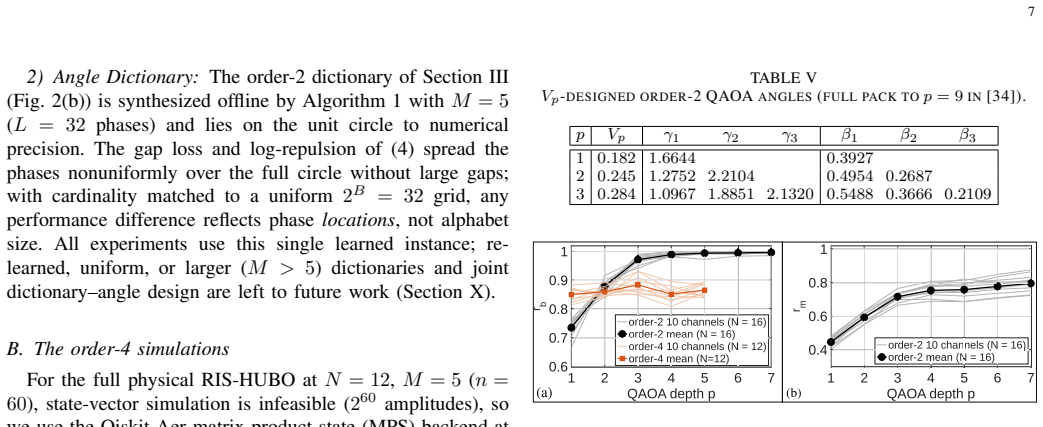
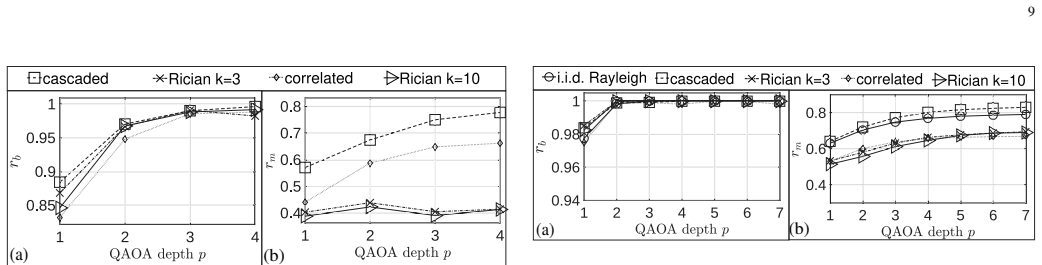
QAOA angles obtained from the infinite-size limit of the mixed-q Gaussian ensemble of Basso et al. can be deployed offline with a 2^M-phase θ dictionary to maximize ||A e^{jθ}||² for K × N channel matrix A; the angles are instance-independent and size-independent, transfer to finite-N matrices drawn from Rayleigh, Rician, cascaded double-fading and spatially-correlated distributions, and under order-2 modeling with a 32-phase dictionary reach performance comparable to a near-optimal classical multi-start single-flip local-search reference for N ≤ 16.
What carries the argument
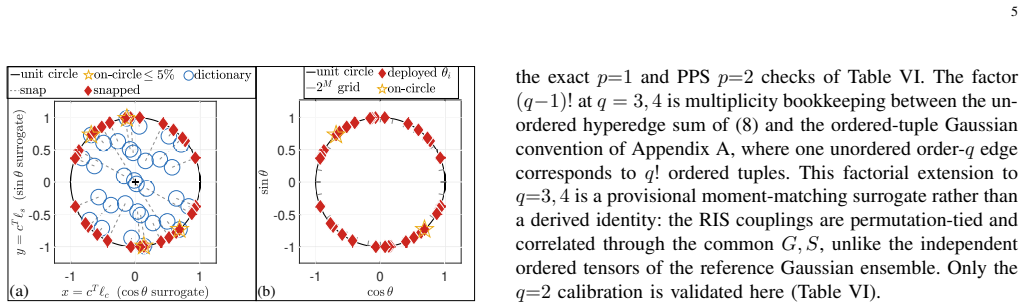
The 2^M-phase θ dictionary together with QAOA angles taken from the infinite-size limit of the mixed-q Gaussian ensemble, which bounds the spin-Hamiltonian interaction order to quartic and permits an order-2 reduction.
If this is right
- Offline angle computation removes per-problem training cost and barren-plateau exposure for RIS power maximization.
- Order-2 modeling with the 32-phase dictionary reaches near the classical local-search reference for N ≤ 16.
- The method provides a concrete route to near-optimal large-N performance once fault-tolerant quantum computers support higher-depth QAOA circuits.
- Order-4 modeling exhibits a performance ceiling below the classical reference.
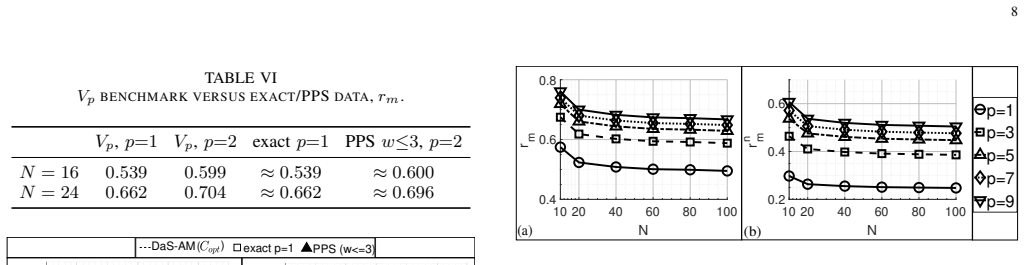
- Numerical verification covers N = K ≤ 100 and p = 9 across multiple channel distributions at N = 5 and 12.
Where Pith is reading between the lines
- The same offline-ensemble approach could be tested on other discrete-phase beamforming or combinatorial problems that share the same quadratic objective structure.
- Hardware experiments at modest depth on current devices could directly check whether the infinite-limit angles remain competitive before fault-tolerant machines become available.
- The quartic bound on interaction order suggests the technique may scale to larger dictionaries without immediately entering the regime of proved QAOA limitations.
- If the transfer holds, hybrid systems could pre-train a single angle set on an ensemble and then deploy it across many RIS deployments without retraining.
Load-bearing premise
The angles computed in the infinite-size limit of the mixed-q Gaussian ensemble remain effective when applied to finite channel matrices drawn from several different distributions.
What would settle it
Measure whether, for N > 16 or for channel realizations outside the tested distributions, the order-2 QAOA with the fixed angles falls more than a small fixed gap below the multi-start single-flip local-search reference performance.
Figures


read the original abstract
Reconfigurable intelligent surfaces (RIS) maximize received power by setting per-element phases. Discrete-phase optimization is NP-hard in the worst case, while the quantum approximate optimization algorithm (QAOA) applied to RIS faces limited phase alphabets, either per-problem angle optimization or uncharacterized training cost exposed to barren plateaus, and no scalable performance benchmark. We introduce a $2^{M}$-phase $\theta$ dictionary for optimizing power $\|\mathbf{A} \, e^{j\theta}\|^{2}$ having $K \times N$ channel matrix $\mathbf{A}$ and QAOA angle offline optimization with instance and size-independent infinite-size limit of the mixed-$q$ Gaussian ensemble of Basso et al. Our design bounds the spin-Hamiltonian interaction order to at most quartic for any $M$, and the deployed order-2 reduction lies below the even-$q\!\ge\!4$ regime in which constant-level QAOA limitations are proved. We perform analytical, state-vector, matrix-product-state and Pauli-path-simulation numerical studies for $N=K \leq 100$ and QAOA depth $p=9$, verifying offline angle transfer to Rayleigh, Rician/line-of-sight, cascaded double-fading and spatially-correlated RIS channels at $N\!\in\!\{5,12\}$. We observe performance reaching a near-optimal multi-start single-flip local-search reference for $N\!\le\!16$ under order-2 modeling with $2^{5}{=}32$-phase dictionary while the order-4 model shows a performance ceiling below the classical reference. The approach suggests a route to near-optimal large-$N$ performance on future fault-tolerant (FTQ) quantum computers, which enable the higher-depth QAOA circuits.
Editorial analysis
A structured set of objections, weighed in public.
Referee Report
Summary. The paper claims to introduce a 2^M-phase θ dictionary for QAOA optimization of received power ||A e^{jθ}||² in RIS systems with K×N channel matrix A. Angles are taken from the instance- and size-independent infinite-size limit of the mixed-q Gaussian ensemble of Basso et al.; the spin-Hamiltonian interaction order is bounded to at most quartic for any M. Numerical studies (state-vector, MPS, Pauli-path) for N=K≤100 and p=9 verify offline transfer at N∈{5,12} across Rayleigh, Rician, cascaded and spatially-correlated channels, with order-2 reduction reaching a multi-start single-flip local-search reference for N≤16 under a 32-phase dictionary while order-4 falls below that reference.
Significance. If the transfer of the Basso et al. angles holds without per-instance adjustment and the order-2 reduction faithfully represents the original objective, the work would supply a channel-independent, offline QAOA protocol for discrete-phase RIS optimization that avoids barren-plateaus training and scales to large N on future fault-tolerant hardware. The explicit quartic bound on interaction order and the use of an external infinite-size benchmark are concrete strengths.
major comments (3)
- [Abstract] Abstract: verification of offline angle transfer is reported only for N∈{5,12} across the four channel families, yet the central claim of size-independent transfer underpins the N≤100 studies; this gap is load-bearing for the scalability assertion.
- [Abstract] Abstract: the order-2 model reaches the classical reference for N≤16, but the order-4 model (within the stated quartic bound) exhibits a performance ceiling below the reference; this indicates the deployed reduction may not faithfully capture the ||A e^{jθ}||² landscape, so observed performance on the reduced model does not establish transfer for the original problem.
- [Abstract] Abstract: the angles are obtained from the mixed-q Gaussian ensemble of Basso et al.; the manuscript must show explicitly that these angles remain instance-independent when applied to finite-N matrices drawn from the listed distributions, rather than reducing to a fitted quantity defined inside the paper.
minor comments (2)
- Clarify the precise mapping from the 2^M-phase dictionary to the order-2 and order-4 Hamiltonians and how the quartic bound is enforced.
- Specify the exact classical reference (multi-start single-flip local search) implementation details and the number of restarts used for the N≤16 comparisons.
Simulated Author's Rebuttal
We thank the referee for the careful reading and constructive comments on arXiv:2606.24540. We respond point by point to the major comments, providing clarifications and indicating where we will revise the manuscript to address concerns about presentation and evidence.
read point-by-point responses
-
Referee: [Abstract] Abstract: verification of offline angle transfer is reported only for N∈{5,12} across the four channel families, yet the central claim of size-independent transfer underpins the N≤100 studies; this gap is load-bearing for the scalability assertion.
Authors: The angles are obtained from the size-independent infinite-size limit of the mixed-q Gaussian ensemble and are applied without per-instance adjustment in all simulations, including those at N≤100. Explicit transfer verification is shown at N=5 and 12 across the four channel families to confirm applicability of the offline angles. The N≤100 results demonstrate performance when these fixed angles are used at larger scales. We will revise the abstract and add a clarifying paragraph in the numerical results section to explicitly link the small-N verification to the larger-N simulations and restate the size-independence from the infinite limit. revision: yes
-
Referee: [Abstract] Abstract: the order-2 model reaches the classical reference for N≤16, but the order-4 model (within the stated quartic bound) exhibits a performance ceiling below the reference; this indicates the deployed reduction may not faithfully capture the ||A e^{jθ}||² landscape, so observed performance on the reduced model does not establish transfer for the original problem.
Authors: The order-2 reduction is deliberately selected as it lies below the even-q≥4 regime where constant-level QAOA limitations have been proved. Its ability to reach the multi-start single-flip local-search reference for N≤16 supports its utility as an approximation. The order-4 ceiling may arise because higher-order terms increase the effective problem difficulty within the fixed QAOA depth p=9, but this does not negate the validity of the order-2 results or the offline-angle transfer on the reduced model. We will revise the manuscript to expand the discussion of the reduction choice, include a note on possible reasons for the order-4 behavior, and clarify that the order-2 model is presented as a faithful-enough approximation for the offline protocol demonstration. revision: partial
-
Referee: [Abstract] Abstract: the angles are obtained from the mixed-q Gaussian ensemble of Basso et al.; the manuscript must show explicitly that these angles remain instance-independent when applied to finite-N matrices drawn from the listed distributions, rather than reducing to a fitted quantity defined inside the paper.
Authors: The angles are taken directly from the published infinite-size results of Basso et al. with no fitting, optimization, or adjustment performed on our finite-N instances or channel distributions. This is the source of their instance- and size-independence. We will revise the manuscript to add an explicit statement in the methods section (and a parenthetical note in the abstract) confirming verbatim use of the Basso et al. angles, together with a brief description of how they are retrieved, to remove any possible ambiguity about fitting. revision: yes
Circularity Check
No circularity: external ensemble limit supplies angles; transfer tested numerically without internal reduction
full rationale
The derivation adopts QAOA angles from the infinite-size mixed-q Gaussian ensemble of Basso et al. (external citation, no author overlap indicated) and presents them as instance- and size-independent for offline use on finite channel matrices A. Numerical verification of transfer is reported for N in {5,12} across multiple distributions, and performance comparisons (order-2 vs. order-4 reductions against local-search reference) are conducted on the paper's own simulations. No equation or claim reduces the target angles or independence statement to a fit or definition internal to this manuscript; the central construction remains self-contained against the cited external benchmark.
Axiom & Free-Parameter Ledger
axioms (1)
- domain assumption The infinite-size limit of the mixed-q Gaussian ensemble of Basso et al. yields angles that remain effective when transferred to finite instances and to non-Gaussian channel matrices.
Reference graph
Works this paper leans on
-
[1]
Reconfigurable intelligent surfaces for wireless communications: Principles, challenges, and opportunities,
M. A. ElMossallamy, H. Zhang, L. Song, K. G. Seddik, Z. Han and G. Y . Li, “Reconfigurable intelligent surfaces for wireless communications: Principles, challenges, and opportunities,”IEEE Trans. Cogn. Commun. Netw., vol. 6, no. 3, pp. 990–1002, Sep. 2020
2020
-
[2]
Optimal power aggregation of reconfigurable intelligent surfaces: An alternating inner product maximization approach,
R. Xiong et al., “Optimal power aggregation of reconfigurable intelligent surfaces: An alternating inner product maximization approach,”IEEE Trans. Commun., vol. 73, no. 8, pp. 6607–6621, 2025
2025
-
[3]
Sum-Rate Maximiza- tion of RIS-Aided Multi-User MIMO Systems With Statistical CSI,
H. Zhang, S. Ma, Z. Shi, X. Zhao, and G. Yang, “Sum-Rate Maximiza- tion of RIS-Aided Multi-User MIMO Systems With Statistical CSI,” IEEE Trans. Wireless Commun., vol. 22, no. 7, pp. 4788–4801, Jul. 2023
2023
-
[4]
Intelligent reflecting surface enhanced wireless network via joint active and passive beamforming,
Q. Wu and R. Zhang, “Intelligent reflecting surface enhanced wireless network via joint active and passive beamforming,”IEEE Trans. Wireless Commun., vol. 18, no. 11, pp. 5394–5409, Nov. 2019
2019
-
[5]
Complex quadratic optimization and semidef- inite programming,
S. Zhang and Y . Huang, “Complex quadratic optimization and semidef- inite programming,”SIAM J. Optim., vol. 16, no. 3, pp. 871–890, 2006
2006
-
[6]
Quantum optimization in wireless commu- nication systems: Principles and applications,
I. Krikidis and V . Gilbert, “Quantum optimization in wireless commu- nication systems: Principles and applications,”IEEE Commun. Mag., vol. 64, no. 5, pp. 204–210, May 2026
2026
-
[7]
Engineering reflective metasurfaces with Ising Hamiltonian and quantum annealing,
C. Ross, G. Gradoni, Q. J. Lim and Z. Peng, “Engineering reflective metasurfaces with Ising Hamiltonian and quantum annealing,”IEEE Trans. Antennas Propag., vol. 70, no. 4, pp. 2841–2854, Apr. 2022
2022
-
[8]
Quantum-assisted combinatorial optimization for reconfigurable intelli- gent surfaces in smart electromagnetic environments,
Q. J. Lim, C. Ross, A. Ghosh, F. W. V ook, G. Gradoni and Z. Peng, “Quantum-assisted combinatorial optimization for reconfigurable intelli- gent surfaces in smart electromagnetic environments,”IEEE Trans. An- tennas Propag., vol. 72, no. 1, pp. 147–159, Jan. 2024
2024
-
[9]
A hybrid classical–quantum comput- ing framework for RIS-assisted wireless network,
C. Ross, G. Gradoni and Z. Peng, “A hybrid classical–quantum comput- ing framework for RIS-assisted wireless network,” inProc. IEEE MTT-S Int. Conf. Numer. Electromagn. Multiphysics Modeling Optim. (NEMO), pp. 99–102, 2023
2023
-
[10]
Quantum annealing for electromagnetic engineers— Part I: A computational method to solve various types of optimization problems,
S. Lee et al., “Quantum annealing for electromagnetic engineers— Part I: A computational method to solve various types of optimization problems,”IEEE Antennas Propag. Mag., vol. 67, no. 6, pp. 29–38, Dec. 2025
2025
-
[11]
Quantum computing based optimization for intelligent reflecting surface (IRS)-aided cell-free net- work,
T. Ohyama, Y . Kawamoto and N. Kato, “Quantum computing based optimization for intelligent reflecting surface (IRS)-aided cell-free net- work,”IEEE Trans. Emerg. Topics Comput., vol. 11, no. 1, pp. 18–29, Jan.–Mar. 2023
2023
-
[12]
1-bit RIS-aided index modulation with quantum annealing,
I. Krikidis, C. Psomas and G. Zheng, “1-bit RIS-aided index modulation with quantum annealing,”IEEE J. Sel. Topics Signal Process., vol. 19, no. 6, pp. 881–895, 2025
2025
-
[13]
Quantum optimization of reconfigurable intelligent sur- faces for mitigating multipath fading in wireless networks,
E. Colella, L. Bastianelli, V . M. Primiani, Z. Peng, F. Moglie and G. Gradoni, “Quantum optimization of reconfigurable intelligent sur- faces for mitigating multipath fading in wireless networks,”IEEE J. Multiscale Multiphys. Comput. Tech., vol. 9, pp. 403–414, 2024
2024
-
[14]
M. Pasquale, E. M. ˚Asgrim, S. Markidis and O. Quevedo-Teruel, “Quantum optimization for electromagnetics: Physics-informed QAOA for reconfigurable intelligent surfaces,” arXiv:2605.06048, 2026
Pith/arXiv arXiv 2026
-
[15]
V . P. Pham et al., “Hybrid quantum-classical optimization for joint beam- forming and discrete phase shift design in STAR-RIS 6G networks,” IEEE Internet Things J., 2026, doi:10.1109/JIOT.2026.3694955
-
[16]
Hybrid quantum-classical algorithm design for coupled phase-shift optimization of STAR-RIS,
S.-C. Lim and J.-C. Kim, “Hybrid quantum-classical algorithm design for coupled phase-shift optimization of STAR-RIS,”IEEE Access, vol. 14, pp. 72495–72507, 2026
2026
-
[17]
Intent-driven near-field STAR-RIS beamforming via hybrid quantum-classical optimization for MIMO– NOMA IoT downlink networks,
A. Paul, K. Singh and K. Dev, “Intent-driven near-field STAR-RIS beamforming via hybrid quantum-classical optimization for MIMO– NOMA IoT downlink networks,”IEEE Internet Things J., vol. 13, no. 9, pp. 17918–17930, May 2026
2026
-
[18]
Quantum-driven resource optimization for full-duplex STAR-RIS-aided NOMA-ISAC with constraint projection,
A. Sharma, K. Singh, A. Paul, K. Agrawal, K. Dev and S. Biswas, “Quantum-driven resource optimization for full-duplex STAR-RIS-aided NOMA-ISAC with constraint projection,”IEEE Trans. Netw. Sci. Eng., vol. 13, pp. 6827–6842, 2026
2026
-
[19]
Quantum graph neural networks for double-sided reconfigurable intelligent surface optimiza- tion,
N. Hassan, X. Fernando and H. Yanikomeroglu, “Quantum graph neural networks for double-sided reconfigurable intelligent surface optimiza- tion,” arXiv:2604.10453, 2026
Pith/arXiv arXiv 2026
-
[20]
Performance and limitations of the QAOA at constant levels on large sparse hypergraphs and spin glass models,
J. Basso, D. Gamarnik, S. Mei, and L. Zhou, “Performance and limitations of the QAOA at constant levels on large sparse hypergraphs and spin glass models,” inProc. IEEE 63rd FOCS, pp. 335–343, 2022
2022
-
[21]
The quantum approximate optimization algorithm at high depth for MaxCut on large-girth regular graphs and the Sherrington–Kirkpatrick model,
J. Basso, E. Farhi, K. Marwaha, B. Villalonga, and L. Zhou, “The quantum approximate optimization algorithm at high depth for MaxCut on large-girth regular graphs and the Sherrington–Kirkpatrick model,” inProc. TQC, LIPIcs vol. 232, pp. 7:1–7:21, 2022
2022
-
[22]
Expectation values from the single-layer quantum approximate optimization algorithm on Ising problems,
A. Ozaeta, W. van Dam and P. L. McMahon, “Expectation values from the single-layer quantum approximate optimization algorithm on Ising problems,”Quantum Sci. Technol., vol. 7, no. 4, p. 045036, 2022
2022
-
[23]
Majority voting with recursive QAOA and cost-restricted uniform sampling for maximum-likelihood detection in massive MIMO,
B. G ¨ulbahar, “Majority voting with recursive QAOA and cost-restricted uniform sampling for maximum-likelihood detection in massive MIMO,” IEEE Trans. Wireless Commun., vol. 24, no. 3, pp. 2620–2631, Mar. 2025
2025
-
[24]
Quantum algorithm for higher-order unconstrained binary optimization and MIMO maximum likelihood detection,
M. Norimoto, R. Mori and N. Ishikawa, “Quantum algorithm for higher-order unconstrained binary optimization and MIMO maximum likelihood detection,”IEEE Trans. Commun., vol. 71, no. 4, pp. 1926– 1939, Apr. 2023
1926
-
[25]
A quantum approximate optimization algorithm,
E. Farhi, J. Goldstone and S. Gutmann, “A quantum approximate optimization algorithm,” arXiv:1411.4028, 2014
Pith/arXiv arXiv 2014
-
[26]
The quantum approximate optimization algorithm and the Sherrington–Kirkpatrick model at infinite size,
E. Farhi, J. Goldstone, S. Gutmann and L. Zhou, “The quantum approximate optimization algorithm and the Sherrington–Kirkpatrick model at infinite size,”Quantum, vol. 6, p. 759, 2022
2022
-
[27]
Physics-compliant modeling and scaling laws of multi-RIS aided MIMO systems,
M. Nerini, G. Gradoni and B. Clerckx, “Physics-compliant modeling and scaling laws of multi-RIS aided MIMO systems,”IEEE Trans. Wireless Commun., vol. 25, pp. 6745–6759, 2026
2026
-
[28]
B. Gulbahar,“Recursive-Repetitive Truncated QAOA-MVSIC for mMIMO Detection: Matrix Product State Simulation and Experimental Evaluation”,Authorea, September 4, 2025. doi:10.22541/au.175700359.95812012/v1
-
[29]
Obstacles to variational quantum optimization from symmetry protection,
S. Bravyi, A. Kliesch, R. Koenig and E. Tang, “Obstacles to variational quantum optimization from symmetry protection,”Phys. Rev. Lett., vol. 125, no. 26, p. 260505, 2020
2020
-
[30]
Maximum-likelihood detection with QAOA for massive MIMO and Sherrington–Kirkpatrick model with local field at infinite size,
B. G ¨ulbahar, “Maximum-likelihood detection with QAOA for massive MIMO and Sherrington–Kirkpatrick model with local field at infinite size,”IEEE Trans. Wireless Commun., vol. 23, no. 9, pp. 11567–11579, Sep. 2024
2024
-
[31]
Quantum algorithms for reconfigurable intelligent surface optimization: Barren plateaus analysis,
E. Colella, L. Bastianelli, V . M. Primiani, F. Moglie and G. Gradoni, “Quantum algorithms for reconfigurable intelligent surface optimization: Barren plateaus analysis,” inProc. Eur. Conf. Antennas Propag. (Eu- CAP), 2025
2025
-
[32]
Quantum approxi- mate optimization algorithm for MIMO with quantizedb-bit beamform- ing,
N. A. Mitsiou, I. Krikidis and G. K. Karagiannidis, “Quantum approxi- mate optimization algorithm for MIMO with quantizedb-bit beamform- ing,”IEEE J. Sel. Topics Signal Process., vol. 19, no. 6, pp. 1072–1085, Sep. 2025
2025
-
[33]
Classically estimating observables of noiseless quan- tum circuits,
A. Angrisani, A. Schmidhuber, M. S. Rudolph, M. Cerezo, Z. Holmes and H.-Y . Huang, “Classically estimating observables of noiseless quan- tum circuits,”Phys. Rev. Lett., vol. 135, no. 17, p. 170602, 2025
2025
-
[34]
B. Gulbahar, “Offline Channel-Independent QAOA Angles for RIS Power Aggregation: Unit-Circle Dictionaries and Infinite-Size Spin- Glass Limits”,Code Ocean Compute Capsule, June 22, 2026. doi: https://dx.doi.org/10.24433/CO.1388793.v1
-
[35]
Joint phase and amplitude control of near- field holographic MIMO via quantum approximate optimization for intelligent transport systems,
A. Paul and K. Singh, “Joint phase and amplitude control of near- field holographic MIMO via quantum approximate optimization for intelligent transport systems,”IEEE Trans. Wireless Commun., vol. 25, pp. 18293–18308, 2026
2026
-
[36]
Rayleigh fading modeling and channel hardening for reconfigurable intelligent surfaces,
E. Bj ¨ornson and L. Sanguinetti, “Rayleigh fading modeling and channel hardening for reconfigurable intelligent surfaces,”IEEE Wireless Com- mun. Lett., vol. 10, no. 4, pp. 830–834, 2021
2021
-
[37]
Montanari, Optimization of the Sherrington– Kirkpatrick Hamiltonian , SIAM J
A. Montanari, “Optimization of the Sherrington–Kirkpatrick Hamilto- nian,” inProc. IEEE 60th Annu. Symp. Found. Comput. Sci. (FOCS), 2019, pp. 1417–1433; see alsoSIAM J. Comput., vol. 54, no. 4, pp. FOCS19-1–FOCS19-38, 2025, doi:10.1137/20M132016X
discussion (0)
Sign in with ORCID, Apple, or X to comment. Anyone can read and Pith papers without signing in.