REVIEW 3 major objections 5 minor 28 references
Non-linear Schr\"{o}dinger-type formulation of scalar field cosmology: two barotropic fluids and exact solutions
T0 review · 3 major / 5 minor · reviewed 2026-08-14 · deepseek-v4-flash
Pith's one-line read The Friedmann equations for a canonical scalar field plus two barotropic fluids are exactly equivalent to a time-independent nonlinear Schrödinger equation under the variable change $u=a^{-n/2}$, $E=-\kappa^2 n^2 D_1/12$.
desk verdict Correct and honest, but narrow: the NLS–Friedmann dictionary is extended to two fluids and one new exact solution is found, yet the paper never verifies that the reconstructed scalar field is real on the full domain. read the letter →
The pith
A machine-rendered reading of the paper's core claim, the machinery that carries it, and where it could break.
The reading
What carries the argument
The load-bearing object is the variable change that identifies Friedmann variables with NLS variables: $u(x)=a^{-n/2}$ together with $\dot{x}=u$, $E=-\kappa^2 n^2 D_1/12$, and $P(x)=(\kappa^2 n/4)a^n\epsilon\dot\phi^2+(mD_2/12)\kappa^2 n a^{n-m}$. Substituting these definitions into the Friedmann and acceleration equations reproduces the time-independent NLS equation (15). The role of $P(x)$ is to absorb both the scalar-field kinetic term and the second barotropic fluid while $E$ stays constant; that constancy is what allows the known solution table to be applied unchanged. The relation $x(t)=\int u\,dt$ completes the dictionary, so any NLS wavefunction $u(x)$ can be converted into a scale factor $a(t)=u^{-2/n}$ and then into a Hubble rate, redshift, and scalar potential.
What would settle it
Choose any of the eight solutions, substitute $u(x)$ and its derivatives into (16), and scan the domain for intervals where the right-hand side is negative or where the resulting $V(\phi)$ is multi-valued; the first such interval would show that the solution is not a scalar-field cosmology.
Extended reading notes
Core claim
The central claim is an exact identity between two dynamical descriptions. The flat or curved Friedmann equations sourced by a canonical scalar field, with density $\rho_\phi=\frac12\epsilon\dot\phi^2+V(\phi)$, and two non-interacting barotropic fluids with densities $D_1/a^n$ and $D_2/a^m$, are equivalent to the stationary nonlinear Schrödinger equation $u''+[E-P]u=-(nk/2)u^{(4-n)/n}$ once one sets $u=a^{-n/2}$, $E=-\kappa^2 n^2 D_1/12$, and $P=(\kappa^2 n/4)a^n\epsilon\dot\phi^2+(mD_2/12)\kappa^2 n a^{n-m}$. Every NLS solution therefore yields a cosmological solution: the scale factor is $a=u^{-2/n}$, and the scalar kinetic term and potential are recovered from $u$ and its derivatives. The paper carries out this translation for seven exact NLS solutions taken from the literature and one new solution, $u=-e_0\sinh^2(b_0x)$, giving explicit $a(t)$, $H(t)$, $z(t)$, and $V(\phi)$ for each. It also observes that all eight NLS wavefunctions are non-normalizable, that the implied first-fluid density is often negative or zero, and that the time-independent formulation should therefore be upgraded to the time-dependent NLS case.
Load-bearing premise
The argument assumes that the scalar field recovered from each NLS solution is a genuine real canonical field: the kinetic term from (16) must be non-negative everywhere and $V(\phi)$ must be single-valued, but none of the eight solutions is checked against that condition.
Editorial extensions
If this is right
- Every solution of the stationary NLS equation yields a two-fluid FRW cosmology with scale factor $a=u^{-2/n}$, so the eight listed $u(x)$ forms translate directly into explicit cosmic histories.
- The first barotropic fluid is fixed by the constant $E$, while the second fluid enters only through $P(x)$; the same $u(x)$ can therefore be paired with different second-fluid equations of state without changing the wavefunction.
- Because all eight NLS states are non-normalizable and have negative total $E$, the stationary wavefunction cannot support a probabilistic quantum-cosmological reading, a limitation the paper itself states.
- The paper proposes the time-dependent NLS formulation as the next step, expecting more realistic solutions and deeper physical insight.
Reading between the lines
- The paper never tests whether the right-hand side of $\epsilon\dot\phi^2=(4/\kappa^2 n)uu''+\dots$ stays non-negative on the whole domain for each listed solution; if it does not, that solution is not a valid canonical scalar-field cosmology and would need a phantom interpretation or rejection.
- The second-fluid constants $D_2$ and $m$ drop out of the reconstructed scalar sector, suggesting the dictionary underdetermines the second fluid: an observed cosmology could be matched to several different $m$ values without changing $u(x)$.
- The new solution 8 produces the same scale factor, redshift, and Hubble rate as solution 6; a plausible reading is that the two are related by a simple transformation of $x$, making solution 8 a re-expression rather than an independent model.
- A direct test of physical relevance would be to compute the scalar-field equation-of-state $w_\phi(t)$ for each solution and compare it with the observed accelerating expansion; most of the listed models are unlikely to survive that comparison.
Signed reviews
Editorial analysis
A structured set of objections, weighed in public.
Referee Report
Summary. The paper constructs a time-independent non-linear Schrödinger (NLS) formulation of FRW cosmology with a canonical scalar field and two non-interacting barotropic fluids. It defines u = a^{-n/2}, E = -(κ² n² D1)/12, and P(x) = (κ² n/4) a^n ε φdot² + (m D2/12) κ² n a^{n-m}, and derives the exact equivalence of the Friedmann and acceleration equations to the NLS equation (15). The paper then supplies a dictionary of cosmological quantities in terms of NLS variables, examines eight exact u(x) solutions (seven attributed to D'Ambroise and one presented as new), and computes scale factors, Hubble rates, redshifts, and density parameters for each. It concludes that all listed solutions are non-normalizable and that a time-dependent NLS formulation would be needed for a more realistic description.
Significance. The formal equivalence in §III is derived transparently, and the algebraic dictionary is the main useful contribution: it is an exact map rather than a fit, and the paper does not claim to adjust parameters to observational data. The catalogue of eight solutions with their stated conditions is a compact reference, and the new solution in §IV H is correctly checked against the NLS equation. The principal limitation is physical rather than algebraic: several of the solutions will not define real canonical scalar-field cosmologies unless nontrivial sign and single-valuedness conditions are verified, so the blanket correspondence claimed near Eq. (27) is not yet established. If these checks are carried out, the dictionary would be a reliable tool for constructing two-fluid cosmologies from NLS solutions.
major comments (3)
- [§III, Eq. (16) and §IV F] The paper states after Eq. (27) that only ε = 1 is considered, but it never verifies that the right-hand side of Eq. (16) is nonnegative on the whole domain. For Solution 6, u(x) = -e0 cosh²(b0 x), k = 0, E = c0 - 2b0², Eq. (16) at x = 0 gives ε φdot² = 4e0² c0/(κ² n), which is negative whenever c0 < 0, a case allowed by the stated conditions c0 < 2b0² and D1 > 0. Since the D2 term in Eq. (16) is not constrained in sign unless m is restricted, the addition of the second fluid does not automatically repair this. The same nonnegativity check is needed for the other seven entries before the claim that each NLS solution yields a cosmological solution can stand.
- [§III, Eqs. (17) and (24)] Even when Eq. (16) is nonnegative, V is first computed as a function of x, while the cosmological formulation requires a potential V(φ). For the dictionary to be valid, the relation between x and φ must be invertible on the relevant domain, or V must be shown to be single-valued as a function of φ. The manuscript does not discuss monotonicity of φ(x) for any of the eight solutions, so the identification of the reconstructed object with a canonical scalar-field potential is not established.
- [§III, Eqs. (14) and (16)] Substituting the expression for ε φdot² from Eq. (16) into Eq. (14) makes the terms containing D2 and m cancel identically, so P(x) and equation (15) are independent of the second-fluid parameters. The manuscript does not state this consequence or specify the admissible values of D2 and m; the only constraint on these parameters is the nonnegativity of Eq. (16), which remains unchecked. The freedom in D2 and m therefore cannot be cited as a source of new solutions unless the reality conditions are imposed.
minor comments (5)
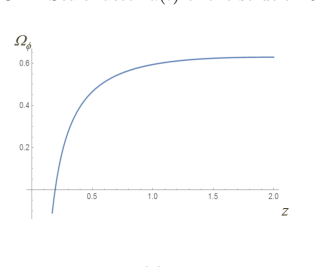
- [§IV F] The sentence after Eq. (72) reads "Plot of a(t) and Ωφ(z) are in figures 1 and ." and the reference to the second figure is incomplete.
- [§III, Eq. (24)] Equation (24) is difficult to parse because of unbalanced parentheses and an undefined ± sign convention; please rewrite it with explicit sign branches.
- [§IV H, Eq. (80)] The notation "arcCoth" should be written as "arccoth" for consistency with standard usage elsewhere in the paper.
- [§I, Eq. (1)] The introduction refers to the "Ermakov-Penny" equation; the standard spelling is Ermakov-Pinney, which is used in the rest of the paper.
- [§IV H] Solution 8 is presented as new but yields the same scale factor, Hubble rate, and redshift as Solution 6; the sense in which it is new should be clarified.
Circularity Check
No significant circularity found: the NLS-Friedmann correspondence is an exact algebraic equivalence and the listed solutions are external or independently checkable.
full rationale
The derivation is self-contained: Eq. (15) is obtained from Eqs. (9)-(11) by the definitions (13)-(14), and the mapping back to epsilon phi_dot^2, V, rho_phi, etc. in Eqs. (16)-(22) is an algebraic inversion of the same relations. The eight u(x) solutions are either quoted from D'Ambroise's thesis [26], an external author rather than a self-citation, or, for Solution 8, asserted to satisfy the NLS equation; the paper does not fit any parameter to data, nor does it claim observational success, explicitly stating that the plots "do not resemble current observation." The self-citations to Gumjudpai [19,22-25] are contextual, used only to contrast earlier bottom-up ansatz approaches, and are not load-bearing for the derivation. That a solution of the NLS equation yields a Friedmann solution is a mathematical identity in both directions, not a prediction forced by a fit. The unverified positivity of epsilon phi_dot^2 for epsilon = 1 is a physical-validity concern, not circularity.
Assumptions & free parameters
free parameters (3)
- Solution constants e0, b0, c0, d0 =
not fitted
- Barotropic index n =
varies per solution (e.g., n=4 in solutions 1 and 2.2, n=1 in solution 3)
- Second fluid parameters m and D2 =
not fitted
assumptions (5)
- domain assumption FLRW equations with minimally coupled canonical scalar field and two non-interacting barotropic perfect fluids accurately model the universe
- domain assumption The NLS-Friedmann correspondence of Hawkins-Lidsey and D'Ambroise-Williams is correct
- domain assumption The seven exact solutions in Table I from D'Ambroise's thesis are correct
- ad hoc to paper The reconstructed V(phi) and phi-dot^2 define a valid canonical scalar field
- ad hoc to paper The scale factor a(t) = u^-2/n is real for all t
Cite this review
Pith. "Pith review of Non-linear Schr\"{o}dinger-type formulation of scalar field cosmology: two barotropic fluids and exact solutions." pith.science (2026). https://pith.science/paper/DJ3ZRXAL
@misc{pith2026190811265,
  author       = {Pith},
  title        = {Pith review of: Non-linear Schr\"odinger-type formulation of scalar field cosmology: two barotropic fluids and exact solutions},
  year         = {2026},
  howpublished = {\url{https://pith.science/paper/DJ3ZRXAL}},
  note         = {Machine review of arXiv:1908.11265}
}
read the original abstract
Time-independent non-linear Schr\"{o}dinger-type (NLS) formulation of FRW cosmology with canonical scalar field are considered in case of two barotropic fluids. We derived Friedmann formulation variables in terms of NLS variables. Seven exact solutions found by D'Ambroise \cite{DAmbroise:2010dgl} and one new found solution are explored and tested in cosmology. The result suggests that time-independent NLS formulation of cosmology case should be upgraded to the time-dependent case.
Figures

Reference graph
Works this paper leans on
-
[1]
Taylor expansion of the solution (64) is u(x) =−e0 [ 1 +b2 0(x−x0)2 + b4 0 3 (x−x0)4 +
The results are x(t) = 1 b0 arctanh [−e0b0(t−t0)] and u(t) = −e0 1−e2 0b2 0(t−t0)2 , (65) and the scale factor, redshift and Hubble rate are a(t) = [1−e2 0b2 0(t−t0)2 −e0 ]2/n , a (z) = 1 e2/n 0 (z + 1) (66) z(t) = 1 [1−e2 0b2 0(t−t0)2]2/n− 1, (67) H(t) = −4 n [ e2 0b2 0(t−t0) 1−e2 0b2 0(t−t0)2 ] , (68) H(z) = −4 n|e0||b0| √ z(z + 1), (69) where n⁄= 0. Ta...
-
[2]
D. Kazanas, Astrophys. J. 241, L59 (1980); A. A. Starobinsky, Phys. Lett. B91, 99 (1980); A. H. Guth, Phys. Rev. D 23, 347 (1981); K. Sato, Mon. Not. Roy. Astro. Soc. 195, 467 (1981); A. Albrecht and P. J. Steinhardt, Phys. Rev. Lett. 48, 1220 (1982); A. D. Linde, Phys. Lett. B108, 389 (1982)
work page 1980
-
[3]
S. Masi et al. , Prog. Part. Nucl. Phys. 48, 243 (2002); C. L. Bennett et al. , Astrophys. J. Suppl. 148, 1 (2003); WMAP Collab. (D. N. Spergel et al. ), Astrophys. J. Suppl. 148, 175 (2003); SDSS Collab. (R. Scranton et al. ), arXiv: astro- ph/0307335; Supernova Search Team Collab. (A. G. Riess et al. ), Astron. J. 116, 1009 (1998); SNLS Collab. (P. Asti...
-
[4]
T. Padmanabhan, Curr. Sci. 88, 1057 (2005); E. J. Copeland, M. Sami and S. Tsujikawa, Int. J. Mod. Phys. D 15, 1753 (2006); T. Padmanabhan, Dark energy: mystery of the millennium, in AIP Conf. Proc. Albert Einstein’s Century Int. Conf., eds. J.-M. Alimi and A. F¨ uzfa (AIP, New York, 2006),861 p. 179
work page 2005
-
[5]
Nojiri and S
S. Nojiri and S. D. Odintsov, Int. J. Geom. Meth. Mod. Phys. 4, 115 (2007)
2007
-
[6]
H. R. Lewis, J. Math. Phys. 9, 1976 (1968); J. R. Ray and J. L. Reid, Phys. Lett. A71, 317 (1979)
work page 1968
-
[7]
V. P. Ermakov, Univ. Izv. Kiev 20, 1 (1880)
- [8]
Show all 28 references
-
[9]
R. M. Hawkins and J. E. Lidsey, Phys. Rev. D 66, 023523 (2002)
2002
-
[10]
Lutzky, Phys
M. Lutzky, Phys. Lett. A68, 3 (1978)
1978
-
[11]
W. E. Milne, Phys. Rev. 35, 863 (1930)
1930
-
[12]
F. L. Williams, P. G. Kevrekidis, T. Christodoulakis, C. Helias, G. O. Papadopoulos, gr-qc/0302120
-
[13]
F. L. Williams and P. G. Kevrekidis, Class. Quant. Grav. 20, L177 (2003)
2003
-
[14]
D’Ambroise, Int
J. D’Ambroise, Int. J. Pure Appl. Maths. 3, 417 (2008)
2008
-
[15]
F. L. Williams, P. G. Kevrekidis, T. Christodoulakis, C. Helias, G. O. Papadopoulos and T. Grammenos, Trends in General Relativity and Quantum Cosmology, Ch. V. Benton (ed.), Nova Science Publ., p. 37 (2006)
2006
-
[16]
Kamenshchik and G
A. Kamenshchik and G. Venturi, Russ. Phys. J. 52, 1339 (2009)
2009
-
[17]
J. E. Lidsey, Class. Quant. Grav. 21, 777 (2004)
2004
-
[18]
D’Ambroise and F
J. D’Ambroise and F. L. Williams, Int. J. Pure Appl. Maths. 34, 117 (2007)
2007
-
[19]
F. L. Williams, Int. J. Mod. Phys. A 20 (2005) 2481
2005
-
[20]
D’Ambroise and F
J. D’Ambroise and F. L. Williams, J. Nonlin. Math. Phys. 18, no. 2, 269 (2011)
2011
-
[21]
Gumjudpai, Gen
B. Gumjudpai, Gen. Rel. Grav. 41, 249 (2009)
2009
-
[22]
Hence it can not be probabilistically interpreted
was also claimed to correspond to non-normalizable NLS wave function). Hence it can not be probabilistically interpreted. The NLS total energy E is negative. The time-independent NLS formulation interpretation in quantum cosmology that u(x) and E could be the wave function and...
-
[23]
J. E. Lidsey, arXiv:1309.7181 [gr-qc]
-
[24]
Gumjudpai, Astropart
B. Gumjudpai, Astropart. Phys. 30, 186 (2008)
2008
-
[25]
Phetnora, R
T. Phetnora, R. Sooksan and B. Gumjudpai, Gen. Rel. Grav. 42, 225 (2010)
2010
-
[26]
Gumjudpai in Dark Energy: Current Advances and Ideas Ed
B. Gumjudpai in Dark Energy: Current Advances and Ideas Ed. J. R. Choi, Research Signpost (2009) (arXiv:0904.2746 [gr-qc])
2009 arXiv
-
[27]
Gumjudpai, JCAP 0809, 028 (2008)
B. Gumjudpai, JCAP 0809, 028 (2008)
2008
-
[28]
D’Ambroise, Ph.D
J. D’Ambroise, Ph.D. Thesis, University of Massachusetts Amherst 2010: arXiv:1005.1410 [gr-qc]
2010 arXiv
Reviewed August 14, 2026 · model on record in the stance chip above.
Discussion (0). Continue with ORCID to comment.