REVIEW 2 major objections 1 minor 4 references
Peculiar velocity corrections in the Laniakea Supercluster Zone of Avoidance remain small enough to support reconstruction from redshift data alone.
Reviewed by Pith at T0; open to challenge. T0 means a machine referee read the full paper against a public rubric. the ladder, T0–T4 →
T0 review · grok-4.3
2026-06-30 18:45 UTC pith:DJGAQF62
load-bearing objection New IR photometry on 163 MeerKAT ZOA galaxies gives binned peculiar velocities that look small, but the distance reliability in high extinction is the untested step. the 2 major comments →
Peculiar velocities at low Galactic latitude
The pith
A machine-rendered reading of the paper's core claim, the machinery that carries it, and where it could break.
Core claim
By obtaining infrared photometry for 163 HI-detected MeerKAT galaxies in the Zone of Avoidance and calculating their peculiar velocities, the authors find that bin-averaged corrections in the Laniakea region are not large. Therefore galaxies without peculiar velocity data can be placed at their Hubble distances without compromising the reconstruction of the supercluster.
What carries the argument
Infrared photometry applied to HI-detected galaxies to estimate distances and peculiar velocities, followed by averaging into redshift bins.
Load-bearing premise
The infrared photometry produces reliable distance and peculiar velocity estimates for the 163 galaxies without large systematic errors caused by extinction or other Zone of Avoidance effects.
What would settle it
A direct comparison of the derived peculiar velocities against independent distance indicators for the same galaxies that reveals average corrections larger than a few hundred km/s in the relevant redshift bins.
If this is right
- Peculiar velocity corrections in the Laniakea Supercluster ZoA region are not prohibitively large.
- Reconstruction of the supercluster can proceed using the available HI redshift data.
- Additional HI-detected galaxies without peculiar velocity measurements can be placed at their Hubble distances for mapping purposes.
Where Pith is reading between the lines
- The same photometry-plus-binning method could be tested on other supercluster regions that cross the Zone of Avoidance.
- If the corrections remain small at higher redshifts, the approach may extend to larger-scale structure mapping beyond Laniakea.
- The result bears on whether the observed distribution of galaxies in Laniakea matches expectations from cold dark matter simulations once the ZoA is filled in.
Editorial analysis
A structured set of objections, weighed in public.
Referee Report
Summary. The manuscript presents new infrared photometry for 163 MeerKAT HI-detected galaxies in the Zone of Avoidance (ZOA) of the Laniakea Supercluster, supplemented by 2MASS extended sources, to derive peculiar velocities. These velocities are averaged into redshift bins, leading to the conclusion that the corrections are not prohibitively large and that reconstruction of the supercluster can proceed using redshift data alone, extending the CosmicFlows4 database.
Significance. If the result holds after validation, it would be significant for local large-scale structure studies by justifying the incorporation of abundant HI redshift data into supercluster reconstructions despite the ZOA, thereby enabling tests of cold dark matter predictions for structures like Laniakea without requiring full peculiar velocity coverage.
major comments (2)
- [Abstract] Abstract: the central claim that binned peculiar velocity corrections 'are not prohibitively large' is stated without reported uncertainties on the averages, sample selection criteria for the 163 galaxies, or any quantitative comparison to known velocities, preventing assessment of whether the data support the reconstruction recommendation.
- [Abstract and photometry section] The conversion of IR photometry to distances (and thus v_pec) for the new MeerKAT sample implicitly assumes no residual systematic bias from ZOA extinction or confusion; no cross-check against independent distance indicators (e.g., Tully-Fisher) is described for these 163 objects, which is load-bearing for the binned-mean result.
minor comments (1)
- [Abstract] The abstract would be clearer if it specified the redshift range and binning scheme used for the averages.
Simulated Author's Rebuttal
We thank the referee for their constructive comments, which help clarify the presentation of our results on peculiar velocities in the Laniakea ZOA. We respond to each major comment below and indicate planned revisions where appropriate.
read point-by-point responses
-
Referee: [Abstract] Abstract: the central claim that binned peculiar velocity corrections 'are not prohibitively large' is stated without reported uncertainties on the averages, sample selection criteria for the 163 galaxies, or any quantitative comparison to known velocities, preventing assessment of whether the data support the reconstruction recommendation.
Authors: The abstract provides a concise overview, while the full manuscript details the sample selection criteria for the 163 MeerKAT galaxies (Section 2), reports uncertainties on the binned averages (Section 4 and associated figures), and includes quantitative comparisons to known velocities from the CosmicFlows-4 database (Section 5). We agree the abstract would benefit from greater specificity and will revise it to note the sample size, mention of uncertainties on the averages, and reference to the comparison with existing data. revision: yes
-
Referee: [Abstract and photometry section] The conversion of IR photometry to distances (and thus v_pec) for the new MeerKAT sample implicitly assumes no residual systematic bias from ZOA extinction or confusion; no cross-check against independent distance indicators (e.g., Tully-Fisher) is described for these 163 objects, which is load-bearing for the binned-mean result.
Authors: Peculiar velocities for the MeerKAT sample are derived via the standard infrared Tully-Fisher relation as calibrated and applied in prior CosmicFlows work on galaxies outside the ZOA; the photometry section describes the new IR measurements and their reduction. We acknowledge that an explicit cross-check of these 163 objects against an independent distance indicator is not presented. The manuscript's focus is on the binned averages rather than individual validations, but we will add text in the photometry and discussion sections clarifying the reliance on established TF calibrations and noting potential ZOA systematics as a limitation. revision: partial
Circularity Check
No significant circularity; result from new photometry and averaging
full rationale
The paper's central claim follows from new infrared photometry of 163 MeerKAT HI galaxies plus 2MASS sources, computation of peculiar velocities, and bin averaging. No equations or steps reduce by construction to inputs, no fitted parameters are relabeled as predictions, and self-citations (e.g. Kraan-Korteweg et al. 2024) support context but are not load-bearing for the averaged v_pec result. This is a standard observational analysis self-contained against external data benchmarks.
Axiom & Free-Parameter Ledger
axioms (1)
- domain assumption Infrared photometry combined with HI redshifts yields usable peculiar velocity estimates in the ZOA.
read the original abstract
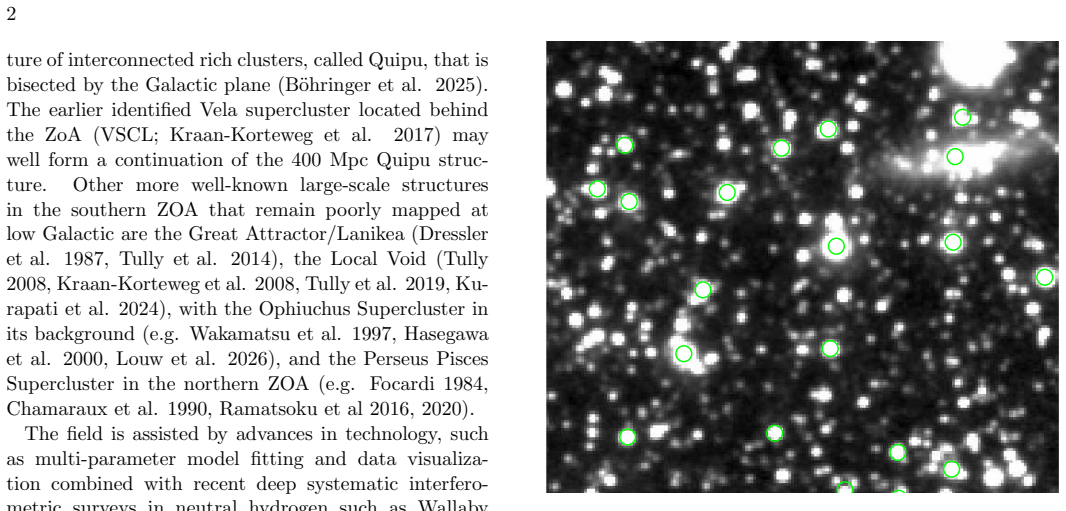
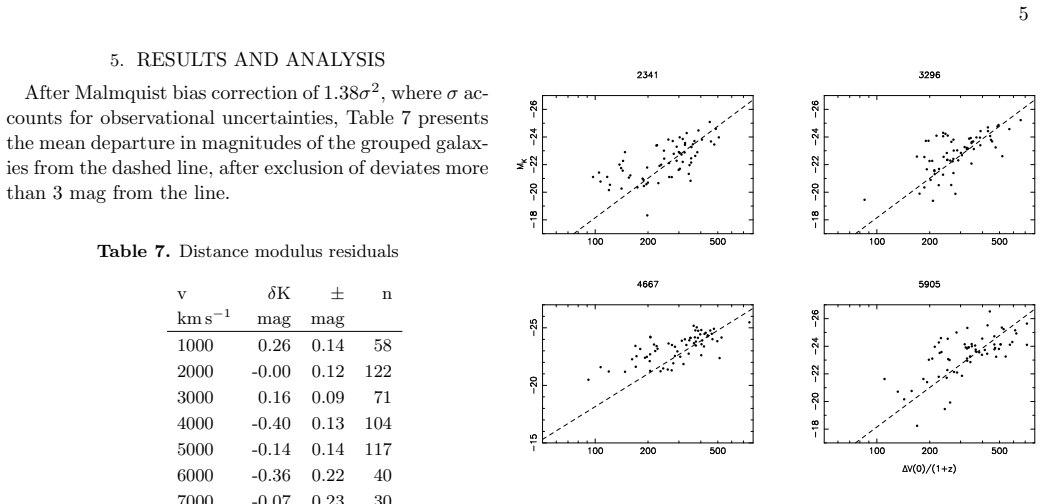
The Laniakea Supercluster is the closest large scale structure of galaxies. Is such a structure expected in the standard cold dark matter model of cosmology? This would be a relatively simple question to answer, were it not for the fact that the Zone of Avoidance (ZOA) runs right through it. Recent improvements to this paucity of data in the innermost ZOA can be made from systematic 21 cm surveys using the MeerKAT telescope (e.g. Kraan-Korteweg et al. 2024), and implementing these HI-redshifts as an extension to the CosmicFlows4 database for reconstruction (Hollinger et al. 2026). In this paper we test the assumption that for the purpose of reconstruction, additional HI detected galaxies without peculiar velocity determinations could be placed at their Hubble distances. We present infrared photometry of 163 of these in HI detected MeerKAT ZOA galaxies, in addition to 2MASS Extended Sources in the ZOA to determine their peculiar velocities. Averaging these peculiar velocities into redshift bins, we find that peculiar velocity corrections in the Laniakea Supercluster ZoA region are not prohibitively large, and that one can proceed with its reconstruction using the copious redshift data now available.
Figures



Reference graph
Works this paper leans on
-
[1]
Aaronson, M., Huchra, J. & Mould, J. 1979, ApJ, 229, 1 Alonso, M. et al. 2025, A&A, 700, 33 B¨ ohringer, H. et al. 2025, A&A, 695, A59 Carr, A., Howlett, C. & Ansellem, A. 2025, arxiv 2502.03232 Chamaraux, P. et al. 1990, A&A, 229, 340 Courtois, H. M. et al. 2011, MNRAS, 414, 2005 Courtois, H. M. et al. 2013, AJ, 146, 69 Courtois, H. M. et al. 2025, A&A, ...
-
[2]
ZOA galaxies Namel bw50 K±A K vCM B b/a deg deg km mag mag mag km s−1 s−1 HIZOA J0653-03B 216.62 -1.35 283 13.53 1.00 0.42 2900 0.20 065919-013114 215.18 1.06 171 12.15 0.21 0.24 2069 0.30 070019-022344 216.08 0.88 50 11.37 0.38 0.26 2115 0.20 070934-052541 219.81 1.55 273 11.10 0.09 0.14 2092 0.64 071248-091823 223.65 0.46 84 11.78 0.14 0.21 2832 0.40 07...
work page 2069
-
[3]
Williams et al. (2014) galaxies Namel bw50 K Note A K vCM B b/a deg deg km mag mag km s−1 s−1 J0622+11B 199.78 -1.15 366 11.02 0.32 5594 0.38 J0709-05 219.83 1.54 248 9.49 0.14 1903 0.64 J0716-18C 232.57 -3.11 253 10.77 0.54 3002 0.20 J0727-23 238.23 -3.31 398 10.42 0.33 4600 0.34 J0730-22 236.82 -1.85 262 9.20 0.57 987 0.20 J0740-22 238.83 -0.10 155 11.1...
work page 2014
-
[4]
Said et al. (2016b) galaxies Namel bw50 K 0 vCM B b/a deg deg km mag km s−1 s−1 J0635+14A 197.78 3.30 275 10.62 3941 0.27 J0652-03 216.27 -1.55 173 12.06 2772 0.35 J0653+07 206.80 3.71 329 12.65 7185 0.29 J0657-13 225.40 -4.61 69 13.00 6396 0.68 J0658-12 224.75 -4.06 113 12.83 5670 0.26 J0659-00 214.27 1.69 264 12.88 7152 0.64 J0700-11 224.51 -3.27 410 9....
work page 1925
discussion (0)
Sign in with ORCID, Apple, or X to comment. Anyone can read and Pith papers without signing in.