Suppression of Active Super-Diffusion: Impact of String Defects and Canted Multi-Domains
Pith reviewed 2026-06-25 20:05 UTC · model grok-4.3
The pith
Topological defects suppress active super-diffusion in liquid crystals by disrupting coupling to gapless Goldstone modes.
A machine-rendered reading of the paper's core claim, the machinery that carries it, and where it could break.
Core claim
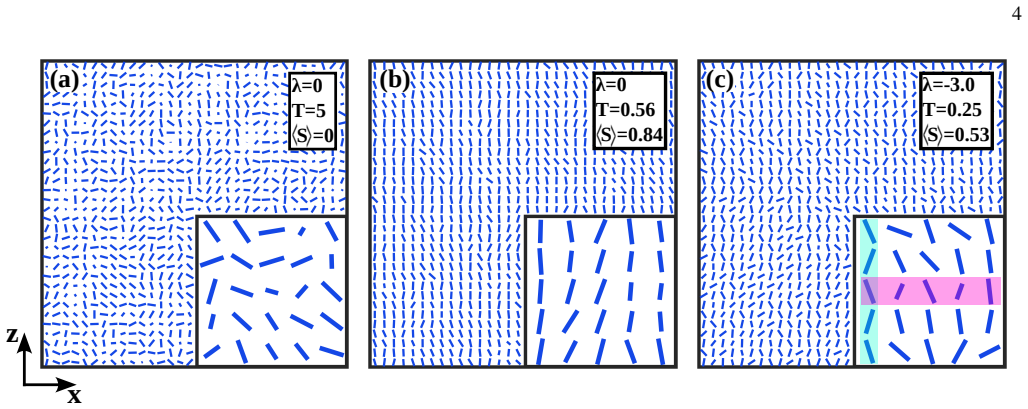
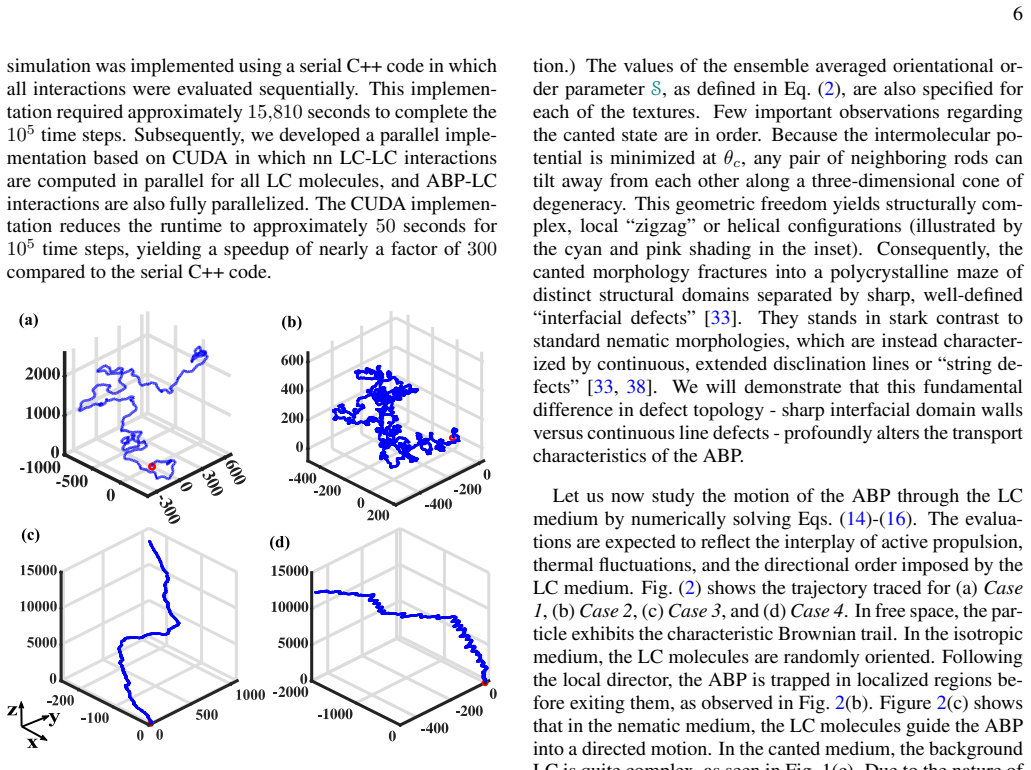
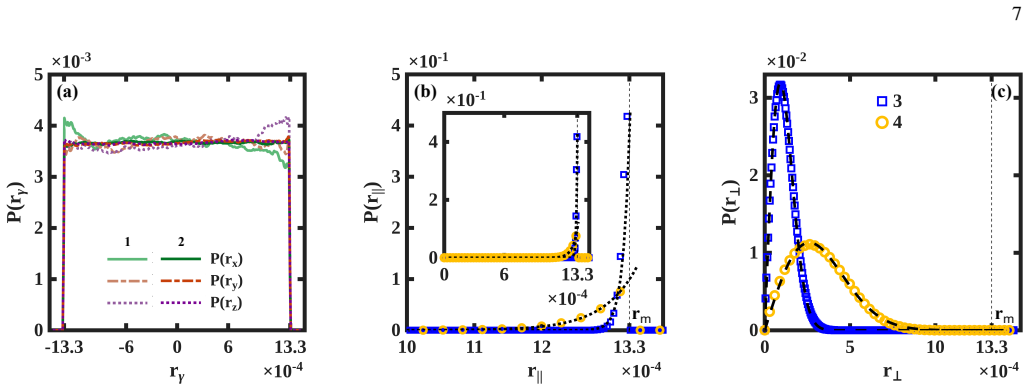
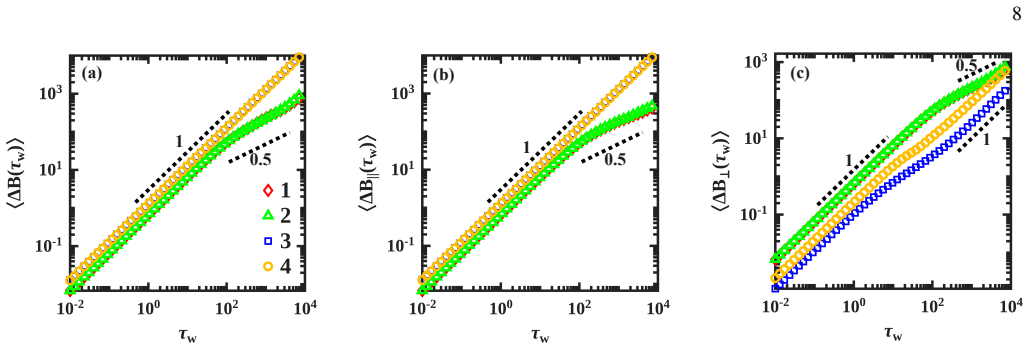
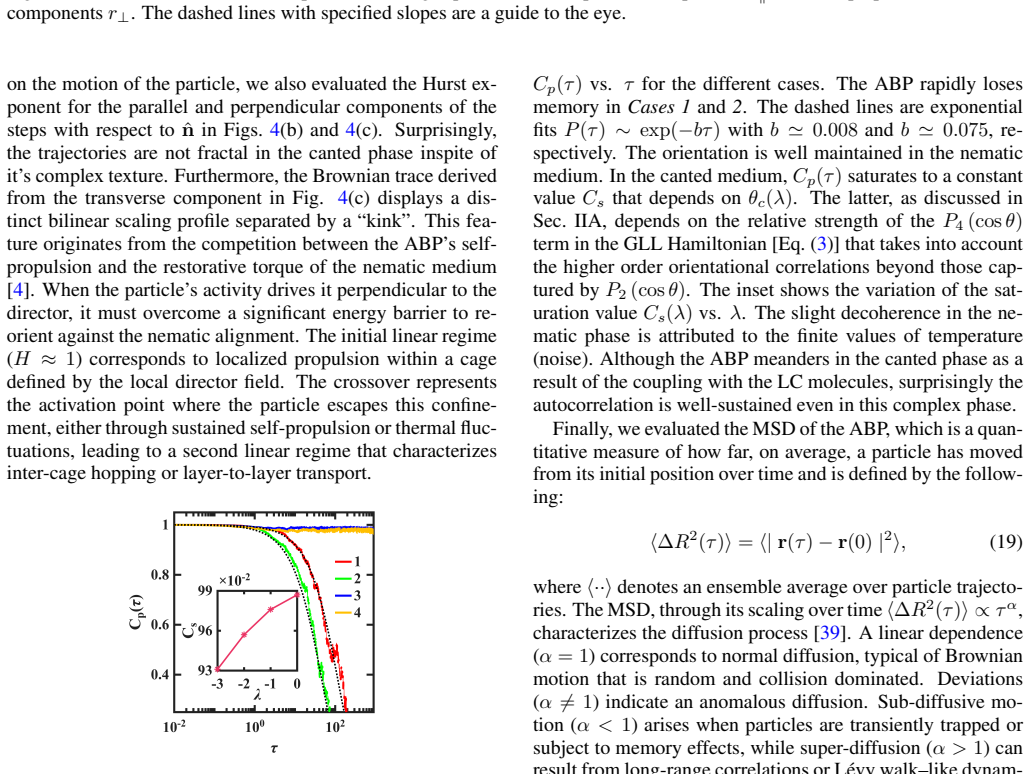
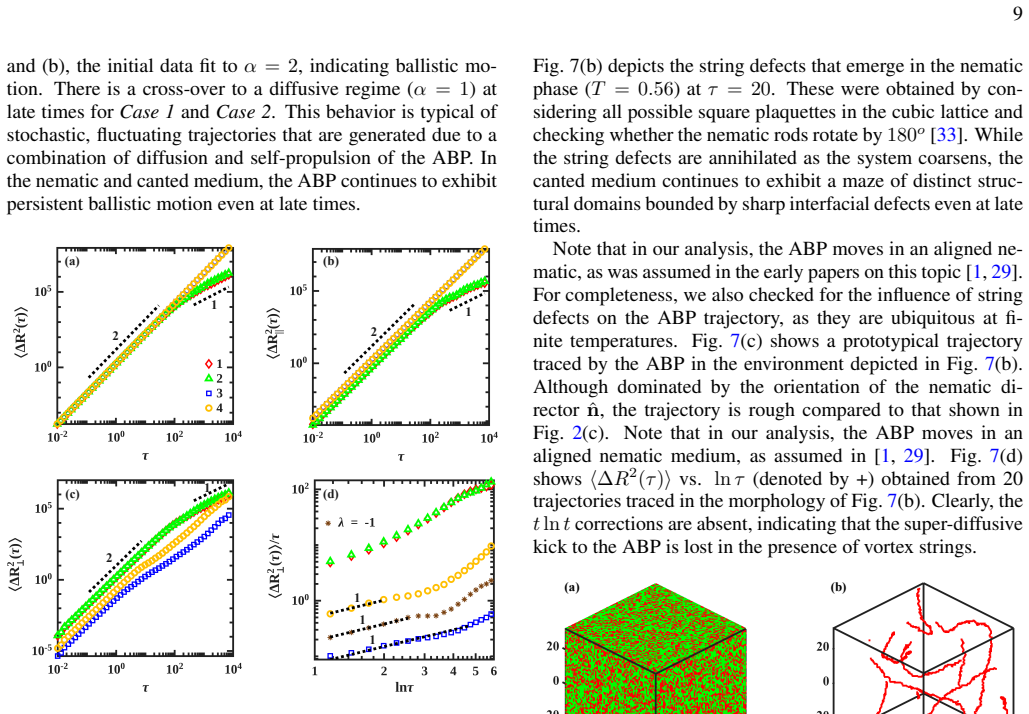
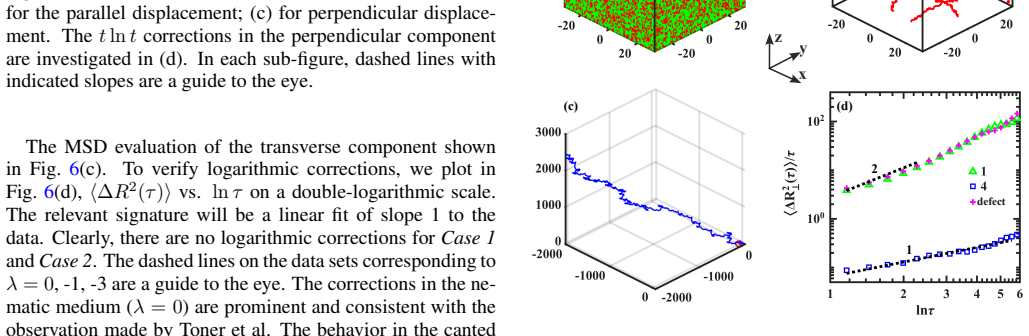
In the uniform nematic phase the anisotropic matrix channels the active particle into left-skewed exponential step-size distributions parallel to the director and Rayleigh distributions transversely, with the transverse mean-square displacement acquiring an explicit t ln t super-diffusive correction from coupling to gapless Goldstone modes. This scaling is suppressed both macroscopically inside the canted multi-domain phase by a structural mass gap and locally inside the nematic phase by scattering off string defects, so that the t ln t term vanishes while local step-size distributions remain qualitatively similar.
What carries the argument
Coupling of the active particle trajectory to the host's gapless transverse Goldstone modes, which topological defects (string disclinations and canted domain walls) disrupt through a mass gap or scattering.
If this is right
- Transverse transport in the uniform nematic obeys a Rayleigh step-size distribution plus the t ln t correction.
- The t ln t scaling is absent throughout the fractured canted phase because of the structural mass gap.
- Local step-size distributions inside the nematic remain similar to the defect-free case, yet the super-diffusive correction disappears when vortex lines are present.
- Tuning the defect architecture of the liquid-crystal host switches the active-particle transport class from super-diffusive to ordinary.
Where Pith is reading between the lines
- Controlling defect density could provide a route to localize or steer active particles without changing the underlying interaction parameters.
- The same mechanism may operate in other orientationally ordered media where Goldstone modes are gapped by topological constraints.
- The reported mass-gap effect suggests that fluctuation spectra measured by scattering or rheology should show corresponding changes across the canted transition.
Load-bearing premise
The off-lattice over-damped Langevin dynamics of the Generalized Lebwohl-Lasher model faithfully reproduces the particle coupling to gapless Goldstone modes without introducing artifacts that would mask the reported t ln t scaling.
What would settle it
A measurement of transverse mean-square displacement that continues to follow t ln t scaling inside a controlled canted multi-domain configuration or in the presence of isolated vortex lines would falsify the claimed suppression.
Figures
read the original abstract
We investigate the transport dynamics of an active Brownian particle (ABP) traversing a complex, non-Newtonian liquid crystal (LC) matrix. Employing the Generalized Lebwohl-Lasher (GLL) model, we systematically vary higher-order orientational interactions to stabilize three distinct host environments: isotropic, uniform nematic, and structurally frustrated canted phases. Modeling the coupled system via off-lattice over-damped Langevin dynamics, the resulting trajectories are characterized by evaluating their step-size distributions (SSDs), mean-square displacements (MSDs), and Hurst exponents. In the uniform nematic phase, the anisotropic matrix elastically channels the ABP, producing a left-skewed exponential SSD and persistent ballistic motion parallel to the director $\hat{\mathbf{n}}$. Similarly, transverse transport obeys a Rayleigh distribution and acquires a prominent $t \ln t$ super-diffusive correction-an explicit signature of the particle coupling to the host's gapless transverse Goldstone modes, as predicted by Toner et al. [Phys. Rev. E {\bf 93}, 062610 (2016)]. Crucially, we reveal that this active super-diffusion is systematically suppressed when the long-range Goldstone fluctuations are disrupted by topological defects. This breakdown manifests both macroscopically within the fractured, multi-domain canted phase due to a structural mass gap, and locally in the unfrustrated nematic phase through scattering by vortex disclination lines. Consequently, while the local SSDs qualitatively mirror the ideal nematic state, the transverse $t \ln t$ scaling vanishes in the presence of these structural constraints. Our findings demonstrate that tuning the background defect architecture of a complex fluid can fundamentally alter the transport universality class of active matter, offering a novel paradigm for controlling microscopic mobility.
Editorial analysis
A structured set of objections, weighed in public.
Referee Report
Summary. The manuscript studies an active Brownian particle (ABP) in a Generalized Lebwohl-Lasher (GLL) liquid-crystal host simulated via off-lattice overdamped Langevin dynamics. It reports that transverse transport in the uniform nematic phase exhibits the t ln t superdiffusive correction predicted by Toner et al. for coupling to gapless Goldstone modes, while this scaling is suppressed both globally in the multi-domain canted phase (structural mass gap) and locally near vortex disclination lines (scattering). The central claim is that defect architecture can change the transport universality class of active matter.
Significance. If the numerics are shown to preserve gapless long-wavelength director fluctuations, the result would establish a concrete mechanism by which topological defects alter active transport scaling, extending Toner’s analytic prediction to realistic defected hosts. The work supplies a tunable experimental knob (defect density) for controlling microscopic mobility in complex fluids.
major comments (2)
- [Abstract] Abstract (and implied Methods): the reported t ln t transverse scaling is presented as direct evidence of coupling to gapless Goldstone modes, yet no verification is described—e.g., director-fluctuation dispersion relation, system-size dependence of the logarithmic correction, or comparison of transverse vs. longitudinal relaxation times. Without such checks the suppression claim cannot be distinguished from possible overdamped-Langevin artifacts or finite-size cutoffs that artificially damp long-wavelength modes.
- [Results] Results (trajectory analysis): the distinction between “uniform nematic” and “canted multi-domain” phases is central to the mass-gap argument, but the manuscript does not report how the director correlation length or Frank elastic constants are extracted, nor whether the canted phase is equilibrated long enough for the structural mass gap to be unambiguously identified versus transient domain coarsening.
minor comments (2)
- Notation: the Hurst exponent is introduced without an explicit definition or reference to its relation to the MSD exponent; a brief equation or sentence would clarify whether H = 1 corresponds to ballistic or to the t ln t regime.
- Figure captions: the SSD and MSD panels should state the number of independent trajectories and the fitting window used for the t ln t term so that readers can assess statistical robustness.
Simulated Author's Rebuttal
We thank the referee for the careful reading and constructive comments on our manuscript. We address each major comment below and have revised the manuscript accordingly where appropriate.
read point-by-point responses
-
Referee: [Abstract] Abstract (and implied Methods): the reported t ln t transverse scaling is presented as direct evidence of coupling to gapless Goldstone modes, yet no verification is described—e.g., director-fluctuation dispersion relation, system-size dependence of the logarithmic correction, or comparison of transverse vs. longitudinal relaxation times. Without such checks the suppression claim cannot be distinguished from possible overdamped-Langevin artifacts or finite-size cutoffs that artificially damp long-wavelength modes.
Authors: We agree that explicit verification of the gapless character of the director fluctuations would strengthen the interpretation. In the revised manuscript we add (i) the director fluctuation dispersion relation extracted from the structure factor in the uniform nematic phase, confirming linear dispersion at long wavelengths, (ii) a finite-size scaling analysis of the transverse MSD showing that the t ln t correction persists with increasing system size, and (iii) a direct comparison of transverse versus longitudinal relaxation times that rules out overdamped-Langevin artifacts as the origin of the observed scaling. revision: yes
-
Referee: [Results] Results (trajectory analysis): the distinction between “uniform nematic” and “canted multi-domain” phases is central to the mass-gap argument, but the manuscript does not report how the director correlation length or Frank elastic constants are extracted, nor whether the canted phase is equilibrated long enough for the structural mass gap to be unambiguously identified versus transient domain coarsening.
Authors: The canted phase is stabilized by the higher-order orientational terms in the GLL model, which by construction introduce a finite director correlation length. We have expanded the Methods section to detail the extraction of the correlation length from the exponential decay of the two-point orientational correlation function and the Frank constants from the quadratic fluctuation spectrum. In addition, we have performed longer equilibration runs and monitored the time evolution of the structure factor and domain-size distribution; these data confirm that the multi-domain structure and associated mass gap remain stable and are not artifacts of transient coarsening. revision: yes
Circularity Check
No significant circularity; claims rest on external benchmark and direct simulation
full rationale
The paper reports numerical observations from off-lattice over-damped Langevin simulations of the Generalized Lebwohl-Lasher model, noting t ln t transverse superdiffusion in the uniform nematic phase that matches the external Toner et al. (2016) prediction for coupling to gapless Goldstone modes, with suppression observed in canted and defected phases. No load-bearing self-citations, fitted parameters renamed as predictions, self-definitional steps, or ansatzes smuggled via prior work appear in the provided text. The derivation chain is therefore self-contained against the cited external benchmark and the simulation outputs themselves.
Axiom & Free-Parameter Ledger
axioms (1)
- domain assumption The Toner et al. (2016) prediction for t ln t transverse super-diffusion holds exactly in the uniform nematic phase of the GLL model.
Reference graph
Works this paper leans on
-
[1]
Active Brownian Particle Typically, the ABP executes both a translational and a rota- tional motion. Assumingr a(t)and ˆpa(t)to be the instanta- neous position and orientation of the ABP, the corresponding Langevin equations for translation and rotation are given by [37]: md2ra(t) dt2 =−ζa dra(t) dt + F0ˆpa +η(t),(4) I [ d2ˆpa(t) dt2 + ˆpa (dˆpa(t) dt )2]...
-
[2]
5 They are translationally immobile and have only rotational degrees of freedom
Nematic Liquid Crystals For the LC background, we assume a system consisting of classical spins{ri}of unit length on a simple cubic lattice. 5 They are translationally immobile and have only rotational degrees of freedom. The dynamics of such spins can also be prescribed by the over-damped Langevin equation, analogous to the orientational dynamics of the ...
-
[3]
interfacial defects
ABP-NLC coupled system In describing the dynamics of the ABP as it moves in the LC medium, we follow the assumptions made by Toner et al. The particle does not have long-term memory or an internal compass as it moves through an ordered nematic medium. As a consequence, the preference for any directional motion must arise from the local nematic director ˆn...
-
[4]
Toner, H
J. Toner, H. Löwen, and H. H. Wensink, Phys. Rev. E93, 062610 (2016)
2016
-
[5]
Schimansky-Geier, M
L. Schimansky-Geier, M. Mieth, H. Rosé, and H. Malchow, Phys. Lett. A207, 140 (1995)
1995
-
[6]
Romanczuk, M
P. Romanczuk, M. Bär, W. Ebeling, B. Lindner, and L. Schimansky-Geier, Eur. Phys. J. Spec. Top.202, 1 (2012)
2012
-
[7]
Bechinger, R
C. Bechinger, R. Di Leonardo, H. Löwen, C. Reichhardt, G. V olpe, and G. V olpe, Rev. Mod. Phys.88, 045006 (2016)
2016
-
[8]
Qiu, T.-C
T. Qiu, T.-C. Lee, A. G. Mark, K. I. Morozov, R. Münster, O. Mierka, S. Turek, A. M. Leshansky, and P. Fischer, Nat. Commun.5, 5119 (2014)
2014
-
[9]
X. N. Shen and P. E. Arratia, Phys. Rev. Lett.106, 208101 (2011)
2011
-
[10]
G. Li, E. Lauga, and A. M. Ardekani, J. Non-Newtonian Fluid Mech.297, 104655 (2021)
2021
-
[11]
Turiv, J
T. Turiv, J. Krieger, G. Babakhanova, H. Yu, S. V . Shiyanovskii, Q.-H. Wei, M.-H. Kim, and O. D. Lavrentovich, Sci. Adv.6, eaaz6485 (2020)
2020
-
[12]
Morales-Navarrete, H
H. Morales-Navarrete, H. Nonaka, A. Scholich, F. Segovia- Miranda, W. de Back, K. Meyer, R. L. Bogorad, V . Kotelian- sky, L. Brusch, Y . Kalaidzidis, F. Jülicher, B. M. Friedrich, and M. Zerial, eLife8, e44860 (2019)
2019
-
[13]
Viney, A
C. Viney, A. E. Huber, and P. Verdugo, Macromolecules26, 852 (1993)
1993
-
[14]
S. S. Suarez and A. A. Pacey, Hum. Reprod. Update12, 23 (2006)
2006
-
[15]
V . A. Martinez, J. Schwarz-Linek, M. Reufer, L. G. Wilson, A. N. Morozov, and W. C. K. Poon, Proc. Natl. Acad. Sci. U.S.A.111, 17771 (2014)
2014
-
[16]
Zöttl and J
A. Zöttl and J. M. Yeomans, Nat. Phys.15, 554 (2019)
2019
-
[17]
S. Liu, S. Shankar, M. C. Marchetti, and Y . Wu, Nature590, 80 (2021)
2021
-
[18]
Goral, E
M. Goral, E. Clement, T. Darnige, T. Lopez-Leon, and A. Lind- ner, Interface Focus12, 20220039 (2022)
2022
-
[19]
M. J. Stephen and J. P. Straley, Rev. Mod. Phys.46, 617 (1974)
1974
-
[20]
P. G. De Gennes and J. Prost,The physics of liquid crystals, 83 (Oxford University Press, 1993)
1993
-
[21]
Priestly,Introduction to liquid crystals(Springer Science & Business Media, 2012)
E. Priestly,Introduction to liquid crystals(Springer Science & Business Media, 2012)
2012
-
[22]
Andrienko, J
D. Andrienko, J. Mol. Liq.267, 520 (2018)
2018
-
[23]
C. Peng, T. Turiv, Y . Guo, Q.-H. Wei, and O. D. Lavrentovich, Science354, 882 (2016)
2016
-
[24]
O. D. Lavrentovich, Curr. Opin. Colloid Interface Sci.21, 97 (2016)
2016
-
[25]
M. M. Genkin, A. Sokolov, O. D. Lavrentovich, and I. S. Aran- son, Phys. Rev. X7, 011029 (2017)
2017
-
[26]
I. S. Aranson, Acc. Chem. Res.51, 3023 (2018)
2018
-
[27]
Sokolov, A
A. Sokolov, A. Mozaffari, R. Zhang, J. J. de Pablo, and A. Snezhko, Phys. Rev. X9, 031014 (2019)
2019
-
[28]
A. Vats, P. K. Yadav, V . Banerjee, and S. Puri, Phys. Rev. E 108, 024701 (2023)
2023
-
[29]
A. Vats, V . Banerjee, and S. Puri,Ferronematics and Living Liquid Crystals(Springer, 2025)
2025
-
[30]
Kaiser, A
A. Kaiser, A. Peshkov, A. Sokolov, B. ten Hagen, H. Löwen, and I. S. Aranson, Phys. Rev. Lett.112, 158101 (2014)
2014
-
[31]
Sokolov, S
A. Sokolov, S. Zhou, O. D. Lavrentovich, and I. S. Aranson, Phys. Rev. E91, 013009 (2015)
2015
-
[32]
Ferreiro-Córdova, J
C. Ferreiro-Córdova, J. Toner, H. Löwen, and H. H. Wensink, Phys. Rev. E97, 062606 (2018)
2018
-
[33]
P. A. Lebwohl and G. Lasher, Phys. Rev. A6, 426 (1972)
1972
-
[34]
Zhang, M
Z. Zhang, M. J. Zuckermann, and O. G. Mouritsen, Mol. Phys. 80, 1195 (1993)
1993
-
[35]
Chiccoli, P
C. Chiccoli, P. Pasini, and C. Zannoni, Int. J. Mod. Phys. B11, 1937 (1997)
1937
-
[36]
Birdi, V
N. Birdi, V . Banerjee, and S. Puri, Europhysics Letters132, 66002 (2021)
2021
-
[37]
P. S. Addison,Fractals and Chaos: An Illustrated Course(In- stitute of Physics Publishing, Bristol, 1997)
1997
-
[38]
Lagugné Labarthet, T
F. Lagugné Labarthet, T. Buffeteau, and C. Sourisseau, J. Phys. Chem. B102, 5754 (1998)
1998
-
[39]
Lagugné Labarthet, T
F. Lagugné Labarthet, T. Buffeteau, and C. Sourisseau, Appl. Spectrosc.54, 699 (2000)
2000
-
[40]
Risken,The F okker–Planck Equation: Methods of Solu- tion and Applications, 2nd ed., Springer Series in Synergetics, V ol
H. Risken,The F okker–Planck Equation: Methods of Solu- tion and Applications, 2nd ed., Springer Series in Synergetics, V ol. 18 (Springer, Berlin, Heidelberg, 1996)
1996
-
[41]
A. Vats, V . Banerjee, and S. Puri, Soft Matter17, 2659 (2021)
2021
-
[42]
M. J. Saxton and K. Jacobson, Annu. Rev. Biophys. Biomol. Struct.26, 373 (1997)
1997
-
[43]
H. Chi, M. Potomkin, L. Zhang, L. Berlyand, and I. S. Aranson, Commun. Phys.3, 162 (2020)
2020
-
[44]
Mertelj and D
A. Mertelj and D. Lisjak, Liq. Cryst. Rev.5, 1 (2017)
2017
-
[45]
L. J. Selvin Robert, A. C. Das, V . Jure ˇciˇc, V . Bobnar, O. D. Lavrentovich, M. Ravnik, and I. Muševiˇc, Soft Matter (2026), 10.1039/D5SM01104C
-
[46]
O. D. Lavrentovich, I. Lazo, and O. P. Pishnyak, Nature467, 947 (2010)
2010
-
[47]
O. D. Lavrentovich, Liq. Cryst. Rev.8, 59 (2020)
2020
discussion (0)
Sign in with ORCID, Apple, or X to comment. Anyone can read and Pith papers without signing in.