Ergodicity and High-Frequency Inference for Hybrid Switching L\'{e}vy-Driven Stochastic Differential Equations
Pith reviewed 2026-07-02 00:34 UTC · model grok-4.3
The pith
A three-stage estimator for parameters in hybrid switching Lévy-driven SDEs is consistent and jointly asymptotically normal under high-frequency sampling and ergodicity.
A machine-rendered reading of the paper's core claim, the machinery that carries it, and where it could break.
Core claim
Under ergodicity and the high-frequency sampling scheme, consistency, joint asymptotic normality, and a polynomial-type large deviation inequality hold for the full three-stage estimator; the joint limit exhibits a transparent covariance structure where the drift and scale blocks are coupled through the third moment of the driving Lévy noise while the switching-rate block is asymptotically uncorrelated with the continuous-coefficient blocks.
What carries the argument
Three-stage inference procedure that combines staged Gaussian quasi-likelihood with an intensity-type contrast, supported by weighted exponential ergodicity proved via a fixed skeleton-chain argument.
If this is right
- The estimator attains joint asymptotic normality whose covariance matrix has an explicit block structure determined by the Lévy noise.
- Switching-rate estimates remain asymptotically independent of the continuous-parameter estimates.
- A polynomial large deviation inequality supplies quantitative rates beyond the central limit theorem.
- The ergodicity conditions can be verified directly from the model coefficients without invoking Brownian smoothing.
Where Pith is reading between the lines
- The skeleton-chain technique for ergodicity may apply to other pure-jump switching models that lack a diffusion component.
- The asymptotic separation of switching-rate estimates could simplify the construction of separate confidence regions in practice.
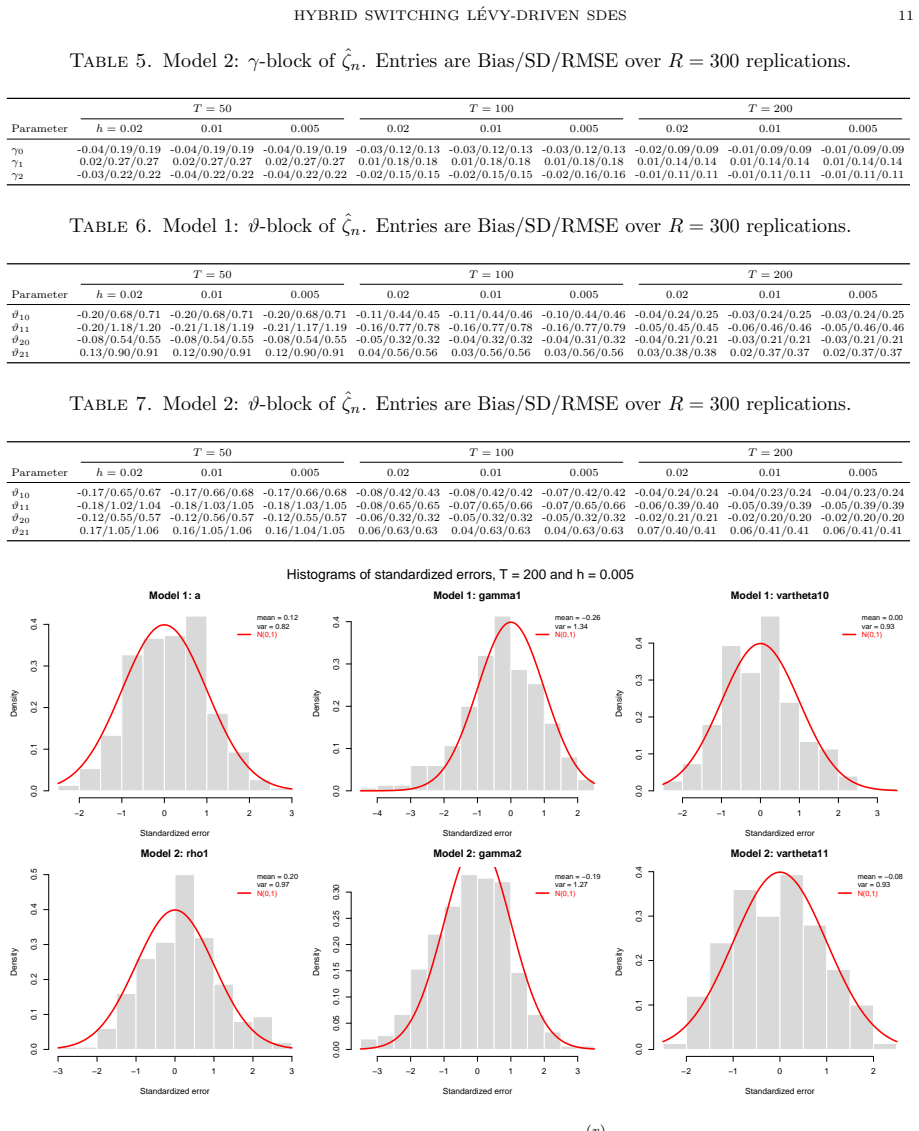
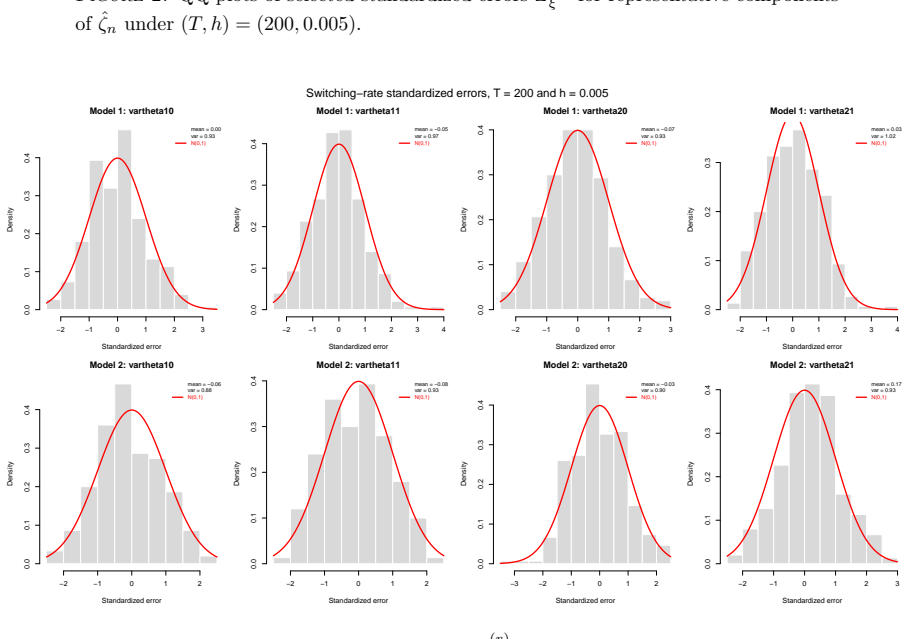
- Numerical checks with normal inverse Gaussian noise already indicate that finite-sample performance aligns with the derived limits.
Load-bearing premise
The hybrid process satisfies weighted exponential ergodicity, proved via a fixed skeleton-chain argument that combines small-jump accessibility and regime connectivity.
What would settle it
High-frequency data from a model satisfying the stated conditions where the sample covariance between the drift-scale estimators fails to converge to the value predicted by the third moment of the Lévy noise.
Figures


read the original abstract
Hybrid switching L\'evy-driven stochastic differential equations with pure-jump noise and state-dependent switching rates are studied under high-frequency observation. A three-stage inference procedure is proposed for the drift, scale, and switching-rate parameters, combining a staged Gaussian quasi-likelihood with an intensity-type contrast. Checkable sufficient conditions for weighted exponential ergodicity are established for the hybrid process; the proof does not rely on Brownian smoothing, but uses a fixed skeleton-chain argument combining small-jump accessibility and regime connectivity. Under ergodicity and the high-frequency sampling scheme, consistency, joint asymptotic normality, and a polynomial-type large deviation inequality are proved for the full estimator. The joint limit exhibits a transparent covariance structure: the drift and scale blocks are coupled through the third moment of the driving L\'evy noise, whereas the switching-rate block is asymptotically uncorrelated with the continuous-coefficient blocks. Numerical experiments for models driven by normal inverse Gaussian noise illustrate the finite-sample behavior of the proposed estimators.
Editorial analysis
A structured set of objections, weighed in public.
Referee Report
Summary. The manuscript develops inference for hybrid switching Lévy-driven SDEs observed at high frequency. It introduces a three-stage estimator combining staged Gaussian quasi-likelihood for drift and scale parameters with an intensity contrast for switching rates. Checkable sufficient conditions for weighted exponential ergodicity of the hybrid process are derived via a fixed skeleton-chain argument that relies on small-jump accessibility and regime connectivity (without Brownian smoothing). Under these conditions, consistency, joint asymptotic normality, and a polynomial large-deviation inequality are established for the full estimator; the limiting covariance couples the drift and scale blocks through the third moment of the driving Lévy noise while rendering the switching-rate block asymptotically orthogonal to the continuous-coefficient blocks. Finite-sample behavior is illustrated numerically for normal-inverse-Gaussian-driven models.
Significance. If the ergodicity conditions and asymptotic expansions hold, the work supplies a rigorous, checkable framework for high-frequency estimation in switching jump-driven processes together with an explicit covariance structure that isolates the effect of the Lévy third moment. The skeleton-chain approach to ergodicity and the polynomial large-deviation bound constitute concrete technical contributions that extend standard quasi-likelihood theory to the hybrid Lévy setting.
minor comments (3)
- [Abstract] The abstract states that the joint limit covariance is 'transparent,' yet the precise expression for the cross-term involving the third moment of the Lévy measure is not displayed; a displayed formula would clarify the claimed orthogonality of the switching-rate block.
- The numerical section reports finite-sample behavior for NIG-driven models but does not tabulate the estimated covariance matrices or compare them with the theoretical block structure; adding such a comparison would strengthen the illustration of the asymptotic claim.
- [Introduction] Notation for the regime-dependent coefficients and the intensity function is introduced gradually; a consolidated table of symbols at the end of the introduction would improve readability.
Simulated Author's Rebuttal
We thank the referee for the careful reading of the manuscript and the positive assessment. The referee's summary accurately captures the main contributions regarding the three-stage estimator, the skeleton-chain ergodicity conditions, and the joint asymptotic normality with the explicit covariance structure. We appreciate the recommendation for minor revision.
Circularity Check
No significant circularity; derivation self-contained
full rationale
The paper derives weighted exponential ergodicity via a fixed skeleton-chain argument relying on small-jump accessibility and regime connectivity (checkable conditions independent of the estimator). Consistency, joint asymptotic normality, and large-deviation bounds for the three-stage quasi-likelihood estimator then follow from standard ergodic theory and quasi-likelihood expansions under high-frequency sampling. The reported covariance structure (drift/scale blocks coupled via Lévy third moment, switching-rate block orthogonal) is obtained directly from the expansion once ergodicity holds, without any reduction to fitted parameters, self-definitional steps, or load-bearing self-citations. All steps use external probabilistic tools and are falsifiable outside the fitted values.
Axiom & Free-Parameter Ledger
axioms (2)
- domain assumption The driving Lévy process possesses moments up to at least order three
- domain assumption State-dependent switching rates permit regime connectivity
Reference graph
Works this paper leans on
-
[1]
Odd O. Aalen,Nonparametric inference for a family of counting processes, The Annals of Statistics6(1978), no. 4, 701–726
work page 1978
-
[2]
Andersen, Ørnulf Borgan, Richard D
Per K. Andersen, Ørnulf Borgan, Richard D. Gill, and Niels Keiding,Statistical models based on counting processes, Springer, New York, 1993
work page 1993
-
[3]
David Applebaum,L´ evy processes and stochastic calculus, Cambridge university press, 2009
work page 2009
-
[4]
Romain Aza¨ ıs and Aur´ elie Muller-Gueudin,Optimal choice among a class of nonparametric estimators of the jump rate for piecewise-deterministic Markov processes, Electronic Journal of Statistics10(2016), no. 2, 3648–3692
work page 2016
-
[5]
Ole E. Barndorff-Nielsen,Normal inverse gaussian distributions and stochastic volatility modelling, Scandinavian Journal of Statistics24(1997), no. 1, 1–13
work page 1997
-
[6]
Rabi N Bhattacharya,On the functional central limit theorem and the law of the iterated logarithm for markov processes, Zeitschrift f¨ ur Wahrscheinlichkeitstheorie und verwandte Gebiete60(1982), no. 2, 185–201
work page 1982
-
[7]
Mogens Bladt and Michael Sørensen,Statistical inference for discretely observed Markov jump processes, Journal of the Royal Statistical Society Series B: Statistical Methodology67(2005), no. 3, 395–410
work page 2005
-
[8]
Ørnulf Borgan,Maximum likelihood estimation in parametric counting process models, with applications to censored failure time data, Scandinavian Journal of Statistics11(1984), no. 1, 1–16
work page 1984
-
[9]
HYBRID SWITCHING L ´EVY-DRIVEN SDES 39
Rama Cont and Peter Tankov,Financial modelling with jump processes, Chapman & Hall/CRC Financial Mathematics Series, Chapman & Hall/CRC, Boca Raton, 2004. HYBRID SWITCHING L ´EVY-DRIVEN SDES 39
work page 2004
-
[10]
Douglas Down, Sean P Meyn, and Richard L Tweedie,Exponential and uniform ergodicity of markov processes, The Annals of Probability23(1995), no. 4, 1671–1691
work page 1995
-
[11]
Avner Friedman,Stochastic differential equations and applications, Courier Corporation, 2006
work page 2006
-
[12]
Probabilit´ es et statistiques38(2002), no
Emmanuel Gobet,Lan property for ergodic diffusions with discrete observations, Annales de l’I.H.P. Probabilit´ es et statistiques38(2002), no. 5, 711–737 (eng)
work page 2002
-
[13]
El Houcine Hibbah, Hamid El Maroufy, Christiane Fuchs, and Taib Ziad,An MCMC computational approach for a continuous time state-dependent regime switching diffusion process, Journal of Applied Statistics47(2020), no. 8, 1354–1374
work page 2020
-
[14]
Mathieu Kessler,Estimation of an ergodic diffusion from discrete observations, Scandinavian Journal of Statistics24 (1997), no. 2, 211–229
work page 1997
-
[15]
,Estimation of an ergodic diffusion from discrete observations, Scand. J. Statist.24(1997), no. 2, 211–229
work page 1997
-
[16]
Mathieu Kessler, Alexander Lindner, and Michael Sørensen,Statistical methods for stochastic differential equations, Monographs on Statistics and Applied Probability124(2012), 7–12
work page 2012
-
[17]
Nathalie Krell and Emeline Schmisser,Nonparametric estimation of jump rates for a specific class of piecewise deter- ministic Markov processes, Bernoulli27(2021), no. 4, 2362–2388
work page 2021
-
[18]
Alexey M. Kulik,Exponential ergodicity of the solutions to SDE’s with a jump noise, Stochastic Processes and their Applications119(2009), no. 2, 602–632
work page 2009
-
[19]
Xuerong Mao and Chenggui Yuan,Stochastic differential equations with Markovian switching, Imperial college press, 2006
work page 2006
- [20]
-
[21]
,Convergence of Gaussian quasi-likelihood random fields for ergodic L´ evy driven SDE observed at high fre- quency, Ann. Statist.41(2013), no. 3, 1593–1641
work page 2013
-
[22]
Carlo Mari and Emiliano Mari,Deep learning based regime-switching models of energy commodity prices, Energy Systems14(2023), 913–934
work page 2023
-
[23]
Hiroki Masuda and Yuma Uehara,Two-step estimation of ergodic L´ evy driven SDE, Statistical Inference for Stochastic Processes20(2017), no. 1, 105–137
work page 2017
-
[24]
Florence Merlev` ede and Magda Peligrad,Rosenthal-type inequalities for the maximum of partial sums of stationary processes and examples, The Annals of Probability41(2013), no. 2, 914–960
work page 2013
-
[25]
Sean P. Meyn and R. L. Tweedie,Stability of markovian processes i: Criteria for discrete-time chains, Advances in Applied Probability24(1992), no. 3, 542–574
work page 1992
-
[26]
Sean P Meyn and Richard L Tweedie,Stability of markovian processes iii: Foster–lyapunov criteria for continuous-time processes, Advances in Applied Probability25(1993), no. 3, 518–548
work page 1993
-
[27]
,Markov chains and stochastic stability, Springer Science & Business Media, 2012
work page 2012
-
[28]
Ken-iti Sato,L´ evy processes and infinitely divisible distributions, Cambridge Studies in Advanced Mathematics, vol. 68, Cambridge University Press, Cambridge, 1999, Translated from the 1990 Japanese original, Revised by the author
work page 1999
-
[29]
Masayuki Uchida and Nakahiro Yoshida,Adaptive estimation of an ergodic diffusion process based on sampled data, Stochastic Processes and their Applications122(2012), no. 8, 2885–2924
work page 2012
-
[30]
Gabrielle Viennet,Inequalities for absolutely regular sequences: application to density estimation, Probability Theory and Related Fields107(1997), no. 4, 467–492
work page 1997
-
[31]
F. B. Xi,Asymptotic properties of jump-diffusion processes with state-dependent switching, Stochastic Processes and their Applications119(2009), no. 7, 2198–2221
work page 2009
-
[32]
F. B. Xi and G. Yin,Jump-diffusions with state-dependent switching: existence and uniqueness, feller property, linearization, and uniform ergodicity, Science China Mathematics54(2011), no. 12, 2651–2667
work page 2011
-
[33]
Fubao Xi and G. George Yin,On feller and strong feller properties and exponential ergodicity of regime-switching jump diffusion processes with countable regimes, SIAM Journal on Control and Optimization55(2017), no. 3, 1789–1818
work page 2017
-
[34]
63, Springer Science & Business Media, 2009
G George Yin and Chao Zhu,Hybrid switching diffusions: properties and applications, vol. 63, Springer Science & Business Media, 2009
work page 2009
-
[35]
N. Yoshida,Simplified quasi-likelihood analysis for a locally asymptotically quadratic random field, arXiv preprint arXiv:2102.12460, 2021
-
[36]
Yuzhong Cheng and Hiroki Masuda,Statistical inference for ergodic diffusion with Markovian switching, Discrete and Continuous Dynamical Systems - B30(2025), no. 10, 3910–3940
work page 2025
-
[37]
Nakahiro Yoshida,Polynomial type large deviation inequalities and quasi-likelihood analysis for stochastic differential equations, Ann. Inst. Statist. Math.63(2011), no. 3, 431–479
work page 2011
-
[38]
Chao Zhu, G. Yin, and Nicholas A. Baran,Feynman–kac formulas for regime-switching jump diffusions and their applications, SIAM Journal on Control and Optimization55(2017), no. 2, 1045–1085. Kyushu University, Institute of Mathematics for Industry, 744 Motooka Fukuoka, Japan Email address:cheng.yuzhong.451@m.kyushu-u.ac.jp
work page 2017
discussion (0)
Sign in with ORCID, Apple, or X to comment. Anyone can read and Pith papers without signing in.