REVIEW 3 major objections 5 minor 19 references
Coexistence and evolution of shapes: mean-field-based interacting boson model
T0 review · 3 major / 5 minor · reviewed 2026-08-14 · deepseek-v4-flash
Pith's one-line read One energy surface can fix every parameter of the collective Hamiltonian, without fitting to measured spectra.
desk verdict A clear proceedings-style summary of an established method, with an abstract that overclaims 'complete' parameter determination for the odd-mass case. read the letter →
The pith
A machine-rendered reading of the paper's core claim, the machinery that carries it, and where it could break.
The reading
What carries the argument
The central object is the mapped potential energy surface: the coherent-state expectation value of the IBM Hamiltonian is matched locally to the fermionic SCMF potential energy surface. The mapping uses $\beta_\nu=\beta_\pi\equiv\beta_B=C\beta$ and $\gamma_\nu=\gamma_\pi\equiv\gamma_B=\gamma$, restricts equality to the vicinity of the minimum, and determines all Hamiltonian strengths from that match. This object carries the argument because every spectral and transition prediction is read off from it.
What would settle it
A decisive check would be to fix the IBM parameters for a chain of nuclei with no adjustment and compare the predicted energies of the low-lying $2^+$, $4^+$, and $6^+$ states and the $B(E2;0^+_2\to2^+_1)$ rates against precise data; the paper itself reports order-of-magnitude discrepancies in those cadmium transitions, so accurate measurements at radioactive-beam facilities would settle whether the local mapping captures the dynamics.
Extended reading notes
Core claim
The central claim is that the approximate equality $E_{\rm SCMF}(\beta,\gamma)\sim E_{\rm IBM}(\beta,\gamma)$, imposed near the global minimum with $\beta_\nu=\beta_\pi\equiv\beta_B=C\beta$ and $\gamma_\nu=\gamma_\pi\equiv\gamma_B=\gamma$, completely determines the IBM-2 Hamiltonian $\hat H_B=\epsilon\hat n_d+\kappa\hat Q_\nu\cdot\hat Q_\pi+\kappa'\hat L\cdot\hat L$, with $\kappa'$ fixed separately by the cranking moment of inertia. The mapped Hamiltonian, diagonalized in the laboratory frame, provides energies and $B(E2)$, $B(E3)$, and $E0$ transition rates without phenomenological adjustment. The paper further claims the framework extends to configuration mixing for intruder states, to $f$ bosons for octupole correlations, and to odd-mass nuclei through particle-boson coupling.
Load-bearing premise
The whole construction rests on assuming that the microscopic and bosonic energy surfaces match locally near the minimum, with proton and neutron deformations taken equal and rescaled by a single coefficient; if that local match does not represent the real collective dynamics, the derived Hamiltonian inherits the error.
Editorial extensions
If this is right
- IBM parameters for any nucleus follow from a single energy density functional, removing the need to fit low-energy data.
- The method yields systematic predictions for exotic nuclei, including intruder $0^+$ states and octupole bands.
- Configuration mixing in the IBM can describe coexistence of normal and intruder shapes, with the energy offset fixed by the SCMF minima.
- Odd-mass spectroscopy follows by coupling a single fermion to the mapped boson core, with only a few interaction strengths adjusted.
- DFT and IBM become complementary: DFT supplies the collective potential and IBM supplies tractable spectroscopy.
Reading between the lines
- Inference: the local-match assumption ties the method's validity to how fully the low-energy collective dynamics is contained in the $(\beta,\gamma)$ or $(\beta_2,\beta_3)$ plane; if shape fluctuations reach beyond the matched region, adding coordinates such as hexadecapole deformation or pairing fluctuations would be the natural extension.
- Inference: systematic deviations like the reported tenfold discrepancies in $B(E2;0^+_2\to2^+_1)$ in cadmium provide a direct calibration target for refining either the energy functional or the coherent-state ansatz.
- Inference: the mapping could be inverted, using measured spectra as constraints on the deformation dependence of the energy functional, so that spectroscopy feeds back into the microscopic input.
Signed reviews
Editorial analysis
A structured set of objections, weighed in public.
Referee Report
Summary. The paper presents a method for deriving interacting boson model (IBM) Hamiltonians from nuclear energy density functional (EDF) calculations. A constrained self-consistent mean-field (SCMF) calculation yields a potential energy surface (PES) in the collective coordinates (β, γ), and this surface is equated, in the vicinity of the global minimum, to the expectation value of an IBM Hamiltonian in a boson coherent state (Eq. 1). The IBM-2 strength parameters and the deformation scaling coefficient C are then determined by this local mapping, with the rotational response used to fix κ′. The method is illustrated with two applications: even-even Cd isotopes, where configuration mixing between normal (0p-0h) and intruder (2p-2h) boson spaces is included, and neutron-rich odd-mass Ba isotopes, where octupole (f-boson) and unpaired-fermion degrees of freedom are described with an sdf-IBFM. The central claim, stated in the Abstract and Summary, is that the procedure determines all strength parameters without fitting to the data of the nucleus under study, and that diagonalization then yields excitation spectra and transition rates.
Significance. If the claim of parameter-free microscopic determination of the IBM Hamiltonian were fully realized, the method would constitute a significant step toward a unified microscopic foundation of collective nuclear spectroscopy, enabling predictions for exotic nuclei far from stability. The paper's qualitative successes — the Sm isotopic evolution, the Cd intruder-state systematics, and the predicted octupole bands in 145Ba with specific B(E3) values — are valuable and demonstrate the method's potential. However, the two applications included in this manuscript do not fully support the strongest version of the claim: the odd-mass Ba calculation explicitly fits the fermion-boson coupling strengths to experimental levels, and the Cd calculation reports order-of-magnitude discrepancies for several B(E2) values. The paper is a useful and readable summary, but its abstract and summary need to be qualified to reflect these limitations.
major comments (3)
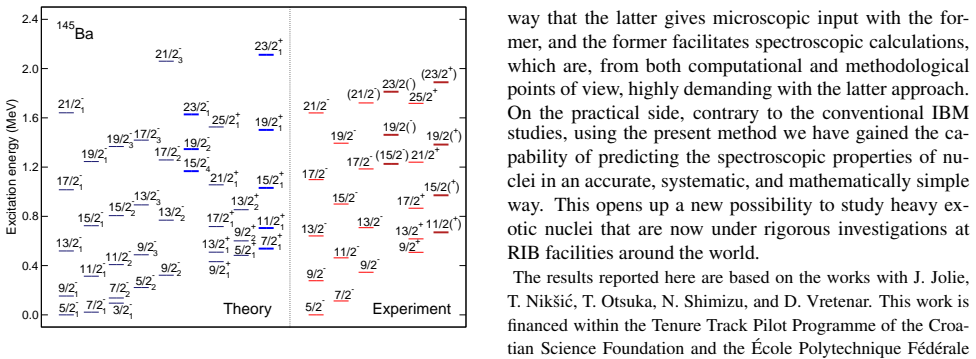
- [§4.2, Eqs. (4)–(7)] The Abstract and §5 claim that the mapping procedure 'completely determines the strength parameters of the IBM' and that spectra are obtained 'starting only from the nucleonic degrees of freedom.' This is contradicted by §4.2, where the IBFM coupling strengths Γ0, Λ0, and A0 are described as 'free parameters' that are 'fitted to reasonably reproduce experimental low-lying levels in a given nucleus.' The 145Ba spectrum in Fig. 7 therefore depends on experimental input through these fitted strengths. The claim must be restricted to the even-even core Hamiltonian, or the odd-mass application must be presented as a partially phenomenological extension, not as a fully parameter-free prediction.
- [§3.2, Fig. 4 and B(E2) paragraph] The paper reports that in the Cd isotopes the predicted normal states are 'systematically too deformed' (evidenced by the 2+, 4+, and especially 6+ level energies) and that B(E2; 0+2→2+1) is ten times underpredicted in 112,114Cd and ten times overpredicted in 116Cd. These order-of-magnitude deviations occur in a quantity that the Abstract explicitly lists as an output of the mapped Hamiltonian ('transition rates'). While such failures do not invalidate the method, they contradict the §5 statement that the method yields spectroscopy 'in an accurate, systematic, and mathematically simple way.' The manuscript should include a quantitative error analysis or, at minimum, a prominent caveat stating that the current quality of reproduction is limited, particularly for transitional nuclei and interband transitions.
- [§2, Eq. (1) and surrounding text] The mapping is defined by the approximate equality ESCMF(β,γ) ∼ EIBM(β,γ) together with the assumptions βν=βπ, γν=γπ, and βB=Cβ, and it is applied only in the vicinity of the global minimum. The paper offers no derivation or error estimate for this local identification, and the rationale for discarding the far-from-minimum region is stated only as an assertion about the IBM model space. This is a structural assumption on which the entire method rests, and the Cd results indicate that the resulting errors can be large. The manuscript should either provide a derivation of the mapping (or a reference where one is given) or explicitly state the approximation's expected accuracy and limitations as a known source of systematic uncertainty.
minor comments (5)
- [Abstract] The phrase 'completely determines the strength parameters of the IBM' is too strong given the fitting performed in §4.2; consider adding 'for the even-even core' or 'up to the fermion-boson coupling parameters' as appropriate.
- [§2, after Eq. (1)] The sentence 'Note that Eq. (1) represents an approximate equality as it is fulfilled within a limited range of (β,γ) plane' is a useful qualifier; it should also appear in the Abstract to avoid overstating the mapping's validity.
- [Fig. 6 caption] The caption states that B(E2) and B(E3) values are given in Weisskopf units, but it does not indicate which values are theoretical predictions and which are experimental; please clarify this distinction for the reader.
- [§4.2] The sentence 'where ϵ_j is the single-particle energy for the orbital j' should read 'where ϵ_j is the single-particle energy of orbital j' for grammatical consistency.
- [§4.1] The comparison 'B(E3; 3−→0+) is predicted for the 144Ba nucleus, but is still considerably smaller than the experimental value [16]' would benefit from stating the numerical values and the experimental uncertainty explicitly, since the paper notes the latter is large.
Circularity Check
Even-even SCMF→IBM mapping is independent, but 145Ba's IBFM strengths are fitted to its own low-lying spectrum, making that highlighted result partially circular.
-
fitted input called prediction
[Section 4.2 (Particle-boson coupling), paragraph following Eqs. (5)–(7)]
"The three strength parameters of ˆHBF, i.e., Γ0, Λ0, and A0, are considered free parameters, and are fitted to reasonably reproduce experimental low-lying levels in a given nucleus."
The 145Ba spectrum in Fig. 7 is presented as a theoretical prediction of the SCMF–IBM framework, but the odd-particle–core coupling strengths used for that exact nucleus were adjusted to reproduce the experimental low-lying levels of 145Ba itself. Hence the agreement shown in Fig. 7 is partly built into the calculation rather than derived solely from the mean-field energy surface. This undercuts the Abstract and Summary claim that the procedure 'completely determines the strength parameters of the IBM' and yields spectra 'starting only from the nucleonic degrees of freedom' for the odd-mass Ba application.
full rationale
The core even-even mapping is not circular. In Section 2, the IBM parameters (including C) are fitted to the SCMF potential-energy surface via Eq. (1), and the resulting spectra for Sm and Cd are compared with experiment without using the experimental levels of those nuclei as input. The Cd configuration-mixing parameters ∆ and the mixing strength are specified against SCMF minima and barrier height, not against data. Thus the primary derivation chain for even-even nuclei is self-contained: it maps a microscopic EDF surface onto IBM parameters and then diagonalizes. The circularity is confined to the odd-mass Ba application: Section 4.2 explicitly declares Γ0, Λ0, and A0 to be free parameters fitted to experimental low-lying levels, and Section 4.3 then presents the calculated 145Ba spectrum as the theoretical result. Because the fit target is the same nucleus whose spectrum is displayed, the highlighted odd-mass prediction reduces in part to its own experimental input. No load-bearing self-citation chain or imported uniqueness theorem is involved; the references to prior papers report earlier applications of the same method rather than an unverified premise that forces the present result. The score reflects this one partial circularity rather than a fully circular derivation.
Assumptions & free parameters
free parameters (4)
- IBM-2 Hamiltonian strengths (ε, κ, χν, χπ, κ′) =
not stated in this text
- Boson deformation scale C =
not stated
- Intruder offset Δ and mixing strength =
not stated
- IBFM coupling strengths Γ0, Λ0, A0 =
not stated
assumptions (5)
- domain assumption The constrained SCMF calculation with a given EDF provides a correct PES for low-energy collective states.
- ad hoc to paper The IBM coherent-state expectation value can be equated locally to the SCMF PES (Eq. 1).
- ad hoc to paper Proton and neutron boson deformations are equal (βν=βπ, γν=γπ) and βB=Cβ.
- domain assumption Low-lying states are spanned by the boson space (s, d and f) built from valence nucleon pairs; single-particle configurations outside this space can be ignored far from the minimum.
- domain assumption The generalized seniority formulas (Eqs. 5-7) describe particle-boson coupling in the IBFM.
Cite this review
Pith. "Pith review of Coexistence and evolution of shapes: mean-field-based interacting boson model." pith.science (2026). https://pith.science/paper/DKBTZ5NC
@misc{pith2026190801960,
  author       = {Pith},
  title        = {Pith review of: Coexistence and evolution of shapes: mean-field-based interacting boson model},
  year         = {2026},
  howpublished = {\url{https://pith.science/paper/DKBTZ5NC}},
  note         = {Machine review of arXiv:1908.01960}
}
read the original abstract
A method of deriving the Hamiltonian of the interacting boson model, that is based on the microscopic framework of the nuclear energy density functional, is presented. The constrained self-consistent mean-field calculation with a given energy density functional provides potential energy surface within the relevant collective coordinates, which is subsequently mapped onto the expectation value of the interacting-boson Hamiltonian in the boson condensate state. This procedure completely determines the strength parameters of the IBM, and the diagonalization of the mapped Hamiltonian yields excitation spectra and transition rates for a given nucleus. Two recent applications of the method are discussed, that is, the descriptions of the intruder states in Cadmium isotopes and the octupole correlations in neutron-rich odd-mass Barium isotopes.
Figures


Figures from the paper (4 more)


Reference graph
Works this paper leans on
-
[3]
Nomura, N
K. Nomura, N. Shimizu, and T. Otsuka, Phys. Rev. Lett. 101, 142501 (2008)
2008
-
[1]
F. Iachello, and A. Arima, The interacting bo- son model (Cambridge University Press, Cambridge, 1987)
work page 1987
-
[2]
Otsuka, A
T. Otsuka, A. Arima, and F. Iachello, Nucl. Phys. A 309, 1 (1978)
1978
- [4]
- [5]
- [6]
- [7]
- [8]
Show all 19 references
-
[9]
Nomura, T
K. Nomura, T. Nikši´c, and D. Vretenar, Phys. Rev. C 97, 024317 (2018)
2018
-
[10]
Vretenar et al., Phys
D. Vretenar et al., Phys. Rep. 409, 101 (2005)
2005
-
[11]
Bender et al., Rev
M. Bender et al., Rev. Mod. Phys. 75, 121 (2003)
2003
-
[12]
Bohr, and B
A. Bohr, and B. R. Mottelson, Nuclear Structure (Benjamin, N.Y ., 1975)
1975
-
[13]
J. N. Ginocchio and M. W. Kirson, Nucl. Phys. A 350, 31 (1980)
1980
-
[14]
P. D. Duval and B. R. Barrett, Phys. Lett. B 100, 223 (1981)
1981
-
[15]
Frank et al., Phys
A. Frank et al., Phys. Rev. C 69, 034323 (2004)
2004
-
[16]
Bucher et al., Phys
B. Bucher et al., Phys. Rev. Lett. 116, 112503 (2016)
2016
-
[17]
Nomura et al., Phys
K. Nomura et al., Phys. Rev. C 93, 054305 (2016)
2016
-
[18]
Iachello, and P
F. Iachello, and P. Van Isacker, The Interacting Boson-Fermion Model (Cambridge University Press, Cambridge, England, 1991)
1991
-
[19]
Rzaca-Urban et al., Phys
T. Rzaca-Urban et al., Phys. Rev. C 86, 044324 (2012)
2012
Reviewed August 14, 2026 · model on record in the stance chip above.
Discussion (0). Continue with ORCID to comment.