REVIEW 3 major objections 5 minor 86 references
A hierarchical search algorithm, Hiss, automatically finds tensor-network structures that beat fixed Tensor Train and Hierarchical Tucker formats by 2.5× to 100× — up to 1000× on radiation transport data.
Reviewed by Pith at T0; open to challenge. T0 means a machine referee read the full paper against a public rubric. the ladder, T0–T4 →
T0 review · deepseek-v4-flash
2026-08-02 17:09 UTC pith:DKTYAK3K
load-bearing objection Useful structural-search algorithm with strong empirical results, but the stated error-guarantee is unproven and the comparisons are not yet apples-to-apples. the 3 major comments →
Hierarchical Search of Tree Tensor Networks for High-Dimensional Data
The pith
A machine-rendered reading of the paper's core claim, the machinery that carries it, and where it could break.
Core claim
The paper introduces the tensor-network structural rounding problem (Problem 2): given a tree tensor network and an error tolerance, find the topology and index reshaping that minimize parameter count while keeping reconstruction error within tolerance. It then proposes Hiss, a two-layer algorithm — stochastic sampling of sub-networks at the global level and deterministic, heuristic-guided recursive search at the local level — that interpolates index clustering, structure search on clustered indices, and recursive refinement with index reshaping. The reported discovery is that this integrated search consistently finds structures with far higher compression than fixed TT and HT formats, and t
What carries the argument
The load-bearing mechanism is the combination of three routines: (1) ClusterIndices, which uses singular-value entropy of all-pair unfoldings to group correlated indices into virtual clusters, reducing dimensionality; ( (2) StructureSearch, an enumerative search over compatible index bi-partitions that estimates network cost via a rank-constrained optimization instead of full decompositions; and (3) TopReshape, a heuristic that factorizes free indices at low-entropy split points. These are orchestrated in RecSearch, where an error budget is split between the clustered search and recursive subnetwork refinements via the quadrature rule ε₁² + ε₂² = ε². This rule is what lets the search be hier
Load-bearing premise
The algorithm assumes that errors from independently optimized sub-network replacements add in quadrature (ε₁² + ε₂² = ε²), so the locally controlled errors guarantee a global error within tolerance; if local truncation errors compound instead, the returned network may violate the promised error bound.
What would settle it
Take a small tensor (e.g., d = 6, modes of size 8) and run Hiss to a nominal ε = 1e-2. Also enumerate all tree topologies and index reshapings with the same budget to get the true minimal network size. If Hiss's output exceeds ε when reconstructed against the exact tensor, or if the exhaustive search finds a structure with, say, 2× fewer parameters at the same error, then the central claim that Hiss finds near-optimal structures within tolerance is false in that regime.
If this is right
- Hiss can serve as a drop-in replacement for TT-rounding in existing tensor-network PDE solvers, reconfiguring the network as solution correlations evolve.
- The 10% transferability result implies that a structure discovered once on representative data can be reused across a family of related datasets, making the search a one-time offline cost.
- Entropy-guided index reshaping exposes latent low-rank structure, such as the x/y separability of flattened spatial grids, that static formats miss.
- Empirical polynomial scaling (even with the exponential terms at the sub-network level) suggests that the approach remains tractable for 20+ dimensional data, unlike prior flat search methods.
Where Pith is reading between the lines
- The quadrature error-splitting rule is unproven as a global guarantee; local truncation errors can align, so the final network's error may exceed ε even if each sub-search respects its budget. Testing on adversarial or non-orthogonal data would reveal whether the reported compression ratios are meaningful at the stated tolerance.
- Because the entropy heuristic is local, it may miss long-range correlations that only appear after multiple regrouping steps; a learned or global entropy surrogate could improve robustness on heterogeneous data.
- The paper only treats tree (acyclic) networks; the bi-partition correspondence used for structure transformation does not extend to loopy graphs, so extending the approach to general tensor networks would require a different structural representation.
- The generalization claim, if stable, suggests that one could precompute a library of reusable structures across simulation phases, essentially converting structure search into a dictionary lookup for common physics regimes.
Editorial analysis
A structured set of objections, weighed in public.
Referee Report
Summary. The paper formalizes the tensor network structural rounding (TNSR) problem, in which a given tree tensor network must be replaced by a smaller-network representation within a prescribed relative error tolerance, and proposes Hiss, a hierarchical search algorithm that combines stochastic sub-network sampling with recursive, entropy-guided structure search and index reshaping. The algorithm is intended to scale polynomially with dimension and to discover structures that outperform fixed tensor train (TT) and hierarchical Tucker (HT) formats. Numerical evidence is reported on analytical functions, thermal radiation transport, neutron diffusion, and compressible Navier–Stokes data, with claimed compression improvements of 2.5–100× over TT/HT, up to 1000× in one application, plus cross-instance generalization of discovered structures.
Significance. If the claims are established, the work addresses an important practical bottleneck: fixed tensor-network topologies can be poorly matched to data, and structure search with index reshaping is a plausible route to substantially better compression. The paper is well written and the empirical suite is broad, including real physics applications and useful ablations against random search and against variants without reshaping. The formal problem definition (Problem 2) is a natural contribution, and the hierarchical decomposition idea is sensible. However, the central error-tolerance guarantee is not proved or verified at the required metric, and the evidence for 'near-optimality' is partly circular. The contribution would be solid if the authors close these gaps; as written, the headline compression ratios are not yet established at the stated tolerance.
major comments (3)
- [Algorithms 1–2; §4.1] The output guarantee stated in Algorithm 1 and Problem 2 — relative Frobenius error ≤ ε against the input network — is never proved. RecSearch splits ε into ε1, ε2 with ε1² + ε2² = ε² (Alg. 2, line 3) and assigns ε2/√k to each of k recursive calls; Algorithm 1 calls RecSearch Tθ times with ε/√Tθ. Such a composition is valid only if errors from different subnetwork replacements are orthogonal in the Frobenius inner product. Replaced subnets share boundary bonds and overlapping index sets, so this assumption is not justified in general; coherent errors could sum to a factor of √Tθ above ε. Moreover, the empirical error metric in §4.1 is computed on 3,000 sampled points against the original function, not against R_I(N), and the text concedes that errors 'occasionally exceed' the tolerance. Thus the reported compression ratios are not established at the stated tolerance. The authors should e
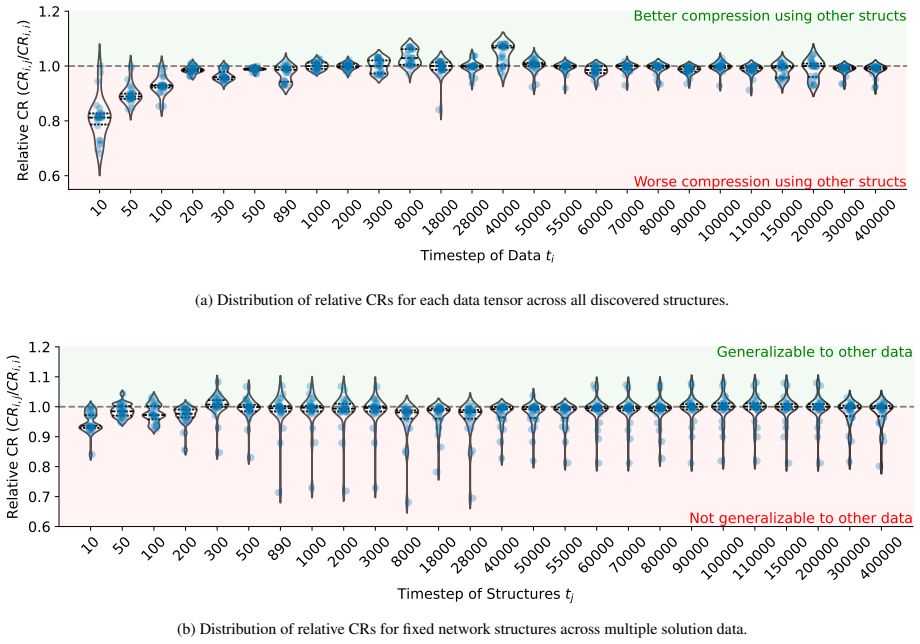
- [§4.2.1, Fig. 11; §4.2.2, Fig. 14] The evidence for 'near-optimality' is the relative compression ratio CR_i,j / CR_i,i being mostly below 1.0. This statistic is almost tautologically below 1.0 for any search that specializes structures to data: a structure optimized for data j is expected to underperform the structure optimized for data i when applied to data i, regardless of whether the search is near-optimal or merely overfits each tensor. To support the optimality claim, compare against a lower bound on the achievable size for the given error, or run exhaustive search on small subproblems; alternatively, report the same distribution for an independent stochastic baseline. As written, the 'near-optimality' inference is not supported.
- [§3.4.3, Eq. (4)] The cost model in Eq. (4) is used to select candidate structures, but the lazy-merge transformation is described only as maximizing reuse of the existing network. No statement or proof shows that the transformation actually realizes the ranks and errors assumed by Eq. (4). If merging, swapping, or splitting introduces truncation in addition to what the cost model accounts for, the final network's error is not controlled by the search. Please state explicitly how the transformation preserves the error budget, or verify the final network against the input network in the experiments.
minor comments (5)
- [Abstract and Highlights] The algorithm is called HIST in the abstract/highlights but Hiss in the main text and algorithms. Please standardize the notation.
- [Algorithm 2] The function signature lists (N_I, ε, C_θ, ϵ, k_θ) but the body uses d_θ from the enclosing context. Either include d_θ in the signature or clarify that it is a global parameter.
- [Algorithm 4, line 8] The 'continue' inside the while loop skips adding an index to the current cluster. This can leave clusters smaller than |I|/d_θ and, in principle, causes repeated iterations when the uniform draw is below ϵ. Please clarify the intended behavior (e.g., redraw until an index is added, or allow variable cluster sizes).
- [§3.3] Typo: 'orthognality center' should be 'orthogonality center'. There are also a few other typos ('comprimising', 'simplication') that a proofread pass should catch.
- [§4.1, Fig. 7] The reconstruction error plots would be more informative if they showed the exact relative error against the input TT network, not only against the original function on sampled points, since Problem 2 is defined relative to the input network.
Circularity Check
No significant circularity; the main issues are an unproven error-composition guarantee and a self-referential optimality diagnostic, neither of which reduces the derivation to its inputs.
full rationale
The paper's chain is an algorithmic construction: Hiss minimizes size (the reported compression numerator) under an error budget, and the empirical comparisons to TT/HT, random-structure, and non-hierarchical baselines are external to the construction. The recursive budget split in Algorithm 2 (Line 3: 'Split ε into ε1, ε2 such that ε1²+ε2²=ε²'; Line 6: 'RecSearch(G_i,j, ε2/√k)') is an unproven quadrature assumption, and Section 4.1 concedes that 'measured errors occasionally exceed the prescribed tolerance ε slightly'; that is a correctness/verification gap, not a circular reduction, because the budget split does not define the final error by construction. The relative-compression diagnostic CR_i,j/CR_i,i used to claim 'near-optimality' is self-referential and therefore weak evidence, but it is a measured ratio, not an input that is later reported as a prediction. The paper does rely on the authors' prior structure-search framework [50] as a subroutine and baseline, but the central contribution (hierarchical sampling + clustering + reshaping) is independently benchmarked, so this is normal inheritance rather than a load-bearing self-citation. No equation reduces to itself or to a fitted parameter renamed as a prediction.
Axiom & Free-Parameter Ledger
free parameters (7)
- N_θ (subnet node number) =
4
- d_θ (dimensionality threshold) =
4
- C_θ (number of cluster candidates) =
5
- ϵ (exploration probability) =
0.1
- k_θ (factorization threshold) =
4
- Top-K reshape candidates =
10
- T_θ (sampling iterations) =
5 (default; 3 in neutron diffusion)
axioms (5)
- domain assumption Tree tensor network unfoldings are valid only for index sets that form a cut; the algorithm restricts to such cuts.
- ad hoc to paper Singular-value entropy (effective rank, Eq. 3) is a reliable proxy for compression potential of an index grouping.
- ad hoc to paper Error budget splitting ε_1² + ε_2² = ε² yields a global error below ε.
- ad hoc to paper The lazy-merge structure transformation preserves the data within the error budget.
- standard math The bi-partition compatibility criterion (nested/disjoint) is sufficient to generate all valid tree structures.
read the original abstract
Tensor network methods provide a scalable solution to represent high-dimensional data. However, their efficacy is often limited by static, expert-defined structures that fail to adapt to evolving data correlations. We address this limitation by formalizing the structural rounding problem for tree tensor networks and introducing a hierarchical search algorithm HIST, which automatically identifies optimized structures with index reshaping for input tree tensor networks. To navigate the combinatorial explosion of the structural search space, HIST integrates stochastic sub-network sampling with hierarchical refinement. This approach utilizes entropy-guided index clustering to reduce dimensionality and targeted reshaping to expose latent data correlations. Numerical experiments on analytical functions and real-world physics applications, including thermal radiation transport, neutron diffusion, and computational fluid dynamics, demonstrate that HIST exhibits empirical polynomial scaling with dimensionality relative to the sampling budget, bypassing the scalability barriers in prior work. HIST achieves compression ratios $2.5\times$ to $100\times$ higher than standard fixed formats such as Tensor Trains and Hierarchical Tuckers (peaking at $1000\times$). Furthermore, HIST discovers structures that generalize effectively: applying a structure optimized for one data instance to a related target data typically maintains compression performance within $10\%$ of the result obtained by performing structure search on that target data. These results highlight HIST as a robust, automated tool for adaptive data representation and high-dimensional simulation compression with tensor network methods.
Figures




Reference graph
Works this paper leans on
-
[1]
Takamoto, T
M. Takamoto, T. Praditia, R. Leiteritz, D. MacKinlay, F. Alesiani, D. Pflüger, M. Niepert, Pdebench: An exten- sive benchmark for scientific machine learning, Advances in Neural Information Processing Systems 35 (2022) 1596–1611
2022
-
[2]
M. H. Zawawi, A. Saleha, A. Salwa, N. Hassan, N. M. Zahari, M. Z. Ramli, Z. C. Muda, A review: Fundamentals of computational fluid dynamics (cfd), in: AIP conference proceedings, V ol. 2030, AIP Publishing LLC, 2018, p. 020252
2030
-
[3]
Bassett, B
B. Bassett, B. Kiedrowski, Comparison of meshless and high-order polynomial functions for neutron transport with streamline-upwind petrov-galerkin stabilization, Tech. rep., Lawrence Livermore National Lab.(LLNL), Livermore, CA (United States) (2019). 27
2019
-
[4]
A. M. Cox, S. C. Harris, A. E. Kyprianou, M. Wang, Monte carlo methods for the neutron transport equation, SIAM/ASA Journal on Uncertainty Quantification 10 (2) (2022) 775–825
2022
-
[5]
A. A. Gorodetsky, P. D. Mullen, A. Deshpande, J. C. Dolence, C. D. Meyer, J. M. Miller, L. F. Roberts, Thermal radiation transport with tensor trains, arXiv preprint arXiv:2503.18056 (2025)
Pith/arXiv arXiv 2025
-
[6]
T. G. Kolda, B. W. Bader, Tensor decompositions and applications, SIAM review 51 (3) (2009) 455–500
2009
-
[7]
I. V . Oseledets, E. E. Tyrtyshnikov, Breaking the curse of dimensionality, or how to use svd in many dimensions, SIAM Journal on Scientific Computing 31 (5) (2009) 3744–3759
2009
-
[8]
Altman, M
N. Altman, M. Krzywinski, The curse (s) of dimensionality, Nat Methods 15 (6) (2018) 399–400
2018
-
[9]
Bachmayr, Low-rank tensor methods for partial differential equations, Acta Numerica 32 (2023) 1–121
M. Bachmayr, Low-rank tensor methods for partial differential equations, Acta Numerica 32 (2023) 1–121
2023
-
[10]
S. V . Dolgov, Tt-gmres: on solution to a linear system in the structured tensor format, arXiv preprint arXiv:1206.5512 (2012)
Pith/arXiv arXiv 2012
-
[11]
Rodgers, D
A. Rodgers, D. Venturi, Tensor approximation of functional differential equations, Physical Review E 110 (1) (2024) 015310
2024
-
[12]
D. P. Truong, M. I. Ortega, I. Boureima, G. Manzini, K. Ø. Rasmussen, B. S. Alexandrov, Tensor networks for solving the time-independent boltzmann neutron transport equation, Journal of Computational Physics 507 (2024) 112943
2024
-
[13]
L. R. Tucker, Some mathematical notes on three-mode factor analysis, Psychometrika 31 (3) (1966) 279–311. doi:10.1007/BF02289464
-
[14]
I. V . Oseledets, Tensor-train decomposition, SIAM Journal on Scientific Computing 33 (5) (2011) 2295–2317
2011
-
[15]
L. Grasedyck, Hierarchical singular value decomposition of tensors, SIAM Journal on Matrix Analysis and Applications 31 (4) (2010) 2029–2054.doi:10.1137/090764189
-
[16]
Falcó, W
A. Falcó, W. Hackbusch, A. Nouy, Tree-based tensor formats, SeMA Journal 78 (2) (2021) 159–173
2021
-
[17]
Veeramacheneni, M
L. Veeramacheneni, M. Wolter, H. Kuehne, J. Gall, Canonical rank adaptation: An efficient fine-tuning strategy for vision transformers, in: Forty-second International Conference on Machine Learning, 2025
2025
-
[18]
Y . Yang, J. Zhou, N. Wong, Z. Zhang, Loretta: Low-rank economic tensor-train adaptation for ultra-low- parameter fine-tuning of large language models, in: Proceedings of the 2024 Conference of the North American Chapter of the Association for Computational Linguistics: Human Language Technologies (V olume 1: Long Papers), 2024, pp. 3161–3176
2024
-
[19]
Ghiasvand, M
S. Ghiasvand, M. Alizadeh, R. Pedarsani, Decentralized low-rank fine-tuning of large language models, in: Proceedings of the 1st Workshop for Research on Agent Language Models (REALM 2025), 2025, pp. 334–345
2025
-
[20]
Zheng, C
H. Zheng, C. Zhou, Z. Shi, A. L. de Almeida, Subttd: Doa estimation via sub-nyquist tensor train decomposition, IEEE Signal Processing Letters 29 (2022) 1978–1982
2022
-
[21]
Q. Xie, Z. Wang, F. Wen, J. He, T.-K. Truong, Coarray tensor train decomposition for bistatic mimo radar with uniform planar array, IEEE Transactions on Antennas and Propagation (2025)
2025
-
[22]
M. Wang, D. Hong, Z. Han, J. Li, J. Yao, L. Gao, B. Zhang, J. Chanussot, Tensor decompositions for hyper- spectral data processing in remote sensing: A comprehensive review, IEEE Geoscience and Remote Sensing Magazine 11 (1) (2023) 26–72
2023
-
[23]
Ravishankar, M
J. Ravishankar, M. Sharma, A hierarchical approach for lossy light field compression with multiple bit rates based on tucker decomposition via random sketching, IEEE Access 10 (2022) 56677–56690. 28
2022
-
[24]
W. A. Sands, W. Guo, J.-M. Qiu, T. Xiong, High-order adaptive rank integrators for multiscale linear kinetic transport equations in the hierarchical tucker format, SIAM Journal on Scientific Computing 47 (6) (2025) A3383–A3412
2025
-
[25]
Ghahremani, H
B. Ghahremani, H. Babaee, A deim tucker tensor cross algorithm and its application to dynamical low-rank approximation, Computer Methods in Applied Mechanics and Engineering 423 (2024) 116879
2024
-
[26]
Ghahremani, H
B. Ghahremani, H. Babaee, Cross interpolation for solving high-dimensional dynamical systems on low-rank tucker and tensor train manifolds, Computer Methods in Applied Mechanics and Engineering 432 (2024) 117385
2024
-
[27]
F. Pan, P. Zhang, Simulation of quantum circuits using the big-batch tensor network method, Physical Review Letters 128 (3) (2022) 030501
2022
-
[28]
G. Kalachev, P. Panteleev, M.-H. Yung, Multi-tensor contraction for xeb verification of quantum circuits, arXiv preprint arXiv:2108.05665 (2021)
Pith/arXiv arXiv 2021
-
[29]
C. Huang, F. Zhang, M. Newman, J. Cai, X. Gao, Z. Tian, J. Wu, H. Xu, H. Yu, B. Yuan, et al., Classical simulation of quantum supremacy circuits, arXiv preprint arXiv:2005.06787 (2020)
Pith/arXiv arXiv 2005
-
[30]
Nakatani, G
N. Nakatani, G. K. Chan, Efficient tree tensor network states (ttns) for quantum chemistry: Generalizations of the density matrix renormalization group algorithm, The Journal of chemical physics 138 (13) (2013)
2013
-
[31]
V . Murg, F. Verstraete, R. Schneider, P. R. Nagy, O. Legeza, Tree tensor network state with variable tensor order: An efficient multireference method for strongly correlated systems, Journal of Chemical Theory and Computation 11 (3) (2015) 1027–1036
2015
-
[32]
Gunst, F
K. Gunst, F. Verstraete, D. Van Neck, Three-legged tree tensor networks with su (2) and molecular point group symmetry, Journal of chemical theory and computation 15 (5) (2019) 2996–3007
2019
-
[33]
Ferrari, G
G. Ferrari, G. Magnifico, S. Montangero, Adaptive-weighted tree tensor networks for disordered quantum many- body systems, Physical Review B 105 (21) (2022) 214201
2022
-
[34]
K. Seki, T. Hikihara, K. Okunishi, Tensor-network strong-disorder renormalization groups for random quantum spin systems in two dimensions, Physical Review B 102 (14) (2020) 144439
2020
-
[35]
Hikihara, H
T. Hikihara, H. Ueda, K. Okunishi, K. Harada, T. Nishino, Automatic structural optimization of tree tensor networks, Physical Review Research 5 (1) (2023) 013031
2023
-
[36]
Ke, Tree tensor network state approach for solving hierarchical equations of motion, The Journal of Chemical Physics 158 (21) (2023)
Y . Ke, Tree tensor network state approach for solving hierarchical equations of motion, The Journal of Chemical Physics 158 (21) (2023)
2023
-
[37]
Yang, Z.-C
S. Yang, Z.-C. Gu, X.-G. Wen, Loop optimization for tensor network renormalization, Physical review letters 118 (11) (2017) 110504
2017
-
[38]
J. Gray, G. K.-L. Chan, Hyperoptimized approximate contraction of tensor networks with arbitrary geometry, Physical Review X 14 (1) (2024) 011009
2024
-
[39]
Y . Gao, H. Zhai, J. Gray, R. Peng, G. Park, W.-Y . Liu, E. F. Kjønstad, G. K.-L. Chan, Fermionic tensor network contraction for arbitrary geometries, Physical Review Research 7 (2) (2025) 023193
2025
-
[40]
R. Watanabe, H. Manabe, T. Hikihara, H. Ueda, Ttnopt: Tree tensor network package for high-rank tensor compression, arXiv preprint arXiv:2505.05908 (2025)
arXiv 2025
-
[41]
Dektor, D
A. Dektor, D. Venturi, Coordinate-adaptive integration of pdes on tensor manifolds, Communications on Applied Mathematics and Computation 7 (4) (2025) 1562–1579. 29
2025
-
[42]
Dektor, D
A. Dektor, D. Venturi, Tensor rank reduction via coordinate flows, Journal of Computational Physics 491 (2023) 112378
2023
-
[43]
Rodgers, A
A. Rodgers, A. Dektor, D. Venturi, Adaptive integration of nonlinear evolution equations on tensor manifolds, Journal of Scientific Computing 92 (2) (2022) 39
2022
-
[44]
Oseledets, E
I. Oseledets, E. Tyrtyshnikov, Tt-cross approximation for multidimensional arrays, Linear Algebra and its Ap- plications 432 (1) (2010) 70–88
2010
-
[45]
Handschuh, Numerical methods in tensor networks, Ph.D
S. Handschuh, Numerical methods in tensor networks, Ph.D. thesis, Dissertation, Leipzig, Universität Leipzig, 2015 (2015)
2015
-
[46]
C. Li, Z. Sun, Evolutionary topology search for tensor network decomposition, in: International conference on machine learning, PMLR, 2020, pp. 5947–5957
2020
-
[47]
C. Li, J. Zeng, Z. Tao, Q. Zhao, Permutation search of tensor network structures via local sampling, in: Interna- tional conference on machine learning, PMLR, 2022, pp. 13106–13124
2022
-
[48]
C. Li, J. Zeng, C. Li, C. F. Caiafa, Q. Zhao, Alternating local enumeration (tnale): Solving tensor network structure search with fewer evaluations, in: International conference on machine learning, PMLR, 2023, pp. 20384–20411
2023
-
[49]
M. Hashemizadeh, M. Liu, J. Miller, G. Rabusseau, Adaptive learning of tensor network structures, arXiv preprint arXiv:2008.05437 (2020)
Pith/arXiv arXiv 2008
-
[50]
Z. Guo, A. Deshpande, B. Kiedrowski, X. Wang, A. Gorodetsky, Tensor network structure search with program synthesis, arXiv preprint arXiv:2502.02711 (2025)
Pith/arXiv arXiv 2025
-
[51]
S. Börm, L. Grasedyck, W. Hackbusch, Introduction to hierarchical matrices with applications, Engineering analysis with boundary elements 27 (5) (2003) 405–422
2003
-
[52]
Z. Chen, R. Cai, F. Xie, J. Qiao, A. Wu, Z. Li, Z. Hao, K. Zhang, Learning discrete latent variable structures with tensor rank conditions, Advances in Neural Information Processing Systems 37 (2024) 17398–17427
2024
-
[53]
Anandkumar, R
A. Anandkumar, R. Ge, D. J. Hsu, S. M. Kakade, M. Telgarsky, et al., Tensor decompositions for learning latent variable models., J. Mach. Learn. Res. 15 (1) (2014) 2773–2832
2014
-
[54]
Linderman, R
S. Linderman, R. Adams, Discovering latent network structure in point process data, in: International conference on machine learning, PMLR, 2014, pp. 1413–1421
2014
-
[55]
B. N. Khoromskij, O (d log n)-quantics approximation of n-d tensors in high-dimensional numerical modeling, Constructive Approximation 34 (2) (2011) 257–280
2011
-
[56]
C. J. Hillar, L.-H. Lim, Most tensor problems are np-hard, Journal of the ACM (JACM) 60 (6) (2013) 1–39
2013
-
[57]
Zheng, X.-L
Y .-B. Zheng, X.-L. Zhao, J. Zeng, C. Li, Q. Zhao, H.-C. Li, T.-Z. Huang, Svdinstn: A tensor network paradigm for efficient structure search from regularized modeling perspective, in: Proceedings of the IEEE/CVF Confer- ence on Computer Vision and Pattern Recognition, 2024, pp. 26254–26263
2024
-
[58]
M. Wang, B. Yu, S. Zhang, L. Mi, W. Wang, Y . Wang, P. Jia, X. Wei, Z. Xu, R. Guo, et al., Renormalization group guided tensor network structure search, arXiv preprint arXiv:2512.24663 (2025)
arXiv 2025
-
[59]
Juels, M
A. Juels, M. Wattenberg, Stochastic hillclimbing as a baseline method for evaluating genetic algorithms, Ad- vances in Neural Information Processing Systems 8 (1995)
1995
-
[60]
G. Evenbly, A practical guide to the numerical implementation of tensor networks i: Contractions, decomposi- tions, and gauge freedom, Frontiers in Applied Mathematics and Statistics 8 (2022) 806549. 30
2022
-
[61]
O. Roy, M. Vetterli, The effective rank: A measure of effective dimensionality, in: 2007 15th European signal processing conference, IEEE, 2007, pp. 606–610
2007
-
[62]
S. R. White, Density matrix renormalization group algorithms with a single center site, Physical Review B—Condensed Matter and Materials Physics 72 (18) (2005) 180403
2005
-
[63]
S. R. White, Density-matrix algorithms for quantum renormalization groups, Physical review b 48 (14) (1993) 10345
1993
-
[64]
Evenbly, Gauge fixing, canonical forms, and optimal truncations in tensor networks with closed loops, Phys- ical Review B 98 (8) (2018) 085155
G. Evenbly, Gauge fixing, canonical forms, and optimal truncations in tensor networks with closed loops, Phys- ical Review B 98 (8) (2018) 085155
2018
-
[65]
Morrison, S
D. Morrison, S. Jacobson, J. Sauppe, E. Sewell, Branch-and-bound algorithms: a survey of recent advances in searching, branching, and pruning. discret optim 19: 79–102 (2016)
2016
-
[66]
Ballani, L
J. Ballani, L. Grasedyck, M. Kluge, Black box approximation of tensors in hierarchical tucker format, Linear algebra and its applications 438 (2) (2013) 639–657
2013
-
[67]
G. Ryzhakov, A. Chertkov, A. Basharin, I. Oseledets, Black-box approximation and optimization with hierarchi- cal tucker decomposition, arXiv preprint arXiv:2402.02890 (2024)
Pith/arXiv arXiv 2024
-
[68]
G. B. Rybicki, A. P. Lightman, Radiative processes in astrophysics, John Wiley & Sons, 2024
2024
-
[69]
Y .-F. Jiang, An implicit finite volume scheme to solve the time-dependent radiation transport equation based on discrete ordinates, The Astrophysical Journal Supplement Series 253 (2) (2021) 49
2021
-
[70]
Kurzer-Ogul, B
K. Kurzer-Ogul, B. M. Haines, D. S. Montgomery, S. Pandolfi, J. P. Sauppe, A. F. Leong, D. Hodge, P. M. Kozlowski, S. Marchesini, E. Cunningham, et al., Radiation and heat transport in divergent shock–bubble inter- actions, Physics of plasmas 31 (3) (2024)
2024
-
[71]
Einkemmer, K
L. Einkemmer, K. Kormann, J. Kusch, R. G. McClarren, J.-M. Qiu, A review of low-rank methods for time- dependent kinetic simulations, Journal of Computational Physics 538 (2025) 114191
2025
-
[72]
M. K. Bhattacharyya, D. Radice, A finite element method for angular discretization of the radiation transport equation on spherical geodesic grids, Journal of Computational Physics 491 (2023) 112365
2023
-
[73]
B. S. Southworth, S. Olivier, H. Park, T. Buvoli, One-sweep moment-based semi-implicit-explicit integration for gray thermal radiation transport, Journal of Computational Physics 517 (2024) 113349
2024
-
[74]
Z. Wang, Z. He, L. Mu, S. Dong, Parallel algorithm and its convergence of spatial domain decomposition of discrete ordinates method for solving radiation heat transfer problem, Chinese Journal of Aeronautics 28 (1) (2015) 77–85
2015
-
[75]
S. Brunner, L. Einkemmer, T. Haut, Domain decomposition dynamical low-rank for multi-dimensional radiative transfer equations, arXiv preprint arXiv:2602.14854 (2026)
arXiv 2026
-
[76]
J. P. Jessee, W. A. Fiveland, L. H. Howell, P. Colella, R. B. Pember, An adaptive mesh refinement algorithm for the radiative transport equation, Journal of computational Physics 139 (2) (1998) 380–398
1998
-
[77]
Velarde, F
P. Velarde, F. Ogando, Radiation transport in amr, in: Adaptive Mesh Refinement-Theory and Applications: Proceedings of the Chicago Workshop on Adaptive Mesh Refinement Methods, Sept. 3–5, 2003, Springer, 2005, pp. 271–280
2003
-
[78]
Allaire, Y
G. Allaire, Y . Capdeboscq, Homogenization of a spectral problem in neutronic multigroup diffusion, Computer methods in applied mechanics and engineering 187 (1-2) (2000) 91–117
2000
-
[79]
W. Xiao, X. Liu, J. Zu, X. Chai, H. He, T. Zhang, Operator inference driven data assimilation for high fidelity neutron transport, Computer Methods in Applied Mechanics and Engineering 430 (2024) 117214. 31
2024
-
[80]
Wilson, M
S. Wilson, M. Eaton, J. Kópházi, A symmetric interior-penalty discontinuous galerkin isogeometric analysis spatial discretization of the self-adjoint angular flux form of the neutron transport equation, Computer Methods in Applied Mechanics and Engineering 432 (2024) 117414
2024
discussion (0)
Sign in with ORCID, Apple, or X to comment. Anyone can read and Pith papers without signing in.