REVIEW 3 major objections 5 minor 56 references
Prediction of a wide variety of linear complexions in face centered cubic alloys
T0 review · 3 major / 5 minor · reviewed 2026-08-14 · deepseek-v4-flash
Pith's one-line read This paper predicts that face centered cubic alloys can form three new types of stable nanoscale linear complexions at dislocations, and that two types can coexist in a ternary alloy.
desk verdict A credible simulation-based extension of linear complexions to fcc alloys; worth refereeing, but the Al-based predictions rest on a potential known to give the wrong stacking fault width. read the letter →
The pith
A machine-rendered reading of the paper's core claim, the machinery that carries it, and where it could break.
The reading
What carries the argument
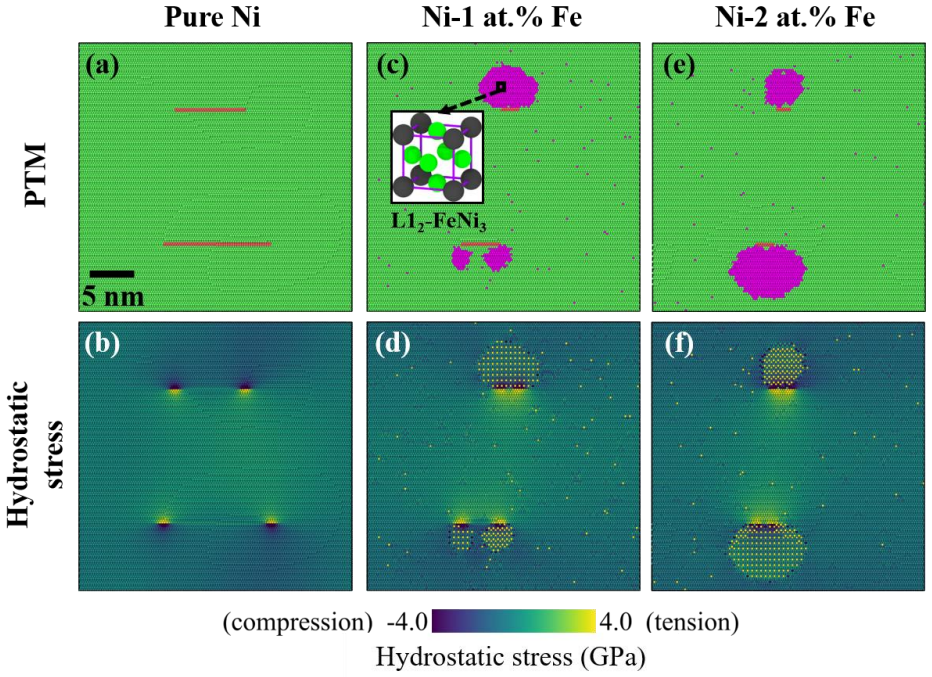
The central object is the dissociated edge dislocation in an fcc crystal, which splits into two Shockley partial dislocations bounding a stacking fault and creates a local stress field plus a chemically distinct fault plane. The simulations combine hybrid Monte Carlo/molecular dynamics in a variance-constrained semi-grand canonical ensemble, which swaps atomic species to reach a target composition while molecular dynamics relaxes the structure, so phase and complexion transformations emerge without being prescribed. Local structure is identified with polyhedral template matching (PTM), which labels fcc, hcp, bcc, icosahedral, and $\mathrm{L1_2}$ environments, and the dislocation extraction algorithm (DXA) tracks whether the original partial dislocations survive or are destroyed. Together these tools let the authors map which solute-rich ordered or disordered states are stable at the dislocation as a function of temperature and composition.
What would settle it
A targeted experiment on Ni-2 at.% Fe aged near 500 K using atom-probe tomography and transmission electron microscopy: if it shows no L12-FeNi3 particle arrays along dissociated partial dislocations and no accompanying reduction in stacking fault width, the nanoparticle array complexion prediction for this system would be contradicted. An independent density functional theory calculation of the segregation energy of Fe to the compression side of a Shockley partial in Ni that disagrees with the Ni-Fe potential's sign would also undermine the central mechanism.
Extended reading notes
Core claim
The paper's central claim is that dislocations in face centered cubic metals are not just defects but can transform into thermodynamically stable, nanoscale 'linear complexions' through solute segregation. Using equilibrium atomistic simulations, it predicts three distinct types: nanoparticle arrays of the ordered $\mathrm{L1_2}$ phase in Ni-Fe, Ni-Al, and Al-Zr; stacking fault complexions in Cu-Zr in which the fault transforms into a layered structure matching a (111) plane of the $\mathrm{Cu_5Zr}$ intermetallic; and platelet arrays of Guinier-Preston zones in Al-Cu. The three types differ in how they treat the original dislocation: they preserve it, delocalize it, or restructure it into faceted segments. The paper also predicts that in ternary Al-Cu-Zr, $\mathrm{L1_2}$ nanoparticles and GP-zone platelets can coexist at the same dislocation, and that linear complexion diagrams, with regions and boundaries like a bulk phase diagram, can be constructed for each system.
Load-bearing premise
The predictions stand on the classical interatomic potentials accurately reproducing segregation energies, phase stability, and stacking fault energy for each alloy; if any potential misrepresents those quantities, the predicted complexions and their diagrams could shift or vanish.
Editorial extensions
If this is right
- If the predictions hold, dislocations in fcc alloys can act as equilibrium reservoirs of nanoscale second phases, decorating dislocation networks with $\mathrm{L1_2}$ particles, GP-zone platelets, or layered $\mathrm{Cu_5Zr}$-like states without bulk precipitation.
- The predicted reduction in stacking fault width when a complexion forms gives a direct, observable fingerprint: measuring fault width changes with composition could confirm complexion formation in experiments.
- Because complexion type is set by interface compatibility with the matrix, alloy systems can be screened for which complexion will form by comparing interfacial energies of candidate phases with the matrix, not just by bulk phase diagram.
- In multicomponent alloys, different solutes can segregate to different sides of the same dislocation and form coexisting complexions, so linear complexion engineering becomes a multi-element design problem.
Reading between the lines
- A natural extension the paper does not pursue is the mechanical consequence: if $\mathrm{L1_2}$ nanoparticle arrays pin partial dislocations, they could raise the flow stress of the alloy; this could be tested by simulating shear of a complexion-decorated dislocation.
- The stacking fault complexion in Cu-Zr is proposed as a precursor to bulk $\mathrm{Cu_5Zr}$ precipitation; if correct, dislocations would control the precipitation sequence, which could be checked by aging experiments that look for $\mathrm{Cu_5Zr}$ nucleating on faults.
- The predictions rest on classical potentials, so a first-principles test of the segregation energies at the partial dislocation cores (especially the counterintuitive Fe-on-compression-side result in Ni-Fe) would be the quickest way to see which predicted complexions are robust.
Signed reviews
Editorial analysis
A structured set of objections, weighed in public.
Referee Report
Summary. The manuscript uses hybrid Monte Carlo/molecular dynamics simulations with existing interatomic potentials to study segregation-driven structural transitions near dissociated edge dislocations in five fcc alloy systems. It reports three predicted classes of linear complexions—L12 nanoparticle arrays in Ni-Fe, Ni-Al, and Al-Zr; stacking-fault complexions with Cu5Zr-like layered order in Cu-Zr; and GP-zone platelet arrays in Al-Cu—plus coexistence of multiple complexion types in ternary Al-Cu-Zr. Temperature-composition plots are assembled as linear complexion diagrams for each system, and the paper argues that these states are stable thermodynamic equilibrium features confined to dislocations.
Significance. If the predictions are correct, the work substantially broadens the complexion concept from the recently discovered bcc Fe-based linear complexions and from planar grain-boundary complexions to a wide class of fcc alloys and dislocation geometries. The study is methodologically transparent: it uses documented interatomic potentials, describes the hybrid MC/MD setup, verifies periodicity along the line defect with long cells for representative cases, identifies local structure with DXA and PTM, and supports structural assignments with RDF comparisons to candidate bulk phases. The authors also explicitly flag known limitations of the potentials, most notably the unrealistic pure-Al stacking-fault energy. The remaining barriers are not lack of internal consistency but the short equilibration used for a 'stable equilibrium' claim and the absence of a robustness check for the Al-based predictions, both of which are load-bearing for the central novelty claims.
major comments (3)
- [Section 2, Methods] The equilibration protocol is very short for the claimed 'stable, nanoscale-size structural and chemical states ... in thermodynamic equilibrium.' Each system is heated over 0.1 ns and relaxed for another 0.1 ns, with equilibration judged by an energy-gradient criterion over the last 20 ps. Nucleation and growth of nanoscale ordered precipitates at dislocations, especially at 300 K in Al-based systems, can be far slower than this. The paper should demonstrate independence of the final states from the initial configuration and from run length (multiple seeds, longer production runs, or additional equilibration metrics), or soften the equilibrium language to describe the observed states as long-lived metastable states of the simulation protocol.
- [Section 3.1 and Figure 5(d)] The Al-Zr, Al-Cu, and Al-Cu-Zr predictions depend on a dissociated-dislocation template with widely separated Shockley partials, yet the paper admits that the pure-Al potential gives 'much wider stacking faults than any of the other systems' because of 'the much lower stacking fault energy in the simulated Al potential (again a deviation from reality...).' Real Al has one of the highest fcc stacking-fault energies, so the partial separation and the stress-field and Suzuki-segregation geometry that drive the predicted L12 arrays and GP-zone platelet arrays would be qualitatively different. A direct robustness test is required—for example, repeating the key simulations with a potential that reproduces the experimental Al SFE, or systematically varying the stacking-fault width in a controlled way—before these systems can be presented as physical predictions rather than potential-specific artifacts.
- [Sections 3.1 and 3.3; Figures 5 and 13] For Al-Zr and Al-Cu the paper does not report the bulk phase boundaries, in contrast to the Ni-Fe system where the bulk fcc+L12 field is shown in Figure 3(a). The authors define a complexion as a state that is stabilized by the defect and would not exist without it, and in the Ni-Fe case they explicitly separate dislocation-assisted heterogeneous nucleation inside the bulk two-phase field from genuine complexion states outside it. Without the corresponding bulk boundaries for Al-Zr and Al-Cu, the predicted L12 arrays and GP-zone platelets cannot be distinguished from ordinary heterogeneous nucleation of bulk phases, and the 'new complexion type' claim for these systems is not yet substantiated. The bulk phase-field limits should be computed with the same potentials and overlaid on the linear complexion diagrams.
minor comments (5)
- [Section 3.1, near Figure 4] The sentence referring to 'the simulation cell, identical to the one shown in Figure 1(a) but without dislocations' appears to reference the wrong panel; the simulation cell with dislocations is shown in Figure 1(b), not Figure 1(a).
- [Section 3.1] There is a typo in 'Additional analysis can also epxlain the reduction in stacking fault width'—'epxlain' should be 'explain.'
- [Section 3.2] The paper notes that the term 'linear complexion' is applied to the ribbon-like stacking-fault complexions and that this terminology 'should be discussed and evaluated further.' This is an important conceptual point; a brief justification or a more precise term would strengthen the presentation.
- [Section 3.3] The naming of GPI versus θ'' and GPII versus θ' layers is stated without a source for the equivalence; a reference or a clarifying sentence would help avoid confusion because the GPI/GPII and θ''/θ' labels are used with varying conventions in the literature.
- [Figures 9 and 13] The dashed lines in the linear complexion diagrams are described as schematic or fitted in an under-specified way. The Ni-Fe dashed boundary uses an Arrhenius fit to the simulated bulk saturation composition, but the fitting procedure, the number of points, and the uncertainty are not reported; describing this as a definition of the boundary rather than a fit would be more accurate.
Circularity Check
No significant circularity: the predicted linear complexions are emergent outputs of hybrid Monte Carlo/molecular dynamics simulations, not quantities fitted into the model.
full rationale
The paper's derivation chain is self-contained as a simulation study: choose interatomic potentials, insert dissociated edge dislocations, run variance-constrained hybrid Monte Carlo/molecular dynamics over a grid of compositions and temperatures, and then classify the relaxed atomic structures. No complexion type, transition boundary, or coexistence state is used as a fitting target in constructing the interatomic potentials. The potentials were selected to reproduce bulk phase diagrams and solubility limits, which encodes some bias toward bulk-stable phases, and the authors themselves conclude that the complexion structure is typically the next phase on the bulk phase diagram; however, the physical content of the claim lies in where and how these phases appear at dissociated dislocations, which is not fitted. The only fitted line in the paper is the dashed solubility-limit boundary in Figure 3(a), obtained by an Arrhenius fit to the simulation data; that is a post-hoc description rather than an independent prediction, and it is not load-bearing for the central predictions. Self-citations [26,27] are used as background and motivation from prior bcc work and do not supply the proof for the fcc results. The admitted deviation in the Al potential's stacking fault energy is a real accuracy limitation, but it is a correctness risk, not circularity. The acknowledged agreement with known GP-zone observations and Cu5Zr precipitation provides external consistency rather than demonstrating that the predictions reduce to their inputs. Overall, the central derivation is not circular.
Assumptions & free parameters
free parameters (1)
- dG (free energy change due to dislocation presence) =
not stated (fitted to simulation data)
assumptions (4)
- domain assumption The interatomic potentials (Bonny Fe-Ni, Mendelev Cu-Zr, Mishin Ni-Al, Cheng Al-Zr/Al-Cu) capture the relevant thermodynamic and structural properties of these alloys, including phase stability, solubility limits, and stacking fault energies.
- domain assumption Hybrid Monte Carlo / molecular dynamics with the described protocol reaches equilibrium states in the simulated times.
- domain assumption The simulation cell with two opposite edge dislocations and periodic boundary conditions is representative of bulk material behavior for complexion formation.
- standard math The identification of local crystal structures by PTM and dislocations by DXA is correct and does not misclassify the complexion phases.
Cite this review
Pith. "Pith review of Prediction of a wide variety of linear complexions in face centered cubic alloys." pith.science (2026). https://pith.science/paper/DKUW474H
@misc{pith2026190801849,
  author       = {Pith},
  title        = {Pith review of: Prediction of a wide variety of linear complexions in face centered cubic alloys},
  year         = {2026},
  howpublished = {\url{https://pith.science/paper/DKUW474H}},
  note         = {Machine review of arXiv:1908.01849}
}
read the original abstract
Linear complexions are defect states that have been recently discovered along dislocations in body centered cubic Fe-based alloys. In this work, we use atomistic simulations to extend this concept and explore segregation-driven structural transitions at dislocations in face centered cubic alloys. We identify a variety of stable, nanoscale-size structural and chemical states, which are confined near dislocations and can be classified as linear complexions. Depending on the alloy system and thermodynamic conditions, such new states can preserve, partially modify, or completely replace the original defects they were born at. By considering different temperatures and compositions, we construct linear complexion diagrams that are similar to bulk phase diagrams, defining the important conditions for complexion formation while also specifying an expected complexion size and type. Several notable new complexion types were predicted here: (1) nanoparticle arrays comprised of L12 phases in Ni-Fe, Ni-Al, and Al-Zr, (2) replacement of stacking faults with layered complexions comprised of (111) planes from the Cu5Zr intermetallic phase in Cu-Zr, (3) platelet arrays comprised of two-dimensional Guinier-Preston zones in Al-Cu, and finally (4) coexistence of multiple linear complexions containing both Guinier-Preston zones and L12 phases in ternary Al-Cu-Zr. All of these new complexion states are expected to alter material properties and affect the stability of the dislocations themselves, offering a unique opportunity for future materials design.
Figures


Figures from the paper (1 more)

Reference graph
Works this paper leans on
-
[1]
M. Kuzmina, M. Herbig, D. Ponge, S. Sandlöbes, D. Raabe, Linear complexions: Confined chemical and structural states at dislocations, Science 349 (2015)
work page 2015
- [2]
-
[3]
P.R. Cantwell, M. Tang, S.J. Dillon, J. Luo, G.S. Rohrer, M.P. Harmer, Grain boundary complexions, Acta Mater. 62(1) (2014) 1-48
work page 2014
-
[4]
J. Luo, Grain boundary complexions: The interplay of premelting , prewetting, and multilayer adsorption, Appl. Phys. Lett. 95(7) (2009)
work page 2009
-
[5]
J. Luo, X. Shi, Grain boundary disordering in binary alloys, Appl. Phys. Lett. 92(10) (2008)
work page 2008
- [6]
-
[7]
X. Shi, J. Luo, Developing grain boundary diagrams as a materials science tool: A case study of nickel-doped molybdenum, Phys. Rev. B 84(1) (2011)
work page 2011
-
[8]
C.H. Liebscher, A. Stoffers, M. Alam, L. Lymperakis, O. Cojocaru -Mirédin, B. Gault, J. Neugebauer, G. Dehm, C. Scheu, D. Raabe, Strain -Induced Asymmetric Line Segregation at Faceted Si Grain Boundaries, Phys. Rev. Lett. 121(1) (2018) 015702-015702
work page 2018
Show all 56 references
-
[9]
Frolov, S.V
T. Frolov, S.V. Divinski, M. Asta, Y. Mishin, Effect of interface phase transformations on diffusion and segregation in high-angle grain boundaries, Phys. Rev. Lett. 110 (2013) 1-5
2013
-
[10]
Frolov, M
T. Frolov, M . Asta, Y. Mishin, Segregation -induced phase transformations in grain boundaries, Phys. Rev. B 92 (2015) 020103
2015
-
[11]
N. Zhou, J. Luo, Developing grain boundary diagrams for multicomponent alloys, Acta Mater. 91 (2015) 202-216
2015
-
[12]
Frolov, M
T. Frolov, M. Asta, Y. Mishin, Phase transformations at interfaces: Observations from atomistic modeling, Curr. Opin. Solid State Mater. Sci. 20(5) (2016) 308-315
2016
-
[13]
Frolov, W
T. Frolov, W. Setyawan, R.J. Kurtz, J. Marian, A.R. Oganov, R.E. Rudd, Q. Zhu, Grain boundary phases in bcc metals, Nanoscale 10(17) (2018) 8253-8268
2018
-
[14]
Q. Zhu, A. Samanta, B. Li, R.E. Rudd, T. Frolov, Predicting phase behavior of grain boundaries with evolutionary search and machine learning, Nat. Commun. 9(1) (2018)
2018
-
[15]
Khalajhedayati, T.J
A. Khalajhedayati, T.J. Rupert, High-Temperature Stability and Grain Boundary Complexion Formation in a Nanocrystalline Cu-Zr Alloy, JOM 67 (2015) 2788-2801
2015
-
[16]
Pan, T.J
Z. Pan, T.J. Rupert, Effect of grain boundary character on segregation -induced structural transitions, Phys. Rev. B 93 (2016) 1-15
2016
-
[17]
S. Yang, N. Zhou, H. Zheng, S.P. Ong, J. Luo, First -Order Interfacial Transformations with a Critical Point: Breaking the Symmetry at a Symmetric Tilt Grain Boundary, Phys. Rev. Lett. 120(8) (2018) 85702-85702
2018
-
[18]
Frolov, D.L
T. Frolov, D.L. Olmsted, M. Asta, Y. Mishin, Structural phase transformations in metallic grain boundaries, Nat. Commun. 4 (2013)
2013
-
[19]
T. Hu, S. Yang, N. Zhou, Y. Zhang, J. Luo, Role of disordered bipolar complexions on the sulfur embrittlement of nickel general grain boundaries, Nat. Commun. 9(1) (2018)
2018
-
[20]
Khalajhedayati, Z
A. Khalajhedayati, Z. Pan, T.J. Rupert, Manipulating the interfacial structure of nanomaterials to achieve a unique combination of strength and ductility., Nat. Commun. 7 (2016) 10802
2016
-
[21]
Turlo, T.J
V. Turlo, T.J. Rupert, Grain boundary complexions and the strength of nanocrystalline metals: Dislocation emission and propagation, Acta Mater. 151 (2018) 100-111. 26
2018
-
[22]
Rupert, The role of complexions in metallic nano -grain stability and deformation, Curr
T.J. Rupert, The role of complexions in metallic nano -grain stability and deformation, Curr. Opin. Solid State Mater. Sci. 20 (2016) 257-267
2016
-
[23]
Andrievski, Review of thermal stability of nanomaterials, J
R.A. Andrievski, Review of thermal stability of nanomaterials, J. Mater. Sci. 49 (2014) 1449- 1460
2014
-
[24]
Schuler, O.K
J.D. Schuler, O.K. Donaldson, T.J. Rupert, Amorphous complexions enable a new region of high temperature stability in nanocrystalline Ni-W, Scripta Mater. 154 (2018) 49-53
2018
-
[25]
Kwiatkowski Da Silva, D
A. Kwiatkowski Da Silva, D. Ponge, Z. Peng, G. Inden, Y. Lu, A. Breen, B. Gault, D. Raabe, Phase nucleation through confined spinodal fluctuations at crystal defects evidenced in Fe -Mn alloys, Nat. Commun. 9(1) (2018) 1-11
2018
-
[26]
Turlo, T.J
V. Turlo, T.J. Rupert, Dislocation -assisted linear complexion formation driven by segregation, Scripta Mater. 154 (2018) 25-29
2018
-
[27]
Turlo, T.J
V. Turlo, T.J. Rupert, Linear Complexions: Metastable Phase Formation and Coexistence at Dislocations, Phys. Rev. Lett. 122(12) (2019) 126102
2019
-
[28]
Kwiatkowski da Silva, G
A. Kwiatkowski da Silva, G. Leyson, M. Kuzmina, D. Ponge, M. Herbig, S. Sandlbes, B. Gault, J. Neugebauer, D. Raabe, Confined chemical and structural states at dislocations in Fe - 9wt%Mn steels: A correlative TEM-atom probe study combined with multiscale modelling, Acta Mater...
2017
-
[29]
Suzuki, Segregation of Solute Atoms to Stacking Faults, J
H. Suzuki, Segregation of Solute Atoms to Stacking Faults, J. Phys. Soc. Jpn. 17(2) (1962) 322-325
1962
-
[30]
Chiba, M
A. Chiba, M. Kim, nbsp, Soon, Suzuki Segregation and Dislocation Locking in Supersaturated Co-Ni-Based Alloy, Mater. Trans. 42(10) (2001) 2112-2116
2001
-
[31]
Saka, Factors affecting the dissociation width of dissociated dislocations in FCC metals and alloys, J
H. Saka, Factors affecting the dissociation width of dissociated dislocations in FCC metals and alloys, J. Mater. Sci. 51(1) (2016) 405-424
2016
-
[32]
Kontis, Z
P. Kontis, Z. Li, D.M. Collins, J. Cormier, D. Raabe, B. Gault, The effect of chromium and cobalt segregation at dislocations on nickel-based superalloys, Scripta Mater. 145 (2018) 76-80
2018
-
[33]
Makineni, A
S.K. Makineni, A. Kumar, M. Lenz, P. Kontis, T. Meiners, C. Zenk, S. Zaefferer, G. Eggeler, S. Neumeier, E. Spiecker, D. Raabe, B. Gault, On the diffusive phase transformation mechanism assisted by extended dislocations during creep of a single crystal CoNi -based superalloy, ...
2018
-
[34]
Smith, B.D
T.M. Smith, B.D. Esser , B. Good, M.S. Hooshmand, G.B. Viswanathan, C.M.F. Rae, M. Ghazisaeidi, D.W. McComb, M.J. Mills, Segregation and Phase Transformations Along Superlattice Intrinsic Stacking Faults in Ni-Based Superalloys, Metall. Mater. Trans. 49(9) (2018) 4186-4198
2018
-
[35]
Plimpton, Fast Parallel Algorithms for Short-Range Molecular Dynamics, J
S. Plimpton, Fast Parallel Algorithms for Short-Range Molecular Dynamics, J. Comput. Phys. 117 (1995) 1-19
1995
-
[36]
Bonny, R.C
G. Bonny, R.C. Pasianot, L. Malerba, Fe –Ni many -body potential for metallurgical applications, Modell. Simul. Mater. Sci. Eng. 17(2) (2009) 025010
2009
-
[37]
Mendelev, M.J
M.I. Mendelev, M.J. Kramer, R.T. Ott, D.J. Sordelet, D. Yagodin, P. Popel, Development of suitable interatomic potentials for simulation of liquid and amorphous Cu–Zr alloys, Philos. Mag. 89 (2009) 967-987
2009
-
[38]
Mishin, M.J
Y. Mishin, M.J. Mehl, D.A. Papaco nstantopoulos, Embedded-atom potential for B2 NiAl, Phys. Rev. B 65 (2002) 224114
2002
-
[39]
Cheng, E
Y.Q. Cheng, E. Ma, H.W. Sheng, Atomic Level Structure in Multicomponent Bulk Metallic Glass, Phys. Rev. Lett. 102(24) (2009) 245501
2009
-
[40]
Y. Hu, T.J. Rupert, Atomistic modeling of interfacial segregation and structural transitions in ternary alloys, J. Mater. Sci. 54(5) (2019) 3975-3993. 27
2019
-
[41]
Y. Hu, J.D. Schuler, T.J. Rupert, Identifying interatomic potentials for the accurate modeling of interfacial segregation and structural transitions, Comput. Mater. Sci 148 (2018) 10-20
2018
-
[42]
Sadigh, P
B. Sadigh, P. Erhart, A. Stukowski, A. Caro, E. Martinez, L. Zepeda -Ruiz, Scalable parallel Monte Carlo algorithm for atomistic simulations of precipitation in alloys, Phys. Rev. B 85 (2012) 1-11
2012
-
[43]
Stukowski, Visualization and analysis of atomistic simulation data with OVITO–the Open Visualization Tool, Modell
A. Stukowski, Visualization and analysis of atomistic simulation data with OVITO–the Open Visualization Tool, Modell. Simul. Mater. Sci. Eng. 18 (2010) 015012
2010
-
[44]
Stukowski, V.V
A. Stukowski, V.V. Bulatov, A. Arsenlis, Automated identification and indexing of dislocations in crystal interfaces, Modell. Simul. Mater. Sci. Eng. 20 (2012) 085007
2012
-
[45]
Larsen, S
P.M. Larsen, S. Schmidt, J. Schiøtz, Robust structural identification via polyhedral template matching, Modell. Simul. Mater. Sci. Eng. 24(5) (2016) 055007
2016
-
[46]
Aguilar, V
C. Aguilar, V. Martínez, L. Navea, O. Pavez, M. Santander, Thermodynamic analysis of the change of solid solubility in a binary system processed by mechanical alloying, J. Alloys Compd. 471(1) (2009) 336-340
2009
-
[47]
Eckert, J.C
J. Eckert, J.C. Holzer, C.E. Krill, W.L. Johnson, Mechanically driven alloying and grain size changes in nanocrystalline Fe‐Cu powders, J. Appl. Phys. 73(6) (1993) 2794-2802
1993
-
[48]
Hirth, J
J.P. Hirth, J. Lothe, T. Mura, Theory of Dislocations (2nd ed.), Journal of Applied Mechanics (1983)
1983
-
[49]
de Campos , Selected Values for the Stacking Fault Energy of Face Centered Cubic Metals, Mater
M.F. de Campos , Selected Values for the Stacking Fault Energy of Face Centered Cubic Metals, Mater. Sci. Forum 591-593 (2008) 708-711
2008
-
[50]
L. Peng, H. Xie, G. Huang, Y. Li, X. Yin, X. Feng, X. Mi, Z. Yang, The phase transformation and its effects on properties of a Cu−0.12wt% Zr alloy, Mater. Sci. Eng. A 633 (2015) 28-34
2015
-
[51]
Muramatsu, H
N. Muramatsu, H. Kimura, A. Inoue, Microstructures and Mechanical Properties of Highly Electrically Conductive Cu -0.5, Cu-1 and Cu -2 at%Zr Alloy Wires, Mater. Trans. 54(2) (2013) 176-183
2013
-
[52]
Gunawardana, S.R
K.G.S.H. Gunawardana, S.R. Wilson, M.I. Mendelev, X. Song, Theoretical calculation of the melting curve of Cu-Zr binary alloys, Phys. Rev. E 90(5) (2014) 1-8
2014
-
[53]
Guinier, Heterogeneities in Solid Solutions, in: F
A. Guinier, Heterogeneities in Solid Solutions, in: F. Seitz, D.B.T.S.S.P. Turnbull (Eds.), Academic Press1959, pp. 293-398
-
[54]
Gornostyrev, M.I
Y.N. Gornostyrev, M.I. Katsnelson, Misfit stabilized embedded nanoparticles in metallic alloys, PCCP 17(41) (2015) 27249-27257
2015
-
[55]
Liu, S.K
C. Liu, S.K. Malladi, Q. Xu, J. Chen, F.D. Tichelaar, X. Zhuge, H.W. Zandbergen, In -situ STEM imaging of growth and phase change of individual CuAlX precipitates in Al alloy, Sci. Rep. 7(1) (2017) 2184
2017
-
[56]
N. Zhou, T. Hu, J. Luo, Grain boundary complexions in multicomponent alloys: Challenges and opportunities, Curr. Opin. Solid State Mater. Sci. 20(5) (2016) 268-277. 28 Figure 1. (a) The time evolution of the potential energy during the equilibration of a Ni-2 at.% Fe sample at...
2016
Reviewed August 14, 2026 · model on record in the stance chip above.
Discussion (0). Continue with ORCID to comment.