Quantum algorithm for the nonlinear Schr\"odinger equation via the Lax-pair scattering
Pith reviewed 2026-06-30 07:37 UTC · model grok-4.3
The pith
A quantum framework solves the 1D nonlinear Schrödinger equation by mapping fields to spectral space for linear evolution and reconstructing via quantum singular value transformation.
A machine-rendered reading of the paper's core claim, the machinery that carries it, and where it could break.
Core claim
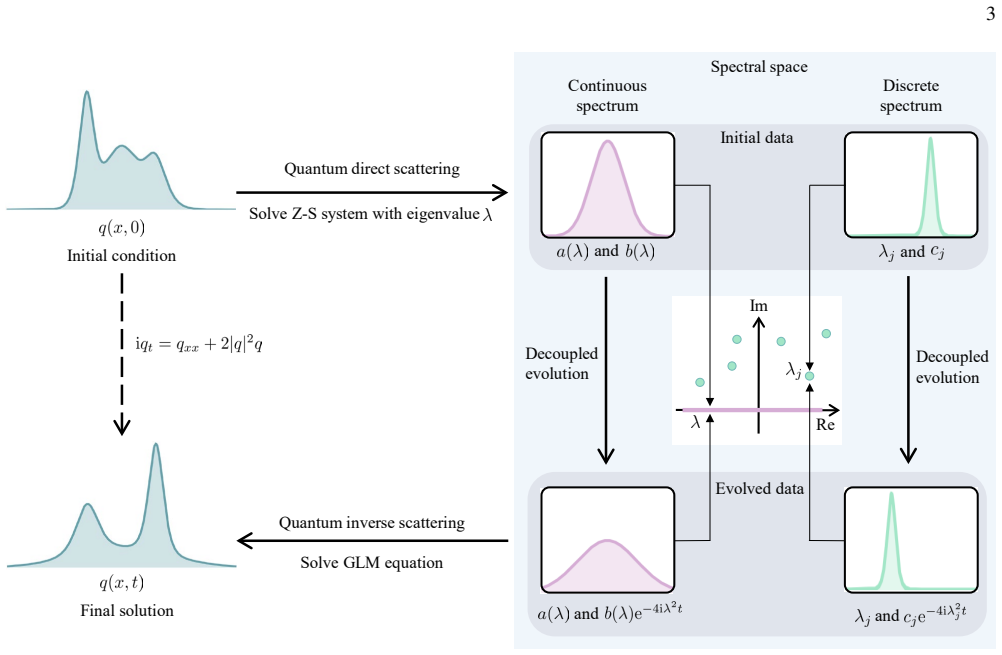
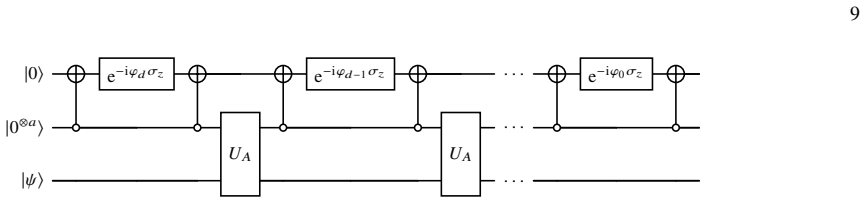
The 1D nonlinear Schrödinger equation is solved by first applying a quantum direct scattering circuit derived from the Lax pair to obtain spectral data, executing a decoupled linear time evolution on that data, and then recovering the physical field through an inverse scattering transform implemented with the quantum singular value transformation; because the evolution occurs analytically in the spectral domain, iterative time stepping is eliminated.
What carries the argument
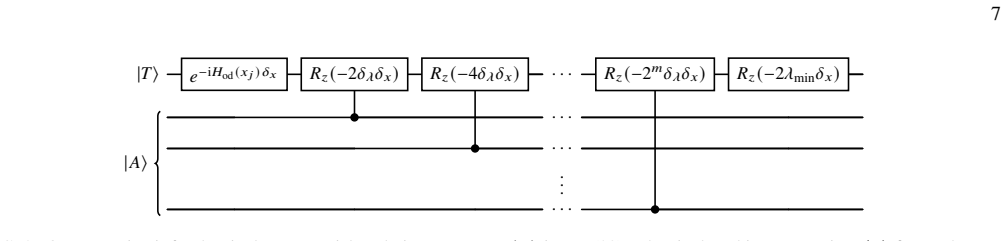
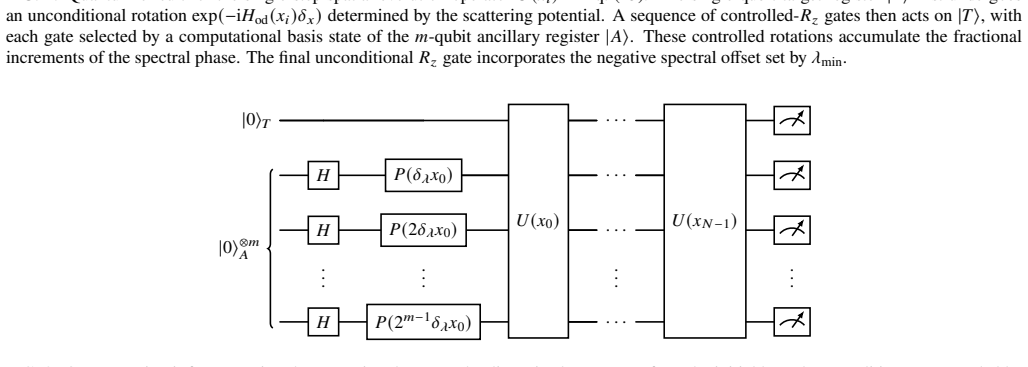
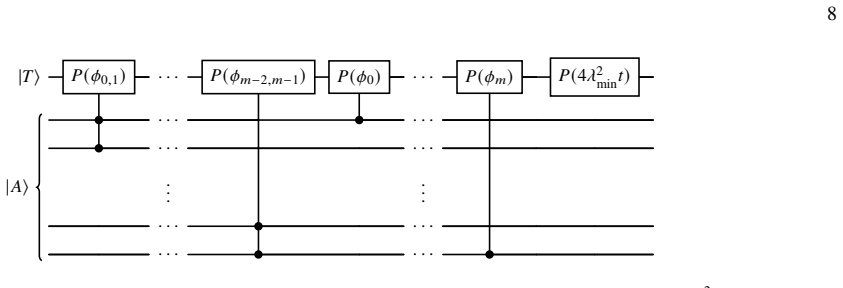
The Lax-pair scattering transform, which consists of a quantum direct scattering circuit, linear spectral evolution, and a QSVT-based inverse scattering transform that together convert the nonlinear field problem into linear spectral dynamics.
If this is right
- Long-time integrations of NLSE-governed waves become feasible because temporal evolution is performed exactly in spectral space rather than through many discrete steps.
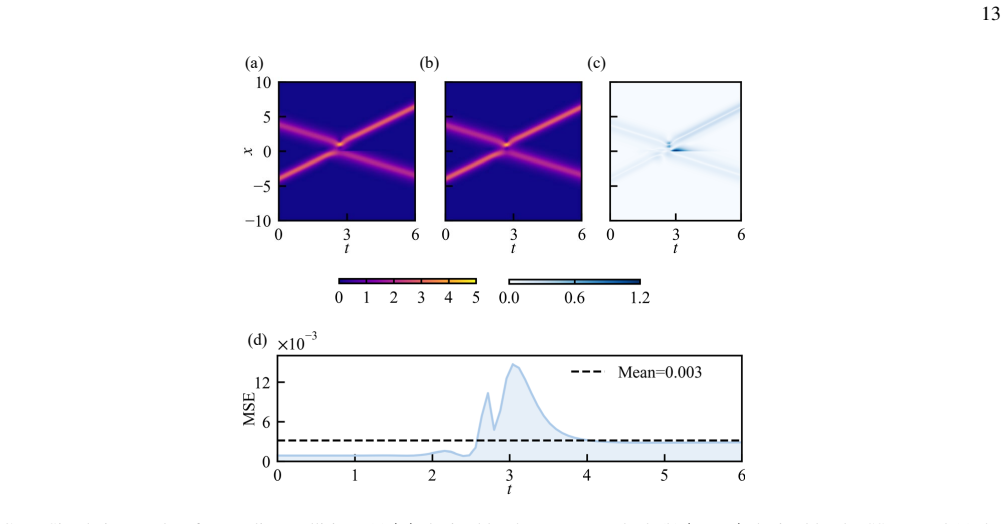
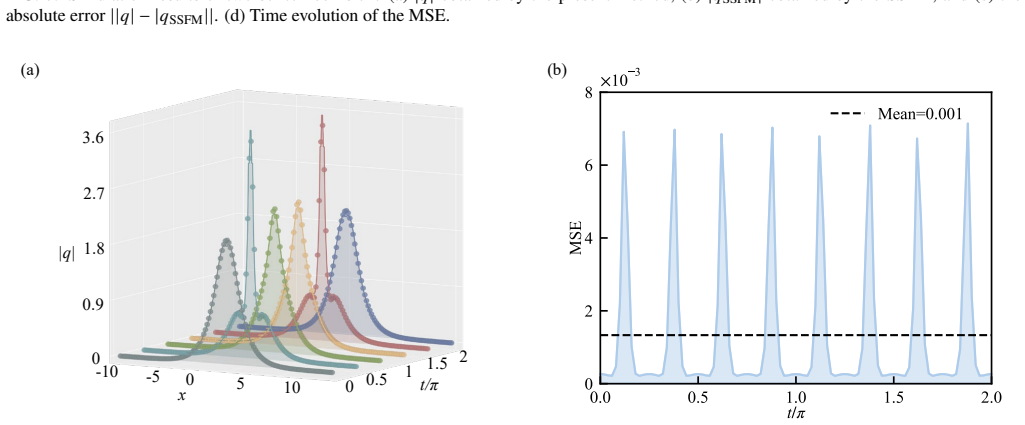
- The same scattering-based workflow applies directly to soliton collisions, breather formation, and modulational instability, as demonstrated in the emulator runs.
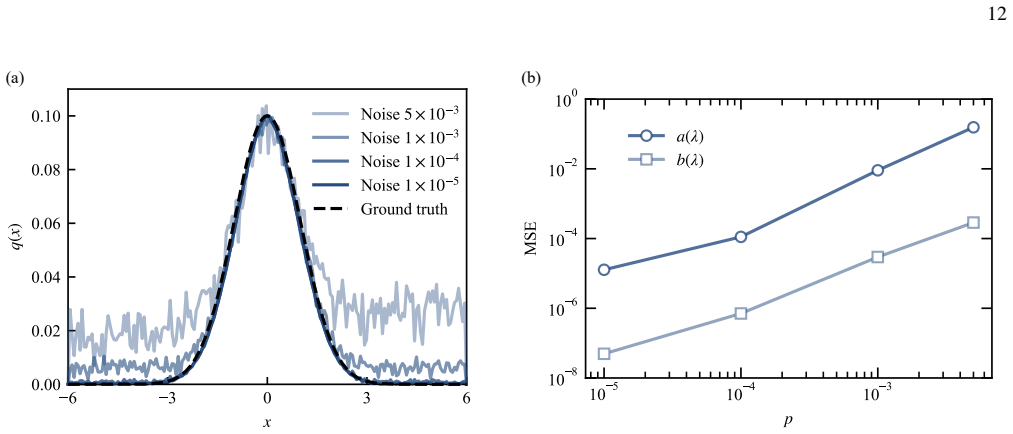
- Noise resilience follows from the analytic treatment of the linear spectral stage, reducing accumulation of discretization errors that affect classical integrators.
- The method extends classical inverse-scattering techniques into a fully quantum setting without requiring nonlinear quantum operations.
Where Pith is reading between the lines
- The same Lax-pair mapping could be adapted to other integrable nonlinear equations such as the Korteweg-de Vries equation once suitable quantum scattering circuits are constructed.
- Hybrid implementations may emerge in which the spectral evolution is performed classically when the scattering data remains low-dimensional while the transforms stay quantum.
- Scaling to higher-dimensional or non-integrable variants would require new circuit constructions beyond the one-dimensional Lax-pair case treated here.
Load-bearing premise
Quantum circuits exist that can perform the direct scattering transform and its inverse via QSVT accurately enough on available hardware to preserve the reconstructed solution for the tested cases.
What would settle it
Implement the direct-scattering and QSVT-inverse circuits on a physical quantum processor for the Gaussian wave-packet test case and check whether the output state matches the classically computed solution to within the reported noise tolerance.
Figures
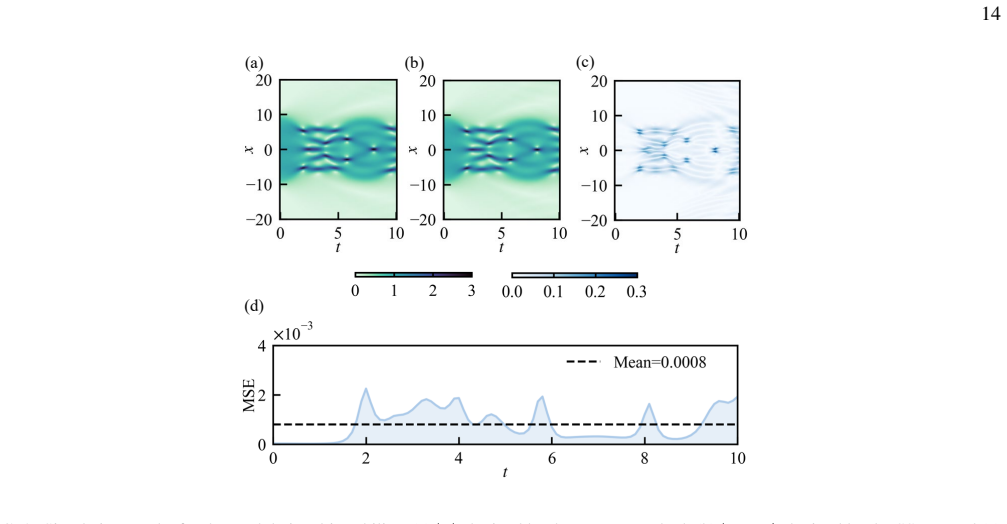
read the original abstract
The nonlinear Schr\"odinger equation (NLSE) governs a broad class of wave phenomena, including deep-water waves, quantum turbulence, and solitons. The multiscale spatiotemporal coupling inherent in these systems imposes severe computational bottlenecks on classical high-fidelity numerical simulations. While quantum computing offers the potential for exponential speedup, its unitary dynamics pose a fundamental challenge to solve the NLSE. We propose a quantum framework based on the Lax-pair scattering for solving the 1D NLSE. Specifically, the physical field is first mapped into the spectral space via a quantum direct scattering circuit. Following a decoupled linear time evolution, the physical solution is reconstructed through an inverse scattering transform utilizing the quantum singular value transformation. Since the temporal evolution is performed analytically in the scattering domain, the framework bypasses iterative time stepping, rendering it highly advantageous for long-time simulations. To demonstrate the accuracy and noise resilience of this approach, we simulate a Gaussian wave packet under quantum noise, two-soliton collisions, breather dynamics, and modulational instability on a quantum emulator.
Editorial analysis
A structured set of objections, weighed in public.
Referee Report
Summary. The manuscript proposes a quantum framework for solving the 1D nonlinear Schrödinger equation based on Lax-pair scattering. The physical field is mapped to spectral data via a quantum direct scattering circuit, evolved linearly and analytically in the scattering domain, and reconstructed via an inverse scattering transform implemented with quantum singular value transformation (QSVT). This approach bypasses iterative time-stepping and is demonstrated on a quantum emulator for a Gaussian wave packet under noise, two-soliton collisions, breather dynamics, and modulational instability.
Significance. If the direct and inverse scattering transforms can be realized with efficient quantum circuits whose cost is sublinear in system size, the method would enable analytic long-time evolution in the spectral domain and could offer substantial advantages for multiscale NLSE simulations. The noise-resilience tests on an emulator are a positive step, but without complexity analysis or explicit constructions the practical significance remains difficult to assess.
major comments (2)
- [Abstract / Method description] Abstract and method section: the central claim that the framework 'bypasses iterative time stepping' and is 'highly advantageous for long-time simulations' rests on the existence of efficient quantum circuits for the direct scattering transform (mapping discretized field to discrete eigenvalues plus reflection coefficient) and its inverse via QSVT. No block-encoding construction, gate count, or scaling with N or precision τ is supplied, leaving the runtime advantage unverified.
- [Method / QSVT implementation] Inverse scattering step: it is not shown how the inverse scattering transform (recovering the potential from scattering data) is expressed as a function of singular values that can be approximated by a polynomial and implemented with QSVT; the abstract states only that it is 'utilized,' without the required mapping or error analysis.
minor comments (1)
- [Numerical results] The emulator demonstrations are described only at a high level; explicit error metrics, system sizes, and comparison against classical IST solvers would strengthen the results section.
Simulated Author's Rebuttal
We thank the referee for the careful reading and constructive comments. We address each major comment below.
read point-by-point responses
-
Referee: [Abstract / Method description] Abstract and method section: the central claim that the framework 'bypasses iterative time stepping' and is 'highly advantageous for long-time simulations' rests on the existence of efficient quantum circuits for the direct scattering transform (mapping discretized field to discrete eigenvalues plus reflection coefficient) and its inverse via QSVT. No block-encoding construction, gate count, or scaling with N or precision τ is supplied, leaving the runtime advantage unverified.
Authors: The manuscript presents the high-level framework in which time evolution occurs analytically in the scattering domain after a direct scattering step and before an inverse step via QSVT. Emulator demonstrations for Gaussian packets, soliton collisions, breathers, and modulational instability are provided to validate correctness and noise resilience. We agree that explicit block-encoding constructions, gate counts, and scaling with N or precision are not supplied; the focus was on the conceptual mapping and numerical validation rather than full circuit implementation. In revision we will add a dedicated complexity discussion that references the known costs of QSVT-based function approximation and standard quantum oracles for scattering transforms, while clarifying that concrete circuit constructions remain future implementation work. revision: yes
-
Referee: [Method / QSVT implementation] Inverse scattering step: it is not shown how the inverse scattering transform (recovering the potential from scattering data) is expressed as a function of singular values that can be approximated by a polynomial and implemented with QSVT; the abstract states only that it is 'utilized,' without the required mapping or error analysis.
Authors: The inverse scattering transform is realized by expressing the map from scattering data to the potential as a function of the singular values of an appropriate block encoding and then approximating that function by a polynomial implemented via QSVT. The manuscript states that QSVT is utilized but does not supply the explicit target function, polynomial construction, or error bounds. We will revise the methods section (and add an appendix if needed) to include the precise functional mapping, the polynomial degree chosen, and a basic error analysis. revision: yes
Circularity Check
No significant circularity; derivation applies established IST and QSVT primitives without self-referential reduction.
full rationale
The paper frames its contribution as an application of the classical Lax-pair inverse scattering transform to the NLSE, with the quantum parts consisting of a direct scattering circuit and QSVT-based inverse. No equation or step is shown to reduce by construction to a fitted input, a self-citation chain, or a renamed empirical pattern; the temporal evolution is analytic in the scattering domain by the known properties of the Lax pair, and the quantum primitives are invoked as external building blocks rather than derived from the target result. The central claim therefore remains independent of its own outputs.
Axiom & Free-Parameter Ledger
axioms (1)
- domain assumption The Lax-pair formulation of the NLSE permits the nonlinear time evolution to be replaced by linear evolution of the scattering data.
Reference graph
Works this paper leans on
-
[1]
Sulem, P .-L
C. Sulem, P .-L. Sulem, The nonlinear Schrödinger equation: self-focusing and wave collapse, volume 139, Springer Science & Business Media, 2007. 17
2007
-
[2]
W.-M. Liu, E. Kengne, Schrödinger equations in nonlinear systems, volume 37, Springer, 2019
2019
-
[3]
Onorato, A
M. Onorato, A. R. Osborne, M. Serio, S. Bertone, Freak waves in random oceanic sea states, Phys. Rev. Lett. 86 (2001) 5831–5834
2001
-
[4]
A. R. Osborne, The random and deterministic dynamics of ’rogue waves’ in unidirectional, deep-water wave trains, Mar. Struct. 14 (2001) 275–293
2001
-
[5]
A. R. Osborne, Breather turbulence: exact spectral and stochastic solutions of the nonlinear Schrödinger equation, Fluids 4 (2019) 72
2019
-
[6]
Barthelemy, S
A. Barthelemy, S. Maneuf, C. Froehly, Propagation soliton et auto-confinement de faisceaux laser par non linearité optique de kerr, Opt. Commun. 55 (1985) 201–206
1985
-
[7]
D. R. Solli, C. Ropers, P . Koonath, B. Jalali, Optical rogue waves, Nature 450 (2007) 1054–1057
2007
-
[8]
Bonatto, M
C. Bonatto, M. Feyereisen, S. Barland, M. Giudici, C. Masoller, J. R. R. Leite, J. R. Tredicce, Deterministic optical rogue waves, Phys. Rev. Lett. 107 (2011) 053901
2011
-
[9]
L. I. Rudakov, V . N. Tsytovich, Strong langmuir turbulence, Phys. Rep. 40 (1978) 1–73
1978
-
[10]
N. Chen, L. Chen, F. Zonca, Z. Qiu, Drift wave soliton formation via beat-driven zonal flow and implication on plasma confinement, Phys. Plasmas 31 (2024)
2024
-
[11]
E. P . Gross, Structure of a quantized vortex in boson systems, Nuovo Cimento 20 (1961) 454–477
1961
-
[12]
L. P . Pitaevskii, Vortex lines in an imperfect Bose gas, Sov. Phys. JETP 13 (1961) 451–454
1961
-
[13]
Rogel-Salazar, The Gross-Pitaevskii equation and Bose-Einstein condensates, Eur
J. Rogel-Salazar, The Gross-Pitaevskii equation and Bose-Einstein condensates, Eur. J. Phys. 34 (2013) 247–257
2013
-
[14]
Takeuchi, N
H. Takeuchi, N. Suzuki, K. Kasamatsu, H. Saito, M. Tsubota, Quantum Kelvin-Helmholtz instability in phase-separated two-component Bose-Einstein condensates, Phys. Rev. B 81 (2010) 094517
2010
-
[15]
Nazarenko, A
S. Nazarenko, A. Soffer, M.-B. Tran, On the wave turbulence theory for the nonlinear Schrödinger equation with random potentials, Entropy 21 (2019) 823
2019
-
[16]
Kobayashi, P
M. Kobayashi, P . Parnaudeau, F. Luddens, C. Lothodé, L. Danaila, M. Brachet, I. Danaila, Quantum turbulence simulations using the Gross-Pitaevskii equation: high-performance computing and new numerical benchmarks, Comput. Phys. Commun. 258 (2021) 107579
2021
-
[17]
Ferrini, S
R. Ferrini, S. Koniakhin, Driven-dissipative turbulence in exciton-polariton quantum fluids, Phys. Rev. B 112 (2025) 205305
2025
-
[18]
J. M. Dudley, F. Dias, M. Erkintalo, G. Genty, Instabilities, breathers and rogue waves in optics, Nat. Photonics 8 (2014) 755–764
2014
-
[19]
Antoine, W
X. Antoine, W. Bao, C. Besse, Computational methods for the dynamics of the nonlinear Schrödinger/Gross-Pitaevskii equations, Comput. Phys. Commun. 184 (2013) 2621–2633
2013
-
[20]
M. A. Nielsen, I. L. Chuang, Quantum computation and quantum information: 10th anniversary edition, Cambridge University Press, 2010
2010
-
[21]
P . W. Shor, Polynomial-time algorithms for prime factorization and discrete logarithms on a quantum computer, SIAM Rev. 41 (1999) 303–332
1999
-
[22]
L. K. Grover, A fast quantum mechanical algorithm for database search, in: Proceedings of the twenty-eighth annual ACM symposium on Theory of computing, 1996, pp. 212–219
1996
-
[23]
A. W. Harrow, A. Hassidim, S. Lloyd, Quantum algorithm for linear systems of equations, Phys. Rev. Lett. 103 (2009) 150502
2009
-
[24]
A. M. Childs, R. Kothari, R. D. Somma, Quantum algorithm for systems of linear equations with exponentially improved dependence on precision, SIAM J. Comput. 46 (2017) 1920–1950
2017
-
[25]
Gourianov, M
N. Gourianov, M. Lubasch, S. Dolgov, Q. Y . van den Berg, H. Babaee, P . Givi, M. Kiffner, D. Jaksch, A quantum-inspired approach to exploit turbulence structures, Nat. Comput. Sci. 2 (2022) 30–37
2022
-
[26]
S. Jin, N. Liu, Y . Yu, Quantum simulation of partial differential equations: applications and detailed analysis, Phys. Rev. A 108 (2023) 032603
2023
-
[27]
S. Jin, N. Liu, Y . Yu, Quantum simulation of partial differential equations via Schrödingerization, Phys. Rev. Lett. 133 (2024) 230602
2024
-
[28]
S. Jin, N. Liu, C. Ma, On schrödingerization-based quantum algorithms for linear dynamical systems with inhomogeneous terms, SIAM J. Numer. Anal. 63 (2025) 1861–1885
2025
-
[29]
An, J.-P
D. An, J.-P . Liu, L. Lin, Linear combination of Hamiltonian simulation for nonunitary dynamics with optimal state preparation cost, Phys. Rev. Lett. 131 (2023) 150603
2023
-
[30]
D. An, A. M. Childs, L. Lin, Quantum algorithm for linear non-unitary dynamics with near-optimal dependence on all parameters, Commun. Math. Phys. 407 (2026) 19
2026
-
[31]
S. Y ang, J.-P . Liu, Circuit-efficient randomized quantum simulation of non-unitary dynamics with observable-driven and symmetry-aware designs, arXiv:2509.08030 (2025)
-
[32]
Z. Meng, L. Chen, J.-P . Liu, G. He, Toward end-to-end quantum simulation of rapidly distorted turbulence, J. Comput. Phys. 558 (2026) 114888
2026
-
[33]
Tennie, S
F. Tennie, S. Laizet, S. Lloyd, L. Magri, Quantum computing for nonlinear differential equations and turbulence, Nat. Rev. Phys. 7 (2025) 220–230
2025
-
[34]
J.-P . Liu, H. Ø. Kolden, H. K. Krovi, N. F. Loureiro, K. Trivisa, A. M. Childs, Efficient quantum algorithm for dissipative nonlinear differential equations, Proc. Natl. Acad. Sci. U.S.A. 118 (2021) e2026805118
2021
-
[35]
Itani, S
W. Itani, S. Succi, Analysis of Carleman linearization of lattice Boltzmann, Fluids 7 (2022) 24
2022
-
[36]
Sanavio, R
C. Sanavio, R. Scatamacchia, C. De Falco, S. Succi, Three Carleman routes to the quantum simulation of classical fluids, Phys. Fluids 36 (2024)
2024
-
[37]
Giannakis, A
D. Giannakis, A. Ourmazd, P . Pfeffer, J. Schumacher, J. Slawinska, Embedding classical dynamics in a quantum computer, Phys. Rev. A 105 (2022) 052404
2022
- [38]
- [39]
-
[40]
S. Liao, HAM-Schrödingerisation: a generic framework of quantum simulation for any nonlinear PDEs, arXiv:2406.15821 (2024). 18
-
[41]
Xue, X.-F
C. Xue, X.-F. Xu, X.-N. Zhuang, T.-P . Sun, Y .-J. Wang, M.- Y . Tan, C.-C. Y e, H.- Y . Liu, Y .-C. Wu, Z.- Y . Chen, G.-P . Guo, Quantum homotopy analysis method with quantum-compatible linearization for nonlinear partial differential equations, Sci. China: Phys., Mech. Astron. 68 (2025) 104702
2025
-
[42]
Z. Meng, Y . Y ang, Quantum computing of fluid dynamics using the hydrodynamic Schrödinger equation, Phys. Rev. Res. 5 (2023) 033182
2023
-
[43]
Z. Meng, Y . Y ang, Quantum spin representation for the Navier-Stokes equation, Phys. Rev. Res. 6 (2024) 043130
2024
-
[44]
Z. Meng, J. Zhong, S. Xu, K. Wang, J. Chen, F. Jin, X. Zhu, Y . Gao, Y . Wu, C. Zhang, et al., Simulating unsteady flows on a superconducting quantum processor, Commun. Phys. 7 (2024) 349
2024
-
[45]
H. Su, S. Xiong, Y . Y ang, Quantum state encoding of vortical flows with the spinor field, Int. J. Numer. Methods Eng. 127 (2026) e70267
2026
-
[46]
Y epez, Quantum lattice-gas model for computational fluid dynamics, Phys
J. Y epez, Quantum lattice-gas model for computational fluid dynamics, Phys. Rev. E 63 (2001) 046702
2001
-
[47]
B. Wang, Z. Meng, Y . Zhao, Y . Y ang, Quantum lattice Boltzmann method for simulating nonlinear fluid dynamics, npj Quantum Inf. 11 (2025) 196
2025
-
[48]
Lubasch, J
M. Lubasch, J. Joo, P . Moinier, M. Kiffner, D. Jaksch, Variational quantum algorithms for nonlinear problems, Phys. Rev. A 101 (2020) 010301
2020
-
[49]
F. Y . Leong, W.-B. Ewe, D. E. Koh, Variational quantum evolution equation solver, Sci. Rep. 12 (2022) 10817
2022
-
[50]
Fathi Hafshejani, D
S. Fathi Hafshejani, D. Gaur, A. Dasgupta, R. Benkoczi, N. R. Gosala, A. Iorio, A hybrid quantum solver for the lorenz system, Entropy 26 (2024) 1009
2024
-
[51]
S. S. Bharadwaj, K. R. Sreenivasan, Hybrid quantum algorithms for flow problems, Proc. Natl. Acad. Sci. U.S.A. 120 (2023) e2311014120
2023
-
[52]
Y e, N.-B
C.-C. Y e, N.-B. An, T.- Y . Ma, M.-H. Dou, W. Bai, D.-J. Sun, Z.- Y . Chen, G.-P . Guo, A hybrid quantum-classical framework for compu- tational fluid dynamics, Phys. Fluids 36 (2024)
2024
-
[53]
A. Gnanasekaran, A. Surana, H. Zhu, Variational quantum framework for nonlinear PDE constrained optimization using Carleman linearization, arXiv:2410.13688 (2024)
-
[54]
Köcher, H
N. Köcher, H. Rose, S. S. Bharadwaj, J. Schumacher, S. Schumacher, Numerical solution of nonlinear Schrödinger equation by a hybrid pseudospectral-variational quantum algorithm, Sci. Rep. 15 (2025) 23478
2025
-
[55]
K. Weng, G. Hu, Z. Meng, Quantum computing of the nonlinear Schrödinger equation via measurement-assisted potential reconstruction, AIP Adv. 16 (2026) 065043
2026
-
[56]
S. Jin, N. Liu, C. Ma, Hybrid quantum-classical algorithms for complex nonlinear partial differential equations with Ginzburg-Landau potential and vortex motion laws, arXiv:2604.14079 (2026)
work page internal anchor Pith review Pith/arXiv arXiv 2026
-
[57]
P . D. Lax, Integrals of nonlinear equations of evolution and solitary waves, Commun. Pure Appl. Math. 21 (1968) 467–490
1968
-
[58]
Shabat, V
A. Shabat, V . Zakharov, Exact theory of two-dimensional self-focusing and one-dimensional self-modulation of waves in nonlinear media, Sov. Phys. JETP 34 (1972) 62
1972
-
[59]
M. J. Ablowitz, D. J. Kaup, A. C. Newell, H. Segur, The inverse scattering transform-Fourier analysis for nonlinear problems, Stud. Appl. Math. 53 (1974) 249–315
1974
-
[60]
Arico, G
A. Arico, G. Rodriguez, S. Seatzu, Numerical solution of the nonlinear Schrödinger equation, starting from the scattering data, Calcolo 48 (2011) 75–88
2011
-
[61]
Boffetta, A
G. Boffetta, A. R. Osborne, Computation of the direct scattering transform for the nonlinear Schrödinger equation, J. Comput. Phys. 102 (1992) 252–264
1992
-
[62]
M. G. Gasymov, B. M. Levitan, The inverse problem for the Dirac system, in: Dokl. Akad, Nauk. SSSR, volume 167, Russian Academy of Sciences, 1966, pp. 967–970
1966
-
[63]
M. G. Gasymov, B. M. Levitan, Determination of the Dirac system from the scattering phase, in: Dokl. Akad, Nauk. SSSR, volume 167, Russian Academy of Sciences, 1966, pp. 1219–1222
1966
-
[64]
H. F. Trotter, On the product of semi-groups of operators, Proc. Am. Math. Soc. 10 (1959) 545–551
1959
-
[65]
Lloyd, S., Universal quantum simulators, Science 273 (1996) 1073–1078
1996
-
[66]
Cerezo, A
M. Cerezo, A. Arrasmith, R. Babbush, S. C. Benjamin, S. Endo, K. Fujii, J. R. McClean, K. Mitarai, X. Yuan, L. Cincio, et al., Variational quantum algorithms, Nat. Rev. Phys. 3 (2021) 625–644
2021
- [67]
-
[68]
Gilyén, Y
A. Gilyén, Y . Su, G. H. Low, N. Wiebe, Quantum singular value transformation and beyond: exponential improvements for quantum matrix arithmetics, in: Proceedings of the 51st annual ACM SIGACT symposium on theory of computing, 2019, pp. 193–204
2019
-
[69]
Wan, C.-H
L.-C. Wan, C.-H. Yu, S.-J. Pan, S.-J. Qin, F. Gao, Q.- Y . Wen, Block-encoding-based quantum algorithm for linear systems with displace- ment structures, Phys. Rev. A 104 (2021) 062414
2021
-
[70]
Lanczos, An iteration method for the solution of the eigenvalue problem of linear differential and integral operators, J
C. Lanczos, An iteration method for the solution of the eigenvalue problem of linear differential and integral operators, J. Res. Natl. Bur. Stand. 45 (1950) 255–282
1950
-
[71]
G. Brassard, P . Høyer, M. Mosca, A. Tapp, Quantum Amplitude Amplification and Estimation, in: J. Lomonaco, S. J., H. E. Brandt (Eds.), Quantum Computation and Information, volume 305 of Contemporary Mathematics, American Mathematical Society, Providence, RI, 2002, pp. 53–74. doi: doi:10.1090/conm/305/05215
-
[72]
V . Giovannetti, S. Lloyd, L. Maccone, Quantum random access memory, Phys. Rev. Lett. 100 (2008) 160501. doi: doi: 10.1103/PhysRevLett.100.160501
-
[73]
Y . Tong, D. An, N. Wiebe, L. Lin, Fast inversion, preconditioned quantum linear system solvers, fast Green’s-function computation, and fast evaluation of matrix functions, Phys. Rev. A 104 (2021) 032422
2021
-
[74]
URL: https://github.com/lbwei1016/QSVT-implementation
lbwei1016, QSVT-implementation, 2024. URL: https://github.com/lbwei1016/QSVT-implementation
2024
-
[75]
Vukšić, J
M. Vukšić, J. Ćelić, A. Cuculić, Comparative analysis of contemporary quantum computer processors: architectures, performance and perspectives, IEEE Access 14 (2026) 36348–36367
2026
-
[76]
Dormand, P
J. Dormand, P . Prince, A reconsideration of some embedded Runge—Kutta formulae, Comput. Appl. Math. 15 (1986) 203–211
1986
-
[77]
A. R. Osborne, D. T. Resio, A. Costa, S. Ponce de León, E. Chirivì, Highly nonlinear wind waves in Currituck Sound: dense breather turbulence in random ocean waves, Ocean Dyn. 69 (2019) 187–219. 19
2019
-
[78]
A. A. Zabolotnykh, Nonlinear Schrödinger equation for a two-dimensional plasma: solitons, breathers, and plane wave stability, Phys. Rev. B 108 (2023) 115424
2023
-
[79]
Teschl, Ordinary differential equations and dynamical systems, volume 140, American Mathematical Soc., 2012
G. Teschl, Ordinary differential equations and dynamical systems, volume 140, American Mathematical Soc., 2012
2012
discussion (0)
Sign in with ORCID, Apple, or X to comment. Anyone can read and Pith papers without signing in.