REVIEW 3 major objections 5 minor 54 references
Insulator-metal transition and topological superconductivity in UTe2 from a first-principles calculation
T0 review · 3 major / 5 minor · reviewed 2026-08-14 · deepseek-v4-flash
Pith's one-line read This paper predicts that electron correlations turn UTe2 into a time-reversal-invariant topological superconductor for every odd-parity pairing symmetry allowed by its crystal structure.
desk verdict A timely, honest prediction paper mapping UTe2's odd-parity pairing onto topological invariants, but the metallic Fermi surfaces it depends on only exist for a Coulomb U the paper cannot pin down. read the letter →
The pith
A machine-rendered reading of the paper's core claim, the machinery that carries it, and where it could break.
The reading
What carries the argument
The load-bearing identity is the Fermi-surface formula for the winding number, $\omega = \tfrac{1}{2}\sum_{\mathbf{K}_i} n(\mathbf{K}_i) \pmod 2$, together with analogous formulas for the $\mathbb{Z}_2$ invariants $\nu_1$, $\nu_2$, and $\nu_3$ on the $k_x=0$, $k_y=0$, and $k_z=0$ time-reversal-invariant planes, evaluated in the folded Brillouin zone because the doubled unit cell is compatible with the (100), (010), and (001) surfaces. The occupation numbers come from GGA+U band structures, so the chain runs from the correlation-strength parameter U to Fermi-surface topology to superconducting topology. Gap structures are then classified by the effective Altland-Zirnbauer symmetry class on high-symmetry mirror planes and rotational axes.
What would settle it
Measure the Fermi surface of UTe2 by quantum oscillations or ARPES: if the observed sheets match the small Fermi surfaces of the plain DFT calculation, or if the material is insulating at low temperatures, the predicted winding numbers and Majorana surface states do not follow. A complementary check is low-temperature thermal conductivity: for regions (i) and (ii), B2u pairing requires $\kappa_b > \kappa_{a,c}$ and B3u requires $\kappa_a > \kappa_{b,c}$, so observing different anisotropies would rule out the predicted gap-node structure.
Extended reading notes
Core claim
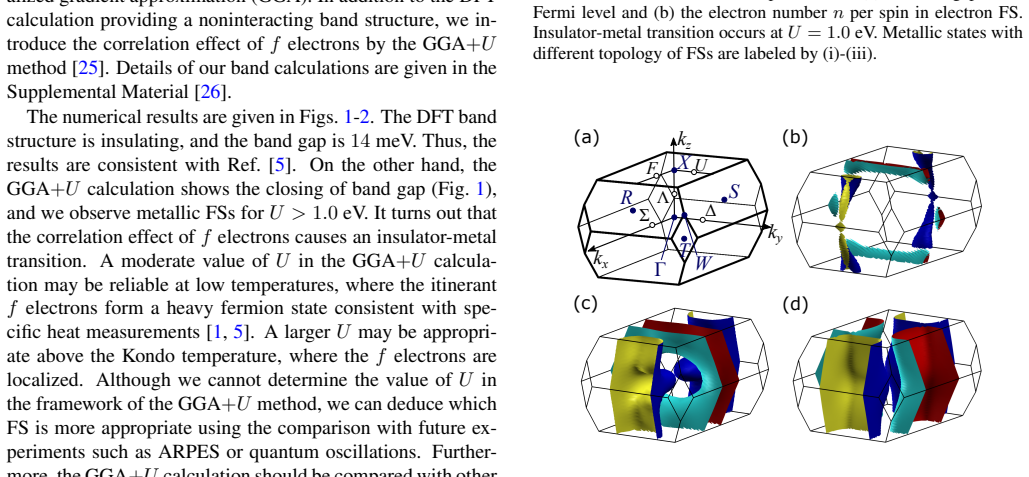
The central discovery is that a Coulomb interaction strength U above about 1.0 eV drives an insulator-metal transition in UTe2, producing Fermi surfaces whose occupation numbers at the eight time-reversal-invariant momenta make the three-dimensional winding number and all three two-dimensional Z2 invariants nontrivial for the moderate-U Fermi surfaces labeled (i) and (ii). Consequently, for each of the four odd-parity irreducible representations Au, B1u, B2u, and B3u, the gapped superconducting bulk is topologically nontrivial, and Majorana surface states appear on the (100), (010), and (001) surfaces. The gap structure depends on pairing symmetry: Au is fully gapped, B1u has point nodes on the kz axis, B2u on the ky axes, and B3u on the kx axes for regions (i) and (ii), while in region (iii) only Au remains topological with an even winding number and B1u becomes fully gapped.
Load-bearing premise
Everything rests on the assumption that a corrected density-functional calculation with an adjustable Coulomb repulsion U above about 1 eV captures the real low-temperature electronic state of the uranium 5f electrons, and the paper itself states that the GGA+U method cannot determine U.
Editorial extensions
If this is right
- If the central claim is right, UTe2 is an intrinsic time-reversal-invariant class DIII topological superconductor, and clean (100), (010), and (001) surfaces should show zero-energy Majorana states detectable by tunneling spectroscopy or ARPES.
- The predicted pairing-symmetry dependence of gap nodes gives distinct thermal-conductivity anisotropies: B1u gives $\kappa_c > \kappa_{a,b}$, B2u gives $\kappa_b > \kappa_{a,c}$, and B3u gives $\kappa_a > \kappa_{b,c}$ for regions (i) and (ii), so a single bulk measurement can select the pairing channel.
- Under a magnetic field along the b axis, the theory predicts two superconducting phases, a line-nodal Bu state at low field and a point-nodal Au state at high field, offering an explanation for the re-entrant superconductivity and a testable field dependence of specific heat and Knight shift.
- The nesting of the calculated Fermi surfaces implies that UTe2 sits near multiple magnetic instabilities, which is consistent with the absence of magnetic order despite strong ferromagnetic fluctuations.
Reading between the lines
- If confirmed, UTe2 would become a material platform for exploring non-Abelian Majorana quasiparticles in a three-dimensional superconductor; the paper itself does not discuss quantum-computation applications.
- The results suggest a practical rule of thumb for actinide heavy-fermion compounds where plain DFT gives a small gap: a GGA+U Fermi surface at intermediate U may be enough for a topological classification. A direct dynamical-mean-field calculation would test whether the U-dependence of these Fermi surfaces survives a more rigorous treatment of correlations.
- Because the topology holds for all four odd-parity pairings at moderate U, the paper implies that the topological superconductivity is controlled by the Fermi-surface geometry rather than by any one pairing mechanism. A testable extension is to feed experimentally measured Fermi surfaces, from quantum oscillations or ARPES, into the same winding-number and Z2 formulas without assuming a specific U
Signed reviews
Editorial analysis
A structured set of objections, weighed in public.
Referee Report
Summary. The paper reports GGA+U electronic structure calculations for the heavy-fermion superconductor UTe2. It finds an insulator-metal transition driven by the Coulomb U parameter, with metallic Fermi surfaces appearing for U > 1.0 eV, and classifies the resulting Fermi-surface topologies into three regions (i)-(iii). Assuming odd-parity pairing and time-reversal symmetry, the authors use Fermi-surface formulas to compute the 3D winding number and three 2D Z2 invariants in the folded Brillouin zone, concluding that for regions (i) and (ii) all four odd-parity pairing symmetries of the Immm space group give topological superconductivity with Majorana surface states on (100), (010), and (001). They also present a symmetry-based classification of gap nodes using effective Altland-Zirnbauer classes and propose experimental tests, including thermal-conductivity anisotropy, to determine the pairing symmetry. A schematic field-temperature phase diagram under magnetic fields along the b axis is also proposed.
Significance. If the metallic Fermi surfaces obtained at U > 1 eV describe the actual low-temperature state of UTe2, the paper provides a concrete and falsifiable prediction of an intrinsic time-reversal-invariant (class DIII) topological superconductor with Majorana surface states, a rare and sought-after situation. The use of well-established Fermi-surface formulas for topological invariants and the systematic EAZ classification of gap nodes are rigorous tools that give the paper a clear logical structure. The predictions for gap structures and surface states are testable by STM, ARPES, and thermal transport. However, the central result is conditional on the choice of the Coulomb parameter U, whose physical value is not determined in the paper, and the competing DFT+U calculation at lower U gives an insulating state. The strength of the conclusion therefore depends on an unestablished premise.
major comments (3)
- The entire topological prediction rests on the insulator-metal transition at U = 1.0 eV, yet the paper explicitly states (p.2) that "we cannot determine the value of U in the framework of the GGA+U method." The competing DFT+U calculation at U = J = 0.51 eV cited as Ref. [42] yields an insulating state, and the bare DFT result is also insulating. Since Table II's invariants (1,1,1,1) for regions (i) and (ii) require the metallic Fermi surfaces, and region (iii) is trivial for most pairings, the claim that UTe2 is a topological superconductor for all odd-parity pairings is not established for the physical material unless an independent constraint on U is provided. The authors should either derive such a constraint (e.g., from specific heat, quantum oscillations, or ARPES) or explicitly frame the result as a conditional prediction over the unknown U window and identify experimental measurements that would discriminate between the regions.
- The occupation numbers n(Ki) in Table II, which determine the parity of the topological invariants, are read off from Fermi surfaces that are tiny near the transition (region (i), U = 1.0 eV). The paper provides no convergence tests with respect to the k-mesh, no comparison of the two double-counting schemes beyond a statement in the Supplemental Material that results were crosschecked, and no deposited input files or raw Fermi-surface data. Since the parity of n(Ki) can change if a small pocket is missed or spuriously created by numerical noise, the authors should demonstrate stability of the Table II entries against numerical parameters (e.g., k-mesh density, RMTKmax, and double-counting prescription) and, ideally, provide the calculated occupancies at all TRIM for each U value.
- The gap-node classification in Table S2 is derived under the assumption that the high-symmetry planes and axes intersect the normal-state Fermi surfaces (stated in the Supplemental Material). The paper does not explicitly verify this condition for the Fermi surfaces in Figs. 2(b)-(d). For instance, a point node on the kz axis (Λ) for the B1u state only affects the excitation spectrum if the Fermi surface actually crosses that axis. If the small electron and hole pockets in regions (i) and (ii) do not intersect the relevant symmetry lines, the predicted point nodes would be absent, and the associated surface Majorana states would not appear as claimed. The authors should check the intersection of each symmetry line and plane with the calculated Fermi surfaces and update Table III accordingly.
minor comments (5)
- The abstract states "topological superconductivity at an intermediate U for all the odd-parity pairing symmetry," but the main text limits this claim to regions (i) and (ii); for region (iii) only the Au state may be topological with an even winding number. This wording should be made more precise to avoid overstatement.
- The explanation of the folded Brillouin zone and the correspondence in Table I is terse. A short derivation or a sketch showing how the doubled unit cell is compatible with the (100), (010), (001) surfaces would help readers trust the use of the folded BZ for the FS formulas.
- The caption says "The values n(Ki)-180 are shown below," but the meaning of the constant 180 and why it is subtracted are not explained in the text. Please clarify.
- The phase diagram in Fig. 3 is schematic and based on symmetry considerations plus qualitative energy arguments. The paper should state explicitly that the proposed two-phase structure is a conjecture, not a result of a microscopic calculation.
- The paragraph on magnetism suggests nesting-induced finite-q fluctuations coexisting with ferromagnetic fluctuations. This is an interesting speculation, but it is not developed quantitatively; please indicate whether this is a suggestion or a derived result.
Circularity Check
No circularity: topological invariants are computed from GGA+U Fermi surfaces with external Fermi-surface formulas; the adjustable U is a stated uncertainty, not a fitted input that forces the conclusion.
full rationale
The derivation is self-contained on the points where the paper makes formal claims. The topological invariants in Table II are computed from occupation numbers n(Ki) obtained from the GGA+U band structures via external Fermi-surface formulas (Eq. (1) and the corresponding Z2 formulas, citing Refs. [11-13]); these formulas do not encode the UTe2 result, and the n(Ki) values are not fitted to superconducting observables. The insulator-metal transition is a parametric property of GGA+U as a function of the adjustable U; the paper explicitly states 'we cannot determine the value of U in the framework of the GGA+U method' and therefore does not present U as a fitted prediction. The gap-node classification uses the authors' earlier EAZ-classification framework (Refs. [18-21], [36,37] and Supplemental Refs. [S7-S17]); this is a parameter-free mathematical classification whose stated assumptions do not include the UTe2 Fermi surfaces, so invoking it is legitimate evidence rather than circular self-support. The remaining uncertainties—e.g., the physically relevant U and the competing insulating DFT+U result at U=J=0.51 eV—are parameter-identification and reproducibility limitations, not reductions of the conclusion to its inputs. No equation in the paper is shown to equal its own premise by construction, and the sweep even yields a trivial outcome (region (iii), omega=0), confirming that the nontrivial invariants are not forced by the method itself.
Assumptions & free parameters
free parameters (2)
- Coulomb U in GGA+U =
U > 1.0 eV for metallic states; representative U = 1.0, 1.1, 2.0 eV
- Hund coupling J =
0 eV (fixed by hand)
assumptions (5)
- domain assumption The zero-field superconducting state of UTe2 has odd-parity pairing and preserves time-reversal symmetry.
- standard math The parity of the 3D winding number and the 2D Z2 invariants is determined by occupation numbers at time-reversal invariant momenta (Sato, Fu and Berg).
- standard math Folding to the doubled unit cell is the correct way to evaluate surface invariants for the (100), (010), and (001) surfaces.
- domain assumption GGA+U with around-mean-field double counting and J=0 is a faithful low-energy approximation for UTe2 correlations.
- standard math The effective Altland-Zirnbauer classification of gap nodes on mirror planes and rotational axes is correct.
Cite this review
Pith. "Pith review of Insulator-metal transition and topological superconductivity in UTe2 from a first-principles calculation." pith.science (2026). https://pith.science/paper/DLCBATVT
@misc{pith2026190804004,
  author       = {Pith},
  title        = {Pith review of: Insulator-metal transition and topological superconductivity in UTe2 from a first-principles calculation},
  year         = {2026},
  howpublished = {\url{https://pith.science/paper/DLCBATVT}},
  note         = {Machine review of arXiv:1908.04004}
}
abstract
We theoretically study superconductivity in UTe$_2$, which is a recently-discovered strong candidate for an odd-parity spin-triplet superconductor. Theoretical studies for this compound faced difficulty because first-principles calculations predict an insulating electronic state, incompatible with superconducting instability. To overcome this problem, we take into account electron correlation effects by a GGA$+U$ method and show the insulator-metal transition by Coulomb interaction. Using Fermi surfaces obtained as a function of $U$, we clarify topological properties of possible superconducting states. Fermi surface formulas for the three-dimensional winding number and three two-dimensional $\mathbb{Z}_2$ numbers indicate topological superconductivity at an intermediate $U$ for all the odd-parity pairing symmetry in the $Immm$ space group. Symmetry and topology of superconducting gap node are analyzed and the gap structure of UTe$_2$ is predicted. Topologically protected low-energy excitations are highlighted, and experiments by bulk and surface probes are proposed to link Fermi surfaces and pairing symmetry. Based on the results, we also discuss multiple superconducting phases under magnetic fields, which were implied by recent experiments.
Figures


Reference graph
Works this paper leans on
-
[42]
A. B. Shick and W. E. Pickett, Phys. Rev. B100, 134502 (2019)
work page 2019
-
[1]
S. Ran, C. Eckberg, Q.-P. Ding, Y . Furukawa, T. Metz, S. R. Saha, I.-L. Liu, M. Zic, H. Kim, J. Paglione, and N. P. Butch, Science 365, 684 (2019)
work page 2019
- [2]
-
[3]
D. Aoki, K. Ishida, and J. Flouquet, J. Phys. Soc. Jpn. 88, 022001 (2019)
2019
- [4]
-
[5]
D. Aoki, A. Nakamura, F. Honda, D. Li, Y . Homma, Y . Shimizu, Y . J. Sato, G. Knebel, J.-P. Brison, A. Pourret, D. Braithwaite, G. Lapertot, Q. Niu, M. Vali ˇska, H. Harima, and J. Flouquet, J. Phys. Soc. Jpn. 88, 043702 (2019)
work page 2019
-
[6]
Y . Tokunaga, H. Sakai, S. Kambe, T. Hattori, N. Higa, G. Nakamine, S. Kitagawa, K. Ishida, A. Nakamura, Y . Shimizu, Y . Homma, D. Li, F. Honda, and D. Aoki, J. Phys. Soc. Jpn. 88, 073701 (2019)
work page 2019
-
[7]
S. Ran, I.-L. Liu, Y . S. Eo, D. J. Campbell, P. M. Neves, W. T. Fuhrman, S. R. Saha, C. Eckberg, H. Kim, D. Graf, F. Bal- akirev, J. Singleton, J. Paglione, and N. P. Butch, Nature Physics (2019), 10.1038/s41567-019-0670-x
Show all 54 references
-
[8]
Knebel, W
G. Knebel, W. Knafo, A. Pourret, Q. Niu, M. Valiˇska, D. Braith- waite, G. Lapertot, M. Nardone, A. Zitouni, S. Mishra, I. Sheikin, G. Seyfarth, J.-P. Brison, D. Aoki, and J. Flouquet, J. Phys. Soc. Jpn. 88, 063707 (2019)
2019
-
[9]
Knafo, M
W. Knafo, M. Valiˇska, D. Braithwaite, G. Lapertot, G. Knebel, A. Pourret, J.-P. Brison, J. Flouquet, and D. Aoki, J. Phys. Soc. Jpn. 88, 063705 (2019)
2019
-
[10]
Miyake, Y
A. Miyake, Y . Shimizu, Y . J. Sato, D. Li, A. Nakamura, Y . Homma, F. Honda, J. Flouquet, M. Tokunaga, and D. Aoki, J. Phys. Soc. Jpn. 88, 063706 (2019)
2019
-
[11]
Sato, Phys
M. Sato, Phys. Rev. B 79, 214526 (2009)
2009
-
[12]
Sato, Phys
M. Sato, Phys. Rev. B 81, 220504(R) (2010)
2010
-
[13]
Fu and E
L. Fu and E. Berg, Phys. Rev. Lett. 105, 097001 (2010)
2010
-
[14]
Qi and S.-C
X.-L. Qi and S.-C. Zhang, Rev. Mod. Phys. 83, 1057 (2011)
2011
-
[15]
Sato and S
M. Sato and S. Fujimoto, J. Phys. Soc. Jpn. 85, 072001 (2016)
2016
-
[16]
Sato and Y
M. Sato and Y . Ando, Rep. Prog. Phys.80, 076501 (2017)
2017
-
[17]
Sigrist and K
M. Sigrist and K. Ueda, Rev. Mod. Phys. 63, 239 (1991)
1991
-
[18]
Kobayashi, K
S. Kobayashi, K. Shiozaki, Y . Tanaka, and M. Sato, Phys. Rev. B 90, 024516 (2014)
2014
-
[19]
Kobayashi, Y
S. Kobayashi, Y . Yanase, and M. Sato, Phys. Rev. B94, 134512 (2016)
2016
-
[20]
Kobayashi, S
S. Kobayashi, S. Sumita, Y . Yanase, and M. Sato, Phys. Rev. B 97, 180504(R) (2018)
2018
-
[21]
Sumita, T
S. Sumita, T. Nomoto, K. Shiozaki, and Y . Yanase, Phys. Rev. B 99, 134513 (2019)
2019
-
[22]
Fujimori, I
S.-i. Fujimori, I. Kawasaki, Y . Takeda, H. Yamagami, A. Naka- mura, Y . Homma, and D. Aoki, J. Phys. Soc. Jpn. 88, 103701 (2019)
2019
-
[23]
Fermi- Surface Instabilities in the Heavy-Fermion Superconductor UTe2,
Q. Niu, G. Knebel, D. Braithwaite, D. Aoki, G. Lapertot, G. Seyfarth, J.-P. Brison, J. Flouquet, and A. Pourret, “Fermi- Surface Instabilities in the Heavy-Fermion Superconductor UTe2,” arXiv:1907.11118
1907 arXiv
-
[24]
Blaha, K
P. Blaha, K. Schwarz, G. K. H. Madsen, D. Kvasnicka, J. Luitz, R. Laskowski, F. Tran, and L. D. Marks, WIEN2k, An Aug- mented Plane Wave + Local Orbitals Program for Calculat- ing Crystal Properties (Karlheinz Schwarz, Techn. Universit¨at Wien, Austria, 2018)
2018
-
[25]
V . I. Anisimov, J. Zaanen, and O. K. Andersen, Phys. Rev. B 44, 943 (1991)
1991
-
[26]
See Supplemental Material for details, which includes Refs. [44–53]
-
[27]
Yoshida, A
T. Yoshida, A. Daido, N. Kawakami, and Y . Yanase, Phys. Rev. B 99, 235105 (2019)
2019
-
[28]
G. E. V olovik and L. P. Gor’kov, Pis’ma Zh. Eksp. Teor. Fiz. 39, 550 (1984)
1984
-
[29]
G. E. V olovik and L. P. Gor’kov, Zh. Eksp. Teor. Fiz.88, 1412 (1985)
1985
-
[30]
P. W. Anderson, Phys. Rev. B 30, 4000 (1984)
1984
-
[31]
V . G. Yarzhemsky and E. N. Murav’ev, J. Phys.: Condens. Mat- ter 4, 3525 (1992)
1992
-
[32]
M. R. Norman, Phys. Rev. B 52, 15093 (1995)
1995
-
[33]
Micklitz and M
T. Micklitz and M. R. Norman, Phys. Rev. B 80, 100506(R) (2009)
2009
-
[34]
Nomoto and H
T. Nomoto and H. Ikeda, J. Phys. Soc. Jpn. 86, 023703 (2017)
2017
-
[35]
Micklitz and M
T. Micklitz and M. R. Norman, Phys. Rev. Lett. 118, 207001 (2017)
2017
-
[36]
Sumita, T
S. Sumita, T. Nomoto, and Y . Yanase, Phys. Rev. Lett. 119, 027001 (2017)
2017
-
[37]
Sumita and Y
S. Sumita and Y . Yanase, Phys. Rev. B97, 134512 (2018)
2018
-
[38]
Joynt and L
R. Joynt and L. Taillefer, Rev. Mod. Phys. 74, 235 (2002)
2002
-
[39]
Nakamine, S
G. Nakamine, S. Kitagawa, K. Ishida, Y . Tokunaga, H. Sakai, S. Kambe, A. Nakamura, Y . Shimizu, Y . Homma, D. Li, F. Honda, and D. Aoki, J. Phys. Soc. Jpn. 88, 113703 (2019)
2019
-
[40]
Yanase, T
Y . Yanase, T. Jujo, T. Nomura, H. Ikeda, T. Hotta, and K. Ya- mada, Phys. Rep. 387, 1 (2003)
2003
-
[41]
Quasi-two-dimensional Fermi surfaces and unitary spin-triplet pairing in the heavy fermion superconductor UTe2,
Y . Xu, Y . Sheng, and Y . feng Yang, “Quasi-two-dimensional Fermi surfaces and unitary spin-triplet pairing in the heavy fermion superconductor UTe2,” arXiv:1908.07396
1908 arXiv
-
[43]
J-Physics
in which point nodes along thea axis are concluded. This implies theB3u state at zero magnetic field consistent with our proposal in Fig. 3. We appreciate helpful discussions with H. Ikeda, K. Izawa, K. Ishida, S. Fujimori, D. Aoki, and H. Harima. This work was supported by a G...
-
[44]
Point Node Gap Structure of Spin-Triplet Superconductor UTe2,
T. Metz, S. Bae, S. Ran, I.-L. Liu, Y . S. Eo, W. T. Fuhrman, D. F. Agterberg, S. Anlage, N. Butch, and J. P. Paglione, “Point Node Gap Structure of Spin-Triplet Superconductor UTe2,” arXiv:1908.01069
1908 arXiv
-
[45]
A. J. K. Haneveld and F. Jellinek, J. Less Common Metals 21, 45 (1970)
1970
-
[46]
M. T. Czy ˙zyk and G. A. Sawatzky, Phys. Rev. B 49, 14211 6 (1994)
1994
-
[47]
V . I. Anisimov, I. V . Solovyev, M. A. Korotin, M. T. Czy˙zyk, and G. A. Sawatzky, Phys. Rev. B48, 16929 (1993)
1993
-
[48]
A. I. Liechtenstein, V . I. Anisimov, and J. Zaanen, Phys. Rev. B 52, R5467 (1995)
1995
-
[49]
E. P. Wigner, Group Theory and Its Application to the Quan- tum Mechanics of Atomic Spectra (Academic Press, New York, 1959)
1959
-
[50]
Herring, Phys
C. Herring, Phys. Rev. 52, 361 (1937)
1937
-
[51]
T. Inui, Y . Tanabe, and Y . Onodera,Group Theory and Its Ap- plications in Physics , Springer Series in Solid-State Sciences, V ol. 78 (Springer-Verlag Berlin Heidelberg, Berlin, Heidelberg, 1990)
1990
-
[52]
C. J. Bradley and A. P. Cracknell, The Mathematical Theory of Symmetry in Solids (Oxford University Press, Oxford, 1972)
1972
-
[54]
Altland and M
A. Altland and M. R. Zirnbauer, Phys. Rev. B 55, 1142 (1997). 7 Supplemental Materials: Insulator-Metal Transition and Topological Superconductivity in UTe2 from a First-Principles Calculation S1. DETAILS OF BAND CALCULA TION We perform the DFT band structure calculation in th...
1997
-
[55]
Atiyah-hirzebruch spectral sequence in band topology: General formalism and topological invariants for 230 space groups,
(S4) From Eqs. (S2)-(S4), we obtain the set of (W T α,W C α,W Γ α ), which indicates the effective Altland-Zirnbauer (EAZ) symmetry class of the Bogoliubov-de Gennes Hamiltonian on the high-symmetry point [S22, S23]. The EAZ class gives us classification of gap structures, assu...
1970 arXiv
Reviewed August 14, 2026 · model on record in the stance chip above.
Discussion (0). Continue with ORCID to comment.